




Abstract
Although the phenomenology of visual hallucinations (VHs) has been investigated, no study to date has related cognitive performance to the content of hallucinations, specifically whether participants who have familiar internally driven hallucinations differ in the executive function from patients with externally driven hallucinations. Here, we examine the relationship between executive function and the content of VHs in Parkinson’s disease (PD) patients. We evaluated three groups: 17 PD patients with internally driven memory-based VHs, 18 PD patients with externally driven non-memory-based VHs, and 20 PD patients without hallucinations on a series of tests previously reported to evaluate executive functions, specifically tests of inhibitory ability, short-term memory, and working memory. Differences were found on test of inhibitory ability with PD patients experiencing externally driven VHs having substantially greater impairment than patients with internally driven VHs. These findings indicate that the cognitive profile of patients may influence the content of the hallucinatory experience and could consequently have implications for treatment of the phenomenon.
Keywords
Background
Research estimates that visual hallucinations (VHs) occur in patients who have Parkinson’s disease (PD) with a prevalence that ranges from 8% to 40%, (Barnes & David, 2001) and give rise to an extremely common and often distressing psychiatric disturbance in patients (Aarsland et al., 1999). Although the exact cognitive mechanisms that are necessary for VHs to occur have not yet been determined, many different lines of evidence are emerging, indicating that hallucinations show a relationship with sleep disturbances and cognitive disruption (Barnes, Connelly, Wiggs, Boubert, & Maravic, 2010; Goetz, Wuu, Curgian, & Leurgans, 2005; Holroyd, Currie, & Wooten, 2001; Manford & Andermann, 1998). A complex variety of hallucinations associated with PD most commonly consist of animals and living or deceased individuals, who may or may not be known to the patient. Typically, the hallucinated figures appear suddenly, in dim light, with the patient’s eyes open (Barnes & David, 2001). Other types of hallucinatory phenomena reported in PD involve hallucinations that are initiated by aspects of the environment, which then morph and change into other forms. These VHs generally involve seeing an inanimate object as a living entity, such as a street light becoming a flying bird, or a dusty floor appearing as a swarm of spiders.
Francis Galton emphasized the connection of all types of visualization, whether externally stimulus driven or internally memory driven (Galton, 1883). Indeed, one could also delineate VHs as internally driven where they consist of familiar objects and people, whereas externally driven processes could create cognitive illusions and VHs of unfamiliar people not present in memory. Neurologically speaking, sensations, mental imagery, daydreams, dreams, and hallucinations are similar in the sense that they are all internally driven processes. Perceptions are externally driven cognitive constructions, assembled from raw sensory data that are united with memory to form a conscious awareness of the external environment. The relative predominance of exterior (sensory) versus internal (memory) inputs to the cerebral mechanisms that construct our conscious experience is constantly shifting and it is the competition between these internal and external inputs for access to this central awareness system that could be leading to the possibility of perceptual memories, imagery, and hallucinations to become indistinguishable from real events.
Memory function and attention are two possible facilitating or causative factors of VHs in PD, as the hallucinating individuals become less able of telling the difference between perceived and imaginary events, they are unable to attend adequately to visual stimuli relying instead on memory for identification, hence hindering their ability to distinguish between perceived and imaginary experiences (Barnes, Boubert, Harris, Lee, & David, 2003). Evidence also suggests a correlation between VHs and an overall reduction in the ability to process information (Collerton, Perry, & McKeith, 2005). Indeed, executive functions are reportedly involved in reality monitoring and contribute significantly to disentangling visual perception (Barnes & Boubert, 2008), from determining external and internal stimuli, to the internal production of a visual image (Grossi et al., 2005; Roth, Johnson, Raye, & Constable, 2009). If this reality monitoring process is inadequate, it might lead to confusion when distinguishing what is virtual from what is real, thereby contributing to the experience of hallucinations (Bentall, Baker, & Havers, 1991). This process could possibly account for hallucinatory syndromes in psychotic conditions as well as neurodegenerative diseases (Brebion, Ohlsen, Pilowsky, & David, 2008). Nonetheless, some aspects of the content (e.g., the predominance of significant or remembered people or animals) and some aspects of emotional significance suggest that higher level cognitive factors may well also play a role in the hallucinatory process.
Previous work with Parkinson’s patients has led to an observation that the hallucinatory phenomenon is quite stereotyped in a given patient. In most instances, hallucinations may be categorized as being an internally driven memory-based hallucination process, where individuals see images of loved ones or people that they know, or an externally driven non-memory-based hallucination, which consists of strangers or bizarre images. Although a previous study has investigated patients with a variety of hallucinations and found impaired inhibitory and executive functions, the study made no attempt to characterize the phenomenological content of the patient’s hallucinatory experience (Barnes & Boubert, 2008).
Based on the above considerations, this present study aimed to extend these observations by investigating if there are any cognitive differences in patients with internally driven hallucinations and patients who experience externally driven hallucinations. We predicted that patients with internal driven hallucinations would have more memory-associated impairments than patients with externally driven hallucinations and no hallucinations. In addition, we expected patients with the externally driven type of hallucinations to show less memory deficits and have more difficulty with tasks requiring an intentional component.
Method
All of the methods described below were formally approved by Oxford Brookes University Health and Life Sciences ethics committee.
Participants
Individuals with PD currently experiencing VHs were recruited using a questionnaire, which asked about VHs and visual disturbances (Barnes & David, 2001). All patients had a presumptive clinical diagnosis of PD and participants were selected on the basis of whether they were experiencing internally based VHs (n = 17), or externally driven hallucinations (n = 18; see Table 1). In addition, a group of patients who had never experienced VHs were recruited (N = 20). The selection of individuals with VHs was based on (a) the frequency of hallucinations (>1 per day) and (b) the absence of epilepsy or cognitive impairment (Mini Mental State Examination (MMSE) > 25; Folstein, Robins, & Helzer, 1983). Participants were recruited with case notes and the help of neurologists and ophthalmologists to ensure that no participant had a clinical diagnosis of Alzheimer’s disease, Lewy body dementia, or any current or past history of eye disease. Individuals were assigned to groups according to whether their VHs were internally or externally driven and they must have had them occurring within the last month. The control patients with PD who had never hallucinated were matched with those with VHs for age and disease severity, as well as medication dosage (see Table 2).
Examples of Hallucinations Experienced by Individuals.
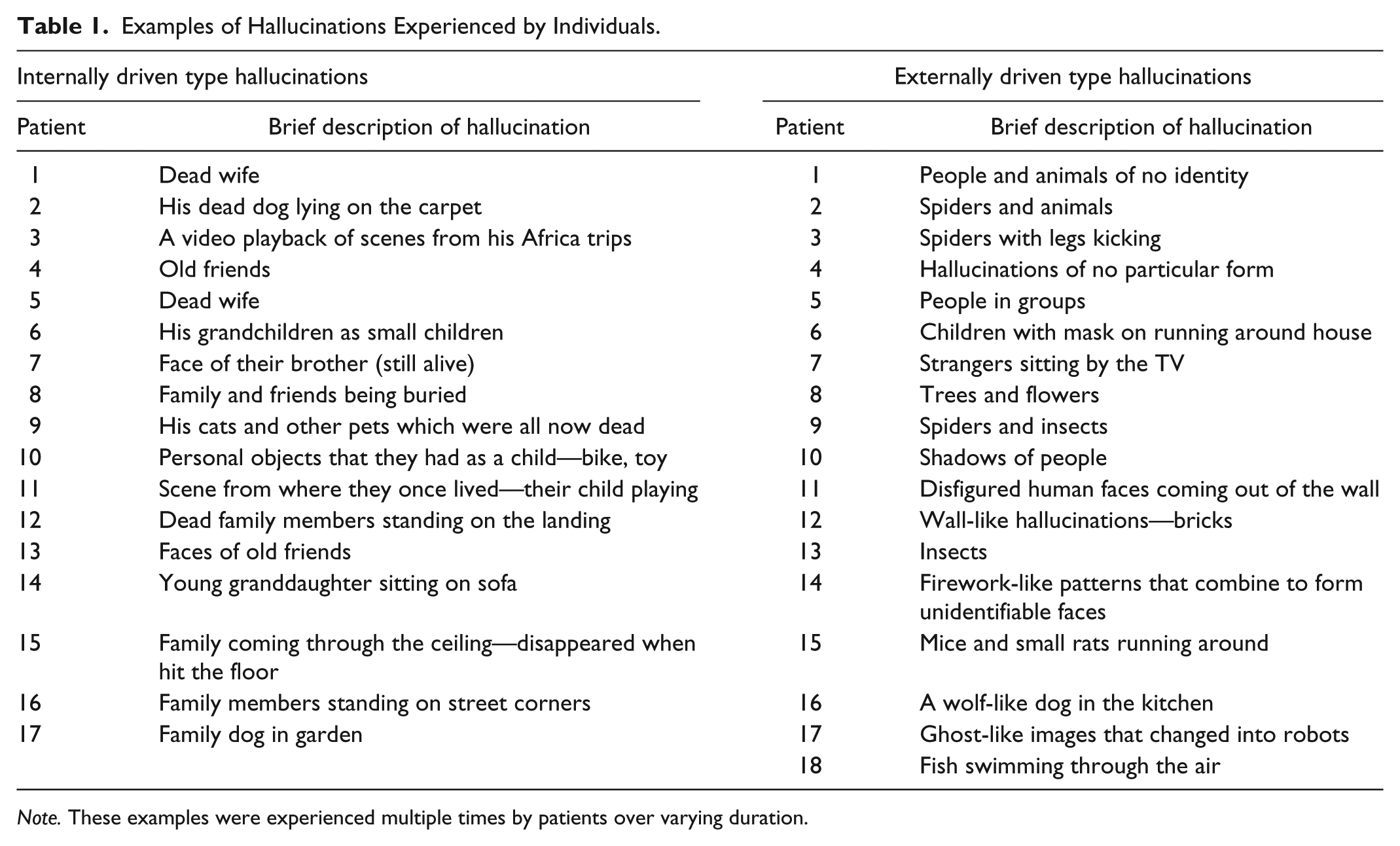
Note. These examples were experienced multiple times by patients over varying duration.
Summary of Results.

Note. ID = internally driven; ED = externally driven; NART = National Adult Reading Test; n.s. = not significant.
A = Significant difference (p< .05) between the ID hallucinator group and ED hallucinator group.
B = Significant difference (p< .05) between ID hallucinator group and non-hallucinator group.
C = Significant difference (p< .05) between ED hallucinator group and non-hallucinator group.
Cognitive Assessment
All patients who enrolled in the study underwent a psychological assessment, which included screening tests for general cognitive abilities. The cognitive tests used were the same as in a previous study investigating executive functioning in PD patients (Barnes & Boubert, 2008). The National Adult Reading Test (NART) was utilized as a general cognitive screening test (Nelson, 1982). Depressed mood was measured with the 21-item Beck Depression Inventory (Beck, Ward, Mendelson, Mock, & Erbaugh, 1961).
Several tests to explore selective cognitive deficits were also selected. Tests of inhibitory ability included category fluency (Newcombe, 1969), which was measured by asking the participants to produce as many words as possible in 60 s from the six categories of furniture, fruit, animals, tools, items of clothing, and insects.
In addition, a standard color Stroop task was carried out (Golden, 1978). This task consisted of 100 stimuli for each subtask. Two control trials were performed first to act as a baseline measure and control for the individual differences in reading speed and color naming. The participants were instructed to read the words, name the colors, and finally, name the ink color of the printed words as quickly and as accurately as possible; the times needed to complete each Stroop subtask served as dependent measures (Stroop I, Stroop II, and Stroop III, respectively). The interference measure was calculated by subtracting the average time needed to complete the first two subtasks from the time needed to complete the third subtask (Interference = Stroop III – [(Stroop I + Stroop II) / 2]; Valentijn et al., 2005).
Participants underwent tests of short-term memory. Digit span Wechsler Adult Intelligence Scale (WAIS-III) was tested by the presentation of digit strings presented orally at a rate of one digit per second. Participants were given two attempts at each digit string length and were instructed to repeat the digits in the same order as they had been presented. Word span was tested using one-syllable concrete nouns, and participant word span was administered in the same way as digit span. The longest string administered was nine words.
A 2-back task was also run (Cohen et al., 1997). This was a computerized task in which the participants were presented with four-letter abstract nouns one at a time at a rate of one word every 2 s and asked to press one button whenever the current stimulus matched the stimulus that had been shown to them 2 s before. A second button was pressed whenever the stimulus was not a match.
Reading span and word span tasks were also administered to each participant (Barnes & Boubert, 2008). To measure reading span, participants read aloud a sentence presented to them on a computer screen. They were then asked to answer a straightforward comprehension question about the sentence. This was then repeated with another sentence, after which participants were asked to recall the final word of each sentence. Participants performed five sets of two-sentence presentations. The word span task was presented in the same way as the digit span task with the longest string being nine words. All words were one-syllable, concrete nouns.
Results
Participant’s demographics and a comparison of tests are summarized in Table 2. An analysis of variance (ANOVA) was performed on the scores obtained for each test considering the effect of the group with post hoc pairwise Tukey’s test to examine significant main effects. Table 2 summarizes the results.
Tests of Inhibition
Significant group effects were found in all tests on inhibitory ability (see Table 2). Stroop inference scores produced significant group effects, F(2, 54) = 33.67, p< .001, with the externally driven hallucinating patients performing at a lower level than internally driven hallucinating patients and normal controls, t(33) = 5.05, p< .001 and t(36) = 8.03, p< .001, respectively. On fluency perseverations, the group effect, F(2, 54) = 20.98, p< .001, indicated that the group experiencing externally driven hallucinations made more perseverations than those without hallucinations and the group with patients experiencing internally driven hallucinations.
Tests of Working Memory
The ANOVA conducted on the corrected hit rate scores indicated a significant effect of group, F(2, 54) = 20.59, p< .001, with both hallucinating groups performing poorly when compared with the control group. There was an effect of groups regarding the percentage of hits, F(2, 54) = 5.87, p< .01, with the control group performing to a higher standard than the PD groups experiencing hallucinations. There was also a group effect on false alarm data, F(2, 54) = 5.62, p< .01, with the hallucinating groups again performing worse than the non-hallucinating group. The analyses of reading span indicated a significant group effect, F(2, 54) = 14.05, p< .001, showing that the PD groups with hallucinations performed at a lower standard than the non-hallucinating group.
Tests of Short Term Memory
With regard to digit span, the PD groups with hallucinations did not perform as well as the non-hallucinating groups, F(2, 54) = 14.06, p< .001. Word span results indicated that patients with internally driven hallucinations had significantly worse performances on the task than individuals with externally driven hallucinations and non-hallucinating controls, F(2, 54) = 15.25, p< .001.
Discussion
The aim of this study was to investigate whether there would be any cognitive differences in patients with internally driven hallucinations that involve top-down cognitive processes and patients who experience externally driven hallucinations that may be more associated with perceptual and attention mechanisms. Patients with externally driven VHs were impaired on all three tests of inhibitory ability when compared against the PD patients with internally generated VHs and also against the controls.
The phenomenological complexity of VHs in PD has been previously highlighted with a number of reoccurring characteristics and clustered experiences being identified (Barnes & David, 2001). In particular, the notion of veridical perceptions changing in some way when observed by the patient into certain common VHs such as faces, spiders, and shapes that take on the form of people is a common factor in this study. Less common, and consequently the more difficult individuals to find and engage are the patients who have hallucinations of identifiable persons or animals and scenes from episodic memory being played back to them in a particular way time after time. Past research has identified that the content of the hallucination seems to be reflective of the functional specializations of the particular part of the cerebral cortex with phenomenological variables clustering into three main symptoms (Santhouse, Howard, & Ffytche, 2000). The ventral temporal lobe is associated with the group of hallucinations consisting of extended landscape scenes, children, and figures. The second group of hallucinations consisting of faces is associated with the superior temporal sulcus, whereas the third group of palinopsia and continuance of visual sensation in the periphery of the visual field is related to the dorsal parietal lobe.
In this study, we observed patients typically experiencing well-formed VHs, consisting of humans and animals, which can be related to dysfunction of the ventral temporal lobe; however, as seen here from the documentation of patient experiences (see Table 1), the content of the hallucination can also be highly personalized and involve episodic memories. In these cases of internally driven hallucinations, the images often expressed seem to be related to how the person thinks or feels about past events. Here, some Parkinson’s patients viewed the content of their hallucinations to be meaningful and to have particular relevance to them. The images within their hallucination played out as memories and manifested as recognizable people and events, which in many cases intensified their experiences of the hallucinatory event. Although the inhibitory ability might indeed represent a significant role in the phenomenology of externally driven hallucinations, this does not imply that the proposed inhibitory disturbances are the sole factors in producing the hallucinatory experience. The exact processes that underlie VHs remain largely unidentified, but center around two main avenues of research; one focuses on the neuroanatomical networks and pathways using brain imaging techniques, whereas the other focuses on cognitive and psychological processes along with the study of mental events involved in VHs.
Previous work with PD patients experiencing VHs has found intact visual imagery, but poor executive function (Barnes & Boubert, 2008), and poor object perception when “switching” between modalities at study and test stages (Barnes et al., 2003). Together, these studies implicate inhibitory control as a factor in the hallucinatory phenomenon. However, they did not, unlike the present study, separate hallucinators based on phenomenological characteristics, so although inhibitory mechanisms are implicated, they may play a large role in externally driven hallucinations. These current findings therefore highlight the complexity of the processes involved and perhaps the need to characterize the hallucinating individual more precisely before we can examine the cognitive mechanisms implicated. Internally driven hallucinations in individuals may be a result of a failure to identify events as self-driven and could occur because of specific deficits in episodic memory. In this study, patients with these hallucinations had a particular deficient short-term memory for words but not digits. This behavioral pattern may be a result of tasks difficulty, but still requires further investigation. Specific deficits in memory may cause confusion regarding the origins of the experience. In support of this premise, findings suggest that PD patients with VHs tend to misidentify the origins and source of stimuli during memory events (Barnes et al., 2003). From a neuroanatomical viewpoint, deficits in the executive function of patients with VHs are consistent with the notion of cognitive inhibitory deficits; indeed, the disruption of executive functions in PD patients has previously been reported (Brown, Schneider, & Lidsky, 1997), and there is evidence of hippocampal involvement in PD with VHs that could link the deficits seen here with the internally driven subtype (Ibarretxe-Bilbao et al., 2008).
The challenge in this area is in determining whether or not these cognitive deficits are dissociable between patients with different types of hallucinatory experiences. This study has highlighted that inhibitory control may have a greater association with hallucinations that manifest themselves from environmental stimuli and may well be initiated in a bottom-up approach from environmental cues. Indeed, the Perception and Attention Deficit (PAD) model of VHs proposes that a combination of attention deficits and abnormal object perception is necessary in the occurrence of recurrent complex VHs (Collerton et al., 2005). Problems with inhibitory control have been linked to a disruption of striatal-dopaminergic projections thought to be particularly salient for selective attention (Casey, Durston, & Fossella, 2001; Casey, Tottenham, & Fossella, 2002). Furthermore, we hypothesize that there may well be a functional lack of connectivity between the frontal and posterior areas in visually hallucinating patients that manifest themselves as a lack of frontal modulatory control of over activation within the visual cortex; subsequently, events that arise are not synchronized normally.
Conclusion
A question raised by the results of this study is the degree to which cognitive impairments seen in PD patients are a uniform set of factors and to what extent are these factors ultimately responsible for VHs. It seems that not only do psychological factors, such as beliefs and attributions, need to be considered when approaching this question, but also the possibility that differing cognitive profiles of the individuals, which have been highlighted here, may play a key modulatory role in shaping the hallucinatory experience. Perhaps further speculation on this issue should be withheld until a replication of these findings has been produced.
Footnotes
Declaration of Conflicting Interests
The author(s) declared no potential conflicts of interest with respect to the research, authorship, and/or publication of this article.
Funding
The author(s) received no financial support for the research and/or authorship of this article.