




Abstract
Organizations wish to perform successfully in the market and if possible to have a sustainable economic growth. However, in the current circumstances of globalization and strong competition, technology is advancing at a rapid pace, hence making the market an unsafe environment. The business organizations (BOs) would have to make full use of all resources available. It is already a well-known fact that human resources or organization personnel constitute a key asset for achieving success. Yet, what makes the employees of a BO satisfied or motivated to achieve the planned objectives? In this research, we analyze some of the factors influencing the motivation of employees to enhance their performance. Through empirical and theoretical analysis, the study will identify the relationship between the motivation of employees and organizational effectiveness and finally the increase of BO revenues. The purpose of this study is to analyze the impact produced by the motivation of employees on organizational effectiveness. Personnel motivation will involve criteria such as employees’ bonus, good communication within the working premises, and satisfaction at their job place.
Introduction
On one hand, globalization has progressively led to the enlargement of markets and the reduction of barriers, but on the other hand, it has highly increased competition between business organizations (BOs). Accordingly, BOs attempt at least to maintain their market share and even expand it. Notably, this is a demanding entrepreneurship as BOs should face not only local but also foreign competitors, new technologies, and different management methods. However, this whole trend generally makes the market unpredictable.
Considering the fact that human resources or organization officials are an added value and the main and most valuable source of the organization (Llaci, 2010) for both its own capacities and competitive advantages (Pfeffer, 1994). First of all, it requires professionals and motivated persons (Llaci, 2012). Furthermore, a need has arisen for a solid and regular cooperation between the employees and BOs. However, skills are required to administer and make this human capital a generator of competitive advantages (Lado & Wilson, 1994; Pfeffer, 1994). Therefore, BOs attach special priority to the flexibility within the organization, thereby creating a warm climate to enhance cooperation with and between the personnel (Hellriegel & Slocum, 1974).
As a result of strong competition, BOs are using different strategies to host talents to the organization, attracting them and without limitation to various material incentives (Llaci, 2010), keeping them in the long-term run not only to withstand the market but also to successfully meet the added value for the organizational effectiveness, both in the short-term and long-term perspective.
Therefore, we bear in mind that organizational effectiveness, according to Quinn and Rohrbaugh (1983), is a slightly complicated and multidimensional issue (Tsui, 1990) as different groups of interest have different perspectives about it in relation to their position. A major role is played by the personnel in increasing or decreasing BOs that has urged many researchers to conduct investigations in this area, to observe what makes a BO employee to be satisfied or motivated to achieve the planned objectives. Currently, being a serious and coherent issue for businesses, it has become an incentive for our research study. By a quantitative empirical research, we will highlight some of the elements of motivation to encourage the personnel to perform better on one hand and directly enhance the results and performance of the BO on the other.
The main purpose of this study is to analyze the impact of staff motivation on the organizational effectiveness by addressing the above cited variables. Through this study, we will identify the correlative link between the dependent variable of motivation and independent variables of financial compensation, communication, and satisfaction at work.
Due to the gap of theoretical and empirical studies of this kind in Albania, the present study relies on the research question of investigative character:
The hypotheses to be tested in the wake of this study are raised on the main components driving motivation among employees in the Albanian banking system. Null and alternative hypotheses and the two following subhypotheses are identified:
Although there are a number of international studies about staff motivation, this is the first of its kind in Albania, thus being considered a pioneer study in the field of management.
Literature Review
It is crucial to admit that BOs need proper motivation inputs as a source of energy to produce outputs. Organizations are systems created by people, who being motivated and in cooperation with each other achieve the set of objectives. The more motivation an organization transmits to an employee, the more rewards the employee will provide, being more effectively involved in an organization (Lee & Bruvold, 2003) and at higher output levels (Gardner, Van Dyne, & Pierce, 2004). Therefore, motivation is an inherent force driving people to achieve their own ambitions and that of the organization. A large number of researchers have investigated motivation during the second half of the last century, which is present in organizational literature and in this study (Adams, 1965; Campbell, Dunnette, Lawler, & Weick, 1970; Campbell & Pritchard, 1976; Lawler, 1973; Porter & Lawler, 1968; Vroom, 1964). Most of them have prepared their own definitions about motivation. Motivation is often described as a purpose to act or as a psychological process causing the arousal, direction, and persistence of behavior (Campbell et al., 1970; Luthans, 1977), and the needs of human beings to administer, control, or explain human behavior (Llaci, 2012).
According to Kanfer’s (1990) taxonomy on motivation theories, they are cognitive choices, processes, and theories (Campbell et al., 1970) investigating the motivation mechanism and guided by the theory of expectation of Vroom (1964). All of them described motivation as a process guiding the individual to make voluntary efforts in his or her work (Campbell & Pritchard, 1976; Graen, 1969; Lawler, 1964). Meanwhile, other researchers argue that the main emotional states are basically motivating (Izard, 1993), and have their trend of action or readiness of action (Fredrickson, 2001; Watson, Wiese, Vaidya, & Tellegen, 1999). From the perspective of Blau (1964), it is based on a social exchange and rate of reciprocity (Gouldner, 1960). To put it differently, emotional organizational commitment may be conceived as an exchange of loyalty and efforts for financial profits and social rewards (Eisenberger, Fasolo, & Davis-LaMastro, 1990). Therefore, motivation is a changeable progress supporting someone for the purpose of achievement (Chowdhury, 2007).
According to the expectance theory of Vroom (1964), performance is a result of multiplying skills with motivation, which is reflected in the following equation:

Latter, Campbell and Pritchard (1976) further expanded the definition of Vroom’s to the following equation: Performance = f (Skill capability × Skill level × Understanding the duty × Selection to make the effort × Selection to continue × Mitigating and aggravating conditions beyond the individual’s control).
Based on the above-mentioned equation, the performance is attributed to at least four or more probable factors. For someone to perform well, he or she should
know what is expected (role expectances),
have the skills to do what is required (necessary knowledge),
be motivated to do what is required (interest), and
work in an environment where the intended actions may be translated into behaviors.
Therefore, it is the action where external and internal forces influence the selection and behavior of a person, which is otherwise known as internal and external motivation (Deci & Ryan, 2000). Further exploring the above cited theories, according to Liberman’ s theory, further extended by Van Dijk and Kluger (2004), people are motivated by intrinsic and extrinsic motives, where each of these two motivations has its own characteristics distinguishing them from each other.
However, motives are also divided in two other groups: (a) implicit motives or hidden motives, which are conceived as associated networks connecting the suggestions of situations with fundamental affective reactions and implicit behavior trends (McClelland, Atkinson, Clark, & Lowell, 1953), and (b) explicit motives, which are clear motives to avoid the confusion of methods for the determination of the normative beliefs according to the desired behavior models (Rokeach, 1973).
Some criteria that are treated below influence the motivation of employees, who may simultaneously be part of the first subdivisions (internal, external) and the second subdivisions (implicit and explicit).
Job Satisfaction
Kim (2004) described job satisfaction as closely connected with the job structure and motivation. Job satisfaction is an emotional effect of performing various functions in accomplishing the duty. According to him, job satisfaction is directly linked with the motivation, involvement, organizational cooperation, and the job performance of employees (Salman et al., 2010). Also, gratitude and rewards are essential factors to increase job satisfaction of employees and motivation, which are directly linked with the organization’s achievements (Jun, Cai, & Shin, 2006). However, different researchers support different theories on how the employees should be satisfied with their job place and feel it. Porter and Lawler (1968) supported the structuring of working environment that effective performance would lead to both internal and external rewards, which in turn would produce complete job satisfaction. Deci (1975) recommended that to make the job more interesting and challenging, which in turn, would increase internal motivation, horizontal expansion is required, which implies the increase in activities, where employees have more tasks, thereby making them feel they are very important. They may see how different parts of jobs are integrated into a significant unit, making them prouder.
In this context, we should take into account vertical expansion, opening job vacancies involving more planning, decision making, and problem resolving, or to put it differently, it increases the employees’ autonomy. Furthermore, vertical expansion in which people have broader opportunities to speak about what they do also valorizes their efforts. Therefore, given that importance (rather than interest) is the foundation of external autonomous motivation, as work expansion might increase both internal and external autonomous motivation. Briefly, it enhances the employers’ autonomy, their self-confidence, and job satisfaction.
Salary, Remuneration as a Component of Motivation
Currently, every work or service is provided against a specific price, and service prices follow the trend of unification regardless of the supplying company. The same applies to employees. They strive to earn a reasonable salary in relation to the labor market and at the same time, they wish to feel worthy for the work they are doing (Houran & Kefgen, n.d.). Money is a basic incentive for people. It has a dominant position over other drives (Llaci, 2010), and has magical power to keep and motivate people for a higher performance, without disregarding the values and other motivation incentives (Sara, Barry, & Kathleen, 2004).
According to Locke (1976), job satisfaction is “a pleasant or positive emotional state resulting from job evaluation or someone’s job experience,” whereas Heneman and Schwab (1985) considered the pay satisfaction as a multidimensional concept. Focusing also on the above-mentioned literature, salary and motivation are external motivators; therefore, satisfaction is not derived from the activity itself but rather from external consequences urging the increase of activity and fulfillment of the objective. These aspects bring pleasure to the employees, which directly influence the enhancement of employees’ performance (Kalimullah, Farooq, & Ullah, 2010). Salaries and bonuses are instruments in the hands of managers who contribute to company effectiveness, influencing the behavior of the individual or group. Therefore, BOs use money, bonuses, promotion, or other methods to encourage the increase of employers’ performance. Furthermore, it is very important for managers to observe everyone’s work within the organization, closely linked with the salary, concurrently based on the personal performance of everyone (Tella, Ayeni, & Popoola, 2007). To sum it up, before any system is established, everyone should make sure that there is a good performance system and that remuneration is proportional to the results.
Communication and Work Relationships
Proper communication (Llaci, 2010) and good relations between the managers and subordinates or between the employees is a key component for the increase or decrease in performance. According to some researchers, BOs that have a good communication and positive work relationships with their employees produce a high level of results (Dastmalchian, Blyton, & Adamson, 1991). Hence, how is the climate within the organization? Is there proper communication and cooperation among the staff members? Is the management capable to handle situations? Often, there may be strong competition between the staff members. Consequently, their communication and cooperation are downgraded as poor communication that would cause conflicts within the BO and as a result, they would reduce both cooperation and results. Therefore, special priority is attached to flexibility and harmony within the organization, among the work staff members and the level of cooperation between the BO and its own personnel (Hellriegel & Slocum, 1974), with the aim of achieving results. Yet, is BO able to manage good communication at all times with its staff? According to Zaltman and Duncan (1977), misunderstandings often occur because staff needs and capacities to adapt to changes are not fully understood. No clear communication is reached with employees about the nature and importance of changes. The employees, their working environment, values, norms, and customs are often overlooked and disrespected.
Research Method
This study is based on the positivist approach with an objectivist ontological position where social reality is present and may be studied independently from us as researchers (Bob Matthews and Liz Ross, 2010). Knowledge about staff motivation for the increase of effectiveness is based on what we, as researchers, may observe and recollect from the reality, being objective about it, without any biases from data and respondents. Therefore, study hypothesis derived from the current reality and casual links between both study variables such as staff remuneration and motivation were included.
To prove the hypothesis, factual data are used with easily observable values obtained from the surveys with 200 bank officers from different banks in Tirana city. Data were encrypted and were subsequently analyzed through the Statistical Package for Social Sciences, version 20. Mean, standard deviation, frequency, and other statistical data will describe the characteristics of sample population, and hypothesis will be tested through chi-square test, where the genuine statistical level is accepted at the quota of p < .05.
Sampling and Sampling Procedures
Officers of second-level banks in Tirana city will be selected as a sample population. Five percent of the officers of each bank in Tirana were randomly selected. Except Pro Credit Bank, where we were not allowed to interview their personnel, at all other banks, we managed to collect data through the questionnaire designed for the measurement of variables. We have contacted all departments of human resources of all banks, wherefrom it results that the total number of employees at the second-level banking system in Tirana is about 50% of the total, namely, about 4,500 employees. Accordingly, the total number of interviewees amounts to 200. Of them, 155 females and 45 males are interviewed. Sampling was randomly conducted by calculating the number of affiliations with the number of employees and number of interviews for each bank. In case an employee refused to participate in the survey, another employee was selected who was currently available.
Measurement Instrument
Data were collected through the reverse score standardized questionnaire, where questions started from the least important to the most relevant for our study. The questionnaire included 37 questions with previously identified options and is divided into three sections that include the following: a demographic section that had questions about gender, age, education, job position, and so on—a total of seven questions were asked in this section. For the section on remuneration as a factor of increase in motivation, a total of 11 questions were asked. Finally, the third section that involved motivation factors, such as communication, equal personnel treatment, job safety, and so on, a total of 19 questions were asked.
Research Limitations
A limitation of this study is the sample that was concentrated only on affiliations of the second-level bank system in Tirana city. Ideally, this study would be extended to the whole territory of Albania but due to the absence of time and opportunities, this study was limited only to Tirana city. This is not an ideal sample, but it is worth mentioning that this is a large sample in relation to the total number of employees.
Another limitation of the study is that we could not conduct any interviews at Pro Credit Bank affiliations as the Department of Human Resources of this bank decided to suspend the interviewing process at their affiliations. Accordingly, Pro Credit Bank was not included in our study.
Data Analysis
The data of this study have been analyzed through statistical program SPSS, where according to the analysis on the demographic section of the questionnaire, it follows that participants in the study were 200 employees of the second-level banking system operating in Tirana city. The interviewees pertain to the below-mentioned age groups: 27 employees less than 25 years of age, 94 employees aged 25 to 30, 68 employees 30 to 40 years of age, 7 employees 40 to 50 years of age, and 4 employees more than 50 years of age. According to data analysis on working years at the entity where they currently work, it appears that 112 employees have less than 5 working years at the entity where they currently work, 70 employees have 5 to 10 working years, and 13 employees have 10 to 15 working years. Only 1 employee has 15 to 20 working years and 4 of them have more than 20 working years. In the meantime, asked on their working years in the position where they currently exercise their profession, it results that 106 employees have less than 3 working years in the current positions, 58 employees have 3 to 5 working years, 26 employees have 5 to 8 working years, and 10 of them appear to have more than 8 working years.
In the second section of the questionnaire where data are collected on remuneration as incentive, it resulted that 177 employees work overtime, whereas for 144 of them, the overtime work lasts from 30 min to 1 hr and 30 min daily, where 143 of them affirmed of receiving no remuneration above their salary for extra hours. When asked on how they are paid—whether according to performance, extra hours, or payment only on basic salary—the 156 interviewees admitted of being paid only on basic salary. Meanwhile, it appears that the remuneration methods for good job performance that apply for 101 employees who are distributed different bonuses, only 15 of them receive cash. Twenty-six affirmed to have been promoted, and 58 employees received no remuneration at all.
The third section established to collect data on factors affecting the increase in motivation, in which the average is analyzed and “the standard deviation” of the collected values for every answer by the interviewees includes the collected results in Table 1; however, questions have been given standardized answers with five levels, respectively; 1 = not at all, 2 = a little, 3 = I like it a bit, 4 = I like it, and 5 = I like it very much.

The main hypothesis for this study has been tested by means of chi-square test, where according to data, its results prove Hypothesis H1, that is, financial remunerations of employees foster increase of motivation.
According to Table 2, the observed statistics of chi-square test is 33.563, with degrees of freedom 16 and importance rate of .006, but for a lower independence rate than .05 (5%), the null hypothesis drops.
Financial remunerations increase motivation.

12 cells (48.0%) have expected count less than 5 The minimum expected count is .26
Furthermore, in Table 3, according to the hypothesis test, “Good Communication between superiors and subordinates fosters increase in motivation”; on the relation of variables, it appears to be a connection of 5% among variables, proving that good communication affects the increase in motivation, because the security level .008 is lower than .05. As a conclusion, this hypothesis holds.
Good communication and motivation.
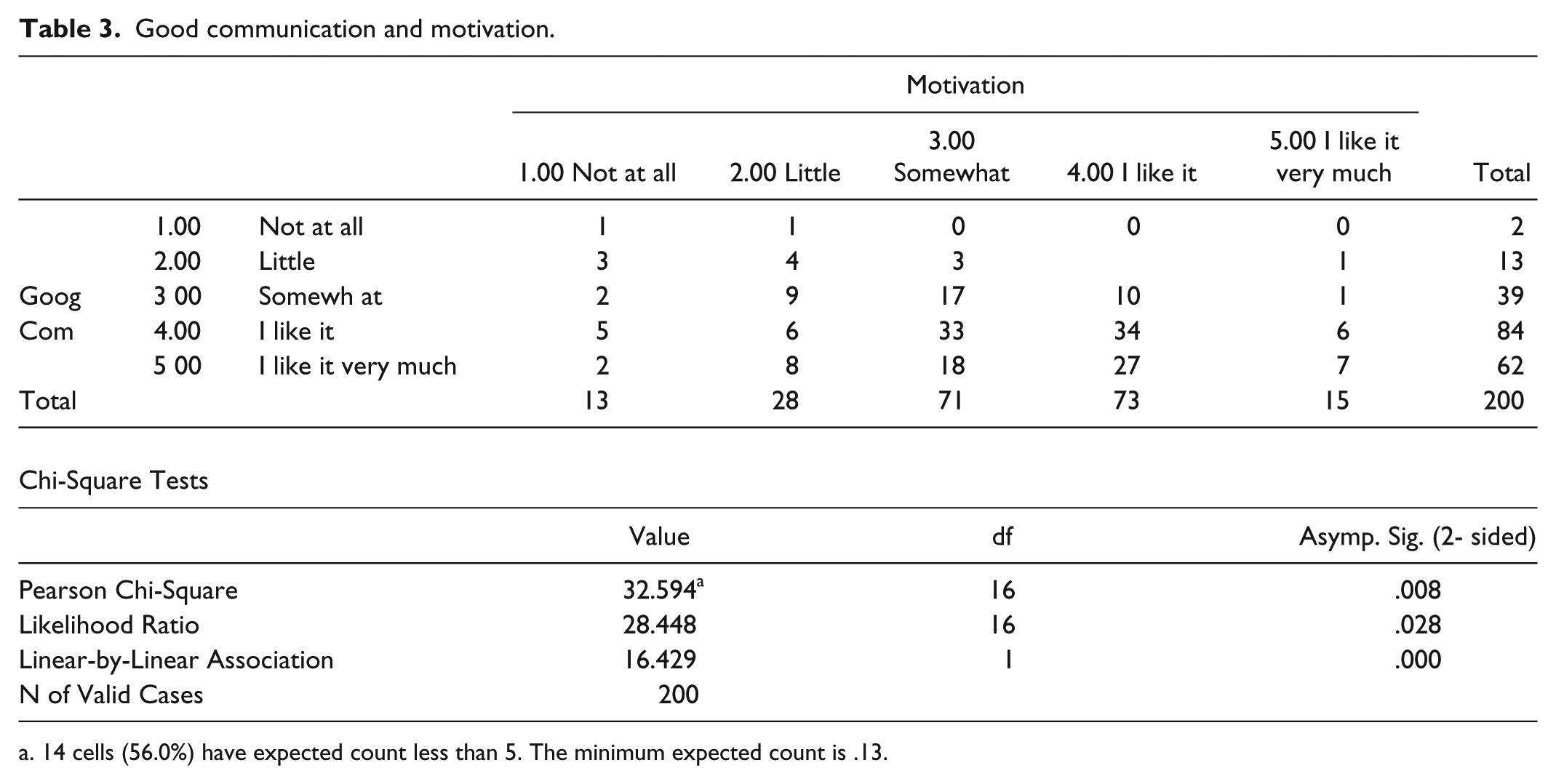
14 cells (56.0%) have expected count less than 5. The minimum expected count is .13.
Meanwhile in Table 4, the hypothesis on the relation test of variables such as satisfaction at work and increase of motivation, has appeared to have no connection between the variables at 5% rate, proving that satisfaction at work does not affect increase in motivation, because the security rate .14 is higher than .05. As a conclusion, this hypothesis is no longer applicable.
Satisfaction at work and increase of motivation.

14 cells (56.0%) have expected count less than 5 The minimum expected count is .20.
According to results of the data of employees who exercise their profession in the second-level banking system, operating in Tirana city, the main factors resulting in the increase in motivation of employees are remunerations and especially the financial ones, as well as good communication between superiors and subordinates.
Conclusion and Recommendations
Apparently, in the second-level banking system in Tirana, there are employees, mainly young generations, and from the interview, it resulted that 27/200 employees or 13.3% are less than 25 years of age, 94/200 employees or 47% are 25 to 30 years, 68/200 employees or 24% are 30 to 40 years, 7/200 employees or 3.5% are 40 to 50 years, and 4 employees or only 2% are more than 50 years. This young vital age constitutes a huge potential in the human capital for these economic units, because their energy, flexibility, and capacity can be converted into considerable outputs for the entity and the society as a whole.
Another observed element during the study is the low level of circulation and lack of promotion of employees within the economic unit. From the results, we observe that 58 employees or 29% of the total have 3 to 5 working years in the same position, 26 employees or 13% have 5 to 8 working years in the same position, and 5% of them have more than 10 working years. Given their age and working years, the internal movement and their promotion is very low. Based on the aforementioned theories, work is transformed into routine, leading to the significant reduction of internal motivation and consequently their performance.
Given that the measurement of performance is made in every economic unit, we recommend a fair harmonization between working years and performance for the promotion of employees in respective economic units. Therefore, this approach would further motivate employees in accomplishing not only the objectives of the organization but also their priorities.
From the data analysis, it appears that 90% of employees worked overtime, which lasted for 30 min to 1 hr and 30 min daily, of whom 72% were not paid for extra hours. By a simple average, this target group works in 12% of cases for unpaid job, adding to 1 month without any payment for the entire year these employees work. This phenomenon is a strong de-motivation factor.
By means of chi-square test, the main hypothesis for this study has been tested, whereas according to data, it appears that “Financial remunerations of employees foster increase in motivation” (H1). Therefore, financial revenues are a key component for the achievement of motivation in employees in the Albanian banking system. In view of the above conclusions, we recommend paying special priority to salaries in general and especially extra hours, because they would definitely increase the performance of employees and the output of an economic unit.
From the conclusions of the study, it results that “good communication between superiors and subordinates fosters increase in motivation.” This hypothesis is proven because in the relations of variables, there is a connection of 5% rate among variables, proving that good communication affects the increase in motivation.
Meanwhile, from the study, it emerges that the hypothesis established to test the relation of variables, such as satisfaction at work and increase in motivation, has appeared to have no connection among variables at 5% rate, proving that satisfaction at work does not affect increase in employees motivation of the banking system, because the security level .14 is higher than .05; therefore, this hypothesis is no longer applicable.
As a conclusion, based on the results of the data of employees who exercise their profession in the second-level banking system in Tirana city, the main factors affecting the increase in the motivation of employees are remunerations and especially financial ones, as well as good communication between superiors and subordinates. The satisfaction at work does not play a significant role in the increase in their motivation.
Footnotes
Declaration of Conflicting Interests
The author(s) declared no potential conflicts of interest with respect to the research, authorship, and/or publication of this article.
Funding
The author(s) received no financial support for the research and/or authorship of this article.