




Abstract
There are well-established relationships among self-efficacy, group effectiveness, extrinsic and intrinsic motivation, and work performance in employees. However, little is known about these relationships among employees with disabilities. The purpose of this study was to examine the mediation roles of extrinsic and intrinsic motivation in the association between self-efficacy and individual work performance and between group effectiveness and individual work performance in Saudi employees with disabilities. A sample of 176 employees (59.1% female) with disabilities (visual, auditory, mobility, and learning disabilities) participated in the study. A set of structural equation models was built to establish the relationships. There were positive relationships between self-efficacy and both task and contextual performance. Furthermore, intrinsic and integrated regulation mediated the relationship between self-efficacy and task performance, and identified integrated regulation mediated the relationship between self-efficacy and contextual performance. Group effectiveness was related to work performance only through motivational regulations. Therefore, it is crucial for organizations to design psychological training to increase self-efficacy beliefs in employees with disabilities and to teach them how to internalize external forces in the workplace to promote individual work performance and organizational progress.
Plain language summary
The aim this study was to examine how self-efficacy and group efficacy benefit the individual performance of employees with disabilities in Saudi Arabia. Further, the study examined the role of intrinsic and the regulations extrinsic motivation as postulated by the self-determination theory. This study was conducted online and a considerable number of employees with disabilities participated in it. There were around 59.1% of females and the participants were aged 37.3 on average. This study revealed that self-efficacy benefited task and contextual performance. Group efficacy had benefits for task and contextual performance only when employees were intrinsically motivated or had integrated the extrinsic motivation into their selves. The results showed also that when employees had managed to internalize the external controls of work, self-efficacy and group efficacy were related to reduced counter-productive work behaviors. This study concludes that, while intrinsic motivation is ideal for the performance of employees, the integration of extrinsic motivation may provide similar benefits. Since some jobs are not intrinsically motivating in nature, learning how to internalize external work incentives may yield positive benefits in employees with disabilities. This is important for managers and organizational psychologists to plan effective trainings and interventions. Although this study provided new insights, the cross-sectional design used and the sampling method don’t allow to draw any causation or generalizability.
Introduction
The World Bank estimates that over a billion people, or 15% of the world’s population, live with some form of disability (The World Bank, 2023). According to the Organisation for Economic Co-operation and Development (OECD), poverty is common among people with disabilities (OECD, 2003) partly due to their low employment rate. A survey conducted by WHO (2011) in 51 countries indicated that only 53% of men and 20% of women of working-age adults with disabilities are employed, versus 65% of men and 30% of women without disabilities. People with disabilities are less likely to be hired even when their qualifications are similar to those of applicants without a disability (Baert, 2016; Ravaud et al., 1992). Furthermore, even when they find jobs, research shows that people with disabilities are often underpaid and underemployed (Schur et al., 2016). A further problem is that workplaces often do not have the accommodations and adapted facilities necessary for disabled employees to succeed at their tasks (OECD, 2003).
Apart from this, individual characteristics have been postulated among factors influencing employee performance. Among these, self-efficacy, group efficacy, and motivation are found to be antecedents of individual performance (Kappagoda, 2018; Kellett et al., 2009; Zhang et al., 2016). However, little research has been conducted among employees with disabilities, especially in Saudi Arabia. Previous research claims that culture may exert a difference between how employees with disabilities perceive themselves and others perceive them in the workplace (Kwiatkowska-Ciotucha et al., 2022). Evidence from different cultures would be beneficial. Therefore, this study’s purpose is to investigate the relationship between self-efficacy, group efficacy, and individual performance and the mediating role of intrinsic and extrinsic motivation among Saudi employees with disabilities.
Individual Work Performance, Self-Efficacy, and Group Effectiveness
Individual work performance (IWP) refers to the essential and desirable employee actions or behaviors in an organization (Koopmans et al., 2016). IWP is a latent variable that cannot be measured directly but only through indicators or dimensions (Koopmans et al., 2011). It consists of task performance, contextual performance, and counterproductive work behaviors (Koopmans et al., 2011; Rotundo & Sackett, 2002). Task performance refers to the proficiency of employees in performing the main tasks associated with their jobs (Campbell, 1990). Contextual performance refers to employee behaviors that support the psychological, social, and organizational environment in the workplace (Borman & Motowidlo, 1993). Counterproductive work behaviors refer to employee performance and conduct that harm the organization’s well-functioning and/or people (Rotundo & Sackett, 2002). IWP is a vital factor impacting an organization’s goal achievement, competitiveness, and productivity (Sonnentag & Frese, 2002).
Self-efficacy is a cognitive dimension regarding a person’s belief in their capability to organize and execute actions necessary to produce specific performance outcomes, and it influences their ability to feel, think, and act (Bandura & Cervone, 1983; Hergenrather et al., 2008). In organizational psychology, self-efficacy is one of the most studied constructs predictive of work-related performance and organizational progress (Judge et al., 2007). Previous research has documented a positive association between self-efficacy and work performance (Stajkovic & Luthans, 1998; Widyawati & Karwini, 2018), and also shown that self-efficacy is associated with task performance. A study involving students reported that self-efficacy is positively related to task performance (Niemivirta & Tapola, 2008). Similarly, Kappagoda (2018) reported in a study among bank employees that those with higher self-efficacy scores have higher task performance scores.
H1a: Self-efficacy is positively associated with task performance.
The results of a meta-analytic study by Sadri and Robertson (1993) confirmed the positive relationship between self-efficacy and work performance. However, this relationship was found stronger in laboratory experiments than in field studies. A review of the literature by Iroegbu (2015) concluded that some studies reported an association between self-efficacy and work performance, and some had no direct relationship though there was an association with intervening mediating variables. A positive relationship between self-efficacy and work performance was also found in employees of Italian organizations (Ingusci et al., 2019). Man et al. (2020) reported that creative self-efficacy increased performance in disabled employees. Salisu and Awang (2018) found in a study of teachers that self-efficacy was related to contextual performance. Similarly, Delgado-Rodríguez et al. (2018) reported a positive relationship between self-efficacy and contextual performance.
H1b: Self-efficacy is positively associated with contextual performance.
Fabian (2000) applied Lent and Brown’s (2008) Social Cognitive Career Theory as a framework for understanding and improving the career-related performance of individuals with serious mental health disorders. He asserted that personal characteristics such as self-efficacy beliefs and outcome expectations were among the factors impacting the job performance of such individuals. Barlow et al. (2002) identified self-efficacy as an important characteristic for people with disabilities in seeking and maintaining jobs. Waghorn et al. (2007) also found that work-related self-efficacy among people with psychiatric disabilities was associated with maintaining employment. In parallel, self-efficacy at work mitigated counterproductive behaviors among employees (Kim & Lee, 2021). A negative relationship between self-efficacy and counterproductive behaviors was also reported in a study among employees in Turkey (Aydinay et al., 2021).
H1c: Self-efficacy is negatively associated with counterproductive behaviors.
One cannot think of an organization without thinking of groups, which have a decisive impact on performance when they are used effectively (Shea & Guzzo, 1987). Group effectiveness, or group efficacy, refers to the collective ability of a group to perform a given task (Gibson, 1999). Group efficacy was found to predict task performance in organizations (Silver & Bufanio, 1996). Kellett et al. (2009) found that collective self-efficacy predicted task performance better than self-efficacy when working on a group task. Another experimental study by Whitney (1994) reported that group efficacy predicted increases in task performance. However, research on how employees with disabilities perceive and contribute to group effectiveness and its relation to individual performance is scant.
H2a: Group effectiveness is positively associated with task performance.
Mowday and Sutton (1993) argued that work group influences organizational contexts. Previous studies suggested that group effectiveness was linked to organizational performance (Podsakoff & MacKenzie, 1997). It was also found to be related to contextual performance, where teamwork was related to contextual performance (LePine et al., 2000).
H2b: Group effectiveness is positively associated with contextual performance.
Previous research reported a link between group effectiveness and counterproductive behaviors (Lajevardi & Ebrahimzadeh, 2002). Group effectiveness was also reported to be negatively related to counterproductive behaviors (Holm et al., 2019).
H2c: Group effectiveness is negatively associated with counterproductive work behavior.
Intrinsic and Extrinsic Motivation as Mediators
Motivation is a crucial determinant of behavior (Deci & Ryan, 1987). According to Self-Determination Theory (SDT) (Ryan & Deci, 2000), motivation can be divided into two broad classes studied in various contexts: intrinsic and extrinsic motivation (Deci & Ryan, 1987; Teo et al., 1999; Vallerand, 2000). When people are intrinsically motivated, they engage in an action because of its inherent interest and the enjoyment they find in it (Feng et al., 2016). When people are extrinsically motivated, they engage in an action because of the external benefits associated with it (Reis, 1994). Extrinsic motivation is fueled by factors that exist outside a person (Feng et al., 2016).
A sub-theory of SDT called Organismic Integration posits that extrinsic values can be internalized and integrated (Deci & Ryan, 2000) and proposes two extremes, intrinsic regulation and amotivation, characterized by inaction or just “going through the motions” (Deci & Ryan, 2000). Extrinsic motivation, with four regulatory styles, lies in between and comprises external regulation (when an employee engages in an action because of rewards and/or fear of punishment); introjected regulation (when an employee engages in an action in order to avoid guilt or to enhance their self-esteem); identified regulation (when external influences have been internalized into the self, but the employee is still motivated by the usefulness of the task), and integrated regulation (when external influences have been internalized and integrated into the self’s identity and self-determination) (Cook & Artino, 2016). Often, knowing what to do is not enough; employees also want to know why the employer wants it done, as that is a critical part of the motivation to do the work.
Based on previous studies, motivation is related to both self-efficacy and performance. Thomas et al. (2009) found that self-efficacy predicted external regulation and identified regulation. Duncan et al. (2010) reported that introjected regulation, identified regulation, and integrated regulation were positively associated with positive attitudes toward exercise, and integrated regulation was associated with exercise duration. Identified self-regulation was found to predict academic performance (Burton et al., 2006). Similarly, intrinsic motivation and extrinsic motivation, such as external regulations, were found to be predictors of task performance (Chen et al., 2019; Lee & Reeve, 2017).
H3a: Intrinsic motivation, identified regulation, and integrated regulation positively mediate the relationships between self-efficacy and task performance and between group effectiveness and task performance.
Intrinsic motivation also mediates the association between self-efficacy and environmentally responsible behaviors such as recycling (Tabernero & Hernández, 2011). Prior research has established the mediational role of motivation in various contexts. Çetin and Aşkun (2018) found that intrinsic motivation partially mediated the relationship between self-efficacy and work performance. Previous research has also related intrinsic motivation and extrinsic motivation, including introjected, regulated, and identified regulation to contextual performance (Yousaf et al., 2015; Zhang et al., 2016). Others also reported that these kinds of motivation mediated the relationship between contextual antecedents and performance (Coelho et al., 2011).
H3b: Intrinsic motivation, identified regulation, and integrated regulation positively mediate the relationships between both self-efficacy and group effectiveness, respectively, and contextual performance.
Prabhu et al. (2008) found that intrinsic motivation mediated the relationship between self-efficacy and creativity (Prabhu et al., 2008). Another study established that amotivation and intrinsic motivation significantly mediated the association between self-oriented perfectionism and burnout (Appleton & Hill, 2012). Previous research has shown that intrinsic and extrinsic motivation was associated with counterproductive behaviors (Finkelstien, 2009; Kojima & Ohno, 2022).
H3c: Intrinsic motivation, identified regulation, and integrated regulation negatively mediate the relationships between both self-efficacy and group effectiveness and counterproductive work behavior.
Zhao et al. (2018) found that intrinsic motivation, identified regulation, and external regulation meditated the relationship between the growth mindset and grit. Nie et al. (2015) found that among Chinese teachers, external regulation, introjected regulation, identified regulation, and intrinsic motivation mediated the association between perceived autonomy support and job satisfaction and that amotivation and external regulation mediated the relationship between perceived autonomy support and work stress. Previous studies reported that amotivation and external regulation were associated with task performance (Irmak et al., 2021; Shin & Hur, 2020).
H3d: Amotivation, external regulation, and introjected regulation negatively mediate the relationships between both self-efficacy and group effectiveness and task performance.
Previous studies reported the mediating role of work motivation in the relationship between work discipline and work performance (Efendi et al., 2020). An indirect effect of self-efficacy on job satisfaction through motivation was reported elsewhere (Chandrawaty & Widodo, 2020). Others have shown that amotivation and external regulation were predictors of contextual performance (Sheikh Khairuddin et al., 2019).
H3e: Amotivation, external regulation, and introjected regulation negatively mediate the relationship between both self-efficacy and group effectiveness and contextual performance.
Others have concluded that external regulation and amotivation were predictors of dropout over time, and introjected regulation was predictive of persistence (Pelletier et al., 2001). Others found that amotivation and external regulation related to unethical behaviors (Belle & Cantarelli, 2019). Figures 1 to 3 portray the study’s conceptual models.
H3f: Amotivation, external regulation, and introjected regulation positively mediate the relationship between both self-efficacy and group effectiveness and counterproductive work behavior.

Conceptual model of task performance.
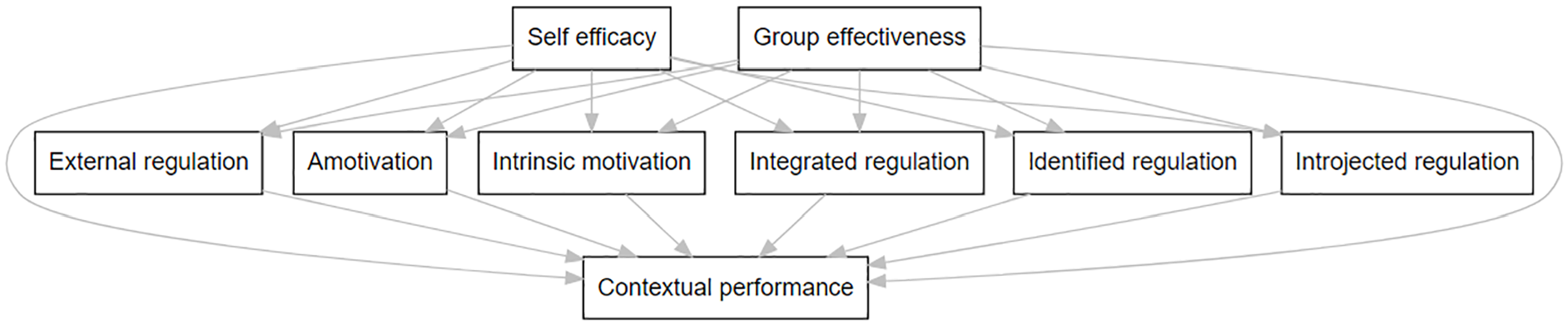
Conceptual model of contextual performance.
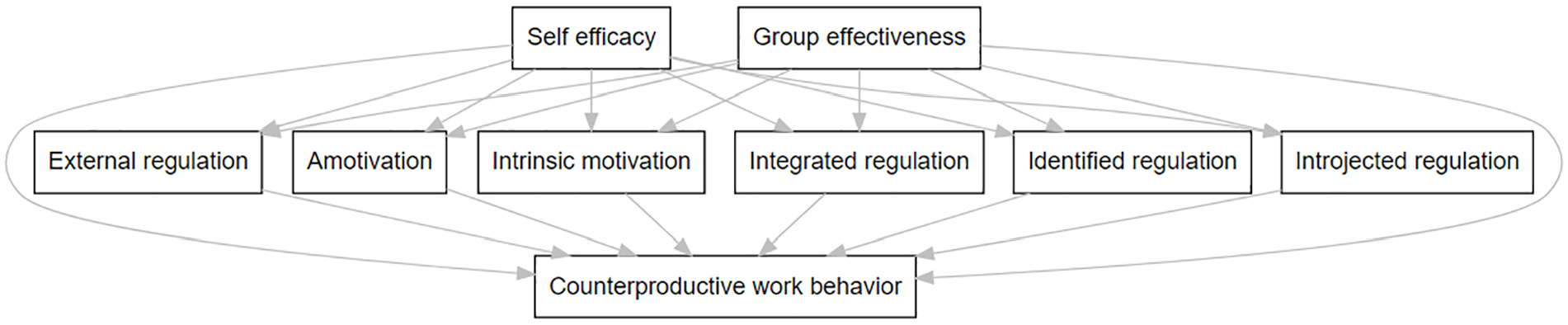
Conceptual model of counterproductive work behavior.
Method
Participants
This study was cross-sectional, and participants were selected using convenience sampling. To reach many and diverse participants, a link to the survey was sent via online platforms, including email, Facebook, WhatsApp, and Twitter. A sample of 176 respondents completed the survey. They were informed about the study’s purpose and intended outcome and provided consent. About 59% of the respondents were female. About 8% had less than a high school education, 24.4% had a high school education, 52.8% were college graduates, 11.4% had a master’s degree, and 3.4% had a PhD degree. About 31.8% had an auditory disability, 3.4% had a learning disability, 21% had a mobility disability, and 43.8% had a visual disability. Permission to conduct this study was granted by XXXX University. It was conducted in accordance with the Declaration of Helsinki’s ethical principles for research involving human subjects, the Code of Medical Ethics of the World Medical Association, and the International Committee of Medical Journal Editors’ Recommendations for the Conduct, Reporting, Editing, and Publication of Scholarly Work in Medical Journals.
Measures
The survey sent to respondents contained the Individual Work Performance Questionnaire (IWPQ) (Koopmans et al., 2013), the Work Extrinsic and Intrinsic Motivation Scale (WEIMS) (Tremblay et al., 2009), the Group Effectiveness Scale (Jung & Sosik, 2002), and the General Self-efficacy Scale (Schwarzer & Jerusalem, 1995), as well as questions about their demographic characteristics.
The IWPQ (Koopmans et al., 2013) is a short instrument of 18 items designed to measure individual work performance of employees. It has three subscales: the task performance subscale with five items, the contextual performance subscale with eight items, and the counterproductive work behavior subscale with five items. The scale is scored on a 5-point Likert scale from 0 to 4 (never–often). The subscale scores are computed by summing the items and then dividing the sum by the number of the items in the subscale (Koopmans et al., 2014). Hence, the possible values for each subscale range between 0 and 4, where higher values indicate better task performance, greater contextual performance, and more counterproductive work behaviors, respectively. The scale has demonstrated good psychometric properties (Koopmans et al., 2013, 2014). This study yielded a Cronbach’s alpha of .84 for task performance, .81 for contextual performance, and .93 for counterproductive behavior.
The Work Extrinsic and Intrinsic Motivation Scale (WEIMS) (Tremblay et al., 2009) is an 18-item scale divided into six subscales of three items each. The six subscales correspond to the six types of motivation described by the SDT (intrinsic motivation, integrated, identified, introjected and external regulations, and amotivation) (Tremblay et al., 2009). The scale is scored on 5-point Likert scale from 1 to 7 (does not correspond at all—corresponds exactly). The possible scores range between 7 and 21 where higher scores indicate greater motivation. The Cronbach’s alpha was .75 for intrinsic motivation, .82 for integrated regulation, .78 for identified regulation, .74 for introjected regulation, .58 for external regulation, and .60 for amotivation. Due to their poor internal consistency reliability, the external regulation and amotivation subscales were not used in subsequent analyses.
The General Self-efficacy Scale (Schwarzer & Jerusalem, 1995) is a self-administered 10-item instrument designed to measure perceived self-efficacy. The scale is scored on a 4-point Likert scale. The composite score is the sum of all the items, making possible values that range between 10 and 40. The scale has demonstrated adequate internal consistency reliability in 23 nations, ranging from .76 and .90. In this study, the Cronbach’s alpha was .85, indicating adequate internal consistency reliability.
The Group Effectiveness scale (Jung & Sosik, 2002) is a five-item instrument designed to measure group effectiveness among employees. The scale is scored on a 7-point Likert scale, ranging from 1 to 7 (strongly disagree—strongly agree). The composite score is the sum of the scores of the five items. Thus, possible values range between 5 and 35. In this study, the scale demonstrated good internal consistency reliability (Cronbach’s alpha = .85).
Data Analysis
All the statistical analyses were performed using RStudio (Ihaka & Gentleman, 1996). First, descriptive statistics and ANOVAs were computed. Second, Pearson correlation coefficients were computed. Third, Cronbach’s alphas were computed using the “psych” software package (Revelle, 2017). Fourth, we used structural equation models to estimate the mediation role of intrinsic and extrinsic motivation using the lavaan package (Rosseel, 2012). To compare different models, fit indices were used, including chi-square, standardized root mean squared residual (SRMR), root mean square error of approximation (RMSEA), Tucker-Lewis index (TLI), and comparative fit index (CFI) (Hu & Bentler, 1999). The figures were plotted using the lavaanPlot software package (Lishinski, 2020).
Results
The ANOVA results are displayed in Table 1. There were no gender differences in task performance, contextual performance, and counterproductive work behavior. However, there were differences in IWP based on education, where more highly educated individuals had higher scores for task performance and contextual performance and lower scores for counterproductive work behavior. There were also differences in task and contextual performance based on marital status; divorced respondents had higher scores. Differences were also observed in counterproductive work behavior based on income, where those earning 5,000 SR to less than 10,000 SR had higher scores. There were differences in task performance, contextual performance, and counterproductive work behavior based on the type of disability, where employees with a visual disability had higher scores on task and contextual performance and lower scores on counterproductive work behavior. There were differences in task performance based on job type, where those working in the government sector had higher scores.
Descriptive Statistics of the Sample and ANOVA Tests.

Note. TP = task performance; CP = contextual performance; CPB = counterproductive behavior.
As shown in Table 2, the mean score for task performance was 2.30 (SD = 0.82), 2.11 (SD = 0.78) for contextual performance, 1.66 (SD = 0.90) for counterproductive behavior, 26.9 (SD = 4.06) for self-efficacy, 23.5 (SD = 5.10) for group effectiveness, 14.7 (SD = 3.13) for intrinsic motivation, 15.1 (SD = 3.72) for integrated regulation, 14.2 (SD = 3.57) for identified regulation, 14.4 (SD = 3.15) for introjected regulation, 14.7 (SD = 2.92) for external regulation, and 10.51 (SD = 3.57) for amotivation. For context, Table 2 also displays the possible range of scores for each construct.
Mean Scores and SD, Skewness, Kurtosis, and Cronbach’s alphas.

The Cronbach’s alphas are shown in Table 2. The IWPQ scales exhibited adequate internal consistency reliability, with Cronbach’s alphas ranging between .81 and .93 (rows 1 through 3). The WEIMS had Cronbach’s alphas ranging between .74 and .82 (rows 6 through 9). Two subscales (external regulation and amotivation) had low Cronbach’s alpha and were removed from further analysis.
The Pearson correlation coefficients are displayed in Table 3. Task performance was significantly and positively correlated with self-efficacy, group effectiveness, intrinsic motivation, integrated regulation, identified regulation, and introjected regulation, respectively. Contextual performance was significantly and positively correlated with self-efficacy, group effectiveness, intrinsic motivation, integrated regulation, identified regulation, and introjected regulation. Counterproductive work behavior was significantly and negatively correlated with self-efficacy, group effectiveness, intrinsic motivation, integrated regulation, identified regulation, and introjected regulation.
Bivariate Correlations.

Note: Column heading numbers correspond to the numbers and variables in the row headings.
All the bivariate correlations were significant at p < .001.
For the mediation analysis, a set of equation structural models were estimated. The first model estimated the relationships between self-efficacy and group effectiveness and between self-efficacy and task performance, along with the mediation role of motivation indicators in these relationships. In this model, the fit indices were very poor (χ2 = 210.98, p < .001; RMSEA = 0.14; SRMR = 0.12; CFI = 0.65; TLI = 0.69). So, to improve model fit, the paths that were not significant were removed. These paths were (as shown in Figure 1): the path from group effectiveness to task performance; the paths from group effectiveness to task performance through external regulation, identified regulation, introjected regulation, and amotivation, respectively; and the paths from self-efficacy to task performance through external regulation, identified regulation, introjected regulation, and amotivation, respectively. This improved model exhibited better fit indices (χ2 = 47.13, p < .001; RMSEA = 0.08; SRMR = 0.07; CFI = 0.90; TLI = 0.89). In this model, self-efficacy predicted task performance directly (β = .29, p < .001) and through intrinsic motivation and integrated regulation (βind = .05, βind = .12, respectively). Group effectiveness predicted task performance only through intrinsic motivation and integrated regulation (βind = .08, βind = .25, respectively). Thereby, hypothesis H1a was supported, and hypothesis H3a was partially supported. This model is portrayed in Figure 4.

Structural equation model predicting task performance.
The second model estimated the relationships between self-efficacy and group effectiveness and between self-efficacy and contextual performance, along with the mediation role of motivation indicators in these relationships. In this model, the fit indices were very poor (χ2 = 201.39, p < .001; RMSEA = 0.17; SRMR = 0.14; CFI = 0.55; TLI = 0.60). In order to improve the model fit, the non-significant paths were removed. These paths were (as shown in Figure 2): the path from group effectiveness to contextual performance; the paths from group effectiveness to contextual performance through intrinsic motivation, amotivation, introjected regulation, and external regulation, respectively; and the paths from self-efficacy to contextual performance through intrinsic motivation, amotivation, introjected regulation, and external regulation, respectively. This improved model showed better fit indices (χ2 = 49.06, p < .001; RMSEA = 0.07; SRMR = 0.06; CFI = 0.91; TLI = 0.89). In this model, self-efficacy predicted contextual performance directly (β = .22, p < .01) and through identified regulation and integrated regulation (βind = .08, βind = .07, respectively). Group effectiveness predicted contextual performance only through identified and integrated regulation (βind = .15, βind = .15, respectively). Thereby, hypothesis H1b was supported, and H3b was partially supported. This model is portrayed in Figure 5.

Structural equation model predicting contextual performance.
The third model estimated the relationships between self-efficacy and counterproductive work behavior and between group effectiveness and counterproductive work behavior and the mediation role of motivation indicators in these relationships. In this model, the fit indices were very poor (χ2 = 245.99, p < .001; RMSEA = 0.19; SRMR = 0.17; CFI = 0.55; TLI = 0.60). In order to improve the model fit, the non-significant paths were removed. These paths (as portrayed in Figure 3) were: the path from group effectiveness to counterproductive work behavior; the path from self-efficacy to counterproductive work behavior; the paths from group effectiveness to counterproductive work behavior through intrinsic motivation, amotivation, identified regulation, external regulation, and introjected regulation, respectively, and the paths from self-efficacy to counterproductive work behavior through intrinsic motivation, amotivation, identified regulation, external regulation, and introjected regulation, respectively. This improved model showed better fit indices (χ2 = 8.26, p < .001; RMSEA = 0.05; SRMR = 0.03; CFI = 0.93; TLI = 0.91). In this model, self-efficacy predicted counterproductive work behavior only through integrated regulation (βind = −.11), and group effectiveness also predicted counterproductive work behavior only through integrated regulation (βind = −.23). Thereby, hypothesis H3c was partially supported (Figure 6).

Structural equation model predicting counterproductive behavior.
Discussion
This study aimed to investigate the relationships between self-efficacy and individual work performance and between group effectiveness and individual work performance and to examine the mediation roles of extrinsic and intrinsic motivation in a sample of employees with disabilities in Saudi Arabia. The main findings revealed a positive relationship between self-efficacy and task performance and between self-efficacy and contextual performance. Group effectiveness predicted task performance only through the mediation of intrinsic motivation and integrated regulation. Intrinsic motivation and integrated regulation also mediated the relationship between self-efficacy and task performance, while integrated regulation and identified regulation mediated the relationship between self-efficacy and contextual performance. There was no direct relationship between self-efficacy or group effectiveness with counterproductive behavior, but both were related through the negative mediation of integrated regulation.
The positive relationships found between self-efficacy and task performance, and contextual performance corroborate the findings of prior research (Çetin & Aşkun, 2018; Ingusci et al., 2019; Kellett et al., 2009; Sadri & Robertson, 1993; Tian et al., 2019; Widyawati & Karwini, 2018). It is conceivable that an employee with a disability who believes in their ability to do well in a job will perform the work better. In fact, an employee with high levels of self-efficacy will persist longer and dedicate more effort to the task (Çetin & Aşkun, 2018), thus increasing the likelihood of success (Tims et al., 2014). The literature has also stressed the importance of self-efficacy in improving the performance of employees and the growth of organizations (Kappagoda, 2018). This concept of self-efficacy is central, especially for employees with disabilities who often experience a sense of low self-esteem (Schur et al., 2016). Therefore employees with disability who manage to increase their self-efficacy perform better at work than those who do not.
The structural equation modeling results indicated that intrinsic motivation and integrated regulation positively mediated the relationship between self-efficacy and task performance, and identified and integrated regulation mediated the relationship between self-efficacy and contextual performance. An employee confident about their capability to perform a task is more likely to view the task as doable and more interesting (Prabhu et al., 2008), which may lead to better work performance. These findings support those of previous research (Çetin & Aşkun, 2018; Nie et al., 2015; Tabernero & Hernández, 2011; Zhao et al., 2018). It seems that when external pressures are internalized by employees, they may yield positive benefits in terms of employee performance. The results also showed that integrated regulation negatively and fully mediated the relationship between both self-efficacy and group effectiveness and counterproductive work behavior. When external motivation has been integrated, that person should experience some sense of enjoyment in work, which may explain a decrease in counterproductive behavior. In fact, integrated regulation has been identified as fully self-determined, at the same level as intrinsic motivation (Selart et al., 2008). Employees who are intrinsically motivated in their jobs derive more positive outcomes from their jobs. However, some jobs are not intrinsically motivating, so it is crucial that employees learn how to internalize extrinsic motivation (Zhang et al., 2016). Research claims that external rewards and incentives are important antecedents of employee performance and the performance of organizations (Shaw & Gupta, 2015; Steers et al., 2004). These findings highlight that intrinsic motivation is vital for the performance of employees with disabilities and that extrinsic motivation is also important, especially when they manage to internalize those external motivations.
In terms of differences, those employees with a disability who were highly educated had higher scores of task performance and contextual performance, and lower scores of counterproductive behaviors. This is in line with previous research that reported that education has a positive impact on task performance and contextual performance (Hassan et al., 2016). Regarding marital status, those employees with disabilities who were divorced reported better task and contextual performance. This is contrary to what was reported by Kalia and Bhardwaj (2019), that married employees had higher scores of task and contextual performance. It is possible that those employees with disabilities who are divorced have to rely heavily on their work and therefore commit to it more than their counterparts. However, there was a relatively low frequency of divorced employees in our study. We also found that those who were earning 5,000 to less than 10,000 SR had higher scores of counterproductive behaviors, which is in line with previous research that also reported differences in counterproductive behaviors based on income (Bayram et al., 2009). Finally, those employees with visual disability had higher scores of task and contextual performance and lower scores of counterproductive behaviors than their counterparts. This is in line with the assertion that every disability has its own challenges in the workplace (Foster & Fosh, 2010).
The study has some limitations to be acknowledged. First, the study’s design was cross-sectional. It was thus impossible to draw causal relationships, and future research should use a longitudinal design. Second, the sample was determined using convenience methods; random methods should be used in future research. Third, as data collection was carried out online via online media, it was impossible to know what situations respondents were in when they completed the questionnaire. Fourth, the questionnaire included many questions, which resulted in many responses with missing data having to be excluded.
Conclusion
Employees with disabilities face many challenges in the workplace. This study contributes to the literature on the psychology of employees with disabilities by investigating the relationships between self-efficacy and group effectiveness with their individual work performance. Our findings show that self-efficacy and group efficiency benefit work performance and intrinsic motivation, and the regulatory functions of extrinsic motivation play positive roles.
Implications and Recommendations
These results have relevance for theory and practice. This study adds to the existing literature’s evidence from another population, providing external validity. The findings are also relevant for managers and organizational psychologists who can plan training and workshops on internalizing external controls. It is advisable to raise awareness in job-related organizations and among managers to plan psychological training to increase the self-efficacy beliefs of employees with disabilities. These results have implications for education and advocacy organizations— it is critical that employees with disabilities should be taught psychological techniques for internalizing external influences in the workplace so they can derive more enjoyment from their work. This has been demonstrated to facilitate individual work performance and, consequently, organizational productivity.
Footnotes
Declaration of Conflicting Interests
The author(s) declared no potential conflicts of interest with respect to the research, authorship, and/or publication of this article.
Funding
The author(s) disclosed receipt of the following financial support for the research, authorship, and/or publication of this article: This study was funded by the Deanship of Scientific Research (DSR), at King Abdulaziz University, Jeddah, under grant no. (G: 100-246-1443).

Data Availability Statement
The data that support the findings of this study are available from the corresponding author upon reasonable request.