




Abstract
The purpose of this study was to characterize a representative body of research to demonstrate the advantage of disseminating educational research in ways that reach the broadest audience. Using the Education Resources Information Center (ERIC) database, I compiled a set of research findings on a number of broad educational themes. Focusing on journal articles and reports, I examined the public availability of the publications, publication quality as determined by peer review, and authorship. In all, 65% of the journal articles were behind a paywall, and 35% were available either as PDFs or freely available on the publisher website; 61% of the peer-reviewed literature was locked behind a paywall. This study also examined a subset of reports—research studies not published in journals but issued by organizations, think tanks, or policy institutes; 27% of the reports were authored by institutions identified with a neoliberal or free-market ideology.
Introduction
Typically, when I work with patrons at the University of California (UC) Berkeley Library, where I am a social sciences librarian, the library has what they are looking for, whether monographs or journal articles. After all, I work in a large research library with an annual collection budget of US$15 million. But when I met with a local high school class in the spring of 2017 to introduce the students to educational research, I had to shift gears. With this group, I realized I could only introduce resources and tools that were available to them as high school students. Although members of the public are always welcome to come to the campus library and use its public workstations to access licensed resources (i.e., online databases, journals, e-books, and other subscription-based research tools), remote access to our licensed resources is only available to currently enrolled students, faculty, and staff. The students I met that day were unlikely to return to the library. In fact, for most of them, this was the first time they had come to the UC Berkeley campus, despite being from Richmond, a community just three or four Bay Area Rapid Transit (BART) stops north of campus.
This got me thinking. Education is a hot topic. High school students, parents, members of the public are keenly interested in education, particularly K-12 public education. The fact that U.S. senators reported that their offices were flooded with tens of thousands of letters and emails opposing the nomination of Betsy DeVos during her 2017 confirmation hearings (Hefling, 2017) is evidence of just how engaged the public is with issues related to education policy. “Education policy” refers to principles and standards that federal, state, or local governments develop to shape how K-12 schools are operated.
But what kind of research findings do curious members of the public have access to if they are exploring educational policy topics like charter schools, privatization, merit pay for teachers, or collective bargaining? A member of the public could be anyone who has a stake in public education—a parent, a teacher, a student, a taxpayer, a school board member, a school administrator, or a voter; in other words, almost any engaged citizen.
In this study, I used the Education Resources Information Center (ERIC) database to compile a set of research findings representing the research output on a number of broad educational themes. I then analyzed this list of publications to answer some key questions: How much of the content is freely available to the public? How much is behind a paywall? Are the freely available publications peer reviewed? Who are the authors or institutions behind these publications, and do they have an advocacy agenda? How much of the content is reliable and research based? The ultimate purpose of this study was to characterize a representative body of educational research and, in so doing, to demonstrate the advantage of disseminating educational research broadly, so that it reaches the largest audience.
Literature Review
Holly Yettick (2009, 2011, 2015, 2016) has written extensively about how the public is exposed to educational research, specifically through news media. Who do newspapers and popular media outlets cite in their coverage of education-related news? Does the news media turn to experts in academia who publish their research findings in the peer-reviewed literature? It turns out that reports produced by advocacy-oriented think tanks are cited disproportionately more than university research in the news media (Yettick, 2015). In a 2014 study, Lauren McDonald also examined this issue, focusing on how the conservative movement brought neoliberal perspectives into the popular discourse on education policy. McDonald (2014) provided a broad analysis of the rise of conservative think tanks starting in the early 1970s and their influence in educational policy. Joel Spring (2014) has for many years provided a regular analysis of the educational agendas of the major political parties and other influential political organizations through several editions of Political Agendas for Education books.
Since the beginning of the new millennium, John Willinsky (2001) has called on educational researchers to make their knowledge “more widely available and accessible, with an eye to increasing educational research’s contribution to the quality of public reason and deliberative democracy” (p. 5). Willinsky (2002) appealed to scholars to make their research more available to the public which, he argued, would “increase the impact educational research has on practice and . . . [provide] an alternative perspective to the media’s coverage of educational issues” (p. 372). He also contended that public access to scholarly research has a “special political significance for the social sciences, as this work bears directly on social policies, programs and practices” (369). Making a parallel to science, he argued that more public access to medical science information creates a “more democratic and educational dynamic in doctor-patient relationships” (Willinsky, 2002). Similarly, a recent commentary argues that social science research could be greatly improved if it incorporated transparency in all research practices in the ways advocated by the open science community, from data sharing to more collaborative authoring (Freese & King, 2018). To quote from the Center for Open Science (n.d.), “we believe an open exchange of ideas accelerates scientific progress towards solving our most persistent problems.” Building on the call to improve the visibility of educational research, Furlough (2010) explored researcher behavior and attitudes and discussed how to better support authors’ needs. In a dissertation by Ellington (2012) on education scholars’ attitudes toward open access (OA), the author discovered that although scholars want their research read by a wider audience, they need more institutional support to make it a practice. On the topic of OA, Suber (2012) has written extensively on the “well-documented phenomenon that OA articles are cited more frequently than non-OA articles . . . due to the larger audience and heightened visibility provided by OA” (pp. 15-16). Not all of the educational literature supports OA, with notable dissent from Marchant (2015) in a paper presented at the American Educational Research Association conference and in a commentary by Beall (2017), both of whom object to OA outlets as low quality and potentially predatory. With the exception of a recent essay and call to action coauthored by faculty and librarians at Florida State University that examines the underutilization of OA by educational scholars (Roehrig, Soper, Cox, & Colvin, 2018), little literature exists written from the perspective of a librarian that considers public access to unmediated educational research.
Method
Creating a Search Result Set
Using the ERIC database, I created a data set by searching a number of educational topics and compiling the results in an Excel file, which I then enhanced with additional coding and classification. It was this list of publications (which will hereafter be referred to as the result set) that served as the snapshot of educational research for analysis.
Why ERIC?
ERIC (https://eric.ed.gov), sponsored by the Institute of Education Sciences (IES) of the U.S. Department of Education, is an index and selective full text database of educational research. Established in 1966, ERIC contains 1.6 million bibliographic records for journal articles, books, conference papers, policy papers, and other materials. The database is freely available on the Department of Education website (IES, 2016). Although it is true that the first stop in the research process for most members of the public would likely be Google or Google Scholar, I used ERIC because of its selectivity. “All materials indexed in ERIC,” states the official selection policy, must be “directly related to the field of education.” Materials indexed must be complete, of “substantive merit,” and important. The other reason to use ERIC is its use of controlled vocabulary (“descriptors”) to classify publications. A search using the ERIC descriptor “educational vouchers” brings all publications under a single term whether the author or abstract uses the term “school vouchers” or “voucher plans” or some other term. The descriptor also indicates that “educational vouchers” is an important aspect of the research, not just a term mentioned in passing.
In other words, by using ERIC, one can construct a precise, reproducible list of publications representing a wide swath of research output on specific educational topics.
Search Terms
My result set was created by searching ERIC on a number of topics of broad interest to the public at large. Librarians keep up with news in their subject areas and generally have a good sense of what is getting published and being searched. My instincts were confirmed by the annual EdNext poll on trends in public thinking on education. This poll showed a number of obvious issues including school choice, common core, and teacher merit pay (West, Henderson, Peterson, & Barrows, 2018). Similarly, the Phi Delta Kappan annual poll gauges public opinion on standardized testing, funding, and vouchers (“49th Annual PDK Poll of the Public’s Attitudes Toward the Public Schools,” 2017). The result set included searches, all with 2016 and 2017 publication dates, on the topics listed in Table 1.
Topics Searched and Number of Publications Retrieved.

Constructing the result set involved the Zotero bibliographic management software and a large CSV file which was then converted into Excel. This Excel file included 1,775 publications, but after removing duplicates, the final result set consisted of 1,610 individual publications.
Discussion
Although the purpose of this study was to examine the characteristics of a representative body of research on educational topics, it is important to note that this study was not a content analysis as I did not actually read the publications in the result set to make evaluative judgments about the scholarship and research findings. Rather, this study looked at the characteristics of the publications. Focusing mostly on journal articles and reports as these two formats represented almost 90% of the result set, this study considered the availability of the publications to the public and the authorship of that research; publication quality was addressed by determining their peer-reviewed status. As I discovered in my analysis, 65% of peer-reviewed journal literature is behind a paywall, suggesting that important, scholarly research is not accessible by the public at large. Similarly, the reports available in ERIC—those publications authored by think tanks and research institutes—are overrepresented by organizations with a neoliberal research agenda
Publication Type
The result set included information on record type (journal and nonjournal), but to further specify publication type required individual record lookups and manually entering information into the Excel file. In all, there were five different item types represented in the set (see Table 2).
Publication Types.

As described in its promotional material, ERIC has a growing collection of education resources including journal articles, research reports, fact sheets, conference papers, books, and other nonjournal material. About 73% of their annual content is made up of journal articles, and 26% is made up of everything else including gray literature and book sources (IES, 2018). The result set, it turns out, was reasonably representative of the total ERIC content in terms of journal article versus nonjournal material. Although ERIC does index some books, it is not the best resource for identifying scholarly monographs published in the field of education. The 43 books that showed up in the result set represent a very selective list of monographs published by a small number of publishers, including Harvard Education Press with 13 titles and Teachers College Press with seven. “Other” is a catchall that includes guides, questionnaires, conference proceedings, and legislative material.
Journal Articles: Freely Available and OA
Full text available
Of the 1,149 journal articles in the result set, 221 (19%) included a PDF of the full content. The database indicated “Full text available on ERIC” and contained a PDF icon along with a link labeled “Download full text”; a PDF from the journal website containing the fully typeset and formatted full text as it appeared in the journal (including pagination and publication logo) is attached to the ERIC record. Any member of the public using ERIC has access to these PDFs.
OA
If a PDF of the publication is not available, ERIC provides a direct link to the content and a reader can follow those links to the publication website. Out of the remaining 919 journal articles (those without the download PDF link), 173 (19%) were freely available online or published OA. OA is officially defined by Suber (2012) as “literature that is digital, online, free of charge and free of most copyright and licensing restrictions” (p. 4). There is a distinction between freely available online and OA in that some subscription-based journals make selective content freely available online—commentaries, book reviews, and editorials, for instance—whereas other content is behind a paywall. Also, a subscription-based journal may make articles available after an embargo period. A key element to the definition of OA is the notion that there are limited copyright or licensing restrictions. Also, some might argue that immediate access to the article upon publication makes it a purer form of OA. In any case, when combined with those journal articles available as PDFs, the public has access to 35% of the journal literature in the result set.
Paywalls
More often than not, when clicking through to the publisher website, one runs into a paywall at which point access must be purchased. The purchase price can be as low as US$0.99 per article but is usually in the US$36 to US$42 range for a single article. Often the journal provides a link that allows a reader to purchase the entire content of the issue, the cost of which can be in the hundreds of dollars. In the result set, 65% of the journal literature was behind a paywall (see Figure 1).

Journal articles: Freely available versus behind a paywall (n = 1,140).
Journal titles
ERIC indexes more than 1,000 journals. This result set included 416 unique journal titles or about 42% of the total. Although not even half of the journals indexed in ERIC were included in this result set, it is still, a fairly comprehensive list of journals. Among the journals with paywalled articles in the result set, 281 unique journal titles were represented; those with the most articles in the result set are listed in Table 3 along with the name of the publisher of the journal. Sometimes, the journal is published by a university or a scholarly society.
Journals With the Most Paywalled Articles in Result Set.
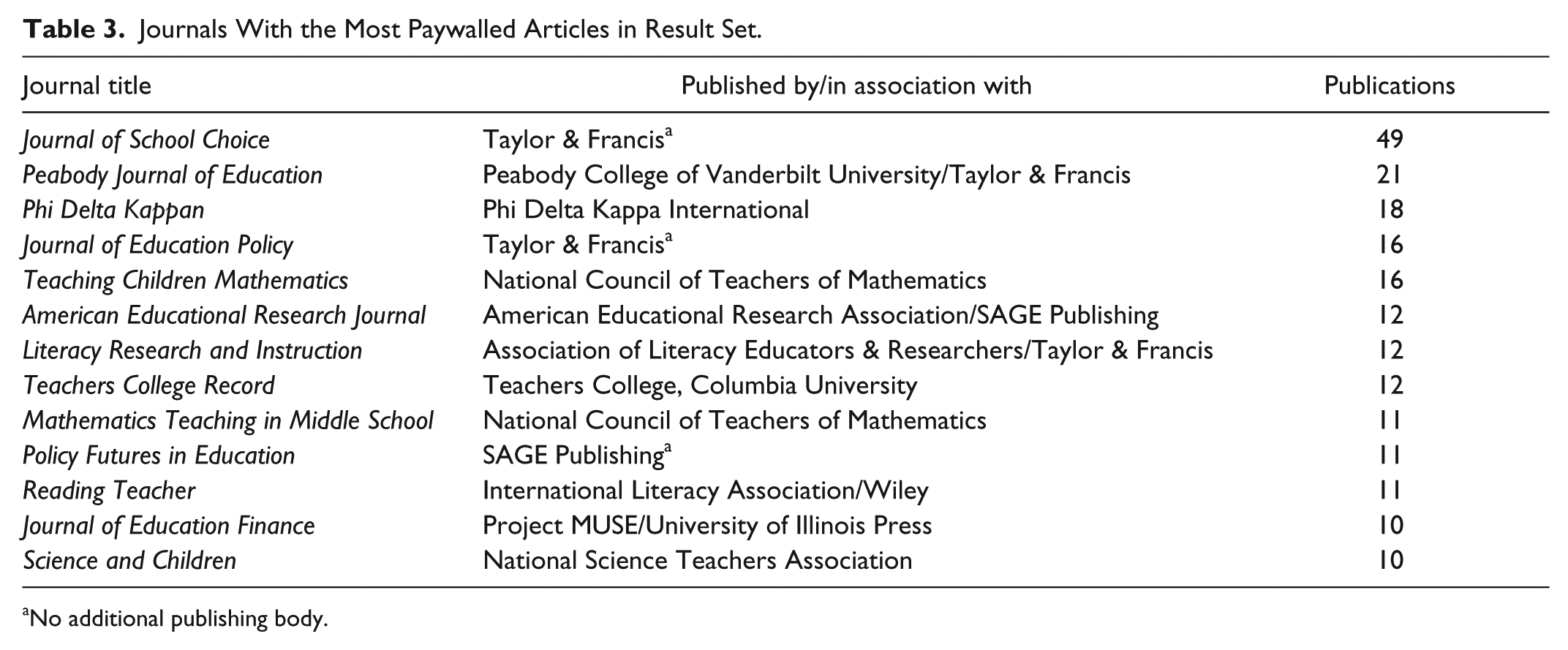
No additional publishing body.
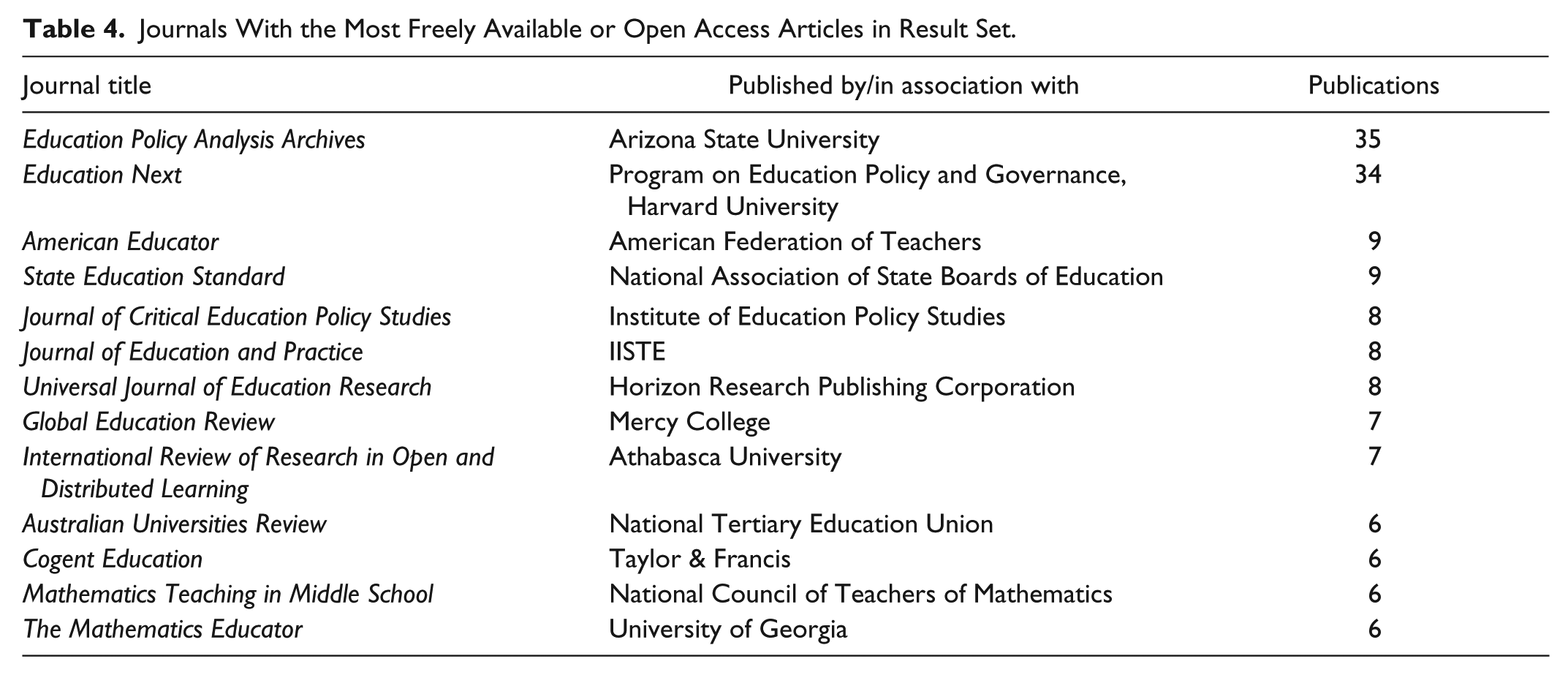
For those journals with freely available articles, 172 unique titles were represented. The journals with the highest number of freely available articles are listed in Table 4. Interestingly, Mathematics Teaching in Middle School shows up in the result set 17 times; six of the articles were freely available, 11 were paywalled.
Journals With the Most Freely Available or Open Access Articles in Result Set.
“Alternative” access
In addition to the articles available on ERIC as PDFs and those that are freely available or published OA, there are alternative ways for members of the public to gain access to articles otherwise locked behind paywalls. Variously referred to as rogue, guerilla, or Robin Hood OA, this alternative access includes resources like SciHub. The SciHub website contains millions of academic papers available for free but has been the subject of a copyright infringement case filed by publishing giant Elsevier (Murphy, 2016). Many paywalled articles may also be obtained on social networking sites like ResearchGate or Academia.edu where academics post and share their publications. There is some question, however, as to the legality of posting publications on these sites (Fortney & Gonder, 2015). There is even a Twitter hashtag for sharing so-called pirated papers—a user sends out a tweet with a URL for an article along with the hashtag #ICanHasPDF. Another Twitter user, with access to an institutional subscription to the article in question will respond to that tweeter with the PDF (“The Scientists Encouraging Online Piracy With a Secret Codeword,” 2015). As all of these methods of access fall outside of what is strictly legal, this study did not examine them further. “Alternative” access to educational research, it seems, is ripe for a research study.
Journal Articles: Peer Reviewed
The vast majority (95%) of the journal literature—whether freely available or behind a paywall—in this result set was identified by ERIC to be peer reviewed. Although scholarly peer review of research findings is far from a perfect system, it is, for now, the generally accepted standard used in academia to determine the research suitability, academic merit, and originality of a research study. It offers the reader a layer of vetting and may help them decide whether an article is worth reading and citing. The fact that ERIC has a “Peer reviewed only” filter further supports the acceptability of peer-reviewed research as a form of quality assurance in academic research. When meeting with students, librarians discuss the peer-review process and describe how to narrow down one’s search to peer-reviewed literature, while, at the same time, addressing the limitations of this system of refereeing research findings.
In all, 1,173 publications in the result set were identified as peer reviewed. Of those, by far, the greatest percentage consisted of journal literature (94%), however, some of the nonjournal literature was identified as peer reviewed as well. In all, 61% of the peer-reviewed literature in the result set was locked behind a paywall.
Reports
Reports, representing 18% of the result set, include publications and other research studies not published in a journal but usually issued by a “state or local agency, a university affiliated program or policy organization, research and non-profit organization” (https://eric.ed.gov/?nonjournals). ERIC further defines reports as follows: Original or technical research, studies of empirical results, experimental statistical studies, case studies, surveys, theory testing, systematic scientific investigations, working papers, white papers, proposals for needed research . . . meta-analyses or other research syntheses; quantitative and qualitative studies; emphasis is on reports with a formal research design, but informal reports also accepted.
Reports: Authoring Institution
More than 90% of the reports in the result set were freely available as PDFs. Given such a high percentage, it seemed important to examine the characteristics of these reports more closely and, in particular, to look into the authoring institutions. Whereas journal literature is routinely indexed by ERIC, for reports to be indexed, the organization that produces them must submit the reports directly to ERIC and, based on a selection process, ERIC will include the report in the database. ERIC has specific criteria for sponsored research, although political affiliation is not considered when selecting material. Organizations that have issued reports on educational topics would be well-advised to submit them to ERIC, assuming they meet the criteria, to gain a larger audience for their publication. Although it is true that these reports, if made available on their organization websites would be discoverable via an Internet search, being included in ERIC gives the report added legitimacy when it resides side-by-side with search results that include journal articles.
An authoring institution could be an organization, think tank, or policy institute. The “Authoring Institution” field that I created in the result set spreadsheet sometimes borrowed information from the sponsor field in cases where a sponsor was listed but no authoring institution. Although much has been written on the influence of philanthropic organizations in educational reform initiatives (Tompkins-Stange, 2016), this study focused less on the sponsor or funders and more on the authoring institution. For example, the Bill and Melinda Gates Foundation funds a great deal of research but, to be fair, not all of that research pushes a particular agenda.
Although the result set included more than 124 individual authoring institutions of some 300 reports, this part of the analysis looked at the 50 organizations that authored two or more reports making a subset of 225 publications. Out of those 50 organizations, those listed in Table 5 authored the most reports.
Top 15 Authoring Organizations Responsible for Two or More Reports.

Ideological Classification of Authoring Institutions
I classified these organizations into broad categories representing the ideological spectrum while understanding that education policy does not fall neatly onto a left–right continuum. Table 6 shows how the classifications broke down.
Ideological Classification of Authoring Institutions.

To determine the ideological perspective, if any, of the authoring organizations in the subset, I did a careful analysis of the organizations’ websites, looking closely at the “About us” part of their webpages and scrutinizing the listed board members and funders. In addition to the organizations’ websites, I used tools like SourceWatch, an online collaborative tool sponsored by the Center for Media and Democracy that tracks influential people and organizations in the realm of public policy. I also conducted general Internet searches and used online databases to find articles or other secondary sources. One of the most useful documents was McDonald’s (2014) analysis of the conservative movement’s entry into educational policy; the paper’s classification of major think tanks was particularly helpful. It is exactly this kind of a deeper investigation that librarians encourage their students to do as part of the research process. We challenge students not to just accept research at face value but to critically evaluate the creator’s expertise, authority, and credibility and to understand the context of that authority (American Library Association, 2015).
Nonpartisan, independent, nonadvocacy
By far, the largest category, 68%, of authoring institutions was nonpartisan, independent, or nonadvocacy. Many organizations self-identify as nonpartisan or independent on their website. For the most part, unless I found evidence to counter this claim, I accepted the organizations at their word when they characterized themselves this way. A number of these independent organizations were affiliated with academic institutions or with state and federal governments such as the IES and the National Center for Education Statistics.
In classifying the authoring institutions, I likely erred on the side of nonpartisan. Without reading the actual publications, it was at times difficult to decipher the information on their websites. The Center on Innovations in Learning, for instance, did not have any obvious ideological bent on their website, although use of the word “innovation” and references to “personalized learning” might, to some, be a red flag. Similarly, references on the website for the Northwest Evaluation Association (NEA) to “innovation” and “actionable data” may strike some as neoliberal in inclination. Nonetheless, they remain in the nonpartisan classification.
Neoliberal, education reform, free market, procharter
This broad classification included organizations committed to education reform, free markets, or a neoliberal research agenda. Procharter organizations were also included in this category. I am reluctant to label this category “conservative” or “right wing” because, when it comes to education policy, many people who otherwise identify as left wing, might advocate free-market solutions to perceived problems in public education.
Education reform
Whereas “education reform” was at one time associated with scholars like Dewey who examined the role of education in society, today education reformers are associated with an ideology that seeks to transform education “into an entrepreneurial sector of the economy” (Ravitch, 2013, p. 19) and advocate for charter schools, vouchers, and other market-based solutions to public education. Or, as Chomsky bluntly stated, “Education reform is a euphemism for the destruction of public education” (Berliner & Glass, 2014).
As with the first category of nonpartisan organizations, some of the organizations in the education reform category are affiliated with academic intuitions. The Program on Education Policy and Governance (PEPG) is located at Harvard University, and one might expect that with this academic affiliation, it would have a nonpartisan research agenda. Although PEPG describes its mission to, among other things, provide training for scholars “to make independent contributions to scholarly research,” the website (http://www.hks.harvard.edu/pepg) also makes multiple references to “school reform.” More digging on their website shows that among the PEPG’s research affiliates are Frederick Hess of the American Enterprise Institute and Eric Hanushek of Stanford’s Hoover Institution, both institutions known for their conservative viewpoints. Polarizing figure Michelle Rhee is listed as an academic visitor. Among the foundations listed as PEPG’s donors are the Thomas B. Fordham Institute, Milton & Rose D. Friedman Foundation, Charles Koch Foundation, and the Walton Family Foundation, Inc., all organizations identified in the literature as being on the conservative end of the political spectrum (McDonald, 2014; Spring, 2014). To get a sense of the research agenda for the Center on Reinventing Public Education (CRPE), also housed at an academic institution (University of Washington), requires one to decode the language on their website. Language like “freedom to solve problems,” “innovate,” “accountability, incentives and capacity for school-level entrepreneurship” as well as emphasis on “personalized learning” are the types of phraseology used by those who promote a market-driven, reform-oriented education policy. But there were no obvious red flags among their staff of experts. To get a real sense of this organization’s research agenda—as with all the organizations discussed in this study—would require going beyond the coded language on the website and actually reading the publications. Even a cursory Internet search found articles on this organization and its close affiliation with the “ed reform” movement such as an exposé of CRPE’s influence in reform efforts within the Minneapolis public schools (Lahm, 2015), and posts in Seattle Education, a blog that covers public education in the Seattle area and beyond which portrayed CRPE as “an anti-public education think tank” . . . “determined to tear down public schools and replace them with publicly funded, privately run charter schools” (Frogge & Pinkston, 2017; Schauble, 2017).
Free market
Although many in the education reform camp advocate for a market-based solution to education, the organizations in this category are more explicit in their free market/limited government point of view.
EdChoice, formerly known as the Friedman Foundation for Educational Choice, is upfront in its mission “to advance educational freedom and choice for all as a pathway to successful lives and a stronger society.” To accomplish this, their goal is to conduct research and educate a diverse audience about school choice and to train policy makers. Also in the free-market category is the Mackinac Center for Public Policy. Besides issuing a press release praising Betsy DeVos’s nomination as Secretary of Education (“Mackinac Center for Public Policy analysts are excited to see how she uses her new role to advocate for quality educational options for all children.” (Lovell, 2017)), the Mackinac Center unapologetically depicts itself as “a nonprofit institute that advances the principles of free markets and limited government.”
The Pioneer Institute website states that they are independent and nonpartisan. Upon closer look, one can see that they seek “public policy solutions based on free-market principles, individual liberty and responsibility, and the ideal of effective, limited and accountable government.” Similarly, the mission of the Manhattan Institute, according to its website, “is to develop and disseminate new ideas that foster greater economic choice and individual responsibility.” They further portray themselves as “a leading voice of free-market ideas.” In terms of education, the institute “pursues an aggressive reform agenda” that centers on, among other things, “accountability and innovation.” Although the Thomas B. Fordham Institute, and its affiliated foundation, are generally characterized as conservative (McDonald, 2014; Spring, 2014), the language on their website—“promote educational excellence for every child in America via quality research, analysis, and commentary”—is more vague. Their advocacy for charter schools is, however, a tip off.
Procharter
Also in this category are organizations with a procharter school research agenda such as the National Alliance for Public Charter Schools, the National Association of Charter School Authorizers, and the National Charter School Resource Center. Of the 225 reports in this subset, 95 were identified by ERIC as being about charter schools. These three organizations were responsible for 19 of those reports. In fact, organizations in the result set classified as “Education Reform/Free Market/ProCharter” were responsible for 46% of the reports on charter schools.
Liberal, Progressive, Proteacher
Only three organizations in this subset were classified as liberal, progressive, or proteacher: the Center for American Progress, the Center on Children and Families at Brookings, and the Civil Rights Project. Even so, although the Center for American Progress self identifies as “progressive,” some have questioned how progressive this think tank is in the realm of education policy (Welner, 2011), especially considering its close alignment with President Obama whose Secretary of Education was Arne Duncan, a “recognized leader in the corporate reform movement” (Ravitch, 2013, p. 26).
It is not surprising that the research output for these organizations, regardless of ideology, was decidedly policy-oriented and that one is less likely to see research in the form of a report when searching on a straight-up educational issue related to, say, pedagogy. Whereas 71% of the publications in the result set were journal articles and 18% reports, a search in ERIC on writing instruction and English-language learners was skewed slightly with 77% of the output in the form of journal literature and 8% reports.
Conclusion
This study sought to examine research output in the field of education and, ultimately, was more descriptive than investigative. In describing the characteristics of this body of educational research, I showed that 65% of the journal literature conducted by scholars was locked behind paywalls. In light of Willinsky’s call to make educational research more available to the public as a way to contribute to the “democratic quality of people’s lives” (Willinsky, 2005, p. 39), these numbers, I hope, provide evidence to support my conclusion that scholars engaging in high quality, peer-reviewed educational research should make their research findings more openly available.
As a librarian, I know from experience that educational research is not esoteric, that many people beyond the hallowed halls of academia are interested in research that affects public education. The public does have access to publications made available on ERIC or that are published OA, but more than a quarter of the freely available reports in ERIC are produced by organizations with a decidedly neoliberal or free-market perspective. Although the publications that are behind paywalls were not analyzed for content, one has to wonder whether the ideological perspective of that scholarly research breaks down along the same lines as the freely available research. And, for a deeper analysis, it would be enlightening to study to what extent the ideological perspectives represented in research-based scholarship on education policy is mirrored, or not, in K-12 policy at the state and federal level.
As I was finishing up this study, I met with a group of high school teachers who had given up 4 weeks of their summer to participate in the Bay Area Writing Project Summer Institute. They were looking into a variety of topics related to writing instruction from civically engaged writing to navigating diverse perspectives in the classroom to building fluency in struggling writers; I introduced the teachers to a number of tools used in educational research and helped them find academic articles to support their areas of inquiry. After their 4-week intensive was over, I cautioned them, they would no longer have access to the deep collection of journals and databases that I had demonstrated. Program director Katherine Suyeyasu summed it all up when she sighed and asked, “If scholars are doing educational research, why would they publish it where teachers can’t even read it?” Why indeed?
Footnotes
Declaration of Conflicting Interests
The author(s) declared no potential conflicts of interest with respect to the research, authorship, and/or publication of this article.
Funding
The author(s) received no financial support for the research, authorship, and/or publication of this article.
