




Abstract
The purpose of this article is to examine the representation of race through images that are published in Spanish physical education textbooks for secondary schools and to offer an insight into students’ beliefs related to racial stereotypes in physical education. The sample was composed of 2,583 images and 87 secondary school pupils. The analysis was carried out through the elaboration of an ad hoc coding scheme. The results showed that people whose appearance is similar to the in-group predominate. The kind of physical activity, the field, space, and level of competence vary according to race. The textbooks analyzed in this study engender a stigmatized vision of racial diversity, and the images reproduce and reinforce racial prejudice.
Introduction
The demographic composition of modern Spain reveals a multiracial context. The country has the second largest number of immigrants in the European Union. In the last decade, the number of non-Spanish residents increased threefold and now stands at 5.7 million, more than 12% of the population. The biggest European immigrant groups are from Romania and the United Kingdom. The greatest numbers of non-European immigrants are from Morocco, followed by those from Ecuador and Columbia. In the last few years, Spain has also seen a significant increase in people arriving from Pakistan and China (Spanish Statistical Office, 2012). With regard to the education system, a report on the school year 2013/2014 (Spanish Ministry of Education, 2013) indicated that numbers of foreign school students had increased in the last decade: In the 2012/2013 school year, there were 726,781 immigrants in full-time education (9.1% of the school population). The biggest group are of South American origin (34.8%), followed by students from the European Union (26.1%) and Africa (27.5%). Students from Asia and Oceania make up 7.5% of the total, with 4% coming from the rest of Europe.
Nevertheless, current educational practices in Spain generally respond to a homogenized scholastic model that fails to successfully educate specific groups made up of racial diverse subjects (Rodríguez, 2010). It is clear that racial stereotypes continue to be rooted in Spanish classrooms.
School textbooks play a central role in the homogenizing process; they reproduce social images and settings that reduce the complexity of social reality and offer a differential schematic that orders and explains that which is configured as reality (Jorquera, 2010). A substantial amount of information that is shown to the student is done so through images that filter into the collective consciousness, with no prior reflection, and this makes iconic language a very powerful medium for the reproduction of stereotypes (Acaso & Nuere, 2005).
With regard to race, the imagery presented in textbooks is simplistic and, rather than facilitating the construction of shared identities, it endorses and perpetuates the hegemony of the (White and Western) in-group (Morales & Lischinsky, 2008; Torres, 2008). The concept of race is still built on erroneous biological considerations that are used to transmit expectations on the performance of individuals that are based on a supposedly collective potential, a message that responds to racist biopolitics and corporal differentiation (McDonald, 2013).
This research project aims to identify the level of racial diversity with regard to the people represented in the images contained in Spanish physical education textbooks. It is clear that the iconic messages presented are perceived as an objective reflection of reality, and, in particular, for those students between 12 and 15 years of age, there is a tendency to legitimize identity with images that are considered an “undeniable reality” (Revuelta, 2008). The referential function of the photograph is of primary interest for this project so the analysis tools use observable “indicators” that provoke the perception of difference. As authors, we are conscious of the limitations of this type of phenotypical analysis (the analysis of representations of race in images in physical education textbooks was confined to observable phenotypic indicators), not least, because it relies on the concept of race that, in both its biologistic and cultural construction, represents a regulatory fiction through which certain differences are transformed into meaningful concepts that legitimize oppression, exclusion, privilege, and dominance (McDonald, 2013; Romero, 2003). Nevertheless, the coding scheme used in this work is utilized as a tool for identifying observable indicators in the photographs considered that act as “semiotic-material” references in the consciousness of the people who view them, and this leads to a process of the development of “ethno-racial” subjectivities: . . . these are not a reflection of a biological reality or the effect of social ordering and interpretation; they are a product of the profoundly unequal, multiple relationships between elements such as: bodies; legislative apparatus; media images; specific locations; celebrations; meals; accents; ways of looking; police controls; dress; fears; scientific activities; the globalised economy; descriptions of the human genome; legalisation papers; position in the labour market; racisms etc. (Romero, 2003, p. 125)
Homogenization of Corporal Culture Through Physical Education and Sport
Corporal culture can be conceptualized as a group of values, uses, knowledge, beliefs, norms, and behavior patterns that delimit corporal appreciation and practices in a given social context. The biopolitical concept provides a framework for the interpretation of physical education and sport 1 as practices inserted in mechanisms for the control and regulation of the population (Foucault, 2009) and the homogenizing and globalizing (Mella, 2005). In this way, the universalizing of sport has contributed to the reduction of the variety and diversity of corporal and motor expressions, which have become limited to a dominant cultural model (Barbero, 2006; Vicente, 2007).
Due to its close relationship with sport, physical education is particularly susceptible to discourses relating to corporal differentiation. The culture of “performativity” has dominated educational discourse, affecting the way in which pupils think and act toward physical education (Evans, 2013). The obsession of explaining the phenomenon of human physical performance has tended to treat people in a technological and mechanical manner, and this has led to the legitimization of reductionist and determinist interpretations of racial distinction that support arguments on differences in motor performance (McDonald, 2013). Hill and Azzarito (2012) explored a number of the ways that young women visualized valued bodies and found that more than half of the posters that the girls created portrayed White men. Only one portrayed women of color, and no Asian women were represented in the posters. As such, legitimate sporting bodies promoted in the school site were embedded in Whiteness.
In Spain, the mass media minimize the role of specific racial groups in sport and promote the formation of stereotypes and prejudicial attitudes (Igartua & Muñiz, 2004; López, 2005; Muñiz, Igartua, & Otero, 2006). The majority of advertising images show White people, as do most TV programs related to sport. This is consistent with research undertaken in other countries: In the United States, Latin American and Asian people hardly feature in sports programs (Billings & Tyler, 2002), and Black people are almost always seen playing baseball, basketball, American football, and doing athletics (Lumpkin, 2009; Thomas, 2004). McCarthy, Jones, and Potrac (2003) argue that the existence of racial stereotypes in U.K. sports coverage not only makes some groups invisible but also reflects the structures of power.
Studies on racial stereotypes reveal that perceptions of competence and future aspirations for sporting participation vary among adolescents of different origins (Azzarito & Solomon, 2006; Harrison, Harrison, & Moore, 2002; Harrison, Lee, & Belcher, 1999; Harrison, Sailes, Rotich, & Bimper, 2011), and that students’ construction of the ideal body is racialized (Azzarito, 2009). In accordance with mass media images, young people attribute certain physical activities to different racial characteristics (Contreras, Pastor, & González, 2008; Gil, 2006) and believe that Black people are physically superior, whereas White people have greater cognitive capacities (Sheldon, Jayaratne, & Petty, 2007). These stereotyped perceptions are also present in the discourses of coaches, teachers, and parents; for example, Black people are more closely identified with athletics, American football, and basketball (Harrison, Azzarito, & Burden, 2004; Hayes & Sugden, 1999).
The most recent National Survey on Spanish population sport behavior (García & Llopis, 2011) found that 45% of immigrants above the age of 15 participate in sport. Immigrants of African origin are the most active (46%), followed by South Americans (45%) and Europeans (42.1%). In terms of the type of activity, results of another study by Llopis (2005) indicate that Africans prefer running, Latin Americans enjoy team sports (especially football), and Europeans are more interested in mountaineering, tennis, swimming, walking, skating, gymnastics, tennis, and team sports.
This data demonstrate that race must be considered a powerful influence on patterns of participation and performance (Harrison et al., 2011).
Racial Stereotypes, Textbooks, and Physical Education
Although many studies have examined racial stereotyping in school textbooks used in a variety of courses and subjects, physical education textbooks have received little attention. This might be explained by the fact that the use of textbooks in physical education is relatively recent. In Spain, the first empirical analysis of physical education textbooks did not appear until the 1990s, and research has focused on gender stereotypes. Only a few contemporary works have specifically examined the representation of race.
Internationally, there is agreement that physical education textbooks offer a rather unbalanced vision of society that perpetuates the use of race as a variable that legitimizes the existence of differences and expectations based on racial groups (McDonald, 2013). The images shown in textbooks are almost exclusively of White or Caucasian people (Botelho, Silva, Queirós, & Caetano, 2008), Black people are closely linked to specific athletic activities (McDonald, 2013), and other social realities are silenced by the dominant culture (Hsu & Chepyator-Thomson, 2010).
All these studies revealed racial stereotyping presented in the educational materials. This study attempted to seek an answer to the following question: What are the patterns of race that are being conveyed by Spanish physical education textbooks?
This analysis contributes to research initiated by these and other authors within the literature related to physical education and sport pedagogy because, specifically, studied how the physical education is “encoded” with particular conceptions of race, and how these may impact students’ perceptions.
Objectives
This work aims to characterize the patterns of race that are transmitted by physical education textbooks in compulsory secondary education in Spain. The following hypotheses were advanced:
Method
The study was based on two methods: (a) a content analysis of images in Spanish physical education textbooks using synchronic, empirical, descriptive, and non-experimental techniques, and (b) a test of secondary school students’ perceptions of a set of images.
Sample
Method 1
The content analysis considered 2,583 photographs from 36 textbooks from 10 Spanish publishing houses. Of the original total (N = 3,316), 733 (22.10%) were discounted as it was not possible to identify the racial origin of the people shown, for example, due to the wide-angle focus that was used.
Method 2
The sample comprised 87 students (45 males and 42 females), aged between 12 and 17. Selection criteria were accessibility (the collaboration of the school authorities) and the inclusion of students from each year of compulsory secondary education.
Variables
The analyzed variables were race, type of physical activity, field of practice, and level of activity. Operational definitions are given in Table 1.
Coding Scheme.

Procedure
Method 1
The codification system for the content analysis utilized a number of sources and strategies. The starting point was López’s (2005) “publicity image analysis system.” In addition to the categories that were theoretically or deductively derived, the codification process was amplified through an inductive or empirical procedure that was the result of a first “superficial viewing” of the images. The categories that were identified in this first viewing were defined in conjunction with specific literature; there were five phases:
Initial trial test. The compilation of categories used by López (2005) was applied to a set of images taken from physical education textbooks. Issues that emerged during the initial viewings of the images also determined several other categories used in the study. In addition to the categories that a priori organized and systemized the test, the procedure was also exploratory: It allowed the researcher to identify new categories and indicators and eliminate others that were shown to be irrelevant to the objectives of the analysis.
Second trial test. A code and an operational definition were assigned to each of the dimensions and categories. A second trial test was carried out to corroborate the validity of the categories. One hundred sixty-eight images were coded.
Consultation with experts. Three content analysis experts participated in the study; two of them hold doctorates in physical education and habitually use content analysis as their main research technique. The third expert is a doctor of philosophy and literature and has a BA in library science and documentation; she is the author of a number of studies based on the content analysis of images and has published a number of articles on content and image analysis of documents. The objective of the consultation with experts was the validation of the coding categories. The experts were asked to complete a questionnaire giving their opinions on five items: suitability of the coding scheme, precision of categories, mutual exclusion of categories, clarity of definitions, and minimization of the subjectivity of the observer. Data were collected by means of the Likert-type scale, ranging from 1 (strongly disagree) to 5 (strongly agree), and complementary, qualitative information.
Second consultation with experts. After making the necessary modifications, the new coding scheme, the corrected definitions, and the questionnaire used in the first consultation were returned to the experts. All items were given a rating of 4 or 5.
Triangulation with observers. Three observers were given training on the coding system and codebook, using images from textbooks that were not in the final sample. The objective was to familiarize the researchers with the pictures, the coding system, the codebook, and registration. The three observers were then randomly assigned 74 images from textbooks. Thirty of them were selected by simple random sampling through a table of random numbers; 44 were selected by non-random sampling. The selection criterion was that all the indicators in the coding scheme had to be codified. Intercoder reliability statistics were calculated to assess agreement. The kappa reliability (>.80) was therefore satisfactory for all categories: type of physical activity (M κ = .90), field of practice (M κ = .86), and level (M κ = .84). The intercoder reliability served as content for a pilot reliability test before full coding commenced; the pilot gave the researchers a final opportunity to alter the coding scheme to maximize reliability.
When reliability levels were considered adequate (based on the results of the reliability pilot test), another representative sample was used to assess reliability for the full sample to be coded. Cohen’s kappa was also calculated for the coding of the final sample of photographs. For the second intercoder reliability analyses, 273 images (more than 10% of the full sample) were selected by simple random sampling using a table of random numbers. According to Lacy and Riffe (1996), the appropriate size of the sample should not be less than 50 units, or 10% of the full sample, and it will rarely need to be greater than 300 units. Cohen’s kappa revealed a high degree of reliability: type of physical activity (M κ = .86), field of practice (M κ = .92); level (M κ = .88).
Method 2
The test of perception of images was oriented at gaining an understanding of the variables that attracted the attention of the young people who saw them in physical education textbooks. The test was developed in four phases: (a) design of the first draft of the test, (b) consultation with four experts, (c) a pilot test with students from 4 years of compulsory secondary education (n = 94), and (d) the design of the definitive perception test.
During the implementation of the definitive test, 15 images taken from physical education textbooks were projected in the classroom. The images were selected in accordance with the results of Method 1, with the aim that they would be representative. The protocol was as follows:
The students were given the “Description and Opinion” form.
The students read the instructions for the test, and any questions or doubts were dealt with. The instruction was to describe what they saw in the images.
Each of the 15 images was shown for 1 min. The students gave a written description of the image with their opinions.
The students handed in the completed “Description and Opinion” form.
Analysis and Data Processing
Method 1
All images were digitized to facilitate coding. The registration process was carried out manually, using a chart for each textbook.
The statistical analysis used SPSS software 15.0 for Windows. The processing of the information involved descriptive univariate analysis and associative measures between the different variables or categories (bivariate analysis). Contingency tables were used to compare the observed frequencies and percentages. The Pearson chi-square statistic significance level (testing independence) was set at 5% (α = .05) and used to identify associations between the variables.
The corrected normalized residuals were utilized to compare results; the marginal values, sample size, and the number of cases in which each remainder was based would otherwise have made it impossible. For the confidence level set for this study (95%), the corrected normalized residuals indicated that the difference between observed frequency and expected frequency was high when its absolute value was above 1.96. Therefore, a corrected normalized residual with an absolute value greater than 1.96 indicates that there are more cases (if it is positive) or less cases (if it is negative) than could be expected if the variables were independent. However, a value between ±1.96 indicates that the difference between observed frequency and expected frequency is small and the variables are independent.
Method 2
The descriptions of the students were subjected to a content analysis, using the N-VIVO 8 program for the categorization of the comments. The software allowed the organization and reduction of the data into content analysis categories. The initial categories were the same as the content analysis of the images, and these were added to by categories that were inductively derived from the first reading of the students’ descriptions.
Results
Hypothesis 1: Prevalence of White People
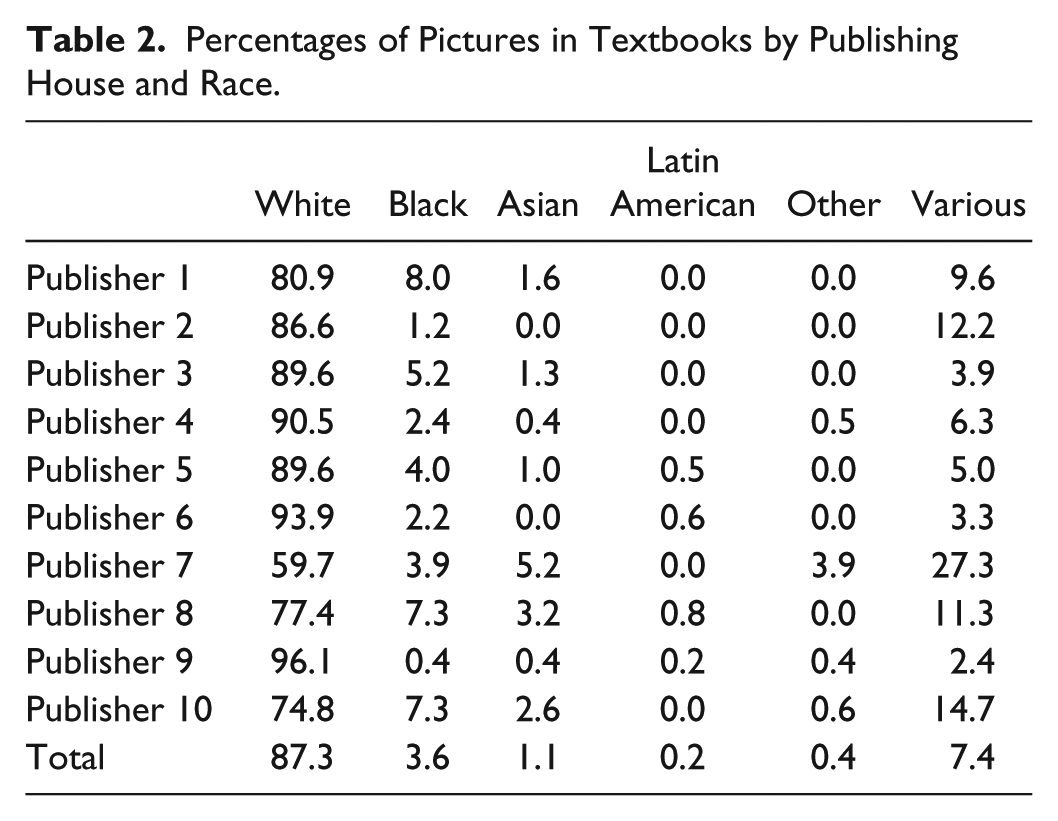
The most numerous group featured in physical education textbooks for secondary schools in Spain is White people (the in-group); they appeared in 2,256 photos (87.34% of the total). This was followed by images that showed individuals from different races at the same time (192 photos, 7.43% of the total); Black people (92 photos, 3.56% of the total), Asians (28 photos, 1.08% of the total), Latin Americans (4 photos, 0.15% of the total), and other racial groups (11 photos, 0.43% of the total).
There were some differences among the publishing houses: the percentage of photographs featuring non-White people ranged from 1.22 to 12.99. The highest percentage of interracial images from one publishing house was 28, and the lowest was below 3 (see Table 2).
Percentages of Pictures in Textbooks by Publishing House and Race.
Hypothesis 2: Type of Physical Activity According to Racial Group
The analysis of the relationship between the variables of racial group and type of physical activity was undertaken by means of contingency tables and the Pearson χ2 test. When the two variables were interrelated, a critical value was obtained, which was associated to the χ2 statistic, lower than 0.05 (p value = .000). This means that the type of physical activity in which the textbooks showed the participants participating varied according to race (α = .05).
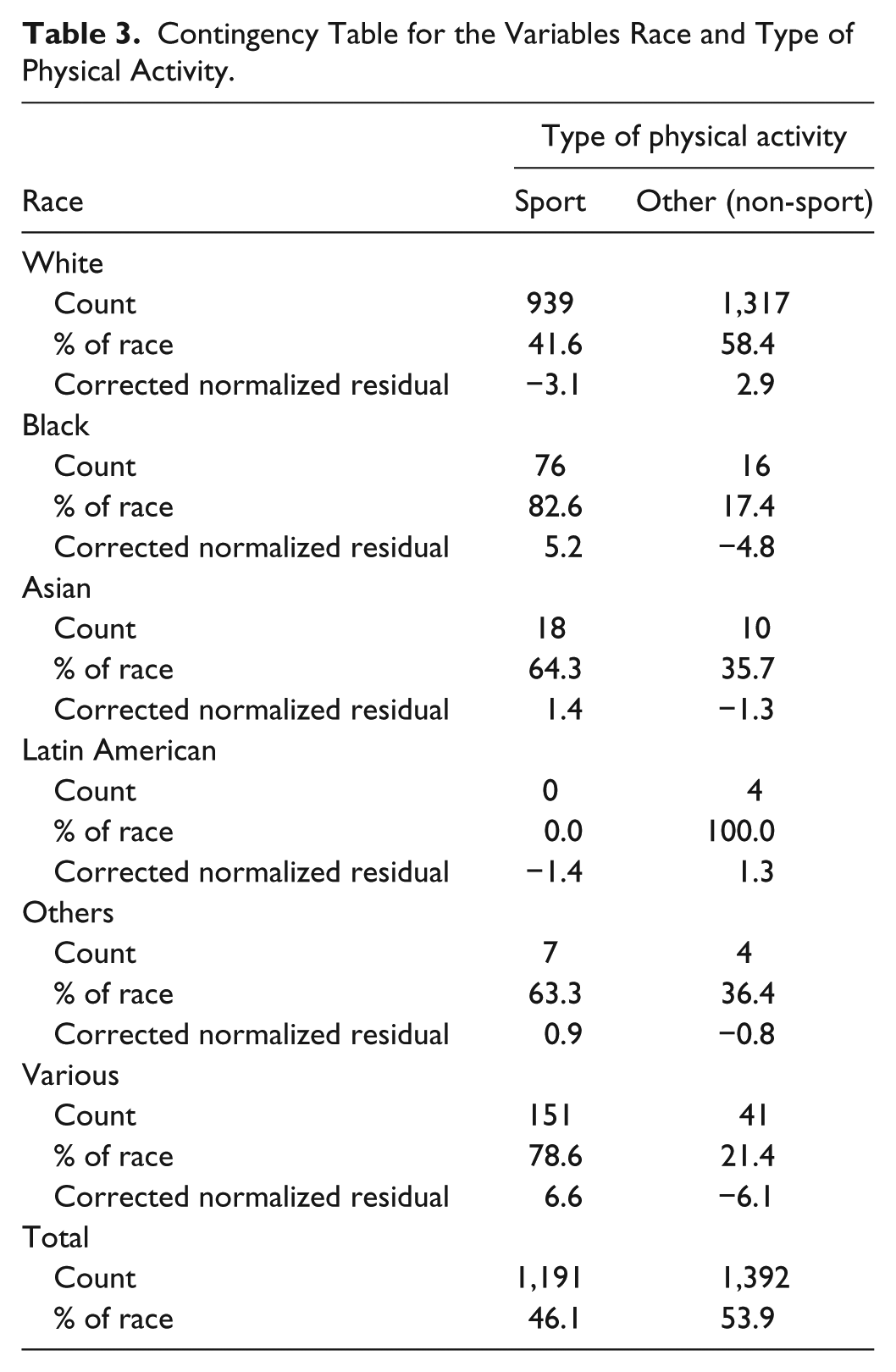
Of the images that featured White people, 19.2% involved team sports, 22.4% individual sports, 10% artistic activities, 15.8% fitness and physical conditioning, 9% physical activities in a natural environment, 9.7% games, and 13.9% showed individuals involved in other types of activities: White people were shown as participating in a wide variety of physical activities. Individuals from Black, Asian, Latin American, and other groups were shown playing sports in 74.8% of the pictures (54.8% individual sports and 20% team sports); depiction of their participation in non-sporting activities was very limited: 9.6% fitness and physical conditioning, 5.9% games, 2.2% artistic activities, 0.7% activities in the natural environment, and 6.7% other activities. Furthermore, Black people were especially shown as participating in sport (82.6%) and specifically in individual sports such as track and field (63%).
There was a similar pattern in interracial images: 78.6% of photographs that featured individuals from different racial backgrounds were of sport (43.2% team sports, 35.4% individual sports) with only 5% involving other physical activities.
The last line in each cell of Table 3 shows high corrected normalized residuals: There is a strong relationship between the variables. The probability that Black people and interracial groups did sport and no other types of physical activities was significantly higher than would be expected if the variables were independent (remainders of 5.2 and 6.6, respectively).
Contingency Table for the Variables Race and Type of Physical Activity.
Hypothesis 3: Field of Practice and Race
The contexts that were linked to the people represented in the textbooks also varied according to the race to which the individual belongs. A .000 significance was obtained with Pearson’s chi-square test, which allowed the rejection of the null hypothesis with a confidence level of 95%. As Table 4 shows, individuals from Black, Asian, and other groups were almost exclusively depicted in competition (75%, 56.5%, and 42.9%, respectively) and were excluded from educational contexts. In the case of Asians and Latin Americans, the percentage of pictures in formal educational contexts was 0.
Contingency Table for the Variables Race and Field of Practice.

Interracial groups were also more frequent in competitive fields of practice (78.6%). In formal educational contexts or other fields, the figure was much lower (8.2%). In contrast, White people were mainly linked to non-competitive contexts.
In the images of competitive activities, there was a significantly higher proportion of individuals from “other” racial groups in comparison with White people (typified residuals of 9.1 and 14.7 compared with −17.8). In the remaining fields of practice (educational and non-competitive), there was a significantly higher proportion of White people than people from other racial groups.
Hypothesis 4: Level of Activity and Race
The Pearson chi-square test results also indicated (significance level of .05) that there was a relationship between racial group and participation in elite level sports (p value = .000).
There was a much higher proportion of pictures of White people in non-elite sports contexts than there were in elite sports (86.3%, compared with 13.7%). This statistic was corroborated by the corrected normalized residuals (−19.8 and 19.8). The proportion of pictures depicting Black people involved in elite-level competitive sports was much higher than the images of activities not related to elite sports (67.4% compared with 32.6%). The corrected normalized residuals were 11.6 and −11.6.
The percentage of interracial group pictures depicting people engaging in elite sports was also higher than that of interracial pictures referring to non-elite sports activities (63.6 compared with 36.4). The corrected typified remainders showed that these differences were statistically significant: 15.1 and −15.1 (see Table 5).
Contingency Table for the Variables Race and Level of Activity.

Hypothesis 5: Images of People From the Out-Group in Physical Education Textbooks Engender Greater Prejudices Than the Images of the In-Group
Sixty-one of the 87 participants (70.11%) wrote some type of comment relating to the racial group of the people featured in the images. A common discourse included reference to “those others,” especially Black people, as “those people from over there,” “not from here.” A Black person is often seen as belonging to “a different team and a different country” (Student 76). In some cases, their presence was considered a problem, both in sporting terms, “the black guy is cheating, he’s pushing the white guy to get the ball off him” (Student 73), and in terms of the wider society, “the Chinese are invading us” (Student 27).
Activities such as football and athletics are seen as most adequate for Black people; the arguments are generalized stereotypes: “black people are usually stronger” (Student 6), “black people run a lot” (Student 46). Students appear to attribute a certain physical superiority to Black people and place them exclusively in competitive environments: “they are the best athletes and help to raise the level of the competition” (Student 87).
Discussion
The Absence of Diversity
Hypothesis 1 was confirmed. Individuals with a different appearance to the in-group (White and Western) are very much excluded from images shown in Spanish schools’ physical education textbooks. This finding coincides with results of research on TV programs and advertising related to physical activity and sport (Billings & Tyler, 2002; López, 2005) and the few published studies on physical education textbooks to date (Botelho et al., 2008): There is almost exclusive representation of Caucasian people and an absence of other racial groups. Black people are the second most represented group, with a much lower percentage. This lack of racial diversity is not exclusive to physical education; previously published works have found similar disparities in other subject areas (Morales & Lischinsky, 2008; Torres, 2008).
Racial Stereotypes and Physical Activity
Hypothesis 2 was confirmed. The analysis revealed the assignation of a specific type of physical activity based on racial appearance. No previously published works on the relationships between racial variables and physical activities in school textbook images have been found. Nevertheless, a study by McDonald (2013) on the configuration of the concept of race in the textual content of physical education textbooks concurred with the results of this current article and argued that textbook discourses emphasize the superiority of the “black race” in the sprint and running disciplines of athletics. Similar conclusions have been drawn with regard to the representation of Black people in the mass media in the United States—representation is almost exclusively oriented toward baseball, basketball, and American football (Thomas, 2004). We were unable to corroborate the association of Black people with baseball; as it is not a sport that features in Spanish physical education textbooks, we could, however, consider athletics, basketball, and American football. The results coincided with the opinions of the students (who linked these sports with Black people) and the results of a number of other studies (Azzarito & Solomon, 2006).
Hypotheses 3 and 4 were confirmed. Black people were frequently depicted in competitive, high-level sporting activities. Images in Spanish physical education textbooks transmit the message that racial diversity neither exists in the school nor in recreational contexts. People who are different from the White and Western model are only shown in institutionalized competitive, high-performance sporting contexts, and this might be the reason for beliefs concerning physical-conditioning superiority (Contreras et al., 2008; Harrison et al., 2004; McDonald, 2013; Sheldon et al., 2007) and homogenized sporting activities (Barbero, 2006; Mella, 2005).
Hypothesis 5 was confirmed through the opinions of the students that evidenced racial stereotypes and prejudices. The students commonly referred to the “others” as “foreigners” and problematized their presence in both sporting and non-sporting contexts. The students perceived the existence of different sports and physical activities in terms of race and considered competition and high-performance sports to be the most adequate for Black people. Following the argument of Harrison et al. (2004), the stereotyped messages implicit in physical education and sport often promote stereotypes based on physical superiority. Nevertheless, the real differences are based on social forces that construct the reality, not on genetic or biological aspects. There is no scientific evidence that substantiates theories that aim to explain the physical superiority of Black people or their supposed intellectual failures in comparison with White people (Hayes & Sugden, 1999).
Conclusion
School textbooks are not coherent with educational policies that favor interracial education and learning. The images in secondary school physical education textbooks portray a racial homogeneity with majority representation of the in-group (White and Western), compared with the minority representation of people from different races (the out-groups).
The messages transmitted by the images shown in Spanish physical education textbooks do not facilitate the construction of racial diverse and shared identities: People with a different appearance from the in-group (mainly Black people) are only represented in a limited number of contexts that are stereotyped in accordance with conceptions of “race.” They only appear in sports and activities such as football, basketball, and athletics and are excluded from artistic physical activities or games that take place in the natural environment. In general, Black people, Asians, and other people who are not from the in-group are always linked to competition and elite sport, and are excluded from recreational or utilitarian contexts in the educational environment.
These sporting contexts, mainly basketball and football in high-performance competition, offer a biased vision of corporal culture and reinforce racial prejudice and stereotypes.
This analysis makes a contribution to the body of research that was initiated by other authors from many countries (e.g., Azzarito & Solomon, 2005; Flintoff, 2015; Grahn, 2014; Harrison et al., 2002). Grahn (2014) studied textbooks used in coaching education programs in Sweden and demonstrated that textbooks construct gender differences. Recently, Anne Flintoff (2015) concluded by arguing for a critical analysis of the construction of Whiteness through physical education teacher education. This study demonstrates the need to raise awareness with regard to the content of physical education textbooks and the importance of working to overcome racial stereotypes associated with sport and physical education. Publishing houses and education authorities must become fully aware of the contents of physical education textbooks to become involved in their improvement. Teachers must analyze the books from a critical point of view to be able to use them in a coherently didactic way. In this respect, the teachers’ initial training should enable them to reflect and become aware of the implications that school materials can have in racial differences.
Footnotes
Declaration of Conflicting Interests
The author(s) declared no potential conflicts of interest with respect to the research, authorship, and/or publication of this article.
Funding
The author(s) received no financial support for the research and/or authorship of this article.