




Abstract
The human brain develops asymmetrically, such that certain cognitive processes arise predominantly from the left or right side. It has been proposed that variations in this laterality contribute to certain forms of mental illness, such as schizophrenia. A convenient measure of brain laterality is hand dominance, and prior work has found that patients with schizophrenia are more likely to be left-handed than the general population. This finding is not consistent, however, and fewer studies have directly compared handedness between psychiatric diagnoses. We assessed hand dominance in 107 patients presenting to an outpatient psychiatric clinic with diagnoses of a mood or psychotic disorder. The prevalence of left-handedness was 11% for mood disorders, which is similar to the rate in the general population. It was 40% in those with psychotic disorders (adjusted odds ratio = 7.9, p < .001). The prevalence of left-handedness was much higher in psychotic disorders compared with mood disorders in this community mental health sample.
Keywords
Introduction
The left and right hemispheres of the human brain are asymmetrical in their physical structure and cognitive functions that they mediate (Samara & Tsangaris, 2011). This asymmetry appears to underlie the development of core cognitive processes such as language acquisition (Crow, 1997a), and variations in development of this asymmetry are suspected to contribute to the pathogenesis of schizophrenia (Crow, 1997, 2008), with some proposing that it may be a central neurological feature of this disease (Angrilli et al., 2009; Li et al., 2012; Oertel-Knochel & Linden, 2011) and perhaps of other forms of psychiatric illnesses (Nowakowska et al., 2008).
One limiting factor in studying brain laterality is the time and expense involved in directly measuring it, a process which typically entails the use of radiological or postmortem methods. The stringency of such methods risks limiting participation in studies, especially from those in the community who may be the most ill and unwilling or unable to participate. A far more convenient, although potentially less precise, method to estimate laterality is to ascertain the dominant hand of the subject. Hand dominance has been shown to correlate with cerebral laterality of language expression (Knecht et al., 2000), vision processing (Willems, Peelen, & Hagoort, 2010), declarative memory (Cuzzocreo et al., 2009; Lyle, Hanaver-Torrez, et al., 2012), emotional processing (Propper, Brunyé, Christman, & Bologna, 2010), and even the processing of taste (Cerf, Lebihan, Van de Moortele, Mac Leod, & Faurion, 1998).
A recent meta-analysis of over 40 studies concluded that left-handedness is more prevalent in psychiatric illness (Dragovic & Hammond, 2005). In particular, they found that patients with schizophrenia were about twice as likely to be left-handed than healthy controls, although not all studies considered in the analysis showed this difference. Indeed, a recent large study of several hundred patients with familial case controls did not find any difference in handedness (Deep-Soboslay et al., 2010). The reasons for these discrepancies are not clear. It has been speculated that methods of measuring handedness and demographic factors, such as race and gender distribution of the study populations, as well as potentially unreported comorbid diagnoses, may confound the results (Deep-Soboslay et al., 2010; Dragovic & Hammond, 2005). Careful re-analysis of the data, however, has not been able to reliably identify these factors, if they exist.
While most attention to handedness has focused on schizophrenia, other work has suggested that prevalence patterns of handedness may also vary in bipolar disorder (Nowakowska et al., 2008). Studies in depression and anxiety, on the other hand, have been more sparse and less certain about whether there is an increase in left-handedness (Lyle, Chapman, et al., 2012; Wright & Hardie, 2012). Most of these studies have compared results to healthy controls, rather than comparing among different psychiatric diagnoses in the same population and using the same methodology. In this sample, we compared the prevalence of left-handedness among a consecutive series of 107 patients who presented to a primarily low-income, urban community outpatient psychiatric clinic for treatment of mood disorders (unipolar depression and bipolar depression) and psychotic disorders (schizoaffective disorder and schizophrenia).
Methods
After obtaining university institutional review board approval, participants from primarily a low-income, urban, outpatient, public mental health clinic were asked for verbal consent to participate in the study (97% agreed to do so). They were then asked from a script “what hand do you normally prefer to write with?” In all, 124 patients were surveyed, with 107 qualifying for inclusion in the analysis (see Table 1 for demographic characteristics).
Demographics of Study Patients (N = 107).
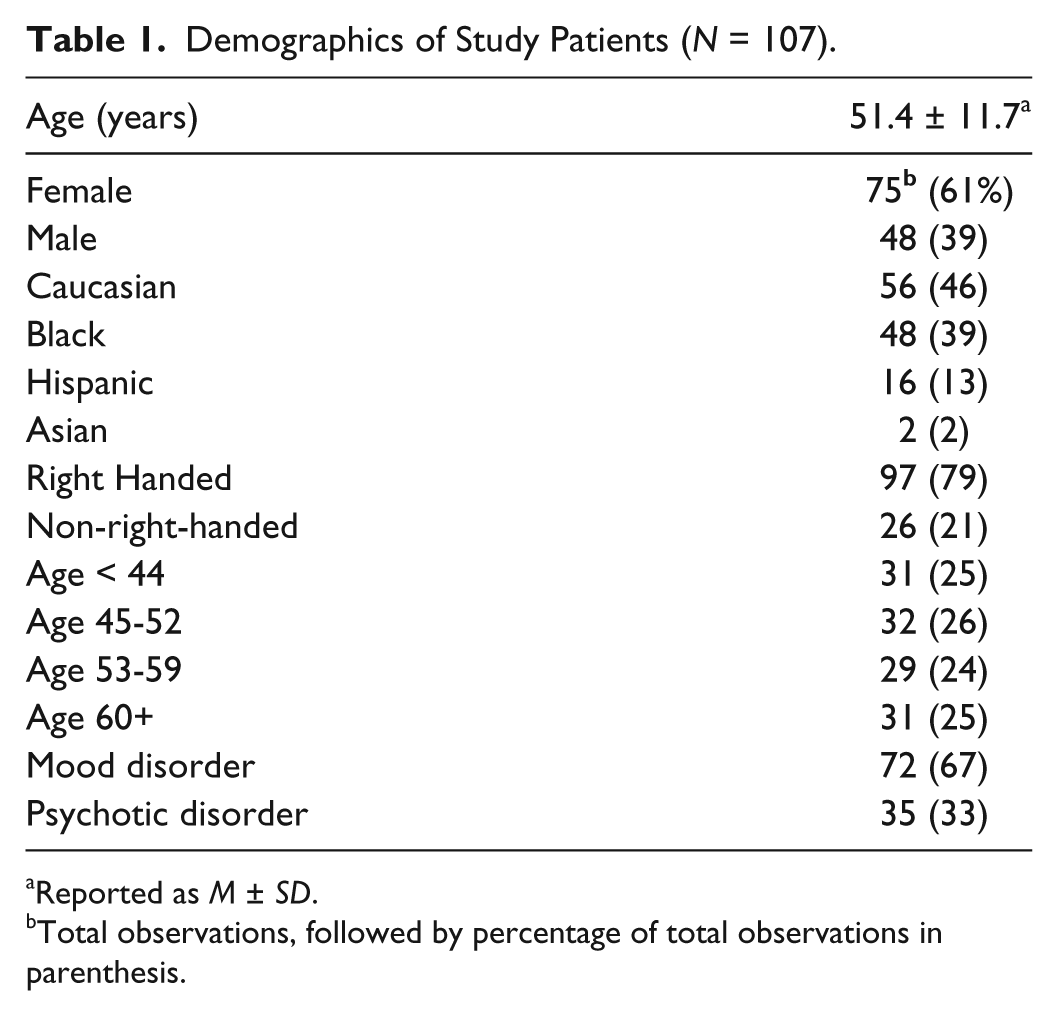
Reported as M ± SD.
Total observations, followed by percentage of total observations in parenthesis.
Patients were assessed in consecutive order of presentation to the clinic and were included in the analysis if they had a primary psychiatric diagnosis of a mood disorder (unipolar or bipolar depression) or a psychotic disorder (schizoaffective disorder or schizophrenia). They were excluded if they were deemed acutely unstable or otherwise unable to give informed consent (e.g., if delirious or mentally disabled), if they had a particular neurological condition known to be associated with altered brain laterality (none were identified), or presented with a mood disorder with psychotic features (none were identified). They were not included in the analysis if they had another psychiatric diagnosis more uncommon in this particular clinic (e.g., an anxiety disorder), as there were insufficient numbers for comparison. Psychiatric illness diagnoses were made by a treatment team consisting of a resident and attending psychiatrist according to Diagnostic and Statistical Manual of Mental Disorders (4th ed., text rev.; DSM-IV-TR; American Psychiatric Association, 2000) criteria, and were made as part of routine care prior to the assessment of hand dominance. Two patients responded that they had no hand preference (both were diagnosed with depression), and were excluded from the analysis given the low reported prevalence of ambidexterity.
Prevalence of left-handedness was calculated by dividing the number of respondents reporting it by the total number of valid responses to that question. We assessed potential risk factors for left-handedness in a logistic regression model adjusting for the demographic variables of age, gender, and race. Two-tailed statistical significance was defined as p ≤ 0.05. All statistical analyses were performed using STATA MP Version 12.0 (STATA Corp, College Station, Texas).
Results
As shown in Table 2, the proportion of left-handedness was found to be 11% in patients diagnosed with mood disorders (depression and bipolar disorder) and 40% in patients diagnosed with the psychotic illnesses (schizophrenia and schizoaffective disorder). After multivariate adjustment, the odds ratio for left-handedness in psychotic illness was 7.9 (p < .001) compared with mood disorder. Left-handedness proportions appeared to be the same for both unipolar and bipolar illnesses (data not shown), but sample size was too small for formal analysis. Likewise, left-handedness appeared to be similarly high for both schizoaffective disorder and schizophrenia, but formal comparison between these groups was not possible due to low sample size. Left-handedness was not different according to age or gender, but was found to be less common among Blacks compared with Caucasians after adjustment. Comparisons among Hispanics and Asians were not possible given the low sample size.
Non-Right-Handedness by Demographic and Diagnostic Groups.

Note. OR = odds ratio; CI = confidence interval.
Total observations, followed by percentage of total observations in parenthesis.
p < .05. **p < .001.
Discussion
Our results show a strikingly higher prevalence of left-handedness among patients presenting with psychotic disorders such as schizophrenia and schizoaffective disorder, compared with patients presenting with mood symptoms such as depression or bipolar disorder. Indeed, the prevalence of left-handedness among the mood disorders was close to 10% in our sample, which is similar to the general population average (Stellman, Wynder, DeRose, & Muscat, 1997). This is in line with prior work that found no or modest differences in handedness in these illnesses (Denny, 2009; Merckelbach, de Ruiter, & Olff, 1989; Nowakowska et al., 2008; Savitz, van der Merwe, Solms, & Ramesar, 2007).
In contrast, most prior work has found significantly increased left-handedness in those with schizophrenia, typically reporting a 15% to 20% prevalence (Dragovic & Hammond, 2005) that is approximately double that of case controls. The range of reported prevalence in those studies varied considerably from 7% to 31%, and our results (40%) are on the high end of this range.
The reason for wide discrepancies in the prevalence of left-handedness observed across various study populations is not clear. There is no doubt that the actual methods used to analyze handedness influence the results, and indeed, studies that attempted to measure left-handedness versus a more inclusive mixed-handedness often produce different results (Dragovic & Hammond, 2005). But while these two measures of handedness do yield somewhat different prevalence findings, they overall seem to agree with the same conclusion, namely, that non-right-handedness by any measure appears to be increased in psychiatric disorders. In this community based study, we chose to measure left-handedness, and did so using a very simple assessment method (asking which hand the participants wrote with) in order to maximize participation in the study. We were especially concerned that those with psychosis or who were otherwise more seriously impaired might refuse participation in a more extended assessment of handedness, which could greatly affect the outcome. By using a simple measure, virtually all patients consented, thus allowing a more accurate representation of this ill community. This community was especially notable for serving primarily low-income patients in an urban setting, many with medical comorbidities. Such a population might potentially be more difficult to recruit for research activities, and thus may represent a less-studied population group with regard to handedness. We acknowledge this as speculation, however, as we did not control specifically for these factors in this study.
It is known that race and gender can influence handedness results (Nowakowska et al., 2008), and indeed, our own data showed that Whites with psychotic illness were more likely to be left-handed than Black patients also suffering from psychosis. Even after controlling for this, however, a large difference between psychotic and mood disorder patients remained.
Schizophrenia and schizoaffective disorder are likely to be syndromes consisting of more than one cause, and one possibility for the observed variance in handedness among various studies is that they surveyed different sub-populations of the illness. Several clues point toward such possible differences. For example, a study showing that those suffering from schizophrenia who were left-handed were less likely to have a family history of psychosis (Cannon et al., 1995). The propensity to develop tardive dyskinesia was also noted to be higher in psychotic patients who were left-handed (McCreadie, Crorie, Barron, & Winslow, 1982), and left- or mixed-handed patients with psychotic disorders have been shown to have more severe impairment in prior scholastic achievement and social functioning, and have poorer functional outcomes (Browne et al., 2000; Hayden, Kern, Burdick, & Green, 1997). Again, these results may suggest handedness as a marker of particular illness subtype(s), although this remains to be seen.
Since language appears to be intimately tied to lateralization (Crow, 1997a), and those with psychosis in this study were far more likely to be left-handed, it would be of particular interest in future studies to examine whether language-associated psychosis phenomena, such as auditory hallucinations, are especially prevalent in psychotic patients who are left-handed. Such findings could be compared against comparative distributions of other sensory forms of psychosis (e.g., visual or tactile hallucinations). In conclusion, we observed a strikingly high prevalence of left-handedness among patients suffering from psychotic disorders compared with those presenting with mood disorders. These results come from an urban, community outpatient clinic and suggest that additional studies of handedness among such patient populations is warranted.
Footnotes
Acknowledgements
The authors wish to thank Matthew Byerly for his support and insightful suggestions that made this study possible.
Declaration of Conflicting Interests
The author(s) declared no potential conflicts of interest with respect to the research, authorship, and/or publication of this article.
Funding
The author(s) received no financial support for the research and/or authorship of this article.