




Abstract
This study examined service-learning (SL) beliefs and participation among faculty in different stages of involvement to develop tailored resources and support. A representative sample of 1,200 faculty members at a major public university in Southeast United States was recruited. The study used the transtheoretical model (TTM) as an innovative way to group SL involvement into five stages: unaware (U), pre-contemplation (PC), contemplation (C), preparation (Prep), and action and maintenance (A/M). Perceived benefits and barriers at different levels were assessed. The distribution among faculty who completed the online survey (n = 450, 60% males) across stages was 20% (U), 31% (PC), 16% (C), 10% (Prep), and 23% (A/M). Analyses showed significant differences on the 4 SL beliefs, F(3, 358) ranged from 7.05 to 78.31, all p< .001, across stages. This study provides the first valuable empirical data to support the application of TTM to the SL arena and identified salient variables influencing faculty involvement across stages.
Keywords
Introduction
Studies have shown reciprocal community–campus partnerships to be an effective and innovative pedagogical approach for engaging student learning, strengthening openness to diversity, as well as realizing civic responsibilities (Bringle, Hatcher, & Games, 1997; Butin, 2006). Adoption of service-learning (SL) pedagogy in U.S. higher education has grown in recent decades as colleges and universities explore ways to increase experiential learning opportunities for students to apply what they are learning to local and global issues. SL is a form of community and civic engagement. In SL courses, students engage in meaningful service activities and critical reflection on the service experience to enhance academic learning, deepen civic understanding, and provide some mutual benefit to the community through their work (Bringle & Hatcher, 1996). Students often report greater satisfaction with such courses and relationship with the instructor, increased personal development and growth, social responsibility, interpersonal and leadership skills, and application of learning (Eyler & Giles, 1999; Eyler, Giles, Stenson, & Gray, 2001). Such reciprocal academic–community interaction betters both the discipline and the communities.
Many recent arguments for the importance of engagement in higher education have been directed at campus leadership and have focused primarily on the benefits for institutions as a means of communicating the credibility and usefulness of universities as important institutions in civic life (Burkardt, Holland, Percy, & Zimpher, 2004; The Conference on Research Universities and Civic Engagement [TRUCEN], 2007; Kellogg Commission on the Future of State and Land-Grant Universities, 1999). Although this call for higher education to return to its civic mission is critical for supporting and advancing SL pedagogy, many questions remain about the role faculty play as catalysts for the ongoing cultural and pedagogical shift toward engagement. Bringle and Hatcher (1995) assert that the faculty role in institutionalizing SL should not be underestimated because faculty are primarily responsible for the direction and design of curriculum and are therefore gatekeepers for the adoption and promotion of innovative pedagogies such as SL.
There have been a few studies examining the level of SL awareness and involvement to assess the readiness among faculty members. One recent study examining faculty involvement in SL showed that about 52% of the faculty indicated that they had no previous involvement. Abes, Jackson, and Jones (2002) sent more than 500 surveys to faculty at 29 Ohio Campus Compact institutions and found that, of those who indicated no involvement, 27% stated that they had never heard of SL, 22% indicated awareness of SL but had not considered incorporating it into their teaching approach, and 51% stated that they had heard of SL and had thought about whether they would incorporate this pedagogy. However, Hammond (1994) surveyed 250 faculty members at various 4-year public and private institutions in Michigan who were previously identified as having incorporated service into their academic courses. This study found that less than 10% of the respondents mentioned having utilized the SL pedagogy only once, whereas the majority (63%) of these faculty indicated that they have utilized SL in their course four or more times. These studies suggest that increased awareness and involvement of SL are still needed, and data support that faculty who use this approach in one course tend to have a commitment to utilizing this approach in future courses they facilitate.
Some most salient motivating factors for faculty adopting SL identified from current literature include greater relevance to the course material, enhanced teaching and learning experiences, enhanced purpose and meaning found in interaction with and service to the community, and development of university–community partnerships (Abes et al., 2002; Bulot & Johnson, 2006; Hammond, 1994; Holland, 1999; Pribbenow, 2005). Existing studies also point to some common challenges and barriers toward utilizing SL. These include time constraints, co-ordination of the service components, challenges of community partnerships and in assessment of student work, as well as lack of institutional recognition of these efforts (Abes et al., 2002; Driscoll, 2000; Hammond, 1994; Heckert, 2010; Holland, 1999; Hou, 2009). The recent national survey among faculty members, the “Faculty Survey of Student Engagement” (FSSE; 2011), has also tried to examine faculty member’s expectations of student engagement and assessed aspects of educational practice including effective components of courses, teaching styles, and service experiences (National Survey of Student Engagement, 2012).
Although significant efforts have also been made examining general perceptions of benefits and barriers regarding SL among faculty members, a closer examination of these perceptions across faculty in different stages of SL involvement will add new understanding of community–higher education engagement to inform effective and tailored programs to encourage SL adoption. Further studies are needed to examine what faculty members who have very different stances toward SL think and how these perceptions differ across faculty involvement stages. These more in-depth analyses can provide higher education administrators and decision makers a better understanding of faculty involvement in SL for developing tailored faculty support programs and reward systems. To build on the existing SL literature, this study aims to (a) utilize a theoretical framework, the transtheoretical model (TTM, described below), to define and examine SL involvement status among faculty members at a major public research institution, and (b) examine how faculty across different stages of SL involvement perceive the benefits and barriers of this pedagogical approach. This study examined SL beliefs as well as participation levels among university faculty members in different stages of SL involvement. This study aims to provide evidence-based data from theory-based measurement scales to help explain, demonstrate, and identify salient beliefs and factors that hinder or facilitate faculty SL involvement at different stages to develop effective and tailored programs and opportunities for faculty at different SL involvement stages. These empirical data can also help inform institution leaders on how better to reform the institutional reward system, provide opportunities for professional development, and encourage more faculty members to become involved.
Applying the TTM to Faculty SL Adoption
To better assess where faculty are in their current stage of incorporating SL into instruction, the authors developed the key research question using a behavior change model called the TTM. The TTM of behavior change was developed by Prochaska and DiClemente in 1983. It was originally applied to smoking cessation behavior, but has since been widely adapted to a variety of behaviors, including screening, physical activities, healthy eating, HIV prevention, and so on (Hou & Chen, 2004; Hou,Fernandez, Baumler, & Parcel, 2002; Hou & Wisenbaker, 2005; Hutchison, Breckon, & Johnston, 2009; Riebe et al., 2005). The TTM argues that behavior change does not occur overnight; it is a process instead of an all or nothing event. This is a model of intentional change, which focuses on the decision-making process an individual makes.
One of its main constructs is the “stages of change,” which includes pre-contemplation, contemplation, preparation, action, and maintenance (Prochaska, Redding, & Evers, 2002). In pre-contemplation stage, the individual has no desire or intention to take action in the foreseeable future (e.g., within 6 months). In contemplation, the individual intends to change behavior within the near future, yet may still be ambivalent. At preparation stage, the individual is ready to change behavior and has begun taking steps to do so. One recognizes that the advantages (pros, benefits) outweigh the disadvantages (cons, barriers) and feels ready to take action and may already have a plan of action. Individuals at action stage have adopted specific action. Maintenance is the stage in which people become increasingly confident that they can continue their change and strive to prevent relapse. Some researchers have included additional stages to further categorize the change process. For example, to distinguish those who are in pre-contemplation from those who are not even aware of the issue, the “unaware” stage is sometimes included, especially when applying the model to a behavior that is not commonly known (Costanza et al., 2005). A “relapse” stage has also been used to distinguish a person who has tried out a behavior but returned to an earlier stage versus someone in an earlier stage such as pre-contemplation or contemplation who has yet to take action toward the change (Segan, Borland, & Greenwood, 2006).
The current study applied the “stages of change” construct from TTM to define faculty SL involvement (see measurement section below). This is the first time that TTM is being applied and examined in the SL arena to help better understand faculty SL involvement. Although one can argue that adoption of a new pedagogy might be different than other health-related behaviors, the nature of the complexity of any intentional behavior change is the same; behavior change is not an overnight event but an individual’s decision-making process. In addition, earlier studies examining some of the similar concepts as those in the TTM, including SL awareness, intention, and repeat involvement, help provide further evidence of the potential applicability of TTM in SL arena (Abes et al., 2002; Hammond, 1994). The research question in the current study is whether TTM might be applied to faculty SL adoption. This can be demonstrated by increased scores of perceived SL benefit and decreased scores of perceived SL barriers as faculty progress to more engagement with SL.
Method
Institutional Context and Study Participants
This research institution established its Office of Service-Learning (OSL) in 2005 to promote and support the development of quality academic SL experiences through a range of faculty development programs and funding opportunities. The OSL is jointly supported by its higher administration through the Offices of the Vice President for Instruction and the Vice President for Public Service and Outreach. The OSL maintains a campuswide SL listserv, hosts regular face-to-face meetings of a SL interest group (SLIG), and administers a SL fellows program for faculty in all stages of SL adoption and a senior scholar program for engaged SL faculty to take institution-wide initiatives to promote SL curriculum development, community engagement, and research. This research institution has language in its promotion and tenure guideline supporting faculty SL activities. In addition, Carnegie Foundation has recently (2010) recognized the study institution with the Community Engagement Classification for its institutional commitment to community engagement.
This study invited a representative sample of 1,200 faculty members from each college/school at one of the major public research universities in the Southeast United States to participate in the Faculty Service-Learning Benchmark online survey. Faculty members who have instructional responsibility or who had taught a course in the previous academic year were eligible to participate. An administrative memo was first sent out to deans, directors, and chairs informing them of the upcoming survey followed by an invitation email sent directly to individual faculty members. Participants had a 3½-week window to respond. The first email reminder was sent out a week after the invitation email, and the second email reminder was sent out a week before the survey was due. Participants clicked through a consent page before taking the online survey to indicate their consent. The survey took about 12 to 15 min to complete. All phases of the research were conducted with the approval of the Institutional Review Board for the Protection of Human Subjects at the principal investigator’s university.
Measurement
The research instrument was an online survey that was developed via reviewing existing assessment tools on SL (Community-Campus Partnerships for Health [CCPH], 2001; Shinnamon, Gelmon, & Holland, 1999), adapting and modifying items relevant to perceptions related to benefits or barriers toward SL pedagogy, and developing new items including corresponding items to assess perceptions among faculty with or without prior SL experience. In addition to literature review, the research team also gathered inputs and feedback from various stakeholder groups, and pilot tested the study instrument before it was finalized and converted into the online format. Detailed description and analyses of the instrument development and validation are documented elsewhere (Hou, 2010). The current study compared four SL-related beliefs across faculty in different stages of SL involvement: perceived benefits at classroom (PROS_CLS) and community levels (PROS_COM), and perceived barriers at classroom (CONS_CLS) and institutional levels (CONS_INST). The study also compared three participation variables across faculty SL stages: SL program participation (SL_Participate), willingness to participate (SL_WTP), and SL resource utilization likelihood (SL_RUL). This article describes the measurement of SL involvement stages, SL beliefs at different levels, and the three participation variables.
Stages of SL adoption/involvement
For the purpose of this survey, SL as adopted by the researchers’ institution is defined as “an experiential education method which integrates academic instruction, meaningful community service, and reflection to enhance the learning experience.” Faculty participants were asked the following question: “In describing your involvement in service-learning, which of the following statements is most accurate?” Seven response categories were developed based on the conceptualized stage of change construct along with lessons learned from existing literature. These included the original five stages plus the unaware and relapse stages:
I don’t know what SL is (Unaware).
I am not currently thinking of incorporating SL into the courses I teach (Pre-Contemplation).
I am interested in learning more about SL (Contemplation).
I am exploring how to integrate SL into my course (Preparation).
I am currently developing or teaching a course with a SL component for the first time (Action).
I have already taught a SL course and plan to continue (Maintenance).
I have already taught a SL course but do not plan to teach again (Relapse).
Perceived benefits and barriers
As emphasized in the TTM, perceived advantages (pros, benefits) and disadvantages (cons, barriers) are important influencers on whether an individual chooses to adopt a change. Based on lessons learned from existing literature, we grouped common motivating and barrier factors into four areas that could be relevant for assessment among faculty across different stages of SL involvement. Two perceived benefits were measured: perceived benefits at classroom (PROS_CLS, seven items) and community (PROS_COM, six items) levels. Similarly, two perceived barriers were assessed: perceived barriers at classroom (CONS_CLS, four items) and institutional (CONS_INST, three items) levels (Hou, 2010). The current study compared these four SL-related beliefs across faculty in different stages of SL adoption.
PROS_CLS (seven items). Items measuring faculty-perceived benefits at the classroom level included enriching classroom discussions, relationship building with students, clarifying areas for scholarship, having an important component of a professional portfolio, understanding own professional strengths and weaknesses, changes in teaching style, and enjoying teaching more.
PROS_COM (six items). Faculty-perceived benefits at the community level included items measuring service that is beneficial to the community, the value of working with community partners, learning new things about communities, the active role that the community plays in planning SL activities, enhanced communication skills, and making a difference in the community.
CONS_CLS (four items). Key barriers assessed included time constraints in co-ordination of the SL experience: the sense of giving up control of the learning experience, challenges in balancing classroom instruction, more requirements of instructor’s time, and challenges in student assessment.
CONS_INST (three items). Institutional barriers measured included the lack of recognition of SL during promotion and tenure, as well as the lack of support from colleagues and administrative leaders.
SL participation
The study also compared three participation variables across faculty SL stages: SL program participation (SL_Participate), willingness to participate (SL_WTP), and the likelihood of SL resource utilization (SL_RUL).
SL_Participate (three items). Faculty were asked to indicate whether they have ever participated in the following three activities: subscribed to the SL listserv, attended a meeting of the SLIG, and applied to be part of the SL fellows program. SL_Participate variables were coded as “1” if faculty ever participated in any of the above three existing SL programs or listserv and coded as “0” if otherwise.
SL_WTP (five items). Faculty were asked to rate their willingness to participate (WTP) in the following five activities in the future: subscribe to the listserv, attend a SLIG meeting, apply to the faculty fellows program, attend a SL seminar, and visit the OSL website.
SL_RUL (eight items). Faculty were asked what resources they would likely utilize if offered: presentations on SL, workshops, individual consultations, a library of resources, a frequently updated website inventory, a colloquium with local community agencies, online resources for course development, or video case studies, podcasts, and other multimedia presentations. Both WTP and resource utilization likelihood (RUL) were measured by a 5-point Likert-type scale, with “1” indicating not willing or very unlikely and “5” as most willing or very likely.
Data Analysis
Demographic background of the study sample was described. Means and standard deviations of perceived benefits and barriers, WTP, and RUL among faculty at different stage of SL involvement were compared using ANOVA test. Faculty who indicated they were not aware of what SL is were excluded from the perceived benefits and barriers analyses as these SL statements would not be relevant to them. They were, however, included in the analyses of the three participation variables. Since participants in action, maintenance, and relapse stages all have already had some experience teaching a SL course, the current analyses grouped them together as one A-M-R group.
Results
Demographics and SL Stages
A total of 450 faculty participated in the study, a response rate of 37.4%. About 11.8% were aged more than 60 years, more than a third of the participants (36.7%) were in their 50s, about a quarter (26.1%) were in their 40s, and another quarter (25.4%) of the participants were in their 30s or younger. About 60% were males and 80% were tenured or tenure-track faculty. The proportions of faculty from each college/school participating in the survey are representative of the overall institutional sample. These distributions were representative of faculty with instructional responsibilities at the study institution (see Table 1). Data showed that 19.4% (n = 87) of the participants were unaware of what SL is (Unaware), 31.6% (n = 142) were not currently thinking of incorporating SL into teaching (Pre-Contemplation), 15.8% (n = 71) were interested in learning more (Contemplation), about 10.5% (n = 47) were already exploring how to incorporate SL (Preparation), and 22.7% (n = 102) were either currently teaching or have taught a SL course (Action/Maintenance/Relapse).
Demographic and Background Information Among Study Participants.
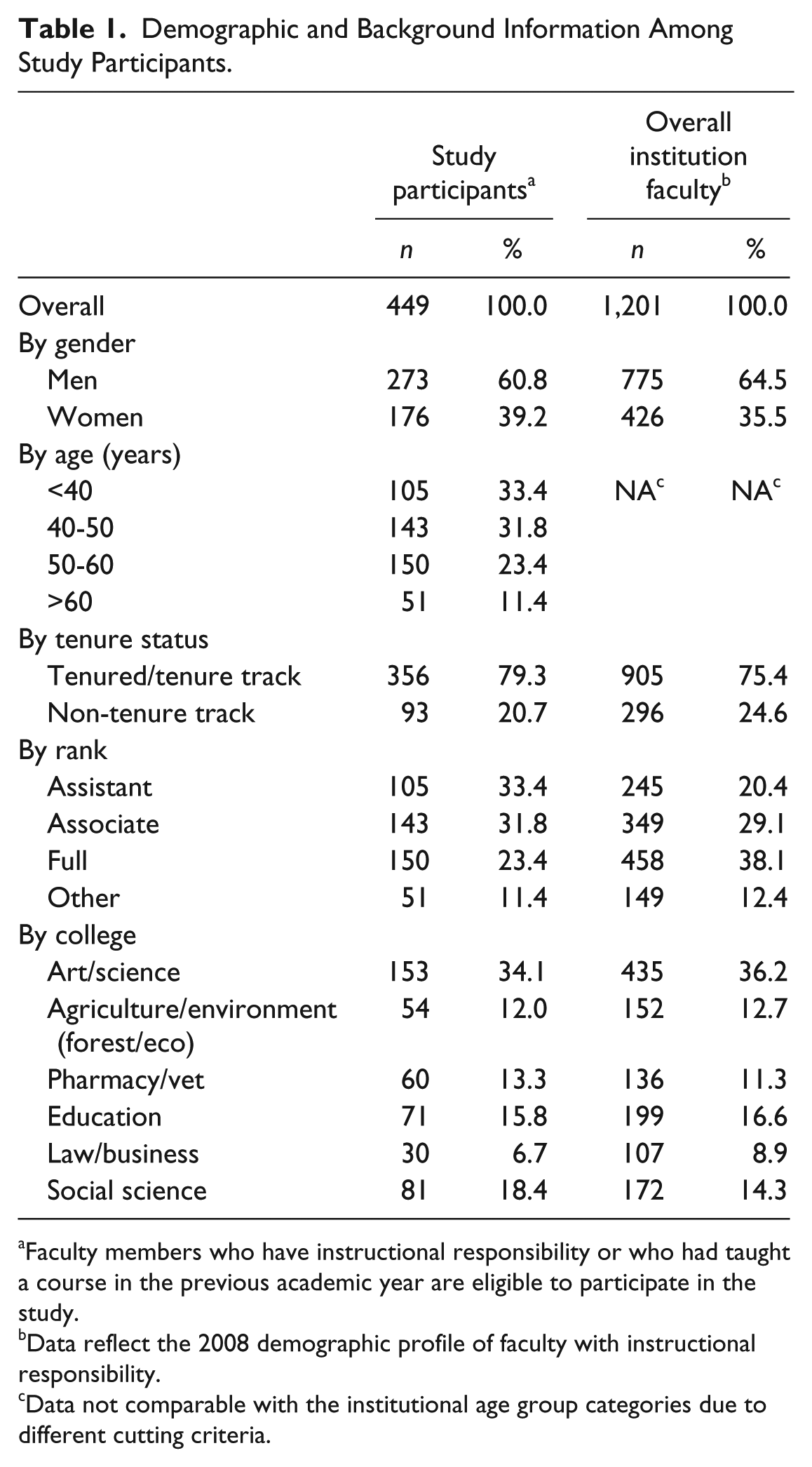
Faculty members who have instructional responsibility or who had taught a course in the previous academic year are eligible to participate in the study.
Data reflect the 2008 demographic profile of faculty with instructional responsibility.
Data not comparable with the institutional age group categories due to different cutting criteria.
Faculty-Perceived Benefits and Barriers Across Stages
Analyses showed significant differences for the four SL-related beliefs across faculty SL stages, F(3, 358) ranged among 7.05 to 78.31, all p< .001. Data showed nearly linear trends of increasing perceived benefits of SL from pre-contemplation (PC) to contemplation (C) to preparation (Prep) stages. The strengths of these positive perceived benefits were similar between faculty in action/maintenance/relapse (A-M-R) stages and Prep stages. Results also showed nearly a perfect linear trend of decreasing CONS_CLS from A-M-R stage to PC stage. The CONS_INST, however, remained high regardless of stages, except that faculty in preparation stage perceived the lowest CONS_INST level. Table 2 describes perceived benefits and barriers among faculty at different stages of SL involvement. Figure 1 provides visual graphs of the relationships on faculty perception across SL stages.
Perceived Benefits and Barriers Among Faculty at Different Stage of SL Involvement.

Note. Faculty who do know what service-learning is (Unaware, n = 87) were not asked about these perceptions toward service-learning.
SL = service-learning; TTM = transtheoretical model; A-M-R = action/maintenance/relapse.
p< .001.
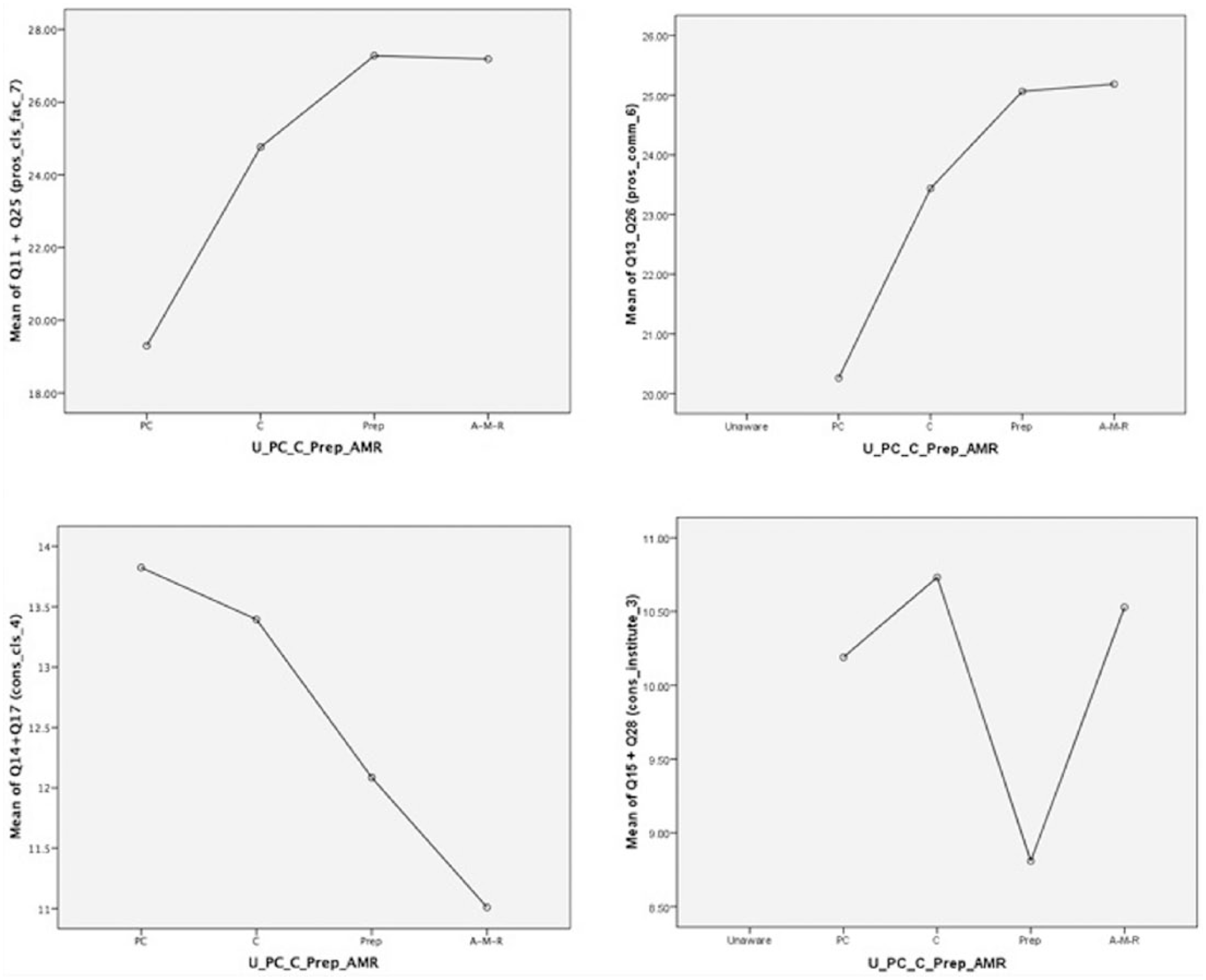
Faculty-perceived benefits and barriers across stage of adoption.
WTP and RUL Across Stages
Analyses showed significant differences on the three SL participation variables across faculty stages, F(4, 444) ranged from 37.59 to 75.61, all p< .001. Data also showed positive dose–response relationships of the three SL participation variables with each advancement of a SL stage. Table 3 details data on WTP and RUL among faculty at different stages of SL involvement. Figure 2 provides visual graphs on the relationships of WTP and RUL across SL stages.
WTP and RUL Among Faculty at Different Stage of SL Involvement.

Note. SL_Participate were coded as 1 = ever and 0 = never. WTP and RUL were scale items rated with 5-point Likert-type scale.
WTP = willingness to participate; RUL = resource utilization likelihood; SL = service-learning; TTM = transtheoretical model; A-M-R = action/maintenance/relapse.
p< .001.
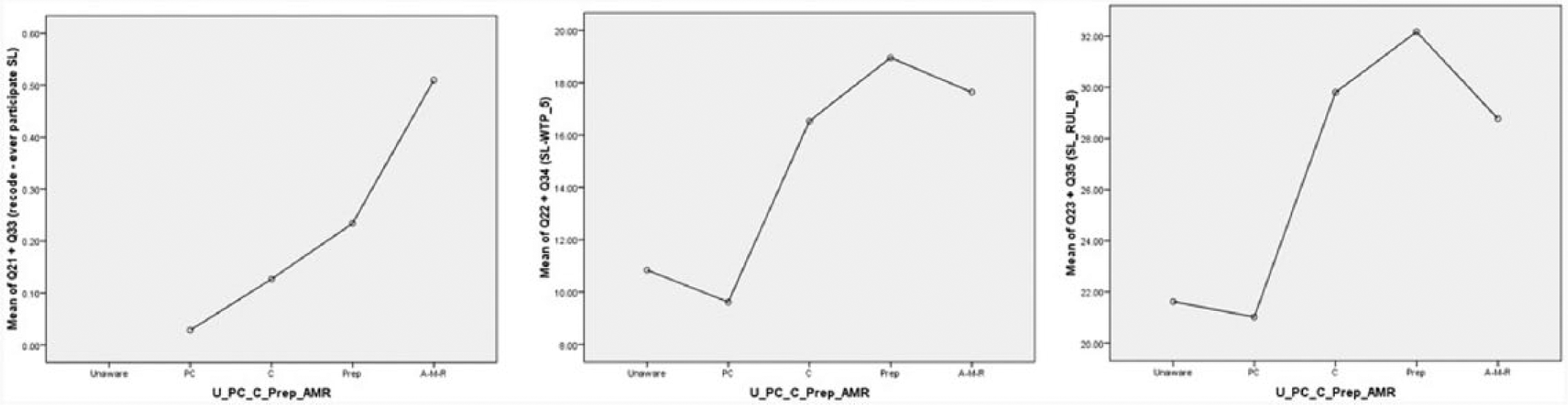
Participation, WTP, and RUL of service-learning activities across faculty in different stage of SL adoption.
Discussion
Data showed that perceived benefits were higher among faculty in the later stages of SL adoption compared with those in the earlier stages and represented nearly a linear relationship. The perceived benefits of SL were, however, similar among faculty of A-M-R stage and preparation stage. This indicated that perceived benefits might reach their maximum effect if individuals advanced to preparation stage. However, the perceived cons of SL showed linear negative relationship across different stages. Data indicated that as faculty advanced to the A-M-R stages, their perceived barriers continually decreased, although their perceived benefits of SL plateau were at preparation stage. The perceived barriers at the institutional level, however, showed no clear trend. Data indicated that institutional barriers were perceived to be high among faculty in pre-contemplation, contemplation, as well as A-M-R stages. Institutional barriers were, however, perceived lower among faculty in preparation stage. In addition, it is interesting to note that the WTP in SL activities (SL_WTP) and utilizing SL-related resources (SL_RUL) increased with advancement of SL involvement and reached peak among faculty at preparation stage and then decreased a little bit in A-M-R stage. This may not be surprising as one could argue that the A-M-R group who was already incorporating the SL approach might not view SL-related resources or programs as necessary for them. The current findings provide empirical data demonstrating the utility of applying TTM to faculty SL adoption. Data showed that faculty in the advanced stages of SL involvement had higher perceived benefit and lower perceived barriers, and faculty in the earlier SL stages had lower perceived benefit and higher perceived barriers.
To better develop resources and support to encourage faculty participation in SL pedagogy, it is essential to understand benefits and barriers faculty members perceive across different SL involvement statuses to identify the key beliefs that could be used to encourage, motivate, and sustain faculty involvement in SL. The empirical data obtained from the current study help identify salient beliefs and factors that hinder or facilitate faculty SL involvement at different stages. The specific items developed under each measurement scale (PROS_CLS, PROS_COM, CONS_CLS, CONS_INST, SL_Participate, SL_WTP, and SL_RUL) serve as the key indicators for guiding faculty support programs and intervention development. SL advocates and scholars can take a closer look at what salient factors or specific beliefs play a key role among faculty in a specific stage of SL involvement and then make recommendations to institutional leaders whether to adapt support or reward systems to reinforce positive beliefs or address specific concerns or barriers that would deepen faculty SL involvement or adoption. Furthermore, the TTM provides 10 processes of change strategies to help an individual move along the stage of adoption process. The TTM also provides guidance on what processes of change are more effective among individuals in particular stages of the change process (Prochaska et al., 2002). The study has implication for developing tailored resources for faculty support and for reforming institutional reward system to encourage faculty in various stages of SL involvement.
This study is among the first large-scale campuswide online surveys conducted at a public research institution and the first using TTM to define faculty SL involvement status and analyze faculty SL perceptions across stages of change. The evidence of quantitative data showing the relationships of the perceived benefits and barriers across faculty in different SL stages is indeed valuable to demonstrate the applicability of TTM to the SL arena. Results interpretation is limited to faculty at research institutions of similar environment or context. Future research could apply these measurements to colleges and universities of different types and levels. Replication of the study and comparison of results across institutions of same or different types (i.e., community colleges, teaching-intensive) is encouraged as such replication studies could provide additional insights and understanding of faculty SL involvement. Data from the current study were measured and validated via an online survey, which holds promise for easy adoption and expansion for SL-related research in the future. The current study is the first to develop and validate a theory-based research instrument of this kind on SL adoption and related beliefs and perceptions. Results provide empirical data for researchers and administrative leaders better to assess and understand current faculty statuses, motivations, and barriers, and to facilitate developing tailored resources and infrastructure to support faculty SL adoption.
In summary, current findings were consistent with the TTM regarding the relationship of perceived benefits and barriers with stages of SL adoption. This study showed increased perceived benefits and decreased perceived barriers as faculty move forward in their SL involvement. In addition, SL participation, WTP, and RUL showed positive relationships across SL stages. This study utilizes an innovative approach to assess faculty SL involvement. It also provides the first valuable empirical data to support the application of the TTM to the SL arena, and pave an important foundation for future intervention and evaluation studies focusing on faculty SL support programs. Future faculty development programs could utilize the study measurement tools to identify SL benefits and barriers relevant to faculty at different stage of SL involvement, and develop tailored program or interventions for faculty members interested in deepening their involvement and utilization of SL in their instruction.
Footnotes
Acknowledgements
The principal investigator is grateful to all faculty participants for their time and support of this institutional-wide benchmark study. Special thanks to Dr. Denise Gardner for participant sampling, research assistants Erin Adams for literature and assessment tool review, and Joel Scott for technology support. In addition, sincere thanks go to the offices of the Vice President for Instruction and the Vice President for Public Service and Outreach for the endorsement and support on this project.
Authors’ Note
This research was conducted with the approval of the Institution Review Board for the Protection of Human Subjects at The University of Georgia.
Declaration of Conflicting Interests
The author(s) declared no potential conflicts of interest with respect to the research, authorship, and/or publication of this article.
Funding
The author(s) disclosed receipt of the following financial support for the research and/or authorship of this article: This study was supported by the Office of Service-Learning (OSL) at University of Georgia (UGA).