




Abstract
This study was conducted to examine the psychometric properties of the classic Arabic version of the 10-item Perceived Stress Scale (PSS10) in a large sample of Moroccan population. A cross-sectional survey was yielded between December 2013 and January 2014 following an accidental sampling. Individuals aged above 18, from different socioeconomic categories, were invited to take part in the study. The participants had completed a questionnaire including the classic Arabic versions of PSS10. Two data collection methods involving the paper questionnaire (PQ) and an electronic questionnaire (EQ) were solicited. The psychometric properties of PSS10 were examined by internal consistency, test–retest reliability, convergent validity, and factorial structure. A total of 1,099 individuals have participated in the study. Internal consistencies of the classic Arabic PSS10 for both of PQ and EQ were respectively α = 0.72 and α = 0.85; the test–retest reliability score was 0.91. In both of PQ and EQ, PSS10 scores were higher among females (p < .01), and were positively and significantly correlated with the DASS21 subscales. The principal component analysis provided a two-factor structure. The percentages of variance explained by the two factors were 55.58 for EQ and 54.61 for PQ. The classic Arabic version of the PSS10 showed satisfactory psychometric properties in both data collection methods.
Introduction
Improving the quality of life is one of the fundamental concerns of health professionals, which aims to ensure the personal well-being and the professional and social development of the individual. However, this property can be negatively influenced by a number of factors such as psychological stress.
Stress is defined as a special relationship between the individual and the environment that is appraised by the individual as taxing or exceeding his or her resources and threatening his or her well-being (Lazarus & Folkman, 1984). When the coping resources of people are considered insufficient to meet the high demands or threats, the risk of disease is assumed to increase (Cohen, 1988). Therefore, the measurement of stress is a major concern to monitor the state of mental health.
The literature contains dozens of scales measuring psychological stress, developed and validated in different populations. The “Perceived Stress Scale (PSS)” is a valid tool for measuring psychological stress and has adequate psychometric properties (Cohen, Kamarck, & Mermelstein, 1983). Originally developed in a Likert-type scale composed of 14 items based on the transactional model of Lazarus and Folkman (1984), PSS tends to measure the perception and evaluation of the individual with regard to stressful life events. In 1988, the forteen items Perceived Stress Scale (PSS14) was factor analyzed; using principal components method with Varimax rotation, and a smaller version was then extracted. The 10-item Perceived Stress Scale (PSS10) has been derived by deleting the 4 items with relatively low factor loadings (Cohen, 1988). PSS10 showed good reliability (α = 0.78) and construct validity as the longer scale PSS14 (α = 0.75) in addition to its reduced administration time, and hence the authors recommend its use (Cohen, 1988). Moreover, the frequent use of this scale has shown to be highly correlated with various measures of psychological (Andreou et al., 2011; Candrian et al., 2008; Morgado, Freitas, Bessa, Sousa, & Cerqueira, 2013) and physiological symptoms (Gollenberg et al., 2010; Malarkey, Pearl, Demers, Kiecolt-Glaser, & Glaser, 1995).
Through several studies, PSS10 has been shown to have adequate psychometric properties in terms of reliability and validity in different populations, which have made PSS10 a tool that is internationally recognized and valid, and therefore, it has been translated into many languages—in Greek (α = 0.82; Andreou et al., 2011), Spanish (α = 0.82; Remor, 2006), Portuguese (α = 0.83; Reis, Hino, & Añez, 2010), and Chinese (α = 0.83; Leung, Lam, & Chan, 2010).
However, two studies have examined the psychometric properties of the Arabic PSS in specific small samples (students, pregnant and postpartum women in Qatar [Chaaya, Osman, Naassan, & Mahfoud, 2010], teachers, and technical staff from three high schools in Jordan [Almadi, Cathers, Hamdan Mansour, & Chow, 2012]).
The aim of our study was to examine the psychometric properties of the classic Arabic Scale of PSS10 in a large sample of the Moroccan population.
Method
Sample and Procedure
After obtaining ethical permission from the Ethics Committee for Biomedical Research of the Medical Faculty of Casablanca, we conducted a cross-sectional survey between December 2013 and January 2014 in Casablanca following an accidental sampling. The participants invited to take part in the study were as follows:
students belonging to several institutions of higher education (Faculty of Medicine and Pharmacy, School of Engineering, Faculty of Science, Institute of Training for Health Executives);
employees and civil servants of private and public administrations as well as health professionals considered regulated professions;
employees engaged in commerce, craft industry, and agricultural activities, a category considered non-regulated occupations; and
non-active persons (such as housewives, unemployed, and retired people).
The study included participants aged above 18 whose mother tongue is Arabic and who are Moroccan locals.
Furthermore, it is important to note that there are two varieties of Arabic languages in Morocco; Moroccan dialect, that is used in everyday communication, and Classic Arabic, which Moroccans are taught in schools. Classic Arabic is not spoken to carry out the everyday social interactions and transactions, but its use is limited to administrative offices and schools. For this reason, illiterate people have been excluded from the study because although Classic Arabic is the official language in Morocco, it is not well understood except by literate people.
Measures
A questionnaire in Arabic consists of two versions: the first in paper format (PQ) distributed to participants after obtaining their consent and the second version, in electronic format (EQ), was introduced on the web through social networks, and participants volunteered to fill it in. The electronic format was used to expand our study sample because it allows easy data collection. The respondents were informed of the purpose of the study as well as the anonymity of the questionnaire that contained 40 questions, including the Arabic version of PSS10 (Chaaya et al., 2010). PSS is a scale that invites the participant to indicate the frequency of occurrence of each item during the previous month. The answers vary according to a Likert-type scale of 5 points ranging from 0 = never to 4 = very often. The scale PSS10 consists of two factors: the first includes 6 negative items measuring the individual perceived stress, while the second consists of 4 positive items measuring the coping (Cohen, 1988). Total scores, ranging from 0 to 40, were obtained by summing across all 10 items after reversing the scores on the 4 positive items. A high score indicates a high level of stress.
To assess the convergent validity of the Arabic version of PSS10, the Arabic version of the 21-item “Depression, Anxiety, Stress Scales” DASS21 (Taouk, Lovibond, & Laube, 2013) was used. DASS21 has undergone a process of translation and preliminary validation in Arabic, by Taouk and colleagues (2013). DASS21 has many advantages over DASS42; it is short, it has good construct validity and reliability; therefore, it is more appreciated by the respondents (Antony, Bieling, Cox, Enns, & Swinson, 1998; Henry & Crawford, 2005). DASS21 can identify symptoms of depression, anxiety, and stress in a person during the last 7 days. Each DASS21 subscale consists of seven items. The participant answers according to a Likert-type scale, ranging from 0 (“does not apply to me at all”) to 3 (“applies to me very much or most of the time”). The maximum score in each DASS21 subscale is 21. Total scores were obtained by summing across all subscale items. Other variables were collected: gender, age, marital status, profession, tobacco use, and alcohol consumption.
Analyses
To assess its reproducibility, we invited a small sample of the PQ respondents who are easy to re-contact, to fill in the Arabic PSS10 Scale again within an interval of 1 week. Forty-five participants agreed to fill in nominative questionnaires twice.
Among the respondents to EQ, those who were not Moroccan or non-residents in the Moroccan territory were excluded from the analysis.
Internal consistency was measured by Cronbach’s alpha, and the intra-class correlation coefficient (ICC) was used to examine the test–retest reliability of the Arabic PSS10 in paper format (PSS10-PQ).
Examining the construct validity of the Arabic version of PSS10 was based on principal component analysis with Varimax rotation. Factors with eigenvalues higher than 1.0 were retained. The criterion of Kaiser–Meyer–Olkin (KMO) and Bartlett’s Test of Sphericity were calculated to assess the degree of inter-correlations of items of the Arabic PSS10 Scale. Convergent validity was expressed as Spearman correlation coefficients between the PSS10 and DASS21 subscales. The analyses were performed using SPSS (Version 16.0).
Results
Descriptive
Among the people invited to complete the paper questionnaire, 4.8% did not meet the inclusion criteria (illiterate person), and of the 348 individuals who responded to EQ posted on the web, 300 (86.2%) met the inclusion criteria (those who were Moroccans and residents in the Moroccan territory). Ultimately, a total of 1,099 individuals participated in the study (799 individuals responded to PQ, 300 responded to EQ). The response rate across PSS10 for PQ was 93.4%. All demographic characteristics of the samples studied are summarized in Table 1.
Demographic Characteristics of PSS10-PQ and PSS10-EQ Samples.

Note. PSS10-PQ = 10-item Perceived Stress Scale, Paper Questionnaire; PSS10-EQ = 10-item Perceived Stress Scale, Electronic Questionnaire; RP = regulated profession; nRP = non-regulated profession; UP = unspecified profession.
The internal reliability of the PSS10 for both questionnaires was good with Cronbach’s alpha coefficients of 0.72 and 0.85 for PSS10-PQ and PSS10-EQ, respectively. The test–retest reliability measured using the PQ in PSS10-PQ was satisfactory with an ICC = 0.91, 95% confidence interval [CI] = [0.82, 0.94]. Cronbach’s alpha for DASS21 subscales in the hall sample were 0.86 for Depression, and 0.85 for each Stress and Anxiety subscales.
Regarding the scores of PSS10 measuring stress in the sample, an average of 19.3 (SD = 6.3) was reported in the respondents to the PQ with slightly higher scores in females (20.33, SD = 6.1), the widowed and the divorced (20.5, SD = 3.6), students (20.8, SD = 6.3), and alcohol consumers (21.31, SD = 5.5). Similarly, an average score of 19.8 (SD = 6.7) was reported among respondents in EQ with high scores recorded in women (21.23, [SD = 6.7] vs. 18.1 [SD = 6.3] for men). PSS10 scores of the different categories of the study sample are shown in Table 2.
Mean Scores and Standard Deviations of PSS10-PQ and PSS10-EQ by Participants Characteristics.

Note. PSS10-PQ = 10-item Perceived Stress Scale, Paper Questionnaire; PSS10-EQ = 10-item Perceived Stress Scale, Electronic Questionnaire.
Correlations and Principal Component Analyses
However, we found (Table 3) that the PSS10 Scale was strongly correlated with the DASS21 subscales (p < .01).
Correlation Between PSS10-PQ, PSS10-EQ, and DASS21 Subscales.
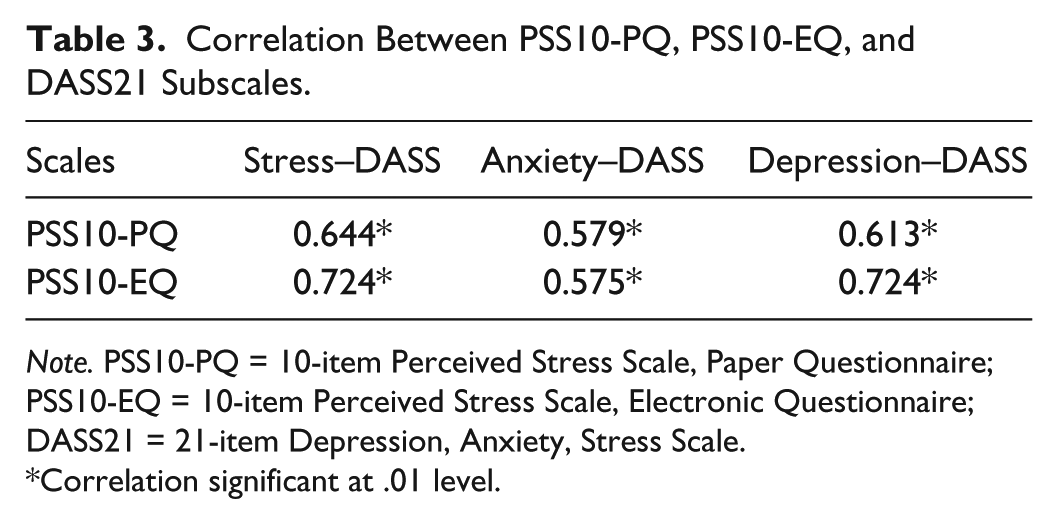
Note. PSS10-PQ = 10-item Perceived Stress Scale, Paper Questionnaire; PSS10-EQ = 10-item Perceived Stress Scale, Electronic Questionnaire; DASS21 = 21-item Depression, Anxiety, Stress Scale.
Correlation significant at .01 level.
In terms of the principal component analysis, the KMO value and the Bartlett’s Test of Sphericity were significant, for both types of questionnaires, so suggesting that the results are acceptable, and the items can be considered appropriate for factor analyses. As shown in Table 4, the principal component analysis, after Varimax rotation, allowed the extraction of two factors that explained 54.61% of the variance for the PQ and 55.58% for the EQ. In both models, Factor 1 showed the variability of items related to negative stress (1,2,3,6,9,10), while Factor 2 was related to coping items (4,5,7,8).
Items and Factor Loading for PSS10-PQ and PSS10-EQ With Varimax Rotation.
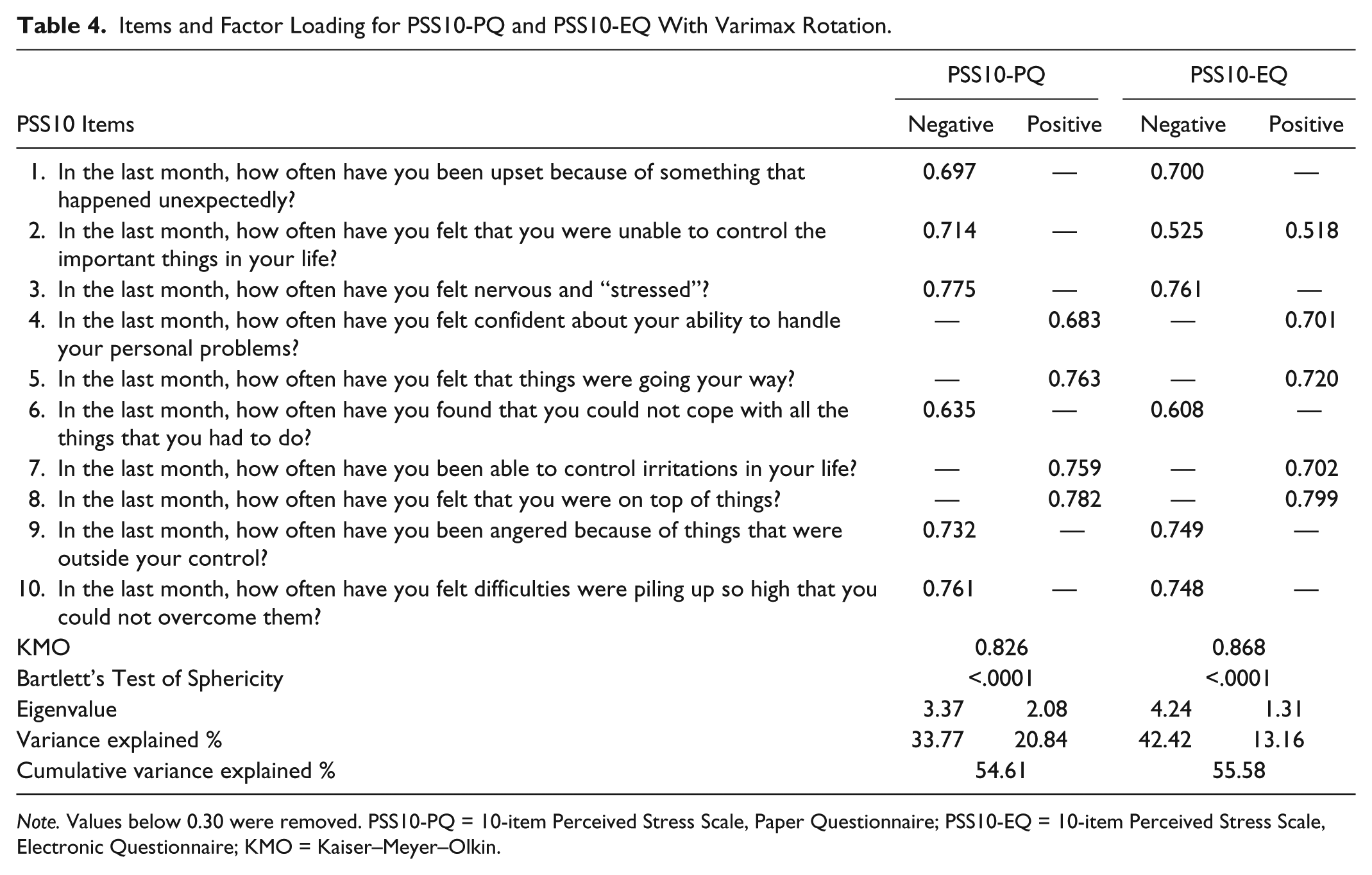
Note. Values below 0.30 were removed. PSS10-PQ = 10-item Perceived Stress Scale, Paper Questionnaire; PSS10-EQ = 10-item Perceived Stress Scale, Electronic Questionnaire; KMO = Kaiser–Meyer–Olkin.
Discussion
The results show that the Arabic version of the PSS10 Scale has adequate psychometric properties. Moreover, the results are stable regardless of the collection method used (paper, electronic). In terms of limitations of our study, it should be noted that the sampling method used was accidental to facilitate access to individuals. This can lead to a selection bias limiting the generalization of the results about stress on the whole population. However, as the questionnaire was in Classic Arabic, the illiterate category was excluded from the study and hence the importance of the PSS version of the Moroccan dialect that is understood by all the population.
The internal reliability of PSS10 of both versions PQ and EQ obtained was good. This result is similar to those obtained for the same scale (α = 0.74; Chaaya et al., 2010) and the original English version of PSS10 (α = 0.78; Cohen, 1988), suggesting that the items of the Arabic version of PSS10 consistently measure the main concept, that is, the perceived stress. The test–retest reliability of PSS10-PQ has a satisfactory value of ICC = 0.91 better than those obtained in a sample of university professors in Brazil after a week of re-administration (ICC = 0.86; Reis et al., 2010), and a sample of students in Thailand after 4 weeks (ICC = 0.83; Wongpakaran & Wongpakaran, 2010).
The results of the factor structure are similar to that found in the original version of PSS10 (Cohen, 1988). The items are grouped into two factors listing the positive and negative items separately. This two-factor structure has been widely observed in translation studies of PSS10, especially as the variance shown in the two factors ranged from 47.3% to 57.8% (Al-Dubai, Alshagga, Rampal, & Sulaiman, 2012; Chaaya et al., 2010; Reis et al., 2010). According to Hewitt, Flett, and Mosher (1992), the first factor is called “perceived stress” as it includes items that relate to negative emotional reactions, while the second factor, noted “coping,” includes items reflecting the perception of the ability to cope with stressful events.
In accordance with the literature (Andreou et al., 2011), PSS10 scores are positively and significantly correlated with scores of the subscales “Stress” and “Depression” of DASS21, respectively.
PSS10 scores obtained from the PQ and the EQ were similar. Significant associations were found between the scores of stress and gender, social status, level of education, and occupation. High stress scores reported in women are similar to the results of the literature (Lesage, Berjot, & Deschamps, 2012; Remor, 2006). Always in agreement with what has been reported (Andreou et al., 2011; Yang, Rockett, Lv, & Cottrell, 2012), participants belonging to the social category “single” and “divorced/widowed” reported higher stress scores compared with the category “married,” and according to participants’ educational level, those belonging to the category “university” showed lower stress scores compared with participants in other categories. However, comparing the scores of stress with respect to the participants’ profession, we note that the “Active” category is the one with lower stress scores followed by the “student” category. Moreover, the literature indicated that tobacco is associated with stress (Warner, Patten, Ames, Offord, & Schroeder, 2004). However, no association was observed between stress and smoking in our study; this may be related to the small number of smokers included.
The psychometric properties of the Arabic PSS10 Scale were more satisfactory in the electronic version of the questionnaire. This may be due to the composition of the sample that consisted mainly of university participants (83.3%); they were able to respond consistently to all scale items of PSS10 in the EQ. However, it is noted that with the latter, only a specific category of respondents (users of Internet, social networks . . . ) can be targeted, and therefore, EQ remains a limited tool that does not allow access to all social categories of the population.
Conclusion
The examination of the Arabic PSS10 Scale showed that this tool has adequate psychometric properties in a heterogeneous sample of the surveyed population, giving it the necessary pre-requisite for its use in the Moroccan literate population.
Footnotes
Authors’ Contribution
| Name of the author | Contribution |
|---|---|
| Dalal Ben Loubir | Study concepts, Study design, Data collection, Data analysis, Manuscript writing, Drafting the article |
| Zeineb Serhier | Study concepts, Study design, Data collection, Data analysis, Manuscript writing, Drafting the article |
| Omar Battas | Revising the article, Approval of final version of Manuscript |
| Mohamed Agoub | Revising the article, Approval of final version of Manuscript |
| Mohammed Bennani Othmani | Study concepts, Study design, Revising the article, Approval of final version of Manuscript |

Declaration of Conflicting Interests
The author(s) declared no potential conflicts of interest with respect to the research, authorship, and/or publication of this article.
Funding
The author(s) received no financial support for the research, authorship, and/or publication of this article.