




Abstract
Analysis of definite articles in Leopold’s essay The Land Ethic found evidence of deliberate usage of a rhetorical device for emphasis. The device, a type of definite article, is commonly used and usually abused. Leopold’s uses evidently affected his essay’s contribution to environmental communications.
Keywords
Introduction
For centuries, the value of rhetoric has been vociferously debated (Vickers, 1989). In Gorgias, Plato (ca. 380 b.c.e./1871) showed Socrates brilliantly using rhetoric to debate Sophistic rhetoricians (Wardy, 1996). In his definition, Socrates shows his distrust of their persuasive discourse as follows: . . . rhetoric is of two sorts: one, which is mere flattery and disgraceful declamation; the other, which is noble and aims at the training and improvement of the souls of the citizens, and strives to say what is best, whether welcome or unwelcome, to the audience . . .
Then he asks, “but have you ever known such a rhetoric . . . ?” (Plato, ca. 380
Examples of both kinds of rhetoric abound in works of environmental sciences, literature, and criticism. One prominent example is the emergence of the term sustainability (Anholt, 2003; Cronon, 2013) as a replacement for terms evoking imminent crises, such as Earth in the Balance (Gore, 1992). An Ngram (Figure 1) for sustainability shows a steep climb since the 1970s, perhaps due in part to its Socratic “noble aim,” but also possibly its power to flatter audiences that policies, practices, or products are sustainable (e.g., BP, 2013). Another example is growing rebranding of global warming as climate change (Figure 2) following audience responses to weather patterns (Conway, 2008). In these and other examples, persuasive discourse leads to changes in scholarly research, public policy, and cultural practices.
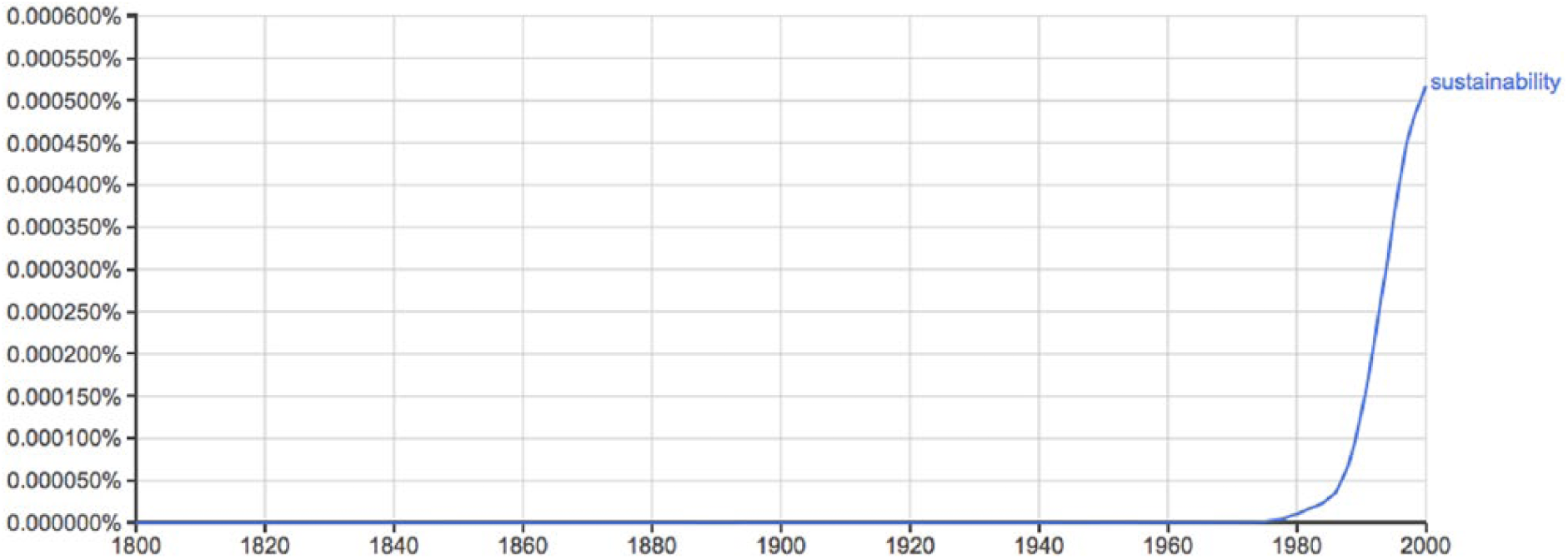
Sustainability Ngram.

Global warming versus climate change Ngram.
To ask a rhetorical question, how does persuasive discourse work? In seemingly small ways, ideas form, enter discourse, and reproduce in a vehicle that Dawkins (1989) defined as a meme, “a unit of cultural transmission” (p. 192). Long before, Hugo (1877) described the effects of persuasive discourse as, “One resists the invasion of armies; one does not resist the invasion of ideas” (Chapter X). In such cases, ideas attached to discourse can conquer and occupy the world.
This essay examines one specific rhetorical device that helped to spread an environmental idea throughout the world. Aldo Leopold’s (1949/2013) essay The Land Ethic (TLE) is regarded as a seminal document in histories of environmental movements (Meine, 1988, 2004). The Ngram (Figure 3) for the phrase, the land ethic, shows a steep upward curve starting in the 1970s, long after its initial publication, as this idea spread along with the expansion of environmental studies (Worster, 1994). Previous analyses of Leopold’s rhetoric (e.g., Willard, 2007) have looked at Leopold’s writings as through a telescope, showing the depth of his invention and disposition. This analysis looks as through a microscope at one technique of his elocution, evidently aimed at both flattering and ennobling his audiences.
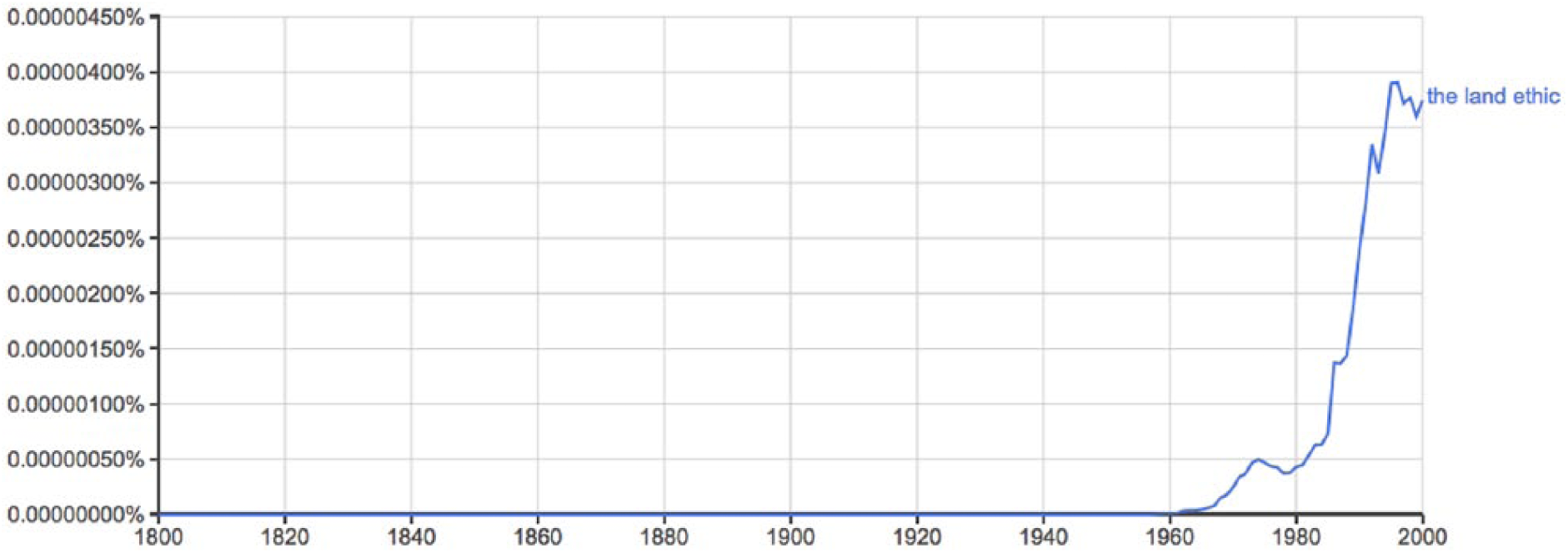
The land ethic Ngram.
“That Imperial First Word”
TLE is about 6,650 words long, including its title and section headings. This essay is focused on Leopold’s usage of one of those words, the, a definite article that he uses 477 times in TLE. The Oxford English Dictionary (OED) lists 23 various definitions of the, one of which is, “ . . . Referring to a term used generically or universally” (Item II, Example 19). This study concentrates on Leopold’s usage of that specific meaning, making a simple distinction among three types of usage, as per The Chicago Manual of Style (16th ed.): A definite article points to a definite object that (1) is so well understood that it does not need description (e.g., “the package is here” is a shortened form of “the package that you expected is here”); (2) is a thing that is about to be described (e.g., “the sights of Chicago”); or (3) is important (e.g., “the grand prize”).
Examples of these three usages are shown in Table 1, a tabulation of the fourth paragraph of TLE, in a section headed “The Ethical Sequence.”
Examples of Usage.

This essay will concentrate on usages categorized as Type 3 excluding some singular nouns (i.e., Plato’s the soul). Most Type 3 usages have grammatical and semantic alternatives. For instance, Leopold’s usage of the tendency could have been tendencies, which would be more grammatically consistent with two plural nouns that it precedes, individuals or groups.
Among alternatives in English (Master, 1997), Leopold chose a Type 3 definite article in titling his essay TLE as would have been distinct from a land ethic or land ethics. The former usage is an example of an indefinite article, and the latter use is an example of a null article. A fourth type of article is partitive, as in some land ethics.
The incidence of Leopold’s usages of Type 3 definite articles in TLE is shown in Tables 2 and 3. Among 32 usages counted as Type 3, Leopold uses the phrase the land ethic only twice not counting the title; those usages are described below. He uses 75% of these Type 3 articles in three of the eight sections, as will also be discussed below after some general points about their rhetorical functions.
Incidence by Word of Type 3 Definite Articles in TLE.
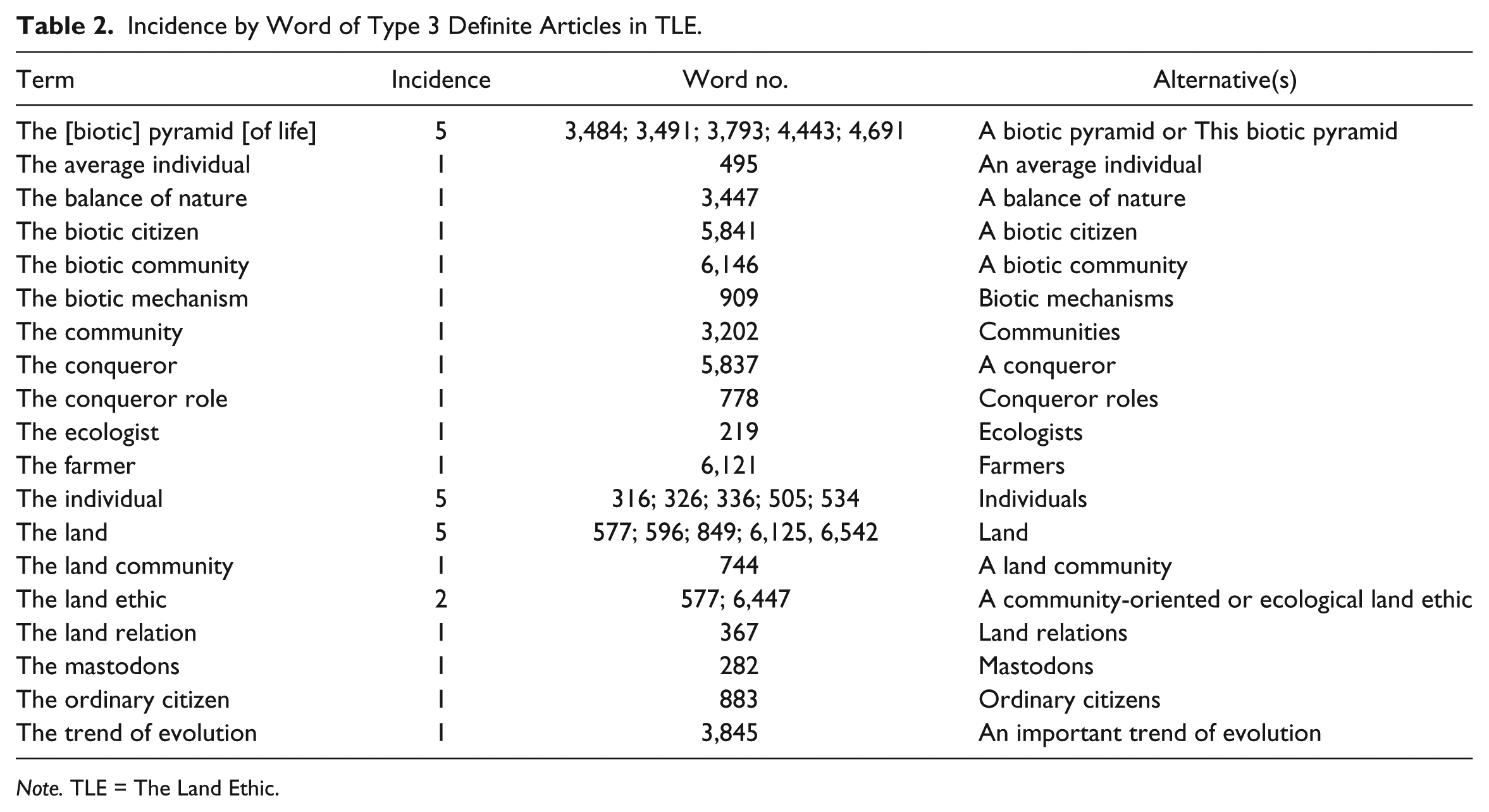
Note. TLE = The Land Ethic.
Incidence by Section of Type 3 Definite Articles in TLE.
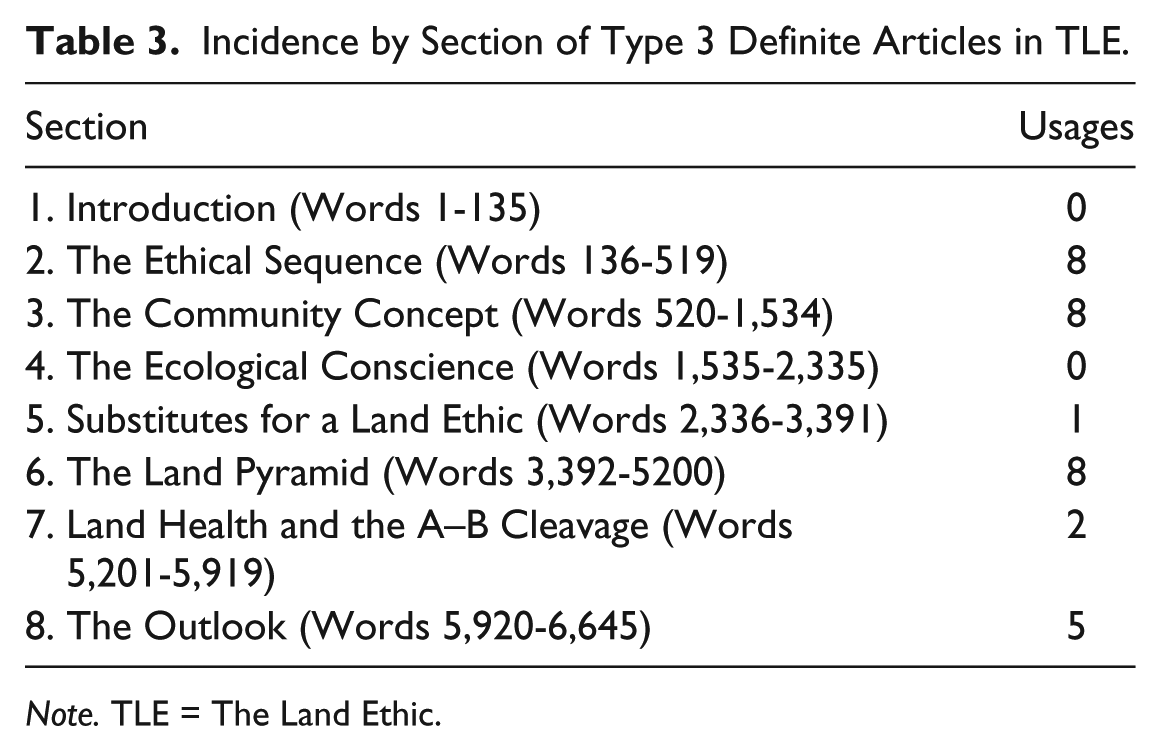
Note. TLE = The Land Ethic.
For what rhetorical purposes does Leopold use these words? It seems fair to infer that he is using definite articles to claim universality, a well-known rhetorical technique. Such claims are occasionally overstatements, known to rhetoricians as hyperbole, an example of which Mark Twain (1907) colorfully described in his article on The First Church of Christ, Scientist: “THE” I uncover to that imperial word. . . . It lifts the Mother-Church away up in the sky, and fellowships it with the rare and select and exclusive little company of the THE’s of deathless glory—persons and things whereof history and the ages could furnish only single examples, not two: the Saviour, the Virgin, the Milky Way, the Bible, the Earth, the Equator, the Devil, the Missing Link—and now The First Church, Scientist . . .
Twain found bombastic flattery in a usage that literally uplifts an institution’s name. In addition to such sublime connotations, definite articles can be used to connote solidity, as Leopold does by invoking pyramids to describe invisible ecological relations. This technique is called reification as defined by Whitehead (1925/1997): . . . a process of constructive abstraction [by which] we can arrive at abstractions [through] simply located bits of material . . .
In short, using Type 3 definite articles can lend both uplift and solidity to abstractions. This usage, however, entails risks along with benefits of accessibility. Whitehead calls one great risk “the fallacy of misplaced concreteness,” making false oversimplifications of complex abstractions.
A lexical authority in Leopold’s time, Fowler (1926/1983) inveighed against misuses of this type: “ . . . inserting the where it is indefensible, in the false belief that it is impressive or literary . . . ” (p. 642). For example, the land is often invoked as a reified abstraction without reference to specific places (Williams, 1985). Despite risks of illogical reification, Type 3 definite articles derive rhetorical force by combining specificity from Types 1 and 2 in a tactic that Burke (1966) called a “ . . . terministic screen . . . stretched to cover not just its own special field but a more comprehensive area” (p. 52).
In TLE, Leopold uses Type 3 definite articles for specific purposes. First of all, he modulates them in alternating sections that have more frequent usage than sections in which he uses few or even none (Figure 4).

Frequency by section of Type 3 definite articles in TLE.
Three sections of TLE were modified from articles published in scholarly journals and had been edited for usage according to various styles. Leopold revised them for this essay (Meine, 1988). In the resulting sections that Meine calls “the scientific backbone” of TLE occur the most frequent usages of reified abstractions such as “the land” or “the individual.”
Leopold made special use of Type 3 definite articles in two other sections. In the section headed “Land Health and the A–B Cleavage,” Leopold identified two types of conservationists: One he called Group A, who use land for “commodity production” contrasted with Group B conservationists who regard land “as a biota, and its function as something broader.” In the next section headed “The Outlook,” Leopold elevated Group B’s ethics to higher status with a canny usage of articles in his definition: “A thing is right when it tends to preserve the integrity, stability, and beauty of the biotic community. It is wrong when it tends otherwise” (at Word 6301, emphasis added). He could have used “ . . . a biotic community” without diminishing the force of that statement, but he used a Type 3 article to infer a universal idea that all living things are joined.
In that concluding section of Leopold’s last published work, in what Meine (2004) called “ . . . arguably the most important sentence that Aldo Leopold ever wrote” (p. 210), Leopold said, “I have purposely presented the land ethic as a product of social evolution, because nothing so important as an ethic is ever ‘written’” (1949/2013, p. 188, at Word 6442; emphasis added). The next two uses of ethic are also modified indefinitely with an and any. What Leopold did in this sentence and in the title of the essay was to promote without lengthy argument his version of a land ethic—one of admittedly two types—over all others, despite Fowler’s admonition against indefensible logic. No less than THE First Church, THE Land Ethic stakes a claim for universality. To complete his peremptory elevation, Leopold repeats the title with its definitive article for the second time about 200 words from the end of the essay with a rhetorical technique known as peroration (Lanham, 1991).
Upshots
The rhetoric of TLE was deployed to persuade a general audience. Leopold was a prolific author who had published many scientific articles, textbooks, and tracts on land use, forestry, and wildlife. He was a recognized practitioner of scientific rhetoric in which universal statements and affectations of impartiality are valued (Bazerman, 2000). He was also a fecund writer of letters, journals, and phenological data, who left a trove for scholars after his untimely death in 1948. In that same year, he crafted TLE with rhetoric admittedly different from what he used for persuading professional peers. He renders judgments and calls for actions. For instance, he refers to the conservation movement as “the embryo” (1949/2103, p. 172, at Word 457) for whom (at Word 6645) “The case for a land ethic would appear hopeless but for the minority which is in obvious revolt against these ‘modern’ trends” (p. 188). He then appeals to the broadest possible audience by evoking two universals: evolution and religion (at Word 6464): Only the most superficial student of history supposes that Moses “wrote” the Decalogue; it evolved in the minds of a thinking community, and Moses wrote a tentative summary of it for a “seminar.” I say tentative because evolution never stops (p. 188)
Leopold, a lover of music, here plays his prose instrument fortissimo. In this passage, he aligns his land ethic with the Mosaic Decalogue, further enshrining a biotic and ecological land ethic as a version of the Golden Rule of universal morality (Stace, 1937/1990).
He also connects his land ethic to evolution, which he cites in TLE 12 times as a noun or adjective and cites twice in the paragraph beginning, “I have purposefully presented the land ethic . . . ” He is unswerving in his conviction that evolution is a universal mechanism of natural, social, and moral change. He nonetheless expressed doubt about future changes.
TLE was published in a section “The Sand County Almanac” that he had titled The Upshot using another Type 3 definite article. As Leopold well knew, the literal term derives from a hunting shot taken in an up-range direction. As the heading for TLE, it denotes uncertainty about what lies ahead; it is repeated in the section titled with another Type 3 definite article “The Outlook.” He said, “Perhaps the most serious obstacle impeding the evolution of a land ethic is the fact that our educational and economic system is headed away from, rather than toward, an intense consciousness of land” (1949/2013, p. 187, at Word 5968). Weary from war, plagued by illness, and disappointed that his colleagues had not turned—as he had—away from exploiting natural resources toward their stewardship, Leopold was not optimistic.
He had been present at many changes, including forestry and ecology as disciplines of applied science; conservation policy at public and private agencies; and as a pioneer researcher and developer of wildlife and soil and water management. He was an internationally renowned scholar whose doubts set a tone for environmental communications in decades to come, fusing rhetorics of science and morality to skeptically describe present harms and warn of impending dangers (AtKisson, 1999). Like Socrates, his skepticism cohabited with his idealism.
Conclusion
TLE was published posthumously as an epilogue to the descriptive prose of A Sand County Almanac and as a reflection following his observations of life on a small plot of land. In this analysis, one small but important effect in TLE was Leopold’s deft usage of definite articles to confer universality on his proposed ethic. He eschewed fallacies or hyperbole that have plagued rhetorics since Plato’s time. Twain, Whitehead, and Fowler warned that bombast can sprout in the shade of a tiny word but withers under scrutiny. Rather than that, TLE’s survival and prosperity have contributed to evolving rhetorics, policies, and practices in science, politics, and philosophy.
After two decades of neglect, TLE achieved much of its author’s purpose. By its fifth decade, it had influenced a host of environmental activists who have affected environmental policies and practices in deploying their own rhetoric combining scientific rigor and spiritual fervor, as Leopold did. Dyson (2008) observed, There is a worldwide secular religion which we may call environmentalism, holding that we are stewards of the earth, that despoiling the planet with waste products of our luxurious living is a sin, and that the path of righteousness is to live as frugally as possible. . . . The worldwide community of environmentalists - most of whom are not scientists—holds the moral high ground, and is guiding human societies toward a hopeful future. Environmentalism, as a religion of hope and respect for nature, is here to stay
Whether or not environmentalism is a secular religion, its alignment of practical wisdom and spiritual idealism does seem to be implanted in public discourse. By now, the land ethic is a phrase that meets all the criteria of a successful meme, along with such others as sustainability or climate change. In coining it, Leopold combined Sophistic flattery and Socratic nobility in ways that have persuaded multitudes to join his Group B among scientists, policymakers, and citizens around the world. In Twain’s words, the land ethic with its “imperial first word” has indeed joined that “rare and select and exclusive little company of the THEs of deathless glory”.
Footnotes
Acknowledgements
Thanks to Wallace Sherlock and anonymous reviewers for astute comments on early drafts.
Declaration of Conflicting Interests
The author(s) declared no potential conflicts of interest with respect to the research, authorship, and/or publication of this article.
Funding
The author(s) received no financial support for the research and/or authorship of this article.