




Abstract
Nurses have great potential to contribute to the development of health policy through political action. We undertook a systematic website review of international- and national-level professional nursing organizations to determine how they engaged registered nurses in health policy activities, including policy priority setting, policy goals and objectives, policy products, and mechanisms for engaging nurses in policy issues. We reviewed 38 organizations for eligibility and 15 organization websites met our inclusion criteria. Six professional nursing organizations had comprehensive websites with a discussion of specific policy goals and objectives, policy-related products and mechanisms for nurses to become engaged. Future research is needed to evaluate how nursing professional organizations establish policy priorities and to evaluate the effectiveness of the strategies used to politically engage nurses.
Introduction
Background
Nurses have great potential to contribute to the development of health policy through political action. Nurses who do engage in policy often do so through participation in their employers’ policy committees or through supporting nursing professional organizations (Mechanic & Reinhard, 2002). Professional nursing organizations worldwide have mandates and processes for nurses to engage at some level in policy development (American Nurses Association [ANA], 2012a; Australian College of Nursing, 2012; Canadian Nurses Association [CNA], 2012; Royal College of Nursing [RCN], 2012). However, despite the efforts of professional nursing organizations, it is still challenging to encourage nurses to be politically active and to engage in health policy issues for a variety of reasons (Vandenhouten, Malakar, Kubsch, & Gallagher-Lepak, 2011). Cited barriers to nursing involvement in health policy include a lack of political awareness and understanding of the importance of being involved in nursing organizations, time to engage in policy development outside of nursing work, and resources to develop skills in policy participation (Boswell, Cannon, & Miller, 2005; Deschaine & Schaffer, 2003). This contributes to registered nurses’ (RNs) perception that their role is to exclusively provide patient care, which leads to their inability to see the “big picture” beyond the bedside regarding the factors that determine how health care services are distributed and how policies are generated and reformed (Cramer, 2002). Nurses also do not have a clear understanding of how they can inform discussions of health care services planning and delivery and often see this as the “decision makers” job (Hewison, 2008; Maslin-Prothero, Ed, & Masterson, 2002). To be successful in political engagement, nurses must understand both the policy process and how to influence key decision makers. Professional nursing organizations could play a key role in helping to bridge these gaps, so nurses, in whatever role and sector they work in, can be actively engaged in health policy to positively affect the profession and the health of their country’s citizens.
While nurses make up the largest group of health care providers in most developed countries, they often do not engage in health policy, political participation, or political activism (Spenceley, Reutter, & Allen, 2006). In 2010, there were 287,344 RNs, including nurse practitioners (NPs), in Canada, with an average increase from 2007 to 2010 of approximately 4.8% (CNA, 2012a). In comparison, in the same year there were 68,000 physicians in Canada (Canadian Institute for Health Information, 2010), therefore a 4 to 1 ratio of nurses to physicians. Comparable ratios exist in other developed countries with 3.1 million nurses in the United States in 2008 and 954,226 physicians (American Medical Association, 2010) resulting in just over 3 to 1 ratio of nurses to physicians. In Australia, the ratio is 3.8 to 1 with 276,751 nurses in 2009 and 72,739 physicians (Australian Government and Australian Institute of Health and Wellness, 2012). Even though the number of nurses far outpaces the number of physicians, it continues to be the medical profession that has the dominant voice and therefore influence when it comes to decisions related to health policy and health system changes. There have been many authors who have written about this domination, and although not the focus of this article, it is important to highlight that if more nurses were politically engaged what difference they could make (Lewis, 2010; Lum & Williams, 2000; Tuohy, 1999).
As pointed out, a key mechanism for political engagement of nurses is through national organizations that are members of the International Council of Nurses (ICN). However, in Canada, for example, there are approximately 285,000 nurses but just over half (145,000) belong to the CNA. According to MacDonald, Edwards, Davies, Marck, and Guernsey (2012), low levels of member participation in nursing organizations limit the overall impact that nursing organizations can make on health and nursing policy issues. Nursing professional organizations, such as the ANA, the CNA, the Australian College of Nurses (CAN), and the United Kingdom’s Royal College of Nurses, represent nurses on policy issues and can engage nurses to be politically active at the national and international levels. For example, the CNA has various forums to give nursing a voice at a national level and provide “tools” for nurses to have an impact on policy decisions, and the ANA offers RNs support on how to be politically active and lobby the government. A feature of some national- and international-level professional nursing associations is to make available key research evidence about promising nursing practices as well as ideas about improving the health and health care system that nurses could utilize in trying to influence decision makers. One way for professional nursing associations to be involved is to offer opportunities for nursing knowledge and expertise to be shared with government officials and the policy community through think-tank sessions, national task groups, and summits. This would allow nurses to contribute to the shaping of policy ideas and plans for engaging policymakers. In addition to engaging nurses to become politically active, a key function of the national and international nursing professional organization is to develop policy products such as briefing notes, position statements, and research summaries on pressing current health care policy issues to support policymaker decision making.
One strategy for nurses to engage in health and nursing policy issues is through accessing a national professional nursing organization—often through the first point of entry—the organization’s website. However, little is known about the web-based strategies that national nursing organizations use to engage nurses in health and nursing policy issues. Despite a thorough search of the literature, no research studies were found on this issue to inform our article. The majority of articles describing political engagement among nurses were greater than 5 years of age, indicating a limited amount of research on this topic. Research is needed to better understand what priority setting strategies, policy products, and web-based mechanisms that national nursing organizations use on their websites to engage nurses in health and nursing policy issues.
Purpose of Study
The purpose of this study was to examine, through the review of websites, how national professional nursing organizations engage nurses in health and nursing policy. We examined websites for the following four activities: (a) policy priority setting strategies, (b) policy goals and objectives, (c) policy products, and (d) mechanisms for engaging nurses in policy issues.
Method
Design
This study utilized a “systematic website review” of international- and national-level professional nursing organizations. While there is no formalized method for a “website review,” we chose to undertake a systematic process which we called a “systematic website review.” Unique to our process was the use of inclusion/exclusion criteria, two data extractors to independently extract data, and a matrix to record data extraction.
Sampling and Procedures
Identification, inclusion, and data extraction from websites involved a systematic and iterative process involving two reviewers (C.C., R.H.V.) using a third reviewer (K.S.), if needed, when disagreement arose that could not be resolved through discussion. All disagreements between the two reviewers were resolved through discussion. Two reviewers (C.C., R.H.V.) independently identified potentially relevant international- and national-level professional nursing organizations using the following Internet search engines: Google and Yahoo. A matrix was created to record the websites for international-level professional nursing organizations and national-level professional nursing organizations in North America (e.g., United States, Canada), Europe, and the South Pacific (e.g., Australia and New Zealand). Using this matrix, the reviewers recorded the organization website and scored each against the following eligibility criteria: (a) websites in English or enough pages translated into English that data could be extracted, (b) websites that were professional nursing organizations at the international and/or national level, (c) professional nursing organizations that focused on the advancement of the nursing profession as a whole as opposed to specific sub-specialties or topical issues in nursing, and (d) professional nursing organizations that focus on more than regulatory, licensure, or union/labor issues but also considered other nursing and health care issues, and/or nursing and health policy issues. We decided to focus on those national- and international-level organizations that concentrated their mandates and activities across multiple nursing issues that could have an impact on the profession as a whole, as well as nursing and health policy, as opposed to those organizations whose emphasis is on the advancement of clinical sub-specialties. While these specialty organizations are also important, their focus varies widely and it is sometimes difficult to assess the impact that these sub-specialty organizations might have on health policy reform and/or changes to the profession overall. Organizations that met these four criteria as determined by the two reviewers were included in the website review and will be referred to as “included organizations” throughout the article.
Data Extraction
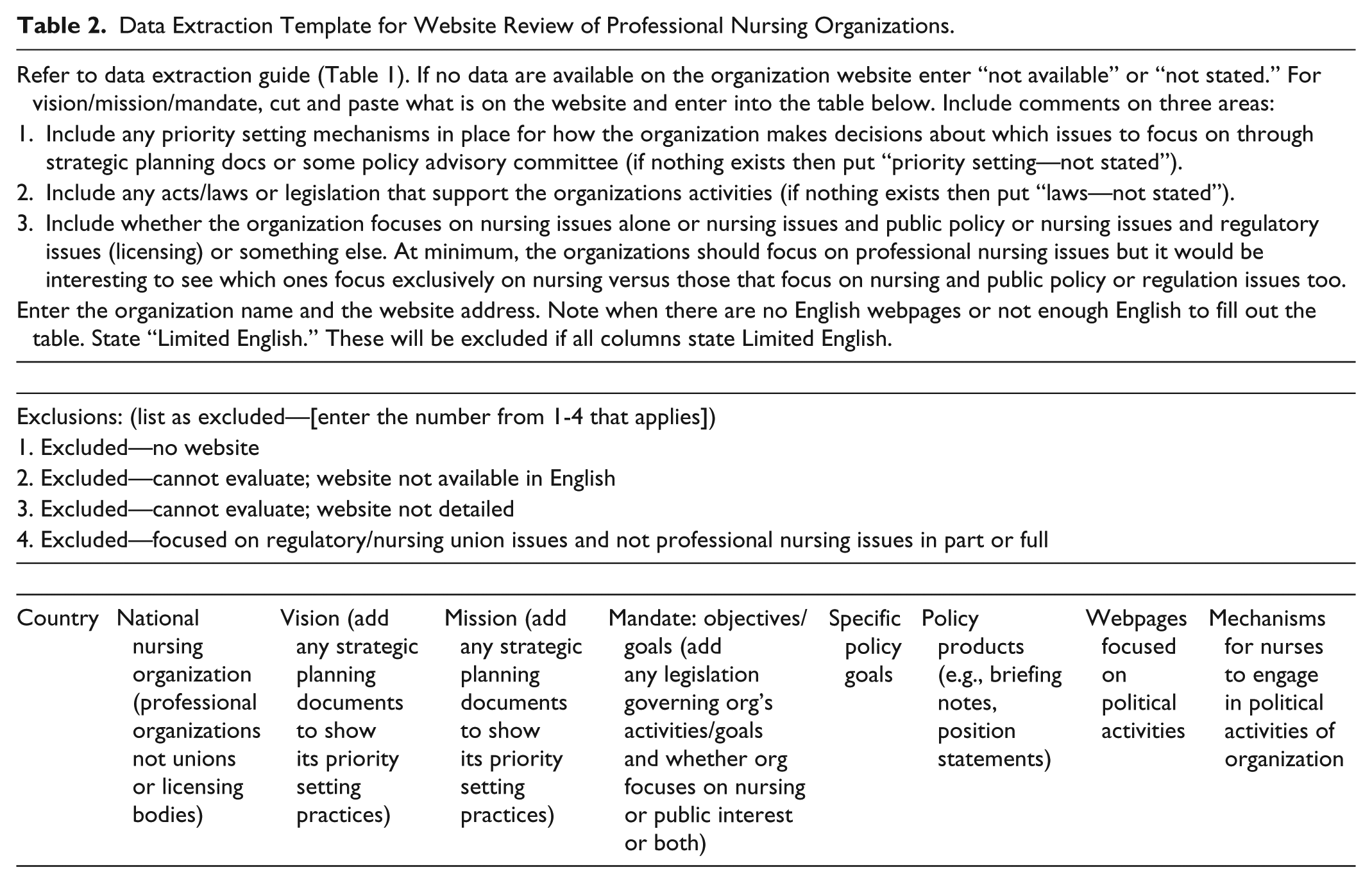
We created a data extraction tool for the two reviewers (C.C., R.H.V.) to independently extract data from the included organizations. A guide for data extraction is provided in Table 1. The following types of information were collected using our data extraction tool: (a) level of the organization (e.g., international, national, country name); (b) name and website of the professional nursing organization; (c) organization’s vision; (d) organization’s mission; (e) organization’s mandate, objective, and goals; (f) specific policy goals; (g) policy products; (h) webpages focused on political activity; and (i) mechanisms for nurses to engage in political activities. A sample data extraction tool is provided in Table 2. For the organization’s mission and vision, we sought to identify any strategic planning documents or materials that discussed how the organizations determined which issues they selected for priority and focus for policy advocacy. For the organization’s mandate, we recorded when the website discussed any legislation governing the organization’s activities or goals and whether or not the organization focused on nursing issues, public interest issues, or both. We defined policy products to include any document that presented a nursing or health policy issue and a nursing response to the issue such as briefing notes, fact sheets, and position statements. We extracted data on political activities carried out by the professional nursing organizations and the nature of these activities such as bringing awareness to a policy issue, political advocacy, and the engagement of nurses. Finally, we identified the types of mechanisms that organizations used to engage nurses in political action such as petition signing, rallies, and presentations. While data extraction was completed, the two reviewers met to review each independent extraction for consistency and thoroughness. Using the two extraction templates, a final overall extraction template was developed for each included organization and used in analysis. Data were then coded and entered into SPSS Version 20.0 according to the categories of the data extraction tool.
Guide for Data Extraction for Included Professional Nursing Organization Websites.

Data Extraction Template for Website Review of Professional Nursing Organizations.
Data Analysis
Descriptive statistics using SPSS were conducted for the organizations to give a summary of the policy priorities, goals, products, and mechanisms used by organizations for engaging nurses in policy issues. Qualitative information contained in the data extraction templates was analyzed using a constant comparison method to identify the main areas addressed by professional nursing organization and the presentation of gaps when seeking to engage nurses in nursing and health-policy-related issues.
Results
Our review resulted in 38 international- or national-level professional nursing organizations being selected for potential eligibility. Using our eligibility criteria, 15 organizations were included (39.5%) and 23 were excluded (60.5%). Among the included organizations, three organizations focused on international-level nursing issues, two were at the North American level, one focused on Australia and represented our South Pacific category, and nine focused on European-level professional nursing issues. Among the excluded organizations, one from New Zealand did not possess more than a webpage and no other information about the organization to support inclusion. The remaining excluded organizations (n = 22) were from European countries and were found to be ineligible because the professional nursing organizations’ websites lacked at least one of the following characteristics: a description of the organization and its activities (n = 6), webpages presented in English (n = 9), complete translation of all webpages in English (only a few webpages were presented in English and we could not evaluate inclusion; n = 2), focus on nursing or health policy issues (main focus was on nursing regulatory or union/labor issues; n = 5).
Table 3 outlines the frequency with which included organizations described their vision, mission, mandate, specific policy goals, and products and mechanisms for nurses to become politically engaged through the organization. The majority of included organizations provided a statement of vision, mission, and an overall mandate. Few included organizations outlined the process used to identify nursing policy issues for priority, specific organizational goals related to nursing or health policy, policy products or mechanisms for RNs to become politically engaged. Two included organizations (Finnish Nurses Association and the German Nurses Association) had some webpages that were partially in English and partially in another language without additional translation. However, six organizations’ websites were identified that met all of our criteria and performed a number of functions in relation to engaging nurses politically from explicitly described political action or engagement in their organizational vision, mission, and/or mandate to outlining policy-related products and ways for RNs to become more involved. These were the ICN (international level), the CNA, the ANA (North American level), the CAN (South Pacific level), the European Forum of National Nursing and Midwifery Associations (EFNNMA), and the United Kingdom’s RCN (European level).
Included Professional Nursing Organization’s Focus on Nursing and Health Policy Issues.

Note. LE = Limited English—Unable to evaluate fully.
Professional Nursing Organizations Structured to Engage RNs
International Council of Nurses (ICN)
The ICN describes the goal of influencing health policy as a core organizational mandate. This organization describes its strategic planning activities through a publically available strategic plan. Nursing, health and social policy are clearly articulated as part of this strategic plan, including the identification of policy trends, defining opportunities to be political active and administering press releases and fact sheets declaring ICN’s position and the role it plays in influencing health and social policy. Various projects detailing the ICN policy position are listed on the ICN website, some of which include counterfeit medicines, international nursing migration, non-communicable diseases, and wellness for health care workers. Upon review of policy products, ICN provides position statements, fact sheets, press releases, and presentations on some of its topics. ICN offers opportunities for nurses to engage in networks, and one network in particular is focused on nurse politicians. The ICN website lists events such as upcoming conferences and their location.
Canadian Nurses Association (CAN)/Association Des Infirmières et Infirmers Du Canada
The CNA describes a mission and vision that includes discussion of political advocacy with a focus on healthy public policy and a quality health care system. Its organizational goals from 2010 to 2014 are listed, including a goal specific to advancing health public policy at national and international levels. The CNA provides a publicly available annual report which outlines the organization’s accomplishments in the past year, including how it has advocated for public policy such as encouraging nurses to engage in debate during the national election, discussions on health care system transformation, NP legislation, and nursing regulation issues. The CNA devotes a section of its website, which is named “On the Issues,” to outline specific policy goals and describes the areas of nursing and health care policy where it focuses its activities. Some of these activities include a national expert commission to explore nursing contributions to the health care system, staffing and patient outcomes, emergency preparedness, interprofessional practice, chronic disease prevention, healthy aging, and pharmaceutical access. The CNA has webpages focused specifically on the organization’s political action activities and the process that it uses to engage health policymakers. Nurses are invited to be politically involved with the CNA’s activities with detailed instructions for writing letters to political representatives, working with the news media, and meeting with policymakers. Policy products include CNA open letters, position statements, briefing notes, research summaries, and fact sheets.
American Nurses Association (ANA)
The vision and mission of the ANA includes a discussion of policy advocacy to promote the rights of the nurse in the workplace, the image of nurses, and lobbying government for changes on nursing and health-related issues. A summary of the past year’s annual report is provided online and discusses political advocacy activities such as lobbying for the “Affordable Care Act,” representation of nurses in Accountable Care Organizations and for reimbursement to advanced practice RNs. The ANA has webpages dedicated to policy and advocacy, and these provide downloadable testimonies that the ANA has presented before congress on various topics such as the clean air act, Medicaid, Health Care Reform, Clean Water Act, and Nursing Workforce Development Programs. Policy products that the ANA offers include a “policy activist tool kit” (ANA, 2012b). As part of this tool kit, RNs are provided with resources that include how to get involved in a political campaign, writing letters to the editor, how to engage politicians and carry out lobbying activities. From the political activist tool kit website, RNs can seek to sign up for the ANA’s Nurses Strategic Action Team to help nurses engage across the United States.
Australian College of Nursing (ACN)
The ACN is an organization which has formed after the merger of the Royal College of Nurses Australia (RCNA) and The College of Nurses (TCoN). The vision, mission, and mandates of the ACN refer to advancing the nursing role in health policy through advocacy. From a publically available annual report from 2011, the ACN cites activities related to influencing policy development and formation and advocating for nursing-related issues (Royal Colleges of Nurses of Australia, 2011). The ACN’s ongoing policy activities include lobbying political leaders and decision makers, providing feedback for health sector consultations, and participating in a range of high-level national, states, territories, and non-government committees significant to the nursing and health professions and encourages and supports its members to submit articles for publications. The ACN’s website provides policy products such as guidelines for nurses interested in lobbying activities, position statements, fact sheets, and invites its members to apply to advisory committees with potential to affect policy decisions.
European Forum of National Nursing and Midwidery Associations (EFNNMA)
The EFNNMA was created in November 1996 and includes 26 national nursing and midwifery associations and World Health Organization (WHO; 2012) with a signed declaration to join in action of promoting health and health care in Europe. Their aim and mission is to strengthen and promote the exchange of information, ideas, and policies between national nursing/midwifery associations and WHO. The EFNNMA also strives to integrate appropriate policies, to formulate policy statements and recommendations on health of the population at a national level, and to initiate projects of evidence-based practice for nurses and midwifery. The EFNNMA claims that each year they focus on one theme then formulates a statement on it and works with nursing and midwifery associations to take forward their recommendations to affect the national policy and practice. The recent years’ focus of themes has been international code on recruitment of health personnel, stewardship and governance, health systems, health and wealth, HIV/AIDs, maternal, child and adolescent health with a focus on obesity, and mental health. Areas not well described include the mechanisms for nurses to engage in political activities and publically available policy-related products. While we were able to locate a few reports, other policy products were not displayed on the EFNNMA website.
Royal College of Nursing (RCN)
The RCN’s vision and mission involves the interest of the diverse voice of nurses by influencing and implementing policy through lobby government and stakeholders to improve the quality of patient’s outcome. RCN clearly articulates a health policy focus in its vision, mission, and mandate. Policy products available for download include fact sheets, briefing notes, and consultation documents. Example topics include health workforce issues, the future of nursing, and welfare reform. In addition to policy products, mechanisms for nurses to be more involved in health policy include applying to be a representative of the organization on committees, invitations to join committees or task group, or be elected to council. The RCN also encourages its members to provide consultations on current issues and provides its members with current news, events, and campaigns.
Discussion
This website review of international- and national-level professional nursing organizations provides a first examination of organizational practices and activities undertaken to politically engage RNs in nursing and health policy issues. Six organizations were identified to meet all of our criteria, including establishing clear policy goals and mandates, offering policy-related products on nursing and health-related issues, and implementing activities to engage nurses in policy-related activities. Typically, professional nursing organizations provided a description of their organization’s vision, mission, organizational mandate and goals on their website. Professional nursing organization websites varied regarding how well they described specific policy goals and objectives as part of their organizational mandate. While some organizations provided publically available documents detailing their organization’s activities, such as annual reports and strategic plans, no organization explicitly discussed how they prioritized nursing or health policy decisions within their organization. This includes the processes undertaken by organizations and the decisions made for which issues would be the primary focus for the organization as a representative of RNs nationally and internationally. Priority setting is an important process for nursing professional organizations to consider as it involves activities that identify which health service issues should receive priority, which nursing issues require urgent attention, and who as patients need immediate attention over others. Our finding is consistent with other authors who identified that there is limited research evidence on the priority setting activities identified by professional nursing associations and the factors that influence these decisions which could affect how well nursing associations implement their organizational mandates and goals (MacDonald et al., 2012; Mitton, Patton, Waldner, & Donaldson, 2003; Peacock, Mitton, Bate, McCoy, & Donaldson, 2009). Likely, many professional nursing organizations undertake one or more processes to support priority setting but do not describe these on their organization’s website. An area for future research would be to examine what these priority setting practices are, how they affect the work of the organization and how well the determined policy priority areas reflect the organization’s vision, mission, and mandates.
Despite organization websites offering a limited description of their priority setting activities, the six organizations that met our criteria provided a number of policy products that discussed their position on various nursing and policy issues and methods for nurses to engage in these policy issues. Common policy products were position statements, briefing notes, fact sheets, media releases, and research evidence summaries. A common way to engage nurses was to provide “tips” to writing letters to government representatives, lobby government on nursing issues, policy and legislation, and how to meet with government representatives. Some organizations presented information about conferences and events for nurses to attend but these were not always focused on the policy activities of the organization. One organization, the ANA, provided a “policy advocacy” tool kit but this was housed on a website separate from the organization. Few websites provided a means for nurses to collaborate on nursing and health policy issues such as through networks, coalitions, and partnerships. Our findings are consistent with other authors who describe similar attempts to advocate for nursing and health policy issues (MacDonald et al., 2012; Vandenhouten et al., 2011). One limitation arising from our review is that organizations’ websites may not accurately portray the intensity with which organizations may engage on certain nursing or health-policy-related issues. This includes a need to understand the factors that influence which policy products nursing organizations select to use and the decisions made about the packaging and sharing of policy products. According to Vandenhouten et al. (2011), nursing participation in health policy was influenced by psychological engagement, including nurses who were interested in health policy issues and confident that their actions might make a difference. This could be an important factor for professional nursing associations to consider when attempting to engage nurses. From our website review, while organizations describe their activities to advance policy issues and present the importance of nurses to take action, no included organization explicitly described the specific impact on the advancement of nursing and health policy issues that would result from nursing engagement in the organization and the policy advocacy activities. Greater efforts to support nursing psychological engagement might encourage more nursing participation in policy advocacy activities. Our results also revealed that few nursing professional organizations evaluate how well their policy advocacy activities are effective in stimulating greater nursing political activity. Future research to evaluate the impact of the policy products and mechanisms to engage nurses offered by international- and national-level nursing organizations is needed.
Our study presented a first look at international- and national-level nursing professional organizational websites for their policy priority setting activities, specific policy objectives, products, and mechanisms for engaging nurses in policy issues. However, a limitation of our study is our emphasis on organizations with an English-language website. There were a number of websites from Europe which we had to exclude from our review because there were not enough webpages in English to determine inclusion. Future research might include attempts to have individuals fluent in these languages interpret the websites for inclusion and be involved in data extraction when applicable. Our study was also limited by the amount of information that organizations chose to place on their websites. Many times organizations carry out a number of activities behind the scenes that are not declared or presented on their websites. Improvements could involve study methods that incorporate additional methods such as survey or interviews alongside the website review to obtain a broader perspective of the organizational activities undertaken.
Implications for Nursing Policy
To facilitate political engagement, nurses need a greater exposure to the principles of and current issues related to health policy through education at the undergraduate and graduate levels. Nurses often cite a lack of political awareness, including the internal workings of the government and how policy decisions are made (Abood, 2007; Cramer, 2002). Nurse leaders who work with nursing professional organizations and nurse educators need to cultivate greater political interest and engagement beginning with undergraduate-level nursing students and continuing with practicing nurses (Deschaine & Schaffer, 2003; Duncan, Thorne, Van Neste-Kenny, & Tate, 2012; Vandenhouten et al., 2011). Introduction of a health policy course within the nursing curriculum at the undergraduate and graduate levels can help facilitate political engagement through broadening student awareness of current health policy issues and the policy processes used to address these problems. Professional nursing organizations can play a role in providing ongoing continuing education for nurses in practice to address knowledge gaps (Vandenhouten et al., 2011). Educational strategies can focus nursing awareness on the typical pressures faced in a policy environment such as fast-paced setting, multiple competing demands, limited time to make influential decisions, and a need for timely evidence for decision-making (Catallo & Sidani, 2014). With a better understanding of the policy process and the policy arena, including the pressures surrounding decision-making and multiple competing drivers, nurses can identify and develop a role that facilitates ongoing political engagement. Some examples of areas that nurses could improve their skills include activities that support the articulation of a current health problem using a nursing and policy lens, identifying options that policymakers would deem relevant within the broader health system to address the nursing and/or policy problem, and describing local implementation considerations in a succinct manner, should an option be selected. These areas of focus are consistent with international initiatives such as the SUPPORT Tools for evidence-informed health Policymaking (STP) series by the SUPporting POlicy relevant Reviews and Trials (SUPPORT) project, an international collaboration funded by the European Commission’s sixth Framework (http://www.support-collaboration.org; Lavis, Oxman, Lewin, & Fretheim, 2009). These SUPPORT Tools are a series of 19 articles describing the types of information that health policymakers need to know, what evidence is required for health policy decision-making, and specific interventions such as development of policy briefs and policy dialogues which facilitate health-policy decision-making. The SUPPORT Tools material could be helpful to include as part of nursing education and skill development to better equip student and practicing nurses to articulate and respond to nursing and policy-related issues. The SUPPORT Tools can be found in the Health Research Policy and Systems Journal Volume 7 Supplement 1: http://www.health-policy-systems.com/supplements/7/s1
Conclusion
This study offers a first review of international- and national-level professional nursing organizations and how they engage nurses in health and nursing policy through their policy priority setting strategies, policy goals and objectives, policy products, and mechanisms for engaging nurses in policy issues. This study offers promising results, in that many nursing organizations are actively working to address nursing and health-policy-related issues. Continued work is needed to promote nursing engagement and to evaluate the effectiveness of the strategies used by professional nursing organizations to support political activity.
Footnotes
Authors’ Note
C.C. conceived of the study and obtained funding. C.C. and R.H.V. oversaw data entry and analysis. K.S. helped with data interpretation. C.C., K.S., and R.H.V. drafted the manuscript and contributed to revisions.
Declaration of Conflicting Interests
The author(s) declared no potential conflicts of interest with respect to the research, authorship, and/or publication of this article.
Funding
The author(s) disclosed receipt of the following financial support for the research and/or authorship of this article: This project was funded by a publication grant from the Faculty of Community Services, Ryerson University, Toronto, Canada.