




Abstract
The hospitality industry is dependent on a professional staff to exceed guests’ expectations. Existing research has focused primarily on the various attributes necessary for success in the hospitality industry. The primary focus of this research was professionalism and hospitality students’ self-perception of their professional attributes. Data collected from a focus group of hospitality human resource managers were used to develop a professionalism scale. The scale produced five factors that explained 53.6% of the variance in the responses. Students were more likely to agree in their preparedness for the interview process, but less in agreement of their preparedness for workplace issues. This research provides an exploratory study into a student’s perception of his or her own professional abilities and could be used as a placement tool for human resource managers and a benchmark to determine student’s professional aptitude by hospitality management professors.
Keywords
Introduction
The hospitality industry is dependent on quality employees to provide exceptional service to its guests. As the industry has grown, so has the need for qualified employees (Tesone & Ricci, 2006). Based on this demand, the number of college programs offering hospitality majors has increased (Rivera & Upchurch, 2008). Studies have been performed to access the skills necessary to be successful in a hospitality career (Emenheiser, Clay, & Palakurthi, 1998; Kwok, Adams, & Feng, 2012; Ruetzler, Taylor, Reynolds, & Baker, 2011; Tesone & Ricci, 2006).
Kwok et al. (2012) focused on attributes necessary to increase students’ chances to receive a job offer in the hospitality industry (intellectual skills, academic performance, work experience, internship experience, leader/career preparedness, job-pursuit intention, interview behaviors, and professionalism). Ruetzler et al. (2011) explored perceptions by students, faculty, and industry representatives about what they considered to be indicators of future job success.
Tesone and Ricci (2006) identified the necessary knowledge, skills, and abilities (KSAs) as well as attitudes of hospitality students as entry-level workers by examining hospitality managers’ expectations. Emenheiser et al. (1998) identified skills of successful managers in the restaurant industry (communication, management, organizational, marketing, and psychomotor).
“The hotel business is an employee-intensive and quality-driven service industry. The competitiveness and productivity of the industry depend primarily on the skill levels and professionalism of its employees” (Subhash, 2012, p. 37). The competencies quality hospitality employees should possess vary based on the perceptions of those we ask. Great time and effort goes into training to ensure that employees have the KSAs to succeed in the industry, but it appears to be a moving target with guests’ needs, desires, and expectations constantly changing. Regularly, hospitality employers train their staff members to match the KSAs only to realize that guest expectations have suddenly shifted toward different quality expectations and/or capabilities of the guest service employees (Chandana, Pollard, Chort, Choi, & Wanjohi, 2013; Kay & Moncarz, 2004). In a changing global environment, the hospitality industry is being faced with the daunting tasks of keeping up with consumer demands while providing excellent customer service. Therefore, training in the area of professionalism at the university level to ensure a seamless transition into the hospitality workplace has vital importance. The importance of this training has been magnified due to the exponential growth of the industry on a global scale now that 1 in 11 jobs world-wide are supported by tourism (World Travel and Tourism Council, 2013).
Literature Review
Professionalism
Hussey, Holden, and Lynch (2010) determined creation of professional dimensions to be key for educational interventions, which take place to ensure that the lessons are having a positive impact. The following key dimensions of tourism that were found in the research include altruism, the existence of a code of ethics, a body of knowledge, and specialist skills. Altruism is defined by a person who has a belief in a service orientation (Kuhlmann & Bourgeault, 2008) and may be considered one of the “soft skills” desired by employers.
The second dimension listed by Hussey et al. (2010) code of ethics has been considered of utmost importance in the hospitality and tourism industry (Payne & Dimanche, 1996). Fox (2000) refers to ethics as a value system that is “the generalized principles that guide a person’s evaluation of decisions or specific instances of conduct” (p. 70). The need for ethics in business is recognized by business and consumers (Laczniak & Murphy, 1991). Ethics, too, can be considered a “soft,” yet important skill for a hospitality and tourism worker.
Hussey et al.’s (2010) third dimension body of knowledge focuses on the need for a person to be trained in a profession and able to apply what they learned. Bloland and Tempel (2004) have found that the skills learned are straightforward but how they are unique to the discipline and not applied elsewhere to be a challenge. The application of the knowledge to workplace situations is necessary for any kind of learning initiative (Paauwe & Williams, 2001). The connection between knowledge and application can solve the problem of whether the knowledge gained is specific to the industry that is studied (Bloland & Tempel, 2004). The body of knowledge for hospitality and tourism is considered a “hard” skill set for the industry’s workforce.
The final professional dimension shared by Hussey et al. (2010) included specialist skills and expertise. Page, Wilson, and Kolb (1993) mentioned the importance of skill mastery and shared difference of hard skills (physical exertion and technical) and soft skills (managing relationships). Of the two types of skill sets, Caudron (1999) found that hard skills were the easiest to learn and measure proficiency.
Professional and the hiring of employees can be approached in various manners. LaSala and Nelson (2005) discussed professionalism in terms of hiring future nurses. The study found that items such as communication skills, dress (attire), and overall behavior had important roles and impacts on how others perceived professionalism in nurses. As with the high interaction between a hospitality employee and a tourist or guest, nurses spend a large amount of their workday interacting with patients (i.e., guests). According to LaSala and Nelson, “[T]he nurse should reflect a high degree of professionalism to patients, the public, and other professionals . . . making a positive first impression in seeking a new position with . . . colleagues and the public” (p. 67).
Proost, Schreurs, Witte, and Derous (2010) found that individuals will use impression management to achieve their social goals; one of which can be getting hired. “Impression management refers to the activity of controlling information in an attempt to steer the impression others form of oneself in the service of personal or social goals” (p. 2156). Their study focused directly on the attempts individuals use to modify their professionalism during interviews with the outright goal of impressing the interviewer to a high degree with the ultimate goal of job attainment. The outcome of managing one’s impression to control the likeability by the employer indicated an increased likelihood of employment. Furthermore, if the individual’s professional impression was managed in such a manner that was enhanced and the candidate also ingratiated the interviewer with pleasantries and desired responses, he or she could further enhance the potential for hire.
Professionalism in the Hospitality Industry
Previous research has focused on what is necessary for success in a professional environment based on the perceptions of hospitality practicing professionals primarily through the examination of KSAs or related job competencies deemed specific to the hospitality industry. However, students’ perspectives of their own abilities and characteristics and how those may or may not influence their success remain an unexplored topic. The bridge between the industry and education can be strengthened by examining these gaps in education, potentially leading to better preparation, student awareness, and future career success. A student’s future success in the hospitality industry may be measured using a variety of attributes or constructs as deemed relevant by the researcher. As discussed throughout this brief literature overview of existing literature, numerous constructs indicating hospitality industry career success are highlighted, predominantly in the areas of job competencies, job readiness, and/or perceptions of job success (Emenheiser et al., 1998; Kwok et al., 2012; Ruetzler et al., 2011; Tesone & Ricci, 2006).
As the hospitality industry requires its employees to continually demonstrate professional and ingratiating style with guests and customers, this research indicates a possibility for hospitality job candidates to overemphasize these behaviors to have hiring success.
The authors would like to explore the concept of professionalism and the hiring process as it directly relates to the hospitality industry. Currently, research is quite limited in this area. Hence, the current research focused on professionalism as part of the hiring process with the exploratory purposes of this study is as follows:
Determine a student’s professional skills based on his or her own perspective.
Determine if the responses to students’ perception of their professional skills may be categorized to find strengths and weaknesses that can assist human resource professionals in job placement.
Data Collection and Methodology
A large, public, state university in the southeastern United States was used for the setting; this university has one of the largest hospitality management college-level programs in the world. Junior- and senior-level hospitality students were given the survey during a face-to-face class meeting and were asked to fill out the anonymous survey in the April 2013. In all, 165 surveys were distributed across multiple course sections of vacation ownership management face-to-face class sections and 159 were returned, resulting in a response rate of 96.3%.
The survey contained a professionalism skills scale. This scale (see Table 1) was developed from information gathered from a focus group consisting of eight human resource managers and six executives from various segments of the hospitality industry (hotel, vacation ownership, restaurant, etc.). SPSS statistical program Version 22 was used to analyze the data.
Professionalism Inventory Items.
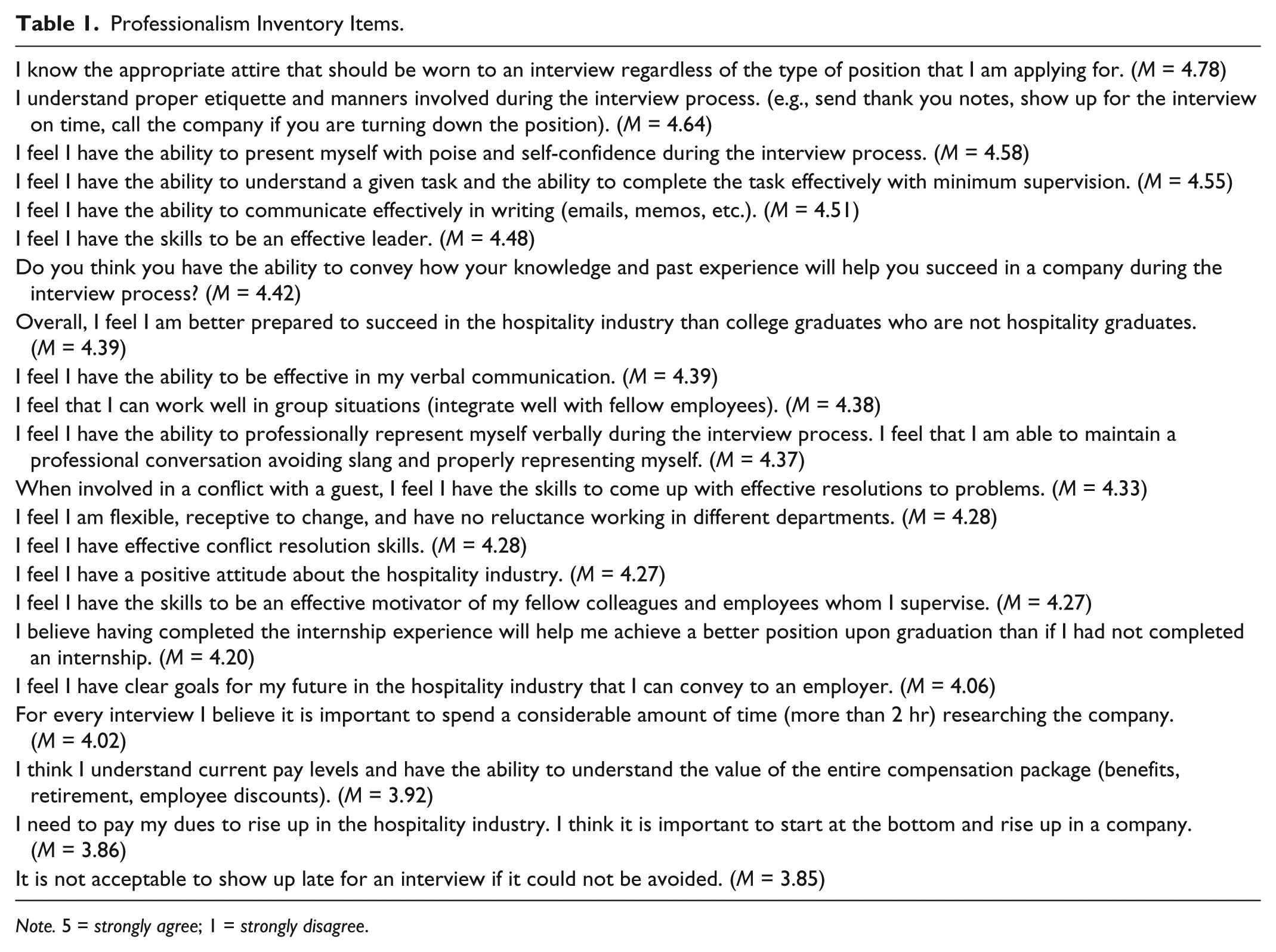
Note. 5 = strongly agree; 1 = strongly disagree.
The professionalism scale’s internal consistency was tested using Cronbach’s alpha. The result was .795, indicating that this scale is internally consistent. The survey also asked the gender of the respondents and whether or not they were currently working in the hospitality industry.
Data Analysis
Most students were currently working in the hospitality industry (90%). In all, 69% of the sample was female. Professional attributes were measured using a 5-point Likert-type scale. The top three professional attributes (see Table 1) that students agreed with included the following: (a) I know the appropriate attire that should be worn to an interview regardless of the type of position that I am applying for (4.78), (b) I understand proper etiquette and manners involved during the interview process (4.64), and (c) I feel I have the ability to present myself with poise and self-confidence during the interview process (4.58). These top-rated attributes all related to areas of appearance. The three professional attributes students agreed with the least included the following: (a) I think I understand current pay levels and have the ability to understand the value of the entire compensation package (benefits, retirement, employee discounts; 3.92), (b) I need to pay my dues to rise up in the hospitality industry; I think it is important to start at the bottom and rise up in a company (3.86), and (c) it is not acceptable to show up late for an interview if it could not be avoided (3.85). These attributes focused more on work ethic and knowledge of the industry.
Factor Analysis
The professionalism inventory was factor analyzed utilizing principal component analysis to determine if there was any factor grouping to explain variance in their responses. The Kaiser–Meyer–Olkin measure of sampling adequacy was .809, indicating that factor analysis was an appropriate analysis for the data. Bartlett’s Test of Sphericity had a .000 significance, indicating that all items were correlated with themselves and had some level of correlation with the other items.
Five different factors were elicited utilizing principal component analysis with Varimax rotation. These factors explained 53.6% of the variance in the responses (see Table 2). Factor 1: Leader/communicator included responses related to the student’s ability to effectively lead and communicate (16.4% variance explained). Factor 2: Leader/conflict resolver included responses related to leadership and conflict resolution skills (13.2% variance explained). Factor 3: Positive/goal-oriented included responses related to a student’s positive outlook about the hospitality industry and his or her goal-oriented personality (9.8% variance explained). Factor 4: Worker/prepared included responses related to a student’s work ethic and preparation for the realities of the hospitality industry (7.5% variance explained). Factor 5: Miscellaneous included responses to two questions that were not related (6.6%). The data were analyzed without the two questions from Factor 5 and there was no significant variance in the data.
Factor Groupings of Professionalism Scale.

Discussion
This exploratory research resulted in a professionalism scale that measured the student’s inventory of his or her abilities, knowledge, and perception pertaining to the hospitality industry. Based on the professionalism inventory, respondents felt more comfortable in how they presented themselves than their actual skills and knowledge of the profession would indicate. This could be problematic with regard to the idea that “style” is more relevant than “substance.” Respondents consistently indicated high scores when asked to present themselves versus presenting content knowledge of the industry. As examples, some statement response averages are as follows: what to wear to an interview (4.78), etiquette and manners during an interview (4.64), and poise and self-confidence during an interview (4.58). These all examined one’s ability to present his or her perceived knowledge, not the actual work knowledge.
The questions that evoked neutral responses included the following: I think I understand current pay levels and have the ability to understand the value of the entire compensation package (benefits, retirement, employee discounts; 3.92), I need to pay my dues to rise up in the hospitality industry; I think it is important to start at the bottom and rise up in a company, and It is not acceptable to show up late for an interview if it could not be avoided (3.85). These show areas that hospitality educators can focus on in their classes. Although many professors may believe that their students understand the importance of these concepts, the students are not embracing the importance of these professional skills.
The five factors explained more than half of the variance in the responses. Four developed a solid structure of the characteristics of the respondents. These factors could be used as a possible tool for job placement. The leader/communicator factor responses could determine a candidate who has the potential for a managerial role in the hospitality industry. The leader/conflict resolver factor could indicate whether a candidate has the potential as a human resource manager.
Limitations
This was a convenience sample at one university and cannot be generalized outside of this setting. Other areas were not taken into consideration such as the level of work in which the students were employed in the hospitality industry (i.e., hourly, supervisory, managerial) and/or the length of time at the specific job.
Future Research Areas
The professionalism inventory scale needs to be tested and refined in other settings. A longitudinal study comparing freshmen with seniors could show differences that could be used to help professors and employers fill in needed gaps in the students’ education. A wider range of students’ opinions, preferences, and background questions could be developed to find richer relationships.
Summary
This research explored students’ self-perception of their professional skills. A scale was created that will be a useful tool for managers in hospitality and hospitality educators. The study showed that students perceive themselves as professional. There are areas where they are less sure of themselves and these need to be addressed by educators. Hospitality educators need to continue to challenge students and reiterate the skills necessary to becoming a successful hospitality manager.
Footnotes
Declaration of Conflicting Interests
The author(s) declared no potential conflicts of interest with respect to the research, authorship, and/or publication of this article.
Funding
The author(s) received no financial support for the research and/or authorship of this article.