




Abstract
In recent years, the use of the word “gay” as a synonym for dumb or lame or stupid has become prevalent in our culture. Because of this, it is clear that many individuals do not consider the word to be a slur and are not offended by its use. Using an original data set (N = 790) collected from four Midwestern universities in the winter of 2011-2012, this article examines the characteristics of those college students who perceive the word gay to be a slur or who are offended. We find that those individuals who report having more gay friends are more likely to take offense at the use of the word gay as a slur even after controls are instituted. We also find that, contrary to expectations, attendance at religious services appears to have a direct relationship, with more frequent attenders more likely to express offense at the use of gay as a slur. Egalitarianism also emerged as a significant predictor. We offer suggestions as to why some college students perceive the word to be a slur while a majority of college students do not.
Keywords
Introduction
Spend time among a group of high school or college students and you are likely to hear the phrase “that’s so gay” applied to people, inanimate objects, or situations with relative frequency. The term gay has several meanings in history, and the 20th century exemplifies this. In the beginning of the 20th century, gay took on a duality of meaning that included joyous, lively, merry, and happy but was also associated with negative connotations of frivolousness and lack of seriousness (Pyles & Algeo, 1993). The word took on further meaning by the early to first half of 20th century when it became a standard term of reference for homosexuals (Leith, 1997). In the late 20th century, the term gay took on a third meaning of stupid or as a general term of disparagement. It is uncertain how the term devolved into the third meaning, but according to the Historical Dictionary of American Slang (Lighter, O’Connor, & Ball, 1994), it first appeared in this context in 1978 in America.
While the use of the word gay in the innocuous first form of the 20th century has all but disappeared with the rare exception of this use among the elderly, today the term has been implanted into the lexicon of slang as a common pejorative. The word’s usage is particularly common among younger individuals in reaction to animate or inanimate phenomena (Burn, Kadlec, & Rexer, 2005). Indeed some argue the phrase “that’s so gay” has become so common—especially on college campuses—that it is simply tolerated as background noise (Conan, Nunberg, & Byard, 2009). To better understand the present use of the term gay, we asked a 25-year-old male college graduate to provide us with sentences in which he had used or heard the phrase “so gay” used in high school or college. Young men tend to use the phrase more often than young women because women are more likely to interpret this usage in a negative context (Lalor & Rendle-Short, 2007). Within 5 min, he was able to produce 26 instances that include both references to inanimate as well as animate subjects. Some examples include the following:
“It’s so gay that I have to work today.”
“This movie is so gay.”
“That song is so gay.”
“Those jerseys are so gay.”
“You’re so gay. Be more aggressive.”
“Nice haircut. You look so gay.”
“My parents are so gay; they won’t let me go on spring break.”
“Look at the way he is dancing. He is so gay.”
At times, it seems the term is so accepted today that the notion it might be offensive to some individuals does not even seem to be considered by large majorities of the population. This background is the basis for our research question and study.
In the fall of 2011 and winter of 2012, we conducted a survey that, in part, attempted to address whether or not college students find the term offensive. Current literature has only begun to discuss this particular topic. At the time of our survey, there were very few studies documenting the use of the phrase “that’s so gay” and the variables influencing its use or the perception of the phrase as a slur. Our study adds to the literature in that while political tolerance attitudes toward gays or lesbians have appeared to increase substantially among college students in the last several years, this increased tolerance seems to stand in contradiction to the continued use of phrase that is pejorative and degrading.
Literature Review
Lalor and Rendle-Short (2007) find that while some young people refrain from using the term gay because of its negative connotations, others find it difficult not to use it among their peer groups due to its proliferation in conversations, even though they realize it is politically incorrect to use the term. Also of note is that when the participants of Lalor and Rendle-Short’s study were asked about their perceptions of whether the use of the term gay in this negative sense signals homophobia or general intolerance toward gays, some agreed yes it did, while others stated that it was simply an adjective to describe something “bad” or “lame” and had nothing to do with a “homosexual meaning” or connotation. However, even if the term is not used to intentionally harm lesbian, gay, or bisexual (LGB) students, it “may be experienced as antigay harassment and contribute to psychosocial stress” (Burn, Kadlec, & Rexer, 2005, 25). Further, Woodford, Howell, Kulick, and Silverschanz (2012) argue the prolific use of the term, viewed as a microaggression or an everyday derogatory term directed at a marginalized population (Nadal, Rivera, & Corpus, 2010), may contribute to a hostile university campus environment for LGB students and should not be tolerated similar to the intolerance of racial slurs. Interestingly, another study finds that the heterosexist environment of college campuses in which gay slurs are tolerated has a negative impact on individuals, producing higher levels of depression or anxiety, regardless of sex or sexual orientation (Silverschanz, Cortina, & Konik, 2008).
If using heterosexist language suggests intolerance toward lesbian, gay, bisexual, and transgender (LGBT) persons particularly, then the use of “that’s so gay” may be related to intolerance toward gays or lesbians generally as well as toward gay rights. In addition to our primary question revolving around intergroup contact, we also consider whether respondents who view gay rights as an important issue in today’s society are more likely to be offended by the use of the term gay as a slur.
Social contact theory suggests that interpersonal contact among various ingroups and outgroups helps to reduce prejudice for those outgroups (Allport, 1954). Among other things, contact with outgroups can help reduce prejudice by demonstrating that stereotypes are incorrectly held (Altemeyer, 2002). Nevertheless, it is recognized in the literature that the positive effects of intergroup contact are neither guaranteed nor definitive. One of the keys to social contact or intergroup contact theory may be both intensity and duration. As Herek and Capitanio (1996) note, it may be the case that multiple contacts are necessary because individuals are able to dismiss a single individual who does not fit the stereotype. In addition, sustained contact rather than irregular or infrequent contact may be necessary to bring about a reduction in prejudice (Cook, 1985).
Nevertheless, with intergroup contact theory, there is an inherent assumption at work. It is the assumption of awareness. The theory requires people to be aware of the fact that they are dealing with or interacting with members of an outgroup. In other words, for positive feelings toward an outgroup to emerge, individuals need to know they are dealing with someone different than themselves. When feelings of prejudice are racially based, these differences are well defined. To be blunt, a White person generally knows when he or she is interacting with a Black person. Conversely, gays or lesbians have a choice whether or not they wish to disclose their identity and may decide to hide their identity from friends, coworkers, and even family whereas individuals of a different race do not always have that option. Over the last 25 years, it is evident that more gays or lesbians have been choosing to disclose their identity as well as doing so at a younger age (Shilo & Savaya, 2011). While this point is intuitively understood by many people in contemporary society over that time span, there are two Los Angeles Times’ polls that help illustrate the point that there has been an increase in the number of gays or lesbians who disclose their identity to family or friends.
The first Times’ poll is from 1985; the second is from 2004. In both polls, respondents were asked if they knew someone who is gay or lesbian. In 1985, only 24% of respondents gave an affirmative response. It should be noted, however, that an additional 21% of respondents stated they believe someone around them is gay. Nevertheless, a majority (54%) responded that they did not know nor did they believe that any family members or associates are gay. By 2004, however, the situation flipped with a solid majority of respondents (69%) stating they personally know an individual who is gay or lesbian. And today, an overwhelming majority of gay men (96%) or lesbians (94%) have disclosed their sexual identity to a close friend (Pew Research Center, 2013, p. 44).
It is now commonly acknowledged that one of the driving forces for increased support of gay marriage is personal contact (Barth, Overby, & Huffmon, 2009; Wilcox, Brewer, Shames, & Lake, 2007; Wilcox & Norrander, 2002; Wilcox & Wolpert, 2000). Similarly, Schope and Eliason (2000) find that that the closeness and quality of the relationship is often a factor in respondents’ positive attitudes toward gay and lesbians generally. This is partially supported by the findings of Woodford et al. (2012) who found that students with more LGBT acquaintance/coworker relationships use the expression less often overall, though they also use it less often than students with more LGBT friend relationships. The findings of Woodford et al. contradict those of Chonody, Rutledge, and Smith (2012) who found no support that the number of LGBT friends had an effect on the use of the words fag or gay as slurs. Indeed, for the usage of the word gay, Chonody et al. did not find significance even at the bivariate level (i.e., social contact × usage of the word gay as something to mean stupid, lame, or boring). In short, the evidence suggests that students with more LGBT friends had less of an impact on the usage than did LGBT acquaintances. We examine relationships based on three categories: family members, friends, and coworkers. We chose not to include the category of classmates because the category of classmate does not suggest a sense of closeness that we believe the other categories embrace.
Also acknowledged in the literature is that sympathetic media portrayals of gays or lesbians may have a positive effect on support for gay marriage (Wilcox et al., 2007). Over the years, there is little doubt that the media has portrayed gays or lesbians more positively, even if, at times, unevenly. Indeed, since 2007, the Gay & Lesbian Alliance Against Defamation (GLAAD) has published an annual report in which they measure “the quantity and quality of images of LGBT people on television.” From the data, GLAAD calculates a Network Responsibility Index in which they rate both broadcast and cable networks. Examining only broadcast media, the index has generally shown a steady increase among broadcast networks even though that increase is uneven across networks (GLAAD, 2010, p. 4; see also GLAAD, 2008, 2011).
Previous studies have pointed to the increase of positive portrayals of gays or lesbians in the media as a probable reason why support for gay rights has increased. In particular, Wilcox et al. (2007) suggest that, starting in the early 1990s, some movies have portrayed gays sympathetically and positively, even though those two terms are not necessarily the same thing. This same theme has been sounded by Wilcox and Norrander (2002) as well as Wilcox and Wolpert (2000). Interestingly enough, Brewer (2003) suggests that all of this may not have a completely positive effect, noting that there could exist a dampening effect on public opinion toward gays as a group. In addition, Calzo and Ward (2009) note that there continue to be mixed messages within the media with the continued use of stereotypes to depict gay or lesbian individuals. As an attempt to determine the impact that the television media might have, we include a measure of individuals’ reported viewing habits asking respondents to report how often they view a TV show portraying gay characters in a positive way.
Data
We conducted a convenience sample of university students at four Midwestern universities, including two public universities and two private universities. Of the private universities, one is a Catholic university while the other has a nominal affiliation with the Churches of God, General Conference (Winebrenner). We attempted to obtain as large a sample as possible by surveying our own courses as well as the courses of any colleagues who responded to our email request for access to their class. If a colleague offered us access to his or her class, we surveyed the class. We did not, however, keep track of the course content for each class that we surveyed.
Administered in late fall 2011 through winter 2012, we were able to obtain a total of 890 respondents. 1 Our survey consisted of over 50 questions and took respondents, on average, about 15 min to complete. Respondents were allowed to ask questions or get clarification on any items while completing the survey. The research study had Institutional Review Board approval through The University of Findlay; it is cataloged as project #566. Of those students who started the survey, only a handful failed to complete the survey. Because it was a convenience sample, we did not attempt to obtain equal sample sizes from each university. The distribution was the following: the Catholic university comprised 4.4% of the sample; the private, nominal church affiliation university composed 55.4% of the sample; and the two public universities composed 40.2% of the sample. Even though the sample appears to be skewed toward the religious universities, the private, nominally-affiliated university functions as a secular university, having only a few trappings of Christianity throughout the campus. Included in the survey was a question asking participants about the use of the word gay as a slur or derogatory term.
Our rationale for choosing a convenience sample is very straightforward. Our choice of a convenience sample was driven solely by the limitation of resources available to both researchers. We are aware of the limitations that such convenience samples have and realize that our convenience sample is not representative of either the region or the nation. Nevertheless, we see considerable variation across demographic variables within the survey’s respondents. Moreover, we observe substantial variation among the key social contact variables that we are evaluating. Valentino, Hutchings, and White (2002) make a similar observation with their research that also relies on a convenience sample. Finally, convenience samples are not inherently illegitimate methodological approaches; they simply must be properly interpreted, which is true with any data collection. It is the attempting to make unqualified generalizations to larger populations from convenience samples that is illegitimate, which we do not claim to do. We understand that our results should be considered as offering preliminary insights and are suggestive of the effects or impacts that we find rather than as definitive indicators of the attitudes or beliefs that might exist among the larger population. In addition, we make no causal claims for any of the significant findings that emerge in our models. Again, we believe our research is important, but suggestive. It offers insights that other researchers can build from as they develop more methodologically sophisticated research designs around the same question.
Variables
Dependent Variable
The dependent variable is whether or not respondents are offended by the use of the word gay as a derogatory term or as a slur. In the survey, respondents were asked the following question: “Today, it’s common for some people to use the word ‘gay’ in a derogatory way. Would you say that you’re offended or not offended when that happens?” Respondents were provided three possible responses: offended, not offended, or never heard anyone use the word gay in a derogatory way. In Figure 1, we provide an overview of how all respondents (N = 790) answered the question. For our regression models, we excluded those who indicated they never heard the word used derogatorily.

Percent of respondents who are offended or not offended by the use of the world “gay” (N = 790).
Independent Variables
For our independent variables, we included the standard demographic variables of age, sex, race, and sexual orientation. For sexual orientation, we simply asked respondents what their sexual orientation is, with the following two choices provided: heterosexual or gay/lesbian. The standard variable of education has little variance due to our sample being university students and was excluded from analysis. The remaining independent variables revolved around the following concepts: social or intergroup contact theory, the effects of media, political ideology, egalitarian beliefs, traditional moral beliefs, and religion. Contact theory suggests that interpersonal contact between or among groups helps to attenuate prejudice toward outgroups. We included three measures of social contact, with each having the same form. We asked participants how many gay family members they know, how many gay friends they know, and how many gay coworkers they know. For each question, respondent could choose 0, 1, 2, 3, or 4 or more. With the coworkers variable, if respondents indicated that they were not employed, we coded them as having 0 gay coworkers because, by definition, they have no coworkers, gay, lesbian, or otherwise.
For the possible effects of media, we asked participants how often they watch a TV series that portrays a gay individual in a positive light. We are not suggesting a causal link of media exposure with tolerance; our methodology does not allow us to draw that conclusion. Rather, we are simply examining whether this media exposure variable exhibits a significant relationship with the dependent variable, which seems the first step toward determining causality. Participants were given the following choices: never, once or twice per year, several times per year but less than once a month, once a month, a few times per month but less than once a week, once a week, or more than once a week. For the specific text and formatting of the questions used for our interpersonal contact measurements as well as the question on the media, please see Appendix A.
Egalitarian beliefs as well as traditional moral beliefs have also been suggested as having significant, although opposite, effects on public opinion regarding gays or lesbians (Brewer, 2003; Olson, Cadge, & Harrison, 2006; Wilcox et al., 2007). Following Brewer (2003), we constructed two scales: an egalitarianism scale and a moral traditionalism scale. In constructing the scales, we used questions from the American National Election Studies and slightly modified them for our purposes. For the full text of the questions, please see Appendix B. The reliability coefficients were robust. The egalitarianism scale resulted in a Cronbach’s alpha of .793; the moral traditionalism scale had a Cronbach’s alpha of .778. Each scale taps into different attitudes as well as targets different ends of the ideological spectrum. The egalitarianism scale measures the concept of fairness or equality. We expect that those who score higher on egalitarianism will be more likely to be offended, whereas those who score higher on the moral traditionalism scale will demonstrate less likelihood of being offended.
We also included two political variables. The first is a standard 7-point, political ideology scale that extends from extremely conservative to extremely liberal. We expect that those who are more liberal will be more likely to view the word gay as offensive. We also include a measure of gay rights issue salience. In the survey, we asked participants, with no prompts present, to list what they believe to be the top three most important problems facing the United States. All of the answers were recoded into 0 if participants did not mention gay rights or 1 if they did mention gay rights. While the number of participants who specifically did mention gay rights as an important problem is small (54 individuals or 6.1% of the sample), we believe the number is substantial enough to include in our models.
Nevertheless, it is important to acknowledge that the word “problem” is ambiguous because people may view the lack of gay rights as a problem while others view extending gay rights as a problem. To address this ambiguity, individuals were only coded a 1 if they mentioned gay rights and were also in favor of gay marriage. In other words, we assume that if a person supports gay marriage and mentions gay rights as a problem, then the person is seeing the lack of gay rights as problematical and not the extension of gay rights as being a problem. Certainly, this is a logical conclusion consistent with the data. Interestingly enough, 40 out of the 54 people who mentioned gay rights as one of the three problems facing the United States today also support gay marriage. So, we believe that these individuals have a somewhat heightened sense of issues facing gays or lesbians, which is why we believe it important to include the variable in the model. We do acknowledge, however, that the surveys were self-administered and were not face-to-face, which means we did not have an opportunity to probe respondents further regarding their intentions. The alternative is to drop the variable, which we decided not to do even though it may appear to be an imperfect measure. And, of course, to a certain extent, all self-administered survey questions are imperfect because the nature of the instrument does not allow for follow-up questions or probing. Regardless, a discussion of the limitations of self-administered surveys is beyond the scope of this article.
The final independent variables revolve around religion. We asked participants how often they attend religious services, how they view the book their religion holds to be sacred, and whether or not they consider themselves to be born again. Even though church attendance was entered as a separate variable, it was also recoded to help better identify respondents’ religious traditions.
We recoded church attendance into four categories of never, nominal, infrequent, or frequent. A nominal attender is someone who reports attending only once per year. An infrequent attender is someone who reports attending several times per year to as often as once or twice per month. A frequent attender is someone who reports attending weekly or more. In addition, we asked respondents about their religious belonging or religious affiliation. We then aggregated respondents into the various religious traditions that have been identified by Steensland et al. (2000) and Guth, Kellstedt, Smidt, and Green (2005); see also Woodberry, Park, Kellstedt, Regnerus, and Steensland (2012). Those traditions are as follows:
Protestant Traditionalist
Protestant Centrist
Protestant Modernist
Roman Catholic
Jewish
Muslim
Other, Christian (Mormon, Orthodox, or Unitarian)
Other, Non-Christian (other, Pagan or Wiccan)
Secular (agnostic, atheist, or non-religious)
While we believe the born again variable works as a nice proxy to identify evangelical participants, it is imperfect because evangelicals are not the only ones who may self-identify themselves as born again, even though they are much more likely to do so than other religious traditions such as mainline Protestant. Indeed, as Hackett and Lindsay (2008) note, Gallup has used the term as a proxy for evangelical. In addition, Mitchell and Tilley (2008) find using born again to be a good identifier of conservative Protestants or evangelicals. Therefore, while generally following Guth et al. (2005), we develop a hybrid coding scheme for religious traditions that uses church attendance, views of the Bible, and born again self-identification to define the three Protestant traditions of Traditionalists, Centrists, or Modernists. For the remainder of the traditions, our coding is extremely similar to Steensland et al. (2000) and Woodberry et al. (2012). Of the three Protestant traditions, Traditionalists are most in line with evangelicals. See Appendix C for how each category was classified using the variables noted above.
What is important to remember is that the Protestant traditions are not intended to represent denominational affiliation. The measure used here is more analogous to the political concept of ideology than it is to party identification. So, for example, a person who is coded as a Protestant Traditionalist could very well be affiliated with a denomination that is mainline rather than evangelical. We are aware of that. Nevertheless, the individual still remains Traditionalist in his or her beliefs and some, even if not all, of his or her behavior even though their denominational affiliation may not reflect that particular tradition. Even so, it should be remembered that the same is true for political ideology. For example, someone may self-identify as a Conservative but, at times, vote for a candidate who is Democrat. As researchers, it is not legitimate to recode that individual as a liberal simply because there is a fairly high correlation today between voting Democrat and being liberal. Similarly, we are not going to recode someone into a different religious tradition simply because some, albeit few, within mainline denominations embrace the term born again.
Demographics of Data Set
In our logistic regression models (N = 790), 46.2% of the respondents are male and 53.8% are female. With respect to race, 80.4% of respondents are White, 10.6% are Black, 3.2% are Asian, 2.5% are Hispanic, and the remainder are other. Students were asked their sexual orientation. Of those students included in the model, 96.2% are heterosexual, and 3.8% are gay or lesbian. The average age is 21.6, with the youngest participant being 17 and the oldest being 60. Still, 91% of the participants are 26 years old or younger, which explains why age is not significant in either of our models. Given that we surveyed university students, it is unsurprising that the overwhelming majority of our sample is under 26. The average number of semesters completed is 5.39 semesters; the average GPA was 3.35, with a minimum GPA of 1.50 and maximum GPA of 4.0. The majority of participants are Christian, with 45.8 % Protestant and 27.5% Roman Catholic. The largest non-Christian group is Muslim, with 3.7%. Jewish individuals make up 1.3% of participants. Atheists or agnostics comprise 14.3%, with 2.5% of participants stating they are secular or non-religious. The demographics are also summarized in Table 1.
Demographics (N = 790).

Hypotheses
Methodology
To determine which variables were more likely to have an impact on the perception of the word gay as a slur, we estimated two binary logistic regression models. A binary logistic model is appropriate because the dependent variable is dichotomous, with 0 = respondent not taking offense at the use of gay in a derogatory way and 1 = respondent taking offense. In the analyses presented, we estimated two models to better determine or isolate those variables having an impact. Our primary independent variables are how many gay family members participants have, how many gay friends the participant has, and how many gay coworkers participants report having. For each of the model, standard demographic controls were included. Moreover, we controlled for measures of egalitarianism, moral traditionalism, political ideology, and issue salience.
In Model 1, the primary or social contact independent variables were modified or operationalized to conceive of them as dichotomous measures rather than how they appeared in the survey. For example, we recoded the gay family variable so that 0 = no gay family members and 1 = one or more gay family members. The same approach was used for both gay friends and gay coworkers. By way of contrast, for Model 2, the three social contact variables were entered normally (i.e., participants’ responses of 0, 1, 2, 3, or 4+ were entered). The purpose of running the two models is to determine if simply having a gay family member, friend, or coworker is sufficient to bring about an impact on the dependent variables or is it the idea of having multiple contacts that produces the effect or impact. It is important that all other variables were entered into both models in the same form. The only variables modified in Model 1 were the social contact variables. And the specific reason we took this approach is to check for the impact that intensity might have on the probability of respondents viewing the word gay as a slur. Finally, we thought that it was important to be consistent within the models so that if the gay family variable was entered as a dichotomous variable then the other two should be similarly coded. The same logic holds for model 2.
Results and Discussion
As we begin our discussion, a number of points are worth nothing. The first is that only 1.2% of the sample (or 11 individuals) indicated that they have never heard the word gay used in a derogatory manner. See Figure 1. At the very least, this seems to indicate that the word has become part of popular culture, which was amply illustrated anecdotally in our introduction. The prevalent use and awareness of the term suggests that understanding how the term is used and perceived is an important topic to study and understand. The second noteworthy point is that only about 21% of participants take offense at the derogatory use of the word. Nevertheless, this is unsurprising, even if it is a bit disheartening. The effects of education on tolerance have long been known to have their limitations (Lawrence, 1976; Sullivan, Piereson, & Marcus, 1979, 1982). It would seem that similar limitations with education may be at work here as well. In spite of media campaigns on the issue—albeit limited—as well as the relatively high level of education achieved by the participants (the average participant had completed over 5 semesters of university work or approximately 2.5 years), it remains that only about 21% of participants view the term as being offensive. Apparently, education only takes us so far. For the present issue, it appears to takes us to 21% of college students viewing the word gay as a slur.
A second point worth noting is that the percent of individuals who view the word gay as a slur generally increases with each additional point of contact (see Figure 2). There is a bit of an anomaly going from 0 gay friends to 1 gay friend. Nevertheless, as a person increases in the number of gay friends or gay coworkers or gay family members, a higher percent report viewing the word gay as a slur. Similar results are obtained by looking at gay family members or gay coworkers (data not shown). Even so, with any of the categories, there is never a majority of respondents who view the word as a slur. The highest percent is 41% of those respondents who report having 4+ gay friends.

Percent of respondents who view the word gay as a slur by number of gay friends respondent reports (N = 790).
Moving to the logistic regression models, we first estimated three simple binary logistic models with gay coworkers, gay family members, and gay friends entered separately as independent variables (data not shown). The reason is to see what the predicted probabilities were for each of the three variables, absent controls (see Figure 3).

Predicted probability of viewing word gay as a slur by number of gay contacts (friends, coworkers, family) (N = 790).
Regardless of the nature of the social contact, it is clear there is a higher probability that individuals will view the word gay as a slur as they report having more gay coworkers, gay family members, or gay friends. The patterns are interesting. For gay friends, the increase probability is much more pronounced (or steep) than either of the other two variables. In addition, even though it starts out at a lower point, respondents who report having 4+ gay friends are more likely to view the word gay as a slur than respondents who have 4+ gay coworkers or 4+ gay family members. This is consistent with our expectations. We expect that greater contact (especially with close friends) will yield higher probabilities of viewing the use of the word gay as a slur. Simply knowing one gay individual does not appear to have the same impact as knowing multiple gays or lesbians. In the discussion section of the article, we briefly examine this topic and offer some suggestions as to why we see this pattern. It is also interesting to note that many more respondents reported having 4+ gay friends than they did 4+ gay coworkers or 4+ gay family members. This can be seen by Figure 4.
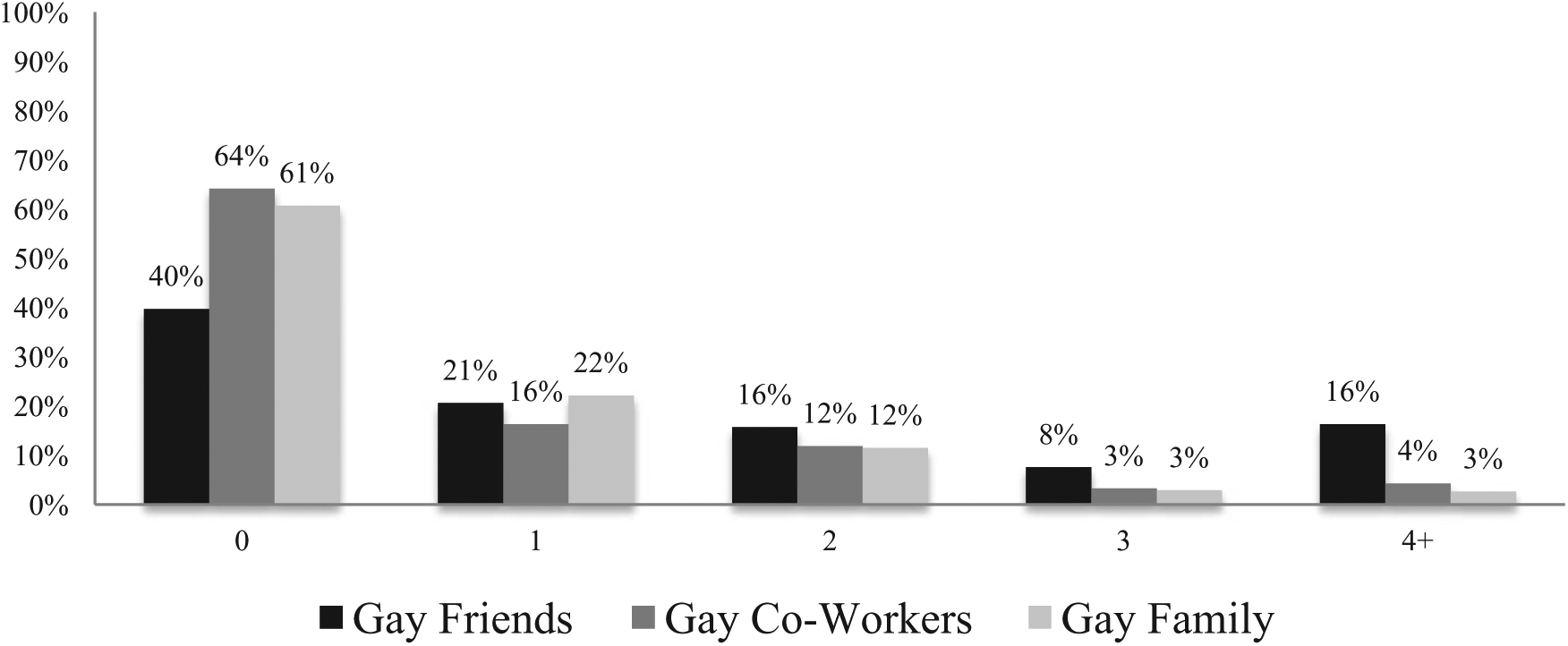
Percent of individuals who report having 0, 1, 2, 3, or 4+ gay friends, gay coworkers, or gay family members (N for each = 790).
In Figure 4, we provide an overview of each of the social contact variables and the distribution of respondents among those variables. The results are quite striking because it is plain that a much higher percentage of respondents report having 4+ gay friends than either gay family members or gay coworkers. At least 4 times as many participants report having 4+ gay friends as they do of either gay relatives or gay coworkers. In addition, over 60% of respondents reported having 0 gay coworkers or 0 gay family members, while only 40% of respondents reported having 0 gay friends. While this should not be too surprising, the results are dramatic, nonetheless. The differences noted across each social contact category (friend, coworker, or family member) is not a trivial number because it allows us to determine if the number of gay contacts makes a difference and not simply the fact that a person has at least one gay contact, which is a point we noted above.
Turning attention to Model 1, in which the primary or social contact variables were operationalized as dichotomous measures, none of the gay contact variables achieve significance. Indeed, the social contact variables do not even approach significance, suggesting that mere contact is insufficient to bring about an effect. So, our first hypothesis that interpersonal relationships will produce a positive effect cannot be sustained. Moreover, the media variable also does not achieve significance. Surprisingly, the media variable performed quite poorly in both models, having no significant relationship whatsoever with the dependent variable. Even so, we acknowledge that the wording on the media question is suboptimal because the question only asked if respondents watched a TV series that “portrays gay characters in a positive way.” The reason that wording is suboptimal is that it does not include the term “lesbians,” which means it is possible that respondents might not consider TV series that portray lesbians positively and were only considering TV series that portray gay men positively. Therefore, we are potentially understating media effects because we found no significant relationship. In any of our discussion regarding the effect or lack of media effect, the deficiency of the question should be kept in mind. Regardless of the question’s defect, at this point, we must dispense with Hypothesis 3 suggesting media exposure may have an effect on whether or not individuals perceived the word gay as a slur. With the data available to us, media does not have an effect. It may be the case, however, that a more nuanced question could identify an effect that we were unable to discover (see Table 2).
Model 1: Predicting Offense at the Use of the Word Gay as a Slur.

p < .05. **p < .01. ***p < .001.
Outside of the demographic variables, the one variable that has any connection at all with issues revolving around gays or lesbians is the variable gay rights salience. Those participants who mentioned gay rights as one of the top three most important problems facing the United States are more than two and a half times more likely to take offense at the use of the word gay, Exp(B) = 2.265; p < .01. This confirms Hypothesis 4, which posited that respondents who perceive gay rights to be an important issue in today’s society will be more offended. Nevertheless, the number of individuals who fall into that category is small, comprising about 5% of respondents in the model. Finally, the egalitarianism scale also achieved significance, having a positive impact, Exp(B) = 1.083; p < .01. By way of contrast, the traditionalism scale had a negative impact, Exp(B) = .942; p < .05. In other words, those who are more likely to embrace ideas of fairness and equality are more likely to be offended while those individuals who embrace a more traditional view of life are less likely to be offended.
With respect to the demographic variables, both sexual orientation and the sex of the respondent are significant and in the expected direction. Females are more likely to be offended, Exp(B) = 2.096; p < .001, as are gays or lesbians, who are three times more likely to be offended than heterosexuals, Exp(B) = 3.731; p < .01. None of the religious variables achieved significance. Neither age nor race achieved significance, which is unsurprising.
With Model 2, the social contact variables are operationalized normally to capture the effect of intensity of contact, the most notable point is that gay friends emerges as a significant variable and with the anticipated effect, Exp(B) = 1.206; p < .05. Except for the traditionalism variable, the other variables repeat the patterns seen in Model 1, with both sex and sexual orientation being significant.
The religious variables are interesting and consistent across both models. Attendance was significant with an odds ratio of almost 1.4 (p < .01), which is inconsistent with our expectations. What is not consistent, however, is the direction of coefficient. We expected that increased attendance at religious services would result in less probability of being offended at the use of the word gay as a slur. Increased attendance at religious services results in respondents being more likely to take offense. The religious traditions variable, however, fared very poorly. The only religious tradition that differs significantly from Protestant Traditionalists, which is our reference category, is Roman Catholics. It is Roman Catholics who are less likely to be offended than Protestant Traditionalists. Our expectation was that Protestant Traditionalists would differ significantly from both Protestant Modernists and from agnostic/atheist/seculars, with Protestant Traditionalists being the tradition that is much less likely to take offense at the term. Clearly, this is not the case.
So the models have two curious findings with respect to religion. First, they suggest that those who attend religious services more regularly are more likely to be offended. And second, Protestant Traditionalists are not less likely to be offended than any other religious tradition. Because the effects are in the opposite direction of what we would expect, to investigate further, we ran the model with religious attendance entered as a categorical variable so as to determine how the various categories compared (data not shown.) When run as a categorical variable, the reference category is those respondents who never attend religious services. While the variable as a whole is significant at p < .05, the only category that is significant is those who attend religious services once per week. Those respondents are more likely to be offended than those who never attend religious services. This is still curious. Though contrary to our prediction, these results are similar to those of Pascoe (2012).
In a study of high school students, Pascoe’s study suggests that Christian sects buttress male power through their religion’s teachings which means that Christian males may feel less of a need to use terminology that reinforces male or heterosexual dominance. It is important to note that Pascoe does not suggest that Christians are less homophobic or less interested in maintaining gender inequality. Christian males simply express it in ways that do not depend on interaction; they rely upon institutional claims that their religion provides.
The most important finding within Model 2 is that the variable of gay friends was significant (p < .05). See Table 3. This finding is consistent with Herek and Capitanio (1996) who found that multiple contact with gays resulted in more favorable attitudes toward the group. As those authors propose, it may simply be the case that multiple exposure produces a number of benefits that leads individuals to demonstrate more favorable opinions toward the groups or, in our case, more sensitivity to issues that the group may face. First, multiple exposure would seem to suggest to individuals that there is diversity within the group. Certainly, we would expect that two individuals, even though they share a common characteristic such as their sexual orientation, would be different. This variability could easily have a positive effect on attitudes toward the group. A second effect that Herek and Capitanio note is that the variability prevents one from discounting a single member of the group’s behavior as being uncharacteristic. Finally, Altemeyer (2002) reaches a similar conclusion that contact with gays or lesbians works to demonstrate that stereotypes are incorrect and thereby reduce prejudice. We believe that a reduction of prejudice then would lead to people being more sensitive regarding how their words are perceived by that outgroup.
Model 2: Predicting Offense at the Use of the Word Gay as a Slur.
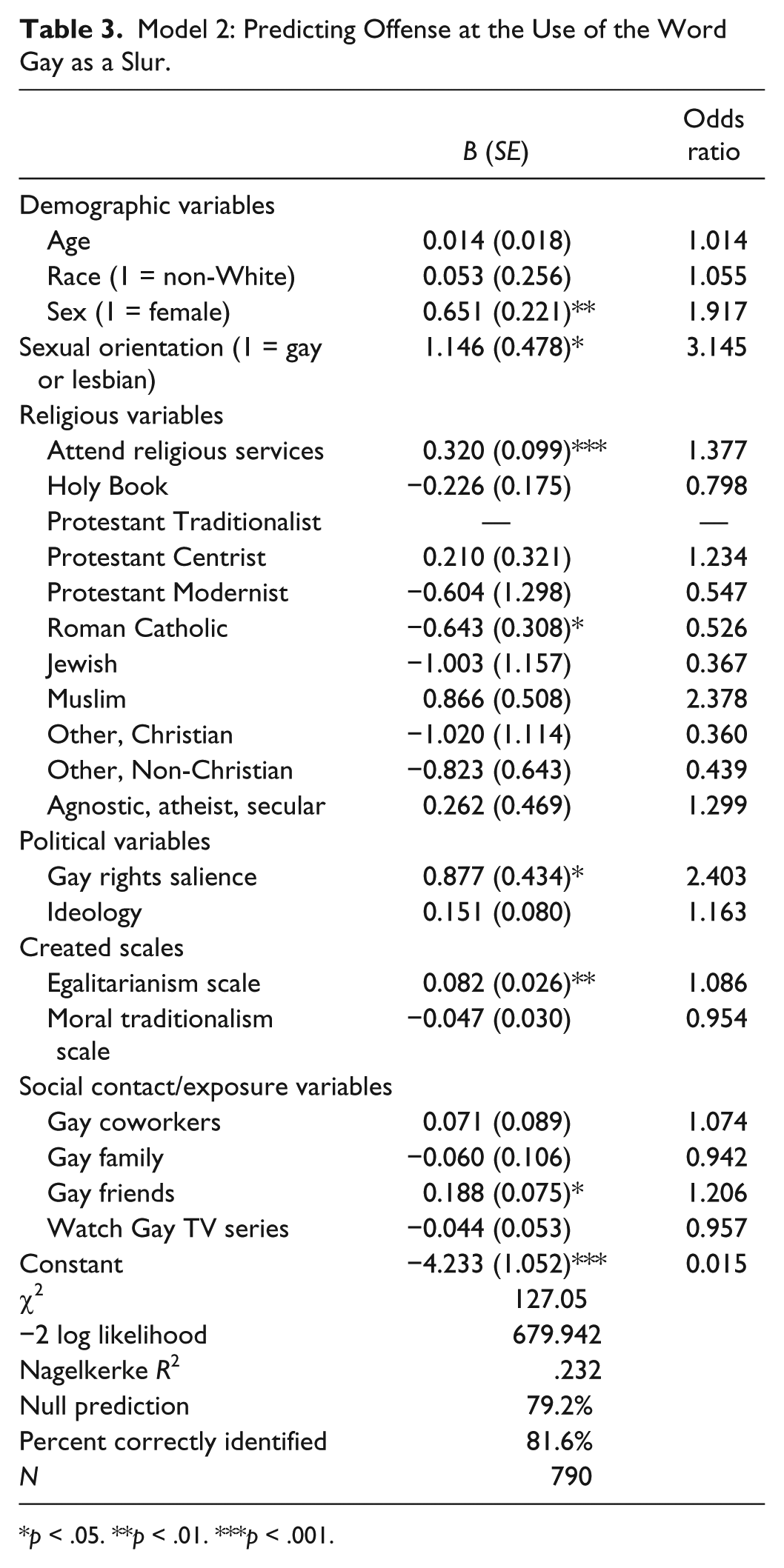
p < .05. **p < .01. ***p < .001.
Conclusion
In this article, we examined four hypotheses related to the perception of the word gay as a slur. In this section, we summarize those four hypotheses and offer a short reflection on each. First, we address Hypotheses 2 and 3. Our second hypothesis suggested that women would be more likely to be offended than men. This held to be true and is consistent with the literature. On this hypothesis, we have no new insights to offer. Our research on this point is simply confirmatory and unremarkable. The third hypothesis focused on the effects of the media. We found no effects of the positive portrayals of gays in the media. Within our survey, we even asked participants to list the TV series that they watch monthly or that portray gay characters in a positive manner. The three most mentioned series were Glee (n = 71), Modern Family (n = 127), and Will and Grace (n = 39). Even when we ran logistic models with those shows entered as a variable in place of the more general question that we ultimately used, media was not significant. It may simply be the case that we expect too much from the media. This would suggest, however, that any hand wringing that occurs today by conservatives about the negative impact of exposure to the so-called liberal media may be misplaced. Another possibility is that our measure of the media was not nuanced enough to capture the effects of media. We noted that the media can still use stereotypes to portray gays or lesbians and that not all sympathetic portrayals in the media are positive. It seems that analyzing the effects of media is not something that can be easily accomplished with cross-sectional data, if at all. Further research on this issue should probably consider using an experimental design.
Our first or primary hypothesis was that interpersonal contacts would have a significant effect. We have found relatively strong, albeit a bit uneven, support for this hypothesis. While neither gay family members nor gay coworkers proved to be significant variables, gay friends was significant when it was entered normally so as to allow for intensity. That is to say, when it was measured so as to demonstrate that respondents had multiple contacts with gays or lesbians, the variable results in individuals who are more likely to take offense at the term being used derogatorily. This is consistent with previous studies and is our main contribution to the literature.
Moreover, it is actually an important finding that neither gay family members nor gay coworkers emerged as significant. Indeed, the fact that they are not significant actually may support the finding noted above. It should be remembered that the number of respondents who report having 4+ gay family members or 4+ gay coworkers is quite small. The same pattern holds for those report having 3 gay contacts in each category, with twice as many respondents reporting having 3 gay friends than reporting they have 3 gay family members or 3 gay coworkers. One of the limitations of the study, however, is that we have no data on what those relationships look like or how intense those relationships are. In other words, we assume that the relationships are positive and include regular interaction, but we did not ask any questions along those lines. We allowed participants to determine what they considered to be a close friend when they completed the survey.
A second important contribution to the literature is our finding that those who believe gay rights to be a salient issue today are more likely to be offended by the use of the word gay as a slur (Hypothesis 4). It would seem that these individuals would be more apt to take notice of the word being used derogatorily than those who do not see gay rights as a primary issue today. In some ways, this would be an unremarkable finding except for the fact that gay marriage is again in the news today. The attention that gay marriage has been recently receiving could start a dialog on other issues revolving around gays or lesbians. If the issue continues to be highlighted, the greater exposure could result in more people viewing the issue as an important one facing the United States today. If that is the case, then there might be more awareness that terminology seeking to marginalize a group of individuals is unacceptable. Future research should explore the impact that finding gay rights to be salient has on perception of terminology used toward gays or lesbians.
Footnotes
Appendix A
Appendix B
Appendix C
Reltrad Coding a
| Coding for respondents who indicate they are not born again |
||||
|---|---|---|---|---|
| Frequency of church attendance |
||||
| View of Bible | Non-attenderNever attends | NominalOnce/year | InfrequentSeveral times/year | FrequentWeekly or more |
| Actual Word of God | Centrist | Centrist | Traditionalist | Traditionalist |
| Inspired Word of God | Centrist | Centrist | Traditionalist | Traditionalist |
| Written by men/other | Modernist | Centrist | Centrist | Centrist |
| Coding for respondents who indicate they are not born again |
||||
| Frequency of church attendance |
||||
| View of Bible | Non-attenderNever attends | NominalOnce/year | InfrequentSeveral times/year | FrequentWeekly or more |
| Actual Word of God | Centrist | Centrist | Centrist | Traditionalist |
| Inspired Word of God | Centrist | Centrist | Centrist | Traditionalist |
| Written by men/other | Modernist | Centrist | Centrist | Centrist |

Upon request, the SPSS syntax is available for review.
Declaration of Conflicting Interests
The author(s) declared no potential conflicts of interest with respect to the research, authorship, and/or publication of this article.
Funding
The author(s) received no financial support for the research and/or authorship of this article.