




Abstract
This article mainly aims at examining the use of phrasal verbs in the written discourse of Omani student-teachers. The participants of the study composed of three groups: first-year student-teachers, fourth-year student-teachers, and a group of native speakers. Two production tests and one recognition test were presented to the participants to find out if they could produce and recognize phrasal verbs, especially idiomatic ones. The results of the study showed that phrasal verbs were rare or non-existent in Omani students’ writing. Hence, the researchers identified implications and provided recommendations through which Omani learners of English can be helped to use phrasal verbs efficiently in their communication.
Keywords
Introduction
There seems to be a consensus among those dealing with spoken and written English discourse of L1 Arabic users that the proper use of phrasal verbs is one of the most problematic linguistic areas for Arab learners of English to master. This notion was supported by Siyanova and Schmitt (2007) who stated that one of the most challenging aspects of learning English vocabulary by non-native speakers is developing native-like proficiency of phrasal verbs in both spoken and written English.
As a teacher of English for 7 years at Sohar University, the first author has observerd this outstanding phenomenon in the writing of Omani student-teachers of English. Those students who are going to be teachers of English do not or rarely use phrasal verbs in their writing, preferring their equivalent single-word verbs even though the use of phrasal verbs is more appropriate as they provide vibrancy to discourse as they “seem to be a lot more vivid and emphatic than their single verb counterpart” (Hampe, 2002, p. 110). This notion was supported by Chen (2007), who stated that phrasal verbs are frequently used by native speakers of English because of their “characteristics of flexibility, practicability, adaptability and efficiency” (p. 350). To validate the researcher’s personal observation regarding Omani student-teachers of English, this study will examine the types and frequency of the phrasal verbs used by Omani student-teachers.
Based on what has been stated above, the study sets out to answer the following questions:
Do Omani learners of English use phrasal verbs in their writing?
Do Omani learners of English use certain types of phrasal verbs and refrain from using other types?
Do they use such verbs in the same frequency that native speakers of English do?
Do these learners really avoid using phrasal verbs?
Are there any reasons why Omani learners of English avoid using such verbs?
Are there any proposed methods that teachers of English follow to encourage their students to use various types of phrasal verbs in their written discourse?
Phrasal Verbs
Phrasal verbs are intriguing linguistic phenomena as they are on the interface between the domains of syntax and semantics (Davies, 2009). They are commonly defined as linguistic units that are engendered from the amalgamation of a verb proper and a particle that can be an adverb, a preposition, or both. The meaning of such combinations cannot always be inferred from the meaning of the verb and the particle independently. Aldahesh (2009) supports this definition stating that a phrasal verb is a combination of two or three items (a verb + a preposition, a verb + an adverb, or a verb + an adverb + a preposition) which function as a single unit of meaning in the sense that its meaning cannot be deduced from the total sum of the meanings of its separate elements. (p. 1)
Consider the following example:
They did not
The authors of this article intend to adopt the definition introduced by Gardner and Davies (2007) who proposed a more functional definition of phrasal verbs stating that two-word items consisting of a lexical verb and an adverbial particle are to be considered phrasal verbs. This definition adaptation is based on the notion that in spite of the many attempts made by grammarians and linguists to distinguish between phrasal verbs, prepositional verbs, phrasal-prepositio-nal verbs, and other multiword verb constructions, these attempts, the authors believe, are of little instructional value for non-native learners of English who struggle to master this linguistic area.
Phrasal verbs are commonly divided into three main categories: non-idiomatic, semi-idiomatic, and fully idiomatic (Downing & Locke, 2006). Non-idiomatic phrasal verbs are characterized by their ease of comprehension as the verb and the particle keep their own meaning, for example,
The brothers
In semi-idiomatic phrasal verbs, the verb keeps its own literal metaphoric meaning while the particle is utilized as an aspectual marker of several kinds, for example,
The mother
The meaning of fully idiomatic phrasal verbs (the focus of this study) is too difficult to derive by only examining their constituents because of their inherent idiomaticity. For example, the meaning of the phrasal verb “look + particle” in the following sentences cannot be deciphered by simply looking at the constituents:
I will go back to work if I can find somebody to
We have been
Don’t
I am
A committee was set up to
All we could do was
Would you please
They have to
In the above examples, the change of the particle that follows the verb “look” brings about the change in meaning. These particles are perceived as adverbial particle because “they differ from mainstream adverbs in having very little semantic content” (Börjars & Burridge, 2010, p. 99).
Hence, what causes the difficulty for non-native speakers of English to utilize idiomatic phrasal verbs is that the meaning of the combination of the verb with the particle cannot always be inferred from the literal meaning of the verb and particle independently.
Phrasal verbs like most other English verbs could either be transitive or intransitive, for example,
The man
My car
The object can also be situated between the verb and the particle as in
He had wanted to
However, when the object is an unstressed pronoun, it is predominantly positioned between the verb proper and the particle as in
Can you
Intransitive phrasal verbs, whereby the verb is not followed by a direct object, are commonly used as directives and imperatives (Biber, Conrad, & Leech, 2002), for example,
Moreover, there is a phrasal prepositional verb that consists of a verb (intransitive/transitive) + particle + preposition, such as “come up with” as in
The student
Phrasal verbs are vital linguistic repertoire to acquire as they are “the most productive patterns of the English language” (Cubillo, 2002, p. 95) because of the perpetual combinations of verb + particle that increase overtime. This is, as McArthur and Atkins (1974) put it, mainly due to the productive nature of these kinds of verbs which can emerge at any time, in any situation, and within any context throughout the English language. The main reason for such continuous creation of phrasal verbs, according to McCarthy and O’Dell (2004, p. 144), is due to two fundamental variables, social change and the need to develop words to describe new phenomena. To support their viewpoint, the writers mentioned the following examples that have been recently used by native speakers of English:
After a whole week of birthday celebrations, I feel totally
He
They
I don’t really
I’ll
Sports promoters are trying to
The meanings of the above phrasal verbs are “have had enough of parties,” “praise very highly,” “become or make someone become totally happy,” “complete in a set of ideas,” “send a text message in reply,” “make something seem more exciting than it really is,” “relax completely, or not allow things to upset you” respectively.
Phrasal verbs are units that are claimed to be frequently associated with informal discourse because of their colloquial distinctiveness which situates them “at the informal end of the formal-informal continuum” (Waibel, 2007, p. 31). McArthur (1992) labeled phrasal verbs as units that “are often informal, emotive, and slangy, and may often contrast with Latinate verbs” (p. 774). Though the frequency of phrasal verbs in Davies’s (2008) the Corpus of Contemporary American English (COCA) depicts the fact that these verb + particle combinations are less frequent in academic writing compared to spoken, fiction, magazine, and newspapers (Figure 1), this does not make phrasal verbs rare in written discourse. This is because the total number of phrasal verbs in native speakers’ diverse written forms (fiction, magazine, newspaper, and academic) exceeds the number used in the spoken discourse (Figure 2). The utilization of COCA by the researchers is based on the notion that it provides us with real-life language use of native speakers of English. COCA has been used by many researchers due to its dynamic architecture and rich database. This, in turn, increases the reliability of the results that researches, including the present one, endeavor to reach.

The frequency of phrasal verbs in COCA.

The frequency of phrasal verbs in COCA.
The authors of this article believe that as phrasal verbs play an indispensable role in communication, they are frequently used by native speakers of English both in speaking and writing. A number of recent empirical studies such as Trebits (2008), Chen (2007), and Gardner and Davies (2007) analyzed the writing of native speakers of English and after a thorough analysis of these written texts, they found out that phrasal verbs are frequently used in the written communication of native speakers of English. The authors of this article have also arrived at the same conclusion. Though many grammarians and linguists assert that phrasal verbs are largely used in spoken language, none of the English written texts the authors have gone through is characterized by the non-existence of phrasal verbs.
Studies on Phrasal Verbs
There are several studies that examined the use of phrasal verbs by English as a Foreign Language (EFL) or English as a Second Language (ESL) learners. For instance, Yoshitomi (2006) explored the use of phrasal verbs by Japanese learners of English. The researcher concluded that phrasal verbs are used by native speakers more frequently than the EFL and ESL Japanese learners did. Semantically transparent phrasal verbs were used more often than semantically opaque phrasal verbs. Furthermore, the results also showed that ESL learners differ from EFL learners in their tendency to employ phrasal verbs in a native-like way. Uchida (2012) examined the implementation of phrasal verbs by EFL Japanese learners. The results indicated that Japanese EFL learners tend to employ semantically transparent phrasal verbs more than semantically opaque ones. However, the frequency of phrasal verbs tends to increase gradually with the increase of proficiency levels.
It is fundamental to note that the majority of the studies that examined phrasal verbs in the language of EFL and ESL learners encountered the phenomenon of avoidance of these multiword verbs. Schachter (1974) was the first linguist who uncovered the strategy of avoidance manipulated by learners when they find a structure difficult to use. Schachter stated, “If a student finds a particular construction in the target language difficult to comprehend, it is very likely that he will try to avoid producing it” (p. 213). She further criticized Error Analysis of being deficient in second language acquisition as it was unable to discover avoidance phenomenon. An interpretation of the term avoidance was presented by Kleinmann (1977) who supported Schachter stating that it is a strategy usually resorted to by L2 learners when they perceive that it is difficult to produce a specific target language word or structure though they have already been exposed to it. However, Schachter and his proponents did not highlight the fact that the strategy of avoidance might be the result of the learner’s complete ignorance of the structure rather than conscious avoidance. Studies that examined the avoidance of phrasal verbs include Liao and Fukuya (2004) who studied the phenomenon of avoidance in the discourse of Chinese learners of English. The results of the study showed phrasal verbs are predominantly avoided and both intermediate and advanced-level learners produce less figurative phrasal verbs. Kweon (2006) studied the use of phrasal verbs by Korean EFL learners. The researcher concluded that the avoidance behavior of Korean EFL learners is influenced by “differences between first and second language, the inherent semantic difficulty of phrasal verbs, and developmental framework of interlanguage processes” (Kweon, 2006, p. 175). The use of phrasal verbs by Iraqi undergraduate students in the Department of English Studies in Kirkuk University was studied by Mohammed (2010). The researcher indicated that avoidance is a distinctive feature of the Iraqi students’ writings and it is determined by the level of the phrasal verb complexity, that is, the less transparent the phrasal verb is, the more it is avoided. Sara and Mohammadreza (2013) examined the use of phrasal verbs by Persian EFL learners. The results of the study indicated that the participants avoid using phrasal verbs, and the level of the semantic complexity of the phrasal verbs dictates the occurrence of avoidance in the student’s writings. Kharitonova (2013) examined the use of phrasal verbs by Russian and Norwegian learners of English. The results also showed that avoidance does exist and that negative L1 transfer also occurs whereby students employ phrasal verbs from their mother tongue that have an erroneous meaning in English.
Method
Participants
The sample of the study is composed of three groups. The first group includes first-year students who join the English Department at Sohar University after completing their foundation year; the second group consists of fourth-year students who have already finished their foundation year and seven semesters. A group of native speakers of English who teach at Sohar University in different departments composes the third group. The purpose of choosing first- and fourth-year students is to find out how far their knowledge of phrasal verbs is different due to their different levels of proficiency.
Design of the Study
The study underwent four procedures that revolve around two test types: recognition and production. The recognition test (see Appendix A) was devised to find out how far the two groups of students are able to recognize the phrasal verbs implemented by an English professional writer in a written text. The text in which 17 phrasal verbs are used was given to the two groups to underline all the phrasal verbs used by the writer. A 1-hr period was given to the students to complete the task.
On the production level of the test, the fourth-year students and the native speakers of English were asked to write an essay of about three hundred words on “A Day to Remember” to find out how frequently they use phrasal verbs in their written discourse. The participants were given 1 week to complete the task. It is fundamental to note that the students were strongly encouraged to solely rely on themselves so that remedial aid will be provided to help them in their writing. A comparison between the two groups’ written texts was subsequently conducted to find out the types and frequency of phrasal verbs they used in their essays.
Moreover, a group of fourth-year students were asked to choose the right phrasal verb from a group of phrasal verbs given to them (see Appendix B) to find out if they could use them properly after they had been exposed to them. A 2-hr period was given to the students to complete the task.
It is crucial to mention that in the recognition as well as production tests, explicit verbal instructions were given to the participants as well as a summary of the instructions was provided in each task to facilitate the participants’ comprehension of the tasks presented to them.
Discussion of Results
After investigating the underlined phrasal verbs by the two groups in the recognition test, the results are presented in Table 1.
Performance on the Recognition Test.

Table 1 shows that the second group performed much better than the first group. While 159 phrasal verbs were recognized by the first group, 285 phrasal verbs were recognized by the second group. Moreover, some participants of both groups underlined some constructions which are also composed of verbs and prepositions thinking that they are phrasal verbs, but they are not. It is obvious that the second group is more proficient in English than the first group because of the longer period that they have been studying English. These results are in line with Sara and Mohammadreza’s (2013) who emphasized that the frequency of phrasal verbs used by the students is dictated by their proficiency levels. Furthermore, Uchida (2012) indicated that the frequency of phrasal verbs increases gradually with the increase of proficiency levels. Figure 3 represents the results of the recognition test:
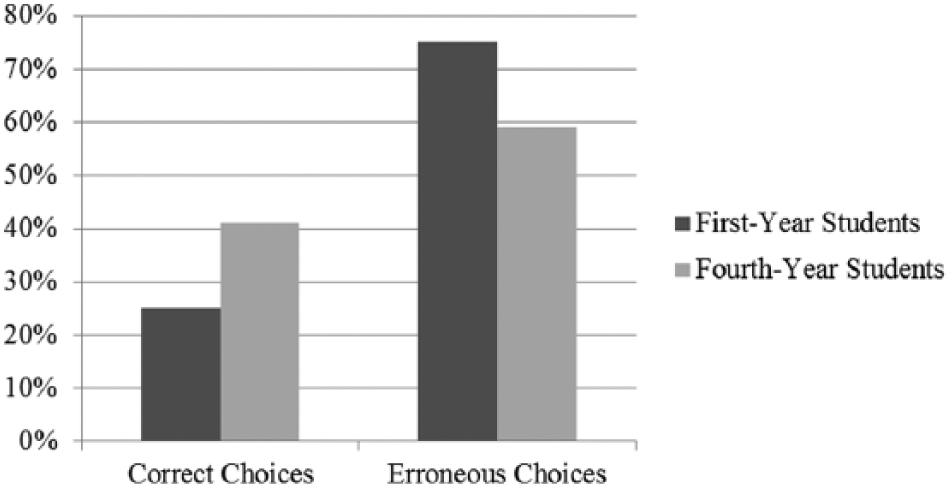
The performance of the first- and fourth-year students in the recognition test.
In the production test, the participants (fourth-year students and native speakers) were asked to write a three-paragraph essay on “A Day to Remember.” The first-year students were not asked to do this test because of their poor performance in the recognition test compared with the fourth-year students. Thus, the authors believe that focusing on the fourth-year students will be sufficient to understand their level of comprehension of phrasal verbs. After a thorough analysis of the essays, the results are noted in Table 2.
Performance in the First Part of the Production Test.
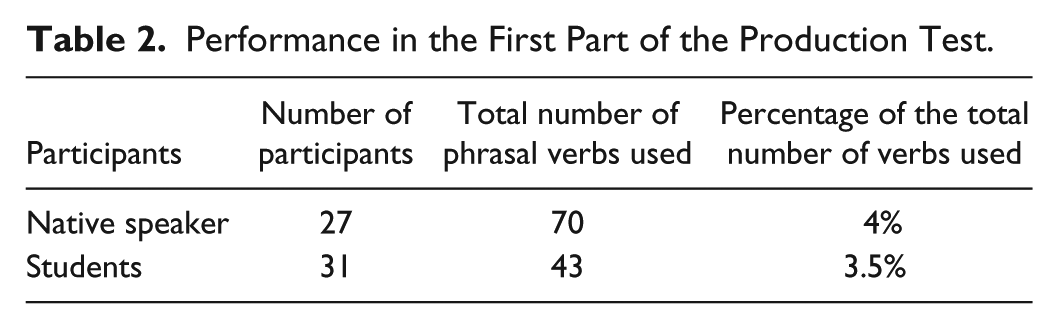
Table 2 shows that both native speakers and the students did not use many phrasal verbs in their writing. This is compatible with what was previously stated by many scholars that phrasal verbs are used informally in spoken language. However, when both groups’ usage of types of phrasal verbs was examined, students are more inclined to use non-idiomatic phrasal verbs whereas native speakers tend to use idiomatic ones. This phenomenon is supported by various researchers. Yoshitomi (2006) also emphasized that non-native learners of English tend to use semantically transparent phrasal verbs rather than the semantically opaque phrasal verbs. To understand this phenomenon, many texts written by professional writers were examined and, surprisingly, they show a tendency to use as many idiomatic phrasal verbs as possible. One of the writers (Alexander, 1964) wrote an essay that has the same title “A Day to Remember.” He used 17 idiomatic phrasal verbs in his three short paragraph essay. This gives an impression that using idiomatic phrasal verbs in writing by professional writers is a feature of this type of writing.
To examine whether the differences between the two groups’ implementation of phrasal verbs is significant, a two-tailed t test with two samples assuming unequal variances was conducted. The Table 3 represents the findings of the t test.
t Test Results.

The results of the t-test statistics, t = 4.53, df = 43, p < .05, indicate a significant variation in the use of phrasal verbs by native speakers and fourth-year students due to the fact that the native speakers used more phrasal verbs than the students did. To elucidate this phenomenon, the authors randomly selected 15 essay papers written by the student participants and examined their contents. The examination indicated that students rarely use phrasal verbs to an extent that there are some essays that have not a single phrasal verb. Moreover, there are instances in which the phrasal verbs are grammatically correctly used, but it is semantically inappropriate, for example, “I put my step in a new house.” Table 4 illustrates the analysis.
Analysis of 15 Selected Essays Written by the Student Participants.

After correcting all the answer sheets of the second part of the production test (fill in the blanks), Table 5 is presented.
Performance in the Second Part of the Production Test.

Again, Table 4 shows the poor performance of Level 4 students even though the list of phrasal verbs given to them represents a list of the 50 most frequently used phrasal verbs in native speakers’ academic writing. The list, retrieved from COCA, includes phrasal verbs given in Table 6.
Fifty Most Frequently Used Phrasal Verbs in Native Speaker’s Academic Writing.

A majority of students do not know how to use phrasal verbs even when provided with a list of them. The poor performance of the participants in this part of the test is expected due to the fact that the non-existence of such verbs in the learner’s repertoire causes him/her to lack adequate strategies to recognize and process them. This means that the avoidance strategy adopted by these learners simply resulted from their ignorance of this structure. Consequently, the phenomenon of avoidance of phrasal verbs arrived at by a number of researchers such as Sara and Mohammadreza (2013), Kharitonova (2013), Mohammed (2010), Chen (2007), Liao and Fukuya (2004) and Dagut and Laufer (1985), the authors believe, is inapplicable to this study.
Pedagogical Implications
The lackluster performance of the participants in the three types of the test indicates why those learners find it difficult to use phrasal verbs in their written discourse. A cause of this is likely the limited exposure of the students to English phrasal verbs in the Omani school English syllabus that is called “English For Me.” English For Me, which is a set of 48 books, is made up of 2 course books and 2 workbooks for each of the 12 school years. Hence, the researchers reviewed all 48 books to examine the type and frequency of phrasal verbs and they found out that only one exercise in Grade 8/B page 23 deals with phrasal verbs under the title “Language Focus” and is presented in Figure 4.

The language focus exercise Grade 8/B text book.
This is the only activity that focuses on the use of multiword verbs (phrasal verbs) during the 12 years in which students study English. The designers of the program even avoid using the term phrasal verbs in the exercise. Thus, Omani learners of English can hardly be familiar with phrasal verbs when using them in their spoken and written discourse. The syllabus Omani students are exposed to is in no way sufficient to help them use and acquire the various types of phrasal verbs in their spoken and written English. In this regard, many scholars like Gardner and Davies (2007), Gilmore (2004), Nesselhauf (2003), and Biber, Conrad, and Reppen (1998) criticized learners’ syllabi that are not based on research findings because the decisions about what to include in those syllabi are usually based on the author’s gut-level impressions and anecdotal evidence of how speakers and writers use the language.
Conclusions and Recommendations
This study examined the use of phrasal verbs in the written discourse of Omani student-teachers. The analysis of the results of the participant’s performance clearly shows that phrasal verbs pose problems even for advanced learners. Nonetheless, the issue is especially evident in the Omani student-teachers who learn English in a foreign language learning setting where the class is the only opportunity for the learners to study and practice English. The scarcity or non-existence of phrasal verbs in the writing of these learners of English means that “about one third of the English verb vocabulary” (Li et al., 2003, p. 513) is practically not a part of the learners’ repertoire. In addition, the learners’ incapacity to use phrasal verbs means that these learners will miss out on the growing number of phrasal verbs with new combinations appearing every year (Villavicencio & Copestake, 2002).
It seems evident that the students, unlike the natives, prefer to use single-word verbs to phrasal verbs especially idiomatic ones though the use of the latter is more appropriate. The result of this tendency is the absence or rarity of these verbs in their writing. Moreover, though native speakers of English do not show the inclination to frequently use these verbs, they, unlike Omani learners of English who commonly use non-idiomatic ones, use idiomatic phrasal verbs more than non-idiomatic ones.
The retrieved results lead to the recommendation that phrasal verbs should be given special emphasis with the aim of enabling the learners to achieve an effective and efficient communication in the English-speaking community. This can be achieved via modifying the syllabus to include the manner in which the most common phrasal verbs are used by native speakers in their everyday language. As phrasal verbs are inevitable in native speakers’ communication for their flexibility, practicability, and efficiency, it is, therefore, recommended that the elements of any Omani syllabus should be selected according to empirical corpus-based research findings to help in compiling a selection of naturally occurring language that can be very useful for teaching both spoken and written English. Selecting items for a syllabus, therefore, should not be in any way based on teachers’ and linguists’ intuition however experienced they are.
As such, this study has shown the difficulty Arabic L1 users commonly face in using phrasal verbs in their English written discourse, and how in particular their use of such verbs is in need of attention. Further research needs to be done into the effectiveness of various approaches to teaching these verbs, especially idiomatic ones, as it is clear that current product-based approaches are not equipping our students with the ability to use them. In this regard, the writers believe that the downward and upward approach recommended by Chen (2007) appears very relevant. The downward approach stresses the teaching of the components of phrasal verbs which students are familiar with. This is a psychologically strategic step by which learners feel that phrasal verbs involve nothing difficult, hence, they will be more confident to learn them. The upward approach is then applied via introducing the phrasal verbs that are used in daily communication.
Footnotes
Appendix A
Appendix B
Declaration of Conflicting Interests
The author(s) declared no potential conflicts of interest with respect to the research, authorship, and/or publication of this article.
Funding
The author(s) received no financial support for the research and/or authorship of this article.