




Abstract
The current experiment investigated the role of intentional-encoding instructions and task relevance at study on visual memory performance. Task relevance was manipulated by having participants keep a running tally of either the to-be-remembered objects or an irrelevant category of objects during study. Half of the participants within each level of task relevance were further instructed to remember one category of objects for a subsequent recognition test, and the other half of the participants were not informed of a memory test. Intentional-encoding instructions improved recognition discrimination only when participants were not already keeping a tally of the to-be-remembered objects. This result suggests that intentional-encoding instructions may improve visual memory via generic attentional modulation, not encoding-specific processes.
Human observers are very good at recognizing previously viewed pictures. In some of the most impressive demonstrations of this ability, observers studied hundreds or thousands of pictures and performed at rates well above chance on a subsequent recognition test (Brady, Konkle, Alvarez, & Oliva, 2008; Shepard, 1967; Standing, 1973; Standing, Conezio, & Haber, 1970; Vogt & Magnussen, 2007). Related work suggests that the representations supporting successful picture recognition are more abstract than visual sensory representations, but are nonetheless visually detailed (Hollingworth & Henderson, 2002). Thus, visual memory refers not just to memory for visually presented information but also to memories that are encoded in the “vocabulary of visual computation” (Henderson & Hollingworth, 2003, p. 68). In this conceptualization, visual memory is an integral part of object perception and recognition (Palmeri & Tarr, 2008). If visual memory is an integral part of recognizing visible objects, then it suggests that visual memory is used (more or less) continuously throughout the day. Given that we (as humans) do not typically have to stop and think about how to recognize objects—the visual system seems to do that more or less automatically—it follows that the processes involved in creating visual memories are carried out without our conscious intent. The question then arises, what happens when observers are intentionally trying to maximize encoding of visual information?
There are several studies in which one group of participants was told about visual memory test during a study phase, the intentional group, and another group was not, the incidental group (e.g., Beck, Levin, & Angelone, 2007; Block, 2009; Castelhano & Henderson, 2005; Varakin, Frye, & Mayfield, 2012; Varakin & Loschky, 2010; Williams, 2010). As reviewed below, it seems that intentional memory instructions have an effect on visual memory performance in some situations. However, it is not clear if the benefit derives from participants’ effective use of encoding-specific processes, or as a mere side effect of generic attentional processes. Encoding-specific processes would be those whose primary purpose is to enhance subsequent recognition. Such operations would be engaged in situations when an observer has reason to encode information in visual memory. Encoding-specific operations might be described in terms of the visuospatial scratchpad being strategically used to help transfer information into long-term memory (e.g., Baddeley, 2010). In contrast, generic attentional processes would be engaged whenever objects are recognized to be relevant to one’s ongoing task and may be described in terms of theories of object recognition (Palmeri & Tarr, 2008) or visual memory’s role in supporting online scene perception (Hollingworth & Henderson, 2002). Generic attentional processes lead to robust visual memory (e.g., Castelhano & Henderson, 2005; Varakin & Levin, 2006; Williams, 2010) but can still be referred to as “generic” because they would automatically operate across a range of tasks that require object recognition, not just tasks that explicitly require visual memory. One important point is that to demonstrate that intentional-encoding instructions engage encoding-specific processes, it is necessary to take into account the fact that generic attentional processes lead to robust visual memory.
However, in experiments that find a beneficial effect of intentional-encoding instructions on visual memory tasks, participants in the incidental conditions are often given a cover task that does not require processing the to-be-remembered objects as task relevant. This confounding of intentional-encoding instructions and task relevance is problematic because it is impossible to separate encoding-specific operations from generic attentional processing. For example, Beck et al. (2007) demonstrated that observers receiving intentional instructions were better at change detection relative to observers in an incidental condition who were only instructed to search for a pair of eye glasses within each scene. In visual search through natural scenes, observers tend to restrict fixations to regions that have a high probability of containing the target (Castelhano, Mack, & Henderson, 2009), which in the case of Beck et al. means that observers in the incidental conditions may have been less likely to fixate objects on vertical surfaces (e.g., clocks, pictures, etc.) than observers who were told about the change detection test. If the changing object was a picture on a wall, observers in the incidental conditions may simply have failed to look at the relevant objects.
Block (2009) also reports a total of five experiments, each demonstrating a beneficial effect of intentional-encoding instructions relative to incidental encoding instructions on memory for objects. In each experiment, objects were presented one at a time on a computer and participants were given a cover story or instructed to perform a cover task. In Experiments 1 and 5, participants were told the experiment was investigating how crowds affect moods, and in Experiments 2 through 4, participants were told to count how many cars were presented in the stream of objects. The incidental groups only received instructions for the cover task, whereas the intentional groups were additionally instructed to remember the faces or birds (depending on experiment) that were presented. The subsequent recognition memory tests only included objects from the category that participants in the intentional conditions were instructed to remember, which requires visual memory because all objects were from the same basic-level category (see Hollingworth & Henderson, 2002). Across a range of presentation durations (500 ms up to about 5 s), the intentional group performed better on the memory test than the incidental groups.
While Block’s (2009) results clearly demonstrate that intentional memory instructions have an effect on participants’ overall visual memory performance, intentional-encoding instructions and task relevance were again confounded: Individual birds (or faces) were task relevant for the intentional group, but not for the incidental groups. Objects in Block’s experiments were presented one at a time; thus, it is likely that participants in all conditions looked at the to-be-remembered objects during the study phase. However, looking at an object does not mean the object was processed: Fixated objects that are irrelevant to an ongoing task are often represented so poorly that their presence cannot even be reported immediately after their disappearance (e.g., Mack & Rock, 1998). In other words, the task irrelevant objects may not have been processed using generic attentional processes that lead to robust representation in visual long-term memory. While Block’s results clearly demonstrate that intentional-encoding instructions have an effect on visual memory, they leave open the possibility that generic attentional processes involved in object recognition were solely responsible for the benefit.
There are several studies in which intentional-encoding and task relevance are not confounded. These studies tend to find no difference between intentional and incidental encoding groups. However, many of these studies were not designed to directly compare intentional and incidental encoding conditions, but rather to address related questions. Castelhano and Henderson (2005) were investigating whether intentional memory instructions were necessary for visual memory to be encoded at all. As such, their comparison of interest was of incidental encoding to chance, not incidental encoding to intentional, so the intentional to incidental comparison lacked sufficient statistical power. In other studies, such as Varakin and Loschky (2010), the primary goal was to test whether the effects of other factors generalize from incidental to intentional-encoding situations. As such, in addition to low statistical power, participants were not randomly assigned to groups because encoding instructions varied across experiments, not within.
Williams (2010) did find effects of intentional-encoding instructions for certain kinds of objects. However, these effects were only observed when intentional-encoding instructions and task relevance were confounded. When unconfounded, Williams’s results suggest no effect of encoding instructions. The primary task in Williams’s experiments was a variation of a conjunction search, in which participants searched for targets among distractors within a stream of objects appearing sequentially at fixation. In Experiment 1 of Williams (2010), encoding was incidental and recognition accuracy on a surprise memory test depended on the object’s status with respect to the search task. Search targets were better recognized than distractors, and distractors that were related to the search target (conceptually or by color) were recognized more accurately than unrelated distractors. In Experiment 2, observers viewed the same sequences, but were simply instructed to memorize the objects—visual search was not performed. Under these conditions, memory for the objects that had been search targets got worse, and memory for unrelated distractors improved, relative to the conditions of Williams’s Experiment 1. However, as the comparison of Experiments 1 and 2 confounds encoding instructions and task relevance, it is not strong evidence that intentional-encoding instructions cause participants to engage encoding-specific processes that benefit visual memory. Indeed, in Experiment 3 of Williams, participants performed the same visual search task as Experiment 1 under intentional-encoding instructions. The results of the two experiments were statistically indistinguishable. Based on this overall pattern of results (which included two additional experiments not mentioned here), one of Williams’s primary conclusions was that intentional memory instructions do not improve visual memory. Note that while Williams’s findings clearly indicate that task-related variables influence visual memory (e.g., search targets were recognized better than distracters), the conclusion that intentional memory instructions have no effect is more tenuous for two reasons that were cited earlier. First, with 24 participants per experiment, the intentional versus incidental comparisons were likely underpowered for medium size effects (f = .25). Depending on how strongly correlated memory for different object types was, power (1 − β) may have been as low as .4, with a significance level (α) of .05 (for between subjects factors in a 2 between × 4 within ANOVA). Second, encoding instructions were manipulated across, not within, experiments, which means that participants were not randomly assigned to conditions.
Varakin et al. (2012) reported a study that addressed many of the methodological concerns of studies that have failed to find an effect of intentional memory instructions on visual memory. In their experiment, participants were randomly assigned to conditions, the sample size was large enough to detect medium effects, and the task relevance of the to-be-remembered objects was manipulated orthogonally with intentional memory instructions. Consistent with the idea that intentional memory instructions do not engage encoding-specific processes, participants in the intentional groups performed no better on the visual memory test than participants in the incidental groups. However, the task relevance of the objects during the study phase did not have an effect either, which is problematic because task relevance is what is supposed to account for the effects of intentional memory instructions in experiments like Block (2009) and Williams (2010). There are several plausible explanations for why task relevance had no effect in Varakin et al., but the general point is that the experimental method might have made it difficult to reveal the effect of intentional-encoding instructions for spurious reasons.
In summary, past work investigating the effect of intentional instructions on visual memory supports the general notion that in some situations, intentional instructions improve visual memory performance. However, it is not clear what causes the improvement. Several studies are consistent with the idea that intentional-encoding instructions do not cause participants to engage effective encoding-specific processes, and that any benefit intentional instructions might confer can be explained in terms of generic attentional processes related to making a subset of objects task relevant. However, because of several methodological issues with random assignment, low statistical power, and/or a failure to find effects of variables that should have an effect even if intentional instructions do not, any conclusions about the effect of memory encoding instructions must remain tentative.
The purpose of the current experiment is to further investigate the effect of intentional memory instructions on visual memory using a design similar to the experiments of Block (2009). Participants viewed a stream of objects and were later tested on their memory for the birds that had appeared. The task relevance of the bird pictures was manipulated independently of memory instructions, by having groups keep a running tally of how many bird pictures appeared (birds relevant) or how many car pictures appeared (birds irrelevant). Thus, for half of the participants in each of the encoding instruction groups (incidental or intentional) birds were task relevant. This design allows the effects of task relevance and intentional memory instructions to be evaluated. If intentional-encoding instructions enable participants to make effective use of encoding-specific processes, then visual memory should improve in the intentional conditions regardless of whether the to-be-remembered objects are already task relevant. If, on the contrary, intentional-encoding instructions do not engage encoding-specific processes, and the benefits instead derive from generic attentional processes, then visual memory in intentional conditions should be equivalent in all conditions in which the to-be-remembered objects are task relevant at study, regardless of whether they are relevant because of the intentional-encoding instructions of another task that does not explicitly involve visual memory.
Method
Participants
The participants were 200 students (169 female; M age = 21 years, SD = 5.46) from Eastern Kentucky University. Participants received course credit in exchange for participation.
Materials
The experiment was conducted on iMac computers with 21.5-inch (diagonal) wide-screen LED-backlit monitors set at a resolution of 1680 × 1050. SuperLab 4.0 (Cedrus, Inc., San Pedro, California, USA) controlled stimulus presentation and recorded responses.
Pictures of individual objects (birds, chairs, cars, and faces) were obtained from various public Internet resources (see the appendix). Each picture was resized to fit within a 250 × 250 pixel square, preserving the pictures’ original ratios. Backgrounds were changed to uniform white.
Design and Procedure
The experiment used a 2 (task relevance) × 2 (memory instructions) between subjects factorial design. For task relevance, participants were instructed to count birds (birds relevant) or to count cars (birds irrelevant). For memory instructions, participants were instructed to remember the birds, or were not told anything about a memory test. To achieve an acceptable level of power for detecting medium size effects (f = .25), 50 participants were randomly assigned to each of the four conditions, which yields power (1 − β) = .94 with α = .05 (power calculations performed using G*Power 3.1; Faul, Erdfelder, Lang, & Buchner, 2007).
Participants completed the experiment individually. After receiving verbal instructions, they were seated at a computer and given another opportunity to read over the instructions and ask any questions. Regardless of condition, the instructions informed participants which categories of objects would appear (birds, cars, chairs, and faces). In the study phase, participants viewed a total of 80 pictures (20 each of birds, cars, faces, and chairs), presented one at a time, at the center of the computer monitor. Each picture was presented for 1,000 ms; there was no delay in between successive pictures. After the study phase, participants were asked to report how many birds (or cars) they had counted. Next, participants were given instructions for a yes/no recognition test. There were 40 recognition trials (20 old and 20 new birds; which set of birds served as old or new was counterbalanced across subjects), each trial terminating upon participant response (input via the key board).
Results
Following Block (2009), recognition performance was analyzed using Snodgrass and Corwin’s (1988) recommended methods. A series of 2 (task relevance) by 2 (memory instructions) ANOVAs with hit rate (HR), false alarm rate (FA), recognition discrimination (Pr), and response bias (Br) as dependent variables were used to test for statistical significance. Descriptive statistics for HR and FA can be found in Table 1, and for Pr and Br in Figures 1 and 2, respectively. Analysis of Pr and Br are theoretically most important, though HR and FA are reported. Analyses were conducted using SPSS 21. Effect size measures f and d were derived from
Mean HR and FA for Each of the Four Conditions.
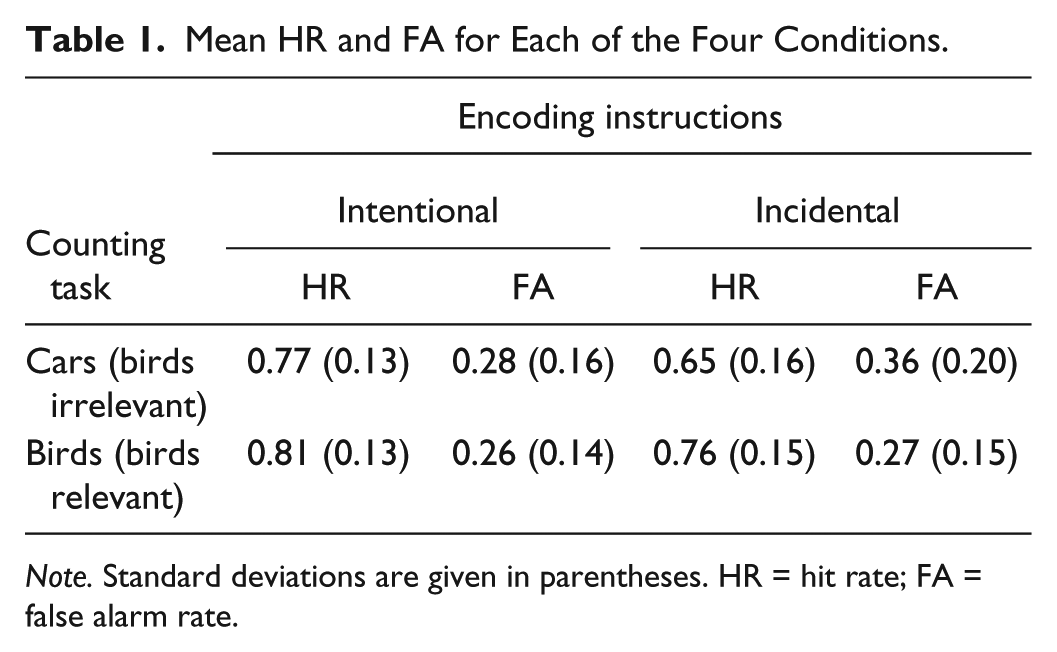
Note. Standard deviations are given in parentheses. HR = hit rate; FA = false alarm rate.

Recognition discrimination for the four conditions.

Recognition bias for the four conditions.
With HR as the dependent variable, there were main effects of task relevance, F(1, 196) = 12.34, p < .01,
With FA as the dependent variable, there was a main effect of task relevance, F(1, 196) = 4.46, p < .05,
With Pr as the dependent variable, all effects were significant: main effect of task relevance, F(1, 196) = 16.49, p < .001,
With Br as the dependent variable, only the effect of memory instructions was significant, F(1, 196) = 4.67, p <.05,
Discussion
The current experiment tested whether the effect of intentional-encoding instructions on visual memory depends on whether the to-be-remembered objects are already relevant for another task, in this case, a simple counting task. Intentional-encoding instructions improved recognition discrimination, but only when participants weren’t already keeping track to the memory relevant objects (birds). Participants who were only instructed to count cars during study had poorer recognition discrimination of birds than participants who counted cars and were told to remember birds during study. In contrast, in terms of recognition discrimination, participants who were only instructed to count birds during study performed just as well as participants who were instructed to count and remember birds. These results suggest that task relevance and intentional memory instructions both improved recognition discrimination, but in a non-additive manner. Overall, these results are consistent with the hypothesis sketched in the introduction that intentional-encoding instructions may not effectively engage encoding-specific processes. Rather, the improvement resulting from intentional instructions seems to derive from generic attentional processes that are engaged whenever objects are task relevant.
What are generic attentional processes? Attention is a somewhat murky concept, classically described as a capacity limited process that selects relevant information for further processing. However, recently it has been argued that attention is better understood as a set of characteristics that can be applied to several different kinds of cognitive operations than as a unitary process in itself (Chun, Golomb, & Turk-Browne, 2011). According to Chun et al., attentional characteristics may be ascribed to both external and internal cognitive operations. External attention would encompass processes such as object recognition, whereas internal attention would encompass processes such as encoding and retrieval of information in memory. The most relevant characteristic of attention for current purposes is modulated processing: Attention may enhance processing of some items, while reducing processing of others. The current result may be understood in terms of the external versus internal distinction. Specifically, intentional memory instructions may lead to benefits in visual memory not because they effectively direct internal attention (e.g., efficiently allocating resources so that objects will be distinctive and salient during subsequent recognition), but because of the effects such instructions have on external attention, specifically, enhanced processing that occurs whenever an object is relevant to an ongoing task.
Why might generic attentional processes lead to better representation in visual memory? The current results cannot provide a firm answer to this question, but is worth briefly speculating. According to several theories of visual attention, the various features of an object (e.g., color, shape, etc.) are not bound together into a single representational entity until an observer focuses attention on that object (e.g., Rensink, 2000; Treisman & Gelade, 1980). The resulting representational structure is often referred to as an object file (Kahneman, Treisman, & Gibbs, 1992), and one of their functions may be to help observers maintain contact with objects across the many kinds of brief disruptions that characterize vision, such as eye movements (Irwin, 1996). Because of the severe capacity limits of visual short-term memory (Luck & Vogel, 1997), maintaining a distinctive representation of an object in visual long-term memory in the form of an object file may be necessary to interact with an object over time scales that are behaviorally relevant (Hollingworth & Henderson, 2002). As such, upon recognizing an object as task relevant, the visual system may automatically store information about the object in visual long-term memory. How long visual memory retains the information about individual objects that are stored as a result of generic attentional processes is an open question, although past research using intentional-encoding instructions suggests very little loss of fidelity over the course 24 hr (Hollingworth, 2005).
Of course, there must be limits to how “generic” these putative generic attentional processes are, and future work will be needed further define these limits. In the current study, task relevance was defined in terms of whether an object will (eventually) require some kind of behavioral response from the observer. However, it’s not clear how far one could expand the set of task relevant objects and still observe the beneficial effect on visual memory that was observed here and in Williams (2010). Evidence from Varakin et al. (2012) and Williams suggest that making all objects task relevant, regardless of category membership, may not actually confer benefits on visual memory. Given that attentional processes are capacity limited and selective (Chun et al., 2011), it follows that generic attentional processes responsible for modulating visual memory would be similarly limited. Whether the limits are defined in terms of feature sets, number of categories and/or by some other dimension is an empirical question.
Up to now, the discussion has been focused on why generic attentional processes would enhance visual memory. A related question is why intentional-encoding instructions do not allow observers to improve visual memory performance over and above the effects of generic attentional processes. The current findings may seem a little counterintuitive, but there are several lines of research on memory and visual cognition that are consistent with the current findings. First, according to theoretical approaches to memory such as levels of processing (Craik & Lockhart, 1972; Intraub & Nicklos, 1985), intent-to-remember is a less important determinant of subsequent remembering than how material is initially processed. Consistent with this general idea, the current results suggest that generic task relevance, and not intent-to-remember, may be the main determinant of encoding in visual memory.
A second line of research consistent with the current findings comes from investigations of visual metacognition and metamemory: It turns out that people are not very good at identifying factors that affect visual awareness (Levin & Angelone, 2008) or memory in general (Simons & Chabris, 2011). Thus, even though there are modes of processing that can increase visual memory performance in settings very similar to those used in the current experiment (e.g., preference judgments seem to lead to better visual memory than basic-level naming; Lupyan, 2008; Richler, Gauthier, & Palmeri, 2011), if people do not know to engage in these modes of processing when trying to remember, it is likely that they will use less effective strategies. Indeed, in other tasks, trying harder to encode visual targets has been shown to negatively affect performance, at least as measured by participants’ ability to detect the second of two targets in a rapid-serial-visual-presentation task (Olivers & Nieuwenhuis, 2006). The basic idea is that people’s metacognition may be faulty: They are unaware of how visual memory works and are therefore unable to effectively improve encoding into visual memory when asked to do so. This idea would predict that improving visual metacognition would lead concomitantly to improvements in the effectiveness of intentional-encoding instructions, an idea that can be tested in future research.
The idea that faulty metacognition may partly account for why intentional memory instructions did not improve recognition discrimination over and above the generic effects of task relevance may also explain the finding that intentional encoding did influence recognition bias. Specifically, participants who expected the recognition memory test were more willing to claim that they recognized birds than participants who did not expect the recognition memory test. This finding was unexpected, although it can be explained in terms of faulty metamemory: If participants believe that intention improves encoding more than it actually does, it may induce overconfidence in the form of a liberal (i.e., less stringent) response criterion. This account is speculative. There are other factors, such as motivation, that may be affected by intentional-encoding instructions as well. Future research may include confidence ratings (or other metacognitive measures) and incentive manipulations (to control for motivation; cf. Olivers & Nieuwenhuis, 2006) to further clarify the nature of the effects of intentional memory instructions on response bias and recognition discrimination.
There are also several limitations to the current study that should be considered when considering our main claim about the effect of intentional-encoding instructions. First, the current experiment was designed with medium effect sizes in mind. As such, if the effect was small (f < .10), then the current design was unlikely to detect it. Thus, it may be more prudent to claim that the effect of any encoding-specific processes that may be engaged as a result of intentional-encoding instructions are small, especially compared with the effect of generic attentional processes. A second important limitation to the current experiment is the stimulus duration at encoding. During encoding, each object was viewed for only 1 s. While this is plenty of time for observers to recruit attentional resources for purposes of recognizing an object, operations that depend on elaboration and rehearsal might take longer to engage. Indeed, Block’s (2009) experiments suggest that increasing stimulus duration at study beyond 1 s can improve recognition discrimination. However, the effects of intentional memory instructions (in Block’s experiments) were usually of similar magnitude regardless of stimulus duration at encoding. In any case, the current results suggest that during the first second or so of encoding, the benefit of intentional instructions derives from generic attentional processes, but for longer encoding durations, future research will be needed.
In conclusion, the current results suggest that intentional memory instructions may not improve encoding of visual memory over and above the effects of generic attentional processes, although intentional memory instructions at study may induce a liberal recognition bias at test. Both the lack of an effect of intentional-encoding instructions on recognition discrimination and the presence of an effect on recognition bias may be explained in terms of faulty metamemory, although future research is needed to further refine this idea.
Footnotes
Appendix
Acknowledgements
The authors thank Kenra Frye and Bailee Mayfield for their assistance in preparing the stimulus materials, and Elizabeth Sinner for her assistance in collecting data. Michael Hout, Carrick Williams, and an anonymous reviewer provided valuable comments on earlier versions of this manuscript.
Declaration of Conflicting Interests
The author(s) declared no potential conflicts of interest with respect to the research, authorship, and/or publication of this article.
Funding
The author(s) received no financial support for the research and/or authorship of this article.