




Abstract
Vocational education aims to prepare competent workforce for the needs of continuously changing work life. A competent employee does not only carry out routine tasks but is also required to have the ability to act in the communities of practice in his field and develop his way of working. The challenge of Finnish school-based vocational education has been in creating such learning environments that promote learning professional knowledge demanded by work life. The challenge has required vocational teachers to develop their competences in collaboration with employers. The research covers the role of Finnish vocational teachers’ authentic work placement periods in developing competences from the viewpoint of sociocultural learning. During the work placement period, a teacher furthers his or her competences by working in goal-oriented and planned ways in the work communities of enterprises or in the public sector of their fields. The purpose of the present qualitative case study is to increase the understanding of the role of authentic work placement periods in vocational teachers’ competence. Experiences of teachers representing different subjects were studied during their work placement periods. The results show that work placement period supports the development of teachers’ competences and provides prerequisites for work-based vocational education.
Introduction
Vocational education’s purpose is to prepare competent workforce for the needs of work life, which is continually changing. The concept of professionalism is nowadays broader than before, and one cannot succeed by only doing strictly defined routine work (Appelbaum & Batt, 1994; Barnett, 2001; Boreham, 2002). Lifelong learning skills are required by employees, for example, ability to cooperate with colleagues and in professional networks of their fields, as well as, applying their knowledge to new situations and managing and developing their work (Engeström, 2001; Hager, 2001). Work is not only the thing that is learnt but also the context in which one learns (Guile & Griffiths, 2001).
According to Usher (2009), the professional competence of an employee is nowadays defined not only based on professional substance knowledge but also based on professional flexibility, lifelong learning, and social skills. Learning in work life is connected to the participation in the interaction process of the community. An individual acts in the cultural context of his profession and builds his knowledge as a member of the community in question, first in the margin and then after increasing knowledge in a more and more important role (Lave & Wenger, 1991; Wenger, 1998, 2009).
Changes in work life toward requiring initiative, interaction, and problem-solving ability have caused reevaluation of educational activities in vocational institutes. Border crossing between work life and educational institutes is desired (Engeström, 2001). According to Tynjälä, Virtanen, and Valkonen (2005; also Guile & Griffiths, 2001), education and training must be planned, implemented, and evaluated together with work life. Finnish vocational education has met these challenges by deepening contacts with work life, for example, by arranging learning-at-work periods which have become an important part of vocational studies.
The demand for work life cooperation also gives rise to the need for developing teacher competences (Stenström & Tynjälä, 2009). A vocational teacher must have, besides professional and pedagogical competences, communication skills needed in planning, developing, and evaluating a new kind of work life–oriented education (Helakorpi, 2007; Tiilikkala, 2004).
In successful work life cooperation, it is important for teachers to be aware of the situation in the field of their professions (e.g., Boud & Salomon, 2001; Griffiths & Guile, 2004). Various scholars (Cort, Härkönen, & Volmari, 2004; Eerola, 2007b; Tanttu, 2006) have underlined that to increase the teachers’ knowledge of work life and deepen cooperation, the teachers’ authentic work placement periods ought to be developed to correspond to the respective periods of students. The work placement periods were designed to span from 2 weeks to 3 months. During this period, the teachers work in the jobs of their expertise areas, either in enterprises or in the public sector.
The Finnish Ministry of Education and Culture started a developmental pilot project “Competent to Work Markets” for teachers in autumn 2011 as a part of the ESF (European Social Fund) projects of 2007-2013. According to the Finnish Ministry of Education and Culture (2011), work life skills should be developed during the work placement period and by participating in continuing education. The aim is to develop substance knowledge pedagogy as well as to create facilities to systematic cooperation between the work place and educational institution.
This research will examine how teachers experienced work placement periods with respect to both professional competence and pedagogical development. Professional knowledge was expected to become updated and professional awareness strengthened. Work placement periods were expected to offer possibilities to reflect on the aims, methods, and assessment criteria of students as well as the developmental trends in education together with work life representatives (e.g., Eerola, 2007b; Tanttu, 2006).
One of the authors participated personally in work placement periods and simultaneously acted as a participant observer in a concert project of vocational music teachers at conservatory. The project was planned and implemented together with professional musicians. Six (F = 6) musical performances were prepared, rehearsed, and presented in concerts during the years 2005 to 2009. According to the author’s experience, careful planning of the training periods was very important, because it was directly connected to the experienced successes. The central aim of all the preparations was the development of a teacher’s personal competence through the successful realization of the authentic work placement period.
The author’s experiences were in accordance with the research literature on work life learning, although the implementation was not typical. The work placement period was positive concerning professional competence, growth of professional awareness, and motivation.
This qualitative case study will examine how working in professional work communities is connected to the competence of teachers. The article will approach learning from the sociocultural viewpoint understanding the development of competence as constructing new knowledge and skills through joint processes in the communities of practice (Lave & Wenger, 1991; Wenger, 1998, 2009). The research will explain how acting in the communities of practice in the field of expertise will affect learning in vocational education contexts. The research questions were as follows:
The study will first examine the expertise and sociocultural learning of a vocational teacher. Next, the study will examine the role of a teacher’s work placement periods from the viewpoint of expertise development. The study outcomes will then be compared with the researcher’s personal experiences of his work placement periods in the field of music.
Increasing In-Service Teachers’ Professional Competence
The contents of an in-service vocational teacher’s competence are not permanent. Some researchers (e.g., Boreham, 2002; Guile & Griffiths, 2001; Usher, 2009) have noted that the needs of work life change as do education, technical development and production, and action policies. Organizational structures are flexible. Knowledge of educational areas, professional practices, and the expectations of vocational education also change.
In educational research (e.g., Bereiter & Scardamalia, 1993; Hakkarainen & Paavola, 2006), competences and expertise have been dealt with as practical, experiential knowledge. It is a feature which shows theoretical knowledge and practical skill as merged into professional competence. Becoming an expert requires a long and appropriate process of learning.
However, any experiences do not make an expert (Bereiter, 2002). In a changing work life, the core of expertise is the ability to solve problems. For that reason, expertise will develop in the duties which require problem solutions (Chi, 2006) as well as the ability to adapt the gained knowledge in new situations (Hatano & Inagaki, 1992).
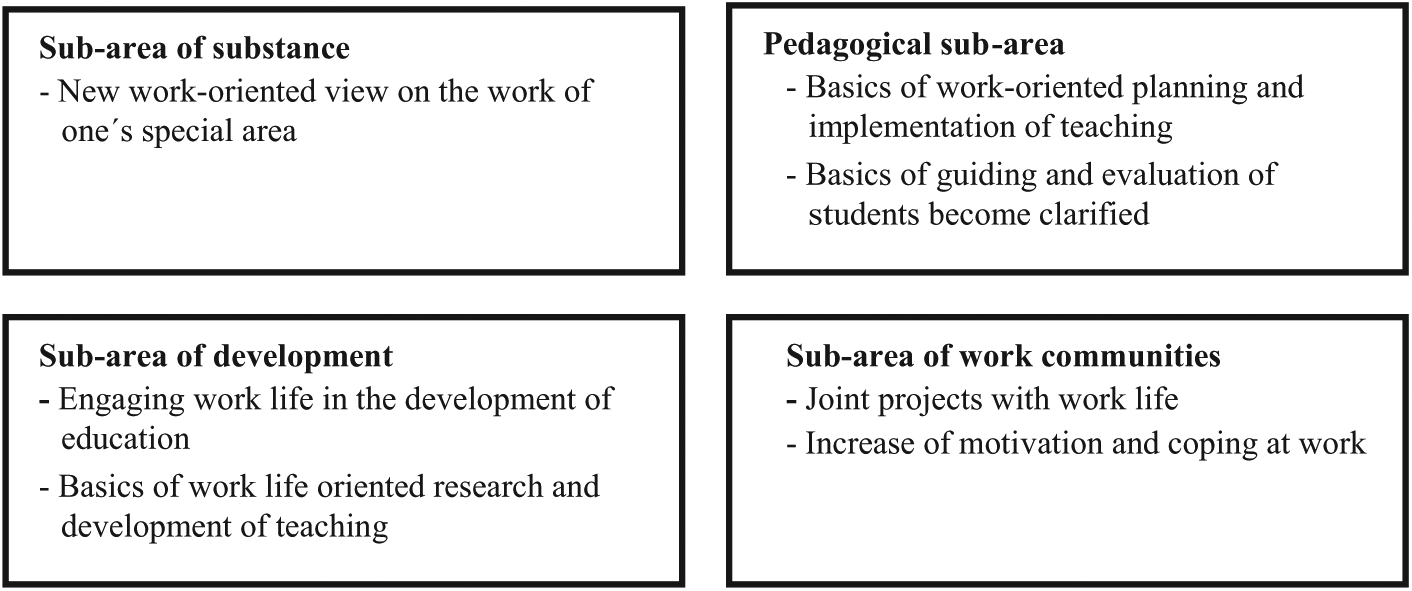
Helakorpi (2007) divides a vocational teacher’s expertise into four competence areas: substance, pedagogy, development, and working community (Figure 1). The two first mentioned are convergent with Tiilikkala’s (2004) classification. Helakorpi includes interaction and personality in pedagogical expertise but sees personal and work life–oriented developmental competences, as well as work community skills, as separate aspects. They emphasize the reflectivity of a teacher’s work, that is, ongoing observation and assessment, in various subareas of expertise as shown in Figure 1.

Vocational teacher’s expertise and the targets of reflection.
The figure shows how the development of expertise requires teachers’ continuing reflective observation of their actions. They have to assess their levels of competence and set goals for development. At work, they have to try to recognize the developmental goals and improve their achievements (Ericsson, 2006). Competence requirements presuppose keeping up with the times and anticipation of future changes. It is not possible only by acting in a school-centered way, but the teacher has to seek continuing education and practical experiences in work life (Illeris, 2011).
Social Dimension of Learning
To develop teachers’ competences in Finnish vocational education, teachers’ work placement periods are arranged to allow for teachers to work in authentic work tasks in the work places of their own fields (Finnish Ministry of Education and Culture, 2011). It is typical for these periods to be committed to sociocultural learning in communities of practice.
Lave and Wenger (1991) studied the apprenticeship learning, for example, in West African societies and noticed that learning was tied to the learners’ growing possibilities to participate in the activities of the communities. When studying the learning of a tailor’s apprentices, Lave and Wenger noticed that it was practical work that structured the knowledge and skills needed at work and added to the commitment to more responsible tasks. Through the experiences of authentic work tasks, they learnt the process of tailoring clothes, and the complexity of the tasks increased along with learning.
Wenger (1998, 2009; also Ardichvili, 2008; Kietzmann et al., 2013; Wells & Claxton, 2002) suggest that sociocultural learning takes place in small groups of cooperation, that is, communities of practice. They are joined together through three factors: joint enterprise, mutual engagement, and shared repertoire. The last-mentioned factor refers to the interaction traditions, artifacts, action, and concepts of the community. The members have common history and shared experiences which form the basis of certain ways of acting.
In the learning taking place in communities of practice, four starting points will be noticed: (a) man is a social creature which connects learning to social situations, (b) knowledge is competence connected to a certain matter (for instance, making music, repairing machines, writing poems), (c) knowing is participation to attain competence, and (d) meaning is the output of learning. Learning is connected to the social interaction of community (Wenger, 1998, 2009).
Reflection between members has an essential role as a part of goal-oriented communal learning. The starting points of action, process, and contents (e.g., the decisions made and conceptions followed from them) are evaluated critically, which promotes the construction of shared understanding, learning from others, and questioning everyday beliefs and matters taken for granted. Subsequently, the organized understanding will assist in dealing with arising situations (Mezirow, 2009, 1995).
Wenger’s views on the social character of learning can be seen as a communal interpretation of Russian researcher Lev Vygotsky’s theory on the importance of social relationships in learning. Vygotsky (1978) presented that learning takes place at two levels: (a) as inter-psychological construction of knowledge between individuals in social interaction and (b) as an individual’s intra-psychological process. In these both interpretations, interaction, action, and concepts have significant roles.
Research Design and Method
The aim of this study is to explain how work placement period is connected to an in-service teacher’s competence. The study examined vocational teachers’ (N = 552) experiences during the assignments, based on the reports of several work placement period projects (Research Question 1) as well as the researcher’s own experiences in work placement periods in the field of music (Research Question 2).
The research design was a case study and was intended to be the study of lived experiences. The data sets include written reports, background statistics, and classroom action/context participant observations. The data sources are complementary and yield detailed experiential information vocalized by the participants. The experiences of vocational in-service teachers were collected from the reports from the work life assignments and the researcher’s own experiences from notebook entries recorded during participant observation. It is typical in case studies to collect material in different ways, for example, from written sources, literary documents, and participant observation (Stake, 1995; Yin, 2009). The procedures make the researcher’s knowledge of the case more many-sided and build the basis of the research reliability and validity (Kothari, 2004).
The research material was analyzed by content analysis which is a widely used method in the systematic analyzing of different materials in qualitative research. When content analysis is used, the research material is organized thematically for the matter of interest to be interpreted and described clearly. The actual analysis is done, for example, of a text which can be either a literal source or written by the research persons (Schreier, 2012; also Krippendorff, 2004). In this study, the aim is to examine whether there is evidence of connections of work placement periods to vocational teachers’ competence according to the teachers’ own experiences. The theoretical framework for the examination was created by sociocultural learning in communities of practice.
Reliability is improved by the triangulation of inferences across multiple data sources. Case studies often tend to combine various materials and research methods and include several researchers in the process. This practice aims to decrease the influence of a single method on the results. Using multiple methods strengthens validity, when the researchers combine methods which are different from each other, for example, literal material and personal experiences, in examining the research objects (Cohen, Manion, & Morrison, 2007; also Denzin, 1988).
Results and Discussion—Advantage of Work Placement Periods for Vocational Teacher
The work placement period of multi-subject vocational in-service teachers means in this context a sequence of planned training in work communities or enterprises in the teachers’ fields of substance. The work places offer possibilities for updating and developing professional expertise and give perspectives to choose study contents for students to meet the future needs of work life after qualification (Cort et al., 2004). The earlier findings concerning teachers’ work placement periods and their benefits are introduced here first as a type of reference material which allows making comparisons to the new data collected and analyzed for this research.
The information service system of the ESF (2012) lists altogether 18 different vocational development projects in Finland from 2001 to 2007. Of them, 15 informed the number of the participants in the assignments; for a total of 376 teachers. In the Kokeva Start project, carried out over the years 2003 to 2007, 176 teachers participated in work life assignments, after which they evaluated their success (Eerola, 2007a).
The first finding was that according to the project reports (Eerola, 2007a; ESF, 2012), multi-subject vocational teachers (N = 552) felt that during their work placement periods they could create genuine interaction that was significant in the joint development of the education between schools and work places (cf. Wenger, 1998, 2009). The influence could be seen both in the promotion of teachers’ personal competences and concrete integration of the school and work place actions. Personal benefits include all fields of vocational teachers’ professional competences, as Figure 2 shows.
The most central benefits of teachers’ work life assignments compared with the subareas of expertise according to the feedback information.
The benefit from the cooperation is based on increased dialogue. Educational institutions, teachers, and work life have become closer to each other more productively than before (cf. Tanttu, 2006). The teachers’ comments in the present study describe how work placement period offers the possibility to reflect on daily action, improves expertise, and thus provokes new ideas concerning the development of education (cf. Mezirow, 2009, 1995; Olli, 2011).
I got a chance to do different kind of work than I had earlier got used to. So the work placement period widened my expertise. . . . we had very fruitful unofficial discussions at the coffee table on the challenges of the education for the job in question. . . . Due to these discussions my thoughts about the realization of demonstrating vocational skills were changed to a more realistic direction. The work life assignment was very rewarding and its contents many-sided. I went there to get substance knowledge, but I gained much more. New things and applications showed up daily in the form of development ideas and practical examples for teaching. It was rewarding to realize that previously acquired nursing expertise still exists in “real work.” Outstandingly nice were the customer contacts and the positive feedback that I have received from them.
The teachers found it easier to develop teaching methods toward greater work life orientation when they were concretely aware of the topical practices and policies in the respective working fields. During work placement period, the teachers also got an understanding of the situations in which the students are when they go on their learning-at-work training. However, they got the understanding of the challenges that a learning-at-work student brings to the work life.
Work placement period reminded me of the work life based attitude and thinking. In a teacher’s work thoughts easily circle around school and teaching. In the future I need closer cooperation with the enterprises than before. A learning-at-work student is firstly faced with many new things; time is spent getting to know the workmates and the practices of the work place. From the viewpoint of the employer, relatively a lot of time is spent on the initiation when compared to the expected benefit.
Second, for educational institutions, work placement periods offered a tool to observe the quality of education, a method to widen cooperation networks, a possibility to develop local and regional work life, and the educational organization as a service organization (cf. Frisk, 2014; Tanttu, 2006).
Due to the cooperation, work life was informed, for example, about the evaluation of a student and of the contents, purposes, and realization of curricula. Work life representatives also observed that they had been given a possibility to influence educational development (cf. Frisk, 2014; Tanttu, 2006). In Tanttu’s (2006) research, 70% of work life representatives responded that due to work placement periods teachers “can teach more practically,” and 43% responded that teachers “got new ideas for teaching” (p. 36).
What are the concrete results of work placement periods in the long term? To summarize, the following outcomes were found among the multi-subject teachers in the present research (Eerola, 2007a; ESF, 2012; Frisk, 2014; Olli, 2011; Tanttu, 2006):
Work motivation was improved.
Pursuit to maintain and develop work life contacts was increased.
Teaching plans and their implementation were developed to the direction of work life needs—The connections of learning at work and to educational institutions were improved.
Work places got interested in and were better informed about education.
The quality of learning at work improved.
Work Placement Periods in Music Education
In music education, the aim was to create an interactive model for cooperation between an institution and work life which also included in-service teachers’ work placement periods. The starting point was an approach emphasizing collaboration, interaction, and the context of learning (cf. Billett, 2002). Essential was the teacher’s chance to work together with a professional musician to plan and implement performances.
A challenge emerged to integrate the earlier mentioned aspects and work life cooperation. How can a teacher’s work placement period include active cooperation in both authentic music communities and constructive social interaction? Tasks connected directly to a musician’s work, crossing the border between education and work life, as well as the project work guided by a professional musician were all seen as functional solutions (cf. Jarvis, Holford, & Griffin, 2003).
Based on the above visions, a method was developed for music teachers to be suitable to workshop activities during work placement periods and to help teachers gain as much as possible from them. In the workshop method, teachers performed concerts together with professional musicians. Workshops included preparation of the music to be performed, personal instrumental rehearsing, as well as ensemble work. Workshops were concluded with an evaluation meeting in which the central matters of the final product and learning were discussed. Figure 3 presents the basic idea of the activities and the process.

The basic idea of the activities in the musicians’ workshop.
The figure shows that the action model in the workshop was flexible. It allowed variable productions according to the themes. Furthermore, the conversion to different needs and new purposes had been programmed into the model.
The first findings of music workshops, in other words, resembled that of multi-subject teachers: As a learning environment, the music workshops followed contemporary requirements and served the needs of work life and education in many ways. Participation at workshops was two-dimensional: It was about participating in workshop activities, but from a wider point of view, the teacher was also simultaneously engaging with the music community, in both of which the learning experiences were acquired by doing. Central to workshop activities was to realize the joint enterprise of producing music and carrying out a successful performance (cf. Lave & Wenger, 1991; Wenger, 1998, 2009). This will be one direction of developing work life assignments in the near future.
The second finding was the added value of the work placement periods (F = 6) in music; what the author experienced himself correlates to multi-subject vocational teachers’ work placement periods. The author had the chance to participate in the music community’s activities: test competences and skills concerning his substance knowledge in respect to the requirements of the field, for instance, in how to adopt artistically challenging music in a limited time.
Music was challenging especially due to tight comping and difficult playing parts. I did a lot of preparation work, i.e., listening to the original versions, writing down and of course playing. (TOP 07)
Success in the tasks of the work placement period required mutual engagement and relevant usage of shared repertoire from the members of the workshop.
Work placement period thus influenced the motivation of the music teachers, for instance, through the development of substance competence. Working together with a professional musician challenged one to reflect on one’s own competences and development needs. Through goal-oriented cooperation and practicing work tasks, the shared result was attained, which was rewarding (cf. Wenger, 1998, 2009).
The material this time was very challenging. Technically, playing presented challenges I had not earlier faced. It required a lot of personal practice. The professional musician represented, moreover, the top of the world in his expertise and was very demanding in the relationship with the playing mates. . . . (After the concert) it was nice to notice how we could perform the concert material together which felt impossible beforehand. (GH 09)
From a pedagogical point of view the work placement period made the author better equipped to guide the students’ learning-at-work trainings and to prepare them for the vocational demonstration tests. Reflective interaction and dialogue with professional musicians and their interest groups brought new views on the development and realization of various parts of qualification requirements (cf. Mezirow, 2009, 1995). Consequently, vocational demonstration tests via concerts were totally moved into work life, into authentic work contexts.
The goals of work placement periods were thus attained considerably well. The author received important experiences about the days of professional musicians and a good picture of their many-sided work. The thing to be developed most urgently concerns the length of the periods, which should be long enough to give a sufficiently clear picture of the work life of musicians. The author’s personal experience confirms and illustrates the research outcomes: The planning of the period started in the previous spring when we stated the contents and aims. Our idea was to perform the music of Miles Davis’ disc Birth of the Cool according to the most original versions. . . . Our orchestra consisted of teachers and professional musicians, to bring the viewpoint of work life into the activities of the workshop. . . . Work life was also represented by the concert houses where the performances were carried out. Marketing and advertising procedures were planned with them. I got a lot of experience on how to plan and implement a collaborative concert project in the network of music.
Conclusion
Vocational in-service teachers, both multi-subject and music teachers are important players in increasing cooperation between educational institutions and work life. Carefully planned and skillfully guided work in participants’ substance fields predisposes them to the up-to-date practices of the field and creates preconditions to benefit from them. Work life experiences offer them chances to (a) confirm their knowledge of the practices and work cultures in the field, (b) evaluate and reflect on the professional theory and practice of the field, and (c) make good use of refreshed conceptions to develop practices. Positive experiences from connecting theory to practice also added to their motivation to work or study and also the feeling of self-respect.
Cooperation with the professionals in the same field strengthened the teachers’ competence and growth in the membership of their work communities according to sociocultural practices (see Wenger, 1998, 2009). The work placement periods created a basis for a gradually deepening participation in the activities of the working community (see Lave & Wenger, 1991). During the work placement period, a teacher (a) participates in the action of the work community in authentic work situations and (b) shares joint goals and takes responsibility for them. (c) The action is based on the interaction between the members. (d) Knowledge is the competence connected to work, and (e) the members give meanings to competence and reflect on the work.
Cooperation opens opportunities to improve the quality of education. In-service teachers can develop curricula together and with work life representatives, develop plans for learning-at-work periods for teachers and students, develop plans for vocational demonstration tests, and prepare joint projects. They can also plan student guidance and assessment and work for quality assurance. Work life projects have changed the teacher’s role from a school official to the facilitator of learning, lifelong learner, cooperator, as well as a many-sided expert of vocational education. The change of roles will inevitably influence the work identities of teachers. In the future, a kind of swapping with work life will deepen the companionship of educational institutions and work life and benefit both parties: The teachers will share their theoretical understanding and practical knowing with work life representatives who will offer their collaborators real work life situations. Thus, both theory and practice will be intertwined.
Education should be compiled and based on a dynamic view of learning and teaching. It means education which is transformative and able to answer new demands. Theoretical conceptions behind the daily practices should be given attention to. Besides factual contents, that is, technical skills and content knowledge, the participants should increase their skills in acting in work life and their self-knowledge to end up in self-efficacy and autonomy. We should aim at both life-wide and lifelong learning and pursue a deep understanding of dialogical interaction in learning and teaching.
Footnotes
Declaration of Conflicting Interests
The author(s) declared no potential conflicts of interest with respect to the research, authorship, and/or publication of this article.
Funding
The author(s) received no financial support for the research and/or authorship of this article.