




Abstract
A mixed-methods study enabled the exploration of New York City high school data, analyzing performance/demographic scores based on principal and/or student gender, boroughs, and other factors found the following: Significant differences in boroughs’ college and career readiness scores, χ2(4, N = 369) = 26.830, p = .00, with (a) the highest mean rank of 251 for Staten Island, and the lowest mean rank of 156 for Brooklyn; (b) larger socioeconomically integrated schools more successful; (c) failure in small Manhattan and Bronx segregated/poverty female-majority schools; and (d) male students, F(4, 359) = 2.49, p = .043, partial η2 = .027, attained significantly lower scores. Enrollment was significant, F(1, 457) = 7.215, p < .05 partial η2 = .940, with male principals (M = 746.40, SD = 903.58) leading larger schools. Recommendations include the following: gifted vocational education school, gauging for feminization, more Black/Hispanic principals; and assurance of licensed vocational educators.
The Soviet Union’s achievement of being the first to transverse the space barrier with unmanned and manned vehicles could be considered one of the major defining moments in schooling for contemporary America. According to Brand and Johnson (2001), the Soviet’s feat led to the belief that the nation’s schools were deficient in math, science, and technology. Consequently, the National Defense Education Act (NDEA) was enacted in 1958 to fund and promote educational activities to advance the use of technology, and teaching and learning to strengthen national security. Similar to how NDEA was established to address the problem of technological readiness, the No Child Left Behind Act (NCLB) was established to address the increasing problem of poor school performance. Its purpose was to initiate a launch sequence to boost the nation’s sputtering schools out of the low orbit of failure for far too many children to a higher orbit—encompassing success for all children. This time, with NCLB as the boosters, public school principals were to be the thrusters that steered the ship.
The NCLB provided motivation to identify the most important factors contributing to school success or failure. Its mandate was driven, in part, by the need to address the failure of Black students (U.S. Department of Education [U.S. DOE], 2005). There is now a significant concern over the failure of male students (disproportionately Blacks), which is being blamed on the “feminization of schools” (Bradley, 2004; Chen & Addi, 1992; Mulvey, 2009; Steffenhagen, 2001). According to Bitterman, Goldring, and Gray (2013), in the 2011-2012 school year, 52% of the nation’s 89,810 public school principals were females of whom 64% were in primary, 42% in middle, and 30% in high schools.
Noteworthy, it has been suggested that within the White male (androcentric) establishment, which significantly controls school superintendencies, there are sectors cultivating bias against female principals; such an exercise is not the purpose of this study. The rhetoric from both sides of the debate is heated, situational, and personal. As such, Froese-Germain (2006) called for a dialogue informed by research. The findings of such possible research, demonstrated by the result in Figure 1, would provide empirical evidence revealing that in 18 years, females moved from 34.5% of nation’s overall public school principalship to the most recent 52%, a 17.5% gain. In the same time frame, Whites lost 4.2% of principalships (84.2%-80%), Blacks lost 0.1% (10.1%-10%), and Hispanics lost 1.1% (4.1%-3%). On the contrary, “Other,” which includes Asians, made a 2.2% gain. The significance of such result is as follows: Although Blacks and Hispanics made gains to now constitute the nation’s student majority, they lost principalship positions.
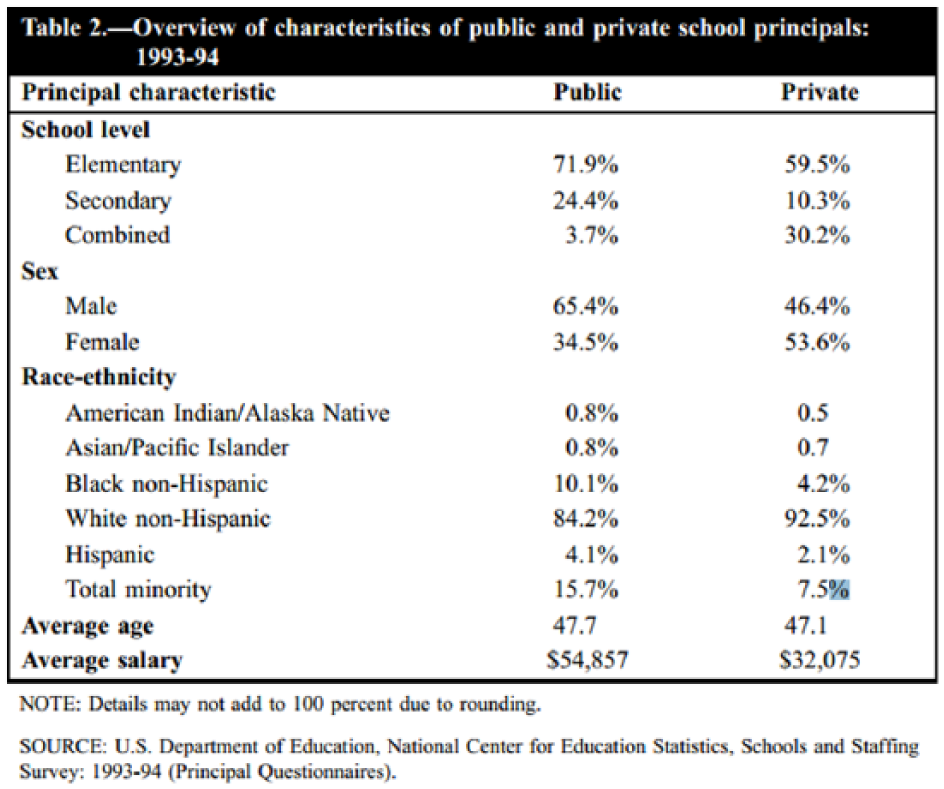
Characteristics of the public and private school principal for the 1993-1994 school year.
Purpose
The purpose of the present study was to examine the relationship, if any, between principal and student gender, New York City (NYC) high school performance scores, and/or other select moderators.
Definition of Key Terms
Large schools. Large schools are those with 1,000 or more students (U.S. DOE, 2009).
Medium schools. By default, for this study, medium schools are those with 451 to 999 students. These are the schools not within the range of small and large schools.
Small schools. Small schools are those with 450 or fewer students (New York City Department of Education [NYCDOE], 2013b).
Moderator. “Factors that affect the strength or the direction of the relationship between the intervention and student education outcomes” (Institute of Education Sciences, 2014, p. iii). Such could be a function of students’ demographic characteristic, or factors within schools, neighborhoods, or educators (Institute of Education Sciences, 2014).
Literature Review
Previous research has shown that gender-specific behaviors affect school principals’ practices and may affect the individual performance of students as well as the overall performance of schools. Females were shown to utilize a collaborative team approach that involves consensus-building in a system where males represented the established and idealized concept of leadership (Durrah, 2009). The idealization of male characteristics emanated from an androcentric perspective, whereby masculine values were elevated as superior and female values were discounted to make them appear inferior (Bethel-Jackson, 2005). Androcentrism has been described as a “pervasive cultural bias that affects interpretations of both gender similarities and gender differences” and is evident when maleness is the default value, resulting in “masculine pronouns being used to represent women and men” (Hegarty, 2006, p. 1). Addi-Raccah (2002) found that, under such conditions, female principals were more likely to appoint males as assistant principals (APs). Principals appointing APs may be the case in Israel, on which Addi-Raccah’s study focused, but it is not the case in NYC.
However, it is believed that as the power of U.S. female principals increased with their growing number, they were more likely to alter the gender composition of their schools’ pedagogical staff (Addi-Raccah, 2002). Nevertheless, several other studies have reported that the success of female principals is dependent on access to resources that are more readily available to male principals within their androcentric network (Jull, 2002; Mertz, 2006).
Freigruber (2009) reported that principals were a critical factor in school success and that characteristics related to their gender and race influenced the achievement scores of urban schools and principal behavior. The significance of principal behavior is found in Winfrey’s (2009) study “How Teachers Perceive Their Job Satisfaction Is Influenced by Their Principals’ Behaviors and Attitudes Related to Race and Gender,” wherein student academic performance was found to be a function of teacher job satisfaction. Notwithstanding that principals do not regularly teach, they are held responsible for student performance (Eginli, 2009).
While some studies found no difference in how male and female principals ran their schools (Lally, 2008), Durrah (2009) reported that teachers and principals perceived differences in behavior between male and female principals. She found that male principals exhibited leadership characteristics that were challenging in nature (i.e., nonsubmissive). Earlier studies also found that men were aggressive, assertive, and domineering (Eagly, Karau, & Johnson, 1992), which led teachers to prefer them as principals of high schools (Brooks, 2009). Shakeshaft (1987, as cited in Chen & Addi, 1992) also reported that females preferred males as principals. Another study reported that male principals were more successful at long-term planning, which is an important component of annual school performance indicators (Brooks, 2009). Finally, Chen and Addi (1992) found that more senior and higher ranked teachers worked more with male principals than female principals, and both male and female teachers expressed greater satisfaction working with male principals.
Female principals, on the contrary, were perceived as appealing to the heart, responsive, sensitive, and having a nurturing disposition (Durrah, 2009; Eagly et al., 1992)—qualities more conducive to working with children and endearing to some teachers and parents (Brooks, 2009). Furthermore, female principals were reported to have an affinity for lower socioeconomic status (SES) students, to be more engaging with teachers, and to be more effective at day-to-day running of the school, resulting in better daily performance indicators such as attendance (Brooks, 2009). Other studies revealed that students performed better and teachers were more involved, collegial, and cooperative with administration when the principals were females (Chen & Addi, 1992).
As the number of female principals increased, strong women principals could emerge to change the narrative that previously described such school leaders as token women. Token women lacked power, requiring some to either act as males to prove their competence, or be more prone to employ males as APs (Addi-Raccah, 2002). As previously noted, NYC principals do not employ APs, and so I digress to elaborate. In NYC, the process of hiring APs (or other administrators) was compromised to ensure whomever the principals or the superintendents wanted was hired. Such nepotism was routine, and it was for such and similar reasons that Chancellor Fariña issued new regulations mandating that all individuals wishing to become school principals or APs have either 5 or 7 years teaching experience (NYC DOE, 2014).
To return to the previous discussion, Kanter (1997, as cited in Cognard-Black, 2004) described token women as those few in an organization dominated by men. Such women were made highly visible, were more scrutinized, and were taxed with a higher expectation of success. Female Black principals reported being even more scrutinized and having to create a persona of authority and competence (Pollard, 1997).
As more females began to fill principal positions, a growing concern was the significant “feminization of schools” led by female principals compared with those led by males (Chen & Addi, 1992). Anecdotal reports depicting concerns about school feminization have been found in countries such as Australia, Canada, and New Zealand. Three examples are (a) Bradley’s (2004) publication “Why Boys Drop Out: Few Male Teachers; Feminization of Our Schools Hurts Boys,” (b) Steffenhagen’s (2001) “The ‘Feminization’ of Elementary Schools: Absence of Male Teachers a ‘Worldwide Puzzle,’ Professor Says,” and (c) Gray’s (2004) “Canty Boys Keen on Segregated Classes With More Physical Action.” Meanwhile, National Public Radio’s (NPR; 2011) “Are Single-Sex Classrooms Better for Kids?” is indicative of U.S. public debate on the matter.
A question relevant to the above concerns was found in the title of Chen and Addi’s (1992) article “Are Male Teachers in a Female-Dominated Workplace Gender Tokens?” Male teachers became opposed to the idea of being token males working in female-dominated schools, which decreased the likelihood that schools led by female principals would have more male teachers (Chen & Addi, 1992). However, these findings were contradicted by Cognard-Black’s (2004) study, which found that male elementary school teachers enjoyed more privileges and preferred working with female principals. Other studies have suggested that men who occupy seats of power in school administrations tend to promote actions and narratives that sustain and support the traditional patriarchal framework to maintain their career, power, and perks (Jull, 2002; Mertz, 2006). Such actions could impede the success of female principals.
With the number of female principals steadily rising, prior discussions around token women may no longer be relevant. However, Black and Latino females comprise a small percentage of public school principals (National Center for Educational Statistics [NCES], 2013a) and, as the demographic shift elevates their significance, White males who are predominantly school superintendents may hire Blacks and Latinos as token principals. The implication is that the closely guarded and hard-to-penetrate “old boys’ network” could deny Black, Latino, and other female principals, resources such as mentoring that they need to succeed at their jobs (Jull, 2002; Mertz, 2006).
However, Carter (2009) found that schools with mentored principals did not achieve higher performance scores than schools with nonmentored principals. Still, Citty (2010) found mentoring to be most effective at helping principals become successful school leaders. Based on the discrepancy, Citty revealed a list of other resources that will aid principal success. They include authority and autonomy, start-up funds, management teams, and access to advanced professional development that teaches how to use data to drive school improvement.
As asserted in numerous studies cited in Méndez-Morse (2004), mentoring was an established and recommended practice in the androcentric culture of educational administration. According to Schwiebert (2000), mentors “provide support to their protégés in an effort to remove organizational barriers, to assist protégés in negotiating the ‘system,’ and to provide protégés with opportunities for upward mobility” (as cited in Méndez-Morse, 2004, p. 3). Because mentors were likely to choose similar and like-minded individuals (i.e., White males) as protégés, those of a different race, ethnicity, or gender were generally overlooked (Méndez-Morse, 2004). Consequently, Black and Latino female administrators, who are often placed as leaders of difficult schools (NCES, 2013b), must contend with “isms” associated with race, ethnicity, and gender while being denied the needed help that mentoring could accord (Méndez-Morse, 2004) and those outlined in Citty (2010). Flores (2011) coined the term racialized tokens to describe Latina administrators serving the same token roles under White female principals as the White female principals served under male principals.
In Regents (1998), the New York State Education Department (NYSED) outlined the inextricable link between student performance and capable school leadership as well as the Regents’ calls for diversity in the state’s school leadership cadre. Children in urban schools, especially those belonging to racial minorities, need to see in their leaders role models with which they could identify and emulate (Ett, 2008). It has been opined that “administrators and staff should be accountable for their position as leaders and role models that students will emulate” (Anthony, 2008, p. 123). Méndez-Morse (2004) stated that school superintendents should be similarly held accountable as role models for female and minority school leaders. The NYSED’s plan to expand diversity in the state’s school administrative cadre was dictated by NCLB. An earlier mandate, Title IX, also addressed gender inequality in school administrations (Mertz, 2006).
As noted above, the NYSED action has implications for the success of NYC schools, especially those that are racially/ethnically segregated. It could help the many NYC male and female Black and Hispanic teachers who aspire to leadership positions in their schools but cannot get their foot in the door because of the barriers they face (Green, 2012). As principals, such individuals could help address the issue of teachers who, being oblivious to, or dismissive of, students’ culture or lived experience, resort to disciplinary actions that initiate students’ school failure (Graham & Erwin, 2011; Green, 2012). The school-to-prison pipeline is the common term used to explain the causal effect of such action. According to Editorial Board (2013), One unfortunate result has been the creation of a repressive environment in which young [Black] people are suspended, expelled or even arrested over minor misbehaviors—like talking back or disrupting class—that would once have been handled by the principal. (para. 1)
Apart from their fear of Black students (Green, 2012), the basis for such action on the part of many White school administrators is explained in Cohen (1973). She revealed that many Whites may lack frequent encounter with experienced Black teachers of their own age, who made impressive display of their skills and the role modeling of Black competence. In addition, they infrequently met (Black) authority figures who exuded confidence and an unequivocal and jovial (nondefensive) attitude regarding their ability to impart their skills to benefit Whites. Such Blacks would exhibit “equal status behavior” as opposed to the “diffused status characteristics,” whereas Whites expected them to assume an inferior role. Cohen reminds me of a White student-teacher colleague who, more than 25 years ago, revealed to the class that her first interaction with Blacks began with her tenure as a New York teacher. She revealed her opinion of them was informed by the media.
In 1997, Pollard, foreshadowing the demographic shift, discussed the paltry number of Blacks in school administration, the lack of research considering the interaction of race and gender, and the failure of researchers to illuminate the gender of participants referred to as minorities. (Of course, such statement may have been made with or without the knowledge of Cohen’s seminal work.) She (Pollard) further revealed the shortcomings of the few studies on Black school leaders, which rendered invisible the historical pedigree of their involvement in school administration and their success as administrators under the nation’s earlier segregated school system.
In addressing her concerns, a later study outlined the devastation that Brown v. Board of Education (1954) wrought on Black principals (Gooden, 2012; Karpinski, 2006). Some were summarily fired, forbidden to be administrators of White teachers or of schools with White children, made into janitors, or given menial tasks. Underlying this treatment was the propagation of the narrative depicting Black principals as callous, ineffective, or unqualified (Gooden, 2012; Karpinski, 2006).
The removal of Black principals from prominence as role models for children and members of the Black community certainly contributed to the current school failure of Black males and the corresponding adverse impact on those seeking career in education (Karpinski, 2006). The U.S. Secretary of Education, Arne Duncan, outlined the basis of the current problem in Graham and Erwin (2011), where he stated, “It is especially troubling that less than 2 percent of our nation’s 3.2 million teachers are African American males. It is not good for any of our country’s children that only one in 50 teachers is a Black man” (p. 398). The evolving shortage of Black male teachers resulted in fewer Black male principals (Greenlee, 1997; Madkins, 2011). Female Black teachers and principals were similarly affected (Berry, 2005).
Fairchild (2009) found that Black female principals were negatively correlated with White teachers’ job satisfaction. In contrast, Pollard (1997) found that Black principals used racial identification with Black students to bridge the barrier for White teachers, helping them better educate those students. These findings highlighted the need for principals to adopt practices that bridge achievement gaps between various student groups. According to Brown and Beckett (2007), the failure of Black students in segregated schools led to the employment of more Black administrators who were building on a practice of school and community leadership in separate Black education that involved extensive engagement with White school district officials and other individuals and groups, was able to facilitate communication between disadvantaged Black families and middle-class White teachers and school district officials, with the result that all stakeholders worked together effectively to develop policies and programs that improved student behavior and academic achievement. (p. 8)
Cooper (2006) described the pioneering work of a female principal, Leah Hasty, who established an all-Black classroom with a male Black teacher to provide a role model for Black Baltimore school boys, which resulted in a modification of NCLB. To advance Hasty’s work, the U.S. DOE adopted new rules giving public schools the option to establish single-sex schools and classes as long as equal opportunity and choice was available to all students (Cooper, 2006). The modification of NCLB by three U.S. Senators, including Hillary Clinton of New York, allowed principals in New York and other states to experiment with all-male school improvement initiatives (Cooper, 2006). In NYC, examples of such schools are the Eagle Academy, the Urban Assembly for Law and Justice, and the Bedford Academy. These were reasonably high performing schools, with all-male Black and Latino students and male principals who focused on learning rather than raising test scores (Rios, 2012).
The counterpart is the all-female student, and female-principal-led and high performing Young Women’s Leadership School. All-female schools generally outperform all-male schools (Cooper, 2006). While the NCLB modification is silent regarding the noted self-selected racial segregation of the schools referenced, given the gravity of school failure of Black and Hispanic students, the National Association for the Advancement of Colored People and other groups have also remained mute with respect to legal challenges (Cooper, 2006), giving principals the leeway to experiment.
While some studies explain that urban students’ success is influenced by principals who are role models by virtue of sharing gender and racial characteristics with students, other studies (Larsen, 2008; Toure, 2008) have described successful Black and high-poverty urban schools led by White male administrators. These studies outlined how some principals, with the aid of Black APs, were able to advance culturally relevant pedagogical practices described in Ladson-Billings (1995) 1 and serve as a bulwark against White staff members who would advance deficit-thinking theory to stereotype students and their families.
Deficit-thinking theory ascribes various labels to urban students and blames school failure on students’ unpreparedness to learn, parental disinterest in education, and family lifestyle (Ford, Moore, & Scott, 2011). In contrast, the literature contains several reports of high-poverty urban schools where both Black and White principals, male and female, were successful (Gerhart, Harris, & Mixon, 2011; Gulbin, 2008; Williams, 2008). Various keys to the success of such schools were their winning grant writers, embrace of parental involvement, collective efficacy, data driven assessment to improve teaching and learning, and/or mindfulness—a function of transformative school leaders (Gulbin, 2008).
With respect to the relationship between principal behavior and student gender, several studies reported that females’ collaborative and consensus-building style was being imposed on, and reinforced in, children from kindergarten to Grade 12 (Mulvey, 2009; Rowley & Wright, 2011). Such approach was reported to adversely affect the education of boys and was a factor in their academic lag behind girls (Johnson & Gooliaff, 2013). It was suggested that such a feminine approach to teaching and learning was incompatible with boys’ socialization and learning styles (Martino & Kehler, 2006). In addressing the problem with New Zealand boys, a principal revealed boys do not succeed “in the sit down, shut up and open your books environment” they have a kinesthetic (movement orientated) learning style that requires more physical actions (Gray, 2004, p. 1). In a U.S. study, Chambers (2009) found that males tended to be louder, more physically aggressive, and they exhibited classroom behaviors that forced teachers to engage in more male-dominated classroom activities. Boys in that study received 70% of the F grades. However, a solution may be found in Johnson and Gooliaff (2013) who wrote, Hawley and Reichert (2010) found that what works well for boys were lessons that: * produce products; * are structured as games; * involve vigorous motor activity; * give boys responsibility for promoting learning of others; * challenge boys to address “open” unsolved problems; * require a combination of teamwork and competition; and * introduce dramatic novelties and surprises. (p. 29)
As noted above, there is growing support for all-boys schools with males as teachers and administrators. However, some have expressed concern and caution against pigeonholing and warehousing male students as low performers (Cooper, 2006). “Despite the claim that male teachers are more tolerant of ‘hands-on’ learning, there is no available evidence that this actually produces better educational outcomes for boys” (Martino & Kehler, 2006, p. 123). Still, Green (2012) advocated a 21st-century Vocational Education (VE) Curriculum to address students’ school failure. Froese-Germain (2006) advised that attempts should be made to identify which boys were failing, rather than categorizing them all as failures based on their gender. Nevertheless, low SES boys generally do have poorer educational outcomes (Arnold & Doctoroff, 2003; Legewie & Diprete, 2012). Notwithstanding, a solution is possible.
Public school educators and parents have expressed support for single-gender schools (Chambers, 2009; Harris, 2009). Such support could compel principals to address the concern raised in Boys (“Let Boys Be Boys,” 2003), which reported, Educators are beginning to quantify an “enthusiasm gap” between girls and boys in co-ed public schools. The reason: Schools, especially elementary schools, have become feminized. Elementary school teachers and administrators, who once understood that boys will be boys, now act, at least, as though they expect boys to be more like girls. Their hostility to the male character—intentional or not—is turning boys off learning. (p. 1)
The NCLB has offered principals the means to eliminate maleness as an excuse for male student failure, just as Title 1 was earlier enacted to eliminate poverty as an excuse for the failure of low SES students (Ett, 2008). A history of the problem illuminates the issue. According to Ett (2008), way prior to NCLB (in 1935-1936), when rural schools were poor and failing, and the majority of the nation’s northern students were from prosperous families, because an influx of poor students began to enter northern schools, schools adopted a stance aimed at education of the majority. Thus, Ett (2008) revealed, “early attempt at ‘tracking’ created special schools for physically and mentally handicapped children” (p. 29). Those schools contained “special classes” filled with children who were considered “backward” or “disruptive.” These were unruly classes filled with a majority of boys, most of who suffered from no physical or developmental problems. They simply did not fit the profile of the normal child and were relegated to a limited education. (Ett, 2008, p. 29)
Given that NCLB requires success for all the nation’s schools, principals are situated at the forefront of this challenge, similar to how schools were similarly situated and challenged to regain the nation’s pride after the Soviet’s spectacular space success. Principals have the power to shape school culture and the tools to make a difference (Deal & Peterson, 1999). Irrespective of the challenges presented by their gender and other characteristics, they must possess the wisdom to guide change while navigating resistance (Evans, 2004). However, moderators and malleable factors influence school performance.
Socioeconomic Integration
Kahlenberg (2012-2013) has long advanced socioeconomic integration to correct the failure of Black (and Hispanic) urban students. He asserts that Blacks who attended (White) schools desegregated by socioeconomic integration attained greater school success than their peers in urban segregated schools. He revealed that the assertion angered Black leaders because they misunderstood him. The 1960 Coleman Report advanced similar argument (Mickelson & Greene, 2006).
Kahlenberg (2012-2013) reported that in desegregated White suburban schools, Blacks (and Hispanics) were exposed to their peers’ self-empowering linguistics, their middle-class values, and related social and cultural capitals. 2 He asserts middle-class values, not students’ color, was the most significant factor behind Black (or Hispanic) success in aforementioned schools. Such values included middle-class parents’ in-school involvement—which was more highly regarded and respected by school administrators. Herein one can understand the angst of Black leaders who challenged Kahlenberg’s assertion. They were being asked to accept that their children’s success impinged on the devaluation of their communities and the embrace of “Acting White” advanced in Fordham and Ogbu (1986)—which caused many smart Black youth to devalue achievement striving, not wanting to be isolated from, or ostracized, by their peers in their neighborhoods. The phenomenon is a troubling problem that needs to be explored. Many smart NYC Black youth may not get into the city’s specialized high schools for the reasons discussed.
In Search of Framework for a Model to Counter Blaming the Victims of Miseducation
Not everyone agrees with Kahlenberg (2012-2013). Many individuals (including educators) subscribe to deficit-thinking theory in blaming the victims (Blacks and Latinos) for school failure (Ford et al., 2011). Some studies highlight the dearth of Black role models in school leadership positions who could (a) provide a counter narrative in culturally relevant pedagogy advanced in Ladson-Billings (1995) or (b) the embrace of intercultural sensitivity wherein “they are willing to modify their behavior as an indication of respect for the people of other cultures” (Bhawuk & Brislin, 1992, p. 416).
However, other studies provide a framework for improving NYC urban schools. Examples are works such as Larsen (2008) and Toure (2008). They revealed successful Black urban schools led by White and Black male administrators. Again, the literature is informative, with studies (e.g., Gerhart et al., 2011; Gulbin, 2008; Williams, 2008) reporting successful urban schools led by either Black or White administrators, or both groups coleading schools to successful outcomes for students.
Notwithstanding the need for racial minorities to see role models in school leadership (Ett, 2008), the remedy must neither be underscored nor obviated with principals who are racialized tokens (Flores, 2011), token men, token females (Addi-Raccah, 2002; Cognard-Black, 2004), or those who are not reflective practitioners. Token individuals, especially given the condition of some male teachers’ reluctance to working with female principals, are unlikely to be up to the challenge, or possess the withitness (Barton, 2010) to educate NYC (difficult) youth. For example, as a VE teacher, I was subjected to the meet, greet, and discuss modus operandi of a White female AP; I thoroughly resented the process because I had never done such things before; I came out of a school where such activities were never practiced, and I frankly viewed it as feminine. Consequently, a charge of insubordination was lodged against me, which the White male principal overturned.
It is not that I lacked commitment to students. But interacting with male students who have been exposed to the criminal justice system, who may both look up and down on me (I am 6 feet tall and many students are more than 6 feet), who are street-wise, and who have been failed by traditional school required that I develop a different persona or a withitness to relate to them. The newly appointed AP lacked such withitness regarding her staff.
The emerging problem NYC schools must address is to avoid having administrators of either gender with no trade or industry experience flaunting NYSED regulation and leading VE or Career and Technical Education (CTE) schools. The problem has emerged because of the state’s Career Development and Occupational Studies (CDOS) requirements necessitating more CTE certified instructors and administrators. It is a problem similar to that where, under the Bloomberg administration, individuals with little or no teaching experience became school administrators, causing Chancellor Fariña’s previously noted action.
It is an imperative to address the problem because VE was found to encourage dropout-prone male students to complete their education (Green, 2012), and undermining the program with unqualified administrators is counterproductive and in violation of the NYSED laws and hurtful to students. Schools cannot grant CTE credits if the teachers are not certified, as some NYC schools/programs are presently doing.
VE
Chambers (2009) revealed how loud, boisterous, and physical male students received significant number of Grade F. Those students’ behavior could be frightening to teachers, and the resulting loss of class time due to office referrals or suspensions could contribute to the number of F grades given. However, previously referenced studies, and some I am currently undertaking in NYC schools, confirm that male students received significantly more Grade F compared with female students. A noteworthy contradiction is that in NYC gifted high schools, there are more male students, implying more gifted males received higher grades than gifted female students. According to the latest data, the majority of students in the city (and the nation’s) gifted schools were Asians (NCES, 2008). Nonetheless, various studies (e.g., Gloria & Ho, 2003; Zhao & Qiu, 2009) outline some reasons for their success and the problems Asians face with meeting the expectations of being the “model minority” and the poster child for academic success. The fact that students can be vocationally gifted (Green, 2012) warranted this line of discussion. It is also noteworthy that throughout the nation, Asians generally shun VE (Green, 2012).
Gray (2004) explained how male students need kinesthetically enhanced (mobile) classrooms experience. An example of such pedagogical practice/classroom facilities is provided in the School of Cooperative Technical Education (Co-Op Tech). It is an alternative education VE program in NYC’s District 79.
NYC school performance is also assessed on college or career readiness performance scores. The career component is the assessment of CTE/VE subjects taught in schools. Some of the city’s academic schools also offer CTE/VE. Co-Op Tech, established in 1946, is a model VE program that attracts many interested students, especially males who failed regular schools, or those sentenced by the courts to attend school as an alternative to incarceration. Students in the program are not subjected to the high-stake tests they faced in regular high schools. Many successful students complete their study with a high paying skill, and New York State (NYS) or industry licenses/certificates. Skills include plumbing, carpentry, computer repairs, welding, child care, vision care, building maintenance, and culinary arts. Male students enjoy the hands-on approach to learning, the competition, the interaction with male teachers and their no-nonsense approach—gained from their earlier experience as industry tradesmen. 3 Their interactions exemplify the vigorous activities recommended in Johnson and Gooliaff (2013) to address male students’ failure.
However, in a manner demonstrating the devaluing of VE in NYC (as it was eliminated from NYC middle schools), Co-Op Tech’s school building was sold by Mayor Bloomberg. Consequently, some teachers were left floundering to find new sites, while others were assigned to cold basements. Despite the problem, students attended the unsuitable classes. Other evidence of VE devaluation is its current use as programs to shunt/“dump” special need students.
While Common Core State Standards (CCSS) is designed to eliminate curricula that are not rigorous, schools are required to educate students who can only be a tradesperson’s helper. According to NYSED (2013), disabled students who are unable to earn a regular diploma may graduate with only the NYS CDOS Commencement Credential, only as long as the students are provided “access to career and technical education (CTE) coursework and opportunities to engage in school supervised work-based learning experiences, either in school and/or in the community” (paras. 4-5). Some such students cannot remember instruction without being continually told what to do, whereas others can master a single skill and perform it repetitiously; thereby justifying my earlier tradesperson helper reference.
Previously, such students were kept in academic schools and were issued a “worthless” Individualized Education Program (IEP) diploma if they passed the state exam. College and the military did not accept the IEP diploma, but would accept it in conjunction with the local high school diploma. Said institutions do not accept the CDOS credentials, which some educators revealed is so worthless the state does not call it a diploma. Its purpose is to certify to employers that the holder possesses employability and trainability skills. Because of the new state regulations, academic schools without certified CTE personnel are incapable of providing CTE/credits or certification. Therefore, a once vibrant VE curriculum at Co-Op Tech is becoming watered down as a very expensive way to accommodate special needs students, whom principals from other schools are happy to send. According to Lehr and Lange (2003), “Use of alternative schools avoids addressing the systemic issue. Once we create an alternative school, the high school is off the hook. They don’t have to change in order to serve these kids” (p. 10).
At Co-Op Tech, the principal revealed, it costs over US$100,000 a year to educate a student—more than the combined costs of any two Ivy League colleges. Still, Co-Op Tech is a program and is not listed as one of the DOE’s CTE schools. Currently, 38% of the city’s 50 CTE schools are female led; in 2010, it was 48% of the 29 schools, and in 2008, it was 45% of the 22 schools. Such data suggest that CTE schools are mostly led by males. However, the gender of the staff and the type of courses being offered were not determined.
The aforementioned undertaking is an expensive way to track students (assigned to certain classes based on real or perceived ability). Notwithstanding, tracking has a historical pedigree in the U.S. educational system, wherein VE was used as a dumping ground for Blacks and those described as the intellectually feeble-minded (Green, 2012). Historically, such actions caused many Black and other interested parents to shun VE for their children. It must be noted, nationwide, Asians do not take VE in any significant number (Green, 2012).
At Co-Op Tech, VE teachers are generally older males, but as they retire, and there is a problem with finding experienced tradesmen to become vocational instructors, more female educators are being hired. However, they are not entering as teachers of carpentry, welding, plumbing, bricklaying, electricity, and other hard-hat VE trades more appealing to male students, but rather as special needs teacher, teachers of courses such as medical billing, medical office assistants—more appealing to female students. The problem here is while hard-hat and kinesthetically orientated VE courses encourage male students to complete their education, CTE schools are now offering more sit-down and less movement-orientated courses, such as those previously described and others dealing with some areas of information technology.
A reason is many of the new teachers do not have the NYSED licensure requirements of 2 years industry experience. Consequently, because finding qualified CTE teacher is a widespread problem (Green, 2012), some principals hire uncertified individuals with work experience alluding to CTE. The problem of hiring is more pronounced when the principals have no CTE experience, as required by NYSED laws.
It is less risky for principals to employ individuals claiming to have medical office management or web design skills as opposed to employing those claiming to have carpentry or electrical installation skills. Although the former individuals can have students sit at a computer and learn, even if experienced carpenters were employed, without CTE credentials, they cannot teach students how to use power saw and other power equipment. In fact, in NYS, a non-CTE certified teacher cannot legally cover a CTE shop class if the CTE teacher is absent, but a CTE teacher can cover an academic class.
The overall fact is, though “VE” has been changed to “CTE” to provide more acceptability (and perhaps finesse), it is a viable option for all students (Green, 2012), and the voluntary sabotaging described in the preceding may have implications related to the feminization of VE courses, shortage of CTE teachers and administrators, and the attempts to comply with NYSED law by trying to circumvent them. Notwithstanding, as advanced in Green (2012), there is a need for NYC to establish VE schools for students who are also gifted in that field. Therefore, more technically competent, higher educated, and state-licensed VE teachers are needed. Such requirements are a tenet of NCLB. According to NCLB, every public school teacher must be highly qualified. “Under the law, ‘highly qualified’ generally meant that a teacher was certified and demonstrably proficient in his or her subject matter” (“No Child Left Behind,” 2004, para. 7).
The establishment of a gifted vocational program is within the purview of current District 79’s superintendent, Dr. Tim Lisante, who can make the recommendation to the current NYC school chancellor, Carmen Fariña. The framework for a gifted VE high school could be similar to the city’s specialized high schools for linguistically and logically mathematically gifted students. However, for that to happen, District 79 must embrace a Type I alternative education framework, as opposed to a Type II or III.
According to Raywid (1994), Type I includes magnet schools with high quality programs. Type II offers programs for students who are too disruptive for regular school and are being offered a last chance before expulsion. Type III is for remedial and rehabilitation to allow students to return to their homeschool. For District 79 to adopt a Type I framework, stakeholders must apply pressure. The District was overhauled in 2007 because many at-risk students—identified by markers such as poor grades, truancy, pregnancy, and disruptive behavior—were being abandoned in its programs (Bosman, 2007; Robinson, 2005).
Many NYC children from other parts of the world were exposed to strong VE programs, as I was exposed as a youth in Jamaica, West Indies (WI). Based on my 20 years teaching experience in the United States, students who have previous VE experience are more likely to activate their prior knowledge and excel at the subject when reintroduced to it. Therefore, Green (2012) outlined the importance for students to be exposed to VE at an early age and not when they are 19 years old. At that age, they are mostly sent to be hidden in a VE program to get them out of academic schools, where the principals do not want those students’ low-performing scores to negatively affect the (principals’) schools’ report card grades. So students may be pushed out of traditional school in a subtle or overt manner (Lehr & Lange, 2003).
School Size
“School size affects student participation and satisfaction independent of the effects of SES and academic ability” (Mickelson & Greene, 2006, para. 6). Most learning was generated in midsize schools of “600 to 900 students,” less in relatively smaller schools, and the least in large schools (Lee & Smith, 1997, p. 217). The various pathologies and the detrimental impact that large schools imposed on students, in particular low SES students and students of color, were delineated in numerous studies (Darling-Hammond, 2006; Darling-Hammond, Ross, & Milliken, 2007). On the contrary, small schools had positive impact on such students.
In NYC for example, Manpower Demonstration Research Corporation (MDRC, 2013) reported, “Findings show that the [small] schools, which serve mostly disadvantaged students of color, continue to produce sustained positive effects . . .” (para. 1). However, small schools and success were not an absolute, as a school’s success could be a function of the impact of principal gender (Freigruber, 2009). Ornstein (1993) found students had higher achievement in larger schools of “495-1000 students.” He also found students in large schools took more courses compared with those in small schools. Given the mixed results, this study is warranted.
The literature justified the need for a study of principal gender, school performance, and related factors. This study will contribute to the present body of knowledge by situating the nation’s largest school system in the literature regarding the impact of principal and student gender on school performance. Its approach encourages the inclusion of the point of view of stakeholders who are fast becoming the new majority, and who seek answers to their questions regarding NYC school failure, especially the failure of male youth. In addition, it lays the foundation for future studies to examine the interactions of race and gender, concentrating on the experiences of Black and Latina principals, as recommended in Pollard (1997) and Flores (2011).
Method
This study employed five research questions to determine whether differences in performance/demographic scores existed in NYC schools based on the interactions of principal and/or student, gender, or other factors. Publicly available data were obtained from the NYCDOE (2013a) website containing the 2012-2013 progress report data for all 459 reporting high schools, and NYCDOE (2013b) containing the 2012-2013 demographic data for all 1,557 NYC schools. The merging of data from both sites resulted in 459 high schools with the requisite data set. To facilitate data analysis, the schools’ performance grades (A, B, C, D, or F) were assigned numerical values as follows (NCLB grade definitions are shown in brackets):
A = 4 (schools making excellent progress),
B = 3 (schools making above-average progress),
C = 2 (schools making satisfactory progress),
D = 1 (schools making less than satisfactory progress), and
F = 0 (schools failing to make adequate progress).
In addition, gender was also assigned a numerical value (female = 1, male = 2).
Microsoft Excel was used to perform sort functions, calculate mean, percentages for principal and student gender, and to filter data.
Data Analysis
Data were analyzed using descriptive and inferential statistics. Excel database was used to perform initial sorting and filtering functions, while Predictive Analytics Software (PASW) facilitated statistical analyses. Tests included ANOVA, independent-sample t test, and a Kruskal–Wallis. ANOVAs returning significance were further explored with Levene’s test of equality of variance and Tukey’s post hoc. The Kruskal–Wallis was used to facilitate nonparametric and inferential statistical analysis. Kruskal–Wallis is not encumbered by strict requirements of mean and variance, relative to sample size, that is required for parametric analytical procedures (Green, 2012). Notwithstanding, it has its own strict requirements. Its use was appropriate because some independent variables had four or more outcomes, and Staten Island introduced low sample sizes. The different tests negated the possibly of Type I error. A Type I error can lead the researcher to draw erroneous conclusions (Yockley, 2011).
Analysis for Research Question 2 was conducted in three phases. The first phase incorporated the A, B, C, D, and Fs of school assessment more familiar to parents, educators, and other stakeholders. The second, with boxplots, checked assumptions and obtained a sense of the data, while the third accommodated in-depth statistical analysis. The approach was undertaken to help advance the use and/or understanding of data analysis in stakeholders such as students, parents, and educators.
Results
A Kruskal–Wallis explored the question. The result depicted in Figure 2 indicates significant differences between the boroughs’ OS, χ2(4, N = 369) = 11.88, p = .018, with the highest mean rank of 223.15 for Staten Island compared with the lowest mean rank of 169.04 for Brooklyn. Significant differences were also found between the boroughs’ C&CRS, χ2(4, N = 369) = 26.830, p = .000, with the highest mean rank of 251 for Staten Island compared with the lowest mean rank of 155.86 for Brooklyn.

Statistics from a mean ranking of NYC school borough performance scores.
Overall, Staten Island’s schools were the highest ranked for (a) educating NYC students and (b) preparing them for college. Brooklyn’s schools were the lowest rated in both regards.
Phase 1
Table 1 displays the result of a cross-tabulation of the factors under study. It reveals that of the 100 schools that received Grade A, the majority had female principals and were located in Manhattan. Of the schools that received Grades D and F, the majority had male principals and were located in Bronx (n = 13) and Brooklyn (n = 18). Based on the data, Manhattan’s female principals generated the most Grade A (n =19). In contrast, Brooklyn’s male principals generated the most Grade F (n = 5).
Statistics From Cross-Tabulation of Principal Gender, NYC Boroughs, and College and Career Readiness Scores.

Note. NYC = New York City; C&CRS = college and career readiness scores.
Phase 2
A boxplot (see Figure 3) reveals Brooklyn female principals received a few extremely low scores (outliers), but Bronx and Brooklyn male principals had higher frequencies of outliers. Such low scores could indicate skewness and a violation of the normal distribution and equal variance requirements for analysis with two-way ANOVA (Weinberg & Abromowitz, 2008). However, a histogram (see Figure 4) reveals the appearance of normal distribution; thus, a threat to my ANOVA was mitigated. In sum, cursory analysis indicates that scores did not vary significantly as a function of principal gender, but they did as a function of borough.

Box and whisker plot of NYC schools’ C&CRS based on principal gender and NYC borough.
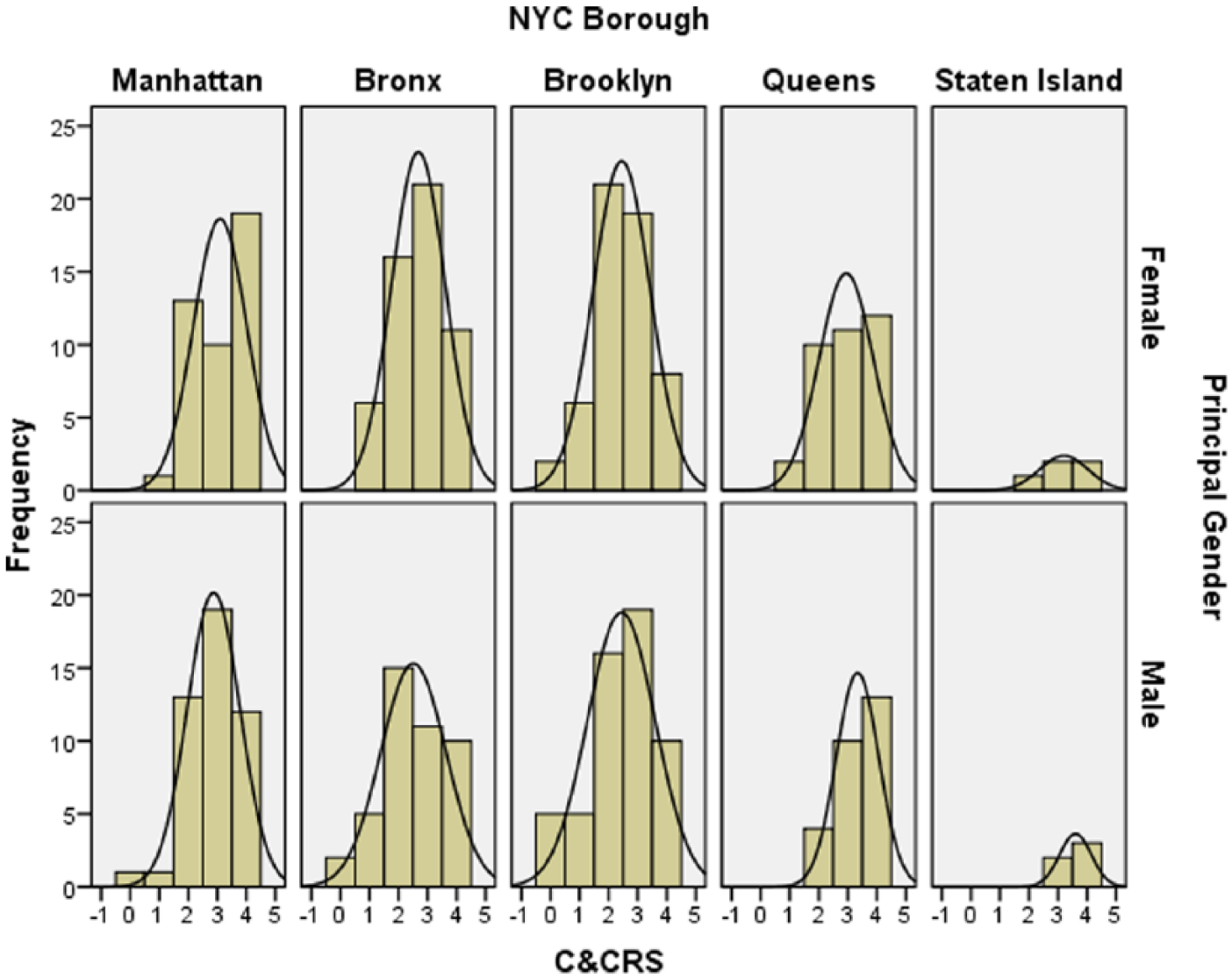
Histogram of NYC schools’ C&CRS based on principal gender and borough.
Phase 3
A two-way between-subject ANOVA with the C&CRS as the dependent variable and principal gender and NYC borough as the independent variables (see Table 2) reveals that (a) principal gender was not significant, F(1, 359) = 0.26, p = .61; (b) the NYC boroughs, F(4, 359) = 8.01, p < .05, partial η2 = .08, was significant; and (c) the combination of principal gender and NYC borough was not significant, F(4, 359) = 1.16, p = .33.
Statistics From Two-Way ANOVA Test of Between-Subject Effect of Principal Gender and Borough on College and Career Readiness Scores.

Note. PG = principal gender; NYC = New York City; SS = sum of squares; MS = mean square.
R2 = .090 (adjusted R2 = .067).
Overall, principal gender did not make a borough-wide significant difference in the NYC schools’ capacity to prepare students for college or career. However, the data on NYC borough (p = .00) in Table 2 confirmed that individual differences existed between the boroughs. How the boroughs differed from one another was the subject of further analysis.
In the appendix, pairwise comparison using the multiple comparison table generated from a Tukey Honestly Significant Difference (HSD) post hoc reveals that Manhattan against Brooklyn’s scores produce a mean difference of .54 and a p value of .001. As p is less than .05, Brooklyn’s schools were significantly less capable of preparing students for college or career compared with Manhattan’s schools. A comparison of Bronx against Queens’ scores produces a mean difference of −.50 and a p value of .015. As p is less than .05, Bronx schools were significantly less capable of preparing students for college or career compared with Queens’ schools. A comparison of Brooklyn and Queens’ scores produces a mean difference of −.67 and a p value of .001. As p is less than .05, Brooklyn’s schools were significantly less capable of preparing students for college or career compared with Queens’ schools. The comparison of Staten Island against Brooklyn’s scores produces a mean difference of .96 and a p value of .027. As p is less than .05, Brooklyn’s schools were significantly less capable of preparing students for college or career compared with Staten Island’s schools.
Overall, as confirmed by the score (M = 2.44 = Grade C) in Figure 5, Brooklyn’s schools taught by either male or female principals were the least successful at preparing NYC students for college or career. Staten Island’s schools with score amounting to Grade A, especially in schools taught by male principals (no significant differences in principal gender withstanding; t = .552, p >.05), were the most successful at preparing NYC students for college and career.

Depiction of NYC schools’ C&CRS based on principal gender and NYC borough.
Figure 6 indicates the majority of the city’s male students generated Grade F irrespective of principal gender. In addition, fewer male students received Grade A, especially those in schools led by female principals.
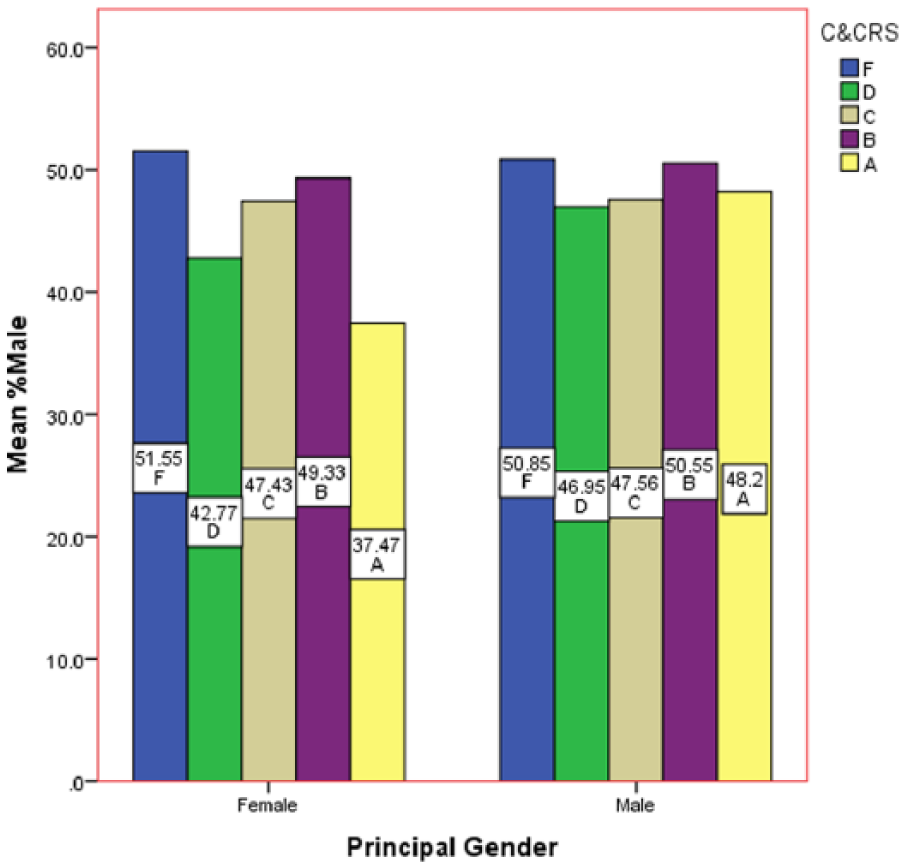
The NYC male student enrollment based on college or career readiness grades/scores and principal gender.
A two-way between-subject ANOVA with the percent male students as the dependent variable and principal gender and C&CRS as the independent variables facilitated in-depth analysis. The result in Table 3 reveals as follows: (a) C&CRS was significant, F(4, 359) = 2.49, p = .043, partial η2 = .027, with more male students receiving significantly fewer Grade A scores (M = 42.62, SD = 17.98) compared with Grade F scores (M = 51.00, SD = 19.89); (b) principal gender was not significant, F(1, 359) = 0.885, p = .347; and (c) the combination of principal gender and C&CRS was not significant, F(4, 359) = 1.47, p = .212.
Statistics From ANOVA of Percent Male Students Based on Principal Gender and C&CRS.

Note. C&CRS = college and career readiness scores; GENS = gender; SS = sum of squares; MS = mean square.
R2 = .055 (adjusted R2 = .031).
The result is depicted in Figure 7. The most highly rated (successful) schools were large (M = 1,701.33), were led by male principals, and were located in Staten Islands. In contrast, the least successful (failed) schools were small (M = 390), were led by a female principals, and were located in Manhattan.

Statistics on NYC best and worst schools at college/career preparation.
The most successful schools with Blacks or Hispanics (M = 86.60) were led by male principals and were located in Bronx. In contrast, the least successful (failed) schools with Blacks or Hispanics (M = 95.64) were led by female principals and were located in Manhattan.
The most successful schools with male students (M = 50.52) were led by male principals and were located in Manhattan. In contrast, the least successful (failed) schools with male students (M = 23.85) were led by female principals and were located in Manhattan. The most successful schools with students with disabilities (M = 21.22) were led by female principals and were located in Staten Island. In contrast, the least successful (failed) schools with students with disabilities (M = 27.85) were led by male principals and were located in Bronx.
Overall, the city’s largest schools led by male principal in Staten Island were significantly the most highly rated (successful) at preparing students for college or career. They had the least number of Black or Hispanic students, slightly fewer number of male students, and slightly above-average students with disability. (Noteworthy: Black or Hispanic students achieved the highest college or career preparation scores in large female-led Staten Island schools.)
The city’s smallest schools located in Manhattan and led by female principals were the lowest rated for preparing students for college or career. They were 96% Black or Hispanic students, had significantly fewer male students (76.15% female students), and the majority of the students had disabilities. Male principals in similarly small schools in Bronx and Brooklyn had equal or worse scores. Common to failed NYC schools in the three boroughs (Manhattan, Bronx, and Brooklyn) was the concentration of female students (M = 75%), the concentration of Black or Hispanic students (M = 86%), and the concentration of student with disability (M = 48%) in small schools.
The result generated from mean test is outlined in Table 4. It reveals the following.
Results From a Comparison of Select Factors Based on Principal Gender and School Borough.

Note. NYC = New York City; ELL = English language learner.
Staten Island’s male principals had the highest performing English Language Arts (ELA) students (M = 3.04, SD = 0.36) compared with Bronx female principal lowest (M = 2.54, SD = 0.25). Staten Island schools also had the highest performing math students (M = 3.31, SD = 0.52) compared with Bronx female principal lowest (M = 2.72, SD = 0.29). Bronx female principal had the highest percentage of English language learner (ELL) students (M = 19.61, SD = 25.32) compared with Staten Island male lowest (M = 2.08, SD = 2.39). Staten Island female principal had the highest percentage of students with disabilities (M = 25.10, SD = 4.74) compared with Queens’ male principal lowest percentage (M = 12.76, SD = 6.57). Bronx male principal had the highest percentage of Black or Hispanic students (M = 94.15, SD = 9.78) compared with Staten Island male principal lowest (M = 30.86, SD = 24.65).
This question did not seek to ascertain significance, but such information is of relevance to the pending discussion. Therefore, it is included. As such, the schools led by Brooklyn male principals generated significantly higher ELA and math tests scores compared with female-principal-led schools. In addition, Queens’s female principals had significantly higher percentage of Black and Hispanic students compared with the borough’s male principals. No other results were significant. Overall, while Staten Island’s male principals benefited from having the higher performing students, its female principals had the highest number of special needs students. The result is manifested in the discrepancy in scores where Staten Island male-principal-led schools, with fewer Black students and with fewer indices of poverty, returned higher scores than schools led by its female principals.
Discussion
This study used secondary NYC school report card data to determine whether there were differences in the boroughs’ capacity to educate students; if feminization was occurring, how it possibly shaped school achievement scores and the possible implications for male students; whether there were moderating variables that informed the performance of NYC schools; and how the characteristics of schools differed based on principal gender. Overall, principal gender did not make a borough-wide significant difference in the NYC schools’ capacity to prepare students for college or career. However, it affected an individual borough. Therefore, Staten Island male principals were the most successful at preparing NYC students for college or career. Male or female principals in Brooklyn’s schools were the least successful in that regard. Female principals led the city’s smallest schools, which concentrated poverty, had more female students, and were the lowest performing schools.
Boroughs’ Capacity Based on Overall and College and Career Readiness Scores
Staten Island’s schools generated the highest rating for preparing NYC students for college or career, whereas Brooklyn’s schools were rated the lowest. The 1960 Coleman Report revealed the pathology of school failure associated with segregated Black schools, whereas Kahlenberg (2012-2013) revealed the success associated with socioeconomically integrated schools. Along with having parents with the highest average household income (US$72,569) compared with parents of all other boroughs, Staten Island’s schools were more socioeconomically integrated, with a majority White and Asian population (M = 59%). In contrast, Brooklyn had a lower household income (US$46,085), and its schools had a majority Black or Hispanic population (M = 86%).
Principal Gender and School Borough, and Relation to School Performance
Female Manhattan principals generated the most Grade A (n = 19). In contrast, male principals in Brooklyn generated the most Grade F (n = 5). In addition, as previously stated, Staten Island male-principal-led schools were rated the highest compared with Brooklyn’s male- and female-principal-led lowest rated schools. The discrepancy was explained by institutional and situational segregation. In addition, Ett (2008), Arnold and Doctoroff (2003), and Legewie and Diprete (2012) aligned school failure with the poverty of various students based on gender and other characteristics. This is a key point because Staten Island schools had the lowest ELL, Black, or Hispanic students; the lowest poverty levels; as well as the highest performing math/ELA students.
In regard to poverty, the difference in household income (US$26,474) between Staten Island and Brooklyn is stark. However, the lowest income among the boroughs was Bronx at US$34,388. Such disparity illuminates the possible middle-class factor outlined in Kahlenberg (2012-2013). He revealed how socioeconomically integrated schools, irrespective of locations, were more successful than segregated Black schools. Staten Island schools were fairly socioeconomically integrated, while Brooklyn’s were highly Black or Hispanic segregated.
Paradoxically, if poverty was a major factor in school performance, Bronx with a household income of US$34,388, instead of Brooklyn, should be the lowest performing borough. Coincidentally, Bronx’s schools with Black or Hispanic student populations (M = 92.3%) were the most segregated of all the boroughs—predicting its failure as per the Coleman Report. However, the paradox in its better performance than Brooklyn’s performance is explained by the fact that Bronx had more than twice the percentage of Hispanic or Black and fewer male students compared with Brooklyn. Nationwide, Hispanic students now generate higher achievement scores than Blacks (U.S. DOE, 2014). In addition, male students generated lower academic scores (Chambers, 2009).
College and Career Readiness Scores, Male Students Enrollment, and Principal Gender
Principal gender was not a significant factor in the college or career scores received by male students. However, male students received significantly lower number of Grade A college and career readiness scores compared with female students. In addition, Brooklyn’s male principals had significantly more male students. Thus, Brooklyn results contradict the literature (e.g., Addi-Raccah, 2002; Bradley, 2004; Mulvey, 2009; Steffenhagen, 2001) regarding the relation between feminization and male students’ failure. Still, it is no consolation to parents, and the borough’s political leadership, that Brooklyn, a significant African American community, was the worst performing school borough in the city. The basis for the discrepancy may transcend principal gender and points to other factors in the discussion. However, the numerical majority of the city’s schoolteachers were females. Therefore, if “feminized” pedagogical practices were a factor in male students’ lower school performance, it would be independent of principal gender (male and female principals will have more female teachers compared with males). Notwithstanding, as previously noted, feminized pedagogical practices would be incompatible with boys’ socialization and learning styles (Martino & Kehler, 2006).
Beyond feminization is the racial component, wherein the majority of NYC principals were White middle-class females, and the majority of students were low SES Black and Hispanic and males. Pollard (1997) spoke of the need to examine the interactions of race and gender as this is a critical issue not covered well in the literature. Principals’ role modeling to, interaction with, and understanding of students and their cultures can enhance success for both groups (Anthony, 2008; Ett, 2008; Graham & Erwin, 2011; Green, 2012). Importantly, the NYSED and the Regents identified the need for diversity in the state’s school leadership cadre. Regents (NYSED, 1998) reveals, We need to recruit from a more diverse talent pool when we look for school leaders. At least that is the impression one gets in looking over the crowd at many of the Leadership Forums. This is part of the problem, and part of the opportunity before us. It must be made a high priority. (para. 8)
Graham and Erwin (2011) supported Secretary of Education Duncan’s assessment implicating the pathology of employment discrimination facing Black teachers as a root cause for the dearth of Black school administrators. Karpinski (2006) revealed how the dearth of Black principals contributed to the current failure of Black males.
Principal Gender, School Borough, and Characteristics of Schools at the Highest and Lowest Performance Levels
The findings here indicate that large male-principal-led schools (M = 2,180), with majority White and Asian student population of practically equal gender, in the majority White-populated Staten Island school borough returned the highest scores for preparing the city’s youth for college and careers. This result is inconsistent with the findings of MDRC’s (2013), linked to the Gates Foundation, that touted the higher success of small NYC schools serving Black or Hispanic and disabled students. It offers a rival hypothesis that asserts that the city’s small school initiative of shuttering large failed schools and converting them to smaller more expensive ones highlight an issue of major significance to NYC schools.
To further refute other findings, medium size schools (M = 516) led by female principals in the majority White-populated borough of Manhattan, with the third lowest Black and Hispanic student population, were also found to be more effective at preparing NYC students for college or career. Mickelson and Greene (2006) reported on the higher success of medium size schools. In contrast, small male- or female-principal-led majority Black or Hispanic schools in the city’s largest White-populated borough—Brooklyn (more than twice the White population of Staten Island)—were the least successful. Highlighting the racial/ethnic population of the boroughs is key because four of the five boroughs are majority Whites, yet the most integrated one (Staten Island)—with majority White students—attained the highest success. This was also true for the second highest integrated borough, Queens, whose schools attained the second highest performing scores of all the boroughs. Therefore, socioeconomically integrating NYC schools could improve their performance.
Socioeconomically integrating NYC schools avoids the dilemma in desegregating the city’s failing schools. According to Kahlenberg (2012-2013), bussing and other methods of forced desegregation, now being overturned by the Supreme Court, were ineffective. Therefore, NYC alternative initiative to improve its schools by restructuring large failed ones into smaller ones is supported by Kahlenberg. However, he asserts that the new schools must be socioeconomically integrated, which can also be achieved through the creation of magnet schools to attract middle-class students. Therefore, merely converting large schools to smaller ones would not assure success (Lee & Smith, 1997; Schneider, Wyse, & Keesler, 2007).
The Select Characteristics of Schools Based on Principal Gender and School Borough
The city’s smallest schools led by female principals in Manhattan were the lowest rated for preparing students for college or career. The schools enrolled 96% Black or Hispanic students, had significantly fewer male students (76.15% female students), and the majority of the students had disabilities. The pathological outcomes of (a) school segregation, (b) concentration of poverty, (c) the warehousing of students with special needs, and those who received the lowest scores on NYS’s eighth-grade ELA and math tests were demonstrated. Those factors were found to be significantly associated with failing NYC schools. The issue of the new state requirements for special needs student was thoroughly discussed, and the pathology of their warehousing was discussed in Lehr and Lange (2003).
In this study, female principals’ wish to be associated with challenged students is in keeping with Durrah (2009) and Eagly et al. (1992). However, the failing schools they led here, with majority Black or Hispanic female students, were almost like single-gender schools. Their dismal failure was not what stakeholders envisioned in their support for small single-gender schools, as revealed in Chambers (2009) and Harris (2009). The question is whether female administrators, especially Black and Latina, have a choice in accepting schools with challenged students. Are such schools and students stepping stone for experience and later move to better positions?
To ensure that NYC school failure is not being ascribed to female principals, it must be pointed out that male principals in similarly small schools in Bronx and Brooklyn had comparable scores. In addition and in contrast, Staten Island male principals had insignificant number of ELL students. Therefore, failure could be attributed to the attitudes and perceptions of educators, as it could be to factors in students’ homes or in their early education. The basis for such statement is evident in the disparate scores generated when the state’s third-grade students are first exposed to high-stake ELA and math test. The result shows Asians, Whites, Native Americans, Latinos, and then Blacks in order of highest to lowest rankings (NYSED, 2015).
Conclusion
Principal leadership, which entails guidance for administrative staff, community outreach, and public relations, affects both teachers’ effectiveness and students’ performance. Therefore, it is critical that principals receive support and are provided with needed resources. Principals must have the flexibility needed to mediate between schools and their various public stakeholders such as parents, teachers, and students.
As our demographic shift unfolds, schools and their communities will become more diverse. Therefore, principals must act to include all vested members of the school community and to develop ways to address their concerns (Piraino, 2009). Similar to how the failure of the nation’s schools is a pressing concern of NCLB, as reaffirmed by the Obama administration (U.S. DOE, 2015), the failure of Black male students is a pressing concern among many New York residents, demanding attention from the city’s high school principals. 4 This study provides a way for NYC principals to navigate the complexity of the problem and respond to their various communities with answers that are research based. The following reiterates some important findings:
Staten Island’s male-principal-led schools were the highest rated at preparing NYC students for college or careers. The schools were large and majority Whites; they had the highest math and ELA scoring students.
The relevance of this result speaks to the impact of socioeconomic integration as a means to improve the city’s schools.
Brooklyn’s highly Black or Hispanic segregated schools led by either male or female principals were rated the lowest at preparing NYC students for college or careers.
The relevance of this result speaks to the need to address a looming problem, where students comprising the nations’ minority–majority are not being properly educated, especially in the areas of science, technology, engineering, and math (STEM). This pathology bespeaks a looming national security crisis, wherein the groups historically receive the least number of STEM degrees. The Department of Defense is concerned that, in the next decade, there will not be enough STEM graduates to replace its aging STEM workforce. In addition, to have Brooklyn, the de facto Black capital of the world (Shipp, 1991), seen internationally as a borough of academically challenged Blacks, is not befitting of the borough of kings.
The city’s male students received significantly more Grade F for college or career preparedness. They also constituted the lowest overall percentage of enrollees in the city’s highest performing schools. The relevance of this result speaks to the need to address the continued failure of male students. VE can address the problem, but its current misuse as a dumping ground is reminiscent of a past practice, where poor male students were housed in special schools for physically and mentally handicapped children (Ett, 2008). In addition, evidence of the feminization of VE courses does not augur well for male students who need the dynamic and mobile learning environment.
The city’s large, followed by its medium, schools were the highest performing, whereas its small schools were the lowest performing.
The relevance of this result speaks to the need to reexamine the city’s small school policy, where large schools are been converted to smaller more expensive ones. Large failing schools converted to small schools with the same failed students will amount to the concentration of failure and poverty in more schools. For the conversion to work, schools must adopt socioeconomic integration, also achievable through magnet schools.
Other important findings are stated below without elaboration. They are stated to generate a conversation between educators, parents and their children, stakeholders, their schools, and their political leaders.
Queens’ female principals had significantly more Black or Hispanic students compared with the borough’s male principals.
Brooklyn’s male-principal-led schools generated significantly higher math/ELA scores compared with the borough’s female-principal-led schools.
The city’s female principals had more special needs students compared with male principals.
Staten Island’s female principals had the highest percentage of students with disabilities, whereas Queens’ male principals had the lowest percentage.
Bronx’s male principals had the highest percentage of Black or Hispanic students, whereas Staten Island had the lowest.
Queen’s schools were the second highest performing and, like Staten Island’s schools, were reasonably socioeconomically integrated.
A major finding generated from my qualitative analysis of the school report card data used in this study is that schools with more Asian students attained higher performance scores. In addition, Asians along with Whites were key components of the success of the city’s socioeconomically integrated schools. Therefore, it is of great importance to compare the third-grade ELA and math scores of all racial/ethnic student groups to pinpoint where school success or school failure begins. Third grade is where public school students take their first state assessment test.
This study emanated from Pollard’s (1997) and Flores’s (2011) recommendations for further studies on the topic, and it lays the foundation for the future examination of the experiences of Black, Hispanic, male, female, and other NYC principals. It illuminated issues of educational significance that will be taking center stage as the race to improve the nation’s schools to educate the emerging “minority–majority” becomes a matter of national security. It informs the need for stakeholders in the various boroughs, especially Brooklyn, to demand accountability, and for the state to scrutinize alternative schools/programs, as it moves to effectively implement the CDOS program.
The findings, in part, reveal a link between the capacity of NYC schools to prepare students for college or careers, principals and students’ gender, poverty indices, how the boroughs with their different socioeconomic levels performed, and how complex the problem is. It highlights the need for forward-thinking policy decisions also focused on improving the educational outcome for both male and special needs students, as well as critically examining the effectiveness of the city’s small school initiative, and its VE programs. However, a limitation is this study only elicited input from three school administrators. One, Dr. Michael Wiltshire, related how his Caribbean roots and his shared culture with his students enabled his school to be highly successful. Another administrator highlighting the racism and discrimination he faces, and an administrator who is surreptitiously and overtly changing a prime VE school into a dumping ground for lower performing students, as a means to accommodate the dumping of students being undertaken by academic school principals.
The data the principal presented to staff at the commencement of the 2015 school year revealed the significant increasing number of special needs students from District 75, which is responsible for educating the city’s special needs students. Additional data he presented revealed that it cost the school more than US$100,000 a year to educate one student compared with the approximately US$16,000 a year it costs for the average NYC school. Are taxpayers and students being adequately served? Such answers can be determined by NYSED scrutiny and future research.
Recommendations
The findings of this study recommend mindful examination of NYC school staffing to gauge the impact of possible feminization of the educational opportunities of both male and female students and how the lack of male role models affects both groups. In addition, it supports the call for more Black and Hispanic administrators, culturally relevant and responsive mentoring, and other resources to help principals improve performance outcomes for underperforming students, especially Black and Hispanic youth. It also recommends the establishment of gifted and talented VE schools, and an examination to determine whether VE schools were being used as dumping grounds for special needs and other low-performing students.
Given the difficulties associated with preparing the data, it is also recommended that principals’ gender and the number of male and female teachers should be included in the schools’ demographic data, and that the enrollment data for high schools (9th-12th grades) should be disaggregated from the lower grades of schools that serve a K-12, or similar population. Finally, the findings indicate that future mixed-methods studies explore variables such as educators’ attitudes and perception in a post majority White school, students’ country of origin, especially in the light of literature revealing immigrant students, including those from countries such as Jamaica, Trinidad and Tobago, Guyana, Barbados, and some countries in Africa, outperform native Black students (Green, 2012).
Footnotes
Appendix
Acknowledgements
Special thanks to Bobby G. Martin, PhD, Airframe and Power Plant (A&P), for his guidance with Excel, making this work possible. Principal John Widlund is lauded for his support.
Author’s Note
This work was not sponsored, funded, nor authorized by any one. It was my sole initiative and undertaking.
Declaration of Conflicting Interests
The author(s) declared no potential conflicts of interest with respect to the research, authorship, and/or publication of this article.
Funding
The author(s) received no financial support for the research and/or authorship of this article.