




Abstract
The article processing charge (APC) financed Open Access is a publication model that provides immediate and free access to scientific articles. More than half of the world’s Open Access articles are published according to this concept. However, a side effect of the model is that research is not published if researchers cannot pay the publication charge. The study examines the nature of this phenomenon, its extent, and implications. The study places a special focus on authors who are not affiliated with a research institution. The proportion of these authors is identified among 2,184 Danish authors in Danish periodicals in 2010. The possibility for poor researchers to receive compensation from publishers is investigated as well. Paying the APC is a problem for many researchers—represented by around 30% of authors who have published in Danish journals (unemployed scientists, students, as well as retired and private employees). Grants from publishers exist, but they are small and too uncertain to ensure that research is published optimally. This study predicts that a large amount of valuable research risks not being published if this publishing model dominates without alternatives or countermeasures.
Introduction
Traditionally, a scientific journal will publish an article if the offered manuscript is evaluated as having a sufficiently high level of quality, that is, all manuscripts of quality are published. This principle is probably no more valid. A political demand that research should be freely available on the Internet, namely, Open Access, has been created in connection with digital publishing. There had been an intense discussion of how free access would be financed when subscription payments are abolished. Furthermore, there has been consensus that free access to research should not be at the expense of quality. Therefore, development of sustainable publishing models is sought.
Two of the three dominant Open Access models will not be discussed here: In the first model, called Green Open Access, authors self-archive their own articles. The existing form of publishing is retained, and subsequently each author makes his article available in an open archive. The second model, Delayed Open Access, retains subscriptions while delaying open access for a period, so the publishing company can manage to generate revenue to cover its expenses.
Neither of these two models is optimal, as there will not be immediate access to the originally published articles, and it is questionable whether the business principles are sustainable in the long run.
The third model, called Gold Open Access, is based on paid release. In most cases, the authors have to pay an article processing charge (APC) to have their research published. The model does not have the other two models’ drawbacks—articles are published immediately after the authors pay their contribution. There is genuine free access.
It has long been debated whether this publishing form would be economically viable (Bergstrom & Bergstrom, 2004), but after a few years of application, publishers such as Public Library of Science (PLoS), BioMed Central, and others have shown that free magazines can be among the world’s top ranked and still be economically viable (King & Alvarado-Albertorio, 2008; Solomon, 2013).
Thus, there has been a noticeable change of attitude toward Gold Open Access. Commercial publishers have stopped their resistance, and even the world’s largest publishers have begun to publish journals based on author payment. Politically, there is also growing support. Based on a report by the Finch committee, the Government of Great Britain supported an Open Access policy based on author payment (Finch, 2012).
However, the author-funded publishing model has a type of built-in system failure that prevents research from being published if researchers or their institutions cannot afford to pay. It is a well-known problem that authors from the poorest developing countries cannot pay even though some publishers have introduced a policy to compensate them partly or in whole.
Even in the wealthiest countries, authors can have problems paying this fee. This study focuses on one such group: the researchers without an institution behind them to pay for their publishing.
APC-based publishing is indeed sustainable for individual journals, but the issue is about whether the publishing form is also sustainable when we consider science from the perspective of the big picture. Is it sufficient to have all research of value published, as the traditional subscriber-based publishing model could deliver? This study will provide evidence of a potential large problem.
APC Financing
It is not quite new that authors have paid to have their research published. In the 1930s, individual journals collected a fee from authors to reduce the price of the subscription (Curb & Abramson, 2012; King & Alvarado-Albertorio, 2008). In 1965, the U.S. government gave official permission to use federal funds for fee waivers. King and colleagues (King & Alvarado-Albertorio, 2008; King, McDonald, & Roderer, 1981) state that more than 50% of articles in science in the 1970s were published with some form of author payment. One paid if you wanted an illustration in color or if the article was above a certain maximum length. There are no statements from humanities, social sciences, and other areas outside science, but the proportion was probably extremely low.
It was mainly company-owned journals that charged extra fees, opposed to society-owned journals. Commercial publishers’ journals were funded by subscription payments, and during the 1970s, many researchers preferred to publish for free in these journals.
In his overview of Open Access, Solomon (2012) describes how the commercial publisher BioMed Central published its first free article in 2000. Its publishing based on APC made the publisher so profitable that in 2008, it was sold to a leading commercial publisher, Springer Verlag. In 2011, 512 publishing houses published 1,825 journals, with a total of 76,000 Open Access articles (Björk & Solomon, 2012), which was almost half of all Open Access articles, and with the continued surge, probably well more than half of Open Access articles today belong to this category of Open Access (Laakso & Björk, 2012).
The level of APC varies widely among journals. Some journals have sufficient external financing and they do not charge APC at all or ask only for a very small amount. An average stands at just over $900 (Björk & Solomon, 2012) or $1,000 to $3,000 (Ware & Mabe, 2012). In contrast, large and prestigious journals with a high impact factor are expensive, up to $3,900 in 2010 (Björk & Solomon, 2012). There was an increase of 10% in the average APC in a selected sample between 2011 and 2013 (Björk & Solomon, 2014). However, there are many other payment structures; for example, institutions may pay a lump sum to cover the publishing of all their researchers’ works, as is done by the world’s largest Open Access publisher BioMed Central. However, other publishers require a payment to have a manuscript judged, and perhaps the author must also pay extra for a subsequent linguistic correction.
Researchers want to publish in the best journals and are, therefore, willing to pay an extra large amount to gain higher visibility and recognition. Publishers behind the APC-based publishing model, therefore, attach considerable importance to marketing themselves to authors, in contrast to the traditional publishers, whose marketing is targeted at users (Björk & Solomon, 2012).
APC System Weaknesses
Initially, it was discussed that the publishing method could have negative consequences. An Organisation for Economic Co-Operation and Development (OECD) report (Houghton & Vickery, 2005, pp. 63-65) outlined a number of potential disadvantages when publishing required a payment:
There will be an even greater disparity between researchers. It was already established that researchers with large research were more advanced than researchers outside, and the difference will be strengthened to the detriment of unknown and young researchers.
It may not work in large areas of the humanities, arts, and social sciences with funding limitations.
It may be difficult to operate in areas with a high number of rejected manuscripts, as the authors of the few recorded additional articles would have to pay the editorial costs of rejected manuscripts.
It would lead to researchers publishing less.
There would be a shift in the published articles because scholars in some research directions would find it easier to raise money than others.
Researchers in developing countries would not have access to publishing.
Liyanage and Raina MacIntyre (2006) explained the problems by distinguishing between multiple types of authors; author-paid publishing is not suitable for researchers early in their careers, researchers employed in government offices or agencies that do not pay for the employees’ publications, or researchers whose research is not funded by the pharmaceutical industry.
The publishing principle may also seem unfair, as research-intensive universities would face an extra financial burden in comparison with more teaching-oriented universities and highly applied areas, interrupting the business to fund most of the cost. Similarly, some countries would pay more than other “free rider” countries that could benefit from research without having to pay. For example, the United Kingdom pays about 3.3% of the world’s costs of journal subscriptions but accounts for 5% of the world’s research (The Science and Technology Department, 2004), and a report from the Research Information Network (Hulls, Rennison, & Rattensperger, 2008) indicates that the United Kingdom produces as much as 6.6% of the world’s research.
Developing countries’ problems are addressed by Papin-Ramcharan and Dawe (2006), who conclude that APC will certainly exclude less fortunate researchers from publishing in Open Access journals. It is true that several publishers offer support, but the articles state that often the publication will be delayed and aid funds may be limited. In general, many researchers are not on an equal footing with their peers in more economically advantaged parts of the world.
Apparently, politicians believe that research funding from foundations also has to include payment of the APC. This has been implemented in the guidelines for many research councils, including Horizon 2020 in the European Union (EU). The British House of Commons stated in a 2004 report (The Science and Technology Committee, 2004) that payment should not depend on a researcher’s personal financial situation; it should not even be his or her institution’s responsibility: “We believe that such funding should originate with the research funder, not the institution. By that payment would be included in the total research funding, this would facilitate effective planning and budgeting” (p. 78).
However, not even one of the richest areas of research, medicine, could have the entire fund paid through these funds (Schroter, Tite, & Kassem, 2006). The study showed that only 41% of externally funded researchers had money available at the time their manuscript was accepted for publication. This was because the project accounts were closed before they should be published, or—if the project was still running—sufficient funds for publishing were not allocated. The conclusion was that the author payment would probably prevent research from being published.
Graczyński and Moses (2004) have the same doubt that planning and budgeting should be able to predict the resources required for publication. Sometimes, a promising project may not carry enough useful knowledge and thus may not utilize the funds allocated for publishing, while other projects and highly productive researchers could produce a large series of interesting articles. Neither research councils nor, for that matter, university departments can predict researchers’ future production capability.
Several studies have been conducted on researchers’ attitudes toward Open Access. Unfortunately, most are based on extremely low response rates, so their results are not statistically valid, and therefore they will not be mentioned here.
Solomon and Björk (2012a) show how researchers specifically funded their APC in various disciplines (Table 1). Their survey shows a big difference in the authors’ opportunities. Research council funding is more common in the life sciences and physical sciences than in the social sciences and humanities (the same conclusion was reached by Curb & Abramson, 2012). Thus, 46% of the scientists in business and economics pay for publishing, whereas 10% got the publisher to waive the charges.
Source of Funding.

Note. The table is based on an investigation of funding from a sample of journals (Salomon & Björk, 2012a, Table 1; Salomon & Björk, 2013). OA = open access.
Articles in the best journals were often funded by research council’s funds or with the support of institutions. By contrast, the proportion of self-payers was greater in lower-ranked journals with a lower rate of APC. This suggests that if you have funds from a research council, you can publish in the best journals, and if you do not have such funds, you have to choose a cheaper journal.
It should be noted that the study has only involved researchers who could raise funds. When the authors were asked about the maximum APC, they will pay, on average, $649. One must consider that the amount would have been much lower if also the researchers who had not published were asked.
For comparison, Halsted (2003) believes that it would be impossible for poorer researchers to finance an APC of $1,500; although even researchers employed by U.S. government institutions would not be able to obtain a grant of this size.
Researchers from poor countries have often had to finance their research themselves; in fact, the entire 39% of research is self-funded, including 14% of the research is published after remission of APC compared with, surprisingly, a respective 11% and 12% in more affluent countries (Solomon & Björk, 2012a).
Liyanage and Raina MacIntyre’s (2006) study of spon-sorship and payment of APC showed a clear link between industry funding and type of published research. They found that the payment model would certainly affect the published research nature, when the author payment favored strong organizations, industry sponsored research, and prosperous countries.
The majority of the published research from universities is basically not financed by external funds. According to King and Tenopir (2004), the universities funded $30 billion of the research that led to the publication, with $5.8 billion from federal grants for research on university institutions, and $10 to $15 billion conducted elsewhere.
Even a rich field of research, such as medicine, has disciplines with a small proportion of externally funded research (Berman, Borkowski, Rachocka, & Moore, 1995; Ernst et al., 1997; Stein, Rubenstein, & Wachtel, 1993; Silberman, & Snyderman, 1997). According Dewan, et al. (1999) were 25% research unfunded in psychiatry. Especially, important basic research is not funded by external funds (Schroter, Tite, & Smith, 2005). The publishing model could also cause problems in countries with little public funding. For example, only 10% of research in Japan and Switzerland is supported by public funds (Worlock, 2004).
Method
This study mainly focuses on identifying a special group of researchers that are unaffiliated with a research institution and have no institutional funding to pay the APC for their research. These researchers “without a research institution” are not employed at an institution that expects research from them. They either have no work (i.e., they are unemployed) or they work in an institution where research is not expected of them.
There is a great interest in research due to its social value. However, the statistical reports do not include researchers outside research institutions. Most countries use the OECD definitions, as described in the Frascati Manual (OECD, 2002) and Canberra Manual (OECD, 1995). Neither of these manuals recognizes the existence of researchers outside institutions. The statistics are imperfect. Only an empirical investigation can shed light on this phenomenon and its extent.
To judge the impact of researchers not having support from a research institution, this study investigates publishers’ policy of compensating for missing funding by giving the authors a waiver (see Table 2).
Publishers’ Waiver Policy.

Note. The waive policy for the largest publishers. Most publishers do not automatically waive researchers from LICs. No publisher provides authors with economic problems an automatic waiver, and the majority does not even offer authors the opportunity to submit an application. 11 publishers offer the possibility, and two publishers do so very rarely. LIC = low-income country; PLoS = Public Library of Science.
Analysis of Journals
To identify researchers without connection with a research institution, Danish scientific journals were reviewed for a single year. All issues of each of the journals were obtained and analyzed. For each article, the author(s) were identified, and their employment situation was subsequently studied.
The study was limited to include only articles from Danish researchers. This was convenient, as it is assumed to be easier to identify Danes. Danish research institutions have very detailed information about their employees not found at all universities and institutions worldwide.
Danish journals are defined as journals published in Denmark and/or with a high percent of Danish authors—on average, more than 50% Danish authors. They are often published in Danish, but they also have an increasing number of articles in English. It would not have been feasible to perform the same intense analysis with international journals. The number of journals would have been very large, and each journal would have had a very small proportion of Danish researchers.
The year 2010 was chosen because it is very close to the present, and therefore gives a picture of the current situation. At the same time, it is assumed that the various databases and websites are reasonably updated, so that information about most of the 2010 magazines was available when the study was conducted.
The contents of 110 journals were examined, resulting in the identification of 2,221 scientists who were authors of 1,386 articles (see Table 3). The analyzed journals are all of the highest scientific quality as they are included in the list of approved professional journals published by the Danish Agency for Science, Technology, and Innovation under the Ministry of Higher Education and Science. This list is produced by the country’s leading researchers to give an indication of the distribution of research funds. The list covers the best research journals in the world as a resource for researchers seeking to publish in quality publications. The list for 2012-2013 was used for this study.
Distribution of Authors in Danish Journals 2010 (n = 110).

Note. An analysis of articles in the Danish journals resulted in this distribution of Danish authors. “Other research institutions” include private institutions at commercial companies such as medical firms.
Of the 208 identified Danish journals on the list, a little more than half were investigated. To make the work manageable, only those journals that allowed easy access for the evaluation and within a reasonable time were selected. A few journals did not publish issues in 2010 and several had no Danish authors. Priority was given to the remaining journals, and journals were selected that had been identified by Burchardt’s (2007a) work and the inventory of Danish journals (Burchardt, 2007b) as journals with the highest scientific quality.
The journals included a variety of publishing models, including subscriber-based journals and Gold Open Access completely sponsored by institutions; only the APC-funded journal model was not represented.
It was decided to include only authors of genuine research papers. This apparently clear concept appeared in the real world to be more complicated, because it was necessary to judge whether a contribution was an article. The journals themselves did not always mention whether a contribution was a peer-reviewed article or a less valuable writing. There is a subjective estimate underlying the assessment, and although the author of the study is a long-standing editor, it required a closer reading of both the article and often another substance in the journal to determine whether a contribution rose up to the level of quality as an article in the particular academic field should have.
The Author’s Real Affiliation
Often, journals give an indication of the article authors’ position and institutional affiliation. This information was widely used in the study. Frequently, the information was checked due to the long publishing process, which in some cases showed that an alleged employment at the time of publication was incorrect. Following the assessment of people’s relationships, journal publishing should be considered as a typically long process. In general, publication of a manuscript is often a year long, from its first time submission to its acceptance. If the author was employed at the time of filing in December 2008, this appointment could have expired when the article was accepted and published in the spring of 2010.
To control this information, this study used the Danish National Research Database that is based on information from universities. This database was supplemented by virtually all local databases from the universities. In total, they provided information on 55% of the researchers.
For practical reasons, the employment situation of these more than 1,000 people has not been further investigated. It is assumed that when they are included in a university database, they have had a more or less permanent attachment to the institution. Sample checks have shown some examples of “researchers outside research institutions” among those who are registered as affiliated with a university, but the number is considered so small that it would not affect the main result. This is specifically a portion of students who are registered as employees, and at the same time, administrative staff and others without proper research duties were included in the databases as well.
Where the biographical information in a journal did not show an association with a research institution at a university, private company, or another organization and no university was listed as the researcher’s place of employment, it was presumed that there was no such connection; a link to a research institution in the scientific community is highly desirable, and it was assumed that any connection would have been mentioned. In these cases, the authors were unemployed, students, retired, or employed at an institution without research duties; their placement between the categories was performed to the best estimate.
The researchers’ employment statuses were identified through various sources. In this phase, the Internet was an invaluable source, where especially LinkedIn, Facebook, and personal websites were seen as credible sources. In these social networking sites, friends and acquaintances would quickly reveal obvious misinformation, and thus the margin of errors was assumed to be minimal. The information was often outdated, but it was generally easy to identify information about the situation in 2010.
Some cases were supplemented by information obtained from the authors themselves or from the journal their article was published in.
A general problem around many of the researchers was investigating whether they had a reasonably close connection with a research institution. Should a temporary teacher with a few hours of training per year be regarded as a university employee? What affiliations did a lecturer with a privately owned company have?
In principle, temporary teachers are not paid for research, and should therefore not be included in the measure of researchers at universities. As mentioned, information from the universities’ own databases was used, and part-time teachers were often erroneously included in the inventory of university-based researchers.
Generally, the persons associations with the labor market in 2010 were studied, and if they were deemed to have at least half-time employment at a research institution, they were included. There were many doubts, and generally, the assessment was conservative.
Investigation of the Publishers’ Waiver Policy
A supplementary investigation was conducted to speculate the actual situation for individual researchers to have their articles published without having to pay the APC.
The world’s most important publishers with businesses based on APC-financed publishing were asked in the spring of 2013. A standard mail was sent to all the publishers with questions about how the publisher would handle an application. A specification of different situations for researchers was included. Some of the publishers did not respond, and therefore their responses were collected from information on their websites.
The selection of the 27 largest publishers (see Table 2) was based on the study conducted by Solomon and Björk (2012b).
Results
The examination of the Danish journals revealed a number of researchers outside research institutions. Based on close examination, these researchers were divided into various categories. The study will analyze these groups and what drives their research (see Table 4).
Distribution of Authors Without a Research Institution.
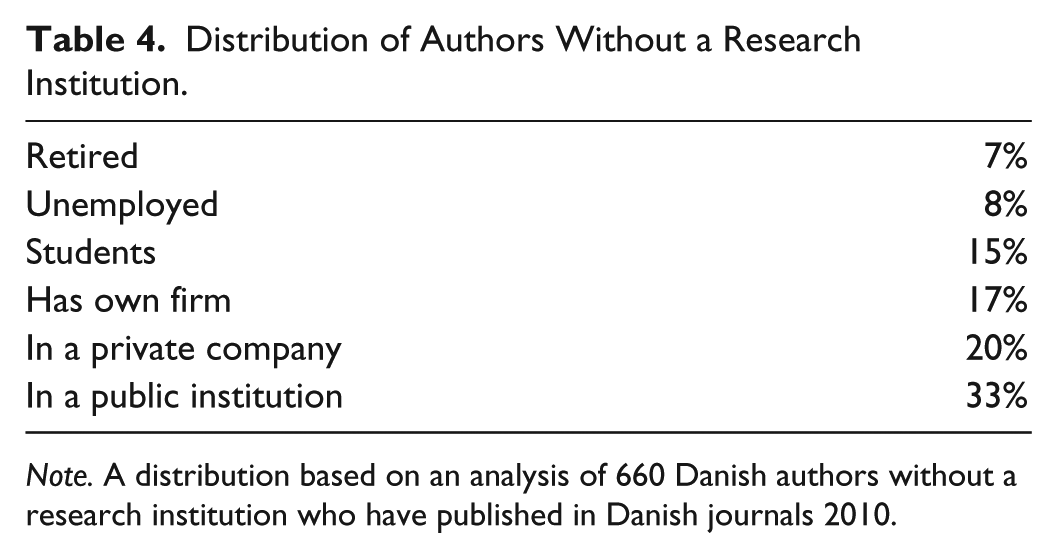
Note. A distribution based on an analysis of 660 Danish authors without a research institution who have published in Danish journals 2010.
The Retired
Pensioners represent 7% of those without an institution. They are scientists of their own volition, often without any reward or hope of future personal benefit. The pensioners’ share seems to be a substantial part, but if the figure is put up to the total number of pensioners, there is actually a remarkably small number of people conducting research in their retirement age. The number is still so high that one can only say that these retirees make a significant contribution to research.
Pensioners can be divided into two groups. The researchers in the largest group were employed as scientists in their past work, and they still care about their research areas.
The Unemployed
The professionals are clearly the majority in this group, compared with the self-taught. The unemployed are virtually all researchers or future researchers.
The groups’ share is just less than 8%. The percentage is probably somewhat higher, because it is not desirable to be known as unemployed, so researchers often indicate a different employment situation, if the opportunity is available. The unemployed provide a significant contribution of relevant research for society. Their proportion fits nicely into the overall unemployment rate, which at that time, according to Eurostat statistics, was on average 7.6% (March 2010).
In a dynamic labor market for researchers, greater periods of unemployment from a job occur when a research project ends before the next one begins, so these unemployment rates may be natural. Mobility, especially for the highly educated, is remarkably high. Graversen (2002) indicates that 30% of researchers at public research institutions change jobs every year.
The Students
One of the major groups is students who publish the results they collected during their studies. Fifteen percent of researchers without institutions fall into this category. Of these, the vast majority is PhD students, but students at lower levels also publish research findings.
The number of students publishing is not particularly high compared with the approximately 6,000 current PhD students, of whom 2,000 graduate each year. Their research is still so large that it is a community resource of significant size and value.
It was difficult to determine whether a student’s article was submitted for publication while he was still a student or whether it was submitted after the final exam. Nevertheless, we note that research institutions mostly do not recognize student research. Only a small number of students are considered participants in their institution’s research, and therefore they are recorded in the databases of research from the institution in the annual report or otherwise.
Employees of Non-Research Institutions
The largest group of researchers outside research institutions comprises those at the many private and public institutions. Seventy percent of researchers without institutions are found in this very diverse group. There are employees of both large/small and private/public companies, and with many different types of contracts.
Approximately, one fourth of the researchers in this group own their own firms. These are typical consulting firms where the holder delivers services. Research is not primarily conducted for benefits, but the holder occasionally works closely with researchers and sometimes conducts research in this context. For example, there are several journalists who provide consulting services with communication functions for clients. The consultant then uses his acquired knowledge to write a scientific article. These companies, especially, need to show “seriousness,” and it cannot be excluded that an acquired advertising effect helps to explain the owner’s interest in publishing.
A portion of the employee’s research is unrelated to the company’s activities. This research is the employee’s own research agenda. It may, for example, be a bank agent providing historical literature. The company draws only limited usefulness from the research, and activities are assumed to be performed at the employee’s leisure.
In the remaining companies, the research topics are partly or wholly related to the company’s activities. An employee can conduct his research because it allows him to gain insight into topics he deals with at work, and he may even be given time to conduct the research during work hours.
Much research deals with the institution’s primary activity. The starting point is the daily practice where experience is summarized in a scientific article. It could be a judge in a court in Greenland who writes an article on the evolution of the Greenland justice, or the bank manager in a large bank who contributes with an article on current monetary and credit developments in the crisis.
Publishers’ Waiver Policy
The statement from the world’s 27 largest Open Access publishers reveals through our questionnaires that only four will automatically waive the APC for authors from the poorest developing countries, as identified in the World Bank classification of countries. Half of the publishers indicate that you can apply to have the APC waived. No publisher automatically gives a waiver to the unemployed, pensioners, and so on.
There is no transparency about the number of applications, and the publisher’s policy can be changed without the public’s awareness. One might assume that the proportion of refusals would be high in areas with many poor scholars. Several publishers claim no connection between the editorial office and the people judging the waiving. However, in a questionnaire response, one publisher wrote that it “gives discount according to the quality of the paper and the academic background of the author, rather than the country of the author.” For this company, it is business; they award discounts on low-quality articles from rich countries but refuse to support articles of the same quality from low-income countries.
The publishers’ secrets about their administration of waivers suggest that it is not possible to examine to what extent publishers have exempted writers from paying APC, but it is assumed to be a relatively small portion; thus, PLoS should have a level of less than 10% (Ware & Mabe, 2012). Ten percent is the level Copernicus Publications supposedly sets aside in the budget for subsidies, and 13% is the number obtained from a sample of journals (Salomon & Björk, 2012a, 2013).
Discussion
Today, sustainable publishing houses manage quality publications based on APC financing. Even the largest commercial publishers have come to stay, and it will be interesting to follow where the levels of APC will stabilize.
It seems that Open Access is here to stay, as Solomon (2013) states, “It enjoys broad-based support and it is easy to sell politically” (p.28). Much of the development is due to public politics. Different initiatives have, in recent years, deemed the market forces ineffective. So far, public research councils require fast Open Access, and thereby indirectly direct research funds to replace the existing subscription revenue, even though one could imagine that the traditionally independent universities would oppose similar reductions in research funding in the order of, say, 2% to 5% to finance the APC.
The business model is certainly mature. Perhaps it is approaching the soaring upward curve, as found in traditional innovation processes, as Solomon and Björk (2012a) predict. They estimate, however, that the precondition is that researchers do not oppose payment: “Author attitudes toward paying the required APCs and their ability to obtain funding, balanced against the quality of the service they experience will determine . . . the future” (p. 105).
This claim can be accepted only if researchers’ resistance at the same time has a political expression. If researchers—even in large numbers—simply fail to publish in author-financed journals, this publishing model could easily continue with great success. If the poorest, say, 40% of scientists could not pay, would the APC-based publishing still be a commercial success, where the 60% pay a contribution so high that the journals can afford to compensate around 10% of poor researchers publishing?
In particular, the questionnaire responses indicate that researchers without funds cannot be sure of having their research published in an author-paid journal. They might apply to some publishers, but half of the publishers do not waive the APC at all. Only four publishers provide automatic support for researchers in poor countries.
The problem with the developing countries few resources for subscription-based journals attempted remedies in the form of adoption of schemes such as the Health InterNetwork Access to Research Initiative (HINARI) project of the World Health Organization (WHO), where publishers deliver magazines for free or at very reduced prices for countries with a minimal per capita income (SQW, 2004). It is debatable whether publishers will have the same opportunity to refrain from APC revenue. The lower income countries have notoriously very few resources to pay for subscriptions, while publishers do not lose anything by providing free digital access. In contrast, the publishers have unfunded costs if they have to waive an APC.
There are probably very few articles from the “low-income economy” countries because they barely reach 0.53% of the world’s publications, according to a count for 2009 from the statistics released by the National Science Board (2012). More significant is that the second-largest publisher, PLoS, automatically charges a reduced fee for low-income countries such as India, Pakistan, and others whose scientific production is much greater.
For the Gold Open Access publishing model, however, one should consider that these companies mostly publish journals in the richest areas of science. An automatic rule for compensation may not be feasible in less wealthy areas of research.
If the author-paid publishing model were dominant, its built-in system failures would mean less published research. Even if countermeasures were to be implemented, as discussed later, a large proportion of research would probably not be published.
In general, the author-paid model discriminates against all authors with little access to funding. This will certainly affect the publishing by researchers without a research institution behind them. This group is of special interest because its members probably can no longer have their research published in Gold Open Access journals, as there is no institution to pay for them. Very few parishes or high schools will pay for their employees (e.g., priest, teacher) to publish research. It is obvious that it would be unthinkable for most retired people, the unemployed, or students themselves to pay for having their research published. Just the payment for two articles in top journals in one year would be a financial strain for most (Table 5).
Potential Loss of Research.
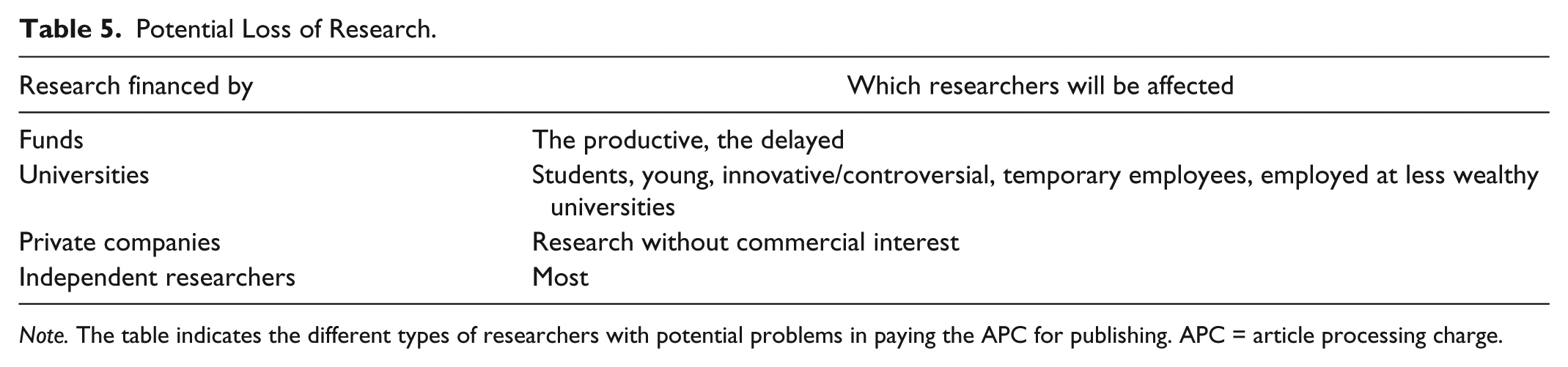
Note. The table indicates the different types of researchers with potential problems in paying the APC for publishing. APC = article processing charge.
The research shows that around 30% of authors in Danish journals are without a research institution behind them. The result is based on statistics for one single year, 2010, but nothing indicates a difference from other years. Some individual journals have a very different publishing profile every year, but with many journals in the sample this should be of minor importance. The largest journals are in medicine, which does not have these shifts in editorial practice.
The sample did not include all the Danish journals, but nothing indicates that the missing journals should have quite another profile.
The interpretation of the status of each researcher is based on qualitative judgments, and this method obviously does not yield a 100% accurate result. Furthermore, as mentioned, this study used information from the universities, where the information was known to include researchers with only a very weak relation to the university; the universities would certainly not pay for all those researchers to publish if they were asked.
Generally, the uncertainty was relatively high for which group a researcher belonged to (“students,” “unemployed,” “retired,” or “employed in an institution without research support”). The greatest uncertainty existed in the distribution of employment types in self-owned firms, and public or private institutions. The single calculated percentages should be treated with caution. However, there was reasonable certainty of whether a person was at a research institution.
There is a possible recent development that can explain some of the phenomenon of researchers without institutions. The labor market is changing rapidly, and many more employees have a very loose connection with their workplace. In the new networked economy, researchers can work for several institutions. Simultaneously, increased mobility implies that researchers often have only a few years at a research institution, when the duration of many grants is just 1 to 3 years, and then the researcher is often transferred to another institute.
The development is similar for students. They are forced to work in international, cross-institutional cooperation, and as a result, they fail to form a strong connection with any single institution.
The study is, to a large extent, based on such qualitative judgments and has the normal problems that occur within this tradition of research. In spite of the known problem that people provide false statements, at this instance claiming that they have a connection with a research institution, the study attempted to control these statements through different methods and sources.
Probably, the percentage of researchers without a research institution is larger than the mentioned 30%, but the number itself is not that important. The phenomenon of a large amount of research not being published is the most important message of the study.
The percentage of researchers in non-Danish journals who are without an institution has not been investigated. Random selections of those journals have shown the same kind of authors. Probably, the percentage of such authors in nationally and regionally oriented journals is larger than in international ones. One could imagine that the regional/national journals have better contact with and knowledge of all potential authors, and therefore can include experience from researchers outside the traditional research institutions; further studies should investigate this distribution. This study has shown the existence of a potential problem.
Not all researchers outside research institutions would have problems with the APC-based publishing model. Some can have their institution pay for them. In some cases, a company might pay the fee for publishing when it will directly benefit from an employee’s published research. One must assume that the work is often performed during working hours and with the institution’s consent. The institution may have two quite different interests in allowing employees’ to conduct research. It may be that the research will help to develop knowledge about the area, and thereby indirectly renew the institution. This is the case with the Greenland legal system, and probably also in part with the bank manager’s contribution. Another large institution-related interest behind scientific activity lies in public relations. It is certain that the bank director’s article shows the bank’s seriousness in having a scientific paper accepted and helps to promote the bank as one of the country’s leading financial institutions. The article should be read by journalists and should highlight the institution.
The gain for a company should be very visible, as an APC for most firms is a significant and extraneous amount, but this is estimated to be a possibility only for a minor percentage of the authors.
The problem with lost research from this group is not the only consequence of the publishing model. As shown in the literature, there would also be a loss of university research from less wealthy universities and research institutions and, of course, typically from researchers in a weak power situation. Young people would find it difficult to break through, the growing number of researchers with a non-permanent relation to an institution would have problems with the modern co-operative networks working on cross-words without belonging to a single institution, and finally innovative and controversial research would probably find it difficult to penetrate.
It is feared that under the new Open Access publishing system, students and part-time employees whose research is currently part of universities’ official statistics would no longer be considered as a part of the university’s research staff if the university pays for their research. Publication of an article from a student is going to compete with the head of department’s trip abroad, so to speak.
Even funded research will be difficult to publish. Although scientists should be better able to manage their budgeting than when Schroter et al. (2006) conducted their study, there will still be a problem for the very productive researchers with late manuscripts (which is not very uncommon).
If the author-paid publishing model just gets a fair spread, there will, for most researchers, no longer be the freedom to choose the best journals for their articles. The best journals would often also be the most desirable but with a high level of the APC. Researchers would find themselves with limited resources. The implication for researchers basically is a loss of academic freedom. They will be forced to publish in journals that do not treat their manuscripts optimally. The finished articles, thus, may have lower quality than articles published under the previous subscription-based model, where top journals printed all the best manuscripts.
It is quite certain that there must be sharp adjustments before the author-paid publishing model can cater to all requirements in the scientific world. Establishing funds to compensate is one solution, but this would necessitate new routines and decision-making processes. This would affect all researchers. Only extremely rich project researchers would be able to send their manuscripts to all journals, including the best and most expensive. The new funds would probably be limited, so priorities would have to be set.
Universities are interested in supporting their researchers’ publishing, and local university publishing funds are probable to appear in the coming years. Universities compete with each other for positions in the various rankings, and here the total impact factor is an important parameter. It will initially be seen at universities with a high proportion of scientific, technical and medical (STM) research, where one can use the Thomson Reuters Journal Citation Reports and similar measuring tools that cannot be used in book-oriented areas such as humanities and social sciences (HSS).
Power relations at universities and similar research institutions are also certainly changing. It is no longer (only) the academic norms, habits, and good practice in the scientific world that will be responsible, but now (paying for) publishing will be determined by economics, which is controlled in a hierarchical system. The decision on publishing will be taken by intruders.
Researchers with no institutional affiliation will be in the worst situation. There will possibly be general funding opportunities established where one can apply, but the same problem with unauthorized decision makers also will exist.
Furthermore, publishers also will be interested in supporting researchers without funding so they do not miss good manuscripts, and several have established internal funds as seen from the questionnaire. However, there is no assurance that the best manuscripts will be selected when there allegedly is no connection between the professional assessment and the aid. Only researchers from the poorest countries can, in a few publishing houses, be sure to receive support.
The problems with financing could be solved with a 100% automatic funding from the (over) state/federal side (Burchardt, 2011; King & Alvarado-Albertorio, 2008). This would allow all items to be funded, and no authors, institutions, or research councils would be burdened with paying. It would also make it easier for publishers who only had to send bills to one place. This idealistic approach is unfortunately not probable. It can be assumed that the brute market power will make a new publishing world with a privileged group of researchers at rich institutions and/or within rich research areas that can publish in the world’s top—and APC-financed—journals. A large group of “proletarian” researchers had to publish in free, lower quality journals that were not optimal for their manuscripts. Their chances of receiving external funds will be reduced compared with the more recognized researchers in the privileged group. The polarization gap will continue to grow.
Conclusion and Perspectives
The study shows that APC-financed publishing is a commercial success already covering more than half of all the published Open Access articles. This model can, due to political support, be the dominant publishing form and probably have a monopoly on publishing within many scientific areas.
Unfortunately, it has a type of built-in system failure that prevents research from being published. The study shows that up to 30% of Danish researchers in Danish journals would have problems having their research published in APC-based journals, because they have no research institution behind them to pay. Other studies have shown that many other researchers risk not having their research published even when they have an affiliation to a research institution.
It would be difficult to specify the size of the lost research, but without further research in this area, no one knows if there will be a loss of 5%, 25%, or 40%. Without counteraction, there will surely be a considerable loss of societal value.
This is the visible drawback. In addition, there is an invisible change in the nature of the research world itself when we no more have the principle that all quality manuscripts are published in the best journals. There is a danger that intruders to academic quality will decide whether an article is published. Another danger is polarization among the group of researchers between lucky star researchers at rich institutions and a proletariat of researchers without accesses to the best journals, and thereby the necessary reputation behind further financing of their research.
In view of the large potential drawbacks, there is actually very little research in this area. One can understand that commercial companies exploit revenue opportunities in a new form of publishing without considering in detail the societal implications. The same indifference could seem surprising for politicians and public administrators.
The development in this area needs to be carefully surveyed. Continued research should discuss compensations that have no side effects on the researchers’ world and the quality of published material. Probably, it should be investigated how less harmful Open Access publishing models like the Green Open Access or central-funded journals could serve an alternative.
The area needs a high priority. If it is true that a very large number of researchers stand outside a potential dominating publishing model and the quality of their published research will deteriorate, it will not only be a problem for individual researchers but also indirectly for the world economy.
Footnotes
Declaration of Conflicting Interests
The author(s) declared no potential conflicts of interest with respect to the research, authorship, and/or publication of this article.
Funding
The author(s) received no financial support for the research and/or authorship of this article.
Author Biography
Jørgen Burchardt an Engineer and Ethnologist is researcher at the National Museum of Science and Technology. His research interests lie in understanding technological and economic development often in a historical perspective.