




Abstract
By 2016, U.S. higher education institutions will face significant turnover among senior leaders. About 50% of university presidents are expected to retire. Historically, the chief academic officer (CAO) has been next in line for the presidency. New evidence suggests that fewer CAOs are interested in this position. Using Job Choice Theory, this article examines the reasons given by CAOs for opting out of pursuing the presidency. Data analysis shows that subjective (psycho-social) factors rather than objective (economic) factors are making the role of president undesirable to CAOs.
Keywords
Introduction
This article presents, within the framework of Job Choice Decision Theory, a look at the reasons that chief academic officers (CAOs) opt out of pursuing college presidencies. The discussion is divided into five main sections. The first section, “Framing the Issue,” includes the purpose of the proposed study, research questions, a brief demographic overview of the CAO’s role in U.S. colleges and universities, and a description of the methodology used in this study.
The second section, “Related Literature Career Moves and Job Choice Decisions,” outlines literature relating to this study topic. This section is followed by a “Theoretical Framework” section. The theoretical foundation of the study is the Job Choice Theory proposed by Behling, Labovitz, and Gainer (1968). Next, the “Implications for Practice” section looks at proposals to address higher education’s handling of the issues. The final section, “Study Limitations and Further Research,” presents the weaknesses in this study and suggests directions for future research.
Framing the Issue
Stepping Stone to the Presidency
U.S. higher education institutions face an impending significant turnover among its senior leadership, particularly presidents, due to retirements. About 50% of university presidents and chancellors, as well as 84% of community college presidents, are expected to retire by 2016 (American Council on Education [ACE], 2007). This anticipated turnover means that institutions of higher education need to have in place good internal pipelines to provide “replacement presidents.”
Historically, the office of CAO has been considered that pipeline, the stepping stone to the college/university presidency (Keim & Murray, 2008; McKenney & Cejda, 2000; Vaughan, 1990). According to the ACE, the percentage of CAOs who became college presidents rose from about 17% in 1998 to about 37% in 2006 (ACE, 2007). Studies on the career aspirations of CAOs have provided further support to the assertion that the office of the CAO is a typical path to the college presidency (Amey, VanDer Linden, & Brown, 2002; Moden, Miller, & Williford, 1987; Murray, Murray, & Summer, 2000). In the Murray et al. (2000) study of randomly sampled CAOs in American Association of Community College (AACC) member institutions, 61% of respondents (n = 120) indicated an interest in pursuing college presidencies as their next career move. A later study of AACC presidents by Weisman and Vaughan (2007) showed that 46% of the respondents (n = 545) had left positions as either chief of academic affairs or vice-president with oversight over academic affairs, to assume college presidencies.
While these studies support the notion that the office of the CAO is the pipeline to the college presidency, new evidence suggests that occupants of the office are becoming less interested in the position of the presidency as their next career move (Eckel, Cook, & King, 2009). Any significant contraction of the presidency pipeline due to CAO attrition could and will compound leadership crises faced by U.S. colleges. This has made the study of CAO lack of interest in the presidency critical. If the shrinking pipeline to the presidency is to be stemmed, it is important to understand the reasons why so many CAOs do not aspire to that office.
Purpose of Study and Research Questions
From a job choice theoretical perspective, this article presents an analysis of the reasons given by CAOs in the Eckel et al. study for choosing not to pursue the college/university presidency. The following research questions are answered in this article:
The CAO
In 2009, the ACE released the first-of-its-kind national census data on CAOs, The CAO Census: A National Profile of Chief Academic Officers (Eckel et al., 2009). It presented the most comprehensive profile of CAOs to date, based on a survey of more than 1,700 CAOs across the country (Table 1).
Summary of CAO Respondents by Institutions.
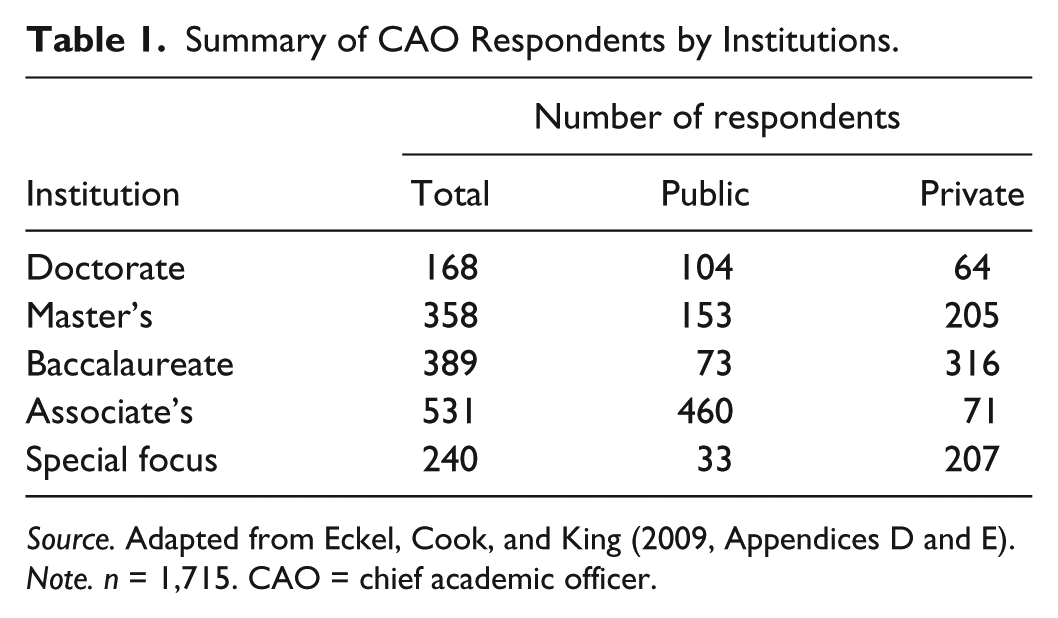
Source. Adapted from Eckel, Cook, and King (2009, Appendices D and E).
Note. n = 1,715. CAO = chief academic officer.
Respondents came from five different types of institutions: doctorate-granting, master’s, baccalaureate, associate, and special focus institutions. The highest number of respondents was from associate degree institutions such as community colleges, while the lowest number came from doctorate-granting institutions. The data presented in Table 2 show that even though U.S. higher education had in the last several years made significant efforts to diversify the leadership of academic institutions, the office of the CAO was still very much male dominated (59.9%) and White (85.4%; Table 2). The average age of a CAO is 56 years. Most of the CAOs (47%) reported being between 51 years and 61 years of age.
Summary of Basic Demographic Indicators of CAOs.

Source. Adapted from Eckel, Cook, and King (2009, Table 1.1 Characteristics of Chief Academic Officers).
Note. CAO = chief academic officer.
As shown in Table 3, most CAOs (52%) are internal hires, with more than 40% rising through the ranks of their own institutions. Prior to becoming CAOs, about 50% of respondents had experience providing academic administrative oversight, 27% had been deans of academic colleges, and 23% had been campus executives in academic affairs. Data also show that CAOs have an average tenure of 4.7 years, and about 63% were very satisfied with their work as CAOs. The length of time that CAOs serve in their positions tends to be relatively shorter than that of college presidents—8.4 years. The data also revealed that the longer CAOs stayed in their roles, the less likely they were to be interested in the college presidency. In fact, 39% of CAOs with fewer than 3 years’ experience were not interested in the presidency. The percentage increased to 42% for those with 3 to 6 years of experience, while the percentage jumped to 62% for CAOs with a tenure of 7 years or more.
Community College CAO Tenure.

Source. Adapted from Eckel, Cook, and King (2009, Table 5.6, Figure 3.1, and Appendix D).
Note. CAO = chief academic officer.
In terms of career moves and their choices after tenure as CAO, looking at the predecessors of the study respondents, Eckel et al. reported that 21% retired, 20% went into presidency roles, and 18% returned to the faculty ranks. These career moves exemplify the “lost knowledge challenge” faced by higher education leadership—the possible decreased capacity for effective action or decision making in specific functions or roles due to conditions such as employee turnover, retirements, and other forms of attrition (Berliner, 2007; Delong, 2004). This gives impetus to the need to study, understand, and address the problem of the lack of CAO interest in the presidency.
Method
This present study relied on secondary data from Eckel et al. (2009). The data were generated from a survey created by the ACE, with the help of a group of CAOs. Based on the input from CAO subject matter experts, an instrument consisting of a combination of yes/no questions, one-response pick lists, and multi-response pick lists was created.
While the use of secondary data has recognized disadvantages such as the lack of researcher control over the data collection process, there are advantages that make the use of secondary data relevant in some studies. The advantages include the accessibility of a large quantity of information and data collection guided by expertise not always available to individual researchers (Boslaugh, 2007; Nicoll, 1999). For the purposes of this study, the advantages of secondary data outweighed the disadvantages. First, the survey results of The CAO census provided the most recent and most extensive quantitative evidence, supporting the notion of CAOs opting out of the college presidency pipeline (Eckel et al., 2009). The results included data on 531 community college CAOs, which represents information on almost one third of community college CAOs/provosts across the United States. Second, the use of secondary data was effective as an exploratory technique. This is because the study results provided a foundation for follow-up qualitative research to further investigate the phenomenon of CAO opt-out among community college CAOs in Pennsylvania. The data provided useful benchmarks for the qualitative study.
In this study, the author utilized the Job Choice Theoretical Framework to categorize reasons reported by CAOs for considering or not considering a college presidency position. The reasons were placed into one of three theoretical categories: objective, subjective, or critical contact. This framework was first proposed in 1968 by Behling, Labovitz, and Gainer to explain how new job applicants made decisions regarding which jobs to apply for and/or accept (Behling et al., 1968; Pounder & Merrill, 2001).
Related Literature: Career Moves and Job Choice Decisions
The notion of career moves/mobility in the research literature often implies vertical or lateral moves and also covers a broad spectrum of change from changing of jobs (within an organization), to changing of organizations, to changing occupations (Feldman & Ng, 2007; Kim & Brunner, 2009). Key assumptions about an individual’s career moves and job choices are as follows: (a) Career advancement equals upward mobility and (b) career advancement is actively sought by working individuals (Hall, 2002; Oplatka & Tamir, 2009). Based on this assumption, researchers have generally attempted to explain the underrepresentation of certain groups, such as women and minorities, in some job roles by identifying barriers and factors that impede their advancement in the workplace. However, a growing body of evidence suggests that this assumed narrative may not tell the entire story of why some individuals do not pursue certain jobs. Research evidence on women in corporate America, as well as K-12 and higher education administration, indicates that individuals choose to opt out of positions for a variety of personal and professional reasons other than barriers and impediments (Hausman, Nebeker, & McCreary, 2002; Lee, Kwan, & Walker, 2009; Pounder & Merrill, 2001; Sullivan & Mainiero, 2008).
Particularly germane to this article are two earlier studies that looked at the job choice decisions and career moves of female deputy school heads in Israel (Oplatka & Tamir, 2009) as well as high school assistant principals and middle school principals (Pounder & Merrill, 2001). In the Israeli study, Oplatka and Tamir (2009) examined the career stories of female deputy heads who did not want to become heads of schools. The researchers sought to identify the reasons for deputies’ job choice decisions regarding school headships. Their findings suggested that the principalship was undesirable to potential candidates because of candidates’ own perceptions and feelings about the job’s attributes, as well as their individual economic and psycho-social needs: . . . female deputies’ positive role perception and high job satisfaction coupled with their images of headship that are believed to be contrary to selfhood, preferences and ways of life are brought up to illustrate their alternative constructions of career advancement and aspiration. (Oplatka & Tamir, 2009, pp. 224-225)
The study participants consistently attributed their lack of interest in pursuing the headship to the following: low confidence in their abilities to perform the head role, the time-consuming nature of the role of the school head, the stresses associated with the role, as well as incompatibility of head role to the personalities of the deputies.
The findings from Oplatka and Tamir mirrored an earlier study by Pounder and Merrill (2001) on assistant principals and principals. In their study, Pounder and Merrill used the Job Choice Theoretical Framework to analyze differences in the reasons why study participants opted out of principalship positions. The theoretical framework allowed them to categorize those reasons in terms of objective factors, subjective factors, critical contact factors, and nature of work influences. Pounder and Merrill’s study participants cited the time demands of the position, the problems and dilemmas associated with the principalship role, as well as the perceived inability to make meaningful contributions to the field, as possible factors that made the principalship role unattractive. For many of the participants, the decision to pursue a principal position often came down to: How much can I afford to sacrifice in terms of personal life and overall quality of life to fulfill my desire to achieve or influence education and to make more money? Or similarly, how much money do I need to make to be worth the loss of personal time? (Pounder & Merrill, 2001, p. 47)
Both Oplatka and Tamir (2009) and Pounder and Merrill (2001) showed that individuals’ job choice decisions and career moves were sometimes influenced directly by the characteristics of the prospective new job, while others were influenced by the individual needs of the potential job candidates. Following Pounder and Merrill, this study utilized a job choice theoretical approach to understand and categorize CAOs’ decisions to opt out of the presidencies, as reported in the Eckel et al. (2009) study.
Theoretical Framework
Job Choice Theory and Job Desirability
The Job Choice Framework is comprised of three theoretical categories (theories) that explain individuals’ job choice decisions: objective theory, subjective theory, and critical contact theory. According to Behling et al. (1968), job seekers evaluated job and organizational attributes that fell under these different theories and then weighed the attributes in terms of their relative importance. A decision whether or not to accept a job or position was then made based on an overall index of job desirability (Behling et al., 1968; Pounder & Merrill, 2001).
The thrust of the objective theory is that people are economic beings; consequently, their preference for particular jobs is driven by economic value. The degree to which potential job candidates may derive maximum economic benefits from a given position is the primary determinant in their decision making. They are therefore influenced by factors relating to monetary value, such as salary and benefits packages, location of job, educational opportunities, and prospects for advancement.
Subjective theory refers to job candidates as psychological beings who base job choice decisions primarily on factors congruent with their personalities as well as their perceptions of the job environment and how the jobs may fulfill specific psychological and sociological needs (Pounder, Crow, & Bergerson, 2004; Pounder & Merrill, 2001).
The critical contact theory suggests that potential candidates make decisions about positions based on either the actual nature of their recruitment/search experience or their perception of it. If individuals are comfortable with how the recruitment/search process unfolds, they are more likely to give positions favorable consideration. Several retrospective studies of job applicant experiences have confirmed this theory regarding applicant job choices (Pounder & Merrill, 2001; Rynes & Miller, 1983; Winter & Kjorlien, 2000).
In the Eckel et al. study, CAOs were asked whether they planned to seek a presidency in the future and their next steps in their career. They were also asked about the steps they had taken to prepare for a presidency. If individuals were not planning to pursue presidencies or were undecided about taking on that position, they were asked to indicate the reasons. As shown in Table 4, almost half (45%) of the CAOs reported no interest in the presidency, and one fourth (25%) were unsure.
CAO Job Choices Regarding College Presidency.

Source. Adapted from Eckel, Cook, and King (2009, Appendix D).
Note. CAO = chief academic officer.
When asked to select all applicable reasons for not wanting to pursue the presidency, the seven top choices of the CAOs (choices selected by at least 20% of the respondents) were Uncertain if I like the nature of the work, Nature of work not appealing, Concern about balancing family and job demands, Ready to retire, Time demands of position, Don’t want to live “in a fishbowl,” Want to return to classroom/lab, Considering possibly working outside of academe, and Too old to be considered. The choices suggest that the desirability of a job is not influenced by a single factor/attribute but by multiple factors at varying degrees. Similar to the reasons of vice-principals and principals regarding the principalship, the CAOs’ reasons were distributed across the three different theories.
Aligning the reasons given in Table 4 with the three Job Choice Theory categories (Figure 1) reveals a skew similar to reports from Pounder and Merrill (2001). The desirability of a job is not influenced by a single factor/attribute but by multiple factors at varying degrees. Similar to the reasons of vice-principals and principals regarding the principalship, the CAOs’ reasons reflected the different levels of the theories: critical contact, objective, and subjective categories. As shown by Pounder and Merrill, CAOs’ reasons were skewed toward one theory: subjective theory. In the Eckel et al. study, the CAOs’ reasons were influenced largely by subjective factors/attributes.
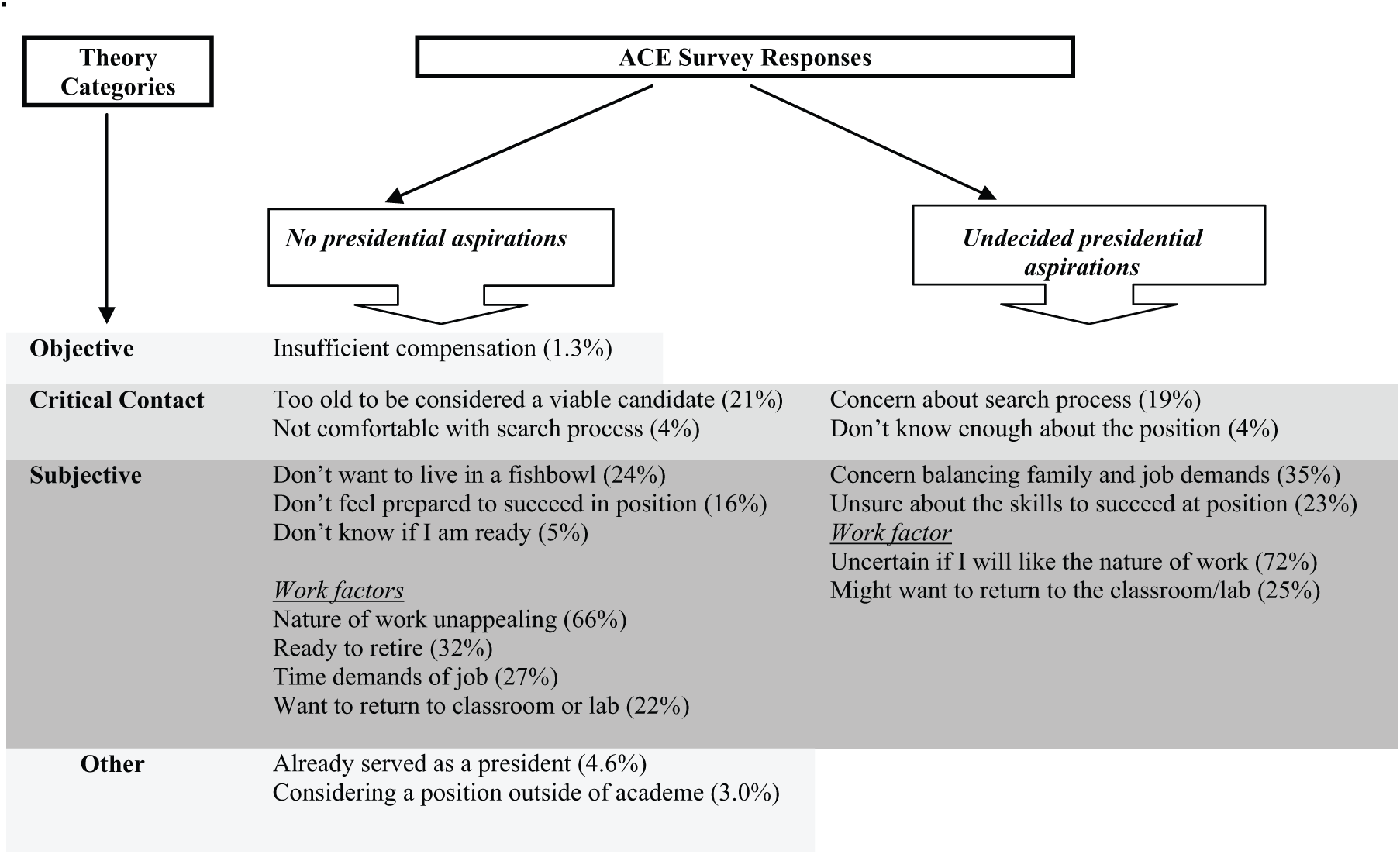
Alignment of CAO reasons with Job Choice Theory categories.
Analysis of Job Choice and Career Moves of CAOs
Objective theory
From the objective theory perspective, one would expect the college presidency to be highly desirable to CAOs because on college campuses, not only does that position represent the most powerful (positional) job, but it is also often the highest paid, only surpassed on occasion by the salaries of some coaches. According to the 2011 Chronicle of Higher Education annual report on executive compensation at universities and colleges (Fuller, 2011), median total compensation for presidents at the nation’s largest state research universities during the 2009-2010 academic year was US$440,487. On the career ladder on college campuses, the presidency represents the highest administrative level and most significant stage in career advancement. Given the high economic value of these attributes, one would expect them to factor prominently in CAOs’ decisions regarding college presidencies.
According to data released by the College and University Professional Association for Human Resources, median base pay of CAOs in 2006-2007 by institution type were US$103,373(2-year), US$130,500 (bachelor’s), US$146,878 (master’s), and US$243,079 (doctorate-granting). In a vacuum, without consideration of other factors, compensation alone could make the presidency attractive to CAOs. However, with only 1.3% of Eckel et al. survey respondents citing concerns of compensation as an issue, it can be suggested that economic factors may not deter the desirability of the presidency for CAOs. It is possible that CAOs, such as vice-principals and principals, also ask themselves questions along the lines of “How much can I afford to sacrifice in terms of personal life and overall quality of life to make more money in the presidency?” The two groups, however, come to different conclusions. While the salary and benefits (objective factors) make the principalship desirable to vice-principals (Hertling, 2001; Norton, 2002; Pounder & Merrill, 2001), those same economic factors do not make the presidency attractive to CAOs.
Critical contact theory
Like the influences in objective theory, critical contact theory influences do not appear to be significant factors in CAOs’ decisions (Figure 1). The percentages of CAO respondents citing critical contact concerns were relatively small. Only 4% with no presidential aspirations were uncomfortable with the search process, while another 19% who were not sure of their presidential aspirations had concerns about the search process. This is to be expected given that the search process is similar for executive positions such as presidents and CAOs.
Subjective theory and work attributes
From the subjective theory angle, the results of the CAO survey mirror the findings in Pounder and Merrill (2001). In both studies, the subjective attributes of the job have the greatest impact on job desirability—more so than the objective attributes. Both CAOs and principals/vice-principals were concerned about the nature of the role as well as the time demands and potential negative effects of the job on their quality of life. The reasons cited by both CAO respondents with no presidential aspirations and the undecided were heavily aligned with subjective factors theory. Six reasons were rated by 23% to 72% of the respondents: Uncertain if I will like the nature of work (72%), Nature of work unappealing (66%), Concern about balancing family and job demands (35%), Time demands of job (27%), Don’t want to live in a fishbowl (24%), and Unsure about having the skills to succeed at position (23%). The CAOs viewed the desirability of the presidency in terms of how it fulfilled their psychological needs.
While Pounder and Merrill distinguished between the nature of work factors and subjective theory factors, the approach adopted in this study was that the two are not distinct enough to merit separation. This is because both subjective factors and nature of work factors point to individuals’ need to attain some psychological and/social fulfillment from their work. This position is influenced by Hackman and Oldham’s (1980) job characteristics model. The model suggests that work factors are antecedents to the psychological responses of individuals to a given profession. Consequently, work factors have an indirect influence on job desirability.
A work factor that needs closer consideration is the nature of the president’s job. A high percentage of CAOs cited this as a factor in not pursuing the presidency: 72% had no presidential aspirations, and 66% were unsure about their presidential aspirations. There are a number of possible explanations for why this particular work factor is critical for CAOs. It is likely that given the proximity within which the president and CAO work, CAOs observe the daily stressors of the president’s role and do not find the role appealing.
Another explanation could be the disconnect between the role of the president and that of the CAO. Even though the CAO office is supposed to be the “training ground” for the presidency, in many institutions the roles have little to no overlap (Anderson, Murray, & Olivarez, 2002; Keim & Murray, 2008; McKenney & Cejda, 2000). It has been suggested that at doctorate-granting and master’s-granting universities, academic deans of large colleges, such as arts, science, business, and medicine, work more like presidents than do the CAOs (Eckel et al., 2009). Generally, the office of the CAO tends to be very internally focused, while that of the president is externally focused. This means that particularly for the 63.7% of CAOs who report being very satisfied with the CAO position, a change in the presidency could be considered a career change. They will be moving into jobs that are not similar to what they currently enjoy doing. The situation can be addressed through job redesign—one with overlaps between the role of the president and the CAO. This will ensure that as CAOs go about their duties, they also acquire skills that will enable them to perform as presidents if and when they step into that role.
The disconnect between the two roles could also explain why up to 21% of the CAOs reported not feeling prepared to succeed as presidents. If the current job descriptions of the CAOs do not relate to the work of the president, they have no way of acquiring the type of on-the-job skills needed for successful presidencies. This problem can be addressed by making formal and informal professional development opportunities related to the presidency role available to CAOs. Participation in such development programs would be one way to prepare CAOs to become more comfortable with the presidency role. However, before this can occur, the job attributes of the presidency need to be examined in more detail and incorporated into any development activities to ensure that attributes identified as unattractive are addressed.
Implications for practice
With about 49% of current presidents aged 61 years proposing to retire in the immediate future, understanding the nature of the shrinking CAO-to-presidency pipeline is critical. It is important for succession planning at higher education institutions, as well as the recruitment of external job candidates to the presidency. Institutions must look for ways to increase the quantity and quality of presidential aspirants among the CAO ranks. Given that the subjective factors seem to outweigh the objective and critical contact factors in influencing the decisions of CAOs, it is important that stakeholders who seek to address the problem develop solutions that target the subject factors. Some solutions could include job redesign, professional development, and career planning.
Job redesign
In higher education institutions where the president and CAO roles do not overlap, such as in community colleges, some form of job redesign should be considered to allow the two positions to overlap and become truly sequential. This will make the CAO role a true pathway to the presidency. A comparison of the percentage of CAOs from doctorate-granting and baccalaureate institutions revealed that doctorate-granting CAOs who tended to spend moderate-to-significant time on typical presidential functions, such as fundraising, fiscal management, strategic planning, alumni relations, and economic development, were more likely to move into the presidency (43.5%) than CAOs from baccalaureate institutions (15.7%), who typically did not perform those functions. A job redesign that leads to an overlapping alignment between the CAO and president roles will help reduce or even eliminate the perception of “career change” sometimes negatively associated with the move from CAO to presidency.
Professional development
Professional development activities and programs provided by organizations such as the ACE and AACC, such as the ACE Institute for New Presidents and ACE Institute for New Chief Academic Officers, tend to focus on helping new or incumbent CAOs and presidents improve their skills for their current roles. Institutes and programs are also needed that provide opportunities to develop skills for future career moves. Specifically for CAOs, development programs should help them acquire competencies needed to engage in the externally oriented duties of the presidency. This will help address the “perceived skills gap” and boost the confidence of potential aspirants who feel dissuaded by their perceived lack of relevant skills.
In addition to having available opportunities, access to them must be expanded. About 70% of the CAOs reported no participation in off-campus leadership development. If non-participation is due to their inability to attend those training programs, then the programs must be situated such that regardless of where CAOs are, whether in rural, urban, or suburban areas, they can reach them. However, if the issue is motivation, then CAOs should be encouraged to attend and provided with incentives to do so by their institutions.
Career planning
In the study of vice-principals, Oplatka and Tamir (2009) found a positive correlation between the patterns of career entry and future career orientations. Vice-principals who had not intentionally planned to take on those roles tended to avoid opportunities to become principals. Is it possible that accidental ascendancy into the CAO position correlated with the lack of desire or unwillingness of some CAOs to consider college presidencies? Cejda (2008) suggested this possibility. In an ongoing longitudinal study of six female CAOs, Cejda (2008) reported that none of his study participants had actively sought the CAO position. Four of the six CAOs had no interest in the presidency, while one was not sure. If this is the case, then career planning for CAO roles should be built with a long-range view—one that includes a career ladder that culminates with the college/university presidency. Such planning will encourage potential CAOs to be intentional about their career development and moves.
Conclusion
Study Limitations
A major study limitation was that it was completely theoretical and based on secondary data. Additional empirical studies need to be conducted to validate the analysis offered here. Phenomenological studies need to be conducted to provide insights into the lived experiences of CAOs. This will shed more light on the nature of the shrinking CAO-to-president pipeline and provide answers that cannot necessarily be captured through statistical analysis.
Recommendations for Further Research
Further research should explore in detail the nature of specific work attributes and the degree to which each attribute influences job choice decisions. The findings of such inquiries will help in the design of targeted solutions for the problem.
It is also important to look at gender differences in CAOs’ job choice decisions. Eckel et al.’s study suggested that up to 75% of the women CAOs had no intention or were undecided about the presidency. At the community college level, women constitute about 50% of CAOs, so the urgency to understand gender differences in the problem cannot be overemphasized. If this problem is not more carefully studied and addressed, it will negatively affect attempts by higher education institutions to achieve diversity and gender parity among senior executives.
Another issue that needs further research is the differences between institutions. It is important to identify what makes CAOs in doctorate-granting institutions more attracted to the college presidency. Such a study could yield possible best practices that could help other types of higher education institutions make the presidency more desirable to their CAOs.
This study is an exploratory inquiry that contributes to understanding of the factors that influence the job choice decisions of higher education leaders. It utilizes a theoretical framework that has proven effective for categorizing job choice reasons. This type of categorization is essential to understanding and addressing the root causes of the shrinking college CAO-to-presidency pipeline.
Footnotes
Declaration of Conflicting Interests
The author(s) declared no potential conflicts of interest with respect to the research, authorship, and/or publication of this article.
Funding
The author(s) received no financial support for the research and/or authorship of this article.

