




Abstract
For engineering students, reading in English is the core competence to absorb professional knowledge in academic settings and their future career, because many authentic textbooks and information about advanced technology have been published in English. The present study sets out to improve English reading comprehension among tertiary-level engineering students. An online reading strategy instruction based on cumulative sentence analysis (CSA) was constructed to enhance the students’ reading comprehension of English technology texts. The comparison between the pre-test and post-test showed that the participants achieved a higher level of reading comprehension performance following the instruction. The findings clearly demonstrated that online CSA strategy instruction is an efficient and feasible approach to helping engineering students cope with their problems of reading English texts. Pedagogical implications are briefly discussed based on the findings of this study.
Keywords
Introduction
According to the vision set by the Ministry of Education (MoE) of Taiwan, it has been generally recognized that the primary goal of foreign language education is to train the students with foreign language proficiency and professional knowledge needed for their future career (Tsai, 2011). Several researchers have emphasized the importance of English in engineering education (Pritchard & Nasr, 2004; Venkatraman & Premak, 2007). For example, it was pointed out that English is the major international language of science community, which enables the students to acquire professional knowledge through reading texts in English (Pritchard & Nasr, 2004). Some authors also stressed that engineering students should be equipped with specific English skills, which will become valuable resources in their career (Joesba & Ardeo, 2005). For engineering students, English reading comprehension ability is crucial in academic settings and their future career. To absorb fundamental knowledge in textbooks and deepen professional knowledge in their workplace, it is essential for engineering students to read in English fluently.
However, there are still a considerable number of engineering students struggling with reading in English in Taiwan. Some authors have attributed engineering students’ reading difficulty to vocabulary knowledge and proposed lexical instruction (Mudray, 2006; Ward, 2009). In second language (L2) research, Alderson (2000) states that the knowledge of syntactic structure plays a significant role in L2 reading. Shiotsu and Weir (2007) also demonstrated the relative contribution of syntactic knowledge to L2 reading comprehension performance.
Hence, the purpose of this study is twofold. The first purpose is to propose a framework integrating cumulative sentence analysis (CSA) instruction (Chang, 2007), to facilitate engineering students’ comprehension of reading professional texts related to their own field. The second purpose is to evaluate the implementation of the course by using technology acceptance model (TAM, Davis, 1993). The remainder of this article is organized as follows: In the next section, we present the literature review concerning teaching approaches to English for Science and Technology (EST), the relationship between sentence analysis and reading comprehension, and the evaluation model of TAM. In the “Method” section, we illustrate the research method including the course design. And, the “Results” section presents the findings of our experimental study, followed by the discussion and conclusion.
Literature Review
Teaching Approaches to EST
The goal of teaching English for specific purposes (ESP) was to help students to read and comprehend English materials in their own field (Ahmadi & Bajelani, 2012). Therefore, the development of interesting and attractive materials (Liao & Chen, 2012) and the instructors who are skillful and understand the knowledge of specific statements well (Chien & Hsu, 2010) are essential for the success of ESP education. In the international generation nowadays, information and technology have become indispensable in our life. Liao and Chen (2012) suggested that if university engineering students want to equip themselves in their career development, suitable ESP materials, such as EST, need to be provided in college courses.
In their research, Pritchard and Nasr (2004) emphasized that English was an important international language for engineering students. In other words, acquiring proficient reading skill in English for technology is required in their workplaces in the future. To improve the reading performance among Egyptian engineering students, Pritchard and Nasr designed the Reading Comprehension Skills Checklist (RCSC). RCSC was invented by experienced teachers and involved the goal of improvement project of foundational reading skill. The researchers summarized 10 important reading skills, including skimming, scanning, understanding the surface meaning and implied meaning of articles; understanding from the figures, diagrams, and tables; realizing the precept and instructional language; finding the main objective; recognizing similar words; guessing meaning by affixes and word families; comprehending nominal compounds; and summarizing and making the conclusions of contents. On the pre-test of this research, the experimental group’s grades of reading comprehension were lower than the control group; however, in the post-test, the scores of experimental group raised almost 27% at the end of the project, and the scores of control group only raised less than 2% (Pritchard & Nasr, 2004). It was demonstrated that increasing learners’ awareness of reading skills could facilitate students’ reading comprehension of science and technology texts in English.
With the advance of information technology, particular attention has been given to the potential of e-learning environment. In his study, Canapero (2004) proposed the design of an e-learning environment, the Web-Enhanced Language Learning (WELL), which promotes collaborative and constructive learning processes of EST. With the integration of web-based materials in daily classroom teaching, WELL instruction promoted the interaction between the tutor and learners, and enhanced collaborative learning through group activities. Link-mediated learning units within a web-enhanced course in EST designed specifically for environmental science students were created to support a fully integrated language course, as well as on the community-creating and web-connecting basis. In Canapero’s research, an online course website was created, which involved the notion to the digital drawing panel to observe the relationship between instructor and learners in an e-learning setting. The study also indicated that it was necessary to find the web resources that were related to the curriculum. Canapero provided the resources such as the BBC’s Science in Action and Horizon Special, CNN’s Science & Technology pages, Scientific American Educational and popular science sites, as well as environmental organizations such as Greenpeace or the World Wildlife Fund. By doing so, it was useful to conform to a predefined set of learning goals in the materials in accordance with the levels of lexical and grammatical intricacy, and then made the decision to fit into the program deign scaffolding. After all, both visual and verbal graphic illustrations can help students build the abstract content-based concept, and students can reap benefits in a technology-enhanced learning environment (Dreyer & Nel, 2003).
Sentence Analysis and Reading Comprehension
Reading comprehension involves the processing of knowledge at different levels, among which syntactic knowledge plays a key role. Several researchers have mentioned the contribution of syntactic knowledge to reading comprehension. For example, Alderson (2000) emphasized the specific effects of syntactic processing ability on L2 reading comprehension, indicating that sentence analysis was essential as a correct structural ability for understanding texts. In their study, Shiotsu and Weir (2007) proved that syntactic knowledge helped readers to perform better in reading comprehension tests, compared with vocabulary knowledge. Furthermore, Cain and Oakhill’s (2007) study revealed that syntactic knowledge processing was one of the factors causing L2 learners’ reading difficulties. It can be observed from L2 learners who have problems with reading at a syntactic level, such as not being able to distinguish the syntactic categories, that the accumulation of these problems may lead to mistakes in comprehending paragraphs and the whole text. Hence, students’ English reading comprehension can be facilitated, if they are equipped with sentence analysis skills. Concerning this, Chang (2007) has proposed the CSA approach, to improve students’ reading comprehension of English science texts. In two recent studies (Tsai, Chang, & Ouyang, 2011, 2012), CSA approach has been successfully adapted to identify the error patterns in engineering students’ English reading comprehension. For the intervention of reading instruction, establishing a CSA online system to reduce students’ automatic reading processes could enhance their reading comprehension.
Evaluation Model TAM
Concerning system evaluation of e-learning, the TAM proposed by Davis (1986, 1989, 1993) has been a well-known instrument to evaluate the effects of e-learning quality (Lee, Hsieh, & Hsu, 2011; Liu, Chen, Sun, Wible, & Kuo, 2010; N. Park, 2005; S. Y. Park, 2009; Roca, Chiu, & Martinez, 2006). The purpose of TAM was to investigate the effects of technology on user behavior. Specifically, perceived usefulness and perceived ease of use were regarded as two major elements influencing users’ willingness of using a specific technology (Davis, 1989). However, it has been argued that TAM only provides general information concerning the acceptance of a specific technology. To develop the technology in the right direction, it is necessary to obtain further detailed information regarding content-specific usage of the technology.
Method
CSA-Supported EST Instruction
This study adapted the CSA instruction proposed by Chang (Chang, 2007; Chang & Chen, 2014). Before the design of the web-based system that is used to support CSA instruction is described, it is necessary to have a thorough understanding of the steps in CSA. CSA consists of six steps, as illustrated in Figure 1.
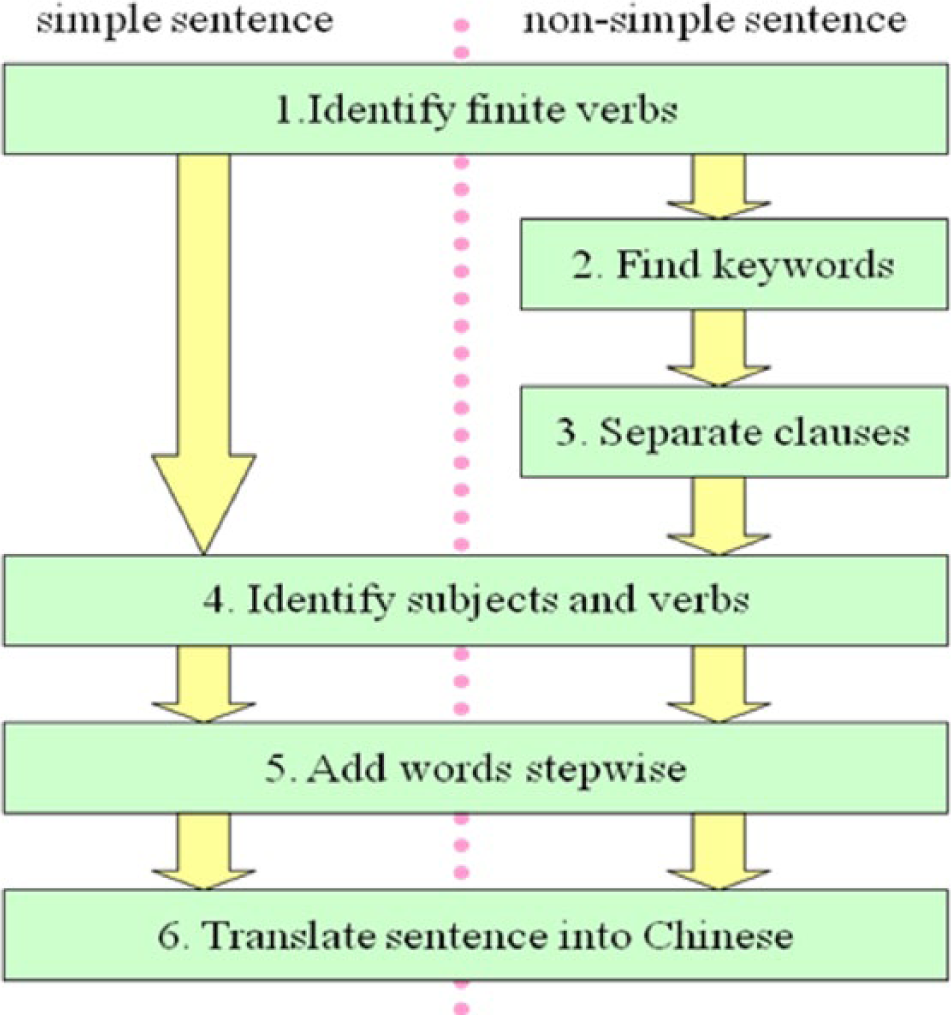
Six steps of CSA.

Screenshot of Steps 1 and 2 in CSA.

Screenshot of Step 3 in CSA.

Screenshot of Step 4 in CSA.

The screenshot of Steps 5 and 6 in CSA.
The EST course was implemented in a computer lab supported by a Blackboard (Bb) course management system (CMS). A conceptual model of the web-based EST reading instruction is presented in Figure 6.
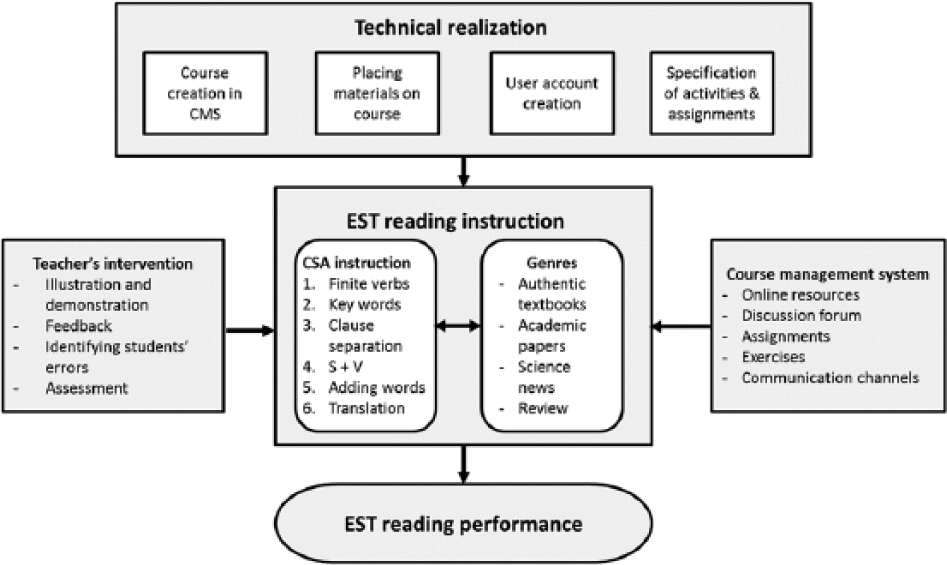
System architecture of the CSA-supported reading instruction.
During each CSA instruction session, the reading materials were selected from the textbook Absolute C++ (Savitch, 2006). Additional reading selections were chosen from the website of the Association for Computing Machinery (ACM Tech News, http://technews.acm.org/).
Participants
The study involved 153 freshmen majoring in Information Engineering department (ages ranged from 18 to 21). All subjects had studied English for at least 6 years in their high schools, and were enrolled in the course of EST at a university in Southern Taiwan. The objective of the course was to increase students’ reading comprehension of English science and technology texts.
Procedure
The participants received the EST curriculum, using a computer lab as a learning environment in combination with the online CSA instruction. In each session, the procedure of CSA was precisely explained through power point demonstration first. After the demonstration of using CSA to comprehend the text, the students were offered the opportunity to practice using the system to read selected readings, either from the textbook Absolute C++ (Savitch, 2006) or ACM Tech News. They were asked to follow the steps of the instruction and submit their responses to a server where all their responses were collected for further analysis. The course was offered 2 hr per week for 14 weeks. The pre-test and post-test of reading comprehension were conducted online during the first and final week, respectively. After the post-test, a questionnaire on course evaluation was conducted. Table 1 illustrates the syllabus design.
Syllabus Design of the CSA-Supported EST Instruction.

Note. CSA = cumulative sentence analysis; EST = English for science and technology. TED = Technology, Entertainment, Design; ACM = Association For Computing Machinery.
Materials
Measurement of reading comprehension
To evaluate the learning outcome of the reading instruction, pre-tests and post-tests of reading comprehension were designed for purposes of quantitative data analysis. The pre-tests and post-tests adopted the same types of questions. The evaluation of teaching effect focused on reading comprehension of English science texts to test significant improvement via CSA instruction in the experimental curriculum. Two articles were selected from technology news in English: “Studies Identify Most Dangerous Place to Surf Online” (527 words, selected from www.pcmag.com) and “Online Learning Startup Rises on Wings of ‘Angels’”(696 words, selected from www.afp.com). Ten multiple-choice reading comprehension questions were constructed for each article. The definitions of vocabulary words were provided to avoid the effect of vocabulary difficulties.
Questionnaire on CSA system evaluation
A questionnaire was designed adapting from the instruments used in Sánchez and Hueros (2010), which were based on TAM (Davis, 1986, 1989, 1993). In this study, some modifications were made by the authors, and six parts were included in the questionnaire: (a) system evaluation, (b) perceived usefulness, (c) computer self-efficacy, (d) perceived ease of use, (e) attitude, and (f) system usage. There were 28 questions in total. Using a 5-point Likert-type scale (code 1 = strongly disagree, 2 = disagree, 3 = neither disagree nor agree, 4 = agree, 5 = strongly agree), the questionnaire elicited students’ perception of using the CSA system. Regarding the reliability, internal consistency coefficients showed that Cronbach’s alpha (α) for total was .89, so there was a high reliability among the questionnaire items.
Results
Comparison Between Pre-test and Post-Test of Reading Comprehension
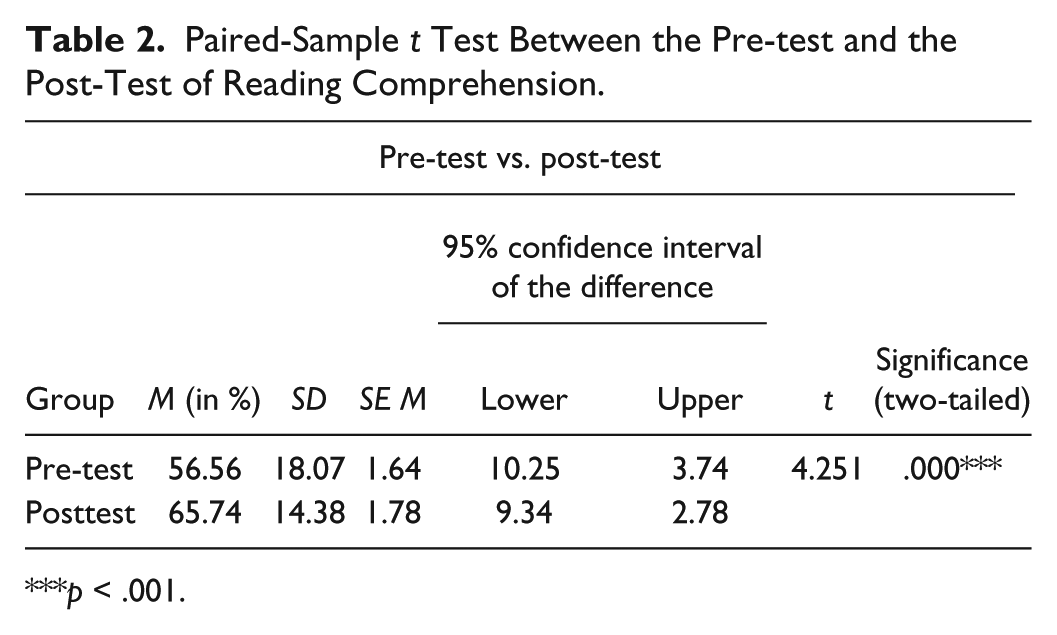
The evaluation of reading comprehension targeted students’ comprehension of science texts. A paired-sample t test was given to analyze students’ reading comprehension performances between the pre-test and the post-test. The statistical results in Table 2 reveal a significant difference in the experimental group (p = .000) between the pre-test and post-test. The accuracy rate of the experimental group had increased from 56% to 65%. The highly significant difference of the participants between the pre-test and the post-test indicates that students had made a considerable progress after the online CSA strategy instruction.
Paired-Sample t Test Between the Pre-test and the Post-Test of Reading Comprehension.
p < .001.
Results of the Questionnaire
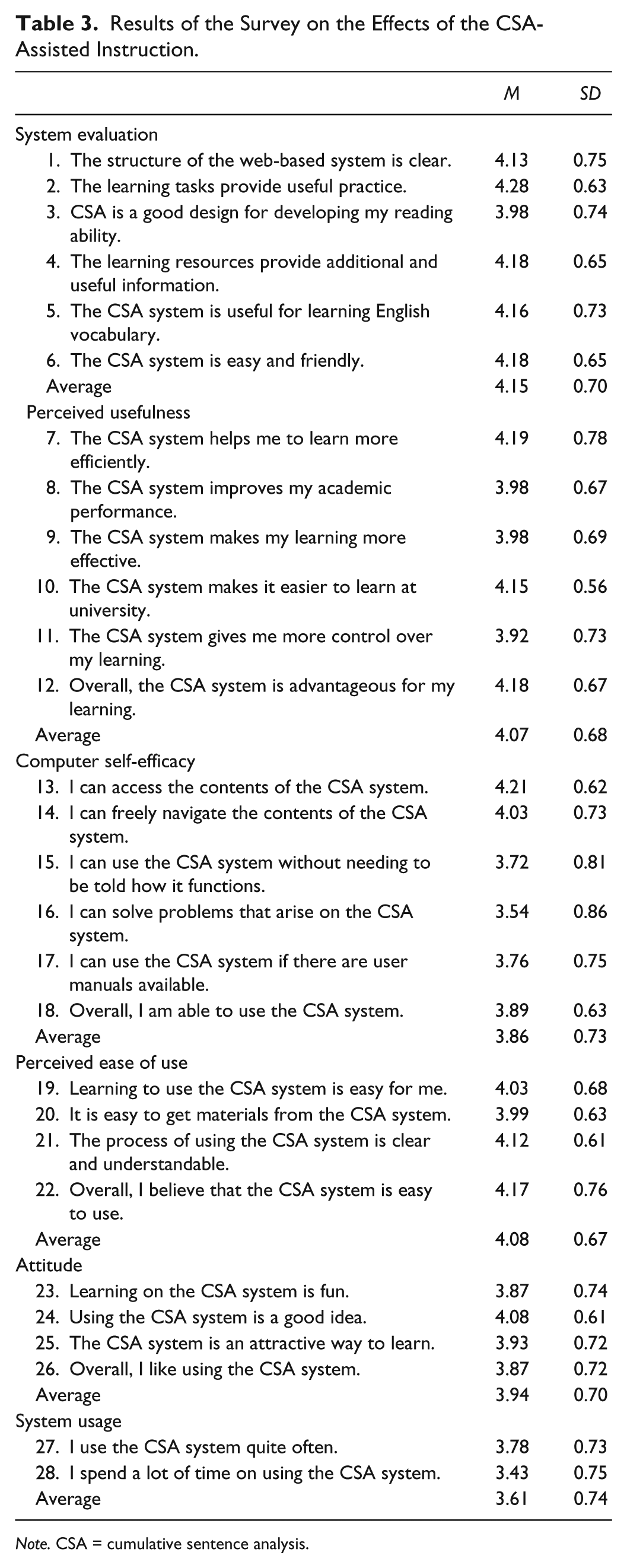
The questionnaire of this study is to investigate the students’ perception of using CSA in EST. Table 3 shows the means and standard deviations of English reading ability toward reading by using CSA. The data indicated that most of the students were satisfied with CSA to assist their learning in EST (M = 4.15, SD = 0.70). Q2 (M = 4.28, SD = 0.63), Q4, and Q6 (M = 4.18, SD = 0.65) had the highest scores, meaning that the learning tasks embedded in the CSA system provided useful practice and the additional learning resources were helpful.
Results of the Survey on the Effects of the CSA-Assisted Instruction.
Note. CSA = cumulative sentence analysis.
Concerning the questions related to perceived usefulness (Q7-Q12), the most salient feature was that none of the students disagreed with this section, with the average mean of 4.07 (SD = 0.68). More than 65% of the students agreed or strongly agreed with each item. They found that the CSA system especially enhanced their efficiency (Q7, M = 4.19, SD = 0.78) and was advantageous for their learning (Q12, M = 4.18, SD = 0.67).
Q13 to Q18 were questions related to computer self-efficacy. It exhibited that 86% of the students had access to the contents of the CSA system easily (Q13, M = 4.21, SD = 0.62). However, only 48.3% of learners indicated that they could solve problems that arose on the web-based system (Q16, M = 3.54, SD = 0.86) and 56% of the students thought that if there was user manuals available, they could use the web-based system more easily (Q17, M = 3.76, SD = 0.75). To sum up, more than 81.8% of the students indicated that they were able to use the web-based system (Q18, M = 3.89, SD = 0.63).
Regarding perceived ease of use (Q19-Q22), most students thought that CSA system was easy to use (average M = 4.08, SD = 0.67), which could be due to the fact that the process of CSA was clear and understandable (Q21, M = 4.12, SD = 0.61). Nearly 80% of the subjects responded that they could easily get materials from CSA system.
Concerning students’ attitude toward the usage of CSA system (Q23-Q26), only 60.8% of the students thought that learning on CSA system was fun. However, up to 79.5% of students indicated that using CSA the web-based system is a good idea (Q24, M = 4.08, SD = 0.61).
The final section of the questionnaire was concerned with system usage (Q27-Q28). Nearly 61% of the students tended to use the CSA system regularly (Q27, M = 3.78, SD = 0.73) and less students spent a lot of time on using the system (Q28, M = 3.43, SD = 0.75).
Discussion and Conclusion
The purpose of the present study was to propose a framework to facilitate Taiwanese engineering students’ reading comprehension of EST. In this study, the CSA reading instruction was embedded in a Bb CMS, which allowed students to practice sentence analysis strategies at different steps of reading processes. The results show that there was significant difference between the pre-test (M = 56.56) and post-test (M = 65.74) of reading comprehension, indicating that the students have improved their reading comprehension after the CSA instruction. Moreover, the questionnaire on system evaluation indicated that most of the students were satisfied with the system (M = 4.15). Accordingly, it is demonstrated that the CSA instruction is a feasible and effective framework to support EST instruction.
In general, the system provides tasks and additional learning resources that are useful and helpful for their learning. Most students agree that the CSA system is easy and friendly (Q6, M = 4.08). The students have perceived usefulness and ease of use on the CSA system. Different from traditional instruction in the classroom, learners can practice sentence analysis during their reading process on the CSA system. By simple clicks, they may analyze the sentences step by step. Therefore, it can not only help learners recognize sentence structures in a more automatic and efficient way, but it also can enhance their reading comprehension, especially for long and complicated sentences. However, only about half of the students indicate that they could solve the problems that they encounter on the system. This suggests that more technical supports should be available, including the users’ manual with Q & A.
The questionnaire results have confirmed that the web-based CSA instruction is a good design for the engineering students learning EST. One of the major reasons is due to the basic feature of the CSA instruction that students can practice on the automated system as long as they need after the instruction. According to Canapero (2004), the web design will influence the learners’ emotion of using technical tools. In addition to using appropriate technical tools, it is also necessary to select appropriate materials with the attempt to attract students to self-motivated learning. With the design of integrating Bb CMS and CSA instruction, the web-based system helps the students learn more efficiently and the subjects also can navigate the contents of the web-based system freely. Moreover, learning resources and online tasks provide additional and useful information for students as well. Each CSA instruction session, in the EST curriculum, is combined with the appropriate textbook to make subjects study for the purposes of application.
In Canapero’s (2004) paper, it is pointed out that to help students read specific materials accurately, it is also important to help the students get familiar with technical tools. The familiarity with technology will affect students’ learning autonomy and the time of familiarity of the technical terms. Pritchard and Nasr (2004) also mention that teachers need to associate with the technology tools timely to instruct students at the right moment in classes. By doing so, the students will know whose suggestion to follow, so that the comprehension and retention of knowledge can be enhanced.
Although the students have perceived usefulness and responded with positive attitude toward the system, their frequency of using the system was not high. This could be attributed to the reasons that either the system is not attractive or the engineering students participating in the present study are not interested in English reading, or both. This result reveals that a friendly, easy, and interesting learning interface design is highly important for the construction of an e-learning system designed for EST instruction, which can promote learners’ motivation. Although the CSA system offers sufficient useful learning activities and reading materials, it is suggested to identify students’ interests, so that the course materials could better meet their needs and elevate learners’ motivation.
Based on the findings of the present study, two pedagogical implications can be offered. First, the present study proved the positive effect of CSA strategy instruction on English as a foreign language (EFL) reading comprehension. For decades, numerous studies have been published on the effect of reading strategy use in reading research and education, specifically in computer-assisted learning systems (e.g., Chang, Sung, & Chen, 2002; Dreyer & Nel, 2003; Yang, Wong, & Yeh, 2008). Overall, our work adds to existing research by proving how the strategy of syntactic analysis could be embedded into an online system efficiently. Second, as Borg and Burns (2008) emphasized the role grammar teaching has played in L2 research and practices, the answer to the question of whether successful reading depends to some degree on knowledge of syntax is confirmed by the present study. The relevance of sentence comprehension in successful reading has been ignored in any instructional process that emphasized domain-general comprehension strategies. Nevertheless, this study reinforces Scott’s (2009) remark that sentence comprehension is a required element of reading comprehension.
There are at least two limitations of the present study. First, in this project we only investigated the effect of the CSA instruction and did not include error analysis. Future investigation is needed to classify error types during the reading process, so that teachers may integrate feedback and explanations of the reading problems in the program for purposes of fostering reading comprehension. Furthermore, the instructional approach can be refined by combining a recommendation system providing exercises suitable for individual learners. The error analysis could provide insight into the unique contributions of an automatic system integrating CSA instruction and a recommendation system to assist reading training, generalization, and follow-up evaluation.
Furthermore, the instruction materials at present were selected specifically on EST, though at a very fundamental level. Although the finding allows a degree of confidence in the topic’s generalness, it is suggested that researchers apply CSA instruction to other subjects, either general English language instruction or ESP, in which distinct complex sentence patterns can be found. The CSA approach was not motivated to restrict itself to EST only.
To sum up, despite some limitations, the findings of our study proved that CSA instruction is a feasible tool useful to foster students’ reading comprehension. It is acknowledged that the sophisticated construction of CSA is worthwhile, because it not only facilitates students’ reading comprehension in EST but also allows teachers to document and trace students’ reading process at different stages. Especially in Taiwan, where there still remain a considerable number of engineering students struggling with reading in English academic texts (Tsai et al., 2011), more classroom-oriented approaches to EST are required to support engineering students overcome their English reading difficulties.
Footnotes
Acknowledgements
The authors would like to thank the anonymous reviewers and the editor for their comments. We would also like to thank Mr. Evan Saathoff for his valuable suggestions for the revision of this manuscript.
Declaration of Conflicting Interests
The author(s) declared no potential conflicts of interest with respect to the research, authorship, and/or publication of this article.
Funding
This work was supported by the National Science Council, Taiwan, under the contract numbers, NSC 99-2410-H-214-024 and NSC100-2410-H-214-015.