




Abstract
The study used pre-existing data on the most vulnerable children’s (MVC’s) and their guardians’ socio-demographic information and the services they received from Pastoral Activities and Services for People With AIDS Dar es Salaam Archdiocese (PASADA) services agency in Tanzania. The purpose was to determine the relationships between the characteristics of these vulnerable children and their guardians and receipt of three types of services provided by an agency. The multivariate regressions revealed that the MVC’s age and guardians’ number of dependents increased the odds of receiving school-related services. In the basic needs services model, coefficient of male MVC significantly related to increased odds of receiving basic needs. In the psychosocial services model, male MVC were 65% less likely to receive psychosocial support than females. Similar to the results for the school-related services model, but not the basic needs model, months receiving services statistically increased the odds of receiving psychosocial support. Similar to both previous models, the number of reasons for being a MVC was positively related to receiving psychosocial support services (odds ratio = 1.88, p < .001). The study has identified MVC and guardian characteristics that relate to specific types of services MVC received in the agency. This information can assist MVC care agencies to refine their assessment procedures for effective interventions for Tanzania’s MVC.
Orphans and Vulnerable Children (OVC) are generally described as children who are at higher risk of missing out on schooling, living in households with less food security, suffer anxiety and depression, and are at greater risk of exposure to HIV (UNICEF, 2006). It was estimated (UNICEF, 2003) that by 2010, around 20 million children globally would have lost one or both parents primarily due to AIDS. More recent data (UNICEF, 2013) estimated that there were 17.8 million children below 18 who were orphaned by AIDS, and that by 2015 the figure was projected to rise to 25 million. The report further informs that approximately 15.1 million of these children, equivalent to 85% live in sub-Saharan Africa. Priority services for OVC care had usually focused on school enrollment and attendance, health and nutrition, safe water and sanitation, legal protection and placement (UNAIDS, 2004). The purpose of this study was to determine relationships between the characteristics of these vulnerable children and their guardians and receipt of three types of services—school related, basic needs, and psychosocial support services—provided by an agency in Tanzania. Implications for service provision are drawn from the analysis.
Literature Review
OVC in Sub-Saharan Africa
In sub-Saharan Africa, research has documented various vulnerabilities, such as inadequate access to quality education, poor health, and psychological problems. These vulnerabilities are associated with socio-demographic characteristics of OVC and their families (Bicego, Rutstein, & Johnson, 2003; Kikafunda & Namusoke, 2006; Oleke, Blystad, Moland, Rekdal, & Heggenhougen, 2006). In Zambia, Zimbabwe, and Kenya, vulnerable children’s failure to enroll in school, dropout, or not being at an appropriate age school grade level are primarily associated with poverty (Fotso, Holding, & Ezeh, 2009; Howard et al., 2006; Robson & Kanyanta, 2007a). School policies are one reason for these relationships. For instance, Zambia provides free basic education (Grades 1-7), but vulnerable children have difficulties affording the cost of school uniforms and books due to impoverishment (Robson & Kanyanta, 2007a).
Kikafunda and Namusoke’s (2006) study on the nutritional status of AIDS-affected children in Uganda revealed that because of poverty, orphaned children are significantly more underweight than non-orphaned children. Cluver, Gardner, and Operario (2007) found that orphans due to AIDS in urban township areas of Cape Town, South Africa, are more likely to experience psychological problems, such as depression, post-traumatic stress, delinquency, and conduct behavior, than non-orphaned children or children orphaned by other causes. The study also reveals a gender dimension of vulnerability. Female orphans are at a higher risk of depression and anxiety, whereas male orphans are at a higher risk of delinquency and conduct problems.
In Uganda, Oleke and colleagues (2006) reported that orphans had varying degrees of psychological vulnerability as determined by age, sex, type of orphanage, economic conditions, and caregivers’ relationship with the orphans. For instance, paternal orphans living with their biological mothers experienced more trust, love, and good care than maternal orphans living with their fathers who frequently remarried. Although the researchers underscored the economic vulnerability of paternal orphans after losing a bread earner, maternal orphans living with their fathers also can experience deprivation because stepmothers tend to favor their own children and neglect their stepchildren. Grandparents provided compassionate and less discriminative care, but they were least capable of providing for the orphans’ material needs.
The Most Vulnerable Children (MVC) in Tanzania
In collaboration with international agencies, Tanzania has been actively involved in addressing the growing needs of children orphaned and made vulnerable by the AIDS/HIV epidemic (UNICEF, 2006). The 2012 National Costed Plan of Action II (NCPA II) for the MVC is Tanzania’s second updated plan as part of the global effort to support Africa’s orphaned and vulnerable children (United Republic of Tanzania, 2012). Tanzania’s NCPA prefers the MVC classification rather than the OVC classification, because the MVC concept recognizes that not all orphans are “most vulnerable,” and even children living with a parent can be “most vulnerable.” Based on this rationale and its usage in Tanzania, the remainder of this article uses the MVC term.
Tanzania’s NCPA characterizes MVC as children who are orphaned, have disabilities, reside in child or elderly headed families and live with caregivers who are elderly, have disabilities or are chronically sick, or at risk of, or suffering from violence, abuse and/or neglect (United Republic of Tanzania, 2012). The number of MVC in Tanzania was estimated to be 930,000, equivalent to 5% of the child population (United Republic of Tanzania, 2008). This large number of MVC is attributed to the impact of HIV/AIDS, high levels of poverty, and disintegration of the traditional family care system (Tanzania Commission for AIDS [TCAIDS] et al., 2008). For instance, the latter report indicates that 2.2 million people have HIV, which is equivalent to 5.8% of the country’s population. About 10% of children less than 18 years have lost a mother, father, or both parents due to AIDS (Research and Analysis Working Group, 2005). In addition, 40% of the child population is estimated to live below the national poverty line (United Republic of Tanzania, 2008).
MVC in Tanzania face similar problems and challenges as those previously described in other sub-Saharan African countries. The AIDS epidemic has increased the magnitude and number of problems experienced by MVC to levels that the traditional extended family safety net can no longer address (Freeman & Nkomo, 2006). As a result, poverty and inadequate access to education among MVC have been documented. For instance, according to Bicego et al. (2003), single or double orphanage is associated with a higher risk of not being in an appropriate school grade level. Baaroy and Webb (2008) also report that 7- to 9-year-old maternal orphans in Tanzania have a higher risk of not attending school compared with their paternal counterparts, because they remain at home to nurse sick parents. MVC in Tanzania are also at risk of suffering psychological problems (Cluver et al., 2007; Makame, Ani, & McGregor, 2002). In a group controlled study of AIDS orphans living in the poor suburbs of Dar es Salaam, Makame and others (2002) found higher levels of internalized problems (e.g., depression, pessimism, sense of failure, anxiety) among AIDS orphans compared with non-orphans. Findings also indicated that female orphans were more likely to experience these internalized problems.
A qualitative study (Whitehouse, 2002) disclosed that the main perceived needs (by study participants) of orphans and other vulnerable children include assistance to attend school (e.g., fees, uniforms, books), food, clothes, medicine, love and understanding from guardians, and advice and counseling (e.g., for loss of parents). The TCAIDS et al. (2008) survey reported that MVC’s households (N = 3,416) receive a variety of services, such as basic medical, emotional, social/material, and school-related assistance. However, the percentage of these households receiving such assistance is low. For instance, only 7% of MVC receive at least one type of support; close to 4% receive school-related assistance; 2.2% receive social/material support (e.g., legal services, clothing, food); 2% receive medical support; and 0.7% receive emotional support (e.g., counseling).
In Tanzania, external support services are typically provided to caretakers and/or families of MVC by community-based organizations and non-governmental organizations (Whitehouse, 2002). A recent report (Nyangara & Lema, 2009) on three community-based programs supporting MVC summarized the services received by the MVC, that is, psychosocial support, health education, home-based care for the sick, and direct material support.
Current Study
The current study analyzed agency data from the Support Program for MVC from the Pastoral Activities and Services for People With AIDS Dar es Salaam Archdiocese (PASADA) in Tanzania. Since 1992, PASADA has been providing care and support services to People Living With HIV/AIDS (PLWHA) and MVC in this country (PASADA, 2006). The goal of this study is to identify the characteristics of MVC and their guardians that are associated with three types of services: school-related, basic needs, and psychosocial support. Based on these associations, we draw implications for assessment and service delivery for MVC and their families.
Method
Sample
This study used data from a sample of 2,200 MVC who received support services from PASADA between January and August, 2012, including those who were HIV/AIDS infected. The PASADA data were recorded and compiled following the Tanzania’s National Guidelines on HIV/AIDS Programs Monitoring and Evaluation in the Department of Social Welfare.
Measures
Dependent variables
We created three dichotomous dependent variables based on three types of services that PASADA provided to MVC and their families (1 = received at least one service; 0 = received none). The services were related to school attendance (e.g., school supplies, uniforms, and fees), meeting basic needs (e.g., food, clothing, housing/shelter, medical treatment, water, hygiene, transportation and foster care services), and psychosocial support (e.g., counseling, home visits, grieving groups, and support group meetings).
Independent variables
MVC socio-demographic characteristics included gender (reference female) and age (continuous). We measured eight reasons for being a MVC (lack of school support, food and medical services; poor housing; guardians’ chronic illness, old age, low income; death of a parent/guardian) as a continuous variable. We assumed that children with more reasons were more vulnerable, and thus more likely to receive services. Duration of services was measured by the number of months involved with PASADA, and assumed that the longer MVC were with the agency, the more services they would receive. The type of MVC was defined as both-parent orphan (reference), maternal orphan, paternal orphan, and other MVC (i.e., a neglected, disabled, abused, or street child; a child-headed family and victims of war/natural disasters). We assumed that MVC who lost both parents were most vulnerable.
The characteristics of MVC’s guardians included gender (reference male) and age, which was collapsed into three groups: younger (below 40 years), middle (41-54 years), and older (55+ years), the reference group. The assumption was that MVC with male and older guardians had increased vulnerability (PASADA, 2006). The number of the guardians’ dependents was a continuous variable, and employment status was coded 1 if the guardian was employed (unemployed = 0). We collapsed the guardians’ level of education into three categories: primary education (seven standards), post-primary education (six forms in secondary education and beyond), and never schooled (reference). We assumed that guardians of MVC who had more dependents, were unemployed, and had no formal education would be more vulnerable. Finally, we measured the MVC’s relationship with the guardian, which included grandfather/grandmother (reference), father/mother, and others (e.g., other relatives, friends). We assumed that because of age, a grandparent guardian would place MVC at highest risk of vulnerability.
Data Analysis
We calculated descriptive statistics (means and standard deviations or percentages) for the study variables. To determine the factors that were associated with receiving the three types of services, we used a multivariate logistic regression model, an appropriate method for estimating models with binary dependent variables. Each odds ratio (OR) is interpreted as the effect of each independent variable on the odds of receiving at least one type of service adjusted for the effects of the other independent variables.
Addressing Human Subjects
The data used in this study involved 2,200 MVC who received support services from PASADA between January and August, 2012. Although it also included the children who were HIV/AIDS infected, this study did not identify their HIV status in the data set that was accessed. The researcher had obtained written permission from PASADA to access the MVC data and support services the MVC received. Before accessing the data, the researcher issued to PASADA a written guarantee to strictly use the data only for professional publication that must not identify any child. Both PASADA and the researcher understood that providing the researcher with the agency data did not place any child whose information was sought at any risk beyond those encountered in everyday life. The researcher also informed that the children were not expected to personally benefit directly from this research. However, the children were informed that the results of the research were expected to assist PASADA and other partners involved in MVC care system to better services to the MVC and their families.
Results
The descriptive statistics (means and standard deviations or percentages) for the variables in the analysis are presented in Table 1 below. The majority of MVC (84.52%) received school-related services; approximately two thirds (63.44%) were provided with basic needs services, and less than one third (29.82%) received psychosocial support. MVC gender distribution was approximately equal. The average of reasons for being a MVC was 2.17. Paternal orphans comprised the majority (45.21%) of MVC-type, followed by losing both parents (30.56%). “Other MVC” category represented 14.29% of the sample which comprised of the neglected, disabled, abused, chronically sick, or street children. Female guardians were overrepresented (82.97%) in the sample, and the average number of dependents per guardian was 3.21. Slightly more than two thirds (68.78%) of the guardians were employed, approximately three quarters (77.42%) only had a primary education, and 13% were never schooled. Finally, a majority of MVC (53.05%) remained with their parents (father/mother).
Means, Standard Deviations, and Percentages for the Study Sample (N = 2,002).

Note. MVC = most vulnerable children.
The results of the multivariate analysis of school-related, basic needs, and psychosocial support services are presented in Table 2. Six coefficients were statistically significantly related to receiving school-related services. The characteristics that increased the odds of receiving this type of service included child’s older age (OR = 1.05, p < .05), higher number of reasons for being a MVC (OR = 1.50, p < .001), and higher number of dependents per guardian (OR = 1.16, p < .01). However, as the number of months receiving services increased, MVC were less likely to receive school-related services (OR = 0.28, p < .001), and compared with MVC who lost both parents, paternal orphans (OR = 0.61, p < .05) and other MVC (OR = 0.44, p < .01) were less likely to receive these services.
Multivariate Logistic Analysis of School-Related, Basic Needs, and Psychosocial Services.
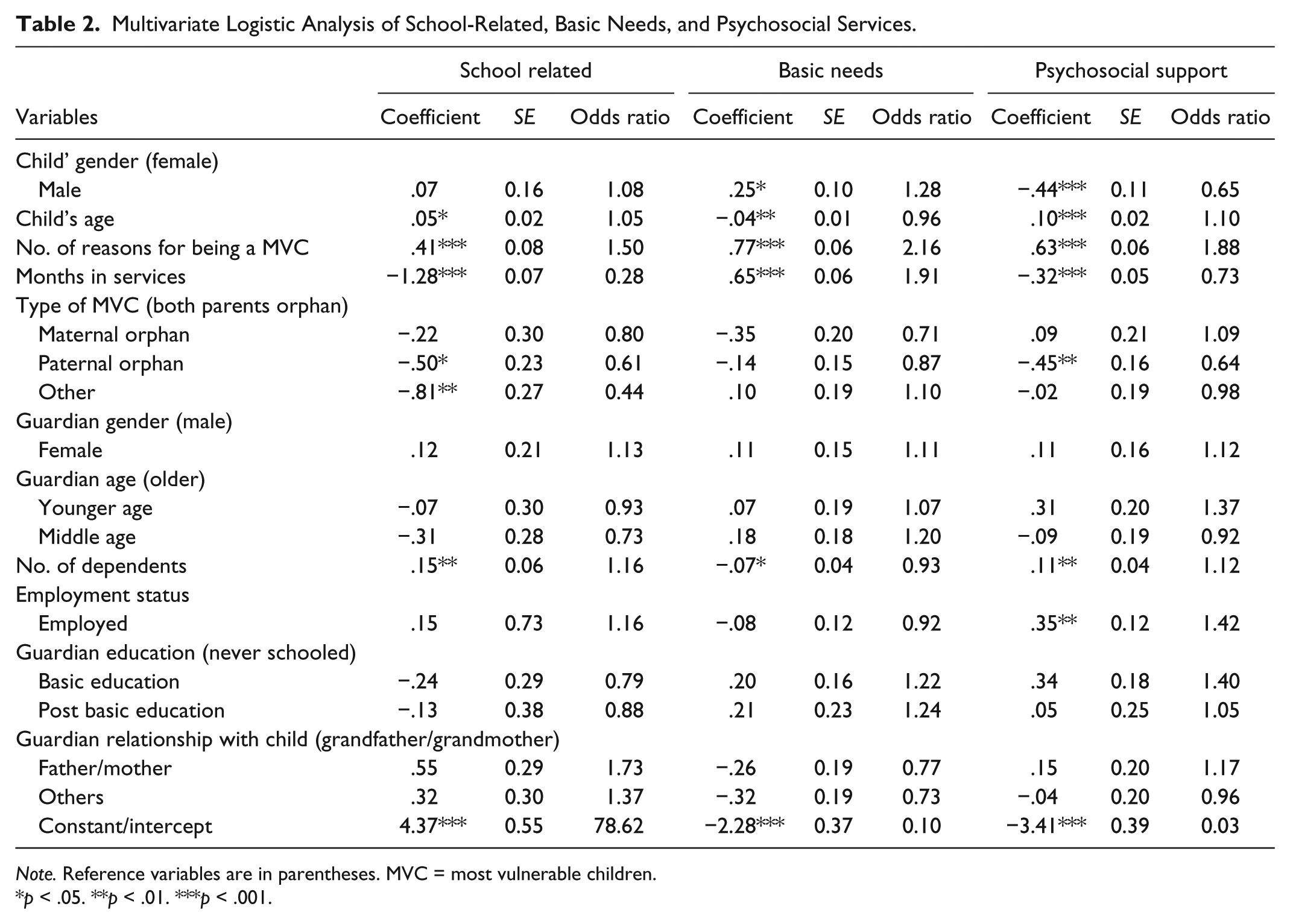
Note. Reference variables are in parentheses. MVC = most vulnerable children.
p < .05. **p < .01. ***p < .001.
In the basic needs services model, five coefficients were statistically significant. The coefficient for child’s gender, which was not significant in the school-related services model, indicates that male MVC had a 28% increase in the odds of receiving basic needs services, compared with females (OR = 1.28, p < .05). Similar to the previous model, the higher number of reasons for being a MVC was associated with increased odds (2.16, p < .001) of receiving basic needs services. In contrast to the school-related services, more months of receiving services was related to an increased odds (OR = 1.91, p < .001) of receiving assistance for basic needs. Children’s younger age (OR = 0.96, p < .01) and the lesser number of dependents per guardian (OR = 0.93, p < .05) were associated with decreased odds of receiving this type of service.
In the psychosocial support services model, seven coefficients were statistically significant. In contrast to the positive coefficient for male gender in the basic needs model, male MVC were 65% less likely to receive psychosocial support (OR = 0.65, p < .001) than females. Similar to the results for the school-related services model, but not the basic needs model, increase in child’s age (OR = 1.10, p < .001) and less months receiving services (OR = 0.73, p < .001) were associated with increased odds of receiving psychosocial support. Being a paternal orphan (OR = 0.64, p < .01) was also associated with increased likelihood to receive the support. Higher number of dependents per guardian (OR = 1.12, p < .01) was significantly related to increased odds to receive the support. Similar to both previous models, the higher number of reasons for being a MVC was positively related to receiving psychosocial support services (OR = 1.88, p < .001). In contrast to the previous results, employed guardians, compared with unemployed guardians, were 42% more likely to receive psychosocial support (OR = 1.42, p < .01). The results of the three models indicate that some of MVC and guardian characteristics are related differently to the three types of services provided by PASADA.
Discussion
This study established relationships between characteristics of MVC and their guardians and receipt of three types of support services in a Tanzania PASADA agency. The results suggest implications for future research and for assessing and providing services to MVC.
School-Related Services
MVC’s older age, higher number of reasons for being a MVC, and the higher number of dependents per guardian were positively related to the likelihood of receiving school-related assistance. The TCAIDS et al. (2008) report also supports the importance of school-related assistance for older children, because MVC’s families cannot pay the required school fees (Baaroy & Webb, 2008). The positive relationships between the number of reasons for being a MVC and the number of guardians’ dependents and the likelihood of receiving school-related services are consistent with the assumptions that these characteristics place MVC at a heightened vulnerability. These characteristics are also likely to be associated with poverty, which other research demonstrates is related to poor educational attendance (e.g., Robson & Kanyanta, 2007b).
MVC who receive services for more months, and compared with losing both parents, paternal orphans, and other MVC (not maternal orphans), have decreased odds of receiving school-related services. Because school-related services are the most common type of services that MVC receive (85%), perhaps providing these services is a priority; and if these services are needed, they are provided relatively soon after services are sought. The findings also highlight the decreased risk of paternal orphans and “other” MVC, compared with those who lost both parents, of needing school-related assistance. These findings are partially consistent with Baaroy and Webb’s (2008) study in Tanzania, which reported a lower percentage (76.5%) of school enrollment of double orphans compared with maternal (91.4%) and paternal (83.1%) orphans. The current study, however, found no significant relationship between being a maternal orphan and receipt of school-related assistance.
Basic Needs
In this study, more than half (63%) of MVC received some type of basic needs services. In addition, male MVC, number of reasons for being a MVC, and months in service are positively related to receiving this type of assistance. The gender difference suggests that females receive fewer of these services than males. A good understanding of the factors affecting access (at least for basic needs) between male and female MVC requires further research. The positive relationship between more reasons for being a MVC and receiving basic needs assistance highlights the heightened vulnerability of these children who are probably more likely to be poor, which is supported by other research (Howard et al., 2006). In contrast to the negative relationship between duration of services and school-related services, we found a positive relationship between length of services and basic needs assistance. Perhaps MVC whose guardians have problems meeting the family’s basic needs are in need of longer term services; however, it might take longer periods of time to secure such services.
In contrast with the findings of the school-related services model, MVC’s age and the number of the guardians’ dependents are negatively related to receiving basic needs services. Perhaps these findings are the result of economically stable families/guardians preferring to foster older MVC because they can assist in domestic chores. Older MVC also might be more likely to be employed as domestic servants in unrelated families where they reside. Thus, older MVC might need less assistance to meet their basic needs. The negative relationship between the number of dependents and receipt of basic needs services is surprising, as we assumed that these families would be more vulnerable to economic problems. This is an area for future research, but the findings might suggest that individuals with more financial resources are more likely to become guardians of MVC.
Psychosocial Support
The current findings indicate that compared with other types of services, fewer MVC (30%) received psychosocial support. Being an older MVC, more reasons for being a MVC and guardians who have more dependents and are employed appear to increase the need for psychosocial support services. These results suggest that older children have more psychological problems and guardians need more assistance with parenting older MVC and when they have larger families. The results could also mean that older children have more access to psychological support. The relationship between the higher number of reasons for being a MVC and the receipt of psychosocial support could imply that these MVC were more likely to access psychosocial support. The results could mean that they have more problems and are more easily identified as being in need by the provider of services. But it could also be a bias in the providers tending to think of older kids (adolescents) as having psychological problems than younger kids who they think are only in need of basic services. Indeed, it could also be the issue of skills as most providers may not have skills for identifying and addressing psychological needs of younger children. Employment for guardians of MVC might cause familial stress or result in less child supervision, situations which could benefit from psychosocial support.
This study also found that male MVC, months receiving services, and maternal orphans compared with MVC who lost both parents were less likely to receive psychosocial support. Possibly, males have fewer psychological problems than females, which is supported by some research (e.g., TCAIDS et al., 2008). However, other studies indicate that gender is related differentially to internalizing and externalizing problems. For example, female orphans are at higher risk of depression and anxiety (Makame et al., 2002), whereas male orphans are at higher risk of delinquency and conduct problems (Cluver et al., 2007). An alternative explanation for the current finding is that guardians of male MVC or male MVC themselves are not as responsive to receiving psychosocial support services, such as counseling, compared with guardians of females or female MVC. Similar to receiving school-related assistance, increase in months receiving services is negatively related to receiving psychosocial support, which again might be a priority for the relatively few MVC who receive these services. Finally, paternal orphans, compared with children who lost both parents, are less likely to receive psychosocial support. Perhaps these children are more likely to reside with their mothers, who are well prepared to care for their psychological needs, or they have supportive social support networks.
Conclusion
This study identified specific characteristics of MVC and their guardians that significantly related to the receipt of three types of support services in Tanzania. Thus, the findings suggest important areas for refining assessment and interventions to MVC. The increased degree of MVC vulnerability and poverty such as having multiple reasons for being a MVC, full orphan status of the MVC, and large number of dependents in the MVC families had heightened their need and consideration to access educational support. With regard to basic needs support, gender difference that suggests that females accessed fewer of such services compared with males calls for further assessment of their help seeking behavior.
The study also found that some MVC characteristics were negatively related to support received. For instance, the negative relationship between MVC’s young age and less number of the guardians’ dependents and accessing the basic needs services. Also, the increase of months MVC spent receiving services negatively related to receipt of educational and psychosocial support assistance. This pattern of unfamiliar negative relationships could be attributable to the possibility that the MVC received what the agency could provide at various times. However, future nuanced qualitative research could provide more insights regarding which profile of MVC and vulnerability typically seeks assistance.
Study Limitations
This study has several limitations. Although we were able to associate particular characteristics of MVC and their guardians with three types of services, we cannot assume that these relationships are causal, or that provisions of these services enhanced well-being (e.g., educational attainment). Even though we controlled for the number of months PASADA provided services to MVC, the data were only available for an 8-month period, and the children entered the agency at different times. Therefore, some of these MVC might have received services that were not captured by this study. Finally, because the data came from one agency, we cannot generalize the findings to other MVC in Tanzania.
Implications for Practice
Despite the study’s limitations, our findings suggest important implications for tailoring assessment to identify needs for school-related, basic needs, and psychosocial support services for MVC and their guardians. First, the positive relationship between male MVC and basic needs assistance and the negative relationship between males and psychosocial support suggest two refined assessments. Practitioners might further assess female MVC to determine if their basic needs are being met, or whether females are engaged in activities that might assist them in meeting these needs, but it might be harmful in other ways. Practitioners also might determine whether male MVCs are actually less likely to exhibit psychological problems than females, or whether there is a resistance to engaging in these types of services or males are socialized to keep such problems to themselves. Second, because the findings indicate that as children become older they appear to be vulnerable to needing school-related services and psychosocial support, assessment should pay particular attention to these needs among older MVC. Because MVC are at risk of receiving an inadequate education in Tanzania (Baaroy & Webb, 2008), assessing educational need is particularly important, especially among older children. Although some school-related expenses must be met by all students in Tanzania, secondary education levels require payment of fees to attend school. However, younger children appear to need more assistance with meeting basic needs; and similar to female MVC, assessment might determine the ways that older MVC’s needs are met.
Third, as the number of reasons for becoming a MVC is the only characteristic that is positively related to all three types of services, specifically assessing these multiple risk factors (e.g., poor housing, low income) could assist in providing appropriate services. Fourth, assessing the number of the guardians’ dependents appears to be particularly important, as it increases the risk of needing both school-related and psychosocial support. Unexpectedly, however, MVC from families with more dependents appear to be less likely to need assistance with basic needs. Finally, MVC of employed guardians, compared with those who are unemployed, appear to be in more need of psychosocial support services. This finding suggests that in these families, further assessment of stress and child supervision might be indicated.
This study has identified MVC and guardian characteristics that relate to specific types of services MVC received in an agency in Tanzania. This information can assist MVC care agencies to refine their assessment procedures, which should result in more suitable and effective intervention for Tanzania’s MVC.
Footnotes
Declaration of Conflicting Interests
The author(s) declared no potential conflicts of interest with respect to the research, authorship, and/or publication of this article.
Funding
The author(s) received no financial support for the research and/or authorship of this article.