




Abstract
The purpose of this research study was to determine undergraduate students’ perceptions of ethical dilemmas as a means of measuring general concern for leadership ethics within the marketplace. With the end goal of identifying best practices for ethics education in business and to further aid our understanding of how individual factors, such as disgust sensitivity, can alter students’ moral assessments, we measured the relationship between emotion and cognition in affecting ethical decision making. We found specific coursework in business ethics can produce a significant gain in moral reasoning. These results suggest that in the absence of strong moral intuitions, discipline-specific ethics coursework can lead to more postconventional moral decision making.
Keywords
Due to numerous corporate scandals during the late 1990s and early 2000s, the United States is in need of constructive organizational leadership. This study investigated the preparation of future business leaders by analyzing development of moral judgment during postsecondary ethics education.
Based on the notion that today’s learners are future business leaders, the purpose of this study was to determine undergraduate student perceptions of ethical dilemmas as a means of measuring general concern for leadership ethics within the marketplace. As a foundation of reality, ethics informs “the morality of the processes of social choices and action in which the leaders and followers engage and collectively pursue” (Bass & Steidlmeier, 1999, p. 181).
The link between the study of ethics in college and an evolution of students’ consideration of ethical dilemmas has been established and research related to moral reasoning is well documented (Carlson & Burke, 1998). Early works of Piaget showed that children learn through activity and replication (Bresler, Cooper, & Palmer, 2001). He suggested that development of moral reasoning is the foundation of ethical behavior. To encourage moral development, Piaget argued that schools should “should emphasize cooperative decision-making and problem solving, nurturing moral development by requiring students to work out common rules based on fairness” (Nucci, 2008).
Lawrence Kohlberg (1971) built on Piaget’s foundation by developing the theory of postconventional morality. He expanded the study of moral development to secondary-school and university students, noting that moral development took much longer to develop than Piaget originally argued (Nucci, 2008).
In turn, he theorized that one achieved moral development by completing six stages of growth (see Table 1; Kohlberg, 1975). These stages range from complete self-absorption and care for nothing but one’s survival, as is the case in infancy, to Level 3, where one finds a balance between self and community (Kohlberg, 1981). Advancement through these stages occurred as one developed proficiency in terms of self-view and worldview. This proficiency occurred through acquisition of knowledge through informal or formal education (Kohlberg, 1981).
Kohlberg’s Stages of Moral Development.

The increase of government activity within the realm of ethics, beginning in the 1960s, led to an increase in academic research. Public concern related to civil rights and corporate scandal spawned a variety of studies related to social responsibility (DeGeorge, 2005). This was the beginning of university involvement in ethics education.
Prior to inception of university business ethics courses, ethics study was considered part of philosophy or theology (DeGeorge, 2005).
The new ingredient and the catalyst that led to the field of business ethics as such was the entry of a significant number of philosophers, who brought ethical theory and philosophical analysis to bear on a number of business issues. (Bowie, 1986)
By the 1980s, numerous universities offered coursework that blended ethics theory from a philosophical standpoint with business issues of the day.
A number of studies indicated that university education played a vital role in developing ethical attitudes of business primary school students who are likely to be future business leaders (Chai, Lung, & Ramly, 2007). To coincide with increased interest in the development of ethical decision making at the college level, Crane (2004) proposed that business students’ desired increased knowledge related to ethical dilemmas and moral reasoning.
To that end, an important part of resolving ethical dilemmas “involves prioritizing one’s values and being prepared to deal with values conflicts that might occur” (The Association to Advance Collegiate Schools of Business International Board of Directors, 2004). Kohlberg argued that the goal of education should have been personal development (Rest, 1986). He indicated that achieving the next stage of moral development should have been the goal of educators. Rather than teaching characteristics, such as happiness and kindness, he indicated that it was critical that schools aid in the learning of reasoning that resulted in just choices (Power, Higgins, & Kohlberg, 1989).
Moral Development
Moral judgments can be defined as, “evaluations of the actions or character of a person that are made with respect to a set of virtues held by a culture or sub-culture to be obligatory” (Haidt, 2001). Kohlberg’s model of morality assumes that the best way to understand moral development is to examine it as a cognitive process (Thoma, 2006). Initially, this understanding of morality included six stages of development (see Table 1) and morality was the product of rational, cognitive operations. Since, modifications to this original conception of morality have emerged. The neo-Kohlbergian view maintains that cognitive processes are central to the understanding of moral development; however, this outlook is less dependent on discrete stages and acknowledges that moral development probably shifts more gradually from lower levels, which are governed by self-interest to more flexible conceptions of morality that include reciprocity, shared ideals, and inquiry (Thoma, 2006). According to this view, moral dilemmas activate “schemas” that originate from the synthesis of previous knowledge, personal experience, and life events, as illustrated in Table 2.
Neo-Kohlbergian Stages of Development.

When presented with a moral dilemma, these schemas serve as the default program for interpretation and produce a moral judgment in situations where accepted, intuitive, or easily recognizable codes of conduct cease to exist (Thoma, 2006). The cognitive approach to morality presupposes that gains in moral development may be achieved through ethics education, assuming it involves some aspect of cognitive training.
An alternative theory of morality points to the influence of humans’ evolutionary history. The need to evaluate moral dilemmas may have preceded the advanced cognitive skill sets required to deliberate different points of view. Therefore, moral judgments may be influenced more by emotion, than reason. This view is summarized by the social intuitionist model of morality. It suggests that moral judgments arise automatically and the activation of a cognitive schema is secondary (Haidt, 2001). In other words, moral assessments stem from initial, gut reactions. In support of this view, Haidt (2001) presents evidence that emotional reactions were better predictors of a person’s moral judgments than deliberate attempts to reason. The primary difference between these two models of moral reasoning depends on the timing and use of moral reasoning. To social intuitionists, moral reasoning occurs after the moral judgment is made; to cognitive theorists, moral reasoning is used to reach the judgment.
Disgust is a strong emotional reaction elicited by a variety of aversive stimuli. Interestingly, the neural substrates activated by disgust are the same substrates presumed to be activated by moral judgments. Across a variety of cultures, similar facial expressions are used to express the rejection of disgust-inducing physical stimuli, such as rotten food, and socially inappropriate behaviors such as incest (Haidt, Rozin, McCauley, & Imada, 1997). Furthermore, a study by Schnall, Haidt, Clore, and Jordan (2008) demonstrated that disgust-inducing changes in the physical environment had an impact on moral judgments. In this study, a bad smell (induced with fart spray) led to more severe condemnation of consensual sex between first cousins and legislation that would allow first cousins to marry. On the contrary, another study by Liljenquist, Zhong, and Galinsky (2010) found that willingness to engage in charitable behavior and reciprocity was promoted in the presence of a clean smell (i.e., a spray of Windex). There is considerable variability in tolerance to the conditions that elicit disgust. For example, one person may be repulsed by the thought of eating monkey brains, whereas another person could be excited or intrigued.
Because the activation of disgust is closely tied with the severity of a person’s moral judgment and clean, not disgusting, conditions may influence reciprocal and charitable behavior, it is important to understand whether individual differences in disgust sensitivity influence moral judgments. These findings could have important implications for the teaching of ethical decision making. First, if the social intuitionist model of moral judgments is correct, promoting the cognitive aspects of moral development through specific training in ethics may be a minimally effective means of improving moral judgments and ultimately, moral behavior. Second, these findings suggest that a better understanding of the moment-to-moment situation and environment influences that influence morality could be used to promote certain moral sentiments over others.
The purpose of the present study was to better understand the role of cognition and emotion in moral awareness, specifically in the context of ethics education. We are interested in the relationship between disgust sensitivity and the level of moral judgments made by undergraduate business students before and after exposure to a discipline-specific ethics course (Business Ethics) and predicted that exposure to the ethics course will increase students’ level of moral development. In addition, we predicted that disgust sensitivity would be related to moral development.
Method
Participants
Forty-five (22 male and 23 female) undergraduate business and management students participated in the study. Participants were recruited from business courses at Alfred State. About 24 participants were first-semester freshman and 21 were seniors. All but 2 of the participants were younger than 25 years of age. Participation was voluntary and participants were not offered an incentive for participation. Written informed consent was obtained from each participant.
Materials
The Defining Issues Test–2 (DIT-2)
The DIT-2 (Rest, Narvaez, Thoma, & Bebeau, 1999) measures individual variation in moral judgments. Participants are presented with five moral dilemmas and respond to 12 statements offering different views to aid the process of moral decision making. Responses on DIT-2 are calculated to produce a score that fits within the three-level, neo-Kohlbergian model of moral judgments: the lowest level, personal interest schema, reflects moral judgments that are evaluated in relation to the cost and benefits that may be directly experienced by the individual. The second level is the maintaining norms schema, where moral judgments reflect values, norms, and rules that govern a social system. Third, the postconventional schema is the highest level where moral judgments operate on shared ideals, reciprocity, and openness to inquiry.
Historically, participants’ moral development has been indexed with the P-score, representing the proportion of items selected that appeal to postconventional moral reasoning. More recently, N2 scores have been adopted as the preferred method of analysis because N2 scores estimate the degree to which a participant prioritizes postconventional statements, in addition to the proportion of those statements. In other words, N2 scores reflect both the rating and ranking of postconventional moral reasoning. Higher N2 scores indicate higher levels of moral development. Both P-score and N2 scores tend to be in the 30s for high school seniors and in the 40s for college students (Bebeau, Rest, & Narvaez, 2006).
The Disgust Scale–Revised (DS-R)
The DS-R is a 25-item, 5-point, Likert-type scale that is used to detect individual variation in the sensitivity to disgust. The scale is based on a three-factor model of disgust that includes core disgust, animal reminders, and contamination. It is shown to be a valid and reliable index of disgust, demonstrating a Cronbach’s alpha of .87 (van Overveld, de Jong, Peters, & Schouten, 2011).
Procedures
All participants completed paper-and-pencil versions of the measures in a group setting first completing the DS-R, then completing the DIT-2. Freshman participants took the measures within the first month of class during a fall semester. Senior participants completed the measures at the end of a discipline-specific ethics course (Business Ethics). All procedures conformed to ethical guidelines and were approved by the college’s institutional review board (IRB).
Results
Raw data for the DIT-2 were sent to The Center for Ethical Development at the University of Alabama for scoring. One participant was purged from the analysis. Once returned, N2 scores for each participant were entered into SPSS version 19.0. Descriptive statistics are presented in Table 3.
Descriptive Statistics.
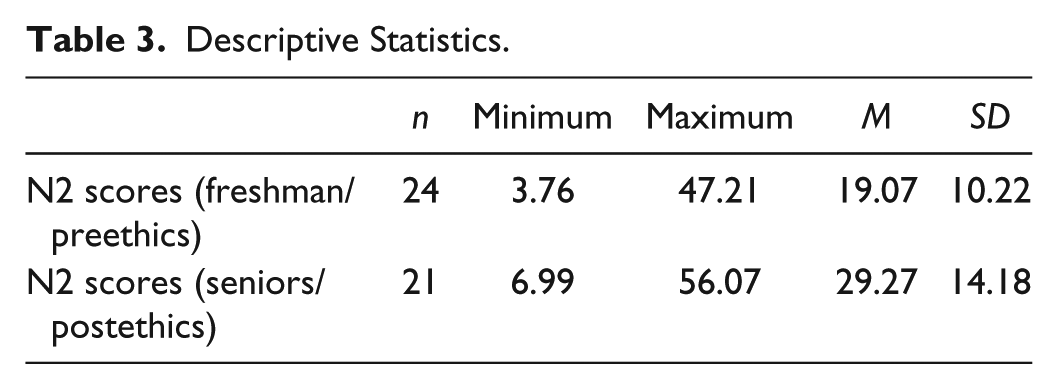
An independent-samples t test was conducted to compare N2 scores between freshman (preethics) and seniors (postethics) with college status (freshman or senior) entered as the independent variable and N2 scores entered as the dependent variable. The test was statistically significant, t(43) = −2.79, p ≤ .01. In addition, moderate to large effect size (Cohen’s d = .78) was found for this analysis (Cohen, 1988). The results indicate that seniors (M = 29.27, SD = 14.18) scored significantly higher than freshman (M = 19.08, SD = 10.22) on the DIT-2. The independent-samples t test revealed that disgust sensitivity scores did not differ significantly between freshman (M = 54.33, SD = 18.54) and seniors (M = 49.90, SD = 17.22), t(43) = .83, ns; (Cohen’s d = .30). To test the relationship between disgust sensitivity and DIT-2 scores, a bivariate Pearson Product–Moment correlation was computed. The correlation between disgust sensitivity and N2 scores was not significant (r = –.14, ns). This suggests that college students’ moral reasoning capacities increase after exposure to a discipline-specific ethics course; however, disgust sensitivity had no relationship to DIT-2 scores.
Discussion
We hypothesized that students who participated in a discipline-specific ethics course would achieve higher levels of moral reasoning as measured by the DIT-2 than incoming students with no or limited exposure to business ethics. Our prediction was supported, suggesting that gains in moral development may be attributed to specific coursework in business ethics. In addition, we hypothesized that individual variation in disgust sensitivity would affect moral reasoning; however, this prediction was not supported. These results suggest that despite previous research demonstrating that environmental conditions that elicit disgust make moral assessments more severe, individual differences in disgust sensitivity are not a significant source variation in N2 scores. One interpretation of this finding is that moral development, as measured by the DIT-2, is more influenced by cognitive training and coursework in ethics course than by individual personality characteristics, such as tolerance for disgust.
We used a between-subject design to assess the changes in moral reasoning in undergraduate business and management students that occur as a result of a discipline-specific ethics course. Future studies using a within-subjects design that uses the same participants over time would strengthen the validity of our findings. Also, previous literature shows that DIT-2 scores increase with age. We did not control for the effects of age, but all but two of our participants were under the age of 25.
Another question concerns whether or not gains in moral reasoning are the result of the increased ability to employ critical and/or analytical thinking that take place over the course of college education. In the future, a control group may be required to clarify whether moral reasoning gains are due to the skills fostered in discipline-specific ethics courses or due to a general increase in analytical and critical thinking skills that occur over the course of undergraduate education.
Finally, it is interesting to note that N2 scores for our sample were approximately 5 points lower than norms for undergraduates (Dong, 2010). This variability may simply reflect differences between college programs; however, an alternative explanation for this difference could be due to the order in which the questionnaires were presented. Both groups (freshman and seniors) completed the Disgust Sensitivity Scale first. It is possible that exposure to this scale may have activated the neural programs related to disgust, which may have resulted in lower level moral judgments on the DIT-2. We are currently investigating this possibility using a different sample and counterbalancing the order of the questionnaires.
The goal of this research was to identify best practices for ethics education in business and to further aid our understanding of how individual factors, such as disgust sensitivity, can alter students’ moral assessments. We found that specific coursework in business ethics can produce a significant gain in moral reasoning. These results suggest that in the absence of strong moral intuitions, discipline-specific ethics coursework can lead to more postconventional moral decision making.
Footnotes
Declaration of Conflicting Interests
The author(s) declared no potential conflicts of interest with respect to the research, authorship, and/or publication of this article.
Funding
The author(s) received no financial support for the research and/or authorship of this article.