




Abstract
The purpose of this research was to understand the cognition of female college athletes on gender consciousness and social support, which will contribute to the wellbeing of college female athletes. The research recruited 332 female college athletes were recruited as research participants. This research compiled a questionnaire suitable for the research topic, including gender consciousness scale, social support scale, and wellbeing scale. Use structural equation modeling to analyze the correlation and influence of various variables. The results showed that their experience as an athlete were mostly 5 to 7 years. The correlation of female college athletes was highest between their peer support and goal of life (r = .58). The more support they received from their peers, the more they could affirm their life goals and wellbeing. The gender consciousness of college female athletes is significantly correlation to wellbeing (γ11 = .71), social support is significantly correlation to wellbeing (γ21 = .83), and gender consciousness has significant influence to social support (β21 = .57). In addition, the correlation between gender consciousness and stereotypes is the strongest λ = .78, the correlation between social support and peer support is the strongest λ = .91, and the correlation between wellbeing and self-identification is the strongest λ = .83. This study concluded that the existing sports environment provides opportunity for female athletes. Female college athletes have gender consciousness regarding self-assurance and stereotype, and they receive support from peers and family in sports groups. These are conducive to their performance and their sense of wellbeing in life.
Introduction
With the globalization of sports today, women have the same substantive rights to participate in sports as men. The vigorous development of female’s sports keeps pace with male’s sports, and female also enjoy the right to exercise and the autonomy of physical development. Since the development of female competitive sports, female athletes in many countries are still influenced by local traditional cultural roles. Therefore, this study purpose to understand how female athletes feel about gender consciousness, social support, and wellbeing in the course of participating in competitive sports. Three themes put forward relevant literatures.
Gurin (1985) proposed that gender consciousness means that one belongs to a group, has common interests, and realizes that the relationship between oneself and the political world is shaped by physical sex. Gerson and Peiss (1985) believe that when women believe that gender discrimination prevents them from obtaining the same opportunities for development, and they firmly believe that they should be treated fairly, they have gender consciousness. Ongtengco et al. (2020) believes that gender consciousness refers to general understanding of gender-related issues, such as gender violence, gender discrimination, gender stereotype, stigma, and the gender pay gap. Female participating in competitive sports may make athletes internalize masculine values and be rewarded in the sports environment (Kidd, 2013). Although competitive sports provide different masculine characteristics for male athletes. Likewise, female athletes also display masculinity, which run in the opposite direction traditional perceptions of femininity and vulnerable to stigmas (Steinfeldt et al., 2011). Stigma refers to society’s negative labeling of gender, race, social class, etc., resulting in them being treated unequally. Common stereotypes in sports, including social class, race, religion, disability, gender, etc. In particular, female athletes often show personality traits opposite to their own gender on the sports field, and females may be at risk of stigma (Schmalz & Kerstetter, 2006). Therefore, competitive sports are a men-leading environment, which affects female athletes’ status in it, also reflects traditional gender hegemony (Krane, 2001). In some high-intensity physical collision sports, athletes must show muscle strength, explosive power, and speed. At this time, female athletes need to meet the expectations of the required cultural requirements. This is a dilemma that female athletes often face (Hoferek & Hanick, 1985; Ross & Shinew, 2008).
Social support involves interaction between an individual and other people (either individually or in groups). It is conducive for an individual to face challenges, stress, and difficulties (Gottlieb & Bergen, 2010). Crutcher et al. (2018) believe that social support can provide individuals with confidence to perform a particular behavior, and social support mostly comes from family members, teammates, and others with special meaning to the individual. Cranmer (2017) believes that social support is through instrumental, emotional, and informative support, social support helps an individual to adapt well in a stressful situation. It also serves as buffer for personal stress, which may come from classmates, family, friends, neighbors, coworkers, or club members (Cranmer, 2017). From the perspective of sports, the main source of social support is that players obtain different forms of assistance and support through interaction with others or groups, which can increase the ability of players to adapt themselves and face the pressure of sports performance (Laird et al., 2018). In other words, the sources of social support are five factors: family, coaches, peers, information, and tools (Kang et al., 2015). Thus, social support may be a favorable prediction index in female athletes’ development in competitive sports.
Scholars have given various definitions of wellbeing, but they all believe that wellbeing is when a person is fully satisfied with life (including positive emotions, physical and mental health, and healthy development), that person can obtain happiness (Brooks & Magnusson, 2007; Koh et al., 2019; von Rosen & Heijne, 2019). When an individual reaches comprehensive satisfaction in life (which involves positive emotions, physical and mental health, and healthy development), that individual can achieve wellbeing. People generally believe that exercise can promote sense of wellbeing and a favorable life. However, this general situation, in which exercise has value to our wellbeing, is based on personal subjective consciousness. In recent years, studies have been conducted on the psychological health generated from exercise, and the results indicated that wellbeing is extremely important for athletes. Ryff (1989) established a scale of psychological wellbeing with six dimensions, including self identification, positive relations, autonomy, environmental mastery, purpose in life, and personal growth. Ryff (1989) believed that wellbeing is developed through the combination of emotional regulation, personality characteristics, identity and life experience, education, and extraversion. Edwards et al. (2004) believe that every dimension of wellbeing can be seen as a challenge in life. Krawczynski and Olszewski (2000) maintained that exercise can increase one’s sense of control, self-esteem, and self-efficacy, thereby improving one’s wellbeing.
Based on the above literature, this research takes female college athletes as the subjects, and wants to understand the wellbeing of their participation in competitive sports, and apply the structural equation modeling to understand the correlation and influence between gender consciousness, social support, and wellbeing. So three questions are raised, including what is the correlation between gender consciousness and wellbeing? What is the correlation between social support and wellbeing? What is the influence of gender consciousness on social support? Three hypotheses were extended based on the research question. Hypothesis 1 (H1): There was a significant correlation between gender consciousness with wellbeing of college female athletes. Hypothesis 2 (H2): There was a significant correlation between social support with wellbeing of college female athletes. Hypothesis 3 (H3): The gender consciousness of female college athletes were significantly influence on social support.
Materials and Methods
Research Framework
According to relevant literature, background variables, gender consciousness, and social support were independent variables, and wellbeing was the dependent variable, as shown in Figure 1. Wellbeing variables include life goals, personal growth, self-acceptance, positive relationship, self identification, and environmental control. Gender consciousness variables include gender stereotypes, gender discrimination, body consciousness, self-assurance, etc. Social support variables include family support, coach support, peer support, etc. Explore the relationship between gender consciousness and wellbeing (H1), social support and wellbeing (H2), and the influence of gender consciousness on social support (H3).

Research framework.
Research Object
In this study, female college athletes in Taiwan were selected as the population. Female college athletes from North, Central, and South were sampled. About 120 female college athletes were randomly sampled from each of the three directions, a total of 360 questionnaires were sent out, 342 questionnaires were collected, and 10 questionnaires with incomplete answers were deducted. A total of 332 valid questionnaires were used to explore the correlation and influence between college female athletes’ gender consciousness, social support, and wellbeing.
Research Tools
This study adopted a self-made questionnaire. Background, gender consciousness, and social support were independent variables, and wellbeing was a dependent variable. Correlations were expected for gender consciousness, social support, and wellbeing. Gender consciousness and social support were expected to influence and predict wellbeing. The questionnaire was named questionnaire on the relationship between female college athletes’ gender consciousness, social support, and wellbeing. This questionnaire was divided into four parts, namely background information (include age, seniority, and sports project), gender consciousness scale, social support scale, and wellbeing scale. After the questionnaire had been compiled, we conducted a pilot test. We sampled 135 female college athletes, retrieved 130 copies, deleted 10 invalid copies, and obtained 120 valid responses.
Gender Consciousness Scale
The female athlete gender consciousness in this study refers to perspectives comprising gender equality participation, gender-friendly interpretation, gender culture, gender mainstreaming, and gender sensitivity (Daly, 2005). The first draft of the female athlete gender consciousness scale contained 17 items. A Likert’s 5-point scale was used for scoring. Each item had five options, the order is strongly agree, agree, somewhat agree, disagree, and strongly disagree, with 5 points, 4 points, 3 points, 2 points, and 1 point, respectively. A high score denotes high gender consciousness in female athletes. Item analysis revealed that the items in the gender consciousness scale all had critical values that reached significant differences (10.06–13.77), so they were all retained. Subsequently, factor analysis was performed. Common factors were extracted using a principal components analysis, and factors with eigenvalues >1 were retained. Promax oblique rotation was conducted, and four factors were extracted, namely gender stereotype (items 1–4), gender discrimination (items 5–7), body consciousness (items 8–10), and self-assurance (items 11–17). The Kaiser–Meyer–Olkin (KMO) value was 0.77, the total variance explained was 83.30%, and Cronbach α = .78, showing that the gender consciousness scale has favorable reliability and validity.
Social Support Scale
Social support is a crucial factor for athletes who hope to continue participating in sports. The life of college athletes mainly involves family and school, and their social support comes from teachers, peers, and family. This study referred to Laird et al. (2018) on the social interaction viewpoint between athletes and their coaches and teammates and referred to Freeman et al. (2014) on viewpoint of college athletes developing social support. The social support scale of this study contained 16 items. A Likert’s 5-point scale was used for scoring. Each item had five options. A high score denoted that the respondent obtained a high level of social support. Item analysis revealed that the items in the social support scale all had critical values that reached significant differences (9.44–12.79), so they were all retained. Subsequently, factor analysis was performed. Common factors were extracted using a principal components analysis, and factors with eigenvalues >1 were retained. Promax oblique rotation was conducted, and three factors were extracted, namely family support (items 1–6), coach support (items 7–11), and peer support (items 12–16). The KMO value was 0.83, the total variance explained was 85.02%, and Cronbach α = .86, showing that the gender consciousness scale has favorable reliability and validity.
Wellbeing Scale
Wellbeing refers to the experiences and feelings of an individual fully exercising their potentials and reaching self-realization, connotations include self identification, positive relationships with others, personal growth, life goals, environmental control, and autonomy. The scale used in this study was adopted from Ryff’s Psychological Wellbeing Scales (Ryff, 1989). It contains 6 dimensions and 23 items. A high score denotes a high degree of wellbeing. A Likert’s 5-point scale was used for scoring. Each item had five options. A high score meant that the respondent had a high degree of wellbeing. Item analysis revealed that the items in the wellbeing scale all had critical values that reached significant differences (9.44–12.79), so they were all retained. Subsequently, factor analysis was performed. Common factors were extracted using a principal components analysis, and factors with eigenvalues >1 were retained. Promax oblique rotation was conducted, and three factors were extracted, namely self-acceptance (items 1–4), environmental mastery (items 5–8), self-growth (items 9–11), positive relationships (items 12–15), life goals (items 16–19), and self identification (items 20–23). The KMO value was 0.82, the total variance explained was 87.19%, and Cronbach α = .85, showing that the wellbeing scale has favorable reliability and validity.
Structural equation modeling
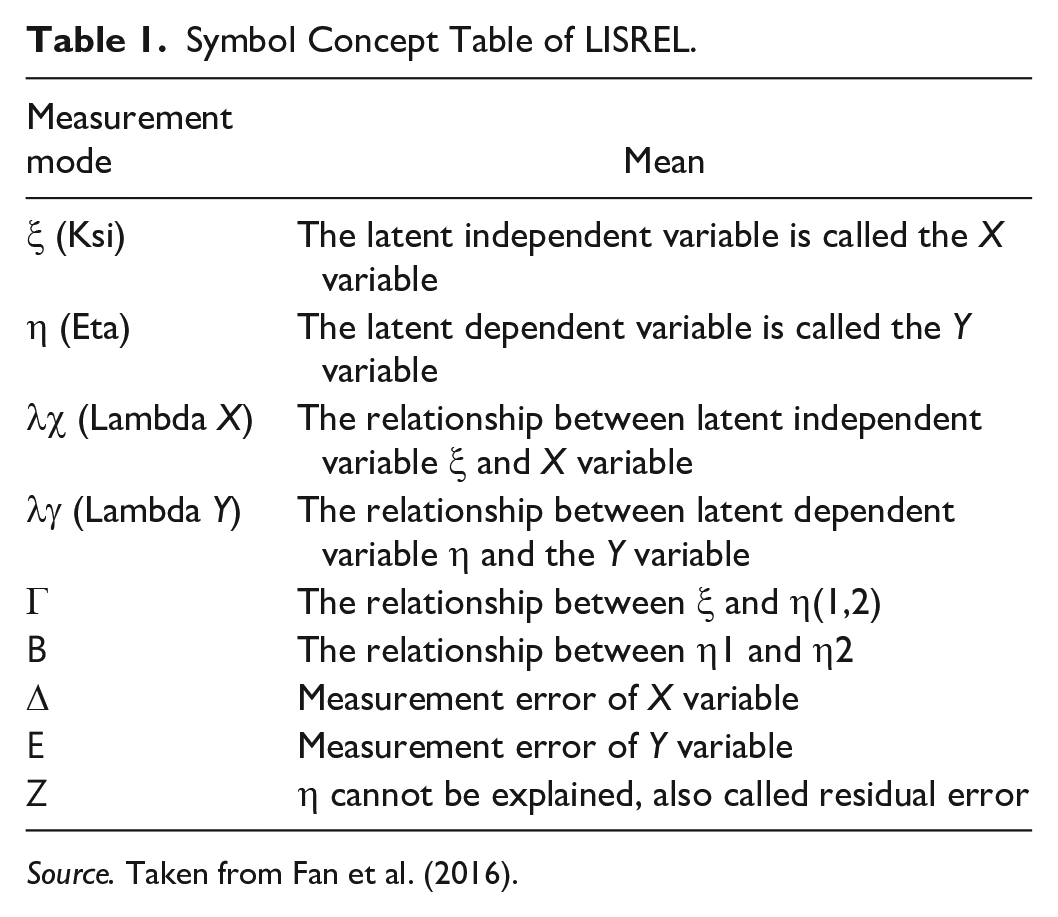
Based on the above three scales of this research questionnaire, draw the overall structural equation modeling (SEM; Fan et al., 2016), as shown in Figure 2, and list the LISREL analysis symbols of each variable, as shown in Table 1.
Symbol Concept Table of LISREL.
Source. Taken from Fan et al. (2016).

Research framework of structural equation modeling.
Data Processing
This study used SPSS 23.0 Chinese version statistical package software for statistical analysis, and set the significance level as p < .05. The statistical methods used include descriptive statistics, Pearson product difference correlation, and the use of SEM to test the relationship of variables in the path model.
Results
The results of this study correlations between the gender consciousness, social support, and wellbeing of female college athletes were divided into three parts, including the analysis of the questionnaire results, correlation analyses on factors in each scale, and the path model.
The Analysis of the Questionnaire Results
The research participants of this study are Taiwanese female college athletes participating in competitive sports (Mage = 21.3 ± 3.1). A total of 360 questionnaires were distributed in the formal questionnaire, after deducting 28 unrecovered questionnaires, a total of 332 valid questionnaires were obtained, and the effective recovery rate was 92.2%. Through the questionnaire survey, we aimed to understand the correlation and influence of gender consciousness, social support, and wellbeing of female college athletes. The survey results showed that about college female’s years of participation in competitive sports, the highest proportion of them reported 5 to 7 years (38.6%), followed by 3 to 5 years (31.1%), and over 7 years (20.0%). Regarding the sports they played, the highest proportion of them played basketball (16.3%), followed by dancing (including street dance) (14.5%), volleyball (13.3%), badminton (12.9%), table tennis (9.9%), and swimming (7.2%).
The items in the gender consciousness scale receiving the highest five scores from female college athletes are, in descending order: Viewing the outfit of female athlete as homosexual is an act of discrimination, I feel sports media report on female athletes less frequently than they do on male athletes, I think that during sports, physical contact is unavoidable. It is normal, not sexual harassment, I think female athletes may become excellent workplace women in the future, and I think female athletes have excellent leadership ability. This result indicated that the gender consciousness of female college athletes was mainly manifested as gender discrimination and self-assurance.
The items in the social support scale receiving the highest five scores from female college athletes are, in descending order: When the competition scores are low, teammates will cheer each other up. Teammates and I discuss sports techniques. Teammates do no care that I outperform them in sports. When I have a game, my family try to be there and cheer me on, and my family members listen to me telling them how hard the training. Clearly, the social support of female college athletes mainly comes from peer support. Female college athletes are supported by their peers and persevere in training. When they have a bad score in a competition, teammates cheer each other up. Teammates do not mind when their teammates outperform them. Female athletes discuss sports techniques and chat about sports.
Regarding the wellbeing of female college athletes, they scored highest in the following two items: “When I reflect on the journey of my life, I am satisfied with the current situation,” “I feel confident and positive about myself.” Secondly, for personal growth “For me, life is an ongoing process of learning, changing, and growing,” “I have grown a lot over time.” Again, “I have good friends with whom I can share my concerns” for positive relationships. Therefore, the wellbeing of female college athletes in life mainly comes from self identification, self-growth, and positive relationships. Contemporary female athletes have their own perspectives. They can stick to their own, correct perspective and make judgments based on their own values. Female athletes can shoulder and manage many responsibilities in their daily life, and they can be responsible for their situation.
Correlation Analyses on Variables in Each Scale
Correlation degree on variables in each scale, as shown in Table 2. Overall, except for variables under environmental mastery, which exhibited a lower correlation (r = .08–.10), the rest of the variables were significantly correlated (p < .01). We further analyzed the correlation between each variable. Goals in life and peer support showed the highest correlation (r = .58), indicating that when female college athletes are supported by their peers, they are more certain of their goals in life, happier about their life, and feel a sense of wellbeing.
Correlation Analysis for Gender Consciousness, Social Support, and Wellbeing.

Note. V = replace variables, 1 = replace gender stereotype, 2 = replace gender discrimination; 3 = replace body consciousness; 4 = replace self-assurance; 5 = replace family support; 6 = replace coach support; 7 = replace peer support; 8 = replace self-acceptance; 9 = replace environmental control; 10 = replace personal growth; 11 = replace positive relationship; 12 = replace life goals; 13 = replace self identification.
p < .05. **p < .01.
Path Model
LISREL is a statistical method used to deal with causality. In recent years, the LISREL analysis method has been valued in social sciences and behavioral sciences. The purpose of this research was to investigate the relationship between gender consciousness, social support with wellbeing of college female athletes. Therefore, LISREL is used to obtain a causal relationship and verification model. Olsson et al. (1999) considered that when the sample was large enough (N > 1,000), the asymptotic distribution freedom method (ADF) was used to improve the theoretical adaptation of parameter estimation. However, because the sample of this study (N = 332) is <1,000 people, another method of maximum likelihood estimation (MLE) is adopted to check the observation variables. Table 3 shows that all observed variables are multi-variate normal distribution.
Means, Standard Deviations, and Multivariate Normal Test of Observed Variables.

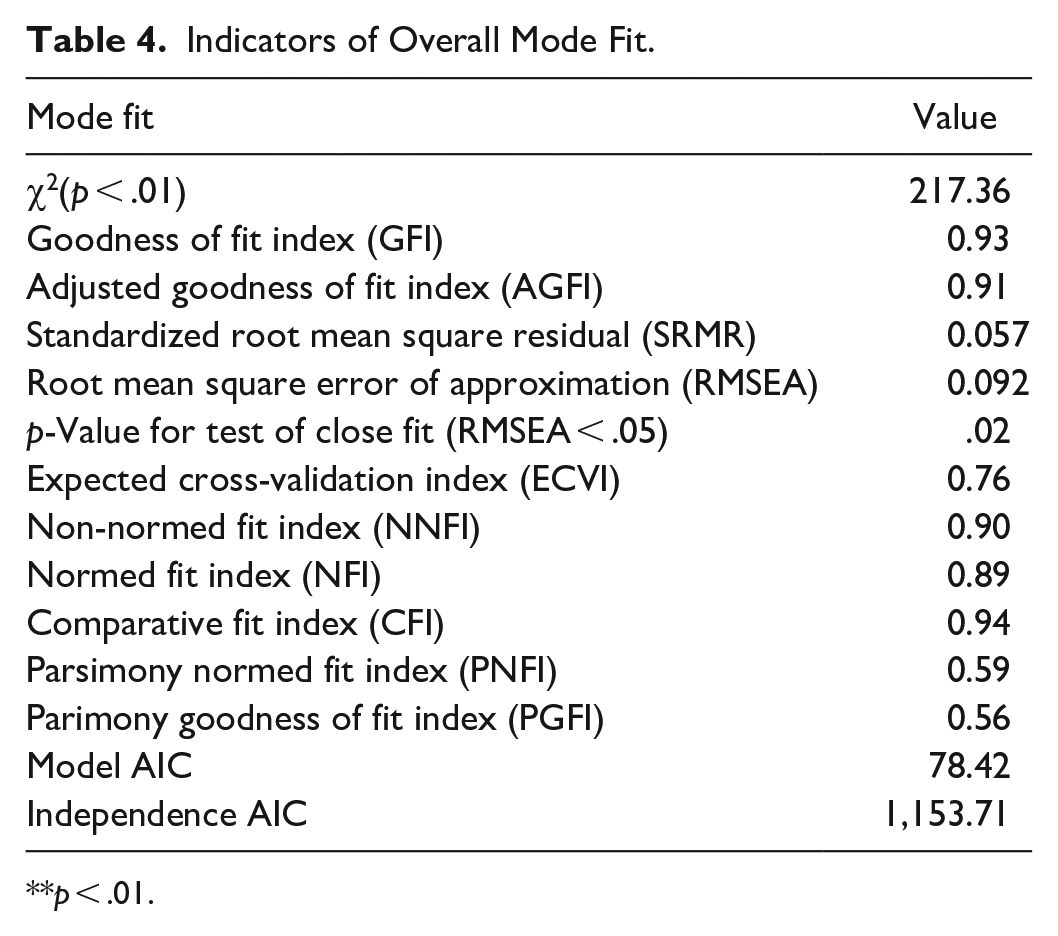
The chi-square fit test of the model and the observation data reached a significant level, as shown in Table 4, χ2 (df = 24, n = 332) = 217.36, p < .01, the null hypothesis showing that model fits the observation data has been overturned . However, in terms of other fitness indicators, the GFI index of this model is 0.93, which meets the verification standard. Second, the SRMR is 0.057, so the passing SRMR should be less than the threshold of 0.08. Furthermore, the ECVI index is 0.76, and the ECVI conforming to the theoretical model must be less than the verification standard of the independent model ECVI, which shows that the model has a small degree of fluctuation between samples and has good stability. In summary, the fit between the model in this study and the observation data is good. Finally, the RMSEA is 0.02, which meets the standard that must be less than 0.05. In summary, it meets the criteria of the absolute fit test, which shows that the model fits well with the observation data.
Indicators of Overall Mode Fit.
p < .01.
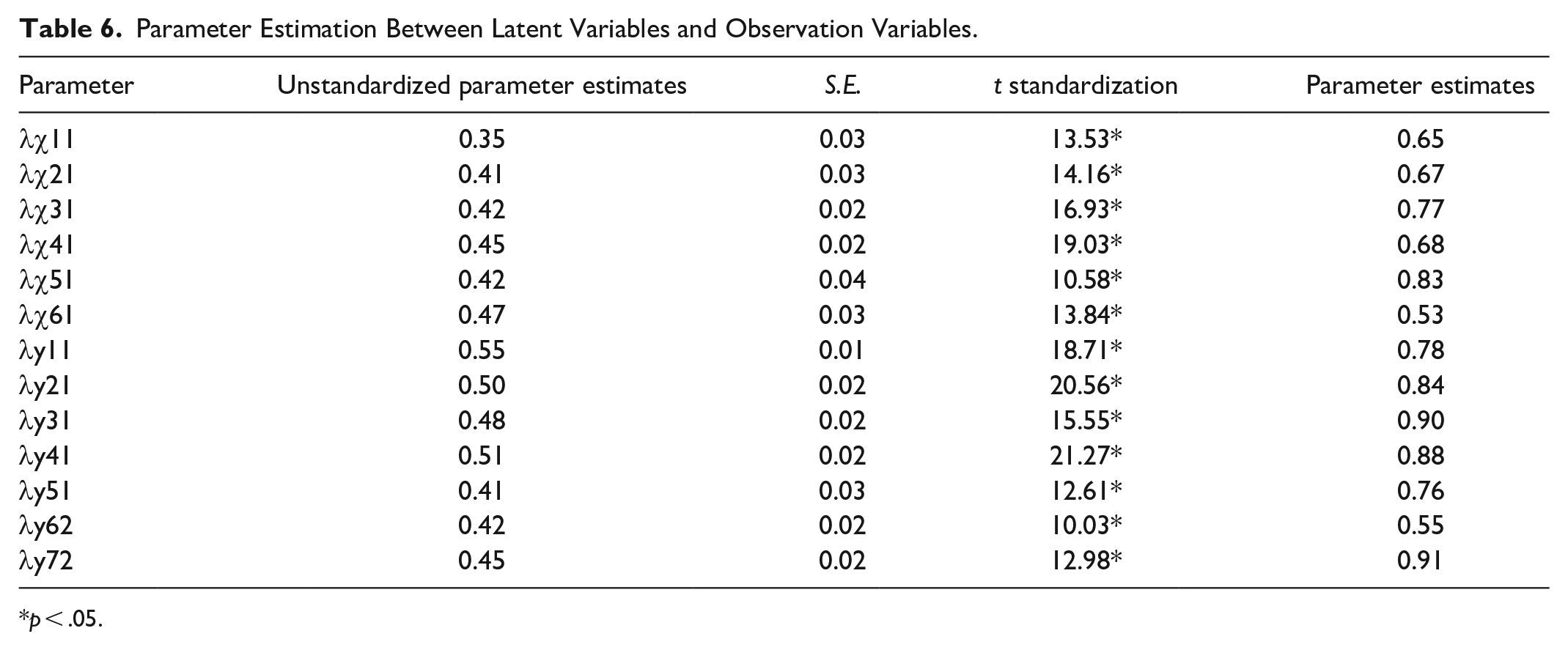
When checking the model estimation, first check whether the observation variable produces an offending estimate. The parameter estimation of the observation variable measurement error in Table 5 does not exceed or is too close to 1 (greater than or equal to 0.72). Table 6 shows that the parameter estimates between the latent variables and the observed variables do not exceed or are too close to 1 (greater than or equal to 0.91). The parameter estimates between the latent variables in Table 7 show that the effects of gender consciousness and social support on wellbeing are both at a significant level, in line with theoretical predictions. Gender consciousness is γ11 = .71 and social support is γ21 = .83. The β21 of gender consciousness and social support = .57, showing that there is a significant influence between the two. In addition, the relationship between gender consciousness and stereotypes is the strongest λ = .78, the relationship between social support and peer support is the strongest λ = .91, and the relationship between wellbeing and self identification is the strongest λ = .83. According to the above construction of the research framework, as shown in Figure 3. Finally, the hypothesis of the completion of this research is verified, that is, gender consciousness is significantly related to wellbeing (γ11 = .71), social support is significantly related to wellbeing (γ21 = .83), and the influence of gender consciousness on social support (β21 = .57), H1, H2, and H3 are all supported.
Parameter Estimation of Measurement Errors of Observation Variables.

Parameter Estimation Between Latent Variables and Observation Variables.
p < .05.
Parameter Estimation Among Latent Variables.


Standardized parameter estimation of wellbeing, gender consciousness, and social support.
Discussion
This research believes that women should have the same right as men do to seek ideals and to create culture from the perspective of feminism (Kuhle, 2012). Therefore, women and men can win sports competitions and experience the glory of a pleasant victory (Hoeber, 2008). Moreover, women’s passion and pursuit of competitive sports are no less than men’s. In contrast, In addition, Fasting et al. (2002) reports that during sports Nowadays, the sports that females participate inomen athletes are participating in sports, in fact, they are required to follow the masculine game rules (Teetzel, 2011). Because athletes must have masculine body types, female athletes hide their femininity to be considered an athlete and to make their profession receive more attention. Especially female weightlifters and shot put athletes exhibit qualities opposite to so-called femininity (Krane et al., 2004). Although studies have taken different perspectives, the social psychological experience of female in competitive sports has received little attention (Knoppers & McDonald, 2010; Shahin & El-Ghazaly, 2017). Currently, more and more media report about female athletes, and their participation in competitive sports have been widely accepted (Coche, 2013; Kian & Hardin, 2009; Petty & Pope, 2018). Nowadays, the sports that female participate in are heavily reported by the media, and even winning prizes have become popular idols or sports stars, such as basketball, soccer, taekwondo, and weightlifting (Lopiano, 2000; Warner & Dixon, 2015). Regarding the years that female college athletes have participated in sports, most of them have 5 to 7 years of experience, and people with 5 years or longer experiences accounted for 58.6%. Most female athletes participated in basketball, dancing (including hip hop), volleyball, and badminton. This result is line with the items that most Taiwanese female college athletes play.
Overall, from the gender consciousness scale, it can be observed that female college athletes think that anyone who derides their fashion sense as homosexual is discriminatory, and the fact that sports media report less frequently on female athletes is discriminatory (Ellemers, 2018; Knight & Giuliano, 2001; Krane, 2001). In addition that is the influence of gender consciousness on social support, Fasting et al. (2002) studies report during sports, women unavoidably have physical contact, and they believe that is normal, not sexual harassment. Many studies report contemporary female athletes can have outstanding leadership ability. They both value their appearance, personal finances, and social life, and they can become outstanding woman in the workplace (Meier, 2015; Toffoletti & Thorpe, 2018). The Olympic record was clear in the past ten years also found female athletes can take high-intensity training, and outstanding female athletes’ achievement can exceed that of male athletes. Evidence from many studies that competitive sports are a men-leading environment, which affects female athletes’ status in it, reflects traditional gender hegemony (Krane, 2001; Meân & Kassing, 2008), and promotes compliance with traditional gender roles (Cunningham & Sagas, 2008; Deaner et al., 2016). For female athletes to succeed in track and field, they must exhibit characteristics of strength, competitiveness, and self-confidence (Kachel et al., 2016). Female often seek traditional male competition levels to develop their sports identity, while attempting to meet the expectations of cultural demands for women, such as attraction, heterosexuality, and interpersonal relationships (Toffoletti & Thorpe, 2018; Wiesemann, 2011).
From the social support scale results show that the relationship between social support and wellbeing of female college athletes is the strongest (γ = .83), and peer support is the main variable that affects social support (λ = .91). The data shows that it was consistent with the views of some scholars. Bellman et al. (2003) believed that females attach importance to the interaction with teammates. In addition to the support on the field, teammates care and encourage each other in daily life, which could reduce the pressure of females in training and competition. Yang et al. (2010) believed that when female athletes suffered sports injuries, they also needed the support of teammates, coaches, and family members to help them do a positive psychological construction during the recovery period. Hagiwara and Isogai (2013) found that the motivation of female athletes to continue participating in competitive sports was mainly the support and encouragement of family members or teammates. Contemporary female athletes are supported by their families. Their families support them to continue sports training and to participate in competitive sports, sharing the stress they receive from the competitions (Kang et al., 2015). Family members talk about sports with female athletes, and when they have competitions, family members will do their best to cheer for them (Laird et al., 2018). Teachers and coaches at school support female athletes, provide the gear required for sports, and they attend the competitions to cheer for them (Camiré, 2015). Teachers assist them in their academic development during the training (O’Neill et al., 2017), and the coaches provide suggestions for their training and adjust their skills. The social circles of female college athletes are primarily their families and schools, and their social support comes from family members, teammates, classmates, coaches, and teachers (Koh et al., 2019). When female college athletes face physical or mental problems, such as high demand from the training environment, physical illness or emotional troubles, they will seek support from their teammates, coaches, and family, especially from teammates and peers (Crutcher et al., 2018). In addition, because social support comes from different sources, it comes in different forms. Family and teachers may provide verbal social support, whereas peers provide interactive social support (Rhind et al., 2011).
From the wellbeing scale, we know that female athletes get change and growth through sports training (Brown et al., 2017). In life, they make friends who also love sports and establish friendships (Cranmer, 2017; Mazerolle et al., 2012), are satisfied with their current situation, proactively make plans for themselves and like their own personality (Laird et al., 2018). von Rosen and Heijne (2019) maintained that wellbeing derives from the satisfaction of one’s needs. Only when one’s needs are met will one feel a sense of wellbeing. If one’s needs cannot be met for a long time, one will feel unhappy (von Rosen & Heijne, 2019). Similarly, evidence from prospective many studies that during activities such as work, recreation, and exercise or through continuous interactions and gaining feedback, one can exercise their potential and meet one’s needs, thereby generating pleasurable sense of achievement and value (Koh et al., 2019; Pressman et al., 2009; Teixeira et al., 2012). The wellbeing of individual comes from comparing one’s actual life status with the goal that individual has constructed. In other words, wellbeing is a result of comparison. This comparison standard changes according to the scenario that one selects (Brooks & Magnusson, 2007).
The results of the study show that female athletes participating in competitive sports are correlated to social support and gender consciousness, and they are particularly positively affected by peer support (i.e., having interaction with friends). When female college athletes are highly satisfied with their self-assurance, they also have higher awareness of gender consciousness and social support. Moreover, this study showed similar results to previous studies that effective supporting behavior among teammates is essential in developing the sports and social support has positive benefits on the wellbeing of female athletes (Gottlieb & Bergen, 2010; Kang et al., 2015; Maccagnan et al., 2019).
Conclusion
All sports are pervaded with various gender, if people do not act according to the gender social norms, then they tend to receive gender discrimination. Stigma consciousness is often given to an individual’s behavior and performance that contradicts people’s shared expectation. Stereotypes are often seen in social class, race, religions, physical disabilities, gender, or sports. People who possess gender characteristics opposite to assigned gender face the risk of being stigmatized. Regarding the correlation between gender consciousness and social support, women’s self- assurance has the most significant influence on social support. It may be because current female college athletes value personal finance and social life, can endure high-strength training, and have good leadership skills. Generally, female athletes worry that their behaviors do not meet traditional social expectations of female comportment, which may have negative influence on their own value. The difference between the body type of female college athletes and the ideal body type that women should have may bring them negative influence. Regarding the female body, they should have a higher standard and self-esteem. Perhaps social support from friends might be conducive to increasing women’s bodily self-esteem. Interpersonal relationship and friendship in the team may help increase female athletes’ bodily self-esteem. Current female athletes are supported by their peers, family, teachers, and coaches. Therefore, when they do no perform well in a competition, teammates will cheer each other up and provide encouragement. Teammates do not mind whether other people outperform them. In their normal life, they proactively implement the plans they make, maintain friendships with friends, and take actions to increase their overall wellbeing.
In short, for many female athletes, their gender consciousness may originate from nation, ethnicity, and gender, and it may be related to other forms of inequality. Both men and women have gender biases of which they are not aware. These biases may be observed without one knowing, unless one takes conscious action to change the way of thinking they unwittingly adopt. Nowadays, female athletes, like male athletes, are supported by peers, family, and teachers and coaches. They have self-confidence, are proactive, have leadership ability, and feel satisfied with their overall wellbeing.
Footnotes
Acknowledgements
The authors would like to thank Lin Jianzhi, the Nangang women’s basketball coach in Taipei, Taiwan, for his important assistance in the distribution of the questionnaire. In addition, thanks to Wallace Academic Editing for completing the English translation and revision. Most importantly, I would like to thank my coauthors for completing this manuscript as well as the members who assisted in the research.
Author Contributions
PHW designed the study and wrote the manuscript. HWY and WCE performed the questionnaire and statistical analysis. Three authors read and approved the final manuscript.
Availability of Data and Materials
The datasets used and/or analyzed during the current study are available from the corresponding author on reasonable request.
Declaration of Conflicting Interests
The author(s) declared no potential conflicts of interest with respect to the research, authorship, and/or publication of this article.
Funding
The author(s) received no financial support for the research, authorship, and/or publication of this article.
Ethical Approval and Consent to Participate
This research was approved by 332 female college athletes who have signed an informed consent form, and we agree to publish this article.
