




Abstract
Organizations want their employees to be engaged with their work, exhibiting proactive behavior, initiative, and responsibility for personal development. Existing literature has a dearth of studies that evaluate all the three key variables that lead to optimal employee performance—critical psychological states (CPSs), work engagement, and personal outcomes. The present study attempts to fill that gap by linking the variable CPSs (which measures experienced meaningfulness, responsibility, and knowledge of results) with the other two. The study surveyed 359 sales personnel in the Indian telecom industry and adopted standardized, valid, and reliable instruments to measure their work engagement, CPSs, and personal outcomes. Analysis was done using structural equation modeling (SEM). Findings indicated that CPSs significantly moderate the relationship between personal outcomes and work engagement.
Keywords
Introduction
India is the world’s fastest growing telecom market. Teledensity in India rose sharply from less than 4% in March 2001 to about 76% by the end of March 2012, by which time it catered to about 951 million subscribers making Indian telecom services industry the third largest in the world. Tariff reduction and steadily falling handset costs helped this market to gain in scale. Broadband penetration received a boost from government auctions of broadband spectrum during 2009 to 2012, which also increased the number of players in the market. Intense competition forced service providers cut costs and widen services, benefiting the consumers immensely and supporting the general economy of India during this period of economic difficulties. Naturally, all these benefits were at the cost of telecom industry, whose profit margins reached all-time nadir during FY 2011-2012. Worried lenders began to hike their lending premia, which were already high due to inflation, falling rupee, ebbing international confidence in Indian economy, and lackluster stock markets. Caught between the dramatically rising cost of debt funding both in India and abroad (latter due to rising sovereign risk premium for India), inability to raise funds from domestic stock market, and inability to raise tariffs, telecom companies turned to their only remaining option—engaging their sales force meaningfully, which included tapping the creative energies of their employees by encouraging them to voluntarily engage in innovative ideas to retain and expand the customers base. This was also the ideal time for such an initiative because economic uncertainties in India discouraged job hopping and it was incumbent on employees to find satisfaction in their current jobs. As ever, Indian economy mirrored the global trend of falling job prospects. It is therefore not surprising that a recent world wide online study of about 7,000 individuals found engagement levels to be stable or rising (Blessing White, 2013). Intent to stay, the main predictor of engagement, remained stable. So did the dynamics of tenure, levels, and age. The top drivers for engagement for employees were clarity on organizational priority, getting feedback, having opportunity to use skills, and prospects for career development. Globally, workforce trust in senior leaders and managers seems to have increased.
MacLeod and Clarke (2012) showed that organizations with high levels of engagements outperform their low engagement counterparts both in public and private sector. Such organizations reported lower staff absence, turnover, and fewer accidents, all linked to increased employee well-being. Aon Hewitt’s (2012) report on employee engagement trends of more than 3,100 organizations globally representing nearly 10 million employees found that engagement levels are stabilizing globally but regional differences continue to exist. Career opportunities, recognition, and organization reputation were the top drivers. A 2004 report of the Forum for People Performance Management and Measurement at Northwestern University linked employee satisfaction to customer satisfaction and a company’s financial success even if the employees had no direct contact with customers. The Incentive Research Foundation (2002) report found that incentive programs engage employees and increase organizational performance. A 5-year trend of employee engagement levels across countries, job types, and industries shows start of a decline in 2010 that accelerated in 2011, cutting across geographic scope, job type, or even industry.
Work Engagement
Schaufeli, Salanova, González-Romá, and Bakker (2002) defined work engagement as positive, fulfilling, work-related state of mind that is characterized by vigor, dedication, and absorption. Vigor is characterized by high levels of energy and mental resilience while working, the willingness to invest effort in one’s work, and persistence even in the face of difficulties; dedication by being strongly involved in one’s work, and experiencing a sense of significance, enthusiasm, inspiration, pride, and challenge; and absorption by being fully concentrated and happily engrossed in one’s work. This gives rise to one of the three dimensions of critical psychological states (CPSs), experienced meaningfulness of work, which is the degree to which the employee experiences the job as one which is generally meaningful, valuable, and worthwhile.
A pan-European study revealed that autonomy and support were more important predictors of work engagement than job demands. Work engagement was mostly influenced by work-related resources. Alarcon and Edwards (2011) found for the first time that engagement was a significant predictor of job satisfaction and turnover intentions controlling for burnout among 227 students (who were employed part-time). Parzefall and Hakanen (2010) found that perceived psychological contracts (state of mind) had both motivational (work engagement, affective commitment, reduced turnover intentions) and health-enhancing effects (positive mental health). May, Gilson, and Harter (2010) researched Kahn’s (1992) ethnographic work which revealed that meaningfulness, safety, and availability exhibited significant positive relations with engagement. Avery, McKay, and Wilsons’ (2007) research found work engagement to be an important indicator of occupational well-being for both employees and organizations. Xanthopoulou, Bakker, Demerouti, and Schaufeli (2007) found that job and personal resources are mutually related, and that personal resources can be independent predictors of work engagement. A recent proposition is that job resources particularly influence motivation or work engagement when job demands are high (Demerouti & Bakker, 2011). Xanthopoulou, Bakker, Demerouti, and Schaufeli (2009) found that personal resources were found to partly mediate the relationship between job resources and work engagement, suggesting that job resources foster the development of personal resources. Inoue et al. (2010) indicated that the effects of organizational justice on psychological distress seem to be mediated by reward at work, while those regarding work engagement were mediated by worksite support to a large extent. Simpson’s (2009) study examined factors such as job satisfaction, turnover cognitions, job search behavior, and work engagement, and discovered that those who responded “thinking of quitting” in the job satisfaction component had significantly moderate work engagement. De Lange, De Witte, and Notelaers’ (2008) findings revealed that work engagement of employees, particularly their job autonomy, was predictive of whether they stayed or quit. Based on the social cognitive theory of Bandura (1962), Bresó, Schaufeli, and Salanova (2011) conducted a quasi-experimental study and found that cognitive behavioral intervention programs increased self-efficacy, engagement, and performance, and decreased burnout among university students. The review of literature supports the relationship between work engagement and personal outcomes. The review further gives evidence that the interaction of meaningfulness, responsibility, and knowledge of results further enhance the relationship between work engagement and personal outcomes.
Critical Psychological States (CPSs)
Research has indicated a relation between work engagement and job resources, job satisfaction, and psychological capital is an important predictor of engagement. Psychological Capital is characterized by having confidence (self-efficacy) to take on and put in the necessary effort to succeed at challenging tasks, making a positive attribution (optimism), and persevering towards a goal (hope) to succeed; and when beset by problems and adversity, sustaining and bouncing back and even beyond (resilience) to attain success (Luthans, Youssef, & Avolio, 2007). However, this method does not measure whether an employee finds meaningfulness in his or her work. An employee could be absorbed and dedicated but might not experience meaningfulness or responsibility in the job, which might ultimately lead to dissatisfaction. Thus, the present investigation was designed on the model of Hackman and Oldham (1975). The job dimensions model measures CPSs as mediating between job dimensions and personal outcomes. Most investigations have omitted the CPSs and have instead investigated only the direct relationships between the job characteristics and a number of personal outcomes (Behson, Eddy, & Lorenzet, 2000). The CPSs is measured by three dimensions of (a) experienced meaningfulness of work—the degree to which the employee experiences the job as generally meaningful, valuable, and worthwhile; (b) experienced responsibility for work outcomes—the degree to which the employee feels personally accountable and responsible for the results of the work he or she does; and (c) knowledge of results—the degree to which the employee knows and understands, on a continuous basis, how effectively she or he is performing the job. The job dimensions model measures CPSs as mediating between job dimensions and personal outcomes. In this study, the researcher studies CPSs as a moderator between work engagement and personal outcomes.
Personal Outcomes
The Job Diagnostic Survey measures personal, affective reactions or feelings a person obtains from performing the job. The outcomes are measured as affective and specific responses measuring the pay, supervisory, and social satisfaction. In this study, the researcher has focused on the overall measure for personal outcome. Said and Munap (2010) examined the relationship of job characteristics on job satisfaction of middle level managers and found a relationship between the five dimensions of the job characteristics model and job satisfaction, and job feedback had the strongest relationship with job satisfaction. These are viewed in the theory of Hackman and Oldham (1975) as the personal outcomes from doing the work. They measured outcomes as general satisfaction, internal work motivation, pay satisfaction, supervisory satisfaction, social satisfaction, and growth satisfaction. In a study by Giallonardo, Wong, and Iwasiw (2010) involving 170 registered nurses found that nurses with <3 years experience working in an acute care setting demonstrated that 20% of the variance in job satisfaction was explained by authentic leadership and work engagement. A study examining the potential antecedents and consequences of work engagement in a sample of women managers and professionals employed by a large Turkish bank found that engagement, particularly dedication, predicted various work outcomes such as job satisfaction and intent to quit. Also engagement, particularly vigor, predicted various psychological well-being outcomes (Koyuncu, Burke, & Fiksenbaum, 2006). Although studies reveal that work engagement predicts job satisfaction and intention to quit, there are no particular studies that measure the relation between work engagement and personal outcome dimensions such as general satisfaction, internal work motivation, pay satisfaction, social satisfaction, supervisory satisfaction, and growth satisfaction. This study attempts to address that gap.
Need and Rationale of the Study
The Indian telecom industry is growing rapidly, and employment opportunities are increasing. Although people are attracted toward sales, yet the sector faces an attrition rate of 20% to 25%. The only functional area that faces high attrition rate is from the sales function in the telecom industry. The Human Resource’s (HR) prime aim in this context is retaining talent, meaningful engagement, and measuring personal outcomes of the employees. In the present competitive world, the concept of work engagement plays a very crucial role. The present study may help realize the importance and the role of work engagement in predicting personal outcomes, thereby improving organizational effectiveness.
Previous studies have consistently shown that job resources such as social support from colleagues and supervisors, performance feedback, skill variety, autonomy, and learning opportunities are positively associated with work engagement (Bakker & Demerouti, 2007; Schaufeli & Bakker, 2004a). Job resources refer to those physical, social, or organizational aspects of the job that may reduce job demands and the associated physiological and psychological costs; be functional in achieving work goals; and stimulate personal growth, learning, and development (Cropanzano & Wright, 2001). Recent research has shown that engaged employees often experience positive emotions (Schaufeli & Van Rhenen, 2006). Ouweneel, Le Blanc, and Schaufeli (2012) contended that positive emotions, personal resources, and work engagement may be related to each other, but without any specific causal sequence.
It is evident from the literature that supervisory support, challenging work, and feedback elicit work engagement. Also work engagement is an antecedent of job satisfaction and psychological outcomes. Research on the job characteristics model shows that it is misleading to study the predictors of personal outcomes without considering CPSs. Rothbard and Patil (2011) contended that further research on work engagement should investigate the contextual moderators that affect the relationship between engagement and employee behavior. Based on the above findings and extensive literature review, the research model was developed by combining the basic Job diagnostic model of Hackman and Oldham (1975) and the job demands–resources (JD-R) model developed by Bakker and Demerouti (2007). Accordingly, the current study intends to investigate the relationship between work engagement and personal outcomes with the CPSs as a moderating factor. The research framework is depicted in figure1.

Diagrammatic representation of the research framework.
Objectives of the Study
The objective of this study was to find out how work engagement is related to personal outcomes in the presence of CPSs (refer figure 1). These linkages would give us more information regarding the affective-motivational underpinnings and determinants of telecom employees’ personal outcomes.
Research Framework
Is work engagement related to personal outcomes of sales personnel in the telecom industry? Are CPSs a significant moderator for work engagement and personal outcomes of the employees?
Design, Selection, and Study Site
Five hundred employees from eight major telecom organizations were administered the questionnaire, 359 (71.9% response rate) responded. Judgmental sampling technique was adopted to collect data. The judgment was inclusion criterion for responding to the questionnaire. A minimum experience of 2 years in the current organization criterion was adopted because the contractual agreement for employees in most Indian telecom companies is 2 years. This tenure gives respondents a better understanding of their work, organization, and their expectations. The respondents would also have undertaken challenging responsibilities, which gives them sufficient experience required for eliciting responses to the questionnaire administered.
Majority of the respondents were men (90.25%). Most were under the age group of 21 to 30 (52.92%), followed by 31 to 40 (44.29%), and above 41 (2.79%). The vast majority of the respondents (71.03%) were married; majority were graduates (65.18%) followed by post graduates (29.25%); and the rest had other qualifications such as certificate, diplomas, and degrees outside the formal educational structure. Majority of the respondents had 2 to 5 years of work experience (54.32%) followed by 5 to 10 years (35.65%) and 10 years more (10.0%).
The primary data were collected by administering the Job Diagnostic Survey questionnaire (Hackman & Oldham, 1975), a standardized tool. The questionnaire consists of 60 questions in five sections measuring job dimensions, CPSs, and personal outcomes, measured on a 7-point Likert-type scale ranging from 1 indicating strongly disagree to 7 indicating strongly agree. The Cronbach’s alpha reliability for the scale for this sample was .74. The personal outcomes were measured with dimensions such as general satisfaction, internal work motivation, and specific satisfaction. The specific satisfaction measured pay satisfaction, security satisfaction, social satisfaction, supervisory satisfaction, and growth satisfaction. The Cronbach’s alpha reliability for this sample was found to be .76 for personal outcomes. Work engagement was measured using a standardized version developed by Schaufeli and Bakker (2004b). Seventeen items measuring three dimensions on a 7-point scale ranged from 0 indicating never to 7 indicating every day. The Cronbach’s alpha reliability for the scale for this sample was .62.
Tests of Overall Model
The research question was tested with structural equation modeling (SEM) using AMOS (Arbuckle & Wothke, 1999). SEM examines the overall fit of the data to the hypothesized model and offers advantages over traditional regression techniques when estimating the relationships among variables (Maruyama & McGarvey, 1980).
The goodness-of-fit statistics for the overall SEMs had a chi-square of 118.797, degrees of freedom (df) = 72; p < .001; comparative fit index (CFI) = 0.760; goodness-of-fit index (GFI) = 0.950; Tucker–Lewis Index (TLI) = 0.696; root mean square error of approximation (RMSEA) = 0.046, indicating a perfect fit model.
Descriptive statistics and correlations between the variables work engagement, CPSs and personal outcomes are presented in Table 1. The descriptive statistics and the intercorrelations between the dimensions of work engagement, CPSs and interaction variables are shown in Table 2. The correlation between work engagement and personal outcomes was found to be significant; however, the strength of their relationship is lower as extraneous variables such as incentives, commissions, and perks that are major factors in Indian sales jobs may have an influence on the personal outcomes that have not been controlled. Controlling and or studying other factors influencing personal outcomes for sales personnel may be a limitation and a suggestion for further studies. The correlation between the moderator CPSs and personal outcome was found to be moderate and significant.
Showing Descriptive Statistics and correlations between Work Engagement, CPSs, and Personal Outcomes (N = 359).
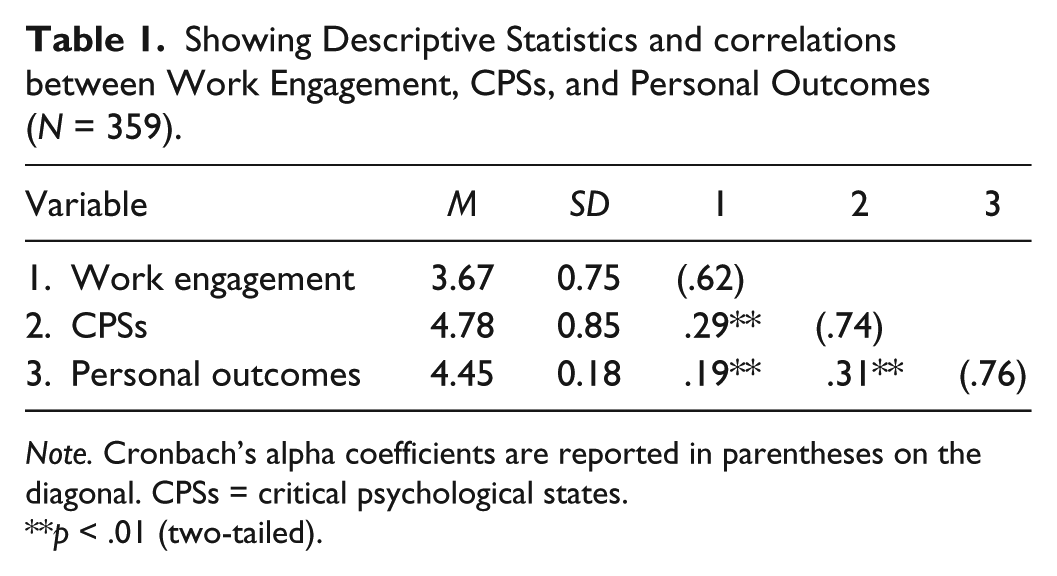
Note. Cronbach’s alpha coefficients are reported in parentheses on the diagonal. CPSs = critical psychological states.
p < .01 (two-tailed).
Showing Descriptive Statistics and Intercorrelations between the dimensions of Work Engagement and CPSs and interaction variables (N = 359).

Note. Cronbach’s alpha coefficients are reported in parentheses on the diagonal. *p < .05 (two-tailed). **p < .01 (two-tailed).
Results
The moderation effect for the interaction variables CPSs and work engagement was adopted from the method of Bagozzi, Baumgartner, and Yi (1992). Bagozzi et al. contended that when variables are measured as continuous, it is preferable to model moderated variable effects as multiplicative interactions to retain the full information contained in continuous variables. Moderated regression maintains original scores on a moderator variable and avoids loss of information resulting from transformation of a continuous variable to a qualitative (discrete) one. The findings in Table 3 indicate that the interaction between work engagement and CPSs did significantly predict the personal outcome.
Showing Regression Coefficients of the Predictor Variables and Moderator Variables on Personal Outcomes.

Note. CPSs = critical psychological state.
p < .01 (two-tailed).
To determine whether the hypothesized direction of the interaction was supported, an interaction plot was plotted.
Figure 2 indicates that when CPSs are lower, the personal outcome decreases, when the CPSs are higher, there is an increased personal outcome. The interactions between the dimensions of work engagement and CPSs were found to be significant, except the interaction between vigor and experienced meaningfulness of work.

Interaction plot between work engagement and personal outcomes.
Discussion
The present study examined the relationship between work engagement, CPSs, and personal outcomes. We find that work engagement had a significant positive relationship with personal outcomes. Although literature supports the assumption that work engagement has a positive relationship with job satisfaction and supervisory support, extending and establishing this relationship for overall personal outcomes (which includes internal work motivation, affective responses, and specific responses) are necessary for the development of the model (Baron & Kenny, 1996). Similarly, CPSs has a significant positive relationship with personal outcomes. The primary hypothesis of this study revealed that the interaction effect of work engagement and CPSs significantly influences personal outcomes, β = .565, significant at p < .01. The interaction plot between work engagement and CPSs explains that when CPSs is high, the personal outcome improves. Consistent with Behson et al. (2000), that without measuring the CPSs, understanding of personal work outcomes can be incomplete or misleading, research provides evidence that the effect of work engagement on personal outcomes increases in the presence of CPSs.
Among the dimensions predicting personal outcomes, the interaction effect of vigor and experienced responsibility of work predicted personal outcomes the highest, β = .461, significant at p < .01, followed by absorption and experienced responsibility of work, β = .342, significant at p < .01. When employees have high levels of vigor and experience responsibility in their work, they will in turn experience higher levels of personal outcomes. Similarly, high levels of absorption and experienced responsibility influence personal outcomes, which indicate that when employees feel they have control over their work environment, they will react with increased eagerness in doing their work. This is similar to the findings of Stander and Rothmann (2009). Research indicates that personal resources which refers to one’s sense of being able to control the work and environment successfully (Hobfoll, Johnson, Ennis, & Jackson, 2003). Similar to their findings, this study also has found that experienced responsibility in this case referring to be able to control the work influences the personal outcomes.
Telecom organizations’ HR strategies should revolve around redesigning sales job by increasing the skills, variety, and identity of a salesman’s job so that his work becomes meaningful, and responsibility to task outcomes and intermittent feedback add to their job satisfaction, leading to enhanced internal motivation of the sales force as a whole. Some evidence suggests that it is possible for the employee to be absorbed with the job; however, difficult jobs may lead to frustration. Matamala (2011) suggested that Big Five personality factors be absorbed and dedicated with his job, thereby resulting in positive personal and organizational outcomes. However, this might be short lived if the CPSs of perceived responsibility are low.
Kahn (1992) described work engagement as one’s psychological presence which is defined as the extent to which people are attentive, integrated, and connected on their role performances. The psychological presence of work engagement measures the involvement a person feels with the job, whereas the CPSs as defined by Hackman and Oldmann (1975) measures whether the person experiences meaningfulness and responsibility when he or she is absorbed with the job. This study is more relevant for jobs with repetitive tasks because even a committed employee may not experience meaningfulness, which in turn might eventually reduce his or her satisfaction levels. Our findings indicate that it is not enough for organizations to measure only work engagement as it gives only a partial picture of the psychological state of the employee. This calls for redesigning such jobs to suit the personality traits of each member of the sales force.
Suggestions for Further Research
The research provides scope for further studies. New research could focus on the relation between work engagement and personal outcomes with the moderating effects of creativity and organizational justice. This would help organizations to focus on HR related activities such as pay, supervisory support, and security. The model can be tested in the presence of employee growth needs as suggested by Hackman and Oldmann (1975).
Conclusion
These findings add to the growing body of research concluding that personal outcomes are a result of employees’ engagement toward work and the psychological state that they experience because of the type of work and the entire work environment. This study acknowledges the conflicting views regarding measuring work engagement. The emphasis is that it is futile to study work engagement ignoring CPSs. The work itself is more interesting, and employees feel accomplished when they are given the opportunity to experience a positive CPSs. Human Resource Management (HRM) practices need to incorporate within positions—task and skill variety, task identity, freedom to plan and execute tasks, and feedback, so that telecom employees will experience a positive psychological state. This in turn will lead to higher work engagement. If telecom organizations need better personal and specific outcomes from their sales force personnel, they need to seek constant employee feedback and use the same to redesign jobs for increased meaningfulness, responsibility, and intermittent knowledge of results.
Footnotes
Declaration of Conflicting Interests
The author(s) declared no potential conflicts of interest with respect to the research, authorship, and/or publication of this article.
Funding
The author(s) received no financial support for the research and/or authorship of this article.