




Abstract
Election outcomes, or more specifically belonging to a political minority or majority, have a significant impact on citizens’ attitudes toward the political system and political involvement. This study aims to broaden our understanding in these regards by taking into account the effects of people’s political convictions on the relation between belonging to a political minority or majority and their dissatisfaction with the performance of the political system. Using a person-oriented approach, four groups of citizens were identified on the basis of their attachment to political parties. The group of people who were not politically attached to any of the political parties were the most dissatisfied, whereas supporters of parties in government were the least dissatisfied. Moreover, supporters of opposition parties who had high levels of political conviction were more dissatisfied than supporters of opposition parties who had lower levels of political conviction. Overall, the findings of this study show that it is crucial to take into account the individual characteristics of citizens when studying the relations between election outcomes and political attitudes.
Keywords
Introduction
In recent decades, election outcomes have received increased attention in research into variations in people’s attitudes toward the political system. A substantial amount of the literature (e.g., Anderson, Blais, Bowler, Donovan, & Listhaug, 2005; Bernauer & Vatter, 2012; Blais & Gélineau, 2007) shows that citizens who, in the previous election, voted for a winning party, that is, a party that made it into government, are more likely to display higher levels of satisfaction with the performance of the political system and of political trust. They are also more likely to believe that the government is responsive to and interested in their needs. Conversely, citizens who cast their vote for a losing party are likely to display more negative attitudes toward the political system, its institutions, and its performance (see, for example, Anderson et al., 2005; Anderson & Guillory, 1997; Anderson & Tverdova, 2001; Blais & Gélineau, 2007; Bowler & Donovan, 2002; Clarke & Kornberg, 1992; Ginsberg & Weissberg, 1978; Holmberg, 1999). Earlier research has also shown that the loser–winner distinction is related to other political attitudes, such as perceived system responsiveness and efficacy, and also to citizens’ willingness to engage in political activism and protest (Anderson & Mendes, 2006; Clarke & Acock, 1989; Clarke & Kornberg, 1992; Whiteley & Seyd, 1998). Overall, previous research has repeatedly demonstrated that electoral outcomes significantly affect citizens’ attitudes toward the political system. In the current study, however, we argue that the relation is complex, and cannot be expressed just as a simple association between two variables. Rather, in this article, we aim to contribute to research on election outcomes by examining the conditions under which attachment to political parties, a measure that is strongly associated with electoral outcome (Campbell, Converse, Miller, & Stokes, 1960; Holmberg, 1994), affects citizens’ satisfaction or dissatisfaction with the performance of the political system. In particular, we aim to examine the interaction between party attachment and political conviction—that is, a person’s feeling of confidence in his or her own political views—in relation to political dissatisfaction. In so doing, we aim to contribute to the debate about election losers and winners, and also to an understanding of the determinants of system support.
The Premises and Limitations of Previous Research
As noted above, individuals belonging to the political majority (the winners) are presumed to differ in their views on the political system and institutions from individuals belonging to the political minority (the losers). The premises underlying this difference in evaluations of the political system by these two groups are presumed to be based on mechanisms rooted in several social-scientific theories, including the economic theory of utility maximization, and psychological theories concerned with emotional responses and cognitive dissonance (Anderson et al., 2005). According to the theory of utility maximization, as used by behavioral economists and game theorists, people prefer winning to losing, simply because the utility of winning is presumed to be greater than that of losing (Kahneman, Wakker, & Sarin, 1997; Thaler, 1994). This way of reasoning is assumed also to apply in the context of elections. The ideas, interests, and preferences of election winners are supposed to be better represented and reflected in policy outcomes. Losers or people in the political minority, by contrast, doubt that their governments are interested in or responsive to their needs and political preferences. They are also worried about the overall confidence in the electoral system and less likely to believe that the political process that leads to the various outputs of the political system is fair (Anderson & Mendes, 2006; Karpowitz, Monson, Nielson, Patterson, & Snell, 2011). In recent years, the role of “fair” institutions in developing democratic legitimacy has received increased attention. Empirical research has shown that citizens who perceive—on the basis of past experiences—that they are being treated fairly by authorities have greater trust in political institutions (e.g., Booth & Seligson, 2009; Esaiasson, 2010; Grimes, 2006; Hibbing & Theiss-Morse, 2001; Linde, 2011; MacCoun, 2005; A. H. Miller & Listhaug, 1999). Thus, the ambivalent feelings of this group regarding the fairness of process of the government, coupled with their doubts about the responsiveness of the political system and about obtaining desired outcomes, are expected to make them more likely to be dissatisfied with workings of the political system and more distrustful about the political institutions. Put bluntly, winners get greater utility from election outcomes than losers, and are therefore expected to show more positive attitudes toward the political system (Anderson et al., 2005).
Moreover, election outcomes are presumed to generate some predictable emotional responses. Winning can make people feel euphoric, while losing is more likely to produce anger and disillusionment (see, for example, Brown & Dutton, 1995; McAuley, Russell, & Gross, 1983; McCaul, Gladue, & Joppa, 1992; Wilson & Kerr, 1999). In terms of election outcomes, whereas winning produces positive emotions toward the election outcome and the political system that has produced it, losing is likely to give rise to gloomy and negative feelings about election outcomes and the institutions related to them. Finally, as well as affecting utility maximization and determining emotional responses, election outcomes are also supposed to have an impact on people’s cognitions. According to theories of cognitive consistency, people seek to maintain and minimize conflicts between their beliefs, opinions, and attitudes (Festinger, 1957). However, after every choice of decision (such as how to vote in an election), a sense of discomfort, called cognitive dissonance, may arise due to inconsistencies between one’s attitudes, beliefs, and behaviors. To deal with the discomfort, individuals change their impressions of the alternatives by, for example, evaluating their chosen alternatives positively, and rejecting negative interpretations (Festinger, 1964). Such attempts to maintain consistency are also supposed to take place in relation to citizens’ attitudes toward the political system. For example, individuals who have voted for an election loser may develop more negative political attitudes toward the political system in an effort to justify their choice and restore consistency (Anderson et al., 2005). All in all, on the basis of a range of theories from various academic disciplines, election outcomes seem to affect citizens’ attitudes toward the political system.
However, the research described above has some limitations. First, the empirical studies that have examined the associations between the loser–winner distinction and citizens’ attitudes toward the political system have not paid attention to the conditions under which individual winning and losing actually matter (see, for example, Anderson & LoTempio, 2002; Anderson & Tverdova, 2001; Henderson, 2008). The few studies that have examined the moderating roles of other variables in the associations between electoral outcomes and political attitudes have taken a macro-perspective by emphasizing the effects of formal and informal system properties, such as types of majority-consensus democracy and electoral systems (see, for example, Anderson & Guillory, 1997; Bernauer & Vatter, 2012; Norris, 1999b). In other words, the main focus, when explaining people’s attitudes toward the political system, has been on interaction between election outcome and institutional environment. An emphasis on macro-explanations, however, has dominated research attempting to explain variations in people’s attitudes toward the political system in general (cf. Robinson, Liu, Stoutenborough, & Vedlitz, 2012). Scholars have, for example, examined the effects on political attitudes of economic performance and growth (McAllister, 1999; Przeworski, Alvarez, Cheibub, & Limongi, 1996), of value changes and cognitive mobilization (Dalton, 1984, 2002; Inglehart, 1977, 1990), and also of corruption and political scandals (Anderson & Tverdova, 2003; Bowler & Karp, 2004; Seligson, 2002). However, to obtain clearer insight into research that attempts to explain people’s attitudes toward the political system in general, and the associations between loser or winner and political attitudes in particular, it is also important to consider micro-explanations and to explain the conditions under which individual winning or losing in elections has consequences for citizens’ attitudes. Consideration of micro-explanations is of importance, because a number of behaviors, values, and attitudes of citizens have been repeatedly pointed to as prerequisites for the functioning and maintenance of democracy (see, for example, Almond & Verba, 1963; Dahl, 1992; de Tocqueville, 1945; Gibson, 1992; Schumpeter, 1950; Sullivan & Transue, 1999). Thus, paying greater attention to individual-level characteristics might contribute to expanding the debate on the role of election outcomes in relation to political attitudes. In this article, we therefore aim to study the effects of interactions between individual characteristics on political dissatisfaction. More specifically, we suspect that not all citizens are affected in the same way by external circumstances. Individuals’ responses to election outcomes in terms of how they view the political system might differ according to their individual characteristics, such as interest in politics, political knowledge, education, and so forth (cf. Almond & Verba, 1963; Weatherford, 1991). In particular, we argue that people’s strong political convictions, having a feeling of confidence in their own political views, and having clear political ideals might matter, as they may contribute to an understanding of the determinants of political dissatisfaction, and also to the debate on the effects of election outcomes. In sum, while we do not claim that institutional factors and other macro-explanations play only a secondary role in explaining citizens’ attitudes toward the political system, we do argue that research needs to take individual characteristics into account.
A second limitation of previous studies concerns the measures that have been used for denoting citizens as either winners or losers. Prior studies have used “vote-recall questions” (such as “Who did you vote for?”) to categorize voters as electoral losers or winners (Anderson et al., 2005). However, it should be noted that basing the categorization of winners and losers on a vote-recall question has some potential problems because of the bias inherent in retrospective vote reporting (cf. Wright, 1993). In particular, citizens are more likely to report that they voted for a winning party after they voted than really is the case (Anderson et al., 2005). This problem of over-reporting of support for the victorious party may be due to poor memory, misrepresentation, or cognitive dissonance. However, whatever the reason, it means that the categorization of citizens on the basis of vote-recall is not optimal. At the same time, the use of vote-recall questions does not leave much room for variation, as people are classified as either winners or losers. This way of classifying leaves, therefore, some significant groups of people out of any analysis. The excluded groups may consist of people who like the governing as well as the opposition parties, or people who do not agree with either the opposition or the governing parties (cf. Almond & Verba, 1989; Klingemann & Wattenberg, 1992; Rose & Mishler, 1998). Thus, there are grounds for questioning existing measures, and for using other ways of classifying citizens, to overcome some of the problems related to recall bias and to capturing groups of citizens other than winners or losers. One way of overcoming the problems involved in using vote-recall questions is to measure the extent to which citizens support opposition and governing parties, so as to capture variations in levels of support.
The Current Study
The current study aims to make two main contributions to research concerned with the influence of election outcomes on citizens’ evaluations of the political system’s performance. The first contribution is methodological. To overcome the limitations of vote-recall questions, the study uses a measure that taps levels of party attachment, thereby capturing two important dimensions of respondents’ attitudes toward political parties: support for opposition parties and support for governing parties. As noted above, one of the limitations of vote-recall questions is that they classify people as either winners or losers. To overcome this limitation, we combine the two dimensions of party attachment in a person-centered analysis, where the existence of all possible groups of citizens with different levels of party attachment is demonstrated empirically. Based on the conceptual distinction between the two dimensions of party attachment, we suggest that citizens may form four qualitatively distinct groups that are founded in the origins of their party attachment: (a) citizens disliking or not supporting any of the parties, (b) citizens supporting all parties, (c) citizens only supporting opposition parties, and (d) citizens only supporting governing parties (cf. Almond & Verba, 1989; Rose & Mishler, 1998).
There are several advantages to using a party-attachment measure. First, the use of a two-dimensional party-attachment measure, instead of a vote-recall question, will reveal greater variations in naturally occurring groups of people. As noted above, it makes it possible also to include other theoretically vital groups of citizens in an analysis, such as citizens who dislike all political parties and citizens who like all parties. Thus, the measure of party attachment in the current study takes into consideration additional groups of citizens, other than election losers and winners. Second, by using party attachment, some bias inherent in the regular approaches to identifying losers and winners can be avoided, such as the bias related to the over-reporting of support for the winning party that may be due to poor memory. Due to the fact that party attachment measures people’s attitudes toward political parties in the present, and not their choices of vote in the past, the bias related to poor memory is eliminated. All in all, basing the categorization of citizens on a party-attachment measure is preferable to basing it on a vote-recall question, as the procedure incorporates more theoretically relevant groups of citizens and eliminates some over-reporting bias.
Third, and finally, we argue that the Swedish political context, in particular its election and party system, might also constitute a good reason for using a party-attachment measure. Elections to the Riksdag (the Swedish Parliament) are held every four years. The electoral system used in Swedish national elections is based on proportional representation, meaning that the share of seats a party receives corresponds closely to the share of the total votes cast for the party in the whole country. However, to take part in the distribution of seats in the parliament, a party must gain at least 4% of all the votes cast (although parties that do not reach this threshold have the possibility to take part in the distribution of fixed constituency seats in a constituency where they received at least 12% of all votes cast). Apart from the five political parties that make up the classic Swedish “five-party system,” only a few other parties have succeeded in gaining seats in the national parliament. Despite a multi-party system, however, Swedish politics have and still are dominated by bloc politics. The political parties in the parliament are commonly divided into two blocs: (a) a socialist (left) bloc, containing the Left Party, the Social Democrats, and the Greens and (b) a bourgeois (right) bloc, containing the Center Party, the Liberals (the Folk Party), the Moderate Party (Swedish Conservatives), and the Christian Democrats. Although bloc politics and political identities have occasionally been unstable, and involved major disagreements within the blocs, during the two last parliamentary terms the left and right blocs have been more ideologically and organizationally coherent than, perhaps, at any other phase in Swedish political history. One main reason for increased coherence within the blocs lies in the formation of the Alliance for Sweden in 2004, which is a political alliance of the four right-bloc parties in the parliament. The alliance won the 2006 and 2010 parliamentary elections on a joint election manifesto, and currently forms a minority government (Aylott & Bolin, 2007; Karlsson, 2013). These far-reaching and stable “two-bloc” politics, in both a past and contemporary Swedish political contexts, have some important implications for the voting behaviors of Swedes, which further justifies the current study’s adoption of a two-dimensional party-attachment measure (i.e., support for opposition parties and support for governing parties). One implication of two-bloc politics concerns tactical voting. It is relatively common for Swedish voters, instead of voting for their first-preference party, to vote for a party in the same bloc if that party is at risk of not passing the 4% threshold needed to enter the parliament. Moreover, due to this tradition of bipolar bloc politics, switching from one bloc to the other is relatively rare. Voter movements occur primarily within each bloc (Granberg & Holmberg, 1990; Hagevi, 2011). There seems, in other words, to be tacit agreement and solidarity within each political bloc, which is important to take into account. Taken together, for these reasons, the two-dimensional party-attachment measure used in this study represents an attractive alternative to vote-recall, and may help overcome some of the methodological limitations of previous studies.
The second contribution of this study is related to its focus on individual characteristics. As noted earlier, it seems important also to highlight the role of individual-level factors in explaining citizen’s attitudes toward the political system. In this article, we therefore aim to examine the effects of the interaction between two micro-explanations, namely party attachment and political conviction, on performance-driven political dissatisfaction. We propose that citizens’ attitudes toward the political system depend not only on whether they support a governing or an opposition party but also on how politically confident they are. People who have clear political opinions and views are likely to be more affected by election outcomes than those who are uncertain where they stand politically, due to the fact that belonging to a political minority or majority is more relevant to their own political views. We therefore hypothesize that supporters of opposition parties with higher levels of political conviction will be more dissatisfied with the performance of the political system than supporters with lower levels of political conviction. And, the opposite effect is expected for supporters of governing parties. Thus, supporters of governing parties with higher levels of political conviction are expected to be more satisfied with the performance of the political system than supporters with weaker political conviction.
These expectations are derived from the idea that ideological extremists, or people whom some scholars have referred to as “hardcore opinion holders” (Noelle-Neumann, 1974, 1993), may be more committed to their political opinions and more inclined to promote them. Noelle-Neumann (1974), who first coined the term, argued that members of the hardcore are “not prepared to conform, to change their opinions, or even be silent in the face of public opinion” (p. 48). Following this line of reasoning, a number of scholars have argued, and shown empirically, that ideological extremists of different kinds are more likely to express their political views, participate in political processes, and be more politically devoted and interested (Anderson et al., 2005; Martin & van Deth, 2007; Putnam, 2000). Thus, based on the logic behind hardcore opinion holding, we expect that people with clear political views (i.e., have a high level of political conviction) to be more affected by whether they belong to a political majority or minority than those who are uncertain where they stand politically. In sum, in this article, we argue that interaction between people’s feelings of confidence in their own political views and party attachment affects their attitudes toward the performance of the political system.
Taken as a whole, the current study has three aims. The first is to use a person-oriented approach, rather than a variable-oriented approach, to establish whether the four theoretically relevant groups of citizens obtained from combining the two dimensions of party attachment do actually exist. The second is to examine how these different groups of citizens differ in their views on performance-driven dissatisfaction. The third is to investigate whether and how citizens’ political conviction moderates the relationship between support for political parties and performance-driven dissatisfaction. More specifically, the current study aims to answer the following three questions: Which groups of citizens have distinct patterns of party attachment? How do these groups differ from each other with regard to performance-driven dissatisfaction? To what extent does political conviction moderate the relationship between party attachment and performance-driven dissatisfaction? When addressing the final question, we control statistically for the effects of variables that have been regarded as relevant predictors of citizens’ attitudes toward the political system: age, sex, income, education, immigrant status, political interest, political knowledge, trust in others, and system responsiveness.
Method
Participants and Procedure
Participants came from a medium-sized Swedish city with a total population of about 135,000. According to national statistics, the city is similar to the Swedish average in annual mean income (225,242 Swedish kronor/person, compared with 229,056 Swedish kronor/person for the whole country), rate of unemployment (9.5%, compared with 8.4% for the whole country), average percentage of immigrants (5.7%, compared with 6.7% for the whole country), population density, and political leanings. The target sample comprised of about 2,902 individuals, who were randomly selected from a list of all 20- to 26-year-olds living in the city. The participation rate was more than 60%. The final analytical sample included 1,669 participants (42.3% males, 57.7% females; Mage= 22.71). The data for the study were collected via postal (85.1%) and online (14.9%) questionnaires. All participants were given the option to fill in the questionnaire in paper form or the equivalent in an online version. The questionnaire was mailed to the target sample together with information about the study and a personalized link to the online version of the questionnaire. To see whether participants who differed in their mode of responding also differed from each other on demographic characteristics (age, sex, income, education, and immigrant status), a logistic regression analysis was carried out. We found a significant difference only for gender. Males were more likely than females to fill in the questionnaire online (odds ratio = 2.18, p < .001). We also compared the two types of survey respondents on a number of relevant political variables, such as political interest, trust, system responsiveness, political conviction, party affiliation, and so forth. No statistically significant differences in these political variables were revealed between the two kinds of participants. The participants were informed that their involvement in the study was voluntary, and they were assured of the confidentiality of their responses. Participants received a gift card worth 250 Swedish kronor (about 27 EUR) for being in the study.
Measures
Performance-driven dissatisfaction
This construct comprised four items. The first two concerned respondents’ level of confidence in the government and the parliament (Klingemann, 1999). The response scale for these two items ranged from 1 (a lot of confidence) to 4 (no confidence at all). The two remaining items concerned dissatisfaction with the performance of political actors and the way democracy works at present. The questions were worded as follows: “How satisfied are you with how the people now in national office are handling the country’s affairs?” (Klingemann, 1999) and “On the whole, how satisfied are you with the way democracy works in Sweden?” (Linde & Ekman, 2003). The response scale for these two questions ranged from 1 (very satisfied) to 4 (not at all satisfied). Alpha reliability for this scale was .83.
Party attachment
Party attachment was measured by asking respondents: “Which of the following parties do you like or dislike?” The alternatives included all parties represented in the cabinet and a number of opposition parties. The response scale for this question ranged from 1 (dislike strongly) to 5 (like strongly). Principal axis factoring with promax rotation was used to identify the underlying structure of this variable. A two-factor solution emerged from the analysis. The first factor, which can be called “support for governing parties,” had an eigenvalue of 3.2 and explained 39.1% of the common variance. The second factor, named as “support for opposition parties,” had an eigenvalue of 1.5 and explained about 14% of the variance. The factor loadings for these two factors ranged between .65 and .81. Alpha reliability for the first factor, “support for governing parties,” was .80, and for the second factor, “support for opposition parties,” .74.
Political conviction
Respondents’ levels of political conviction were measured by responses to the following three statements: “I feel confident in where I stand politically,” “I am convinced that the political views I have today are the right ones for me,” and “I do not think my political views will change that much in the future.” The response scale for this construct ranged from 1 (does not apply at all) to 4 (applies exactly). Alpha reliability for the scale was .86.
Control Variables
Trust in others
Participants were asked to respond to the following question: “Think about people in general. How much do you agree with the following statements?” The statements were as follows: “Most people can be trusted” and “Most people are fair and do not take advantage of you” (Pearson’s r between these two items was .76; Flanagan & Stout, 2010; Flanagan, Syvertsen, & Stout, 2007). They responded on a 5-point scale ranging from 1 (do not agree at all) to 5 (completely agree).
Political knowledge
Political knowledge was measured using four questions: (a) “The European Parliament meets in two cities. Which ones?” (b) “What national share of the vote does a political party need to enter the Swedish Parliament?” (c) “To which ideology does the Swedish Folk Party traditionally claim to adhere?” and (d) “Which parties are partners in the Alliance for Sweden (the current ruling coalition in Sweden)?” Correct responses to these questions were coded as “1,” and incorrect responses as “0.” Thirty-six percent of the participants answered two questions correctly, 28% answered three questions correctly, and 16% answered all the questions correctly.
System responsiveness
This dimension of citizens’ political orientations has to do with experienced opportunities to influence politics and society, and was measured by the following three items: “Those in power in our society listen to and care about people’s concerns and opinions,” “The possibilities of participating in and influencing political decisions are good,” and “It is easy for ordinary people to get their opinions across to those in power.” The response scale ranged from 1 (does not apply at all) to 4 (applies exactly). Alpha reliability for this scale was .75.
Political interest
Respondents’ interest in politics was measured using the following question: “How interested are you in politics?” The response scale for this question ranged from 1 (not at all interested) to 5 (very interested). This standard question, which taps citizens’ political interest, has been included in many surveys, such as the World Values Survey (WVS), the International Social Survey Programme (ISSP), and the Eurobarometer (EB).
Socioeconomic variables
Household income was measured by asking respondents about their pre-tax income per month. The response scale for this question ranged from 1 (0-10.000 SEK) to 7 (60.001 + SEK). Education was measured by asking respondents to choose the category best representing their level of educational achievement. Categories ranged from 1 (unfinished compulsory school) to 6 (college/university—more than 3 years). In the current sample, about 30% of the participants reported that they had completed university/college degree. Immigrant status was measured as a dichotomous variable (1 = immigrant—neither of the student’s parents born in Sweden; 0 = Swedish—at least one of the students’ parents born in Sweden).
Analytical Strategy
We used cluster analysis to identify unique groups of people with different patterns of party attachment. A recommended strategy for identifying such groups of people is first to perform a hierarchical analysis using Ward’s method (Ward, 1963) to determine the number of groups, and then perform iterative k-means clustering (MacQueen, 1967) to optimize the results (Milligan, 1980). Accordingly, in the current study, a hierarchical cluster analysis was performed first to identify the number of groups of citizens based on the two dimensions of party attachment (i.e., support for the opposition and governing parties). Hierarchical clustering does not endorse any specific number of cluster solutions. Rather, it permits multiple cluster solutions to be compared with one another, so as to determine the number of clusters that best describes the data. Ward’s (1963) method was used to generate the cluster solutions. This method aims to minimize the amount of variation within clusters by incorporating the cases that have the shortest distance from each other into the same cluster. During the iteration process, the cases that would minimally increase the error sum of squares (or the sum of squared within-cluster distances) are grouped into that cluster. The clustering procedure is completed when the last case is assigned to one, theoretically meaningless, cluster (Borgen & Barnett, 1987).
The recommended strategy for cluster analysis is to use standardized scores or factor scores if multiple indicators are used to measure the construct in question. The current study used the factor scores of our measures of support for governing and opposition parties, which were then standardized (z-transformed). Following the cluster analysis, two approaches to determining the number of clusters were employed: (a) visual inspection of the dendogram and (b) applying the criterion of a minimum recommended explained variance of 67% (Bergman, Magnusson, & El-Khouri, 2003). The dendogram visually presents the jump in the agglomeration coefficient when a smaller cluster is merged into a larger cluster. Changes in agglomeration coefficients across solutions are interpreted in a scree plot in exploratory factor analysis. The breaking point in the plot indicates the number of cluster solutions that might plausibly best represent the data. Our hierarchical cluster analysis was followed by a k-means cluster analysis to optimize the results. K-means clustering strives to minimize the distances between the variable scores and the cluster centers. Thus, in this case, this classification technique identifies homogeneous groups of citizens who share similar characteristics in terms of supporting either governing or opposition parties. Consequently, citizens in the same cluster are most similar to each other in their profile of party attachment, but most dissimilar to members of other clusters with regard to these same orientations.
Following these cluster analyses, an ANCOVA was conducted to examine the main effects of the cluster variable and political conviction, and also any interaction between them. In other words, the analysis was performed to explore the conditions under which party attachment has an impact on citizens’ dissatisfaction with the performance of the political system, while controlling statistically for the effects of additional variables that may influence the association between the two variables in question. There were two main reasons for the choice of ANCOVA, instead, for example, of a regression-based method. The first concerns the aims of the study. As noted earlier, the second aim of this study was to examine whether various groups of citizens with different patterns of party attachment differ in their views on performance-driven dissatisfaction. In other words, we were interested in examining the mean differences in dissatisfaction between different groups according to the nature of their party attachment. Using a regression framework to test the research question would have been appropriate if the question had focused on how membership of these different groups predicts variations in performance-driven dissatisfaction. Following conventional methods for examining differences between groups, we decided to use ANCOVA.
The second reason for using ANCOVA, rather than regression, had to do with the ease of interpretation of the statistical analyses. Technically, it is possible to use regression models to test for group differences on a given dependent variable. However, this is only possible by using dummy codes or effect codes, which allow treatment of categorical (nominal) variables as predictors in a regression equation. For example, to represent the four-category party-attachment variable, three dummy-coded variables would have to be created. Each dummy code would then relate a group to a reference category. If a regression-based method had been used, we would have had to create three dummy-coded variables for the four-category party-attachment, two dummy-coded variables for the three-category political conviction variable, and the interaction terms between these dummy-coded variables (Aiken & West, 1991). Overall, testing the main effects and the interaction effects of just one reference category would have required the inclusion of 11 unique codes. In addition, the model would have had to be re-run several times to examine all the potential group differences and interaction effects created by changing the reference categories of the dummy codes. Consequently, the interpretation of results gained from regression analysis would have been difficult and complicated, due to the many interaction terms that would have had to be created (Aiken & West, 1991).Thus, for these two reasons, ANCOVA was considered to be a more appropriate method than regression to analyze the data and to fulfill the purposes of the study.
Results
Groups According to Party Attachment
The first aim of the study was to establish whether there were actually different groups of supporters of governing and opposition parties among the citizens. Inspection of the dendogram from the hierarchical cluster analysis suggested that a four-cluster solution would be most theoretically relevant. The four-cluster solution accounted for about 68% of the variation in the error sum of squares. This solution represented the four possible combinations on the two dimensions of party attachment (i.e., support for governing and opposition parties) that had been entered into the analysis (see Figure 1). These groups are named as (a) dislikers (low on support for both governing and opposition parties, n = 96), (b) winners (high on support for governing parties, low on support for opposition parties, n = 352), (c) losers (high on support for opposition parties, low on support for governing parties, n = 419), and (d) ambivalents (above average on support for both opposition and governing parties, n = 802).

Groups of supporters of governing and opposition parties—Party attachment.
To identify whether these four groups significantly differed with regard to support for governing and opposition parties, and also to performance-driven dissatisfaction, a MANOVA was conducted using the three measures as outcome variables simultaneously. A multivariate F test suggested a significant difference across the groups on these variables, F(9, 4929) = 424.05, p < .001, η2 = .44. Univariate comparisons and a post hoc comparison also suggested that all but one of the groups had significantly different mean values on performance-driven dissatisfaction, and the two dimensions of party attachment (see Table 1). The exception was the difference between dislikers and losers on the measure of support for opposition parties. The analysis also showed that those who disliked both government and opposition parties (ambivalents) were the most dissatisfied with the performance of the political system, whereas winners were the most satisfied. Moreover, consistent with our initial expectations and previous research, losers were more dissatisfied than winners. Overall, these results suggest that the groups of citizens with different patterns of party attachment differ significantly from each other with regard to performance-driven dissatisfaction.
Mean Differences Across Groups Defined by Party Attachment and Performance-Driven Dissatisfaction.

Note. Multivariate F test: F(9, 4929) = 424.05; p < .001; η2 = .44.
The different superscripts indicate significant mean differences across the groups of party attachment using the SNK (Student-Newman-Keuls
The Moderating Role of Political Conviction
To examine whether political conviction added to our understanding of the relationship between party attachment and performance-driven dissatisfaction, an ANCOVA was conducted. The independent variables were political conviction (three levels: high, average, and low) and party attachment (four groups: dislikers, winners, losers, and ambivalents). The dependent variable was performance-driven dissatisfaction. Age, sex, income, education, ethnicity, political interest, political knowledge, trust in others, and system responsiveness were used as covariates. The results showed that this model explains about 49% of the variance in performance-driven dissatisfaction (see Table 2). Furthermore, the results suggested that there is a significant interaction effect between political conviction and party attachment on performance-driven dissatisfaction, F(6, 1234) = 8.39, p < .001 η2 = .04. There was also a statistically significant main effect of party attachment, F(3, 1234) = 118.87, p < .001, with a large effect size (η2 = .22). Also a significant, but small main effect (η2 = .01) of political conviction was found, F(2, 1234) = 3.79, p < .05. In addition, the results showed that four of the covariates had significant effects on performance-driven dissatisfaction: sex, political knowledge, trust in others, and system responsiveness. To show the ways in which these covariates affected performance-driven dissatisfaction, a correlation analysis using the Pearson coefficient (r) was carried out. The correlations showed that higher levels of political knowledge, trust in others, and system responsiveness were associated with lower levels of political dissatisfaction (see the appendix). Furthermore, results from a t test showed that males had higher mean values on performance-driven dissatisfaction than females. Overall, these findings show that groups defined by party attachment explain much of the variance in performance-driven dissatisfaction, and that political conviction plays a moderating role in the relationship between the variables.
Results of the Two-Way ANCOVA.

Sex was coded 0 for female, 1 for male.
Immigrant status was coded 1 for immigrant, 0 for Swede.
To further explore and interpret the significant interaction pattern found for political conviction, a least significant difference (LSD) test was conducted (see Figure 2). The test was used to compare different levels of political conviction within each group defined according to party attachment. The interaction was plotted at low (≤−0.5 SD below the mean), average (>−0.5 to <0.5 SD), and high (≥ 0.5 SD above the mean) levels of political conviction. An inspection of the results of the test suggested that there are significant differences with regard to political conviction within three of the four groups. Within the first group (dislikers), we found significant differences between, on one hand, high and low levels of political conviction, and, on the other, between low and average levels, F(2, 1234) = 8.48, p < .001. Significant differences were also found in the second group (winners), F(2, 1234) = 10.42, p < .001, and in the third group (losers), F(2, 1234) = 5.31, p < .01. There were, however, no significant differences in the fourth group (ambivalents), F(2, 1234) = .46, p = .63 (see Table 3). Put differently, the results show that people who were identified as dislikers and scored high on political conviction were also more dissatisfied with the political system’s performance than dislikers, who reported low political conviction. Furthermore, supporters of opposition parties who scored high on political conviction were more dissatisfied than supporters of opposition parties who reported lower levels of political conviction. Conversely, winners who scored high on political conviction were less dissatisfied than winners with low levels of political conviction. All in all, the results suggest that political conviction, as an individual-level characteristic, moderates the relation between party attachment and performance-driven dissatisfaction, after controlling statistically for the effects of the most important political and socioeconomic background variables.

Interactions between four groups of party attachment and three levels of political conviction on performance-driven dissatisfaction.
Mean Differences in Performance-Driven Dissatisfaction at Three Levels of Political Conviction Within the Four Groups of Party Attachment.
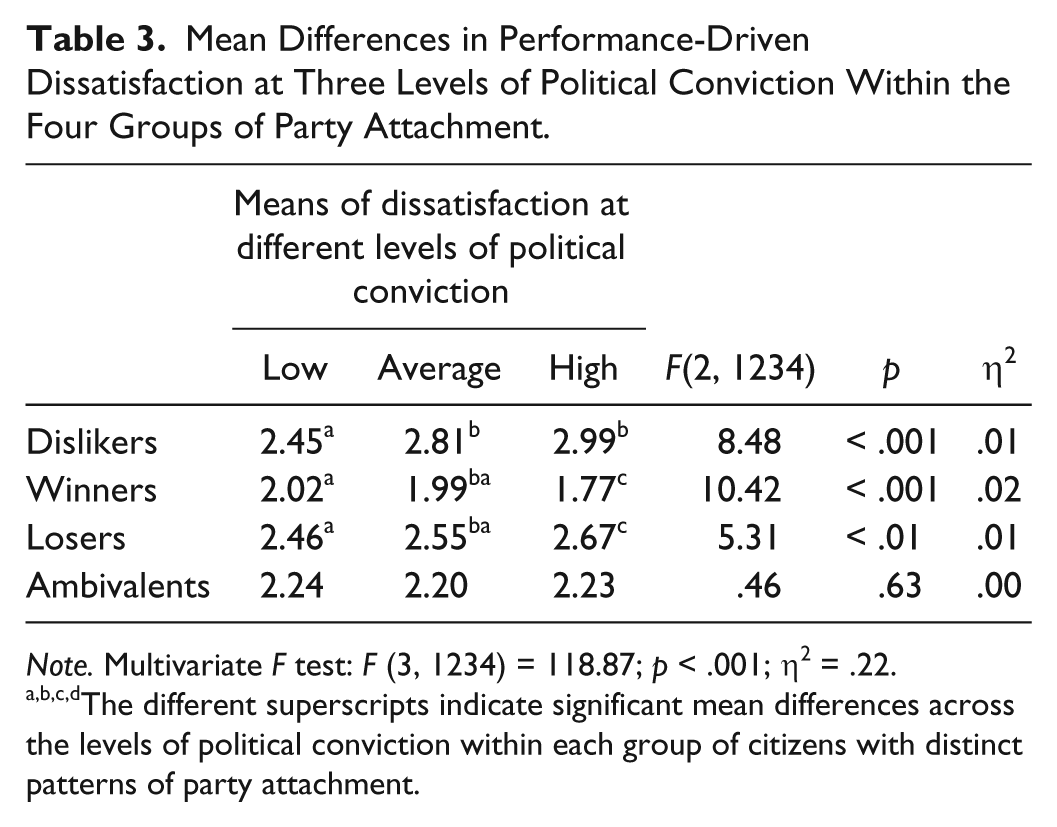
Note. Multivariate F test: F (3, 1234) = 118.87; p < .001; η2 = .22.
The different superscripts indicate significant mean differences across the levels of political conviction within each group of citizens with distinct patterns of party attachment.
Discussion
The main aim of the current study was to contribute to the debate on the effects of election outcomes by focusing on the role of individual characteristics in explaining attitudes toward the political system. The findings of the current study provide additional evidence that supporters of parties out of government are significantly more negative in their evaluations of the political system’s performance than supporters of governing parties. Moreover, this study adds to current knowledge by showing that the most politically dissatisfied group comprises people who are not attached to any political party (dislikers). Given that party attachment is a central component of democratic politics (Dalton & Wattenberg, 2000; Holmberg, 1994; W. E. Miller, 1991; Weisberg & Greene, 2003), the existence of such a group of citizens cannot be regarded as beneficial for the development and functioning of contemporary democracies, especially as its members have negative attitudes toward the political system. Moreover, when more and more people fail to identify with an established party, support for demagogic leaders and extreme parties is likely to increase (Converse & Dupeux, 1962). This is, in fact, what has happened in recent decades in many democratic countries, including Sweden, Canada, Norway, France, Italy, New Zealand, Switzerland, Israel, the Netherlands, Romania, and Chile. In these countries, extreme parties and leaders have gained in popularity and entered the corridors of power (Norris, 2005). Moreover, the current study adds to current understanding of party attachment by showing that the largest group of citizens (ambivalents) consists of those who have about average levels of party attachment. Although this is not surprising in itself, given that previous research has pointed to a general decrease in party attachment among the citizens of the most advanced industrial democracies (Dalton & Wattenberg, 2000; Schmitt, 1989; Van Biezen, Mair, & Poguntke, 2012), it does indicate a need for further research to examine the characteristics of members of this group and the consequences for democratic societies.
In addition, and perhaps most importantly, the current study adds to existing knowledge by showing that individual characteristics in terms of the strength or weakness of citizens’ political conviction influence the association between party attachment and performance-driven dissatisfaction. The results indicate that supporters of opposition parties with higher levels of political conviction are significantly more dissatisfied than supporters with lower levels of political conviction. The same is true of supporters of governing parties and those who do not support any political party (dislikers). For example, supporters of governing parties with higher levels of political conviction seem to be more satisfied than supporters of the same parties with lower levels of political conviction. This finding suggests a more nuanced interpretation of the associations between party attachment and attitudes toward the performance of the political system. It indicates that citizens evaluate the political system differently, not only according to their level of attachment to political parties but also according to their level of political conviction. In order words, the finding adds to current research by showing that, as well as formal and informal system properties, such as majority-consensus types of democracy and electoral systems (Anderson & Guillory, 1997; Norris, 1999a), individual-level attributes are important and should be taken into account. All in all, the current study shows that the party or parties that a citizen supports have an impact on his or her evaluation of the political system’s performance. It also shows that citizens’ political conviction is an important factor to consider when investigating attitudes toward the political system.
There are some possible explanations for why political conviction in interaction with party attachment has an impact on citizens’ attitudes toward the political system. These explanations are based on the theoretical ideas discussed in the “Introduction” to this article in relation to the roots of winning and losing. More specifically, people with higher levels of political beliefs and opinions may suffer a harder loss than those with lower levels, due to the fact that they feel that they gain less utility from election outcomes in comparison with what they have invested. For winners, by contrast, the utility of election outcomes, in terms of reflection of their ideas and their interests in policy outcomes, should be regarded as even higher. Furthermore, the effects of emotional responses to electoral outcomes may be even stronger for individuals with higher levels of political conviction, regardless of whether they belong to the losing or the winning side. For example, losers with strong political convictions, compared with losers of low conviction, are supposed to get angrier at election outcomes, and are more negatively oriented toward the institutions that have produced them. Finally, in accordance with theories of cognitive consistency, it can be imagined that people with high levels of political conviction are more likely to maintain consistency in their beliefs and attitudes than people with low levels. This would mean, for example, that winners with strong political convictions develop more positive attitudes toward the political system than winners with lower conviction to reduce the dissonance of having inconsistent attitudes. However, on the basis of this study, we cannot draw any conclusions about whether these explanations hold. Further research is needed to clarify which mechanisms underlie the effects of political conviction.
Nevertheless, regardless of the mechanisms that may be at work, the findings of this study have some implications for future research. First and foremost, future research on election losers and winners should consider the use of measures that include further relevant groups of citizens and avoid the bias related to vote-recall questions. Moreover, as demonstrated by this study, it seems important to take into account the interactions between individual-level characteristics in explaining citizens’ political attitudes, in particular, the interaction between political conviction and party attachment. The moderating role of political conviction not only provides a fairly nuanced image of the impact of individual-level differences on how people’s belonging to a political majority or minority is translated into different types of evaluation of the political system, but it may also have implications for overall political attitudes and behaviors. One possible impact of the relationship between political conviction and party attachment might concern citizens’ voting behaviors and overall participation in politics. It is likely, for example, that those citizens who are identified here as “dislikers,” with low levels of political conviction, may not be interested in taking part in elections or other types of political activities. Furthermore, it is possible that an unfavorable combination of political attachment and conviction might also have implications, not only for citizens’ attitudes toward the political system but also for other equally important democratic attitudes and values, including tolerance, social trust, humanism, political interest, and so forth. From a democratic viewpoint, a possible withdrawal from politics and a lack of favorable democratic orientations raise concerns, as the development and legitimacy of democracy depend on citizens’ active participation and positive orientations (Dalton, 2013; Easton, 1965). However, as the current study was not designed to examine these implications, further research is needed to examine possible impacts on citizens’ political behaviors and attitudes. In sum, by considering further groups of citizens and systematically combining individual characteristics, future research might better promote understanding of why and how citizens think about their political systems.
Several limitations of this study should be mentioned. First, a potential limitation concerns the external validity of our findings, that is, the possibility of generalizing its results to other democratic societies. Ideally, the findings of this study should be replicated in other democratic societies to gain better understanding of the impacts of political conviction on the relationships between citizens’ party attachment and their attitudes toward the political system. It might be argued that the very fact that the findings are based on a sample taken in a country that, in several important respects, is similar to other Scandinavian and Western democracies makes it reasonable to expect similar findings in other democracies. Nevertheless, there is much still to be learned, and future research should address the issues by using data from several democracies to obtain a more comprehensive picture of the effects of individual characteristics on the relation between party attachment and citizens’ attitudes toward the political system.
A second limitation concerns the age distribution of our sample. In the current study, we were mainly interested in young adults, which entails that our findings cannot be generalized to younger and older generations. However, young adults are at a unique phase in life, especially when it comes to political life. They have, among other things, the right to vote, to run for various political positions, and to join political organizations. They may start assuming more active roles in politics than they did in adolescence, a period restricted by societal regulations, such as those on voting age and election to office. Thus, this age period is an interesting one to investigate.
At the same time, the study has several strengths. First, unlike many other studies in the field, it has considered the importance of a third variable (political conviction) in understanding the relation between being a loser or a winner and citizens’ evaluation of the political system. By empirically showing that the relation between loser–winner, as measured by party attachment, and citizens’ political attitudes is rather more complex than it might appear, this study contributes to the loser and winner debate. A second strength concerns the use of a broader definition of performance-related dissatisfaction. By contrast with many earlier investigations, the current study covers a broad range of citizens’ dissatisfaction by including both dissatisfaction with the performance of political actors and the way democracy works, and also dissatisfaction with political institutions. A final strength is that we used a person-oriented approach to find groups of citizens who identified with the various political parties. The use of a person-oriented approach made it possible to identify naturally occurring groups of citizens with different patterns of party attachment. Taken as a whole, despite its limitations, the study presents a new approach to looking at the relation between being a loser or a winner and citizens’ political attitudes. It provides evidence that citizens’ attitudes toward the political system are affected not only by the political system they find themselves in, which has a structure of its own but also by their own individual characteristics.
Footnotes
Appendix
Correlations Between Performance-Driven Dissatisfaction and the Covariates Employed in the Study.
| 1 | 2 | 3 | 4 | 5 | 6 | 7 | 8 | 9 | |
|---|---|---|---|---|---|---|---|---|---|
| 1. Performance-driven dissatisfaction | — | ||||||||
| 2. Age | .03 | — | |||||||
| 3. Sex | .04 | .02 | — | ||||||
| 4. Income | −.01 | .12*** | .06** | — | |||||
| 5. Education | −.02 | .34*** | −.12*** | .06* | — | ||||
| 6. Immigrant status | .02 | .02 | −.02 | −.02 | .11*** | — | |||
| 7. Political interest | −.07** | .03 | .07** | −.02 | .13*** | −.02 | — | ||
| 8. Political knowledge | −.10*** | .06* | .10*** | −.04 | .18*** | −.15*** | .49*** | – | |
| 9. Trust in others | −.27*** | .03 | −.01 | .01 | .09*** | −.16*** | .09*** | .16*** | – |
| 10. System responsiveness | −.49*** | −.03 | −.06* | .00 | .06* | −.01 | .19*** | .14*** | .26*** |

Note. 1 = sex was coded 0 for female, 1 for male; 2 = immigrant status was coded 1 for immigrant, 0 for Swede.
p < .05. **p < .01. ***p < .001.
Acknowledgements
This study was made possible by access to data from the Political Socialization Program, a longitudinal research program at YeS (Youth & Society) at Örebro University, Sweden.
Author’s Note
Responsible for the planning, implementation, and financing of the collection of data in this project were Professors Erik Amnå, Mats Ekström, Margaret Kerr, and Håkan Stattin.
Declaration of Conflicting Interests
The author(s) declared no potential conflicts of interest with respect to the research, authorship, and/or publication of this article.
Funding
The author(s) disclosed receipt of the following financial support for the research and/or authorship of this article: The data collection was supported by grants from the Bank of Sweden Tercentenary Foundation.