




Abstract
The objective of this study is to know the rate and purpose of the use of e-resource by the scientists at pharmacopoeial libraries in India. Among other things, this study examined the preferences of the scientists toward printed books and journals, electronic information resources, and pattern of using e-resources. Non-probability sampling specially accidental and purposive technique was applied in the collection of primary data through administration of user questionnaire. The sample respondents chosen for the study consists of principle scientific officer, senior scientific officer, scientific officer, and scientific assistant of different division of the laboratories, namely, research and development, pharmaceutical chemistry, pharmacovigilance, pharmacology, pharmacogonosy, and microbiology. The findings of the study reveal the personal experiences and perceptions they have had on practice and research activity using e-resource. The major findings indicate that of the total anticipated participants, 78% indicated that they perceived the ability to use computer for electronic information resources. The data analysis shows that all the scientists belonging to the pharmacopoeial libraries used electronic information resources to address issues relating to drug indexes and compendia, monographs, drugs obtained through online databases, e-journals, and the Internet sources—especially polices by regulatory agencies, contacts, drug promotional literature, and standards.
Introduction
As the world of information continues its march toward the electronic format, librarians need to be savvy in handling the electronic collections. Librarians would never consider adding a significant collection of printed books or journals without a thorough review process. Yet it appears that librarians often add electronic content without a rigorous process. This will have to change. Librarians need to treat electronic content like printed content by developing a set of standards to manage electronic collections (e-collections). The scientific librarians may develop a set of best practices as a template for libraries to effectively manage e-collections (Flatley & Prock, 2009).
The goal of librarians is to provide an effective combination of print, non-print, and electronic resources (ERs), and the integration of use of these resources in support of research at the host institution. The scientific libraries therefore need to formulate a separate e-resource collection development policies to address these issues. The purpose of this policy is to provide guidelines in choosing appropriate resources and establish consistency and priorities in managing this important part of the libraries’ collection (HKUL Library, 2008, [https://lib.hku.hk/cd/policies/erp.html]).
The electronic services are changing library usage patterns; scientific libraries are spending an increasing percentage of their collections budgets on electronic services. The impact of altered usage patterns and increasing expenditures by scientific libraries on electronic services has heightened interest among scientific libraries to measure electronic services usage (Franklin & Plum, 2002).
While there are many ERs and tools available to scientific practitioners to support the update of their professional practice and identify factor limiting accesses (Shanahan, 2009, this study sought to determine use and impact of electronic information resources on quality of research at three geographically disparate pharmacopoeial libraries in the northern region of India. The present study is confined to three pharmacopoeial libraries (owned by Central government) of India, namely (a) Homoeopathic Pharmacopoeia Laboratory (HPL; www.hplism.nic.in), (b) Indian Pharmacopoeia Commission (IPC; www.ipc.gov.in), and (c) Pharmacopoeial Laboratory for Indian Medicine (PLIM; www.plimism.nic.in).
Previous Research
Many studies over the last decade show the adoption rate for electronic journals, the viability of alternatives to the traditional print or electronic peer-reviewed journal system, and the pace of change in various fields. There exist a number of studies on the use of e-resources, but this is the first of its kind within the pharmacopoeial libraries in India.
In a recent study, Resnick, Ugaz, Burford, and Carrigan (2008) found that libraries spend increasingly large amounts on ERs but may not have adjusted staffing to support these resources. Assisting users with ER access problems is often a daunting exercise partly due to occasional scarcity of resources. The objective of this study is to describe the evolution of a library ER problem-reporting help desk. A pilot project was undertaken by librarians at the Texas A&M University Libraries to redesign workflows and staffing to provide an efficient, effective help desk service for solving ER access problems (Cole, 2005; Duranceau & Hepfer, 2002; Feather, 2006; Lewis, 2001; Markwith, Antonucci-Durgan, & Gombo, 2005; Watson, 2003). Participants in the pilot study included librarians with experience in licensing and managing ERs to provide help desk services and response time, improvement, problem resolution, capture systematic information, service expectations and policies, and the development of an ER help desk database with enhanced functionality.
While the use of Web DB, e-book, e-journal, and other e-resources such as CD-ROM, DVD, and micro materials are increasing in libraries, the use of these resources is not comprehensively factored into the general evaluation of libraries, and may diminish the reliability of the overall results. The present study proposes an improved and detailed evaluation mechanism specifically for e-resources in university library evaluations (Noh, 2010).
In a study that uses 172 physicians at the University College Hospital (UCH), Ibadan, Nigeria, as the participants, Ajuwon (2006) found that the physicians used Epi-Info software for data analysis. Of the 31-item anonymous and standardized questionnaire, the mean age of the respondents was 31.95 years (SD = 4.94). Approximately 98% of the respondents had used the Internet, of which 76% accessed it from cyber cafes. Email was the most commonly used Internet service (64%). About 90% of the respondents reported they had obtained information from the Internet for patient care, and of these, 76.2% had searched a database. The database most recently searched was MEDLINE/PubMed in 99% of cases. Only 7% of the respondents had ever searched the Cochrane Library. More than half (58.1%) perceived they had no confidence to download full-text articles from online sources such as the Health Inter Network Access to Research Initiative (HINARI). Multiple barriers to increased use of the Internet were identified, including poor availability of broadband (fast connection speed) Internet access, lack of information-searching skills, cost of access, and information overload.
According to a recent study conducted to evaluate medical and dental students’ utilization of electronic information resources, Romanov and Aarnio (2006) found that 24% of medical students and 19% of dental students searched MEDLINE 2+ times/month for study purposes, and 32% and 24% for research, respectively. Full-text articles were used 2+ times/month by 33% of medical and 10% of dental students. About 12% of respondents never utilized either MEDLINE, or full-text articles. In multivariate models, the information-searching skills among students were significantly associated with use of MEDLINE and full-text articles.
Ramesh and Gopalakrishnan (1998) conducted a survey of Internet use among the professionals in the field of science, technology, and medicine. The study found that the email and web resources were the most frequently used electronic information sources (EIS) by all the categories of professionals.
Vaishali and Kumar (2004) analyzed the information needs and use patterns of faculty members and research scholars, and it was found that the most preferred information sources were the printed sources such as books, periodicals, technical reports, conference proceedings, patents, and standards.
Gowda and Shivalingaiah (2009) conducted a questionnaire-based survey to gather data from researchers of humanities, social science, and science disciplines in six universities in Karnataka. Responses received from 845 research scholars shows that in general the research scholars prefer print resources and there exists significant differences in the preferences of print and ERs among various disciplines. The result of the survey identified the gap in the need and availability of ERs such as online journals and databases in the university libraries. Also, it revealed that the ERs have created a positive hope among the research community in searching the information.
Haridasan and Khan (2009) present the fact that ERs are a significant part of library collections. A large amount is invested in the development and management of e-resources in the libraries. The study aims to identify the acceptance of e-resources in the National Social Science Documentation Centre (NASSDOC) library in New Delhi, India, and determine their usage, performance, degree of user satisfaction, and barriers faced in the access of e-resources. It also attempts to find out the users’ views about computer literacy among the social scientists. The study focuses on the impact and use of e-resources by social scientists pursuing research in the NASSDOC library. The major findings of the study indicate that respondents are aware of the e-resources (such as e-books, e-journals, e-encyclopedias, e-theses, CD-ROM databases, email, Internet, and the online public access catalog [OPAC]). Large numbers of research scholars and faculty members are using these e-resources for their research work.
In a significant study, Jamali, Nicholas, & Huntington (2005) presented the conclusions of several studies that used log analysis to study the use and users of electronic journals. These studies focused on the format preferred by the end users, where it was documented that the users prefer the PDF rather than HTML format. These studies have presented the behavior patterns of users and the growing preference for searching, to the detriment of browsing, as the main means of accessing information.
From the foregoing review of literatures on the use of ERs, and the availability of literature on ERs usage, the findings inferred that there is still a dearth of relevant and appropriate literature pertaining to the policy of ERs usage in pharmacopoeial libraries. Using the viewpoints of the librarians at the pharmacopoeial libraries, this study specifically deals with the aspects and dimensions of ERs usage and pattern at three pharmacopoeial libraries of India.
Statement of the Problem
Pharmacopoeial libraries have to develop a well balanced document collection to meet the needs of present and future requirements of the users. It is possible only when the acquisition is planned. It is important for pharmacopoeial libraries to develop a collection of high standards to attract scientists and provide support to them to use e-resources effectively.
All study libraries have experienced a tremendous shift in content from print to electronic. So far, no study exists that explains the pattern and usage of e-resource in Pharmacopoeial Libraries in India. To know the same, there is a need to study in-depth on e-resource usage, with particular reference to pharmacopoeial libraries in India.
Objectives of the Study
The main objective of the proposed study is to know the current practices of e-resource in pharmacopoeial libraries in India. The other objectives are as follows:
To know the availability of different types of e-resources in pharmacopoeial libraries in India;
Preferences of the scientists toward print and e-resources;
Use and impact of e-resources on quality of research in pharmacopoeial laboratories in India;
Pattern of using e-resources by scientists of pharmacopoeial Laboratories in India; and
To suggest the ways and means for strengthening of the e-resources collection development.
Formulation of Hypothesis (Tentative)
The following hypotheses are formulated:
Scope of the Study
The scope of the proposed study is to examine the preferences of the scientists toward printed books and journals, electronic information resources, and pattern of using e-resources. This can be extended over to the other scientific and health libraries. Detailed analysis can be taken to see the impact of technology on libraries and usage. There is a vast scope for further research to study different types of scientists’ behavior and comparison of scientists’ behavior and attitudes toward the e-resources.
The present study is confined to three pharmacopoeial libraries (owned by Central government) of India, namely (a) HPL, (b) IPC, and (c) PLIM.
Method
To meet the objectives of the study, a close-ended structured questionnaire method is used to collect the data. The collected data from questionnaires is analyzed with descriptive statistical methods.
Data were collected from the three pharmacopoeial libraries through structured user questionnaire. The structured questionnaire was designed keeping in view the stated objectives comprising of various types of questions with the following aspects: types of e-resources, total collection/acquisition of e-resources, reasons for acquiring/subscribing e-resources, selection/recommendation of e-resources, method and mode of procurement of e-resources, promotion of e-resources, problems in e-resource development, and future plans to improve the e-resources development. A total number of 100 self-administrated questionnaires were administered to the scientists of the three pharmacopoeial libraries of India, that is, IPC, PLIM, and HPL, by adopting stratified random sampling (procedure which first categorizes a population into subgroups and then randomly selects from each subgroup until a desired number is reached). Seventy-three questionnaires were received back duly filled in and analyzed by using suitable statistical techniques such as descriptive statistics. Apart from these bar diagrams, pie charts, and tables are also used for representation of data.
Survey Results
The status of respondents includes 19 scientists (26.03%) from HPL, 31 scientists (42.47%) from IPC, and 23 scientists (31.50%) from PLIM (see Table 1 and Figure 1).
Sample Population.


Sample population.
According to their own assessment, a majority (69.86%) of the respondents stated that they are having “average skill” in the use of computers, and 30.14% of the respondents (opined that they have “above average skill” in the use of computers. On the whole, respondents’ self-perceived ability to use the computer for electronic information sources is quite high (see Table 2).
Perceived Level of Computer Literacy of Scientists.

The respondents were asked to indicate the services utilized at the library and information center. The services provided by library and information center are depicted in Table 3. The statistical analysis shows that all the scientists belonging to the pharmacopoeial libraries utilize e-journals, online databases, Internet facility, CD-ROM databases, and the scan/xerox/printout facilities provided by the library (see Table 3).
Use of Library Services.
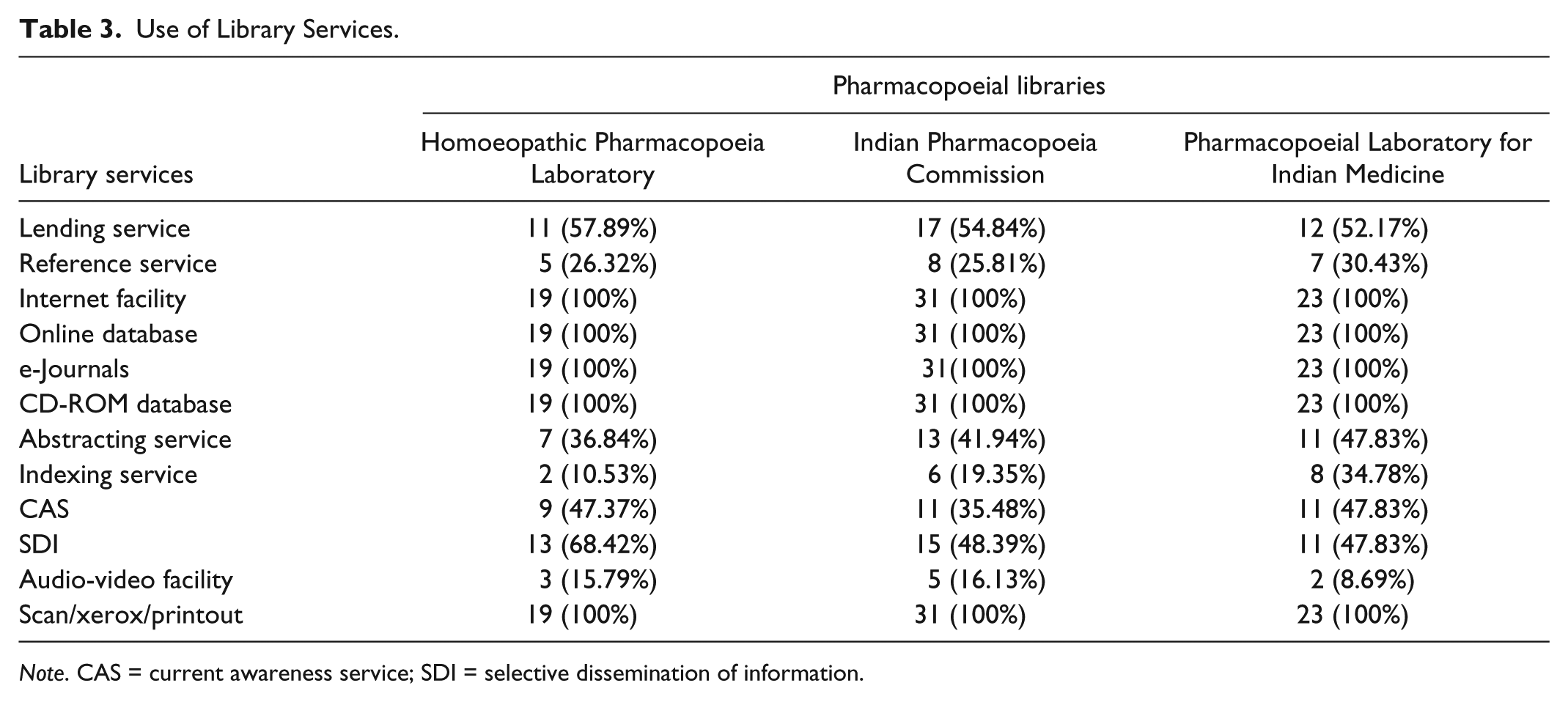
Note. CAS = current awareness service; SDI = selective dissemination of information.
To ascertain various demands, the respondents were asked to state their interest in the use of specific types of electronic information resources. Their responses are depicted in Table 4. The analysis shows that all the scientists belonging to the pharmacopoeial libraries preferred the use of subject-topical website, e-journals, online databases, e-monographs, CD-ROM databases, and standards (see Table 4 and Figure 2).
Use of Types of EIR.

Note. EIR = electronic information resources.

Use of types of electronic information resources.
The respondents were asked to give reasons as to why they use electronic information resources but based on choices fixed by the scientists of pharmacopoeial libraries. Responses for the various professional purposes for which electronic information resources was used were elicited from the respondents. Table 5 indicates the purpose of using the electronic information resources. The analysis shows that all the scientists belonging to the pharmacopoeial libraries used electronic information resources to consult drug indexes and compendia, monographs, drugs-related online databases, drugs-related e-journals, and the Internet sources—especially those presented by drug regulatory agencies, to contact pharmaceutical representatives/experts to consult drug promotional literature and standards (see Table 5).
Purpose of Using Electronic Information Resources.

An attempt has been made here to find out the pharmacopoeias, whether print or CD-ROM, mostly used by the scientists of the concerned libraries. The analysis shows that the scientists belonging to the concerned pharmacopoeial libraries utilized mostly the pharmacopoeia published by the concerned laboratory. Usage of others’ pharmacopoeias is depicted in Table 6.
Use of Specific Types of Subjects and Allied Areas Electronic Information Resources.

The respondents were asked to indicate the Windows application that they used. A significant portion of the scientists belonging to the pharmacopoeial libraries used Windows 7 (68.42%, 64.52%, and 65.22%) which was followed by Windows XP (21.05%, 19.35%, and 17.39%; see Table 7).
Windows Applications in Pharmacopoeial Libraries.

The respondents were asked to indicate the Internet browsers they used to access electronic information resources. A significant portion of the scientists belonging to the pharmacopoeial libraries used Internet Explorer (89.47%, 87.09%, and 82.61%; see Table 8).
Use of Internet Browsers in Pharmacopoeial Libraries.

The respondents were asked to indicate the usage patterns of electronic information resources. A significant portion of the respondents (78.08%) downloaded the contents in removable storage media, mostly into pen drive. A portion of the respondents (42.47%) downloaded to their computer hard disk, and some (58.90%) took a print out (see Table 9).
Using Patterns of Electronic Information Resources.

Table 10 reveals the retrieval performance of e-resources at the three pharmacopoeial libraries. All the scientists belonging to the pharmacopoeial libraries stated that the retrieval performance of electronic information resources was excellent. (see Table 10).
Retrieval Performance of e-Resources.

Another question sought to ascertain the benefit e-resources on the scientists. The analysis shows that all the scientists stated that the electronic information resources helps in evidence-based research, keeping up to date in specified areas and its timely access (see Table 11).
Benefit of Electronic Information Resources.

Another question that sought to ascertain the impact of all e-resources on the scientists was the extent to which they were replacing printed media in satisfying their information needs. The analysis shows that all the scientists stated that to a very high extent, electronic information resources have become a substitute for printed materials. While a significant portion of the scientists belonging to the concerned pharmacopoeial libraries (57.89%, 54.84%, and 52.17%) stated that printed materials are still the basic element in satisfying information needs, to a small extent, electronic information resources have become substitute for printed materials (see Table 12).
User’s Perception of e-Resources as a Replacement for Print in Meeting Their Information Needs.

Effective use of electronic information resources for retrieving needed information will have a profound impact, especially on the quality of research output by the scientists. The analysis shows that all the scientists belonging to the pharmacopoeial libraries use e-resources for drug-testing, good laboratory practice, monographs, sample preparation, and formulation (see Table 13 and Figure 3).
Usage of e-Resources in Research.
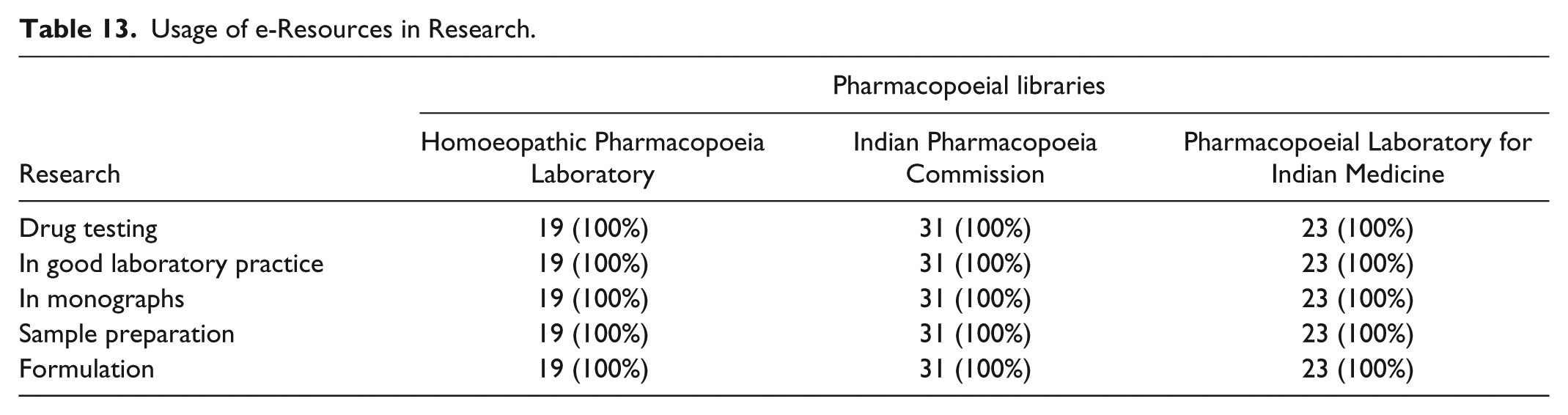

Usage of e-resources in research.
Electronic information resources provide latest, comprehensive, and up-to-date information that are essential for research. The respondents were asked to indicate to what extent they feel the impact of e-resources on quality of research. All the scientists belonging to the pharmacopoeial libraries stated that the electronic information resources highly improved the quality of research pertaining to the specific subject field (see Table 14).
Impact of e-Resources on Quality of Research.

Respondents in this study were asked about the satisfaction with current status of electronic information resources access in their library and information center, which is a very important variable to investigate user behavior. All the scientists belonging to the pharmacopoeial libraries were highly satisfied with the usage of electronic information resources (as depicted in Table 15).
Satisfaction Level of Access to Electronic Information Resources.

Conclusion
E-resources are an accepted means of information resources in the present information society; with the amount of new resources available, the need for adequate computer literacy and aptness in using the existing sources has become the need of the hour and the study reveals its impact in terms of awareness and effective use of the available resources by the scientists of pharmacopoeial libraries of India.
Cost, the level of importance, and the use of e-resources have dramatically increased in the digital library environment; Web DB, e-book, e-journal, and other e-resources such as CD-ROM, DVD, and micro materials have become important sources in libraries.
Pharmacopoeial librarians should use new information technologies and new approaches to better serve their scientists in new ways of acquiring information. Libraries should organize their services so that they bring their information resources closer to the busy scientists. They should acquire new skills and learn how to organize information for presentation on the Internet portals or by handheld devices. Additional drive for Pharmacopoeial librarians in their efforts is the introduction of evidence-based practice. Librarians can teach scientists to search and critically evaluate information, thus helping in the process of their research. Librarians with experience in licensing and managing ERs are effective in rapidly diagnosing and remedying access problems.
Further Research
This study presents the usage of e-resources in three pharmacopoeial libraries, and more exploratory work is needed to determine the situation both nationally and internationally. Research into this area also needs to understand and contextualize its subjects’ access to information—in particular, electronic information—to fully understand both information needs and potential and existing barriers to those needs. Research would also be useful to gain awareness of current electronic information resources related to drugs. There is a lot of work being carried out internationally to make drug-related information freely available online. Whether the information provided by the pharmacopoeial libraries is relevant to the needs of scientists is, again, a subject for further research.
Footnotes
Declaration of Conflicting Interests
The author(s) declared no potential conflicts of interest with respect to the research, authorship, and/or publication of this article.
Funding
The author(s) received no financial support for the research and/or authorship of this article.