




Abstract
Polar business design aims to enable entrepreneurs, managers, consultants, researchers, and business students to better tackle model-based analysis, creation, and transformation of businesses, ventures, and, more generically, collective endeavors of any size and purpose. It is based on a systems-thinking approach that builds on a few interrelated core concepts to create holistic visual frameworks. These core concepts act as poles linked by meaningful dyads, flows, and faces arranged in geometric shapes. The article presents two such polar frameworks as key findings in an ongoing analytic autoethnography: the three-pole Value−Activity−Stakeholder (VAS) triquetra and the four-pole Offer−Creation−Character−Stakeholder (OCCS) tetrahedron. The VAS triquetra is a more aggregated model of collective endeavors. The OCCS tetrahedron makes a trade-off between a steeper learning curve and deeper, richer representation potential. This article discusses how to use these two frameworks as well as their limits, and explores the potential that polar business design offers for future research.
Polar business design is a new way to relate concepts to one another in business model literature. It relies on identifying a handful of key concepts called “poles,” from which other concepts relevant to business design are derived based on a geometric configuration of interrelationships. Going beyond ontologies and lists of important ideas, this approach helps to visualize and name the interrelations that bind key concepts together. In doing so, polar business design enables the creation of cohesive and holistic frameworks to help mediate the analysis, creation, and transformation of collective endeavors.
Linear languages, oral or written, are ill-equipped to represent these concepts-as-interrelationships (Meadows, 2008; Pauwels, 2005; Senge, 1990). This is why polar design relies on visual representations. This article presents two visual mediating tools as examples: the Value−Activity−Stakeholder (VAS) triquetra and the Offer−Creation−Character−Stakeholder (OCCS) tetrahedron. These two frameworks are useful to subjects who have a stake in designing collective endeavors, such as entrepreneurs, Master of Business Administration (MBA) students, business strategists, and scholars. This claim is made where the intended outcome is to better design, visualize, and understand businesses as well as any other collective endeavors such as industries and organizations of various forms and intents.
Three fundamental assumptions underpin polar design: (a) a concept is a discrete idea with constructed boundaries, (b) relating concepts to other concepts in a systems thinking approach unearths insight that otherwise remains unrevealed, and (c) many concepts are better understood as relationships between a few core concepts. These assumptions are hereafter further described.
1. Constructed boundaries. A parent quickly learns that an infant may not have yet drawn boundaries between a table, a glass, and the liquid it holds. That an infant does not know that pulling the table may result in the glass tilting and the liquid spilling does not mean that a child is dim: boundaries around these objects as discrete things have simply not been drawn yet. They must be learned and acquired through experience. This example can be extended to all concepts as abstractions of phenomena, including business models and their many components, as well as theories and theoretical constructs.
Boundaries are constructed through language, thought, perception, and social agreement: They are consensual, artificial, mental-model boundaries. Everything is connected to everything else, and there is no single, legitimate boundary to draw around a system, or any of its elements (Meadows, 2008). Past boundaries are learned and internalized and new boundaries are constructed and externalized (Engeström, 1999). This article builds upon the cultural–historical theory of activity (AT) and the expansive cycle of activity systems: One must learn to know and understand what one wants to transcend. Boundaries are learned and subjected to reflective analysis. New concepts with new boundaries or classic ideas with redrawn boundaries may then be externalized, which is an activity common to scientific papers such as this one.
Constructed boundaries and activity theory matter because to engage in polar design is to engage in constructing and redrawing boundaries. A polar framework with three poles describes a holistic collective endeavor through the interplay of three core concepts. A polar framework with four poles does so with the interplay of four core concepts. Yet both seek to holistically describe the same object. Which concepts should make up the poles and their various interrelationships is a choice. The frameworks proposed here and the choices made regarding what makes up their core concepts are informed by business model literature, reflective analysis, and practice.
2. Systems thinking. Systems thinking is a way of seeing everything as connected to everything else. Closed systems are “what if” abstractions that enable researchers to reduce complexity to manageable proportions (Meadows, 2008). No socially constructed system exists in a vacuum—The fact that a human being defines what a system is makes that system irrevocably tied to an unfolding cultural−historical system of mediating tools. System boundaries are social constructions. Systems and constitutive elements are created for sense-making purposes, and in a business literature context, all collective endeavors are open systems tied to other systems: A business unit exists as part of a larger firm, which may itself be part of a larger conglomerate, which may be part of multiple industries and jurisdictions, and so forth (Berglund & Sandström, 2013).
Why can humans not simply grasp everything as a holistic whole? Why do humans need to bound ideas into discrete concepts and sub-systems to achieve understanding? This article provides no answer, but bows to that reality. It also bows to a complementary aspect of this sense-making exercise: Humans are not content to draw boundaries ad infinitum, but also seek to create hierarchies. They seek a limited number of core concepts from which other concepts sprout.
3. Core concepts. The quest to find root ideas whose interplay yields other ideas is nothing new. In the context of management, author Michael Porter looks for frameworks that try to capture the full richness of business with the most limited number of core elements (Argyres & McGahan, 2002). In the context of science, Einstein looked for theories that make the irreducible basic elements as simple and as few as possible without having to surrender the adequate representation of experience (Einstein, 1934). In the context of spiritual birth, Odin looks for a few runes from which to grow wise and prosper, resulting in words that lead to other words and deeds that lead to other deeds (Campbell, 1972; Larrington, 1999).
These examples illustrate the cultural−historical origins of this ongoing quest for understanding through the identification and interplay of a few core concepts. Since collective endeavors are made of systems nested within larger systems, having to rely on a different framework for each scale of analysis defeats the purpose of working with just a few core concepts. A single framework, capable of mediating design at any scale of collective endeavor, is the preferred solution to keep the number of core concepts as few as possible in this cultural−historical perspective. The findings presented in this article feature as few poles as possible and can be used at any scale of design, from small business units to global industries.
This article proceeds from introduction to literature review, methodology, findings, discussion, and conclusion.
Literature Review
Of the many streams of scientific management literature that have developed over time, Strategic Management is the one that has been closest to systems thinking and the pursuit of holistic frameworks featuring just a few core elements. Mintzberg (1979) introduced a framework of five basic parts describing the organization as an operating core, a middle line, and a strategic apex on top, supported by a technostructure and support staff on the sides. This presented the firm as an arena for strategic behavior, which went in the same direction as Miles and Snow’s (1978) organizational strategy, structure, and process: organizations strategically acting as defenders, prospectors, analyzers, and reactors in an adaptive response cycle to entrepreneurial, engineering, and administrative problems. It also went in the same orientation as Porter (1985) with his competitive advantage approach. Strategy formulation, which seeks to bridge current and envisioned designs, was further explored by Mintzberg, Ahlstrand, and Lampel (1998).
Proponents of the firm as an arena for strategic behavior created numerous actionable frameworks. Porter (1985) did so with the introduction of the value chain, a contribution followed by various complements such as the virtual value chain of Rayport and Sviokla (1995) and the strategic innovation conceptual roadmap of Govindarajan and Gupta (2001). Other strategy-focused frameworks were introduced. Collins and Porras (1994) sought to look at the conceptual foundations that made businesses successful in the long run, yielding a yin-yang framework of core and peripheral issues. Slywotzky and Morrison (1998) presented 22 generic profit models that transcended industries and technologies, and placed these models within the strategic tier of a three-tiered business design framework. Focusing on e-commerce, Rayport, Jaworski, and Siegal (2000) presented a four-infrastructure framework: media, technology, capital, and public policy contributing to a grand e-commerce strategy, divided into six sequential parts: market opportunity, business model, customer interface, market communication and branding, implementation, and metrics. Hamel (2000) synthesized the various business models and business plans he had been privy to and proposed a framework based on four conceptual pillars: customer interface, core strategy, strategic resources, and value network. Sveiby (2001) presented a knowledge-based framework to guide strategy formulation around three core knowledge anchors: external structure, individual competence, and internal structure. In the same year, Normann (2001) presented his Crane framework, advocating strategic conceptualization through scenario formulation.
The scientific interest for business models grew into its own niche of works as researchers sought to decipher order and commonalities out of the chaos and confusion wrought by the digitalization of information and business on a global scale. To understand change, one had to conceptually rise above it—Business had to make sense of e-business, merging the two in a single intelligible vector of transformation. Basic efforts centered on mapping the new economy in terms of actors and their various roles, such as the agora, the broker, the club, and the transformation agent (May, 2000); the e-business storefront, the infomediary, the trust intermediary, the e-business enabler, and the infrastructure providers (Hartman, Sidonis, & Kador, 2001); the vertical and functional eHubs (Mohanbir & Kaplan, 2000); the forward integrated producers, the supply-side aggregators, the backward-integrated users, and the demand-side aggregators (Rayport et al., 2000); and the customers, context providers, contents providers, commerce services providers, and infrastructure providers as arranged through business webs taking the form of agora, alliances, aggregates, value chains, and/or distributive networks (Tapscott, Ticoll, & Lowy, 2000). In parallel, Hagel and Singer (1999) called for the “unbundling” of corporations so that their components could be better re-aggregated in new ways, which Tapscott et al. (2000) echoed through their b-webs.
All of these roles implied various business characteristics, but provided little generic insights beyond topographical and lexical order. In essence, business models were important to sum up the holistic nature of myriad businesses into short narratives, but they were not yet bridging all the elements that made up a business. Magretta (2002) emphasized narrative value in an effort to save the “business model” neologism from falling out of grace after the bursting of Internet’s stock market bubble. The nascent business model literature was thoroughly reviewed and synthesized in a business model ontology by Osterwalder (2004). This ontology became the basis of the Business Model Canvas, a visual framework designed to help business model creation (Osterwalder & Pigneur, 2010).
Through their recent review of the business model literature, Zott, Amit, and Massa (2011) came to the conclusion that scholars in different fields use the same term to explain different phenomena, though they see the emergence of some common ground among various business model researchers, despite the disparity of their approaches in terms of concepts used and phenomena explained. Their findings are four emerging themes—the business model (Finding #1) as a new unit of analysis, (Finding #2) as a system-level concept, (Finding #3) centered on activities, and (Finding #4) focusing on value creation—which could serve as important catalysts for a more unified study of business models.
The main takeaway of the above review is that conceptual frameworks can indeed help better represent business endeavors holistically for varied purposes. As this section culminates with the literature review and insights from Zott et al. (2011), their suggested emerging themes are used to create the conceptual boundaries that make up the poles of the tripolar framework introduced in the “Findings” section.
Methodology
Polar design and polar frameworks are rooted in an ongoing analytic autoethnography that started in 2000. This article covers findings than span from 2000 to 2012, where this article’s co-authors had a stake in analyzing, creating, and transforming business models as entrepreneurs, MBA teachers, and researchers. Knowing through practice is key to understanding and enacting a methodology based on activity theory (Toulmin, 1999). Analytic autoethnography is such a methodology, requiring (a) complete member researcher status, (b) analytic reflexivity, (c) narrative visibility of the researcher’s self, (d) dialogue with informants beyond the self, and (e) commitment to theoretical analysis (Anderson, 2006). Note that narrative visibility of the self would make this article dissonant with the stream of literature to which it seeks to contribute, and is thus avoided here.
Analytic autoethnography provides access to certain kinds of data that are otherwise inaccessible. These data result from writing as a method of inquiry, where such writings satisfy criteria of (a) substantive contribution, (b) aesthetic merit, (c) reflexivity, and (d) impact (Richardson & St-Pierre, 2005). Examples of such data cover a wide spectrum of media and contexts. These include napkin notes and sketches drawn at a business lunch, comments made in a MBA student’s presentation, email discussions between practitioners and experts, conference proceedings, or any similar texts where holistic and systemic insight coalesces onto a fixed medium while satisfying the foregoing criteria.
The work started as a post-graduate research that sought to find common elements in two business projects undertaken in seemingly unrelated fields. Though divergent in terms of markets and industries, these were, like all businesses, endeavors that relied on collective activity. The search for root concepts that would enable the analysis, design, and redesign of businesses of any size or purpose grew into its own reward. Frameworks became the main artifacts used, studied, crafted, challenged, and recast through various writings.
Two courses were used to gather data each fall semester between 2002 and 2012, with a range between 20 and 50 students per course. MBA courses GIE-6083 “Conception d’entreprises de nouvelle économie” (Design of New Economy Enterprises) and GIE-6087 “Global Business Design” at Université Laval required student teams to undertake semester projects that either analyzed current businesses and proposed high-impact business model transformations, or developed business designs for new born global ventures.
An important methodological challenge was to accept that no framework is ideal to everyone. The naming of elements and interrelationships within a framework is a tricky boundary-setting exercise. It makes a framework more resonant within a certain context, and less resonant in others. Frameworks that rely on fashionable buzzwords gain immediate attractiveness, but risk irrelevance as years go by. The solution proposed in this article is to differentiate frameworks from the development process that yields them. Polar business design does not lead to a specific framework, and the ongoing analytic autoethnography that informs this article is not geared toward arriving at such a framework. Writing as a method of inquiry has been most fruitful when tackling questions such as how to develop frameworks, how to use frameworks, and how to enrich frameworks.
The key takeaway is that this article benefits from over a decade’s worth of attempts to better visualize collective endeavors in MBA classrooms and through business practice, informed by business model literature as well as many other sources.
Findings: Polar Frameworks
This section presents findings that result from the authors’ analytic autoethnography, ranging from 2000 to 2012, within the cultural−historical context examined in the previous section.
Business model literature is made up of discrete, malleable, constructed abstractions that are called concepts. Concepts dealing with collective endeavors are highly sensitive to and contingent on contextual conditions (Suddaby, 2010). Genuine understanding can only come by contextualizing these concepts within open, interrelated systems. This article proposes to use a small number of root concepts defined as “poles” to grasp this complexity. Other concepts relevant to business design are revealed as interrelationships between these root concepts.
A polar framework crafted from three poles features “flows” from pole to pole and “dyads” that are the synthesis of two poles and the pair of flows that link these. A polar framework crafted from four poles features flows, dyads, and an additional form of conceptual synthesis called a “face,” combining three poles, six flows, and three dyads. All poles, flows, dyads, and faces can be labeled as concepts that are relevant to current business model literature.
Polar frameworks are not metaphors (Morgan, 1996). Their name designates their geometrical configuration: three poles form a triquetra and four poles form a tetrahedron.
Framework structure is distinct from pole selection and definition. What constitutes a pole depends on what a framework is meant to accomplish and where it finds its conceptual roots. Various sets of labels could be applied to poles and their interrelationships, making up different triquetras or tetrahedra.
Note that each pole and each interrelationship acts as a gateway to important topics in business model and strategic management literature. The object of this contribution is to present polar design as a way to create holistic frameworks, rather than to explore the elements that make up these frameworks in great depth. In this context, most poles and interrelationships are presented in single paragraphs, with references acting as suggested entry gates into the literature of these topics.
VAS Triquetra
Figure 1 introduces the VAS framework, based on a Value pole, an Activity pole, and a Stakeholder pole.

VAS Triquetra framework for conceptualizing collective endeavors.
Stakeholder pole
This is the “who” of the VAS triquetra. Stakeholders are individuals, groups, or organizations who participate in an endeavor to achieve their goals and on whom an endeavor is depending for its existence (Näsi & Näsi, 2002). In the context of business management, stakeholders typically engage in roles such as talent, enablers, and clients. At firm-level, talent refers to resources who carry out value creating activities; clients refer to users or influencers of users who pay for these value-adding activities; and enablers refer to those who help the business bridge talent and clients through support activities, such as investors, partners, suppliers, public organizations, and so forth. This is but one possible, non-exhaustive way to represent stakeholders.
Value pole
This is the “why” of the VAS triquetra. It represents the rationale for stake holding. Value lies in the eye of the stakeholder. It is elusive and prone to assumptions and perceptions. Value is what a set of stakeholders assumes to be valuable to another set of stakeholders (Firat & Venkatesh, 1995; Holt, 1997). This pole does not merely embody what a stakeholder gains from a collective endeavor; it embodies the ongoing dynamics of unearthing such value, which varies with every stakeholder. Gaining insight into what is valuable to its stakeholders is what underpins the firm’s existence in knowledge-based views of the firm (Conner & Prahalad, 1996). Core competencies, or any other type of resources, have relevance insofar as they deliver and capture value (Hamel & Pralahad, 1990). This is what qualifies them as being “core” competencies. Knowledge generation about the nature of value is an ongoing process, as stakeholders are dynamic and evolving systems in the VAS triquetra: Each stakeholder can itself be conceptualized through its own VAS.
Activity pole
This is the “how” of the VAS triquetra, notably encompassing its “what, where, and when.” It represents the activities carried out by stakeholders within the context of the collective endeavor. Stakeholders are this pole’s processors, and this pole deals with their processes, such as internal activities and logistics. This pole sprouts from the Value Chain of Porter (1985) and the literature that followed. Its most fundamental activity is to enact the VAS triquetra in a high-level self-realization process (Montreuil, Vallerand, & Poulin, 1996): generate value to attract and create stakeholders to grow the intended endeavor into existence. Once the endeavor exists, self-realization becomes striving toward the best expression of what the endeavor can be for the benefit of its stakeholders, including society as a whole. Self-organizing activities, and resulting hierarchies of sub-systems, are key features of systems (Meadows, 2008). Boundary-setting activities, from creating and growing an organization to defining what is internal and external to it, can be represented here.
Two of the three poles of the VAS triquetra can be directly derived from the findings of Zott et al. (2011) highlighted in the literature review. The Value and Activity poles are respectively associated with Finding #4 and Finding #3. The system-level, holistic approach (Finding #2) is not a pole, but rather the very nature of the polar approach. Finding #1, which presents the business model as unit of analysis, is problematic. Using it as a pole would invite the creation of new frameworks for objects or units of analysis that are not “businesses,” either in scale or in purpose. This would run counter to finding a limited number of core concepts to represent collective endeavors, as presented in the Methodology section. A firm’s branch, a network of firms, or an entire industry made up of networks of firms are likely concerned with activities (Finding #3) meant to yield value (Finding #4). Each of them can be conceptualized as a system nested in one or more systems, hosting one or more sub-systems. What they share in common is that they are one another’s stakeholders, but at different scales and for different purposes (Benson, Lawler, & Whitworth, 2008; Engeström, 1999; Wilson, 2006). The VAS features a Stakeholder pole to scale between systems and sub-systems, whatever the relevant unit of analysis may be.
The interrelationships between these three poles form six flows.
Role flow
The conceptual flow from Stakeholder to Activity is that of enacting roles, from broadly aggregated groupings to highly segmented or unique ones. They are the masks worn by stakeholders when they undertake activities, such as supplier or customer. Taxonomy brings clarity and insight into which contributions are expected of each stakeholder. Note that many “e-Business models” featured in early business model literature are in fact mostly role descriptions made in the context of the “new economy” (Hartman et al., 2001; May, 2000; Mohanbir & Kaplan, 2000; Rayport et al., 2000; Tapscott et al., 2000).
Network flow
The conceptual flow from Activity to Stakeholder describes how stakeholders are related in their various roles, specifying the responsibilities of each of them in relation to their activities (Martel & Oral, 1995; Poulin, Montreuil, & Gauvin, 1994). Networks can take many metaphorical forms, including supply chains, value chains (Porter, 1985; Porter, 2001), virtual value chains (Rayport & Sviokla, 1995), value webs (Tapscott et al., 2000), and be the subject of multiple categorizations, such as formal versus informal, internal versus external, and so forth.
Contribution flow
The conceptual flow from Stakeholder to Value encompasses past, present, and future inputs in the endeavor, like money, time, and data. This flow details why an endeavor seeks stakeholders, as it depends on their contributions for its existence (Näsi & Näsi, 2002). Contributions can be aggregates of other contributions and can have strong temporal characteristics, valued for their deployment over certain lengths of time or at certain points in time.
Gain flow
The conceptual flow from Value to Stakeholder is gain, defined as enabling or relieving stakeholder value creation (Normann, 2001). For example, an individual may buy reference books because they enable him to learn new facts or relieve him from personally gathering those facts. An employee may work to earn a salary, and an investor may invest to reap a profit; one should see that money is itself an abstract commodity constructed to enable or relieve value creation.
Bundling flow
The conceptual flow from Activity to Value is the aggregation of value potential into coherent forms, such as a product or a service. Bundling shapes how stakeholders access value. This is bundling in its abstract, immaterial sense, where different bundles of activities yield different value to different stakeholders (Shapiro & Varian, 1999). For example, different job offers may bundle different remuneration schemes with different responsibilities and challenges.
Feedback flow
The conceptual flow from Value to Activity represents stakeholders’ response to value, validating or invalidating certain activities. Feedback details how the endeavor acquires knowledge about what is valuable to stakeholders (Sveiby, 2001). What type, quantity, and quality of feedbacks are gathered may be represented here, including the interfaces used to collect and act upon such data.
These six flows come in pairs: Role−Network; Contribution−Gain; and Bundling−Feedback. Together with their respective poles, these form three dyads.
Cost dyad
The conceptual synthesis of the Stakeholder and Activity poles and their Role and Network flows are the costs involved in creating, maintaining, growing, and otherwise transforming such systems. Processors enacting processes require time and effort. This dyad represents how much effort is spent over time, how and why. Costs can be quantified in many ways, from fungible instruments like money to less fungible costs like transfer of ownership in a barter economy.
Revenue dyad
The conceptual synthesis of the Stakeholder and Value poles and their Contribution and Gain flows are the revenues reaped by enabling or relieving stakeholder value creation. This dyad represents how many resources are captured by the endeavor’s offers over time, how and why. These resources may be quite varied, encompassing financial flows as well any other type of resource designed for capture by the Value pole, such as knowledge, trust, and so forth.
Prosperity dyad
The conceptual synthesis of the Value and Activity poles and their Bundling and Feedback flows is to connect cost and revenues in a meaningful way: For example, profit is itself a form of feedback, validating or invalidating activities (Drucker, 2001). Profits are generated by capturing revenue that outweighs the overall design’s costs, but not all endeavors are for-profit. Prosperity encompasses any metric that is relevant to the collective endeavor. The prosperity dyad represents which activities are worth pursuing, which value is worth delivering, and how to best configure these two over time. In for-profit endeavors, these insights can be summed up in short narratives or visual graphs called profit models (Slywotzky & Morrison, 1998).
The VAS triquetra features three poles, six flows, and three dyads: 12 labeled concepts to holistically represent collective endeavors within the cultural−historical context of business model literature. Making everything fit within these 12 concepts means that substantial streams of management literature find themselves grouped under labels that they are not readily associated with. For example, strategy formulation finds itself represented within the activity pole as a high-level activity to guide and contextualize other activities. The VAS is meant to enable holistic visual representation under significant time pressure: Its two-dimensional geometry makes it easy to sketch and use in almost any context. When more time can be invested and/or more depth is needed in analysis, design, and redesign, a four-pole tetrahedron framework becomes a sound alternative.
OCCS Tetrahedron
A polar framework crafted around four interlinked poles geometrically corresponds to a tetrahedron, or simply put a pyramidal structure. It uses 26 concepts to represent a business design: 4 poles, 4 faces, 6 dyads, and 12 flows. In this sub-section, we introduce one tetrahedral framework named the OCCS tetrahedron based on its Offer, Character, Creation, and Stakeholder poles.
A tetrahedron generically breaks away from previous frameworks found in business literature in multiple ways. One of these is visual: Since polar design makes all poles interrelated, their geometrical arrangement can only be evoked through a tridimensional form. This makes it tougher to work with holistically, at least when using two-dimensional instruments. For example, this article presents the OCCS tetrahedron through multiple two-dimensional figures rather than through a single tridimensional interface.
This tridimensional depth translates into conceptual depth. A tetrahedron framework is not a triquetra framework plus one pole. A triquetra framework is holistic by nature, representing the business through its three interlinked poles. A tetrahedron redefines in a richer way what is core to the holistic representation around four poles. Indeed, each of the four faces of a tetrahedron features as many poles, dyads, and flows as a triquetra. In doing so, a tetrahedron dissects and shines light on concepts that would otherwise be folded into other concepts within a triquetra.
The OCCS tetrahedron shares the VAS triquetra’s roots in business model literature. Poles, flows, and dyads that remain mostly unchanged from the VAS are not repeated in this sub-section. As shown in Figure 2, three out of the OCCS’s four poles differ from the VAS. Only the Stakeholder pole remains. This sub-section first presents the OCCS’ four poles, followed by its four faces, its dyads within these faces, and its flows within these dyads.

Poles of the OCCS tetrahedron framework for conceptualizing collective endeavors.
Offer pole
The OCCS features an Offer pole instead of a Value pole. This is because a tetrahedron framework provides a more granular view than the triquetra framework is able to; value is conceptualized as a dyad instead. In contrast to the VAS, the OCCS uses the vessel of value as a pole rather than value itself. The Offer pole represents the polished, coherent result of activities, such as commodities, products, services, experiences, and transformations (Pine & Gilmore, 1999). They serve as the interface upon which third parties choose to become stakeholders. For every stakeholder, there exists an offer that links him, her, or it to the endeavor, such as some combination of goods, money, jobs, or stocks, and the context in which these exist.
Creation pole
The OCCS features a Creation pole rather than an Activity pole. Creation includes activities as well as resources such as tools, knowledge, and competencies. It embeds concepts such as value chains, supply chains, value creation networks, and core processes. “Creation” is also used to emphasize the fact that collective endeavors need to be created. “Creation” emphasizes stakeholders as dynamic and empowered entrepreneurs, innovators, and designers. Though difficult to quantify, the co-authors have found that this label notably matters to MBA students and entrepreneurs as stakeholders in business design.
Character pole
The fourth pole of the OCCS is inherited from systems thinking. Character embodies the purpose of an endeavor (Meadows, 2008). While the OCCS’ Offer and Creation poles bear some similarities with the VAS’ Value and Activity poles, the OCCS’ Character pole is a clear departure from the way that the VAS conceptualizes a collective endeavor. Is purpose worth being used as one of the OCCS’ poles? The co-authors’ finding is that holistic designs that were made by students using the OCCS were substantially enhanced by its Character pole. These students had other options to carry out their business analysis and their design exercise, and some picked other frameworks to work with. Few alternatives offered means to conceptualize that which character represents. Comparative use with hundreds of MBA students over the course of 2002-2012 reinforced this pole’s importance.
The Character pole encompasses both stated goals and deduced organizational behavior, even when these are at odds. It represents the collective actor and his praxis. It refers to planned and emergent purpose as well as past, present, and future action, from the strategic to the tactical (Normann, 2001). Like “Creation,” “Character” is meant to entice design and redesign, explicitly emphasizing anthropomorphism as a tool to accomplish this: The Character pole embraces rhetoric and stated goals, including anthropomorphic notions like culture, will, personality, identity, and soul, which stakeholders collectively mold, enact, and transform (Collins, 2001; Collins & Porras, 1994).
Stakeholder pole
The VAS and OCCS Stakeholder poles are identical.
The four poles of the OCCS create a tetrahedron featuring four faces. These faces are represented as triangles rather than triquetras to avoid confusion with the VAS. Faces and triquetras share the same number of poles, dyads, and flows, but differ in intent: A triquetra framework is meant to be holistic, while a tetrahedron’s face is not. A face represents the interrelationship between three poles, summing up the key idea evoked by three dyads and six flows.
Craft face
As depicted in Figure 3, this face sums up how stakeholders create and deliver offers. Craft represents daily organizational practice without invoking past contexts or future scenarios conceptualized through Character. A key construct rooted in this face is an endeavor’s capacity to generate the timelessness found in losing one’s self in what needs to be done (Mainemelis, 2001). By looking at the poles, Craft can be understood as stakeholders creating and delivering offers; by looking at its dyads, Craft can be understood as a value exchange web. In both cases, the Character pole with its higher strategic and contextual aspects is not in focus. Craft is about the operational part of current and envisioned designs. Its three dyads are hereafter introduced.
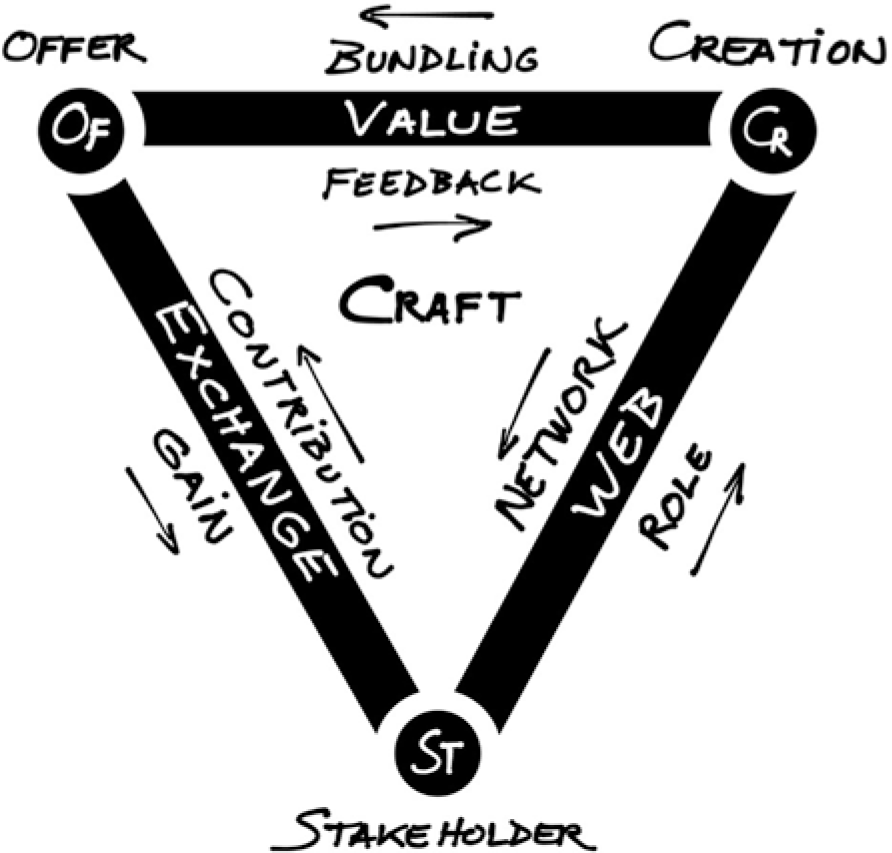
The craft face of the OCCS tetrahedron framework.
Exchange dyad
It is the arrangement of the many contribution and gain flows that link stakeholders with offers. Sales, supply, logistics, operations, engineering, R&D, accounting, and finance are bodies of knowledge highly relevant here. Instruments and tools concerned with time and money permeate this dyad because they are ubiquitous forms of contribution and gain. The Exchange dyad is made up of the Offer and Stakeholder poles, as well as the Contribution and Gain flows. These flows are essentially identical to their namesakes in the VAS and are not repeated here. The position occupied by the Exchange dyad in the OCCS Craft face is the same one that the Revenue dyad occupies in the VAS, but their emphasis is on two different concepts: In the VAS, the Revenue dyad points to quantifying resources reaped by the Value pole. In the OCCS, the Exchange dyad conceptualizes how gain and contributions occur.
Web dyad
A web is a network of networks that evolves through time. This dyad can be used to assign stakeholders to roles in various chains and networks at the core of the creation pole, such as distribution networks, supply networks, production networks, value creation networks, ownership networks, or family networks, as well as to position the endeavor within larger systems in a rich, multi-faceted relationship of networks.
The Web dyad is made up of the Stakeholder and Creation poles, as well as the Role and Network flows. These flows are essentially identical to their namesakes in the VAS and are not repeated here. The position occupied by the Web dyad in the OCCS Craft face is the same one that the Cost dyad occupies in the VAS triquetra. Their emphasis is on two different concepts: Cost points to quantifying efforts undertaken in the Activity Pole. Web is concerned with how roles and networks form and evolve to enable creation.
Value dyad
In this dyad, value is an offspring of assumptions and perceptions; it is what a set of stakeholders assumes to be valuable to another set of stakeholders, delivered through offers, and what that set of stakeholders actually perceives to be valuable, expressed through feedback given through their interaction with offers (Firat & Venkatesh, 1995; Holt, 1997). This discovery process takes place through the creation of offers and the offer’s validation or invalidation of creation.
The Value dyad is made up of the Offer and Creation poles, as well as the Bundling and Feedback flows. These flows are similar to their namesakes in the VAS except for these key differences: Bundling is where costs are conceptualized, and Feedback is where revenues are conceptualized. The position occupied by the Value dyad within the OCCS Craft face is the same one that the Prosperity dyad occupies in the VAS triquetra. The OCCS represents Value as a dyad rather than a pole to emphasize that it is dynamically unearthed over time for every stakeholder.
Prosperity face
Whereas Prosperity is a dyad in the VAS, it is a face in the OCCS, as presented in Figure 4. This face deals with how the collective actor creates and delivers offers in a sustainable way, so as to insure its own continued thriving existence. It involves three dyads: the mastery of “collaboration” and “competition” to generate “value.” As with the VAS Prosperity dyad, the OCCS Prosperity face encompasses any metric that is relevant to the endeavor, such as profits in a for-profit business context.

The prosperity face of the OCCS tetrahedron framework.
The Prosperity face does not include the Stakeholder Pole. This favors contrasting the endeavor and the stakeholders, or the enterprise and the entrepreneur-s, or the government and the citizens. System purposes need not be human purposes and are not necessarily those intended by any single stakeholder of the endeavor (Meadows, 2008). Prosperity for the endeavor is not necessarily conducive to prosperity for every stakeholder. Many designs create imbalances at the expense of one or more stakeholders, and not every endeavor is a win−win proposition for every stakeholder. That the endeavor’s prosperity is achieved at the expense of some or all stakeholders, or that it is shared with some or all stakeholders is something that can be designed and redesigned.
Collaboration dyad
This dyad is about purposeful collective action, both in terms of work orchestration and learning. It is about honing collective skills for an improved praxis. Collaboration can occur on many scales, from individual actors to organizational actors, and can relate to any processor, process, or linkage, such as shared knowledge or logistics (Fjeldstad, Snow, Miles, & Lettl, 2012). This dyad is made up of the Character and Creation poles, as well as the Orchestration and Learning flows. It embodies Miles and Snow’s (1978) strategy, structure, and process, where strategies can be represented through the Character pole, processes through the Creation pole, and structure through the Orchestration flow.
Orchestration flow
From the Character pole to the Creation pole, the orchestration flow is the context provided for activities, including but not limited to goals, hierarchies, and organizational architecture (Fjeldstad et al., 2012). Orchestration prevents chaos and provides order (Mintzberg et al., 1998). Note that the conceptualization of structure and hierarchies presented here is concerned with how chaos is managed and order created, not with which stakeholder assumes which role in one or more resulting networks.
Learning flow
From the Creation pole to the Character pole, the Learning flow is about creating better ways to create. Put another way, learning improves the collective actor’s praxis. It prevents stagnation and provides flexibility (Mintzberg et al., 1998). Over time, it transforms how stakeholders collectively enact the endeavor and thus shape its character.
Competition dyad
It is the array of offers from other endeavors that may tempt potential or current stakeholders away from the business’ own offers, thus threatening its character’s sustainability and calling for proper defenses such as differentiation or name recognition. Marketing and strategy are two bodies of knowledge closely tied to this dyad. Competition exists for all offers, whoever the target stakeholder may be. Multi-scale analysis is crucial to represent this dyad in a meaningful way, connecting the endeavor’s Offer and Character with the wider system to which it belongs, or to other systems relevant to it. The Competition dyad is made up of the Character and Offer poles, as well as the Threat and Defense flows.
Threat flow
From the Offer pole to the Character pole, threats to prosperity are the result of ill-conceived offers that either fail to attract stakeholders, attract stakeholders at costs that are toxic to the endeavor, or generate unforeseen costs such as damages for which the endeavor is held accountable. Threat potential can be appreciated in the context of direct and indirect competition, new entrants, and substitute offers (Porter, 1985). While individual offers may be designed to cost more than the revenues they reap under certain profit models, it is the larger portfolio of offers that is considered here (Slywotzky & Morrison, 1998).
Defense flow
From the Character pole to the Offer pole, it represents what is done to protect past, current, and future offers. Examples are intellectual property (Slywotzky & Morrison, 1998) and differentiation—the creation of a unique market position involving a differentiated set of activities (Porter, 1996). Defenses are not always the result of planned efforts and can be emergent like unique competences.
Team face
This face is made up of the Stakeholder, Creation, and Character poles, as depicted in Figure 5. It can be used to represent formal or informal teams of stakeholders whose main design impacts are to initiate, grow, and transform character, such as a core group of leaders with exceptional clout and charisma (Kleiner, 2003). This face is also composed of the “Web,” “Trust,” and “Collaboration” dyads: a web of trust and collaboration, or lack thereof. Physical and virtual workspaces have profound impacts on organizational constitution, trust, and collaboration (Cascio, 2000; Fjeldstad et al., 2012; Mills & Ungson, 2003; Yan, Zhu, & Hall, 2002). Team workspaces can be described through internal, external, individual, and social dimensions (Adler & Kwon, 2002; Perry-Smith & Shalley, 2003).

The team face of the OCCS tetrahedron framework.
Trust dyad
Trust is a covenant between stakeholders and the collective actor, the essence of what transforms individual effort into a collective endeavor. This dyad can be represented through a spectrum of trust or mistrust that lowers or heightens transaction costs between certain stakeholders (Coase, 1937; Simon, 1951; Williamson, 1975, 1985). For example, is the endeavor’s character meant to favor one group of stakeholders at the expense of others? If so, is the endeavor designed to hide this, or is there an attempt made at redesign for more balance? Ethic as policy can be conceptualized in the Orchestration flow, but ethic as practice should be conceptualized here, where its impact can be analyzed through this dyad, its poles, and its flows. The Trust dyad is made up of the Character and Stakeholder poles, as well as the Engagement and Alignment flows.
Engagement flow
From the Character pole to the Stakeholder pole, it is how the collective endeavor binds stakeholders to its praxis, from the implicit to the explicit, and from the informal to the formal (Berglund & Sandström, 2013). For example, a nation may engage its citizens through rule of might or rule of law. In a business context, the promotion of stakeholder identification with a business—attributes perceived as shared by both the individual and the collective actor—is a form of engagement. Engagement as enactment of purpose can manifest in a number of ways, positively generating stakeholder pride, loyalty, enthusiasm, or negatively generating cynicism, resentment, and spite, which are expressions of disengagement.
Alignment flow
From the Stakeholder pole to the Character pole, it is how individual stakeholder action reinforces collective action. Alignment is founded upon discovering, creating, communicating, and sharing goals, values, and vision between members of a group. Maintaining and enhancing gain is sought by most stakeholders, which is why survival and prosperity are often described as the only real functions or purposes indigenous to organizations: They are goals on which most, if not all, stakeholders share alignment (Näsi & Näsi, 2002). Misalignment can be conceptualized as a force of change (Seo & Creed, 2002). A citizen’s vote can be interpreted as alignment toward a given character, which may or may not be collectively enacted, depending on electoral results.
Community face
As shown in Figure 6, this face’s dyads suggest that an exchange of trust occurs between stakeholders in a competitive environment. This is what community-driven designs seek to achieve, including alumni, lobbies, professional associations, and communities of practice (CoP). Community is something that individuals, groups, and organizations holding stakes in endeavors with similar offers or character may share with one another. Communities can be of varied importance toward stakeholders and endeavors (Benson, Lawler, & Whitworth, 2008; Jawahar & McLaughlin, 2001). CoP can be a strong attractor for stakeholders who value their practice or pastime as a tool for social interaction or as a context for their identity (Nambisan, 2002; Pine & Gilmore, 1999; Rowley & Moldoveanu, 2003; Wolf, 1999). Social capital (Adler & Kwon, 2002) is a key design issue of this face, which invites multi-scale representations where a given endeavor is represented within the wider system in which it is a stakeholder.

The community face of the OCCS tetrahedron framework.
As illustrated in Figure 7, the tetrahedron is a holistic framework counting 4 poles and 22 interrelationships: 4 faces, 6 dyads, and 12 flows. Topics that are not explicitly mentioned in this section are framed within the OCCS’ 26 concepts.

Poles, flows, dyads, and faces of the OCCS tetrahedron framework.
Of Yin-Yang and Pentagram Frameworks
The findings presented here are limited to the VAS and the OCCS because a framework relying on more than four poles seems too complex to offset any gain in granularity. A pentagram of five poles, for example, would feature 20 flows, 10 dyads, 5 faces, and 4 squares, for a total of 39 distinct interrelationships. A framework relying on two poles such as a yin-yang framework of two poles and two flows seems to sacrifice too much granularity to justify a gain in simplicity. Based on the authors’ ongoing analytic autoethnography, only triquetras and tetrahedra achieve the required balance of core elements conducive to understanding.
Canvases for the VAS and the OCCS
Each pole and each interrelationship can be visualized differently. Polar frameworks do not represent what these elements are. Polar frameworks show how these elements are related to one another. Figures 8 and 9 present possible ways to visualize these elements.
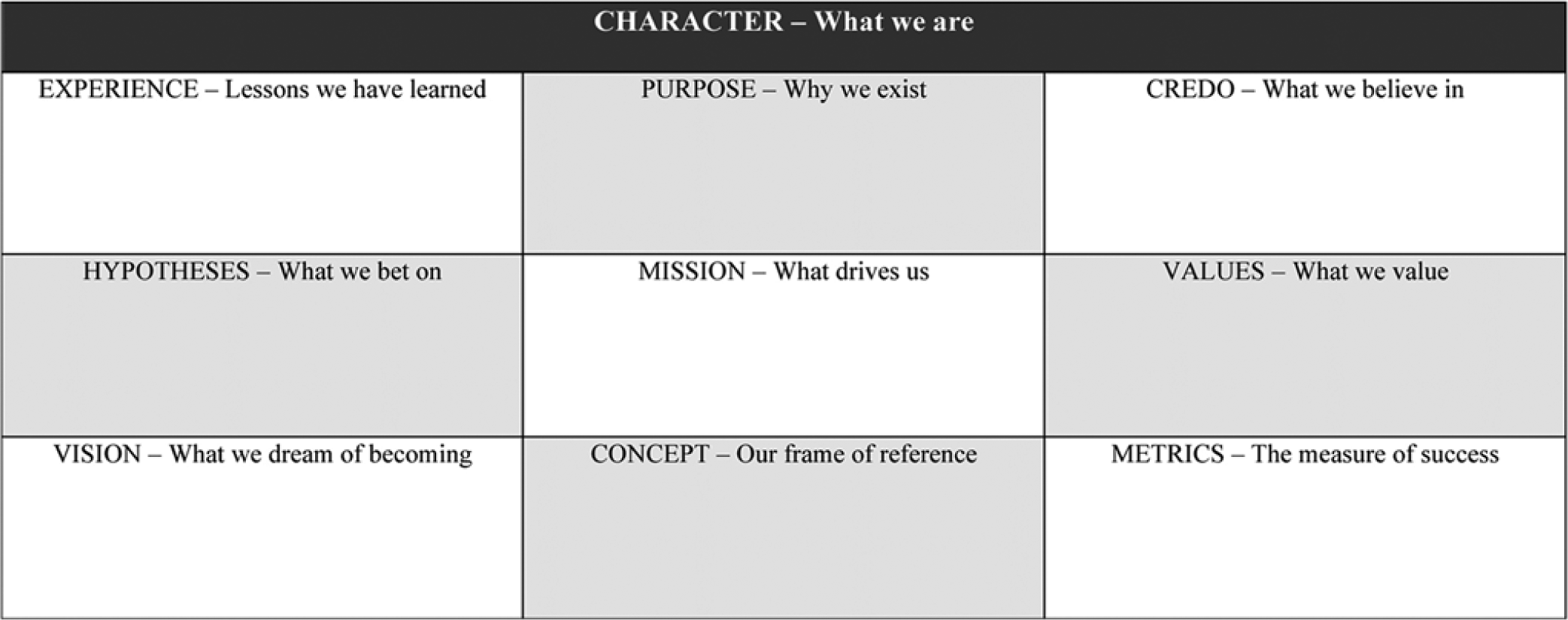
A blank character canvas example for the OCCS tetrahedron framework.

One way to represent key creation design issues using the OCCS within the specific social-historical context of Quebec’s lumber industry in 2005.
Canvases and visual representations such as these were introduced in the co-authors’ MBA classes to facilitate student appropriation of the OCCS poles. Figure 8 is a blank canvas that students are invited to fill, question, and rewrite frequently through their design process. The subheadings within the canvas are conversation starters and should not be mistaken for an exhaustive list of what makes up the character pole. Similar canvases can be devised for each pole.
Figure 9 visualizes a key creation issue for an industry faced with disruptive new economy forces. From left to right, Figure 9 starts with Quebec’s forests considered as a source of ligneous fiber, in abstraction of other uses such as hunting and tourism. Ligneous fiber is subject to multiple uses such as pulp, chips, panels, lumber, and treated logs production. Sawmills transform logs into lumber, which may be further transformed, or used in construction by framers, builders, or consumers, in North America or overseas. This value chain can operate as a “push” mechanism, pushing existing supplies toward estimated demand, or as a “pull” feedback-gathering interface, pulling ligneous fiber toward expressed demand. In 2005, push was increasingly giving way to pull, as companies were attempting to leverage new technology to better assess, analyze, manage, and satisfy demand efficiently in the timeliest manner.
Visual representations are not to be considered mere add-ons or ways to popularize complex reasoning. They facilitate concept development, help uncover relationships, evolutions (e.g., through charts of all kinds), and, generally, make the abstract more concrete and thus more accessible for further inquiry. Such representations not only serve analytical and intermediate purposes, but are often also used to summarize or synthesize empirical findings or a theoretical line of thought. They are an essential part of scientific discourse (Pauwels, 2005).
What constitutes the richest canvas frame or visual representations for each of the poles and each of the polar interrelationships presented here is one of the objects of the co-authors’ ongoing analytic autoethnography.
Discussion
This discussion is divided into two parts: general observations regarding the VAS and the OCCS and their potential use for analysis, design, and redesign, followed by limits and opportunities for future research.
The VAS and the OCCS share a Stakeholder pole. Any collective endeavor can potentially be conceptualized as a stakeholder within the context of other endeavors. Looking at systems within systems for insight is nothing new (Engeström, 1999; Meadows, 2008; Wilson, 2006). The complex relationships between a business and its environment formed the basis of Porter’s (1980) Five Forces Framework. The Stakeholder pole enables a dialectic knowledge representation process that is crucial to analyzing, designing, and redesigning nested systems: the same framework that allows a subject to understand the firm also allows that subject to understand the market, or the business unit and its parent(s). Such multi-level dialectics are largely absent from other frameworks, and users have no alternative than to resort to different holistic constructs at different scales. This is highly problematic. First, using more than one framework entails the use of more core elements, which goes against the grain of trying to represent collective endeavors with the fewest core elements possible. Second, each holistic framework carves up its holistic insight into its own core elements, aiming to represent reality with its own set of concepts. Using different frameworks for different scales or types of endeavors is akin to discussing collective endeavors of different sizes or purposes with different languages. The fact that it is doable does not make it desirable. Yet this is the current state of things without a polar approach enriched by a Stakeholder pole.
How to conduct an analysis, design a new endeavor, or redesign an existing one, are different questions. Polar frameworks remain mute on how to start knowledge representation dialectics between nested systems. They provide no numerical order, nor any hierarchy among their poles. This is a benefit to both researchers and practitioners as it allows the mind’s eye to look at design features that could otherwise fall outside the boundaries of a given hierarchy, centricity, or recipe. It enables effectual and causal logics to come into play without introducing any step-by-step procedural imperative (Sarasvathy, 2001). No pole is generically more important than the others. No pole comes before or after the others.
How to grasp a system as a whole is different from reading a narrative. Since polar frameworks provide no priority or hierarchy between poles, understanding does not come as a linear learning experience. It comes by drawing boundaries, challenging boundaries, and redrawing boundaries anew. This is activity theory’s expansive cycle of internalization and externalization put to work: internalizing and externalizing insights through analytical reflexivity. It is design as an analytical and creative practice.
Understanding a system helps grasp the wider system of which it is part, and understanding the wider system helps decipher its sub-systems. Representations of these nested systems do not sprout forth fully formed, at least as far as the ongoing analytic autoethnography conducted by the authors demonstrate. The OCCS has been used as one of the main teaching materials of two MBA-level business design courses each fall semester between 2002 and 2012, with a range between 20 and 50 students per course. During that period, no satisfying work has ever been submitted by students unless it (a) went through multiple iterations throughout the semester and (b) featured substantial insight into the endeavor within the context of its environment. Most often this has meant for-profit firms analyzed, designed, or redesigned thanks to thorough mappings of relevant markets and industries. The conceptual contour of the environment is revealed in parallel with the endeavor’s character. The business’ most basic offers further inform the markets in which it intends to compete. The environment’s OCCS analysis soon reveals threats and opportunities, which further influence the endeavor’s OCCS design. As both firm and industry OCCS bring issues into focus, both gain in nuance and subtlety.
Polar frameworks remain mute on how to present linear narratives, such as prescribed by Magretta (2002) to shape business models. This has proven problematic in MBA classes and corporate presentations, which usually start with some historical background for the collective endeavor. Stories are compelling ways to convey insight. A polar approach should play to storytelling’s strengths by all means available. The Character pole is a natural starting point for stories spun around the OCCS: (a) character provides context, (b) stakeholders present actors, (c) offers provide them with motives and incentives, and (d) creation presents the plot of their everyday story. From there, faces, dyads, and flows can be presented as pertinent. The VAS’s poles can similarly be used to tell the story of (a) stakeholders engaging in (b) activities that yield (c) value, but lacks the OCCS’s Character pole to set the tone, context, and purpose of the narrative. These can be told, of course, but for the VAS, this is done without the benefit of being anchored in the design framework itself.
To summarize, polar frameworks may help to:
Understand, analyze, synthesize, diagnose, adjust, improve, or redesign past or current endeavors;
Conceive, plan, design, and initiate envisioned endeavors;
Represent granular as well as holistic knowledge about collective endeavors of any scale and purpose;
Unearth, structure, and anchor implicit knowledge by explicitly representing and conceptually positioning design elements as poles and polar interrelationships;
Contextualize knowledge as dialectics between systems of different scale;
Communicate, share, and discuss knowledge about collective endeavors;
Think and innovate using systems thinking.
Limits to polar frameworks owe much to what they are intended to achieve. Representing complex systems that thrive on risk—and adequately representing such risk—may tip the scales in favor of success by unearthing precious insights otherwise obscured, but no business endeavor is a sure bet. However valuable the knowledge represented, however clever the representation, and however brilliant the design, there will always be some risk.
The generic nature of the VAS and the OCCS means that they can be adapted to varied scales and contexts. They may be used to analyze, design, and redesign non-profit and for-profit organizations, ancient barter-and-trade endeavors or recent e-businesses, small organizational units or world-spanning emergent structures. Few frameworks can claim to achieve this (Suddaby, 2010). However, when cultural−historical labeling fit is inadequate, using them may require cultural−historical translation and adaptation. A new triquetra or tetrahedron may be required.
A triquetra and a tetrahedron’s number of poles, and the number of resulting interrelationships, is a trade-off in comprehensiveness and simplicity. A triquetra polar framework is a more aggregated view of collective endeavors. This sheen of simplicity when compared with a tetrahedron cuts both ways: The mental model used to represent the collective endeavor may be simpler, but the endeavor remains just as complex, and the gap between the two becomes a foggy area of blurred ideas left unaddressed and unrepresented. A tetrahedron polar framework, while looking more complex, makes a trade-off between a steeper learning curve and deeper, richer representation potential.
Opportunities for future research are many. First comes the number of poles to be used in a polar framework. Four poles seem the best fit for academia and experts. However, if four poles are too intimidating to promote the OCCS’ selection among some sets of practitioners, three poles may be preferable for them. To help better represent holistic and systemic conceptualizations of collective endeavors, a framework has to be selected over alternatives or its insightfulness risks remaining moot (Weeks & Galunic, 2003).
Second comes the names and boundaries that define poles and interrelationships. A significant contribution of this article is to ground its proposed frameworks in existent business model literature. Polar business design and its set of assumptions, triquetras, and tetrahedrons are the fruits of a transdisciplinary approach. In contrast, most of the labels applied to the VAS and the OCCS are extensions of business model literature. Other streams of literature, inside or outside management, might yield valuable insights to challenge the VAS and the OCCS, and to craft new triquetras, tetrahedrons.
Both holistic constructs presented in this article could benefit from case studies focused on analysis, design, and redesign processes. Activity theory proposes a triadic representation of actions, where mediating artifacts allow a subject to gain an outcome concerning an object. Design could be understood as a conscious and purposeful enactment of AT’s expansive cycle, where a subject internalizes various views of a collective endeavor, engages in reflective analysis, and externalizes a new view of that endeavor through activity. For this subject, a polar framework is a mediating artifact, the collective endeavor is the object, and a richer, empowering understanding of the endeavor is the intended outcome. The co-authors have conducted many case studies that dealt with the analysis of business endeavors rather than with the specific processes by which knowledge is generated and acted upon (Caisse & Montreuil, 2003, 2004, 2005, 2006, 2008; Montreuil & Caisse, 2007). A better understanding of such processes through activity theory applied to design could yield significant new insights.
Conclusion
A concept is a discrete idea with constructed boundaries; relating concepts to other concepts unearths insights that otherwise remain unrevealed; many concepts are better understood as relationships between a few key concepts. With these three assumptions laid bare, this article proposes two frameworks that may help better represent holistic and systemic conceptualizations of collective endeavors: a tripolar triquetra and a quadripolar tetrahedron. Poles are core elements that help find other elements as labeled interrelationships, which can be grouped as flows, dyads, and faces. The VAS triquetra features Activity, Stakeholder, Value poles. These yield six unidirectional flows and three synthetizing dyads. The OCCS tetrahedron features Offer, Creation, Character, and Stakeholder poles. These yield twelve flows, six dyads, and four faces. Both frameworks are holistic and systemic. A triquetra is more aggregated, favoring self-selection over other frameworks though simplicity. A tetrahedron is more granular, favoring depth through the comprehensiveness of the interrelationships it represents.
The VAS is a triquetra framework grounded in business model literature. Two of its poles are named after concepts identified by a rich literature review of the field, though that review did not propose any business design framework of its own (Zott et al., 2011). The OCCS is a tetrahedron framework based on various strands of business literature, including business model literature. Both tripolar and quadripolar frameworks are a significant departure from past contributions. They are greater than their foundational elements in visually revealing core concepts as interrelated in a coherent conceptual system. The VAS triquetra and the OCCS tetrahedron promote and extend dialectical analysis, design, and redesign between systems of varied scale and purpose, from the smallest collective endeavors to the largest ones, whatever their situated cultural−historical context may be.
Footnotes
Declaration of Conflicting Interests
The author(s) declared no potential conflicts of interest with respect to the research, authorship, and/or publication of this article.
Funding
The author(s) received no financial support for the research and/or authorship of this article.