




Abstract
Young women are increasingly diagnosed with sexually transmitted infections (STIs), including HIV. The aim of this study was to test various types of mass media and their associations with interpersonal communication about sex and HIV or AIDS among female college students, stratified by race. The study used a nonexperimental cross-sectional design and an electronic survey. The sample consisted of female college students (N = 776) at a 4-year public university in the southeast. We found that the race of college women influenced their preferred media source for reception of information about sex and HIV/AIDS, which subsequently either motivated or was insignificant to communication with parents and/or partners.
Keywords
Women represent more than one quarter of all new HIV diagnoses in the United States, and unprotected sexual intercourse is the primary exposure to HIV for females ages 13 to 24 (Centers for Disease Control and Prevention [CDC], 2008, 2013b). National data consistently report gender and race as determinates of higher incidence rates, morbidity, and mortality associated with HIV and AIDS (CDC, 2013a). Black women are disproportionately affected by HIV, accounting for the majority of new HIV infections among women (CDC, 2013b). In addition, Black women ages 18 to 24 years have higher rates of unintended pregnancies and are almost 5 times more likely to have had an abortion, than White women (Finer & Henshaw, 2006; James et al., 2009).
Risk factors that promote HIV acquisition among Black college students range from little or no condom-use (Adefuye, Abiona, Balogun, & Lukobo-Durrell, 2009; Jemmott, 1991; Sutton, 2011) to gender-ratio imbalance (larger proportion women enrolled compared with males; Sutton, 2011). The gender-ratio imbalance is also reflected in the African American community, contributing to Black women being more tolerant of partner promiscuity and concurrent relationships (Waldrop-Valverde et al., 2013). Black women, who constitute the population with the highest rate of new HIV infections, are likely to be infected while attending college (CDC, 1995; Gayle et al., 1990). A study by Hou (2009) suggests the need for interventions targeted toward Black female college students, reporting that Black students were more likely than those from traditional White institutions (TWI) to have had vaginal sex at a younger age, to have a sexually transmitted infection (STI), or to have been pregnant. Among adolescents and young adults, media has increasingly become a point of reference for sexual identity and behavior (J. D. Brown et al., 2006; Council on Communications and Media, 2010; Strasburger & Council on Communications and Media American Academy of Pediatrics, 2010). Other studies have concluded that media influences have been significantly associated with sexual intentions and behaviors (Bleakley, Hennessy, & Fishbein, 2011; J. D. W. Brown & Elizabeth, 2002; J. D. Brown, Halpern, & L’Engle, 2005). However, contrasting studies report that exposure to sexual content in the media does not accelerate initiation of sexual intercourse (Steinberg & Monahan, 2011). Our study explored the media sources used for information about sexual health as a foundation for learning how media might be used to facilitate interpersonal communication.
Media, Interpersonal Communication, and the Female College Student
Mass media messages can be an effective tool for providing accurate, culturally, and age-appropriate HIV/STI prevention information (Romer et al., 2009; Sznitman, Vanable, et al., 2011). In a recent report by the National Campaign to Prevent Teen and Unplanned Pregnancy, Black youth (n = 1,500) ages 13 to 21 reported that they often feel invisible in the media that they consume, and when they see themselves, the images seen are insulting (“under Pressure: What African-American Teens Aren’t Telling You About Sex, Love, and Relationships” 2012). More specifically, Black youth reported feeling pressured to have sex from society (51%), the media (48%), and partners (36%). Regarding media, Black youth felt they were portrayed as less intelligent, more prone to failure, and less successful in relationships. On television, Black males are portrayed as nonchalant about sex, and females depend on sex appeal rather than intelligence for their livelihood (“Under Pressure: What African-American Teens Aren’t Telling You About Sex, Love, and Relationships” 2012).
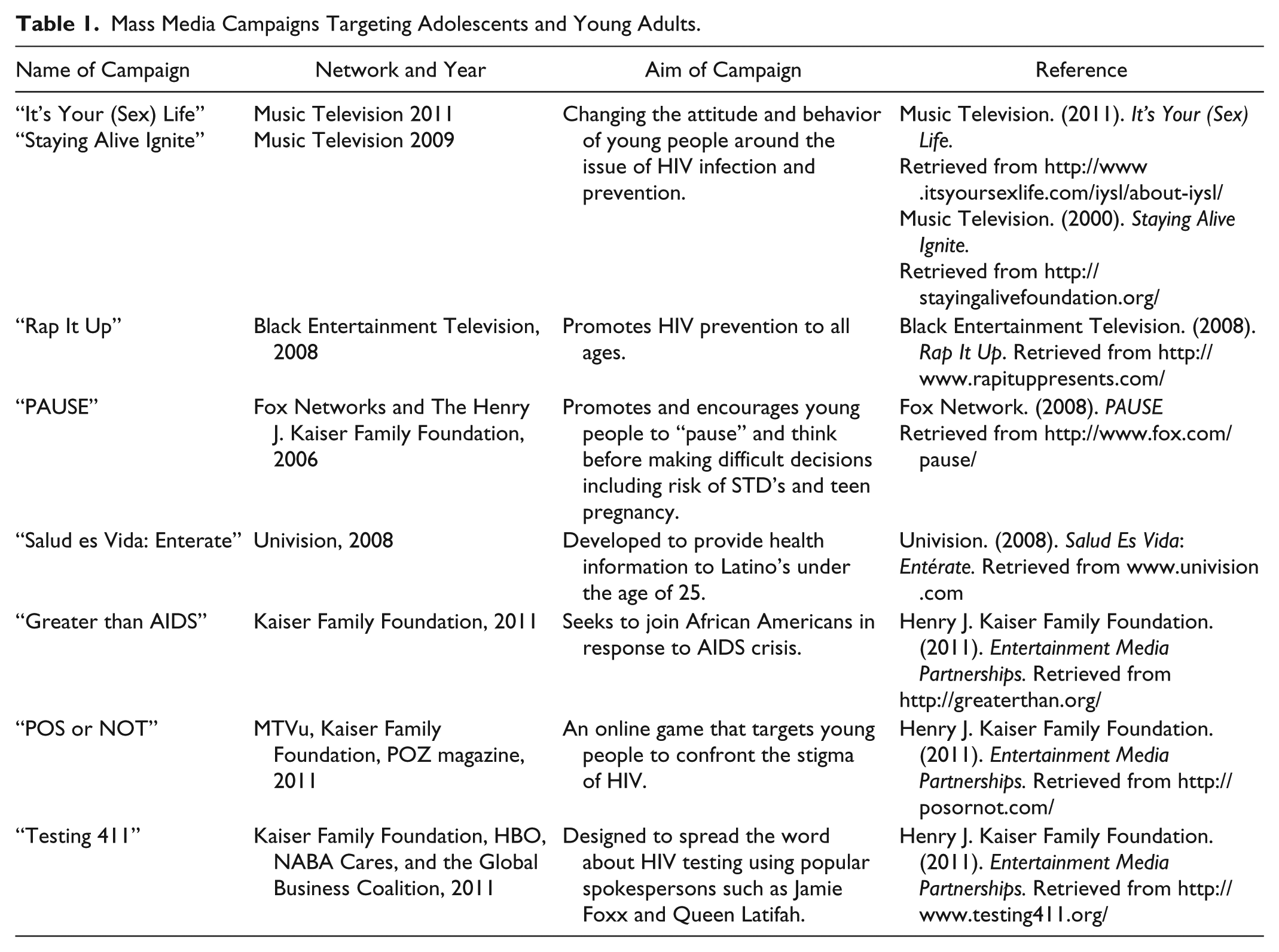
The environmental influence of mass media on interpersonal relationships in college students is a viable area of research (see Table 1), particularly because most HIV prevention messages targeting this age group are through mass media campaigns. Message delivery and cultural background of the target audience are essential for tailoring mass media interventions. Like marketers, analyzing audiences and strategically promoting product/content to targeted populations can be a tool to create and translate HIV/STI prevention campaigns to college women. In the past, there have been mass media HIV prevention messages; however, there are no evaluative tools that determine the impact of these messages. Moreover, there have been few reports of campaign messages’ ability to mediate relationships and help facilitate protective communication with parents and/or partners (DuRant, Wolfson, LaFrance, Balkrishnan, & Altman, 2006; Helme et al., 2011). In addition, understanding gender and racial differences of message receptivity will allow for appropriate customization of HIV prevention messages that promote interpersonal communication.
Mass Media Campaigns Targeting Adolescents and Young Adults.
Empirically based media prevention interventions using efficacious communication techniques may have the greatest potential for reducing HIV incidence (Horner et al., 2008; Jones & Lacroix, 2012; Major & Coleman, 2012; Medina & Rios, 2011; Romer et al., 2009; Sznitman, Stanton, et al., 2011; Sznitman, Vanable, et al., 2011). Younger-aged women are influenced significantly by mass media (J. D. Brown et al., 2005); yet there are few research studies reported on the association of communication systems and interpersonal relationships in college females. Determining mass media influences that might facilitate interpersonal communication and ultimately affect sexual decision making may assist scientists in developing appropriate interventions that appeal to a population of female college students. Therefore, the purpose of this study was to test the associations between race, preferred HIV mass media message mediums, and interpersonal relationships among female college students. Mass media is limited to print media, television (TV), Internet, and radio. This study addressed the following research questions:
Study design and research methods have been previously described (Chandler, et al, in press). However, we summarize the study methodology. In brief, a nonexperimental cross-sectional design was used. Data were collected via an Internet-based survey using the Dillman (2006) Tailored Design Method.
Sample
A convenience sample (n = 766) of female college students ages 18 to 21 years attending a 4-year public university in the southeast was recruited.
Several instruments were combined and placed into an electronic format to test associations between variables. The surveys used included: a demographic questionnaire, the AIDS Risk Knowledge Test, The Parent and Peer Influence Scale, the Parent-Adolescent Communication Scale, the Partner Communication Scale (PCS), and the Sex and AIDS Communication Measure. A detailed description of each survey has been published (Chandler, et al, in press).
Data Collection Methods
After obtaining Institutional Review Board (IRB) approval from the source institution, an encrypted username/password protected online survey program, Ultimate Survey software®, was used for constructing and revising the survey. This program is designed to distribute electronic recruitment messages with survey links, via email, to a large volume of recipients. Email addresses of the target population were obtained from the registrar’s office. Using the Tailored Design Method to ensure maximal response rate (Dillman, 2006), age-eligible female college students could receive a maximum of four email contacts. The second contact was 7 days after the first, and the third and fourth contacts followed in 7-day increments.
Data Analyses
The survey data were exported, in bulk, from the Ultimate Survey® program and analyzed using the Statistical Analysis System (SAS). The data system was password protected on a dedicated computer, to ensure confidentiality with data entry, management, and analysis.
Statistical Methods
Analyses were conducted by race, with demographic characteristics compared by use of student t tests for continuous variables and chi-square tests for categorical variables. Similarly, student t tests were used to compare parent communication, partner communication, peer influence, HIV knowledge, and perceived risk for HIV/AIDS scores by race. Spearman (ranked) correlation coefficients were computed to estimate the strength of relationship between various types of media exposure and media content and parent and partner communication scores. Analyses were stratified by race. General linear models with interaction terms (race × media exposure/content variable) were fit to test for evidence of heterogeneity by race in the relationships between media exposure/content variables and parent and partner communication scores. A two-sided p value less than .05 was used to define statistical significance.
Results
The mean age of the study population was 20 years and did not differ by race; however, Blacks were more likely than Whites to be in their freshman year at the time of survey participation (Table 2). Having a mother who was married was more common in White (74.1%) compared with Black students (50.0%), and fathers of White students were more likely to be college educated.
Demographic Characteristics by Race.

Communication, Influence, and Knowledge Scores
Compared with White students, Black students had higher mean communication scores with their partners (7.6 vs. 5.9, p = .002) and a trend toward higher mean communication scores with their parents (4.0 vs. 3.1, p = .07; Table 3). In contrast, White students reported being influenced more by peers than Black students. The mean HIV knowledge score and perceived risk for HIV/AIDS did not differ statistically by race.
Communication, Influence, and Knowledge Scores by Race.

Media Exposure and Communication
In examining extent of communication with parents, the strongest correlation among White students was for those who reported higher number of hours per week being exposed to magazines (RS = .15, p = .0003; Table 4a). A similar result was also observed for Black students (RS = .17). Yet Black students who reported higher levels of exposure to Black Entertainment Television (BET; RS = .18, p = .07) and radio (RS = .24, p = .02) also reported more communication with their parents. There was evidence of statistical interaction (p = .0003) whereby Blacks exposed to more hours of radio per week reported more communication with their parents, an association that was not observed in White students.
Correlation Between Hours of Various Media Exposure and Parent Communication.

Note. Television (TV); Music Television (MTV); Black Entertainment Television (BET).
p value for interaction between media exposure variable and race.
In examining extent of communication with partners, hours of Internet exposure per day was positively associated with communication among White students (RS = .14, p = .003; Table 4b). A reverse result was indicated in Black students (RS = −.14, p = .25), which yielded a statistically significant interaction effect (p = .02). The other contrary finding with respect to communication with one’s partner was a positive correlation for hours of reading per day among Whites (RS = .11, p = .02) and a negative correlation among Blacks (RS = −.15, p = .22; for interaction p = .009).
Correlation Between Hours of Various Media Exposure and Partner.

Note. Television (TV); Music Television (MTV); Black Entertainment Television (BET).
p value for interaction between media exposure variable and race.
Media Content Exposure and Communication
In evaluating exposure to information on sexual behavior and risk of HIV/AIDS, relationships with parent communication were consistently positive yet small among White students (RS range = .11-.20; Table 4a). Notwithstanding statistical power (i.e., Blacks having a much smaller sample size than Whites and lower statistical power), the relationships between exposure to information on sexual behavior and risk of HIV/AIDS with parent communication were consistently positive and somewhat stronger among Black students (RS range = .16-.33).
A different pattern of association was observed for partner communication (Table 4b). Specifically, exposure to information on sexual behavior and risk of HIV/AIDS was consistently positively associated with partner communication scores among White students (RS range = .14-.40). In contrast, there was essentially no association among Black students for exposure to information on sexual behavior and risk of HIV/AIDS and extent of partner communication.
Differential Association of Radio Exposure
As depicted in Figure 1, the impact of radio exposure on extent of parent and partner communication appeared to differ markedly by race. Specifically, Black students had higher levels of communication with their parents than White students when receiving more radio exposure, particularly, sheer number of hours per week and items about IV drug use and condoms. In contrast, White students had higher levels of communication with their partners than Black students when receiving more radio information about HIV/AIDS and IV drug use (Table 5).

Spearman correlation coefficients between measures of radio media exposure and scores on the Parent and Partner Communication Scales stratified by race.
Correlation Between Media Content Exposure and Parent Communication by Race.

Note. Television (TV); Intravenous (IV); Human Immunodeficiency Virus (HIV); Acquired Immunodeficiency Syndrome (AIDS).
p value for interaction between media content exposure variable and race.
Discussion
Our study indicates that race is related to preferred media sources for information about sex and HIV/AIDS and suggests that exposure motivates communication with parents, partners, and/or peers. The Kaiser Family Foundation’s 2011 survey of Americans on HIV/AIDS reports that media is the public’s top source of information about HIV (KFF, 2011). According to this report, “six in ten Americans say most of what they know about HIV/AIDS comes from the media, putting it ahead of other sources like school, doctors, friends and family.” Similarly, “media is the top information source for younger and older adults alike” (KFF, 2011). Considering that media is a formidable resource for information about sexual health and HIV, the results of our study support the notion that message delivery is relevant to interpersonal dialogue about sex and sexual risk.
Media Exposure and Communication
Black women reported higher parental and partner communication scores when compared with White women; yet, higher rates of STI and HIV/AIDS continue to disproportionally affect Black women (CDC, 2013a; 2013b). For Black women, more hours of radio exposure and BET had a significant relationship with communication with parents. We infer that the exchanges on sexual behavior and risk of HIV/AIDS does not appear to be protective against undesired health outcomes; hence, a need to facilitate more effective dialogue arises.
In recent focus groups conducted by the first author, Black college women expressed that parents were extremely vague when discussing sex, even describing their parents as uncomfortable or fearful of the topic. Yet, many of these Black college women still regarded their parents, especially their mothers, as the most desired source for information about intimacy. When parents are hesitant to discuss sex and sexual risks, perhaps such hesitancy is internalized by their children and thus avoidance of discussing this subject matter is normalized. Avoiding interpersonal conversations about sex cultivates interest in songs heard on the radio and videos seen on television as alternative sources for sex education (J. D. Brown & Keller, 2000). Lyrics are personal expressions from musicians and videos portray a fantastical view, but don’t typically provide a factual depiction of sex or reveal the potential risks. Although hearing and viewing sex laden content stimulates curiosity and prompts conversation with parents and partners, it is unknown the extent to which women are getting accurate or enough information. In contrast, White women’s exposure to magazines influenced their communication with parents. Although specific magazines were not explored, magazines are much more scrutinized with regard to information reliability. Thus, by inference, White women who read content in magazines may be more likely to get a detailed and accurate explanation about sex, and simply may need to confirm what was read with their parents.
Media Content Exposure and Communication
Unlike White students, there was no association among Black students for exposure to information about sexual behavior and risk of HIV/AIDS related to partner communication. Considering the differences between White and Black college women’s preferred media source, and who they feel prompted to talk to about sex when exposed to media about intimacy, a detailed assessment of radio and television (e.g., BET) broadcasting statistics and magazine readership might reveal specific content to which this population is most often exposed. Furthermore, analyzing content from each media domain might be useful to decipher race-related differences and outline for organizations and/or researchers culturally-specific media to promote safe sex and HIV prevention. Our study implies that messages targeting Black women may not be emphasizing the importance of talking with their partners, and learning how to effectively communicate with their partners is essential to safe sex practices, including but not limited to condom negotiation.
The limitations of this study have been published (Chandler et al, in press ).
Conclusion
Because there was no appreciable difference among Blacks and Whites in this study with respect to overall knowledge of HIV/AIDS, we wonder if there remains a deficit with translating information into action. This includes whether these women are being equipped with the skills to apply the information they do know about HIV/AIDS to their relationships with sexual partners. As one approach, we recommend short and informative media (Helme et al., 2011) with a technique that we coined Sex Safety Speed tactics (S3T). Sample topics include (a) strategies on how to know your partner when sexting, (b) romantic cues and content that reveal important information before foreplay, (c) making condom-use your decision but keep it sexy, (d) decode your conversation about sex with parents.
Like other studies, perceived health risk tends to be low and knowledge about HIV/AIDS high in adolescent and young adult populations regardless of race (Lim, Hellard, Aitken, & Hocking, 2007). Thus, in aggregate, college women, regardless of race, generally have some basic knowledge about HIV transmission. However, these women may struggle trying to translate such knowledge into safe sex practices. We recommend that future mass media HIV prevention campaigns integrate messages that help college women build skills that will facilitate effective interpersonal communication. In this realm, messages should be customized to be culturally specific and age appropriate.
Footnotes
Declaration of Conflicting Interests
The author(s) declared no potential conflicts of interest with respect to the research, authorship, and/or publication of this article.
Funding
The author(s) received no financial support for the research and/or authorship of this article.