




Abstract
The Minnesota Self-Determination Scale (MSDS) was translated into Korean. The Korean version was then validated using a sample of 40 individuals with intellectual disabilities between the ages of 19 and 45 years, the legal age of adults in South Korea. The evidence of the reliability and validity was examined. The test–retest was good (.84-.94). The internal consistency was excellent (.96-.99). The construct validity with other Korean translated self-determination measure (K-SDS) was acceptable (.50-.51). The findings indicated that the K-MSDS was an appropriate measure with acceptable psychometric properties. The Korean version was the first self-determination measure for adults with disabilities.
Keywords
Recently, there has been considerable emphasis placed on the role of environmental supports in defining the concept of disability. The International Classification of Functioning, Disability, and Health (ICF) defines disability as the complex outcome between a person’s health condition and environmental factors, which include social, physical, and policy supports (Schneidert, Hurst, Miller, & Üstün, 2003). This emphasis on the role of environment corresponds to the socio-ecological perspective of Bronfenbrenner (1979), who views human development as the evolving interaction between the person and environment (recited in Berry, 1995). The socio-ecological perspective holds that successful outcomes in human functioning may depend more on the match between individuals and their environments than on individual personal characteristics alone (Thompson, Tasse, & McLaughlin, 2008). As such, a disability is heavily influenced not only by internal traits but also by the varied supports that enable an individual to function in the environment (Claes, Van Hove, Vandevelde, Loon, & Schalock, 2012). Environmental support in this context is defined as the overriding “resources and strategies that aim to promote the development, education, interests, and personal wellbeing of a person and that enhance individual functioning” (Luckasson et al., 2002, p.145). Obtaining information about the individual and the environment is a critical starting point which enables the individual to benefit from socio-ecological perspective, because of the inability and limitation the individual has. The primary sources of these environmental supports are parents, siblings, and service providers of the individuals. Abery and Stancliffe (Stancliffe, 1997; Stancliffe & Abery, 1997; Stancliffe, Abery, & Smith, 2000) closely examined the relationship between individual levels of self-determination and residential environment occurring at the micro-system levels of the ecological perspective. The residential environment examined in those studies included staff arrangement, residence size, number of residents, and residence location. Another study by Wehmeyer and Bolding (2001) examined the effects that transitioning from institutionalization to community residences had on self-determination in adults with severe intellectual disabilities. The results of this study were consistent with those of the previous study by Stancliffe and Abery (1997). They found significant improvement in the areas of self-determination, autonomy, and choice-making in adults with severe intellectual disabilities after they moved from more restrictive residential institutions to less restrictive community residences. Stancliffe, Abery, Springborg, and Elkin (2000) also examined the effect of substitute decision-making (e.g., a legal guardianship or conservatorship) on the personal control of adults with intellectual disabilities at the macro-system level. The results demonstrated that adults without any substitute decision makers exercised significantly higher levels of personal control than those with a conservator or a guardian. However, there was no assessment conducted to systemically identify which facilitators and barriers existed, and examined how they influenced the individuals with disabilities either at the micro- or at the macro-system levels in South Korea (Cho, 2009).
Problems
Since 2000, significant efforts have been made in South Korea toward the development of self-determination skills in individuals with disabilities have. These efforts have included development of interventional programs (Bang, 2000; H. O. Park, 2006; Rhyou, 2003), and examination of outcomes related to an individual’s self-determination level after participating in these programs (E. Kim & Kim, 2005, 2006; S. W. Park & Kim, 2004). Shogren et al. (2008) asserted that self-determination measures should be used to develop, implement, and evaluate the effect of self-determination interventions on individuals with disabilities. Unfortunately, the development of norm-referenced and standardized measures of self-determination for individuals with disabilities which report acceptable psychometric properties has been very limited in South Korea. Since 2000, three self-determination measures have been translated into Korean (Cho, 2009). However, only one of these measures included discussion of psychometric properties and contained a standardized sample that matched the recent South Korea census in terms of gender, age, family socio-economic status, and regional representation (J. K. Kim, Cho, Moon, & Kim, 2001).
The second problem identified was the lack of self-determination measures developed for adults in South Korea. Most measures privileged the evaluation of self-determination of secondary students with intellectual disabilities, and focused less on the importance of promoting and measuring self-determination in both young children and adults (Lee & Wehmeyer, 2003). However, the ultimate goal of special education in South Korea is to promote the full inclusion of students with disabilities (Korean Department of Education & Human Resources, 2003). Considering that self-determination is a developmental process intended to increase autonomy over the course of one’s life span (Abery & Stancliffe, 2003; Wehmeyer, 1998), it was valuable for any self-determination measure to account for the changes that adults undergo as they age.
The final problem pertained to the limited perspectives of existing measures of self-determination of individuals with disabilities. There were no self-determination measures representing the socio-ecological perspective. Considering that the nature of disability can be understood as an intersection between a person’s capacities and the context in which that person lives, it was valuable to explore the role of environmental supports in improving the self-determination of individuals with severe disabilities. Notably, the Korean version of the Minnesota Self-Determination Scale (K-MSDS) was the first instrument designed to assess self-determination of Korean adults through the socio-ecological perspective.
The Purpose of the Study
The purpose of this study was to examine whether a translated Korean version of the MSDS, the K-MSDS, might be valid when applied to a Korean population. The original scales were invented to measure adults with developmental disabilities (Abery, Stancliffe, Smith, Elkin, & Springborg, 2000a). The measures were incorporated from the construct of an ecological model of self-determination (Abery & Stancliffe, 2003).
Research Questions
Method
Participants and Setting
Participants included 40 adults with intellectual disabilities residing in three group homes and one residential institution in an urban area of South Korea. The gender breakdown of this sample was 24 males (60%) and 16 females (40%). The age of participants was restricted to 19 or over, because the MSDS was originally developed for use with adults. Mean age was 31.5 years (SD = 6.36, range = 20-42). The ethnicity of the participants was Pacific Islander (Koreans). Of the participants, 28 were recruited from one residential institution and 12 were recruited from three group homes the directors of which agreed to participate in the study.
Participants lived in three different residential settings: (a) group homes, (b) pre-group homes, and (c) a residential institution. Twelve (n = 12) participants resided in three group homes that provided semi-independent living services in integrated community settings. Unmarried participants shared a room with two to three other residents. Married participants lived with their own family members in the group homes. Twelve (n = 12) participants lived in “pre-group home buildings” located within the residential institution, but segregated from the community. The “pre-group home buildings” were created to prepare individuals for the transition to living in an integrated community. Sixteen (n = 16) participants resided in one residential institution which provided 24-hr supervised services. These individuals lived in four-person rooms segregated from the community. Table 1 provides additional demographic information regarding the participants in this study.
Characteristics of Persons Assessed.

ID = Individual disability.
Physical disability = Cerebral palsy.
Psychiatric disorder = Epilepsy.
Structure of Self-Determination Construct
Wehmeyer, Kelchner, and Richards (1996) proposed a functional model of self-determination. They defined self-determination as the attitudes and abilities of the individual to act as the primary causal agent in his or her life. The primary causal agent was based on four functional characters of behavior: (a) autonomy, (b) self-regulation, (c) self-realization, and (d) psychological empowerment. Thus, the model developed by Wehmeyer et al. (1996) was called the functional model. The measure assesses these four self-determination areas.
Abery and Stancliffe (2003) proposed an ecological model of self-determination based on the work of Bronfenbrenner (1979). They defined self-determination as the degree of personal control which one wishes to exercise over those areas he or she considers important. They present personal control as heavily influenced by the interaction between individuals and their environments. Thus, the role of environmental supports was emphasized in the ecological model. Abery and Stancliffe’s (2003) measure assesses the eight environmental support areas. Some examples of these supports include home, leisure activities, friends, health, and work (Abery et al., 2000a).
Measures
The Arc’s Self-Determination Scale (SDS; Wehmeyer & Kelchner, 1995) was developed to measure the self-determination of both secondary students and adults. This measure was comprised of two forms: an adult and an adolescent form, both of which share the same content. The adult form was adapted from the adolescent form (Wehmeyer, 1996). The internal consistency coefficient (Cronbach’s α) was .90.
The Korean version of Arc’s Self-Determination Adolescent Scale (K-SDS) was developed by Kim, Cho, Moon, and Kim (2001). The K-SDS was normed on 710 Korean adolescents with and without disabilities. The internal consistency was .95 in the Cronbach’s α (J. K. Kim et al., 2001).
Construct validity was established through a confirmatory factor analysis which identified the consistent factors between K-SDS (J. K. Kim et al., 2001) and the SDS measure (Wehmeyer & Kelchner, 1995). The psychometric properties of the measure were established by administering it to secondary students with intellectual disabilities. The internal consistency (Cronbach’s α) ranged between .92 and .95 across the four Korean studies. The K-SDS was used for this study.
The MSDS (Abery et al., 2000a) were invented to measure self-determination of an adult in light of the effects of certain environmental factors. The MSDS consisted of three subscales. These subscales included (a) Exercise of Control, (b) Decision-Maker Preference, and (c) Importance of Control. Each subscale included 90 items, grouped into eight domains, which used a 3-point scale system to evaluate the levels of self-determination of the individual. Item questionnaires for the three scales shared the same content, with variation occurring only in initial statements, such as “How much do you care about . . .” on the Important scale, “Who decides . . .” on the Exercise Control scale, and “Who do you want to decide . . .” on the Decision-Preference scale. The MSDS included both a self-reporting adult form and a proxy reporting residential staff form, which share the same content. The proxy forms were used for this study (Abery et al., 2000a). The test–retest (Pearson’s r) ranged between .74 and .87. The internal consistency coefficient (Cronbach’s α) ranged between .88 and .92 for the self-reporting scales (Elkin, 2007).
Procedures
The investigator obtained two types of consents; a signed and an oral consent form. Signed consent forms were obtained from directors of the residential institution and three group homes, and legal guardians of the participants who did not have families and relatives. Oral consent forms were obtained from participants (i.e., residents with intellectual disabilities). Written consent was waived for participants who were not able to read the forms. The consent document was communicated orally by a member of the research team. Each participant was informed that participation in the study was voluntary and could be terminated at any time.
Translation and Back Translation
The translation–back translation technique (also known as retranslation) was used to ensure equivalence on the scale between different cultures (Brislin, 1986; Brislin & Thorndike, 1972). The investigator of this study, who was fluent in both Korean and English, translated the MSDS into Korean. The Korean version was then retranslated into English by a Korean doctoral student majoring in English Literature at the graduate school level, and fluent in both Korean and English. The two versions were compared by translation checkers—two other doctoral students in English literature programs at the same school—who were also fluent in both Korean and English. These checkers were asked to rate how well the items on the two versions of the MSDS aligned to the following criteria: (a) linguistic likeness (e.g., word-to-word correspondence between English and Korean) and (b) content agreement (e.g., delivery of the meanings from English to Korean. The translated-retranslated items were rated using a 5-point Likert-type scale (1-5 points). The items that received ratings equal or greater than a point of 4 on both criteria were retained. Items that received ratings equal to or lower than a point of 3 on both criteria were discarded for later retranslations.
Procedure
Face validity of the second Korean version of the MSDS was rated by a Korean panel of three residential staff members who served individuals with intellectual disabilities. Among panel participants, the mean number of years serving intellectual disabilities was 14 (SD = 6.36, range = 7-21). All participants were certificated social workers. The panel members were asked to rate how well the translated Korean items corresponded to institutional policies and practices in group homes for adults with intellectual disabilities in South Korea. Nine culturally inappropriate items were identified by the panel on the first translated version and replaced with modified items applicable to Korean institutions serving individuals with intellectual disabilities.
Changes in the questionnaires were identically applied to the three subscales, as they shared the same content. The content replaced on the questionnaires was comprised of five items pertaining to the Plans domain, two items from the Support Money domain, and two items from the Support Staff domain. For example, the phrase transition planning meeting in the Plans domain was replaced with “a personal discussion with peer or family member,” as transition planning meetings did not occur in South Korea. The phrase “hiring or paying the service staff” in the Support Staff domain was replaced with “saving money for necessity” and “buying something for the necessity” in the K-MSDS, as individuals who resided in the group homes and residential institution were not able to hire or pay the service staff in South Korea. Table 2 provides sample updated items recommended by the panel.
Comparisons of the Original Items and Modified Items of the K-MSDS.

Note. K-MSDS = Korean Version of the Minnesota Self-Determination Scale; A = original statement; B = modified statement; C = brief reasons.
Both the first and second translated Korean versions were pretested with five individuals with intellectual disabilities. The individuals better understood questionnaires in the second translated version. The second translated Korean version was used for this study
Administrations
Interviews were administered by six volunteers enrolled in an undergraduate special education program in South Korea. The interviewers completed a one-day training workshop (6 hr) to acquire specific information regarding the protection of participants’ privacy, practices and policies in the institutions, and procedures for administering the measures used in the study. Each of the interviewers had an opportunity to practice the interviewing process through role-playing various case studies. In addition, the investigator of this study leaded two discussion sessions with interviewers to assess their competence regarding the process of data collecting activities. The discussion sessions each lasted for 2 hr and were first held immediately after participants began to conduct interviews and, again, later on in the process of conducting interviews.
Results
Test-Retest and Internal Consistency
Test–retest reliability (Pearson’s r) was computed between the first and second administrations of the K-MSDS by the same interviewers with the same respondents. The time interval between the two administrations was approximately 2 weeks (M = 14 days, SD = 2 days). Test–retest reliability coefficients were (r = .94) for the Preference, (r = .89) for the Importance and (r = .84) for the Personal Control Scales. All scale scores on the three scales were significant at the p < .001 levels (two-tailed). Test–retest reliability analyses were also conducted for the domain scores. Test–retest coefficients were strong between domain scores with the exception of two domains.
The internal consistency was analyzed for each of the Preference, Importance, and Personal Scales using Cronbach’s α (Cronbach, 1951). Each of these scales demonstrated a strong internal consistency: Preference (.99), Importance (.99), and Personal control (.96) scales. The internal consistency was also analyzed for the domains within the three scales. Test–retest and internal consistency correlations of K-MSDS are presented in Table 3.
Reliability Coefficients (Pearson’s r) and Internal Consistency (Cronbach’s α) Across Domains in the K-MSDS.

Note. K-MSDS = Korean Version of the Minnesota Self-Determination Scale; α = Cronbach’s α (Cronbach, 1951).
Correlation is significant at the .01 level (two-tailed).
Convergent Validity
Criterion-related concurrent validity of the K-MSDS was examined using K-SDS (Kim, Cho, Moon, & Kim, 2001) as a criterion measure. Pearson correlations (Pearson’s r) were computed between scores on the K-MSDS and on the K-SDS. The K-MSDS and the K-SDS appear to assess similar constructs. Preference (r = .53), Importance (r = .52), and Personal Control (r = .51) Scales were correlated with the K-SDS. Scores on the K-MSDS also significantly correlated with scores on the K-SMS, (Social Maturity Scale; S. Kim & Kim, 1998), an adaptive behavior scale (p < .001, two-tailed). Preference (r = .53), Importance (r = .52), and Personal Control (r = .53) scales were correlated with the K-SMS. Pearson’s correlations between the K-MSDS and K-SDS are shown in Table 3. Also, correlations between K-SDS and K-MSDS including the subscales are presented in Tables 4 to 7.
Descriptive Statistics and Correlation Matrix for K-SDS and K-MSDS.

Note. K-SDS = Korean version of Arc’s Self-Determination Adolescent Scale; K-MSDS = Korean Version of the Minnesota Self-Determination Scale.
Correlation is significant at the .01 level (two-tailed).
Descriptive Statistics and Correlations for the Sub-Scales on K-SDS and for the Domains on Preference Scale.
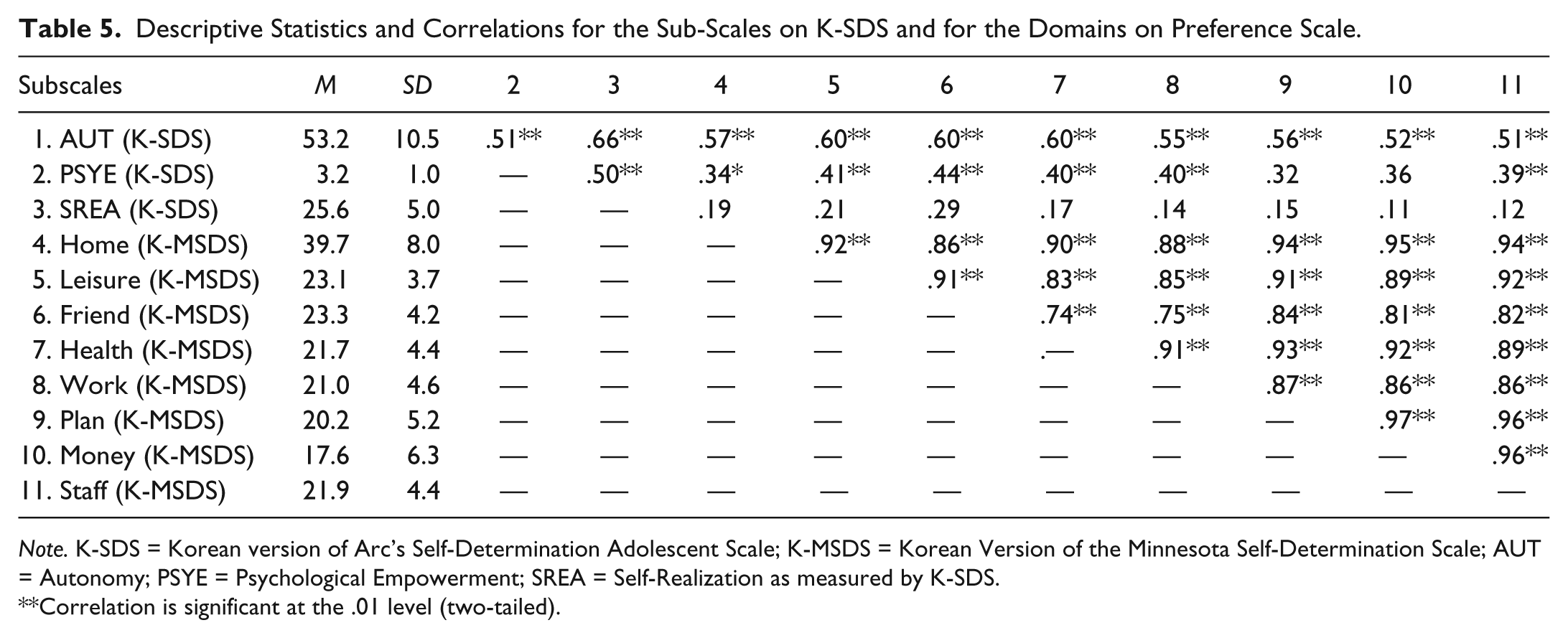
Note. K-SDS = Korean version of Arc’s Self-Determination Adolescent Scale; K-MSDS = Korean Version of the Minnesota Self-Determination Scale; AUT = Autonomy; PSYE = Psychological Empowerment; SREA = Self-Realization as measured by K-SDS.
Correlation is significant at the .01 level (two-tailed).
Descriptive Statistics and Correlations for the Sub-Scales on K-SDS and for the Domains on Importance Scale.

Note. K-SDS = Korean version of Arc’s Self-Determination Adolescent Scale; K-MSDS = Korean Version of the Minnesota Self-Determination Scale; AUT = Autonomy; PSYE = Psychological empowerment; SREA = Self-realization as measured by K-SDS.
Correlation is significant at the .01 level (two-tailed).
Descriptive Statistics and Correlations for the Sub-Scales on K-SDS and for the Domains on Personal Control Scale.

Note. K-SDS = Korean version of Arc’s Self-Determination Adolescent Scale; K-MSDS = Korean Version of the Minnesota Self-Determination Scale; AUT = Autonomy; PSYE = Psychological empowerment; SREA = Self-realization as measured by K-SDS.
Correlation is significant at the .01 level (two-tailed).
Discussion
One of the aims of this study was to examine the reliability and validity of a Korean K-MSDS. Overall, the results demonstrated that the K-MSDS had good psychometric properties for validity, internal consistency, and test–retest reliability. However, this study did not further explore the possible effects of environmental characteristics—residence size and type, guardianship status of adults with intellectual disabilities, and the characteristics of staff who serve in community-based settings—combined with MSDS, examined in previous studies (Stancliffe, Abery, & Smith, 2000; Stancliffe, Abery, Springborg, & Elkin, 2000). Also, because adults with intellectual disabilities do not retain any legal rights as independent decision makers in South Korea, we were not able to examine the effects of possible substitute decisions made by these adults, and, therefore, could not make comparisons with previous studies.
The items on the MSDS were adapted from the Institute on Community Integration Self-Determination Opportunities and Exercise Scale (ICI-SDOES; Abery, McGrew, & Smith, 1994, as cited by Abery & Stancliffe, 2003). Family, teachers, and staff who served children with disabilities were involved as members of an advisory panel during the development of the MSDS. In contrast, only the staff serving adults with intellectual disabilities participated as panel members of the K-MSDS. Thus, items on the K-MSDS were restricted to reflect the opinions of the individuals with disabilities and their residential service providers. For a wider application of the K-MSDS beyond individuals with intellectual disabilities who lived in community-segregated residential settings, more stake-holders such as family, teachers, and service providers in community-inclusive settings are recommended to participate as panel members.
The test–retest coefficients ranged from .84 to .94 for the K-MSDS scales. The test–retest intervals (M = 14 days, SD = 2 days) were similar to those (M = 16 days, SD = 6 days) of the original study (Elkin, 2007). The test–retest intervals administered to individuals with intellectual disabilities in two cross-cultural studies examined varied 1 to 3 weeks (Gonzalez-Gordon, Salvador-Carulla, Romero, Gonzalez-Saiz, & Romero, 2002; Morin & Cobigo, 2009). So a 2-week interval for the study is acceptable. The K-MSDS showed higher test–retest estimates than the MSDS data. These findings provided preliminary support for the reliability of the K-MSDS applied to Korean individuals. The test–retest coefficients were particularly low for the At Work domain, (r = .31). One possible explanation for this, is that participants did not have an opportunity to use employee’s benefits—such as paid vacations, a day off, or task training for new employees—as most individuals with intellectual disabilities were unemployed (81.6%; Employment Development of Korean Institute, 2010). Individuals who had been employed were considered under-employed compared with those with non-intellectual disabilities or those without disabilities (Employment Development of Korean Institute, 2010). Another explanation for this result relates to the difficulties inherent in applying the concept of self-determination to different cultures. Asian cultures, such as those in Korea and Japan, emphasize family values and relationships among community members differently from Anglo-European cultures that value individualism (Zhang, 2005). Because of existing cultural norms, it could be difficult for individuals to request a change in their scheduled lunch time or to express preferences for certain types of work. They may express hesitancy communicating their own opinions on first or second responding, as they fear breaking agency policy or losing better benefits by challenging collective decisions.
Internal consistency for the K-MSDS ranged from .96 to .99. These results were corroborated by the previous results for the original MSDS administered by Elkin (2007), which ranged from .88 to .92. These results indicated that K-MSDS was an internally consistent measure across all the three scales. However, we did not conduct a study examining how well the original MSDS scales were translated to other languages and cultures. Thus, we could not compare the internal consistency values of this study with those of other foreign language and culture-based translated versions of the MSDS. An additional concern involved the use of the coefficient—as the number of items increased, Cronbach’s alpha tended to inflate (Netemeyer, Bearden, & Sharma, 2003).
The criterion-related validity of the K-MSDS was evaluated by examining the relationship between the K-MSDS and K-SDS. The associations between the two measures were moderate. The validity coefficients were .50, .50, and .51 for the three scales of the K-MSDS and the K-SDS. These results provided preliminary support for the use of the measures with Korean individuals. These two measures of self-determination provided different theoretical perspectives; the K-MSDS relied on the ecological perspective (Abery & Stancliffe, 2003), whereas the K-SDS is based on the functional perspective (Wehmeyer, 1996). Therefore, the criterion-related concurrent validity was anticipated as related, but may not actually be as high because those scales might measure the different self-determination characteristics of the same individual.
Scores on the K-MSDS (r = .51-.53) were also significant predictors of individuals’ scores on the adaptive behavior scale (K-SMS). These results validated the previous study by Abery, Rudrud, and Arndt (1995) indicating that adaptive behavior is closely related to self-determination in individuals with intellectual disabilities (e.g., r = .86-. 89). Weller, Watteyne, and Herbert (1994) explained that adaptive behavior and self-determination might share common characteristics, such as making choices without being forced, emphasizing individuals’ interests, and modifying environments based on individual judgments and perceptions of specific encounters. This study indicated that the K-MSDS was a valid and reliable self-determination measure when applied to Korean adults with intellectual disabilities.
Limitation
This study used a convenient sample consisting of 40 adult individuals who participated voluntarily. This sample was not representative of all individuals with intellectual disabilities in South Korea. Interpretation of results should be restricted to this study as generalization to other populations cannot be made. Future studies to examine the technical adequacy of the K-MSDS should extend the sample size of participants to individuals from a wider variety of age ranges, intellectual levels, and residential settings both community-inclusive and segregated.
The use of the K-SDS adolescent form as the criterion measure was a limitation of the study. There was no measure to assess self-determination of adults in South Korea. Even though there was considerable similarity between the Arc’s SDS, adolescent, and adult forms (Wehmeyer & Kelchner, 1995), there was no Korean study to support the similarity between both adolescent and adult forms of the K-SDS.
The study requires the application of sophisticated statistical techniques to clarify which environmental variables existed and how much they contributed to enhanced levels of individuals’ self-determination. Stancliffe, Abery, and Smith (2000) used path analysis to examine whether there was a direct relationship between levels of self-determination and various expected environmental predictors. They found four prominent environmental predictors: self-determination skills, autonomy, individualization, and a discretionary use of money. Another study (Stancliffe, Abery, Springborg, & Elkin, 2000) analyzed self-determination scores combined with adaptive behavior skills and IQ tests to examine the influences of different substitute decision-making statuses on individuals’ levels of self-determination. This method was effective for controlling the compound effects because adaptive behavior and IQ were identified as strongly related to levels of self-determination. These studies provided consistent support for the ecological perspective. Future studies propose that the results of this study will be more convincing when combined with the Environment Scale (Abery, Stancliffe, Smith, Elkin, & Springborg, 2000b). The purpose of the Environment Scale is to identify the environmental features in which an individual lives.
Scale brevity may be a concern (Netemeyer et al., 2003). The study used relatively long interview protocols with individuals with intellectual disabilities. The K-MSDS includes 270 items and requires approximately 3 hr to be completed. Participants became less enthusiastic in the interviews as time progressed. It is suggested that low levels of participant enthusiasm influenced the results of the study. A shorter interview period may increase the test–retest reliability.
Implications for Future Studies
Self-determination measures are used for developing, implementing, and evaluating the effect of self-determination interventions as stated by Shogren et al. (2008). There was no self-determination intervention program for adults with disabilities in South Korea. Future studies should focus on the development of intervention programs for enhancing self-determination in Korean adults. The data from the current study identify the needs of individuals who are placed in Korean group homes and residential institutions, and suggests the need for designing and implementing intervention programs.
Additional studies should include the administration of the K-MSDS combined with the Environment Scale (Abery, Stancliffe, Smith, Elkin, & Springborg, 2000b). The Environment scale was developed for use in combination with one of the MSDS. Its purpose is to identify environmental features in which the individual lives. This scale was not included in this study. Use of the Environment scale will provide individualized information pertaining to what environmental features enhance self-determination, which barriers exist, and how they influence the individuals with disabilities.
Future studies will include the exploratory factor analysis, given the availability of a larger sample population. This methodological approach will be more effective for detecting factor structure and relationships among the factors within the theoretically based-measures (i.e., the K-MSDS, K-SDS).
Footnotes
Declaration of Conflicting Interests
The author(s) declared no potential conflicts of interest with respect to the research, authorship, and/or publication of this article.
Funding
The author(s) received no financial support for the research and/or authorship of this article.