




Abstract
Underpinned by the assumption that people would support affirmative action based on self-interests, and/or when they have high job security not to be threatened by the policy, this study investigated the likelihood that workers would differentially support affirmative action by their demographic attributes. Analyses of three demographic models—social, organizational, and combined(social plus organizational)—were used to determine predictors of support for affirmative action. Findings of the third (combined) model indicated that organizational tenure (an organizational demographic variable) and educational completion (a social demographic variable), respectively, were the two strongest predictors of support for affirmative action. This study suggested that factors of achievement, rather than race-ethnicity or gender, were the strongest predictors of support for affirmative action. This finding may be useful to personnel and human resources leaders in designing programs for employee acceptance of affirmative action programs.
Introduction
The practice and the enforcement of affirmative action (AA) programs have perennially generated debates about the fairness of the policy among the American people (Pincus, 2003). While many people in the public oppose the policy, many others fervently support it. The continuing disagreement over the policy and its various programs has led to its proscription in seven U.S. states (Burns, 2011). Even in states that continue to subscribe to AA, the general public, including workers, differentially support it. One popularly reported reason for the support of the policy, in academic papers, is self-interest or collective interest. That is, people who benefit or expect to benefit from AA are likely to support it, while those who expect to be hurt by the policy will likely oppose it (Bell, Harrison, & McLaughlin, 1997; Bobo & Kluegel, 1993; Kravitz, Stinson, & Mello, 1994; Shteynberg, Leslie, Knight, & Mayer, 2011). This study further investigated the likelihood that workers would support AA based on self-interest as members of protected social demographic classes under AA, by analyzing demographic characteristics of protected classes against organizational demographic factors of job security, to identify the set of demographic characteristics (social or organizational) that most strongly predict support for AA.
Review of Relevant Literature
Affirmative action as a governmental policy dates back to presidential executive orders 10925 and 11246 (in 1962 and 1965, respectively) and their subsequent revisions (Brunner, 2007; Daboe, 2009). The policy, as defined by the United States Commission on Civil Rights, stated that AA was any measure, beyond simple termination of a discriminatory practice, adopted to correct or compensate for past or present discrimination, or, to prevent discrimination from recurring in the future (U.S. Commission on Civil Rights, 1977). The policy requires government contractors and subcontractors (excluding those in construction) who have 50 or more employees and a federal contract for more than $50,000 to develop AA plans for the hiring of women and minority workers (traditional collective victims of employment discrimination) into their organizations. The plan should be effective in each contractor’s organization within 120 days of receiving a government contract; otherwise a contractor (and his or her company) would face debarment (Office of Federal Contracts Compliance Programs [OFCCP], 2002; Pincus, 2003). These guidelines do not specify the specific contents of an AA plan, instead, each contractor is expected to voluntarily design his or her own plan, as well as execute the plan in good faith (OFCCP, 2002; Reskin, 1998). For construction contractors, the OFCCP, rather than the contractors, establishes goals and specifies AA good faith steps the contractors must take to increase the utilization of minorities and women in skilled trades in their organizations. These contractors are not required to develop any written AA programs of their own (OFCCP, 2002).
The manifest function of AA is to encourage employers to be proactive in hiring and promoting protected classes of people (racial-ethnic minorities, White 1 women, people with disabilities, and the aged) who, collectively, are traditional victims of employment discrimination in American organizations (Kennedy, 1998; Pincus, 2003; Reskin, 1998). In addition to the manifest intent of the policy, one can also argue that AA has additional benefits of proactively preventing discrimination, and increasing organizational diversity to enhance creativity, innovation, and organizational success. To meet their various AA needs, organizations have developed various types of AA programs such as employment quota, an illegal practice, but, which in rare, exceptional, and limited situations had been ordered by the courts to be used temporarily to settle charges of egregious and persistent discrimination situations for which no other remedy was sufficient. For example, in the court case Local 28, Sheet Metal Workers V. EEOC, 478 U.S. 421, 1986, a court ordered a sheet metal union to hire non-Whites on a quota basis because the union had repeatedly defied court orders to stop discriminating against African Americans (Reskin, 1998). Other types of affirmative action practices used by organizations have included government contract set-asides (government programs that mandated that a small proportion of government contracts be set aside for minority contractors), race/gender-plus policies (the consideration of race and gender, along with important meritocratic factors in hiring and promotion decisions), race-based academic scholarships (scholarships that are reserved solely for minority scholars), and differential educational admission standards (the use of different admissions requirements by race, ethnicity, and gender by universities to improve enrollment diversity; Connerly, 2000; Pincus, 2003). Identity-conscious AA programs, such as those that target racial-ethnic minorities, women, and people with disabilities as beneficiaries, are typically described as preferential-treatment AA programs by organizations and the general public, as reported in academic research (e.g., Aberson, 2007; Park, 2009; Shteynberg et al., 2011). The definition of AA by Pincus (2003) as “policies intended to promote race/gender equity by taking race/gender into account” (p. 3), and Kennedy (1998) as “policies that provide preferences based explicitly on membership in a designated group” (p. 323), testify to the perception of identity-conscious AA as preferential treatment. It is, however, important to recognize that while identity-conscious or preferential treatment of protected classes of people is a common interpretation of AA, nowhere in the law is preferential treatment expressly stated.
Demographic Factors of Support for Affirmative Action
Conceptual factors such as self-interest (Kravitz, 1995), compensation for discrimination (Pincus, 2003), and promotion of organizational diversity (Tipper, 2004) have been identified as correlates of positive support for AA. Conversely, factors like the violation of value of individualism (Steeh & Krysan, 1996), reverse discrimination (Pincus, 2003), violation of meritocracy (Peterson, 1994), and lesser prevalence of discrimination (the perception that AA is no longer needed because of a belief that employment discrimination today is far less common than it used to be in the distant past; Kravitz & Klineberg, 2000) are associated with negative attitude toward the policy. Unlike these previous studies that measured conceptual variables, attention in this study was mainly on social and organizational demographic predictors of support for AA.
Previous studies have documented many social demographic differences in support for AA (Aberson, 2007; Bell, Harrison & McLaughlin, 1997; Konrad & Spitz, 2003; Park, 2009; Shteynberg et al., 2011; Sidanius, Levin, van Laar, Sears, 2008). Overwhelmingly, these studies focused mainly on the differential effects of race-ethnicity and gender on support for AA, with the conclusion that racial and ethnic minorities tended to support the policy more than Whites, and that women tended to support it more than men (Konrad & Spitz, 2003; Tougas & Beaton, 1993). Konrad and Linnehan (1995) also found that racial-ethnic minorities (men and women alike) and White women significantly supported identity-conscious or preferential AA programs more than White men who tended to oppose such programs. White women however supported identity-conscious AA programs less than racial-ethnic minorities (Konrad & Linnehan, 1995; Konrad & Spitz, 2003; Shteynberg et al., 2011), except for when identity-conscious AA programs targeted women as beneficiaries (E. Smith & Witt, 1990). The lesser support for identity-conscious AA by White women, vis-à-vis racial-ethnic minorities, can be explained in at least three ways. First, because Whites, in general, often under-recognize the pervasiveness of discrimination against racial-ethnic minorities, White women are likely to underestimate the extent of such discrimination. This underestimation of the pervasiveness of racial-ethnic discrimination makes White women to become less likely to support race-conscious AA (see Weber & Higginbotham, 1997). Second, evidence from studies by Branscombe, Doosje, and McGarty (2002) and Iyer, Leach, and Crosby (2003, Study 2) suggested that as members of the high-status White population in the United States, White women may resist acknowledging inequality against racial-ethnic minorities to avoid the potential admission that they, too, have participated in discrimination against those minorities. To admit discrimination against the racial-ethnic minorities may undermine White women’s preferred view of themselves as moral and good. Third, because White women benefit from the high status of being Whites, they tend to resist acknowledging the structural disadvantages faced by racial-ethnic minorities, and, at the same time, they (White women) have difficulty acknowledging the structural advantages they enjoy, as a way to protect the illusion that they have legitimately earned all their outcomes (Phellam & Hetts, 2001).
The differential patterns of support for AA by race and gender are due, mainly, to the perception that identity-conscious AA programs hurt non-beneficiaries, and, as such, this perception is a strong predictor of negative attitude toward AA (Shteynberg et al., 2011). The perception, especially, that race-ethnic-based AA programs hurt Whites, collectively, by depriving them of societal resources, is widespread and significantly influences Whites’ attitudes toward AA (Harrison, Kravitz, Mayer, Leslie, & Lev-Arey, 2006; Kravitz, Blaudau, & Klineberg, 2008; Shteynberg et al., 2011). This position is supported by research which indicated that the greater the perception of collective relative deprivation (CRD) by Whites, the greater their likelihood of negative attitude toward AA (Harrison et al., 2006; Lowery, Unzueta, Knowles, & Goff, 2006). The perception of CRD by Whites is consistent with a 1991 Gallup survey reported by Tomasson, Crosby, and Herzberger (1996), which indicated that 30% of American workers claimed that their organizations actively practiced AA. Among these workers, 20% of non-Hispanic Whites said they had been hurt by the practice, while 23% of Blacks said they had benefited from it (Tomasson et al., 1996). Based on CRD perception, this 1991 Gallup survey was consistent with another Gallup poll in 2005 that found that non-Hispanic Whites were the least to favor AA programs (supported by only 44% of non-Hispanic Whites), while Blacks (72%) and Hispanics (62%) had higher levels of support for AA programs (Gallup, 2006).
Unlike the vast coverage received by race and gender in research on AA, other demographic factors such as age, education, and handicap status have received less attention in scientific research. Of particular interest in this study is the impact of age and education on the likelihood of support for AA. An extensive search for literature with focus on the link between age and AA yielded no recent articles. Jacobson (1985), however, discovered in two separate multivariate analyses that age was neither a correlate nor a predictor of attitude toward AA. The only impact of age (and other selected demographic variables) on attitude toward AA, in Jacobson’s results, was in moderating the value of old fashioned racism on attitude toward AA. Additional information on the relationship between age and AA was presented by Kluegel and Smith (1983) who theorized that younger White workers (less than 30 years old) would likely oppose AA practice because they were likely to perceive younger Black workers as a threat to their (young White workers’) job security. This is because younger Black workers have improved in their educational credentials and are able to compete for similar entry-level jobs as young White workers who lack tenure, seniority, and job security. Kluegel and Smith (1983) also reasoned that older White workers would be more likely to support AA because of their high tendency to have long tenure, seniority, and job security such that they would be less likely to be threatened by older Black workers. Due to the paucity of literature on the effects of age on support for AA, the analysis of age of research participants on support for AA in this study, will be an important contribution to knowledge, as well as fill an important age-related gap in literature, on workers’ attitude toward AA.
The pattern of findings in available research on the link between education and AA, showed that higher educational attainment is positively related to greater likelihood of support for AA (Elizondo & Crosby, 2004; Jacobson, 1983; Sidanius et al., 2008). Consistently with an earlier study by Jacobson (1983), Sidanius et al. (2008) found that at the University of California, Los Angeles, White and Asian students increased their support for the university’s race-ethnic-based AA programs, as these students advanced in education from first year to fourth year. Elizondo and Crosby (2004) similarly found that upper level college students demonstrated greater support for AA than their lower level counterparts. The main pattern of association between education and AA is confirmed as mainly positive (Elizondo & Crosby, 2004; Jacobson, 1983; Sidanius et al., 2008).
Objective
The objective of this study was to investigate the significance of social and organizational demographic factors in predicting support for AA action among organizational members. As mentioned above, several studies have documented demographic correlates of attitude toward AA, but these studies (Gallup, 2006; Konrad & Spitz, 2003; E. Smith & Witt, 1990; Tougas & Beaton, 1993) did not distinguish the differences in the patterns of social and organizational demographic variables in predicting support for AA (see distinguishing explanations below and in following sub-sections).
This study went further than previous research by investigating differences in social and organizational demographic attributes of workers, with clearly defined, non-overlapping demographic boundaries, as predictors of support for AA in an organization. Three demographic models: social demography (consisting of protected classes of people under AA plus educational attainment), organizational demography (consisting of achieved organizational statuses), and a combined model (consisting of social and organizational demographic variables) were used to predict workers’ differential likelihood of support for AA.
By studying differential likelihood of support for AA by distinct demographic categories of workers, insight will be gained into the different strength of both social and organizational demographic attributes of workers, in predicting the likelihood of support for AA. Of particular importance is that this study will reveal the strength of the demographic characteristics of AA-protected classes (expected beneficiaries of AA) relative to the strength of organizationally achieved statuses, in predicting support for AA. Findings from this study will be particularly useful in determining the set of demographic categories (social or organizational demography) that best predict support for AA. This study will also reveal whether or not one set of demographic variables dominates the other in predicting support for AA. This research will, therefore, add scientific knowledge to the relative weights of both social and organizational demography in predicting the likelihood of support for AA practice. By better understanding the predictors of support for AA, personnel and human resources managers will gain insight into the likelihood of support, among their workers, for AA practices in their organizations. Gained insight may become useful to personnel and human resources executives in designing programs of acceptance of AA for their workers.
Social Demography
Social demography, also known as population studies, is the analysis of the relations between demographic and non-demographic factors. In social demography, demographic factors are used to explain and predict social, economic, political, and cultural factors, and vice versa (Ford & DeJong 1970; Kammeyer, 1971; Petersen, 1999). When non-demographic variables are used to predict demographic facts (e.g., using the economy to predict fertility), the analysis is termed population study Type I. A Type II population study occurs when demographic variables are used to predict non-demographic conditions (e.g., using population size to predict housing availability—examples, mine; Kammeyer, 1971).
Ford and DeJong (1970) helped establish social demography as a distinct area of demography relative to formal demography—the use of demographic variables to explain and predict other demographic variables (such as using fertility and mortality to explain natural increase in population). In formal demography, relations among demographic variables are studied for their consequences on population structure and growth (Kammeyer, 1971; Petersen, 1999).
Ford and DeJong (1970) provided the basic analytical framework for studying social demography. The framework consisted of three systems, each with elements that interacted with one another and with elements in other systems to effect changes within their own system and in the other two systems. These systems were (1) the demographic system—containing demographic elements such as population size, composition, distribution, migration, fertility, and mortality; (2) the social action system—containing elements of social institutions such as religion, economy, education, medicine, and welfare; and (3) the social aggregate system—characterized by status classifications like race, gender, income level, social class, occupational categories, and religious categories (Ford & DeJong, 1970). The three systems intersect, indicating their overlapping characteristic, mutual inclusiveness, but also a lack of clear boundaries among the elements in each system. This lack of boundary specification among the elements creates confusion in determining which system a particular element may belong (Kammeyer, 1971). In addition, since all the elements in the demographic system are demographic, the interaction among them constitutes formal demography, creating another layer of confusion in the boundary between social and formal demography.
Social Demography Redefined With Boundary
In this study, social demography describes only the categories of permanent, immutable, attributes of employees. These attributes are permanent employee characteristics that are not subject to loss as one leaves an employment. They are personal demographic qualities of the employee. By this definition, social demography includes characteristics like age, education, religion, gender, height, marital status, race, ethnic identity, social class, and disability status, but not employment characteristics like job tenure, title, and wages, that Ford and DeJong (1970) included in their social aggregate system.
The characteristics of social demography, as defined in this study, often serve as external factors of reward distribution, thereby influencing one’s opportunities and placement in the stratification system of society. For example, being Male, White, able-bodied, and Anglo Saxon (demographic characteristics typically associated with greater privilege in the U.S. society) tend to positively enhance one’s economic opportunities and social ranking, than being female, Black, disabled, and non-Anglo Saxon (demographic characteristics typically associated with lesser privilege in the United States). Unlike those with the more privileged attributes, workers with the less-privileged attributes typically face higher likelihood of various forms of employment discrimination, and they constitute the categories of people whose employment interests and opportunities AA was manifestly designed to protect. In this study, four social demographic attributes of workers (race-ethnicity, gender, age, and educational attainment) were analyzed for their relationships with support for AA. The first three of these attributes—gender, age, and race-ethnicity—are classes of people directly protected by AA policy (see Henderson, 1994; OFCCP, 2002; Pincus, 2003; Reskin, 1998; U.S. Commission on Civil Rights, 1977).
An underpinning premise in this study is that classes of workers with the less-privileged social demographic attributes (women, racial-ethnic minorities, older workers) will be more apt to support AA practice than those with the more-privileged social demographic attributes. It is assumed that the more the attributes of lesser privilege apply to a worker, the more likely the worker will support AA, and vice versa. This is because classes of workers with less-privileged social demographic attributes are likely to recognize that AA was instituted to protect their interests against employment discrimination, and they may, therefore, see it as beneficial to themselves. This self-interest assumption echoes the claims of Kravitz (1995) and Summers (1995), that people would likely support AA practice when they perceived it as beneficial to themselves. Conversely, those with the more privileged social demographic attributes might perceive AA as reverse discrimination as well as detrimental to their opportunities, and therefore not support it (Harrison et al., 2006; Pincus, 2003; Shteynberg, Leslie, Knight, & Mayer, 2011). From these assumptions, it was hypothesized that:
The fourth social demographic attribute of workers, educational attainment, has been cited in literature (Coenders & Scheeper, 2003; Schaefer, 1996) to produce a liberalizing effect on individuals’ social, racial-ethnic, and political attitudes. That is, people with higher educational attainment tend to hold liberal views on social issues. It follows, therefore, consistently with Elizondo and Crosby (2004), Jacobson (1983), and Sidanius et al. (2008), that workers with higher educational attainment would more likely support AA than lesser educated workers. It was, therefore, hypothesized that
Organizational Demography
The concept of organizational demography was developed in the early 1980s to measure relationships between the demographic attributes of organizational members and organizational outcomes (Lawrence, 1997; Sorensen, 2002). A pioneer in the new field, Pfeffer (1983) defined organizational demography as the composition of an organization in terms of its demographic attributes. He (Pfeffer) argued for the use of demographic variables to assess organizational outcomes because they (organizational demographic variables) were easier to measure, as well as more parsimonious than conceptual variables that were typically plagued with measurement problems and lack of parsimony. The ease of observation, measurement, and parsimony of organizational demography make it a reliable, promising, and powerful structural approach to understanding organizational behavior (Pfeffer, 1983). Even though organizational demographers tend to focus primarily on consequences of demographic heterogeneity like age, race, ethnicity, education, and tenure in groups, organizational demography has been used to predict a wide range of organizational outcomes (Sorensen, 2000). Outcomes such as social integration (K. G. Smith et al., 1994), strategic behavior (Hambrick, Cho, & Chen, 1996), employee turnover (Sorensen, 2000), and firm performance (Pegels, Song, & Yang, 2000) have been predicted using organizational demography.
Attributes of organizational demography as stated by Pfeffer (1983) included age, gender, ethnicity, race, tenure, job functions, and marital status of organizational members. A careful observation of what have been traditionally labeled as organizational demography, however, reveals that attributes such as age, gender, ethnicity, and marital status were simply social demography within organizations. Like traditional descriptions of social demography, organizational demography has been appropriately criticized, for example, by Lawrence (1997) as lacking well-defined distinguishing boundaries. Lawrence (1997) indicated that the lack of precision in what constituted organizational demography led “people to wonder whether there was anything that was not organizational demography” (Lawrence, 1997, p. 5).
Organizational Demography Redefined With Boundary
Unlike social demography (as earlier redefined with boundary) that described categories of permanent and immutable attributes of workers, organizational demography, in this study, is described as achieved statuses distributed only by an organization. An employee occupies these statuses as a consequence of his or her organizational membership and achievement within his or her organization. Unless one is a member of an organization, one will not attain these statuses. These statuses are occupied at the pleasure of an organization, and they can be withdrawn from an employee for reasons of job termination, resignation, retirement, or demotion. These statuses are subject to change as an employee changes jobs within an organization’s internal labor market. Essentially, these statuses are temporary for the occupier. Based on these defined boundaries, organizational demography may include characteristics such as line-staff positions, power status, job title, wage, tenure, seniority, job function, etc. The organizational demographic characteristics used in this study were job position, job function, wage, and organizational tenure (see the section on “method” for definitions of all variables).
Organizational demographic characteristics are important sources of job security which may influence a worker’s likelihood of support (or lack of support) for AA. For example, a worker who has a high wage and long tenure may feel secure enough in her position to perceive AA as useful in improving the social diversity of her organization (if she values diversity). She may, therefore, support the practice of AA in her organization. Conversely, a worker who suffers from job insecurity may perceive AA as threatening to her employment security and future promotion opportunities. She may perceive AA as bringing people into the organization who may be her competitor for rewards in the organization. The worker with job insecurity may be inclined to perceive AA as negative, and therefore not support it. Based on this assumption, a third hypothesis was derived for this study:
Method
Primary data were collected at the regional headquarters of a global financial organization located in one fairly large Midwestern city. This regional headquarter was the organization’s operations center, and it had approximately 2,000 employees. The organization was an AA employer which promoted employee diversity, and provided diversity training for its employees. The regional office had a diversity officer, and a vice president for diversity existed at the corporate level.
To protect the privacy of its employees, the subject organization did not grant access to any employee information that could be used for random sampling. Due to limited managerial support that prevented random sampling, research participants were systematically selected by their seat locations (every other seat) in their work areas. The participants were promised confidentiality and anonymity on the questionnaire. Anonymity for the organization was also promised to the organization’s management as a condition for allowing this research in their organization. Of the approximately 500 questionnaires that were distributed, 390 were returned directly to the study investigator, for a return rate of 78%. The respondents had a tenure range of 1 to 5 years with an average tenure of 2 years. They (respondents) ranged in age from 19 to 68 years, with a mean age of 27.5 years, and they had an average wage of $14.23. Forty-three percent of the workers identified as minority, 35% were women, and 55% identified as phone workers.
Consistently with the definitions of the concept by the U.S. Commission on Civil Rights (1977), Kennedy (1998), and Pincus (2003), AA in this study was defined to mean programs directly designed to enhance the opportunities of all classes of minorities and women in employment, beyond the curbing of discrimination. This interpretation and practice of AA have been widely discussed in literature (see, for example, Connerly, 2000; Elizondo & Crosby, 2004; Harrison et al., 2006; Henderson, 1994; Kravitz et al., 2008; Pincus, 2003; Shteynberg et al., 2011; Sidanius et al., 2008).
A six-item (α = .840), six-point (strongly agree = 6, strongly disagree = 1), Likert-type summated rating scale was adapted from Parra (1991) to measure support for AA as dependent variable (see Table 1). Inter-item correlation (matrix) revealed average correlations and absence of multicollinearity among the six items. Also, factor analysis, using principal component extraction method, showed a loading range of 0.696 to 0.839 of all six items under one factor (Table 1). Demographic attributes of the workers (Table 2), as defined in the following, were also asked on the questionnaire:
Inter-Item Correlation Matrix and Factor Analysis Showing Internal Consistency for the Scale of Affirmative Action.

Note. Item 1: Personally, I believe affirmative action is good in general. Item 2: Personally, I believe minority job applicants should be given special treatment in the hiring process. Item 3: Personally, I believe businesses should use affirmative action to ensure fairness in employment. Item 4: Personally, I believe affirmative action results in better utilization of human potentials in society. Item 5: Personally, I believe that affirmative action is good for addressing continuing discrimination against minorities. Item 6: Personally, I believe affirmative action should be used to correct past injustice.
Mean Scores of Support for Affirmative Action for Nominal Variables and Pairwise Deletion Correlation Matrix for All Variables.
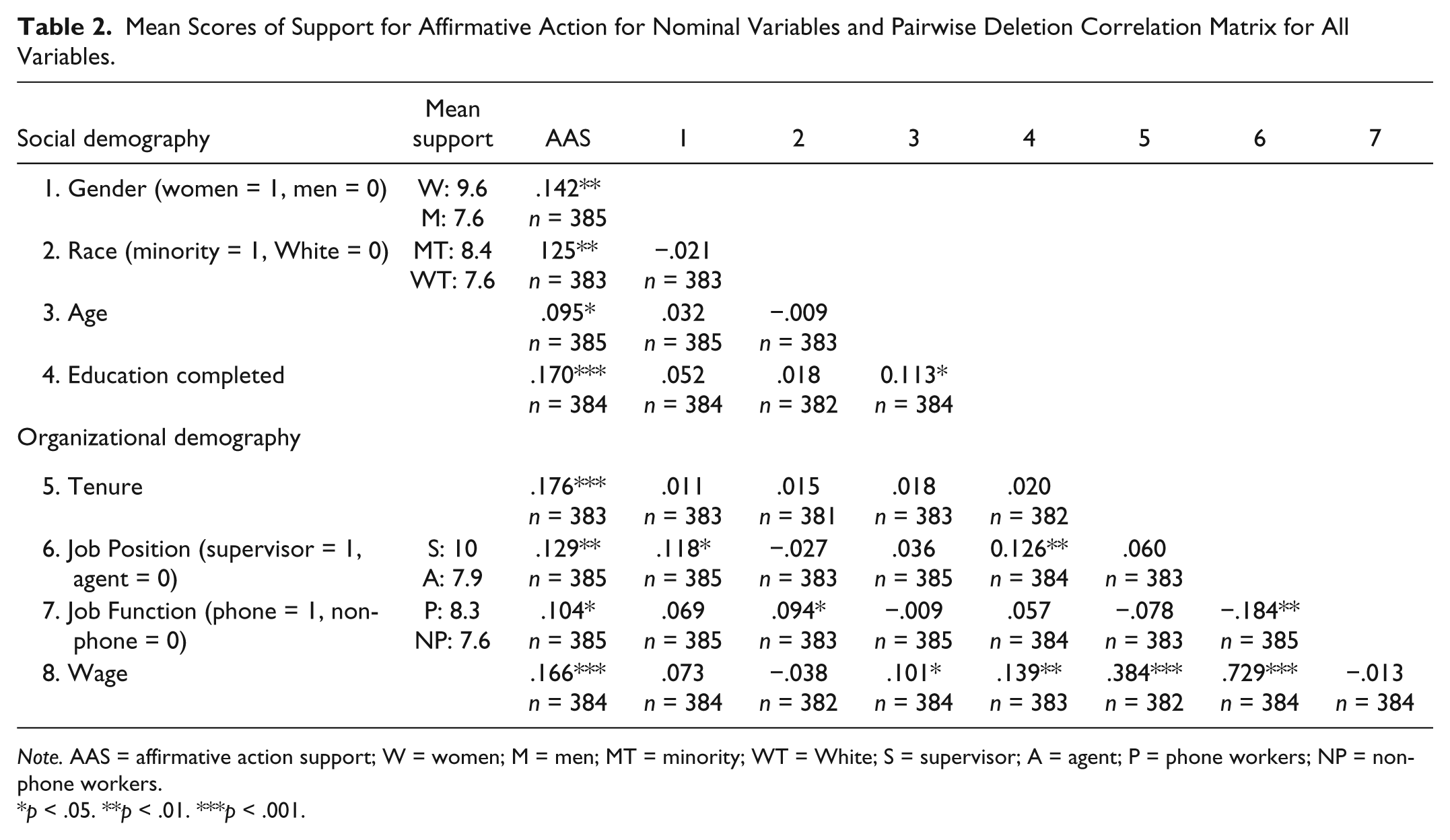
Note. AAS = affirmative action support; W = women; M = men; MT = minority; WT = White; S = supervisor; A = agent; P = phone workers; NP = non-phone workers.
p < .05. **p < .01. ***p < .001.
Social Demographic Variables
Gender: Man or Woman
Age: Current age of the workers in years.
Race-ethnicity: White or Minority: The minority population was not subdivided into smaller units because the focus of this study was on differences between Whites and minorities collectively. The underlying assumption here is that minorities, regardless of their within-category differential workplace experiences, would likely share a collective identity of being victims of employment discrimination compared with Whites. Earlier studies already confirmed that Hispanics, though typically less than Blacks in their support, consistently supported AA (Gallup, 2006; Kinder & Sanders, 1990; Kravitz & Platania, 1993). Also, although it has been suggested that Asian Americans experience less workplace discrimination than other minorities (Minami, 1995), Bell et al. (1997) found that the beliefs and attitudes of Asians about AA programs “although not identical, more closely resemble those of Hispanics and Blacks than those of Whites” (p. 367). In fact, Asian Americans get lower returns on their educational investments than Whites (Kim & Lewis, 1994; Narasaki, 1995), and they are more likely to develop similar attitudes toward AA as other minorities (Bell et al., 1997). Findings of these previous studies served as justification for collecting and analyzing data using “minority” classification, rather than specific racial ethnic categories, vis-à-vis Whites.
Education: Completed level of education, measured in ordinal scores, from grade school through post-baccalaureate education.
Organizational Demographic Variables
Job position: Agent or supervisor: Agents were all the workers under a supervisor. They (agents) were mainly entry-level workers under a supervisor. The supervisor was the first level of management, and he or she controlled a significant amount of power over the agents. Greater power in the organization generally yielded greater job security. Hence, the supervisor was assumed to be a more secured position than the agent.
Job function: Phone worker or non-phone worker: Phone workers received all customer inbound calls pertaining to customers’ accounts. They attended to customers only over the phone. Non-phone workers performed all other complex duties such as customers’ credit reviews, compliance analysis, and bookkeeping for the organization. Anecdotal information from corporate managers indicated that a high attrition rate existed among phone workers who constituted more than 50% of the total workforce in the organization at any given time. This caused a frequent shortage of phone workers, and the organization constantly looked for workers to fill empty phone job positions, as well as tried very hard to retain existing phone workers. The large size, high attrition rate, and the constant effort by the organization to recruit and retain phone workers made phone work much more secure than non-phone work positions, which were fewer in number (than phone positions) and were occupied mainly by Whites. These characteristics made non-phone positions potentially readily threatened by AA practice, in the organization’s effort to improve its workforce diversity.
Organizational tenure (also simply referred to as tenure): Length of time, in years, that the worker had worked in the organization. Longer tenure was assumed to be associated with greater job security.
Wage: Income was measured in hourly wages. Salaries were converted into wage based on a standard 40-hr labor week. Higher wage was assumed as an indicator of higher job security. This assumption was justified by the observed positive correlations (see Table 2) between wage and other factors of job security (job position, r =.729, p = .000; tenure, r = .384, p = .000).
Analyses
Three sets of tests were conducted to meet the objectives of this study. First, because of directional hypotheses, a one-tailed correlation test was conducted to establish the bivariate correlation of each independent variable in each of the first two models (social demography and organizational demography) with support for AA. Second, using only the variables that significantly correlated with support for AA in each model, separate multiple regression tests were conducted for each of the first two models to determine how the variables in each model predicted support for AA. The third test was a multiple regression analysis of all the variables that emerged as predictors of support for AA in each of the first two models. Together, these variables constituted the third model (combined model) of analysis. This model was important because it provided information on the relative value of the variables in each of the first two models in predicting support for AA through an inter-model interactive effect. This analysis also determined the likelihood that either social or organizational demography would dominate the other in predicting support for AA.
Results
Test results are presented, below, under the null for each research hypothesis and by model.
Model 1: Social Demography
Correlation analyses (see Table 2) showed that women scored higher for support of AA than men (r = .142, p = .0026), minorities than Whites (r = .125, p =.0071), and older workers than younger workers (r = .095, p = .0313). The null was rejected for each variable. Workers whose social demographic attributes were manifestly protected by AA demonstrated greater support for the policy than those whose attributes were not manifestly protected.
Bivariate correlation showed that workers with higher educational completion supported AA more than those with lesser educational completion (r = .170, p = .0004). The null was rejected. Higher educated workers supported AA more than lesser educated workers.
The multiple regression test was then used to investigate how all the variables in the social demographic model predicted support for AA. All the variables in the model were entered (block entry) into the regression equation, because each had significantly correlated with support for AA in bivariate correlation analyses. Results, shown in Table 3, model 1, indicated that except for age (p = .135), all social demographic attributes (education, β = .152; gender, β = .134; and race-ethnicity, β = .125) were significant predictors of support for AA.
Regression Models of Support for Affirmative Action.

Partial significance accepted at α = .10 into the final regression equation (Model III) because of its significant contributions to the final regression equation.
Model 2: Organizational Demography
Results (see Table 2) of bivariate correlation tests demonstrated that workers with longer organizational tenure supported AA more than those with shorter tenure (r = .176, p = .0003), supervisors supported the policy more than agents (r = .129, p = .0057), phone workers more than non-phone workers (r = .104, p = .0210), and those with higher wages more than those earning lower wages (r = .166, p = .0006). The null was, therefore, rejected for each variable.
The multiple regression was also used to determine how organizational demographic variables predicted support for AA. No variable was excluded from the block entry regression because each variable significantly correlated with support for AA in bivariate analyses. Result (Table 3, Model 2) showed that except for wages (p = .830), all organizational variables (tenure, β = 0.185; job position [supervisor = 1], β = 0.158; and job function [phone = 1], β = 0.145) emerged as organizational demographic predictors of support for AA.
Model 3: Combined Model (Social Plus Organizational Demography)
For analysis of the combined model, only the three significant predictors of support for AA in each of the first two models (social and organizational demography) were collectively block entered into the final multiple regression equation (see Table 3, Model 3). Regression results showed that all six variables in the model emerged as significant predictors of support for AA, but without any pattern of domination of one set of demographic attributes over the other. That is, neither Model 1 nor Model 2 dominated the other in predicting support for AA. Using standardized beta coefficients to rank the relative strength of each variable, organizational tenure (organizational demography—β = .180) emerged as the strongest predictor of support for AA. Educational attainment (social demography—β = .136), job position (organizational demography—β = .127), and gender (social demography—β = .116), respectively, followed tenure as predictors of support for AA. Job function (organizational demography) and race-ethnicity (social demography) tied with β = .113 as the weakest, but significantly positive, predictors of support for AA, relative to other variables in this model.
Discussion and Conclusions
The underpinning assumption of this study that workers would differentially support AA practices by their social and organizational demographic attributes was largely supported by test findings. Test findings concluded that workers (women and racial-ethnic minorities) whose social demographic attributes fell under the protected classes of AA (that is, likely beneficiaries of AA) were more likely to support the policy than those who were likely to define themselves as potential victims (men and Whites). This interpretation is adequately supported by literature on the relationship among gender, race-ethnicity, and AA (Bell et al., 1997; Kravitz, 1995; Konrad & Linnehan, 1995; Konrad & Spitz, 2003; Shteynberg et al., 2011; Summers, 1995). An exception to this self-interest notion of support for AA is that age (older workers), though a positive correlate in bivariate analysis, did not emerge as a predictor of support for AA in multiple regression containing other social demographic variables. Because age was positively correlated with support for AA in this study, this finding did not support an earlier finding by Jacobson (1985) that age was not a correlate of support for AA. The finding, however, supported Jacobson’s assertion that age did not predict support for AA. Reasons for why age failed to predict support for AA in this study can only be speculated as they were beyond the scope of direct investigation. One speculation is that older workers who theoretically could be expected to significantly support AA for self-interest, as members of a protected class under AA policy, failed to do so because they have attained sufficient job security in the subject organization, and, they therefore, no longer see AA as valuable to themselves. Another plausible speculation, is that age failed to predict support for AA in the subject organization perhaps, because there was no significant difference in age between Whites and the minority workers (Mean age difference = .134 years, p = .8600) who constituted 43% of study participants, and who significantly supported the policy more than White workers. While racial-ethnic statuses between Whites and minority workers predicted support for AA, age similarity between the two sets of workers might have prevented age (as an independent variable), from significantly predicting support for the policy.
The finding in this study, that educational attainment predicted support for AA, is well supported by literature. People with higher levels of education generally tend to be more supportive of policies of AA than lesser educated people (Elizondo & Crosby, 2004; Sidanius et al., 2008). However, this interpretation may be challenged by the assumption asserted by Schaefer (1996), that educated people often gave socially desirable responses to survey questions dealing with racial matters. By this, Schaefer implied that highly educated people were aware of a general social preference for political correctness on sensitive issues, and they (highly educated people), therefore, often respond to sensitive questions in socially desirable ways rather than express politically incorrect attitudes. It may, therefore, be true here (but not known as a fact through data for this study) that the direct relationship between educational attainment and support for AA was due to socially desirable (i.e., politically correct) responses, rather than true attitude. It may, however, equally be true, as indicated by Coenders and Scheeper (2003), that education had real liberalizing effects. That is, highly educated people tend to acquire greater liberal tendencies than people who have attained lesser education. This could be because, among other possibilities, education exposes people to new knowledge and new ways of perceiving realities which may produce change and transformations in the educated. Also, depending on the content of the education received, highly educated people may develop ideologies that favor redistributive racial policies, and they may be guided by these ideologies in their response to government policies like AA. Both the embrace of change and transformations through learning, and the development of ideologies of resource redistribution are plausible examples of the liberalizing effects of education. Had these liberalizing effects been true of the workers in this study, the greater likelihood of support for AA by the more educated workers might be, at least, partially attributed to the liberalizing consequences of their education.
Test findings also concluded that workers with demographic status that offered higher job security (longer tenure, higher positions, and job function) were more likely to support AA than workers with lesser job security statuses. This study also pointed attention to the significance of organizational demography, vis-à-vis social demography, in predicting support for AA. Previous studies on AA (Aberson, 2007; Konrad & Spitz, 2003; Park, 2009; Shteynberg et al., 2011) had predominantly asserted the dominance of race-ethnicity (a social demographic variable) in predicting support for AA, but such studies largely omitted in their analyses, the interactive effects of organizational demography on the strength of race-ethnicity in predicting AA support.
Especially noteworthy in this study was that support for AA was found to be strongest among workers with higher achievements. Based on the values of the standardized regression beta, the top two predictors of support for AA (organizational tenure and educational attainment) demonstrated that workers with greater accomplishments (longer tenure and higher education) were the most likely people to support AA. These achievements also probably provided employment security that, at least, partially provided the workers with some protection from competitions that could result from the use of AA in the organization. In addition, the protection offered by job security might also be compounded by the liberalizing effects of education. This interpretation may signal the importance of employee achievement, job security, and liberalness, over the attributes of race and gender, in predicting the likelihood of support for AA.
The findings of this study may inform organization leaders in approaches to minimizing opposition and resistance to AA practices in their organizations. By implication from this study, the lesser accomplished workers (those with lesser education and shorter tenure), as well as men, Whites, non-supervisory workers and non-phone workers (workers who do complex work) have a higher likelihood of opposing or resisting AA than their respective counterparts. As already mentioned under literature review, workers with high likelihood of opposing AA tend to see themselves as victims and non-beneficiaries of the policy. Also, workers with short tenure may resist AA due to a feeling of job insecurity. To reduce opposition and resistance to AA, the findings of this study suggest that organization leaders (perhaps, high-level personnel and human resources executives) who practice AA actively promote and support higher educational training for their less educated employees. It is also suggested that organizations increase opportunities for workers’ accomplishments, including opportunities for attaining supervisory positions. In addition, since AA is still a legitimate part of the American workplace, it may behoove organization leaders to solicit the services of their employees with higher likelihood of supporting AA as change agents in their organizations. In particular, as this study suggests, workers with longer tenure, highly educated workers, and supervisors (workers with the top three positive beta values for AA support) may be solicited to help socialize and mentor workers with high likelihood of resistance, to be more accepting of the practice of AA in their organizations.
Limitations
The choice of the subject organization in this study was availability. The subject organization was not selected based on a random approach. The organization was selected because it was one of the largest employers in its metropolitan area, as well as one of the employers with a significant amount of diversity in its employment, in a predominantly White Midwestern metropolis. In addition, the subject organization was in the finance industry. Had data been collected from multiple organizations in the same industry or from organizations in other industries and other locations, especially outside the Midwest, it is unknown whether similar or different results would have been obtained. It is, therefore, recommended that future research replicate this study in different organizations and industries outside of the Midwest for result comparisons. Also, even though a careful systematic approach was used in selecting research participants, a random sampling method of participants would have been preferred, had the organization granted the opportunity for random selection. This means that an unknown amount of sampling error can be anticipated in the sample. This error, however, is expected to be, at least, somewhat ameliorated by the high return rate and the systematic sampling approach used to select study participants.
Last, although organizational tenure was the strongest predictor of support for AA in this study, the low tenure average (2 years) and range (1-5 years) may pose some concern on the relative value of tenure in predicting support for AA. The low organizational tenure is suspected to be a consequence of high turnover, earlier mentioned, among the phone workers who constituted the largest percentage of employees in the subject organization, as well as the largest population (55%) of the participants in this study. The exact influence of high turnover in the organization, positively or negatively, on the predictive ability of tenure on AA support is unknown and not measurable because turnover data for the subject organization were not available for this study. Caution may, therefore, be exercised in the interpretation of the result on tenure.
Footnotes
Acknowledgements
I pay gratitude to my former undergraduate student, Mr. Cory Dooley, for his diligent assistance during data collection for this study.
Declaration of Conflicting Interests
The author(s) declared no potential conflicts of interest with respect to the research, authorship, and/or publication of this article.
Funding
The author(s) received no financial support for the research and/or authorship of this article.