




Abstract
Recent studies have increasingly investigated the effectiveness of both mobile and non-mobile digital game-based language learning. To gain an in-depth understanding of the differences in the effectiveness of mobile and non-mobile games, we compared studies from January 2000 to August 2020 investigating mobile game-based language learning (MGBLL) and non-mobile game-based language learning (NMGBLL). Sixty-four articles were analyzed from four aspects: game types, game elements, target languages, and learning outcomes. The results showed that (a) gamification, simulation games, and immersive games were applied most; (b) all games possessed the game elements of goals or rules; (c) the most investigated target languages were English and Chinese; and (d) the most discussed learning outcomes were language acquisition and psychological/affective state. The similarities and differences between MGBLL and NMGBLL were also identified. The current review provides an overview and in-depth analysis of mobile and non-mobile games for language learning, guiding practitioners to select appropriate digital games to cater to specific language teaching goals. Future directions of research are also discussed.
Introduction
Digital games are a new approach for assisting learning across a wide range of subjects, such as mathematics (Naik, 2014), engineering (Petri et al., 2017), science (Chen et al., 2012; Li & Tsai, 2013), law (Furió et al., 2013), and language learning (Zhang & Zou, 2020; Yu, 2018). Language learning appears to be the most promising because through digital games it is grounded in well-established theories, such as immersion in the language learning environment and the use of the target language for interaction in games (Chen et al., 2021; Hung et al., 2018). For this reason, an increasing number of studies have investigated digital game-based language learning (DGBLL) (Hung et al., 2018). DGBLL places learners in interactive situations which engage them in game-based learning tasks (Talan et al., 2020; Xu et al., 2020) while encouraging the use of the target language (Reynolds & Kao, 2021; Xu et al., 2020).
The advent of mobile devices has arrived in tandem with the movement from DGBLL to mobile game-based language learning (MGBLL) (Chang & Hwang, 2019; Schmitz et al., 2012). Mobile games are played with portable devices, such as mobile phones, tablets, personal digital assistants (PDAs), and phablets (Chang & Hwang, 2019; Zhang et al., 2021). Mobile games can engage students in extramural language learning, as they apply mobile and gaming technologies together with socializing and learning activities (Kohnke et al., 2020; Lee, 2019). In this way, learners are able to acquire a language outside the classroom. In addition to mobile devices, digital games in support of language learning can also be played on non-mobile devices, such as personal computers (PCs) and video consoles, and other gaming platforms and means (e.g., multimedia and robots) to support language learning (Hung et al., 2018). Compared with games played on non-mobile platforms, mobile games have been found to be more promising for making language learning portable and seamless (Acquah & Katz, 2020; Hung et al., 2018). This is mainly because MGBLL is usually delivered on devices that enable students to learn anytime and anywhere (Chen et al., 2019; Chen et al., 2020). To gain a more in-depth understanding of language learning through games, a systematic review of mobile and non-mobile games appears timely for two reasons: (1) to enrich the literature by presenting the differences and similarities between the application of mobile games and non-mobile games in language learning; (2) to clarify the efficiency of mobile and non-mobile games for instructional purposes in language learning.
Literature Review
Several reviews on DGBLL have been conducted using diverse analytical methods and review foci (see a summary in Table 1) including four representative ones by Hung et al. (2018), Talan et al. (2020), Acquah and Katz (2020), and Zou et al. (2019). Hung et al. (2018) performed a scoping review of 50 high-quality studies from 2007 to 2016, exploring the impact of digital game-based language education. Their foci were partly in line with the current review and thus can inform our research. Hung et al. reached seven conclusions: (1) mixed methods were used most; (2) researchers frequently applied immersive games and tutorial games to assist language learning; (3) most games were researcher-developed for specific language learning purposes; (4) PCs were the most popular gaming device; (5) among languages English was investigated the most; (6) participants were usually of mixed language proficiency mostly at the university level; and (7) most learning outcomes were positive, in particular language acquisition and affective states. Although Huang et al.’s study guided teachers’ selection of digital games to assist language learning, they did not compare different gaming devices (e.g., PCs, mobile phones, and tablets).
A Comparison of Methodologies and Focus of Previous Reviews.

Note. DGBLL = digital game-based language learning; DGVL = digital game-based vocabulary learning; MGBL = mobile game-based learning.
In another study, a meta-analysis on the efficiency of digital and non-digital educational games of 154 articles from 2004 to 2019, Talan et al. (2020) found that games had modest positive effects on academic achievements and that learning achievements did not vary with the student levels and duration of implementation. However, they did vary depending on the courses, class size (small class size had the largest effect size and large classes the smallest), and game types (the effect size of the non-digital games was higher than digital ones). Notably, both digital and non-digital games contributed to cognitive gains among their reviewed studies. The disadvantages of games, such as the deviation of learning goals, alienation from the social environment, and the difficulty to control the in-class atmosphere, were also reported. Although Talan et al. compared the effect sizes between digital and non-digital games, they did not highlight the specific game genres. They also did not consider target language, knowledge acquisition, and learner affective state, indicating a need for future reviews to investigate these dimensions.
Based on 26 articles from 2014 to 2018, Acquah and Katz (2020) systematically reviewed the influences of digital games on second language learning outcomes for primary to high-school students. Several findings reported by Acquah and Katz were similar to Hung et al. (2018), including the frequent use of mixed research methods, the tendency to use computer games and research-developed games, the tendency to design learning-driven games, the focus on the English language, and the positive influences on language acquisition and affective states. Acquah and Katz identified game features, such as the degree of ease-of-use, challenge, goal-orientation, and interactivity, thereby providing a more thorough understanding of digital games. However, their review did not identify game features of various gaming devices (e.g., PCs, mobile phones, and tablets) learners used.
Focusing on the domain-specific topics, Zou et al. (2019) reviewed past studies from 2008 to 2018 and speculated on possible future trends of digital game-based vocabulary learning (DGVL). They found 10 types of digital games, with tutorial games being the most popular, followed by simulation games and role-playing games. These games enhanced learners’ vocabulary learning both in the short and long term. Zou et al. also categorized the theoretical foundations of DGVL, which included the linguistic theories (e.g., involvement hypothesis, input hypothesis) and the educational theories (scaffolding, game-based learning, etc.). Zou et al.’s review was comprehensive. However, their focus was unitary, without classifying the types of game devices that were used by learners.
Two other studies investigated mobile game-based learning (MGBL). In the first study, Chang and Hwang (2019) reviewed MGBL studies published from 2007 to 2016 resulting in four major findings. First, smartphones, tablet computers, and PDAs were commonly adopted to support mobile games. Second, mobile games were used by several broad discipline areas, such as social science, social studies, science, and languages. Third, some learning strategies were applied to MGBL, such as contests, contextual mobile learning, and project-based learning. Fourth, research topics tended to include multiple perspectives with at least two domains, for example, affective states, learning outcomes, cognition, etc. Although their findings were compelling, Chang and Hwang did not include non-mobile games, thus limiting the scope of their review and suggesting a need for a further review of mobile and non-mobile games for language learning.
In the second study, Schmitz et al.’s (2012) review of 43 studies on MGBL from 2001 to 2011 revealed that mobile learning gaming generated affective and cognitive learning outcomes. As for affective outcomes, features of gaming, such as cooperation, augmented reality (AR), pervasive games, and physical navigation, improved students’ motivation to learn. However, unlike affective outcomes, the educational values of diverse gaming features on cognitive outcomes were less evident. Schmitz et al. (2012) offered insights into the effects of mobile gaming features on affective and cognitive learning outcomes, but they did not focus on other learning outcomes (e.g., knowledge outcomes, learning skills, etc.) and did not investigate non-mobile games. Thus, again, a review of mobile and non-mobile games to understand their influence on learning outcomes would be informative.
In summary, with more empirical studies exploring the effects of digital games on language learning, an updated review is needed to identify their effects on language learning (Hung et al., 2018). Seeing that digital games are played on both mobile devices (e.g., mobile phones and tablets) and non-mobile ones (PCs, video consoles, multimedia, etc.) (Acquah & Katz, 2020; Hung et al., 2018), the present review compares MGBLL and NMGBLL studies. The need for such a comparative review has been noted in previous reviews on digital games, which have been either too broad or too narrow in their focus. To respond to these needs, this study compared MGBLL and NMGBLL studies published from January 2000 to August 2020 in terms of game types, game elements, target languages, learning outcomes, and similarities and differences. Accordingly, the present review is guided by the following questions:
(1) What types of games have been investigated in MGBLL and NMGBLL studies?
(2) What game elements have been investigated in MGBLL and NMGBLL studies?
(3) What target languages have been investigated in MGBLL and NMGBLL studies?
(4) What were the learning outcomes of MGBLL and NMGBLL studies?
(5) What were the similarities and differences between MGBLL and NMGBLL studies?
Method
A three-step process was used to identify and analyze relevant articles: search, selection, and data analysis (Hwang & Fu, 2019; Su & Zou, 2020; Zhang & Zou, 2020). The search was conducted in the Web of Science Core Collection because it is a compilation of high-quality articles published in Social Science Citation Index (SSCI) journals (Zhang & Zou, 2020). In the present study, publications from January 1, 2000 to August 31, 2020 were retrieved by using the keywords: gam* covering game-related keywords (Hung et al., 2018) and language learning (Hwang & Fu, 2019), with AND between them to locate papers related to the review theme. Although the present study is qualitative in nature, it describes some frequencies of the retrieved information (e.g., game genres and game elements) from the identified articles, which were helpful for us to answer the research questions.
Journal Selection
The researchers limited the selected articles to publications from SSCI journals for quality assurance because articles in SSCI journals are published based on rigorous criteria and have a greater impact (Hwang & Fu, 2019). We selected the following journals according to the 2019 Scimago Journal & Country Rank (SJR). First, the top four journals which publish research on educational technology in Language and Linguistics were selected: Language Learning and Technology, Computer Assisted Language Learning, System, and ReCALL. Second, five journals that publish research on language education in E-learning were identified: Computers and Education, British Journal of Educational Technology, Journal of Computer Assisted Learning, Educational Technology and Society, and Interactive Learning Environments. After comparing our journal list with Hung et al. (2018), we found that Educational Technology Research and Development was included in their review of DGBLL. Considering that it is an influential journal in the field, we also included it in our list. In the end, we finalized 10 journals.
Article Selection
Our search at the end of August 2020 generated 155 articles from the 10 journals. These articles were further examined based on certain inclusion and exclusion criteria (Table 2). The criteria for inclusion are (1) being an experimental or empirical study; (2) being related to investigating digital game-assisted language learning; and (3) being explicit in describing the adopted games.
Inclusion and Exclusion Criteria.

Several types of exclusion criteria were applied: (1) being a review, bibliometric analysis, commentaries, or editorials; (2) lacking investigation on language knowledge or skills; (3) lacking application of digital games to learning activities (e.g., descriptions of the game per se, applications of games to social activities); (4) focusing on game upgrade (e.g., algorithm design, game programing, game environment design); (5) lacking any connections to the language subject; (6) lacking any relationship to digital games; and (7) lacking explicit descriptions on digital games. Within these constraints, 91 articles were excluded after the abstract and full-text screening. For example, the following articles were excluded: Chen et al. (2020) for being a meta-analysis review; Troussas et al. (2020) for focusing only on learners’ psychological states rather than investigating language knowledge or skills; Danby et al. (2018) for applying digital games to facilitate social collaboration; Hwa (2018) for being irrelevant to language learning; Calderón et al. (2016) for being irrelevant to digital games; Ravenscroft (2000) for centering on the design of the game environment; and Ryu (2013) for giving sparse descriptions on the adopted game. Thus, 64 articles were included in the review. The method of data collection and processing is illustrated in Figure 1.

Method of data collection and processing.
Coding Scheme
To review MGBLL and NMGBLL studies over the past 20 years, two researchers devised a coding scheme, which consisted of four categories: game genres, game elements, target languages, and learning outcomes.
Game genres, game elements, and target languages
To differentiate MGBLL and NMGBLL, the researchers divided 64 games (one for each article) into two broad categories: mobile games and non-mobile games. Mobile games are games played with portable devices, such as mobile phones, tablets, PDAs, and phablets (Chang & Hwang, 2019). Non-mobile games are those played with non-mobile devices (Hung et al., 2018), such as PCs, video consoles, multimedia, and robots. In total, there were 27 and 37 in the categories of MGBLL and NMGBLL, respectively.
Following Hung et al. (2018) and Zou et al. (2019), we categorized games into 11 genres: simulation games, puzzle games, exergames, tutorial games, immersive games, board games, adventure games, music games, alternate reality games, gamification, and mixed games.
In line with Xu et al. (2020) and Shute et al. (2016), we adopted several game elements applicable to the language learning field to code the identified games: interactive problem solving, goals or rules, adaptive challenges, control, continuous feedback, uncertainty, and sensory stimuli (see Table 3).
Description of Core Game Element (Shute et al., 2016; Xu et al., 2020).

The target languages involved in the selected studies were coded as reported in the articles, for example, English, Chinese, Spanish, Turkish, etc.
Learning outcomes
The learning outcomes included six dimensions: language acquisition, knowledge acquisition, contemporary competencies, participatory behaviors, affective or psychological states, and correlation outcomes (Hung et al., 2018) (Table 4).
Coding Scheme for Learning Outcomes.

Language acquisition included both knowledge and skills (Hung et al., 2018), and it mainly covered listening, speaking, reading, writing, vocabulary, grammar, pronunciation, and pragmatic competence (one’s ability to use knowledge of linguistics and norms in socially bound interactions) (Stockwell, 2007). If a study investigated two or more language knowledge and/or skills, the label “mixed” or “integrated language” was applied (Hung et al., 2018; Hwang & Fu, 2019).
Knowledge acquisition was coded as subject-matter knowledge (content learning in one’s target language), cultural learning, and others.
The category “contemporary competence outcomes” was devised based on Qian and Clark (2016), mainly including critical thinking, creativity, collaboration, and communication or communicative competence.
“Participatory behaviors” referred to students’ use of target languages to engage in game-based language activities, which involved classroom interactions among language learners, in-game linguistic interactions, beyond-game linguistic interactions, and the gaming culture or linguistic ecology (Hung et al., 2018).
“Affective or psychological state” consisted of general perceptions, attitudes, motivation/interest, engagement/flow, technology acceptance/tool evaluation, self-efficacy/confidence, cognitive load, learner autonomy, learning anxiety, willingness to communicate, and others (Hung et al., 2018; Hwang & Fu, 2019).
Some studies have examined the relationship between different influential factors (i.e., affective state, individual difference, and external factors) and learning outcomes, and all of these were classified as correlation outcomes.
Results
The results were divided into four categories: game genres, game elements, target language, and learning outcomes. Based on these, the similarities and differences between MGBLL and NMGBLL were identified accordingly.
Game Genres
Concerning the types of games, we found 11 heterogeneous game genres (Figure 2). Of these, gamification (n = 24) was by far the most popular, followed by immersive games (n = 16), then simulation games (n = 13). A few studies applied alternate reality games (n = 2) and adventure games (n = 2). The following game types were used once in the sampled studies: puzzle games, exergames, mixed games, tutorial games, board games, and music games.

Game genres adopted in MGBLL and NMGBLL.
Gamification refers to the use of game elements and design, such as incentive systems, points, badges, levels, experience points (XP), and leaderboards, to engage players in a task that they otherwise would not find attractive (Talan et al., 2020; Yıldırım & Şen, 2019; Zou, 2020). Gamification was found to be used more frequently in MBGLL than NMGBLL. Examples of mobile gamification were Happy2Languages (Cheng & Chen, 2019) and Duolingo (Loewen et al., 2019). Non-mobile gamification was usually played on computers (e.g., Hao et al., 2010; van de Sande et al., 2016; Young & Wang, 2014). Immersive games provided learners with narrative experiences by allowing them to assume a role and to interact with other learners through avatars in computer-supported immersive gaming worlds (Hung et al., 2018). This game genre was used most in NMGBLL, such as in the 3D multi-user virtual environment (3DMUVE) (Chen, 2020), game-based on 3D virtual world (3DVW) (Chen & Kent, 2020), and massive multiplayer online role-playing game (MMORPG) (Suh et al., 2010), while it appeared only twice in MGBLL (Liaw, 2019; Liu & Chu, 2010). Simulation games attracted similar attention from MGBLL and NMGBLL as they facilitated learning by engaging learners in simulated authentic language activities (Hung et al., 2018). Examples include the use of mobile spherical video-based virtual reality (SVVR) to support Chinese writing (Huang et al., 2020) and the use of the computer game, The Sims, for learning English (Ranalli, 2008).
Two game genres were used infrequently by MGBLL and NMGBLL: alternate reality games and adventure games. Alternate reality games enable learners to interact through multiple media both in the virtual world and in reality. For example, Lan (2015) organized a field observation for students visiting a physical English Village, then constructed a virtual context through a non-mobile game (i.e., 3DMUVE) for learning English. Adventure games provide rich action elements and fictional scenarios for single learner players to conduct language activities in a fantasy setting (Hung et al., 2018). For example, students participated in finding and returning animals to cages according to given storylines in a mobile-enhanced zoo game (Sandberg et al., 2014).
The remaining six game genres were the least adopted. Puzzle games, exergames, and mixed games were found in MGBLL studies, while tutorial games, board games, and music games were found in NMGBLL studies. “Her story” is a mobile puzzle game in which learners construct a murder story by rearranging archived video narratives (Lee, 2019). Mobile HOPSCOTCH is an exer-game that incorporates physical activities into learning via gaming. Lucht and Heidig (2013) applied HOPSCOTCH to assist English learning. When playing this game, learners answered questions on the screen by jumping on a sensor mat. Mixed games refer to the use of two or more different game genres. For example, McNeil (2020) used seven different types of mobile games (e.g., Smurfs’ Village, Clash of Clans) to support language learning. Tutorial games involve teaching presence to facilitate learning in the activities (Hung et al., 2018). Alemi and Haeri (2020), for example, created interactions among an assistant Robot, the teacher, and the children to develop children’s pragmatic performance. As the name implies, board games engage learners by allowing them to play a game using a board, possibly with cards and dice, etc. Wu et al. (2014) used playground board games for genuine communication in the EFL classroom. Finally, learners play music games to learn using music elements (Hung et al., 2018). DeHaan et al. (2010) used a music video game to improve learners’ vocabulary. However, they found the performance of players was not as good as those who were watching.
Game Elements
Following Xu et al. (2020) and Shute et al. (2016), our review summarized seven game elements to answer the second research question.
As illustrated in Figure 3, the most common gaming element was goals or rules (n = 64, 100%), followed by sensory stimuli (n = 28, 43.8%), adaptive challenges (n = 27, 40.2%), continuous feedback (n = 24, 37.5%), control (n = 19, 29.7%), interactive problem solving (n = 14, 21.9%), and uncertainty (n = 3, 4.4%). The less incorporation of control, interactive problem solving, and uncertainty elements indicated much room for improvement among the identified games. For example, a game should possess a “control” element because learners’ control over gameplay and the game environment decides their flow state, learning experience, and learning motivation (Sandberg et al., 2014; Shute et al., 2016), thus influencing the learning outcomes. Further, “interactive problem solving” was a necessary gaming element, as learners actively interacted with games to solve problems or quests. In turn, they gained a sense of achievement (Qian & Clark, 2016; Wen, 2018) and continued to complete their learning tasks (Hwang et al., 2017), which contributed to learning achievements (Chu et al., 2019). Finally, “uncertainty” was important for creating an effective learning experience. It could surprise learners, thereby making them curious and eager to participate in the activities (Sandberg et al., 2014) and maximizes the possibility of language acquisition.

Game elements embedded in MGBLL and NMGBLL.
In both MGBLL and NMGBLL studies, we found that all games were designed to fulfill goals or rules, which was essential for language acquisition (Xu et al., 2020), and that “uncertainty” was the least considered gaming element. The distribution of these game elements in MGBLL and NMGBLL studies was different.
Target Languages
Ten target languages were investigated by the selected studies (Figure 4). Our review found that most studies targeted English (n = 46, 71.9%), with the second most common language being Chinese (n = 6, 9.4%), which corroborates with the findings of Acquah and Katz (2020) and Hung et al. (2018). The remaining eight languages were either discussed by researchers in MGBLL or NMGBLL studies. In MGBLL studies, researchers explored Spanish and Turkish, while in NMGBLL studies, researchers explored Dutch, German, French, Italian, Swedish, and Japanese.

Target languages investigated in MGBLL and NMGBLL.
In both MGBLL and NMGBLL studies, English was investigated most, followed by Chinese. However, English was by far more frequently discussed than Chinese, which matched the findings of Hwang and Fu (2019). This could be because English is widely used for international communication across trade, leisure, entertainment, and education (Wu & Huang, 2017).
Learning Outcomes
The overall learning outcomes are shown in Figure 5, which includes six categories. Specifically, the learning outcomes of language acquisition were investigated by all MGBLL and NMGBLL studies (n = 64, 100%). Approximately 65.6% focused on learners’ psychological/affective state (n = 42), indicating that the research theme tended to be multi-dimensional, including at least two aspects of affective states and learning outcomes. Other learning outcomes included correlational outcomes (n = 20, 31.3%), participatory behavior (n = 12, 18.8%), contemporary competence (n = 9, 14.1%), and knowledge acquisition (n = 7, 10.9%). Each learning outcome is further elaborated below in terms of their frequencies, with relevant studies as examples.

Outcome distribution of MGBLL and NMGBLL.
Language acquisition
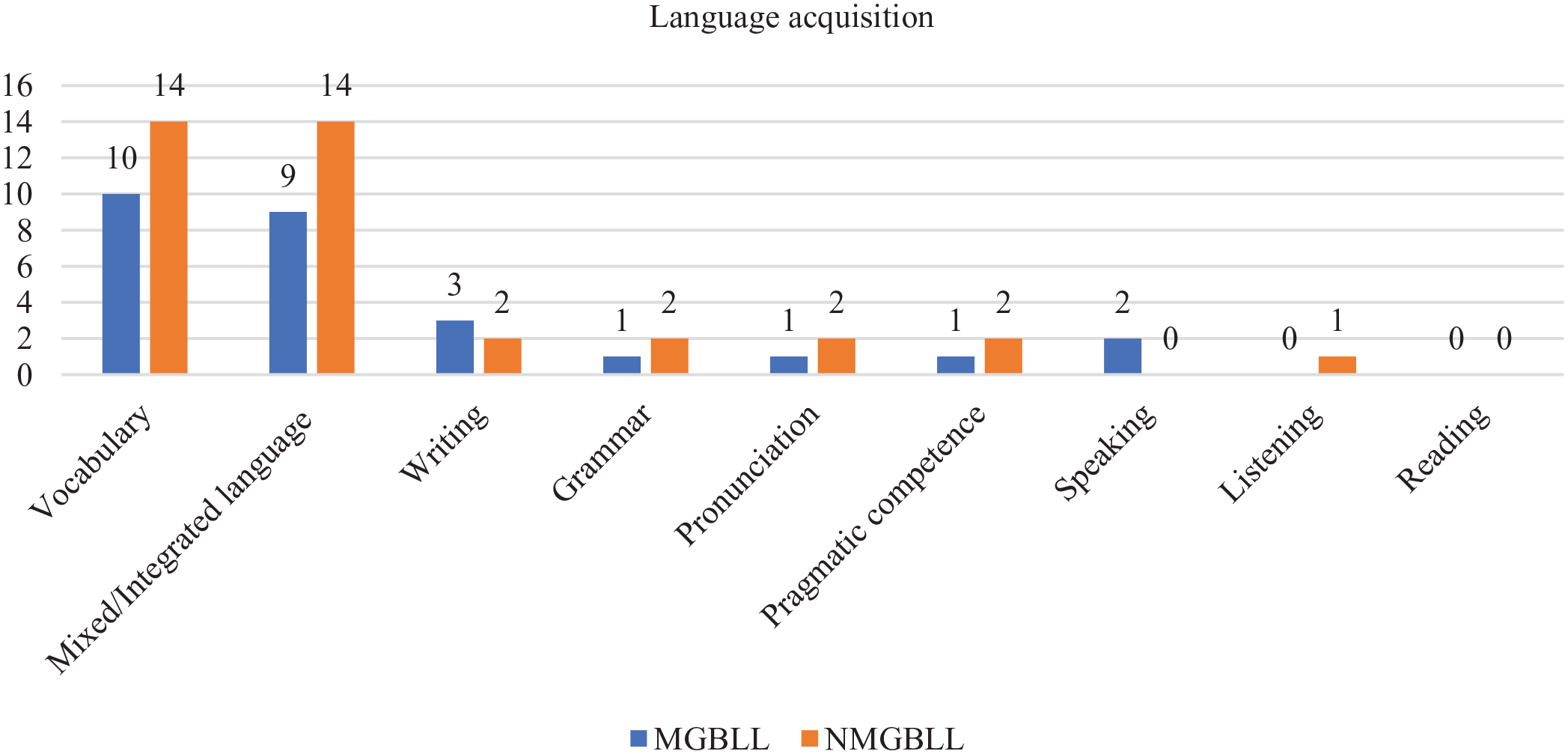
Regarding language acquisition (Figure 6), a majority of MGBLL and NMGBLL studies investigated vocabulary acquisition (n = 24, 37.5%) and mixed/integrated language learning (n = 23, 36%), similar to Hung et al. (2018) and Xu et al. (2020). One MGBLL example of vocabulary acquisition was Wu (2021), who helped learners effectively acquire English vocabulary through the AR game, named Pokémon Go. In this game, learners integrated the words on the flashcards through AR and repeated the Pokémon words (e.g., prefix, suffix, and root) they had learned. In this way, their attitude, motivation, and learning efficiency were improved. Many researchers applied games to facilitate mixed language development. Chen and Kent (2020) engaged learners in English learning through a computer-based 3DVW game. In this game, learners completed two second-life tasks, and then they wrote after-class reflection posts. Through this, learners’ speaking and writing abilities improved significantly.
Language acquisition of MGBLL and NMGBLL.
Underexplored aspects of language acquisition included writing (Lin et al., 2018), grammar (Reynolds & Kao, 2021), pronunciation (Schremm et al., 2017), and pragmatic competence (Alemi & Haeri, 2020). The remaining three language skills (listening, speaking, and reading) are worth noting. Only one NMGBLL study investigated listening skills (Hwang et al., 2017), and two MGBLL studies investigated speaking skills (Grimshaw & Cardoso, 2018; Liaw, 2019). Reading skills alone were not investigated in any study, but they were assessed with other skills. For example, one NMGBLL study explored the co-development of speaking and reading skills through a VirtUAM game (Berns et al., 2013; Chen & Kent, 2020). Kondo et al. (2012) improved learners’ reading and listening skills together through a mobile Nintendo DS game.
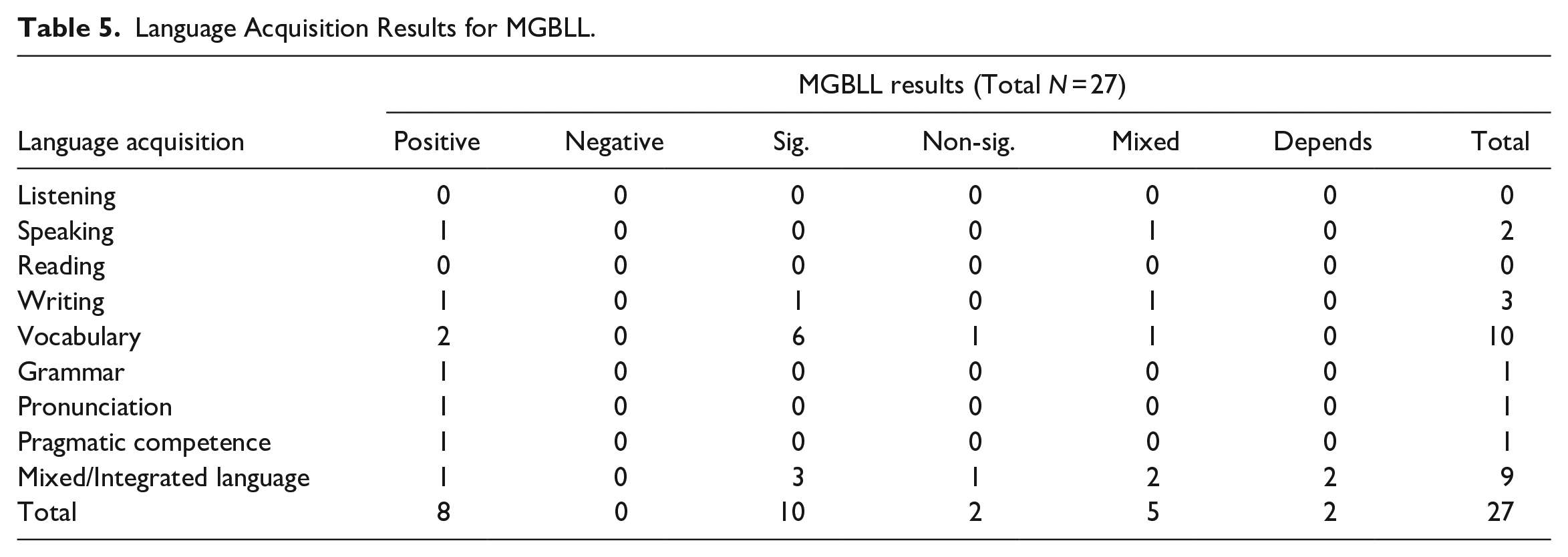
Tables 5 and 6 show the language acquisition results for MGBLL and NMGBLL. Most MGBLL studies (18 out of 27, 66.7%) reported positive results (annotated as positive and significant in Table 5). Regarding these positive results, we found that researchers frequently applied mobile games to facilitate vocabulary learning (n = 8, 29.6%). For example, learners who played mobile VR games (e.g., House of Languages) had greater vocabulary acquisition. To learn simple words, during the gameplay, learners viewed 3D objects with names and listened to their pronunciation through the interactive VR environment. To acquire complex vocabulary, learners played mini-games with increasing difficulty, such as word guessing tests and puzzles (Alfadil, 2020).
Language Acquisition Results for MGBLL.
Language Acquisition Results for NMGBLL.

The second and third most positive results in MGBLL were mixed/integrated language (n = 4, 14.8%) and writing (n = 2, 7.4%), respectively. To assist mixed language development, Cordero et al. (2015) employed Read Create Share (RCS) to help children read and write in Spanish. With RCS, children first read through a passage that culminates in an illustration, and then they located hidden objects in the illustration before narrating their pictures. This approach was promising for supporting learners’ reading and narrative construction. For writing skills, Lee (2019) based their study on the game “Her story” in which learners constructed a piece of creative English writing according to the disordered video clips. Their writing ability and creativity subsequently improved significantly.
Speaking ability, grammar, pronunciation, and pragmatic competence were found to have improved through MGBLL, using digital game-enhanced pedagogy (McNeil, 2020), vTime (Liaw, 2019), Save the Princess with Teddy (Chu et al., 2019), and Kes Sesi (Samur, 2019).
However, not all results were positive. Mixed results of the learning outcomes (n = 5, 18.5%), non-significant results concerning the effectiveness of digital games (n = 2, 7.4%), and results that were conditional upon the players and contexts (n = 2, 7.4%) were identified in MGBLL studies. No studies reported negative results, demonstrating the potential of mobile games to facilitate language acquisition (Hwang & Fu, 2019).
The language acquisition results for NMGBLL are reported in Table 6. A majority of positive results were regarding vocabulary acquisition (n = 10, 27%), followed by mixed/integrated language (n = 7, 18.9%), writing (n = 2, 5.4%) and pragmatic competence (n = 2, 5.4%). Specifically, Yang et al. (2020) found that learners greatly improved their vocabulary through a cognitive, complexity-based competition game in which participants completed three vocabulary tasks with graded difficulty. For mixed language learning, language learners’ collaborative completion of the Second Life-based assignments accounted for their comprehensive improvements in learning French (Hsiao et al., 2015). Through a game-based writing strategy tutoring system (Writing Pal), students had access to strategy instructions and practices, instructional videos, and mini-games when writing their essays, which led to their writing improvement (Allen et al., 2014). Children’s pragmatic performances, such as thanking and requesting, were facilitated through interactions between an assistant robot (NIMA), the teacher, and the children (Alemi & Haeri, 2020).
The other two positive results were in listening (Hwang et al., 2017) and pronunciation (Schremm et al., 2017) skills. Mixed results of the learning outcomes (n = 7, 18.9%), non-significant results concerning the effectiveness of digital games (n = 1, 2.7%), and results that were conditional upon the players and contexts (n = 5, 13.5%) were also found. A negative result was reported by DeHaan et al. (2010), who found that learners who played a music video game recalled less vocabulary than their counterparts who did not play because of attention distraction and cognitive overload.
From the above, we drew the following conclusions. First, a majority of mobile and non-mobile games contributed to language learning, especially in terms of vocabulary acquisition, mixed language learning, and writing. Second, mixed results, non-significant impact, and dependent results existed in both MGBLL and NMGBLL studies. However, one study in NMGBLL reported a negative result regarding vocabulary acquisition.
Psychological/Affective state
The psychological/affective state emerged as a critical area for MGBLL and NMGBLL (Figure 7). Learner motivation/interest (n = 23, 36%) was the most frequently investigated affective aspect in MGBLL and NMGBLL studies. Usually, learners had higher motivation/interest, possibly because the game was interesting (e.g., Chen & Kent, 2020; Huang et al., 2020; Lee, 2019). However, the monotonous presentation of learning materials and the repetition of less interactive tasks in Duolingo, a mobile gamified learning application, caused a decrease in learner motivation (Loewen et al., 2019). The second most discussed affective state was “general perceptions” (n = 13, 20.3%). Although learners encountered some barriers, such as limited technical knowledge and technical problems (Lee & Park, 2020), these detractions did not override the benefits of MGBLL and NMGBLL (Chen & Kent, 2020; Huang et al., 2020). Finally, 13 MGBLL (e.g., Lee & Park, 2020) and NMGBLL studies (e.g., Lin et al., 2018) investigated the sub-category of “others,” such as enjoyment and learning satisfaction.

The psychological state of MGBLL and NMGBLL.
Some studies investigated learner engagement/flow experience (n = 11, 17.1%), learning anxiety (n = 8, 12.5%), and attitude (n = 7, 10.9%). Most learners had high engagement and a positive attitude (Chen & Kent, 2020; Hsu, 2017; Lin et al., 2018; Lucht & Heidig, 2013). Furthermore, these games reduced anxiety (Wei et al., 2018; Wu & Huang, 2017), providing learners with a relaxing learning environment.
A few MGBLL and NMGBLL studies investigated learner cognitive loads and self-efficacy/confidence. Learners usually had lower cognitive loads (Hao et al., 2010; Huang et al., 2020) and higher self-efficacy/confidence in the learning tasks (Chen, 2016; Huang et al., 2020). However, Rachels and Rockinson-Szapkiw (2018) found a decrease in learners’ self-efficacy in mobile learning using Duolingo, which may have been because the adaptive challenges of Duolingo did not stretch learners’ current language knowledge. Notably, little attention was paid to technology acceptance or tool evaluation (Sung et al., 2017), learner autonomy (Chen & Kent, 2020), and willingness to communicate (Grimshaw & Cardoso, 2018).
As for the affective state, researchers in MGBLL and NMGBLL studies investigated the dimensions of learner motivation, general perceptions, engagement, and others more than technology acceptance, learner autonomy, and willingness to communicate. Regarding the affective state of “others,” in addition to the investigation into learning satisfaction and enjoyment, MGBLL studies investigated learner attention (Wu & Huang, 2017), game attraction (Lucht & Heidig, 2013), and self-regulation (Kondo et al., 2012); while NMGBLL studies investigated learners’ perceived tension or pressure when they played digital board games (Wu et al., 2014) and whether learners felt boredom when they played and watched a music game (DeHaan et al., 2010).
Correlation outcomes
A small proportion of MGBLL and NMGBLL studies explored how external factors (n = 10), affective states (n = 5), and individual differences (n = 5) influenced learners’ learning outcomes (see Figure 8).

Correlation outcomes for MGBLL and NMGBLL.
Regarding affective states, four MGBLL studies explored the role they played in learning outcomes, while only one NMGBLL study focused on this aspect. The results suggested that if learners had higher motivation, lower anxiety, and a positive attitude, they learned better (Liu & Chu, 2010; Suh et al., 2010; Wu, 2021; Yang & Quadir, 2018). However, Cheng and Chen (2019) found no relationship between learning motivation and learning achievements, and Hwang et al. (2017) reported that learners with higher anxiety performed better in listening.
MGBLL and NMGLL researchers paid moderate attention to the relationship between individual differences (e.g., gender, learning habits, learning style, and family background) and learning achievement, with mixed results. For instance, gender, learning habits, and learning style did not influence learning achievement (Cheng & Chen, 2019). Learners who had advantaged family backgrounds (Cheng & Chen, 2019) and prior knowledge (Suh et al., 2010; Yang & Quadir, 2018) outscored those who did not.
When looking into the relationship between external factors (time spent, game type, game behavior, etc.) and learning outcomes, our review found that NMGBLL studies focused more on this aspect than MGBLL studies. The relationship between time spent on learning games and learning achievements was discussed most, with four finding a positive correlation (Franciosi, 2017; Kondo et al., 2012; Loewen et al., 2019; Schremm et al., 2017). The remaining study (Segers & Verhoeven, 2005) found a negative correlation between the amount of participation in a computer-based discovery game and phonological gains. Another positive correlation between game type and learning outcomes were found: an interactive mobile jigsaw game facilitated verbal performance (Hwang et al., 2016), and computer inferencing games contributed to vocabulary learning (Smith et al., 2013). No correlation was found between in-game note-taking behavior and learning progress or between the number of games played and learning progress (Chen & Yang, 2013; Segers & Verhoeven, 2003).
MGBLL studies distributed similar weight to identify whether external factors, individual differences, and affective states correlated with learning outcomes, while NMGBLL studies considered external factors the most.
Participatory behaviors
As shown in Figure 9, a few MGBLL and NMGBLL studies discussed learner participatory behaviors. In-game linguistic interaction (n = 6) and classroom interaction (n = 5) were discussed most. In contrast, gaming culture/linguistic ecology (n = 1) attracted less attention, and no study specifically concerned beyond-class interactions.

Participatory behavior of MGBLL and NMGBLL.
Regarding in-game linguistic interaction, researchers in NMGBLL studies were more concerned with this aspect than MGBLL studies. For example, McNeil’s MGBLL study (2020) examined Korean EFL learners’ game participation by analyzing the learners’ journals. The results showed that certain behaviors, such as experience exchanging, preparation to interact in discourses and around games, and willingness to pose questions in the community, were supportive. Through in-game collaboration, students overcame challenges and made learning gains.
Classroom interactions were investigated more by MGBLL than NMGBLL studies. For example, Wong et al. (2011) reported improvements in Chinese learning through the mobile game, Chinese-PP, in which learners continually constructed Chinese characters. In this way, they found that self-efficacy was improved, and the gap between high and low achievers was narrowed. A good illustration of NMGBLL was Hsiao et al. (2015), who found that the Second Life-based French learning environment greatly facilitated students’ classroom collaborations, including context-inclusive collaboration, context-exclusive collaboration, and context-exclusive centralization.
Only one MGBLL study specifically investigated gaming culture, which referred to the integration of in-game and beyond-game interactions. Lee and Park (2020) categorized learners’ social communications into two types: interactions within the team during the authoring stage and outside of the team during the playing stage. Both interactions created opportunities for authentic communication and language learning.
No studies specifically looked at beyond-game interactions. Only Lee and Park (2020) took in-game and beyond-game as a whole. Beyond-game learning behaviors were viewed as autonomous learning, which was facilitative to language learning (Chik, 2014; Hung et al., 2018).
Overall, MGBLL studies were more concerned with classroom interactions than in-game linguistic interactions. In contrast, NMGBLL studies investigated in-game linguistic interactions more than classroom interactions. No single MGBLL and NMGBLL study focused solely on beyond-game linguistic interaction.
Contemporary competence
A few studies investigated contemporary competencies, otherwise known as “21st century skills” (Figure 10).

Contemporary competence of MGBLL and NMGBLL.
Research on communication competence was found in both NMGBLL and MGBLL studies. For example, in the NMGBLL study, Wu et al. (2014) used a digital learning playground to blend communicative skills with simulation gameplay. Results showed that this facilitated learners’ communicative skills regarding daily language use. McNeil (2020) identified learners’ socialization behaviors within mobile gaming spaces, including exchanging experiences, increasing interactions around games, and posing questions in the community. By socializing, learners overcame their learning challenges and gained language awareness.
Only MGBLL studies discussed creativity and collaboration. For example, Lee’s (2019) study focused on the game, “Her story,” in which learners constructed a piece of creative English writing according to a set of disordered video clips. Because of the game, their writing creativity improved significantly. In another study, Grimshaw and Cardoso (2018) invited college students to pilot a spaceship in a mobile ESL game called Spaceteam. In the game, learners successfully collaborated through constant communication and peer feedback. Through this, the familiarity among group members increased, and speaking fluency was enhanced.
Critical thinking skills were mentioned in only one writing scoring rubric (Allen et al., 2014), and no papers focused on it either in MGBLL or NMGBLL.
Regarding contemporary competence, neither MGBLL nor NMBGLL studies investigated critical thinking. However, they frequently investigated communication competence. Learner creativity and collaboration were also explored by researchers in MGBLL studies.
Knowledge acquisition
Figure 11 shows a small number of NMGBLL and MGBLL studies investigating learners’ development of subject-matter knowledge (n = 3) and their cultural learning (n = 4) through game learning.

Knowledge acquisition of MGBLL and NMGBLL.
Only one NMGBLL study (Vandercruysse et al., 2013) and two MGBLL studies (McNeil, 2020; Wu, 2021) explored the development of English subject-related knowledge. For example, Vandercruysse et al. (2013) invited students to play a computer-based game called Divine Divinity, in which learners interacted with the game characters in a 3D environment to complete learning tasks. In this way, their formal and informal business English language usage improved. Wu (2021) facilitated learners’ understanding of vocabulary-related knowledge (i.e., prefix, root, and suffix) by engaging them in the mobile AR game Pokémon Go.
Another four studies in this coding category focused on cultural learning through immersive games (Chen, 2016, 2020; Liaw, 2019) and simulation games (Sung et al., 2017). An example of an immersive game in a MGBLL study is vTime (Liaw, 2019), in which learners socialized with people of different backgrounds. In this way, learners familiarized with the cultures of their interlocutors and learned communicative etiquette (Liaw, 2019). An example of NMGBLL was a study by Sung et al. (2017), who developed a computer-based simulation game to help learners study Chinese culture based on the Analects of Confucius. When playing this game, learners interacted with non-player characters to answer questions related to Analects. The results showed that students eventually acquired higher motivation to learn Chinese culture.
In sum, MGBLL and NMGBLL studies shared more similarities than differences in terms of knowledge acquisition. The results showed that digital games facilitated knowledge acquisition. However, researchers in MGBLL studies investigated subject-matter knowledge more than those in NMBLL studies, which was more concerned with learners’ cultural learning development.
Similarities and Differences Between MGBLL and NMGBLL Studies
Based on the above results, the following is a summary of the major similarities and differences between the selected MGBLL and NMGBLL studies.
Four similarities between NMGBLL and MGBLL emerged from the broad aspects of game genres, game elements, target languages, and learning outcomes: (1) gamification, simulation games, and immersive games were the top three popular game genres; (2) all games possessed goals or rules; (3) most studies targeted English and Chinese languages; and (4) in terms of learning outcomes, learners’ language acquisition and their affective states were the main research foci, but contemporary competence and knowledge acquisition were the least-considered learning outcomes.
The following is six similarities regarding specific aspects of learning outcomes: (1) vocabulary acquisition and mixed language learning were investigated most in language acquisition; (2) motivation/interest, general perceptions, and engagement were the most considered affective state; (3) the correlation between influential factors (i.e., affective states, individual differences, and external factors) and learning outcomes was discussed; (4) learners’ participatory behaviors, especially classroom interaction and in-game linguistic interaction, were considered; (5) communication in the contemporary competence aspect was frequently investigated; and (6) knowledge acquisition was commonly investigated despite low frequency.
There were several differences between the MGBLL and NMGBLL studies. As for game genres, NMGBLL used more immersive games, while MGBLL preferred gamification. Regarding game elements, the “sensory stimuli” element appeared more often in NMGBLL studies, whereas the “control” element occurred more often in MGBLL studies. As for targeted languages, MGBLL studies investigated Spanish and Turkish learning, whereas other languages (e.g., Dutch, German, and Japanese) were explored in NMGBLL studies. Regarding learning outcomes, the differences are elaborated as follows. First, MGBLL studies investigated speaking skills in language acquisition, while NMGBLL studies focused on listening skills. Second, MGBLL studies investigated learners’ attention, game attraction, and self-regulation, while NMGBLL studies investigated learners’ learning tension and learning boredom. Third, MGBLL studies distributed similar weight on identifying the correlation between the influential factors and learning outcomes, while NMGBLL studies considered external factors most often. Fourth, MGBLL studies looked more into classroom interactions than in-game linguistic interaction, as opposed to NMGBLL studies which attached much more attention to in-game linguistic interactions. Fifth, MGBLL studies examined creativity, collaboration, and communication in contemporary competence, whereas NMGBLL studies discussed only communication competence. Finally, regarding knowledge acquisition, MGBLL studies frequently investigated subject-matter knowledge, while NMGBLL studies were more concerned with cultural learning.
Discussion
In this section, we discuss and elaborate on the implications of the major findings.
Game Genres
Unlike Hung et al. (2018) and Zou et al. (2019), who respectively identified immersive games and tutorial games as the most popular, our review found a wide application of gamification, followed by immersive games and simulation games. This may be because they possess rich game elements (e.g., goals, continuous feedback, control) that can maintain learners’ motivation and confidence, raise their curiosity, and offer them ownership during the learning process (Sandberg et al., 2014), and thereby potentially facilitate language acquisition. Additionally, these games mainly capitalized on the unique features of task execution, such as interactions with peers or the gaming system (Sung et al., 2017), authentic language tasks, learning by doing, rich input, collaboration, and individualized instruction (Chen & Kent, 2020). These features align with task-based language teaching (TBLT), which is beneficial for language acquisition. As such, it was found that these games were suitable for operationalizing and assisting language learning.
As for the games themselves, gamification was education-oriented, which helped reduce parents’ concerns, such as deviating from the learning goals (Talan et al., 2020). Moreover, gamification allowed learners to experience online learning exchanges (Grimshaw & Cardoso, 2018; Loewen et al., 2019). In this way, learners were able to acquire additional language skills and knowledge from their peers, offsetting the drawback of being alienated from the social environment. We found that gamification was widely applied by MGBLL studies, which may be because many mobile learning applications (Rachels & Rockinson-Szapkiw, 2018; Yu, 2018) and systems (Wong et al., 2013; Yang et al., 2018) capitalize on gamification features (e.g., badges, levels, XP, leadership). Another possible explanation is that gamification is easy to implement on portable mobile devices. Cutting-edge immersive games also attracted much attention especially from NMGBLL studies because immersive games are usually developed for computers that are more frequently used to assist NMGBLL. Learners who played simulation games were able to experience an authentic language learning environment (Hung et al., 2018). During gameplay, they were more engaged in learning because they could interact with non-player characters (Sandberg et al., 2014), which positively influenced their learning achievements (Allen et al., 2014). Since simulation games can be played on both mobile and non-mobile platforms, both MGBLL and NMGBLL used this genre in similar amounts.
Game Elements
As for game elements in the identified MGBLL and NMGBLL studies, our review discovered that the most commonly appearing elements were goals or rules, sensory stimuli, and adaptive challenges, while uncertainty had the lowest frequency. These results were partly in line with Xu et al. (2020).
There are two main reasons accounting for the wide inclusion of goals or rules as the game element. First, learners can focus on learning objectives when playing goal-oriented games and hence gain learning achievement (Xu et al., 2020). Second, using games for educational purposes rather than for fun helps achieve learning goals (Zou et al., 2021). However, games were less likely to be introduced into classrooms because opponents raised such concerns as violence and overuse (Acquah & Katz, 2020).
Regarding sensory stimuli, games such as computer-based 3DMUVE (Chen, 2020) and 3DVW (Chen & Kent, 2020), which have rich visual and auditory stimuli, created a feeling of presence for learners, allowing them to fully engage in the game-based language activities (Sandberg et al., 2014) which improved their chances of language acquisition.
A well-designed game is able to adapt challenges to match learners’ abilities because tasks that are too easy result in boredom while tasks that are too difficult cause frustration (Sandberg et al., 2014; Xu et al., 2020). For example, Duolingo adapts course difficulty for learners according to the number of questions they have answered correctly in the previous exercises (Loewen et al., 2019). This meets the principle of personalized learning, where learning level difficulty is adjusted according to the learners’ language proficiency (Xie et al., 2017; Xie et al., 2019; Zou et al., 2020). In this way, learners’ motivation can easily be maintained, which, in turn, positively affects learning.
Over-emphasizing the aforementioned language learning-oriented elements resulted in neglecting the game element of “uncertainty.” A game with an uncertainty element can arouse learners’ interest in participating in learning activities (Sandberg et al., 2014), thereby improving the possibility of language acquisition. Moreover, the “uncertainty” element can influence a learner’s psychological state, affecting language acquisition efficiency.
Other important elements, such as competition, collaboration, and rewards (Sandberg et al., 2014), were not covered in our review because we followed Hung et al. (2018) in coding the games. Hence, several game elements that appear infrequently were not included.
Learning Outcomes
Regarding language acquisition, a majority of MGBLL and NMGBLL studies reported positive results, of which vocabulary gains were the largest, indicating that vocabulary acquisition benefited from both mobile (Yu, 2018) and non-mobile games (Alfadil, 2020). Considering that vocabulary is necessary for effective communication (Wu & Huang, 2017), we suggest that researchers adopt different games to facilitate vocabulary acquisition. Aside from the positive results, other result orientations of language acquisition also existed, a possible explanation is that learning achievements were influenced by uncontrollable factors (i.e., individual differences, external factors, and affective states), which was also evidenced by correlation outcomes.
Regarding the affective state, most MGBLL and NMGBLL studies focused on learners’ motivation/interest and general perceptions. Generally, students had positive affective states (e.g., Chen & Kent, 2020; Lucht & Heidig, 2013; Wei et al., 2018; Wu, 2021). However, less encouraging affection still existed, including waved motivation (Loewen et al., 2019) and decreased self-efficacy (Rachels & Rockinson-Szapkiw, 2018). This may have been caused by some displeasure that students encountered during game-based learning, such as the monotonous presentation of learning materials and the repetition of less interactive tasks (Loewen et al., 2019), limited technical knowledge and technical issues (Lee & Park, 2020), and inaccurate adaptive learning recommendations (Rachels & Rockinson-Szapkiw, 2018).
As for learner behaviors, a small number of studies focused on classroom interactions (Hsiao et al., 2015), in-game linguistic interactions (McNeil, 2020), and gaming culture (Lee & Park, 2020). Classroom interactions were usually recorded by system-generated log files, self-reflection, or field observations. In-game interactions were usually explored by analyzing learner journals, through which educators and researchers can know how students overcome learning challenges and make progress (McNeil, 2020). Beyond-game interactions were not specifically investigated by any single study. The combination of in- and beyond-game interactions constitutes gaming culture that demonstrates how students interact during and outside the game playing stage (Lee & Park, 2020). An in-depth exploration of these aspects may help researchers analyze learners’ participation and experiences, learning behaviors, and language forms in gamified learning contexts, thereby guiding educators to adjust the content for learners’ better language acquisition.
Few studies investigated learners’ contemporary competence and knowledge acquisition, indicating that more attention should be paid to such issues. Contemporary competence (i.e., critical thinking, creativity, collaboration, and communication) is indispensable for learners during the gameplay because they need to be creative and think critically (Qian & Clark, 2016). In addition, knowledge acquisition is an educational objective in game-based learning which has been investigated in other disciplines such as science and technology (Hung et al., 2018). Thus, future studies on MGBLL and NMGBLL should keep pace with research trends to understand learners’ knowledge acquisition and enrich the current literature.
Implications
Based on our analyses, we propose the following implications:
(1) In the identified studies, non-mobile games were used more than mobile games. This may be because some games, such as immersive ones, were predominantly developed for use with computers. Considering the current technological and pedagogical trends, we feel that mobile games are more promising than non-mobile ones for making language learning more portable and seamless (Hung et al., 2018) because many free-to-use and cost-effective mobile learning applications exist. Future research thus should constantly refine mobile games to make them effective in assisting language learning.
(2) As for learners’ affective state, technology acceptance and willingness to communicate were seldom addressed in both MGBLL and NMGBLL studies. Therefore, future research should emphasize these two aspects when dealing with learning outcomes in game-based language learning. The degree of technology acceptance may impact learners’ willingness to learn using games, thereby influencing learning performances (Sung et al., 2017). As such, investigations on technology acceptance may help researchers better understand learning performance. The willingness to communicate with peers, game systems, or the instructor is influential to language acquisition, as it allows learners to receive feedback throughout the process, which leads to self-correction and shapes their language acquisition (Sandberg et al., 2014). Research into this area may reveal how learners develop their language ability from others during the gaming process.
(3) Suggestions are put forward regarding game design, teacher training, and teacher role for both MGBLL and NMBGLL. First, it is important to consider learners’ knowledge levels when designing an educational game because prior knowledge influences language achievement (Suh et al., 2010). Learners can make more progress studying a language with which they have some level of existing proficiency (Loewen et al., 2019). Second, pre-technological training for teachers is a prerequisite for them to keep pace with the rapid changes brought by digital games (Alfadil, 2020; Cordero et al., 2015). Without technical knowledge and skills to use advanced digital games, teachers would not be able to introduce games into the classroom, let alone apply them to assist learning. Third, a digital game is usually the teacher’s assistant. Hence, teacher mediation is needed during gameplay (Cordero et al., 2015; Kondo et al., 2012). As learner motivation diminishes over long-term exposure to gamified learning, teachers should be able to analyze learners’ needs and mediate the learning process at the right moment. Teacher scaffolding is indispensable because it reduces learner anxiety and enhances learners’ immersion during learning activities (Alemi & Haeri, 2020).
Conclusion
The current review, which compared MGBLL with NMGBLL studies, found that gamification, simulation games, and immersive games were popular. NMGBLL studies used immersive games more, while MGBLL studies preferred gamification. Despite the rich results, our review had some limitations. First, we assigned the games in the selected studies into categories classified by others. A more effective way to compensate for this could be to categorize different game types as reported by the selected literature. Second, our review was confined to MGBLL and NMGBLL studies in SSCI journals meaning other influential studies may have been omitted. Therefore, it is suggested that future reviews expand the reach of articles from a larger pool (e.g., conference papers, proceedings, and book chapters) to compare more comprehensively.
Footnotes
Declaration of Conflicting Interests
The author(s) declared no potential conflicts of interest with respect to the research, authorship, and/or publication of this article.
Funding
The author(s) disclosed receipt of the following financial support for the research, authorship, and/or publication of this article: This work was supported by the Teaching Development Grant (102489) of Lingnan University, Hong Kong.
