




Abstract
Orientation plays a vital role for organizations to compete to create sustainable competitive advantage. The objective of this study is to examine the relationship between market orientation (MO) and organizational performance (OP) with service quality (SQ) as a moderator in the context of the hotel industry in Malaysia. MO and OP were conceptualized as three- and two-dimensional constructs, respectively, whereas SQ, which consists of two-dimensional constructs, namely, technical quality and functional quality, was used as a moderator. Data were gathered through a survey using a structured questionnaire with a sample of 187 executive-level employees employed in hotels rated three stars and above in Malaysia. SmartPLS 2.0 (M3) with path modeling and bootstrapping was used to examine the standard error of the estimate and t-values. The findings suggest that only competitor orientation dimension of MO was significantly related to OP, whereas customer orientation and inter-functional coordination were not related. Interestingly, SQ was found to have moderated the relationship between MO and performance of the hotels in Malaysia. SQ exists to fill in the gap between customers’ expectations and their perception of the service providers’ performance that further creates differentiation and competitive advantage, which enhance MO practices and ultimately lead to improvements in the firm’s performance. Implications of the findings, potential limitations of the study, and directions for future research are highlighted.
Introduction
In a competitive market, the degree of an organization’s orientation becomes crucial for an organization to stay competitive in the uncertain and competitive business environment (Goldman & Grinstein, 2010). Among the various types of sectors, the service sector has become one of the major contributors to Malaysian economy. As seen, service sector contributed approximately 50% of the nation’s real gross domestic product (GDP) over the past few years and in addition to that, the hotel industry is said to be one of the major contributors to Malaysian economy (Khairil, Isyak, Radzi, & Taha, 2008). Thus, to achieve Malaysia’s 2020 vision of making tourist industry the largest industry in Malaysia, the hotel industry needs to improve on market orientation (MO) and service quality (SQ) for better organizational performance (OP; M. B. Lopez, 2010).
Past studies have shown the positive relationship between MO and OP and further confirmed the importance of MO in determining firm performance (Ahmad, 2011; Chao & Spillan, 2010; Eris & Ozmen, 2012; Hoq & Chauhan, 2011; Sullivan & Butler, 2009). On another note, SQ appeared to be another critical measure of OP especially in service organizations (Voon, 2005). The influence of SQ to create competitive advantage for organizations has been validated by various studies (e.g., Hojati, Shahin, & Shirouyehzad, 2012; Gounaris, Stathakopoulos, & Athanassopoulos, 2003) and generally bring effect on customer satisfaction as well (Arasli, Katircioglu, & Mehtap-Smadi, 2005; Zeithaml & Bitner, 2003) and subsequently better business performance (Kersten & Koch, 2010). This paper is organized as follows. First, discussion of past literatures and hypotheses, methodology, and analysis of the results are highlighted. Next, the limitation of the study and directions for future research are pointed out.
Despite the importance of MO and SQ in determining OP, it is important to know how these variables are related to each other. Based on the research by Aziz, Yassin, and Ahmad (2010), they postulated that MO practices are positively associated with firm performance as well as service organization in the context of Malaysia (Ramayah, Samat, & Lo, 2011). Besides that, SQ was also found to have significant impact on Malaysian universities’ performance from the perspective of international students (Shekarchizadeh, Rasli, & Tat, 2011). In realizing the importance of OP, firms’ pursued to enhance their performance to obtain differentiation in the market (Miguel, Silva, Chiosini, & Schutzer, 2009) through MO practices (Rodrigues & Pinho, 2010) and SQ concentration (Lasser, Manolis, & Winsor, 2000). In addition, better SQ provided by organizations would result in better customer satisfaction and customers’ loyalty, and further resulted in increased customers’ retention (Levesque & McDougall, 1996). Hence, MO and SQ are posited to influence OP, but those studies did not look at the link between MO, SQ, and OP. Thus, this paper tries to fill that gap by conceptualizing SQ as a moderator in the relationship between MO and OP. This paper examines the importance of MO and SQ that may lead to superior OP in which OP is taken as a dependent variable. Two major objectives developed for the present study are as follows:
to investigate the relationship between MO and OP and
to examine the impact of SQ in moderating the relationship between MO and OP.
Conceptual Background and Hypotheses Market Orientation and Organizational Performance
MO
Kohli and Jaworski (1990) were the first practitioners who started investigating MO with three major components, namely, intelligence gathering, intelligence dissemination, and responsiveness to market intelligence in their research and defined MO as a firm implementing the marketing concept to achieve firm superior performance. Later, this topic was further examined by previous researchers (for example, Narver and Slater (1990); Homburg and Pflesser (2000)) that MO would lead to superior value for customers and subsequently resulted in better performances of the organizations (Faryabi, Tajvidi, & Tajvidi, 2011; Ramayah et al., 2011).
Levitt (1960) posited that MO is needed in business management and administration to increase firm performance. As stated by Parasuraman, Berry, and Zeithaml (1988), marketing skills as well as MO were needed in organization to fulfill customers’ needs and satisfaction. In addition, with the skills available, the organizations can make use of MOs and convert into marketing capabilities effectively to gain competitive advantage (Liu & Wang, 2009). In addition to that, Caruana, Money, and Berthon (2000) proposed that market-oriented organizations would be able to deliver superior customer value and satisfaction. Past studies have indicated that market-oriented organizations use inter-functional capabilities to create market-driven customer value (Day, 1994) and customer orientation (CO) and inter-functional coordination (IFC) were important criteria for service companies. Martin and Grbac (2003) described MO as a strategy to create competitive advantage to satisfy customers (Chao & Spillan, 2010; Kok & Biemans, 2009).
CO
Lafferty and Hult (2001) defined CO as a firm must understand the potential customer needs, satisfy customer’s needs, and creating value to them in a continuous basis for sustainable competitive advantage (Taleghani, Gilaninia, & Talab, 2013). Kirca, Jayachandran, and Bearden (2005) stated that the adoption of CO requires firms to collect information about customers and act as an advantage to identify and satisfy customer’s needs and wants through the application of customer data (Kok & Biemans, 2009). Thus, due to the fluctuated of customer’s demand, CO requires firms to target customers in a strategic way to save cost (Zhou, Brown, & Dev, 2009), and CO is also recognized as a firms’ co-creator for value creation (Lewrick, Omar, & Williams, 2011), which will further increase firm performance (Kai & Fan, 2010).
Competitor orientation (CPO)
CPO was defined as the ability to understand the competitor’s short term strengths and weaknesses and its long term capabilities and strategies to generate competitive advantage in the organizations (Zhou et al., 2009). S. P. Lopez, Peon, and Ordas (2005) mentioned that the collaborative organizational culture enables firms to improve competitive performance. Hence, the importance for firms to understand their current and predicted future competitors was highlighted (Kai & Fan, 2010). However, firms that overly focus on CPO might reduce their own innovations (Lukas & Ferrell, 2000) because they tend to follow their competitor’s path by producing similar products to compete in the market. Hence, it is important for organizations to find out their competitors’ information and strategies for the organization to plan and construct strategic strategies and increase competitive advantage.
IFC
IFC was defined as the coordinated efforts of an organization’s resources in creating superior value to customers (Narver & Slater, 1990) and to generate the cooperation among all departments in the organizations to create superior value for customers (Wooldridge & Minsky, 2002). Porter (1980) mentioned that each employee has to play his or her own role effectively and efficiently in each department to generate sustainable competitive advantage for the firm, and each unit must clearly understand their job scope and specification (Narver & Slater, 1990). Farzad, Nahavandi, and Caruana (2008) postulated that employees are no longer people who provide goods or services to customers, but they work as a team that coordinated into functional area. A recent study proposed that IFC be noted as an important determinant to create the ability for employees to work around conflicting perspectives (Auh & Menguc, 2005) and different departments or functions in an organization cooperating to work together to achieve certain objectives (Tay & Tay, 2007).
SQ
SQ is essentially important for firms or organizations, especially service organizations, to create competitive advantage (C. A. Gronroos, 1988), and there is a need to improve the SQ as supported by past researches (Camarero, 2007; Hadikoemoro, 2002). Past researchers defined SQ as existing to fulfill customer’s needs or expectations (Lewis & Mitchell, 1990) and to satisfy their needs (Juran, 1999). Cronin and Taylor (1994) defined SQ as a form of attitude formed in long term throughout the overall evaluation of a performance (Hoffman & Bateson, 2001).
Gronroos’s SQ model had been widely used by recent researchers (Lien & Kao, 2008; Llewellyn, 2005; Lundahl, Vegholm, & Silver, 2009). C. A. Gronroos (1990) defined SQ as a series of activities of intangible nature that take place in interactions between physical resources (customer and service employees) or goods or systems of the service provider. In addition, the SQ model as proposed by C. A. Gronroos (1984) consists of two major dimensions that are technical quality (TQ) and functional quality (FQ). To date, SQ has been commonly used to measure customer satisfaction by researchers (Cronin & Taylor, 1992; Greenberg, 1990; Konovsky, 2000). A recent studied that adopted C. A. Gronroos (1984) SQ model, namely, FQ and TQ, and have show significant relationship between both TQ and FQ on several variables of customer satisfaction (Lien & Kao, 2008).
TQ
TQ was widely accepted and significantly affects customer’s perception toward the service provided (C. A. Gronroos, 1982; Rust & Oliver, 1994). C. A. Gronroos (1984) defined TQ as the quality customers actually receive (result dimension) and mostly hidden from the customers where they have little awareness of it (Bopp, 1990). C. A. Gronroos (2007) explained TQ as what is provided by the service.
FQ
C. A. Gronroos (1984) defined FQ as the way services are delivered (how) to the customer (process dimension) and “how” the product or service functions. In a recent publication by C. A. Gronroos (2007), FQ is defined as the characteristics of service provider and its employees, and how the customer perceives the service process. The related characteristics include professionalism and skills, attitudes and behavior, accessibility and flexibility, and reliability and trustworthiness (C. A. Gronroos, 2007).
OP
Hamon (2003) defined OP as a variable used to measure the degree of OP in achieving organizations’ objectives, efficiency, and effectiveness in achieving their goals (Robbins & Coulter, 2002). In addition, Ho (2008) defined OP as an indicator to measure the efficiency of an organization to accomplish its objectives, in terms of achieving organization MO and financial goals (Li, Ragu-Nathan, Ragu-Nathan, & Rao, 2006).
There are a number of indicators used to measure OP since 1900; however, among the popular indicators in the financial performance (FP) construct of OP were profit growth rate, return on sales (ROS), return on assets (ROA), and overall performance (Hancott, 2005). Furthermore, Li et al. (2006) mentioned that OP can be measured in terms of market performance (MP) and FP, which consists of organization’s profits, return on investments (ROI), market share, and also growth of sales. Discussions in the following sections are about two main dimensions of OP, that is, FP and MP.
FP
FP is defined as the OP in relation to profitability such as ROA, ROS, sales growth, and overall performance (Dimara, Skuras, & Tsekouras, 2004; Ho, 2011). Boyd (1995) and Ocasio (1994) proposed that FP indicators were more on accounting-based financial indicators. However, some even argue that FP indicator should be market-based (Hoskisson, Johnson, & Moesel, 1994). Besides, firms’ FP such as return on equity (ROE) is found to be affected by MO (Tang & Zhang, 2002) and often being used to evaluate the growth of profit (Wolff & Pett, 2006).
MP
MP is related to OP in terms of market share growth, profit ratio, sales growth, or customer satisfaction (Ho, 2011). A firm’s profitability ratios are used to determine how well the firm performs in the market. If an organization is able to perform well in terms of market share or profit ratio, it can be concluded that the organization is doing well in MP. Besides the numeric measures, the increase in customer satisfaction can be related to an increase in MP. If customers are satisfied with the services or products provided, customers’ retention rate will increase. Based on the above view, development of hypotheses is described in the following section.
Development of Hypotheses
MO and OP
In the past decade, a number of past researches had provided an empirical support about the positive relationships that existed between MO and OP (Hanzaee, Nayabzadeh, & Jalaly, 2012; Nayebzadeh, 2013; Osman, Rashid, Ahmad, & Rajput, 2011; Slater & Narver, 1994). MO practice is also found to be positively linked to firm performance in terms of FP and MP (Chao & Spillan, 2010; Kenneth, Inman, Brown, & Willis, 2005; Rapp, Beitelspacher, Schillewaert, & Baker, 2012; Smiraova, Naude, Henneberg, Mouzas, & Kouchtch, 2011) and the creation of organizational competencies that lead to superior performance of hotel industry (Dev, Agarwal, & Erramilli, 2008; Sin, Tse, Yau, Lee, & Chow, 2004; Subramanian, Kumar, & Strandholm, 2009). Martin and Grbac (2003) found that being competitor oriented enable firms to respond to the market and fulfill customer’s needs and results in an increased firm profitability. IFC is also noted to be positively related to firm performance by promoting communication and information sharing among department in a firm (Peters & Fletcher, 2004). Matsuno, Mentzer, and Ozsomer (2002) argued that there existed a positive relationship between MOs and market share. Furthermore, past research also highlighted that MO practices by focusing on customers centered will positively link to firm performance, specifically to an increase of firm’s MP besides increased firm’s FP (Kenneth et al., 2005). The study by Zhou et al. (2009) indicated the importance of CO and CPO in creating a hotel’s competitive advantage for better business performance. Therefore, the following hypotheses are established:
SQ Moderates the Relationship Between MO and OP
Previous studies highlighted the linkage and positive relationship between MO and a firm’s FP (Camarero, 2007; Chao & Spillan, 2010; Rapp et al., 2012; Shoham, Rose, & Kropp, 2005), some even showing the relationship between SQ and MO (Boo, 2006) and firm performance (Kersten & Koch, 2010). SQ is also considered to be a critical measure of OP in terms of FP or MP (Lasser et al., 2000). Moreover, SQ is also regarded as an important indicator in determining a firm’s FP (Kersten & Koch, 2010). The positive linkage between SQ and OP as well as MP has been established (E. Anderson, Fornell, & Lehmann, 1994; Golhar & Deshpande, 1999). For a firm to stay competitive in the market, it should provide differentiation compared with its competitors by developing better SQ (Gounaris et al., 2003) and improving on MO practices (Ramayah et al., 2011). Furthermore, a firm that provides superior SQ would increase MP as well as enhance its corporate image (Arasli et al., 2005; Baumann, Burton, Elliott, & Kehr, 2007). Researchers in the past (e.g., Ramayah et al., 2011) highlighted that SQ has a significant linkage to MO and has an impact on OP.
However, there are no known researches in the past to have found SQ as a moderator in the relationship between MO and OP. Hence, the following hypothesis is established:
Method
Prior to data collection, a pilot study was conducted with 20 randomly selected respondents among the hotels rated three stars and above in Kuching to ensure the clarity and reliability of the questionnaires. A total of 285 questionnaires were sent out to executives employed at the top, middle, and lower management level from 57 selected hotels rated three stars and above in Malaysia. The selection of these hotels was based on the simple random sampling method and a calculation of minimum sample size technique (Luck, Taylor, & Robin, 1987) in which 57 hotels out of 443 registered three stars and above with the Ministry of Tourism Malaysia (2011) were selected. The targeted respondents were comprised of subordinates who were working executives and their immediate supervisors who were lower and middle level managers. Of the 285 questionnaires distributed, 209 (73%) were returned, and only 187 sets were usable. The majority of the respondents were from lower level of management (40.61%), followed by middle level of management (32.1%), and only 18.2% (34 respondents) were from top level of management. The first section was used to collect the demographic profile of the respondents. Next, in Section B, the MKTOR scale developed by Narver and Slater (1990), which consisted of 14 items, was used to measure the degree of MO practices in the organizations. For Section C, 11 items from C. A. Gronroos’ (1984) SQ model was used to measure SQ in their organization. Last, in Section D, 12 items of the OP scale developed by Kohli and Jaworski (1990) were used to measure OP. A 7-point Likert-type scale was used, with 1 (strongly disagree), 2 (disagree), 3 (somewhat disagree), 4 (neither agree or disagree), 5 (somewhat agree), 6 (agree), and 7 (strongly agree; Vagias, 2006).
Findings
This section presents the results of the study. To assess the research model developed in Figure 1, SmartPLS (M3) was used to analyze the data collected. This included path modeling and then bootstrapping (Chin, 1998; Gudergan, Ringle, Wende, & Will, 2008; Ringle, Wende, & Will, 2005). A total of 500 re-samples were used to generate the standard error of the estimate and t-values. As stated by Chin, Marcolin, and Newsted (2003), PLS can give more accurate estimates of moderator effects by accounting for the error that attenuates the estimated relationships and improves the validation of theories (Helm, Eggert, & Garnefeld, 2010; Henseler & Fassott, 2010). First, we tested the convergent validity, which is the degree to which multiple items to measure the same concept are in agreement. Next, we proceeded to test the discriminant validity in which the measures are not a reflection of some other variables and it is indicated by the low correlations between the measure of interest and the measures of other constructs (Cheung & Lee, 2010). Discriminant validity can be examined by comparing the squared correlations between constructs and variance extracted for a construct (Fornell & Larcker, 1981). Finally, we used the Cronbach’s alpha coefficient to assess the inter-item consistency of our measurement items (J. C. Nunnally & Bernstein, 1994).
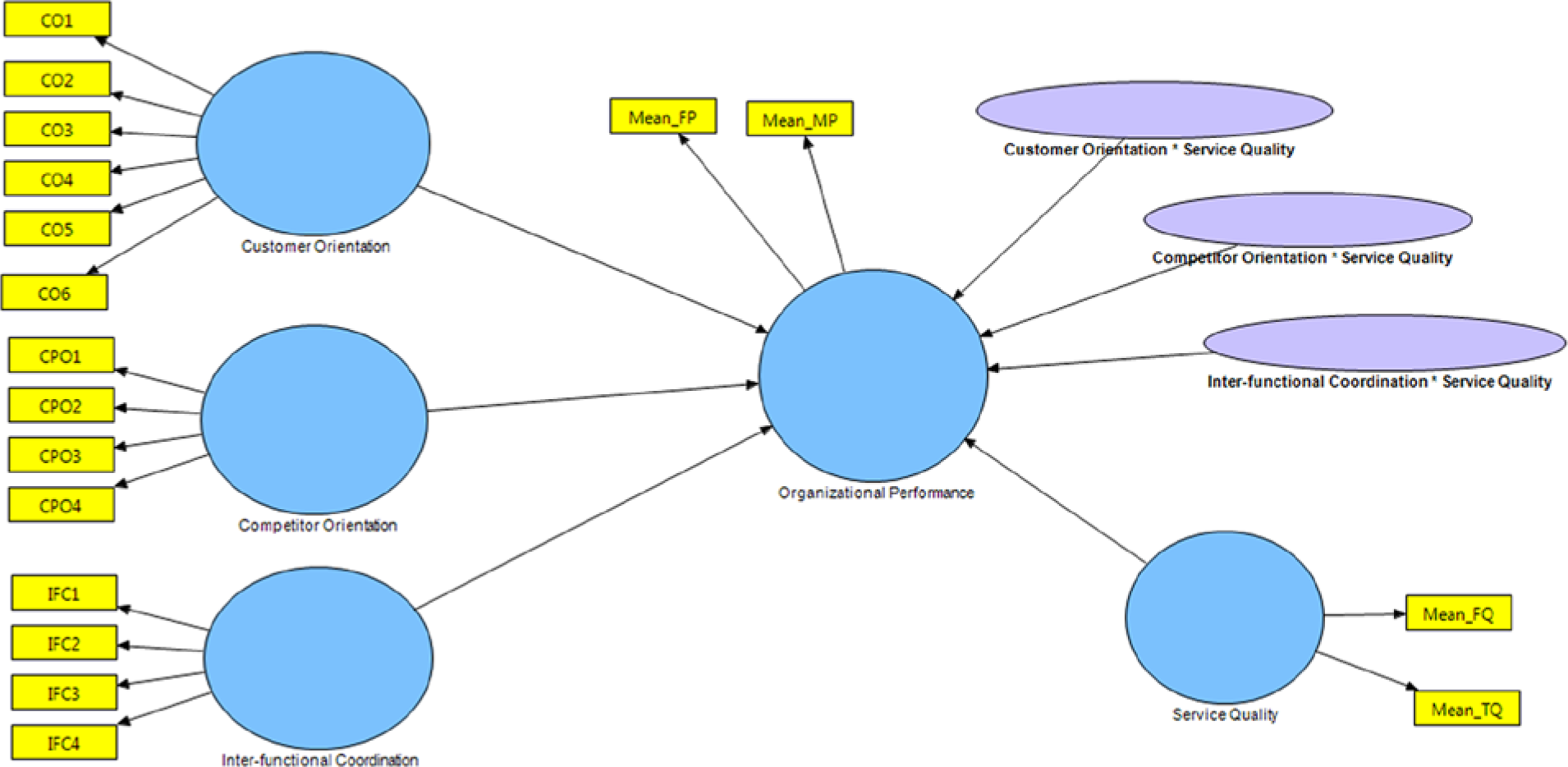
Research model.
Assessment of the Measurement Model
First, confirmatory factor analysis (CFA) was conducted to test the item reliability, convergent validity, and discriminant validity of the measurements scales. As shown in Tables 1 and 2, all the items loading exceeded the minimum cut off point of .50 (J. C. Anderson & Gerbing, 1988; Bagozzi, Yi, & Philipps, 1991; Gefen & Straub, 2000); thus, the internal consistency was achieved. In terms of convergent validity, all the composite reliability (CR) values were above .70 (Chin, 2010; Hair, Anderson, & Tatham, 1998; Requelme & Rios, 2010) and the average variance extracted (AVE) values meet the minimum criteria of .50 (Henseler, Ringle, & Sinkovics, 2009; Rodgers & Pavlou, 2003). In Table 3, all the t-values exceeded 1.96 significant levels (statistically significant at .05 levels), hence, all the measurements items were significantly explaining the research construct. For discriminant validity (see Table 4), the value of AVE was square rooted and testified against the intercorrelations of the construct with other constructs in the research model (Chin, 2010; Komiak & Benbasat, 2006) and all the values noted as greater than each of the constructs correlations (Chin, 2010), hence, the measurement model satisfactory achieved. In order to testify the reliability of the variables, Cronbach’s alpha (see Table 5) was used to validate the reliability of the variables and the minimum cut off point must above .70 (Cronbach, 1951). Thus, all the internal reliabilities of scales were ranged from .786 to .876 which was clearly acceptable. Hence, the measurement model was satisfactory and provided sufficient evidence in terms of reliability, convergent validity, and discriminant validity.
Loadings and Cross Loadings.

Note. Values in bold indicate items loadings CO = customer orientation; CPO = competitor orientation; IFC = inter-functional coordination.
Results of measurement model.
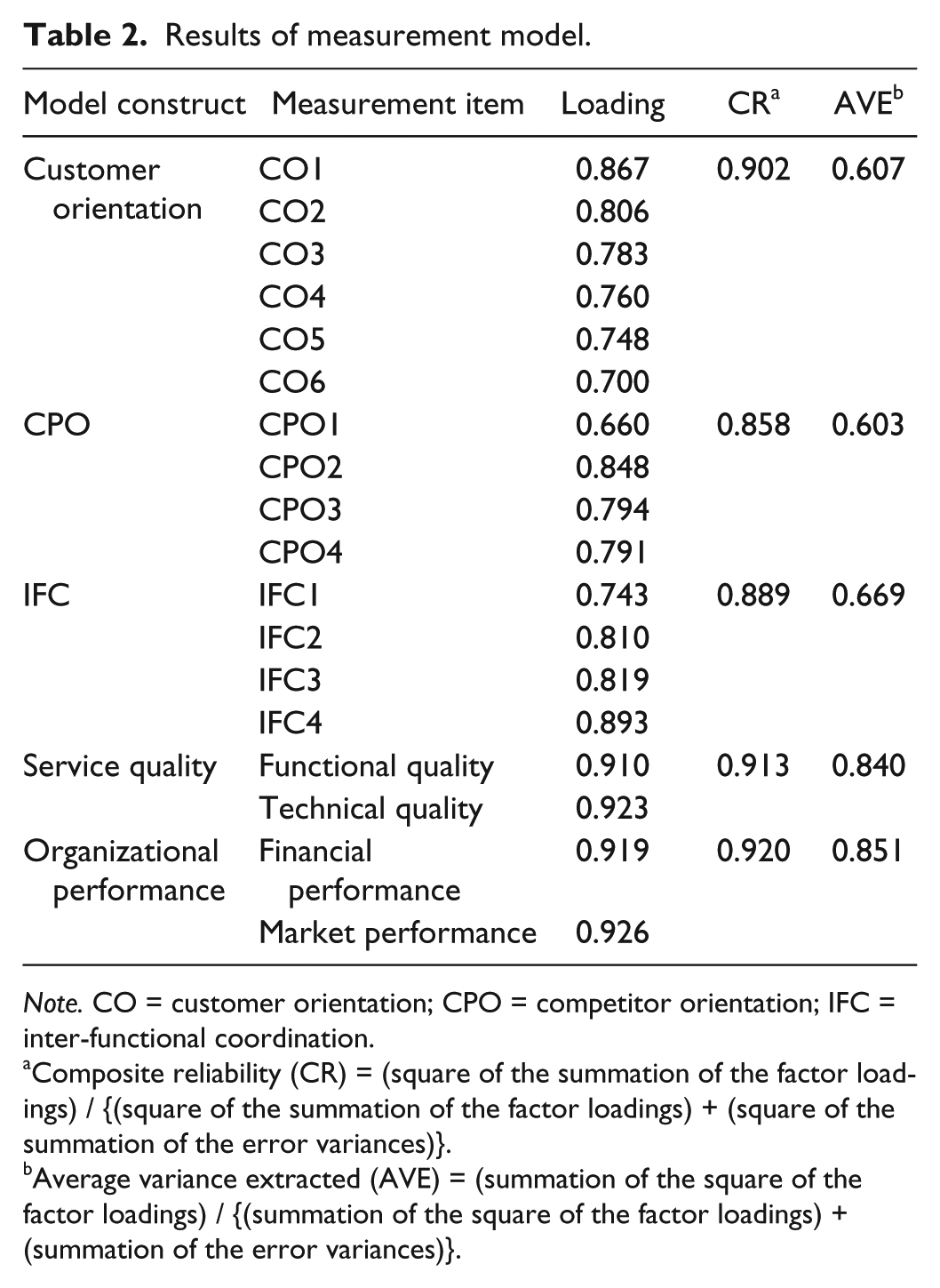
Note. CO = customer orientation; CPO = competitor orientation; IFC = inter-functional coordination.
Composite reliability (CR) = (square of the summation of the factor loadings) / {(square of the summation of the factor loadings) + (square of the summation of the error variances)}.
Average variance extracted (AVE) = (summation of the square of the factor loadings) / {(summation of the square of the factor loadings) + (summation of the error variances)}.
Summary Results of the Model Constructs.

Note. CO = customer orientation; CPO = competitor orientation; IFC = inter-functional coordination.
Discriminant Validity of Constructs.

Note. Diagonals represent the square root of the average variance extracted (AVE) while the other entries represent the correlations.
Result of Reliability Test.

Note. CO = customer orientation; CPO = competitor orientation; IFC = inter-functional coordination.
Assessment of the Structural Model
Next, Figure 2 and Table 6 present the results of the hypotheses testing. The results showed that SQ exists to be moderating the relationship between MO and OP but negative relationship between CO and IFC toward OP. However, CPO positively related to OP. Two hypotheses were accepted, namely, H2 and H4, whereas, H1 and H3 were rejected.

Results of the path analysis.
Path Coefficients and Hypothesis Testing.
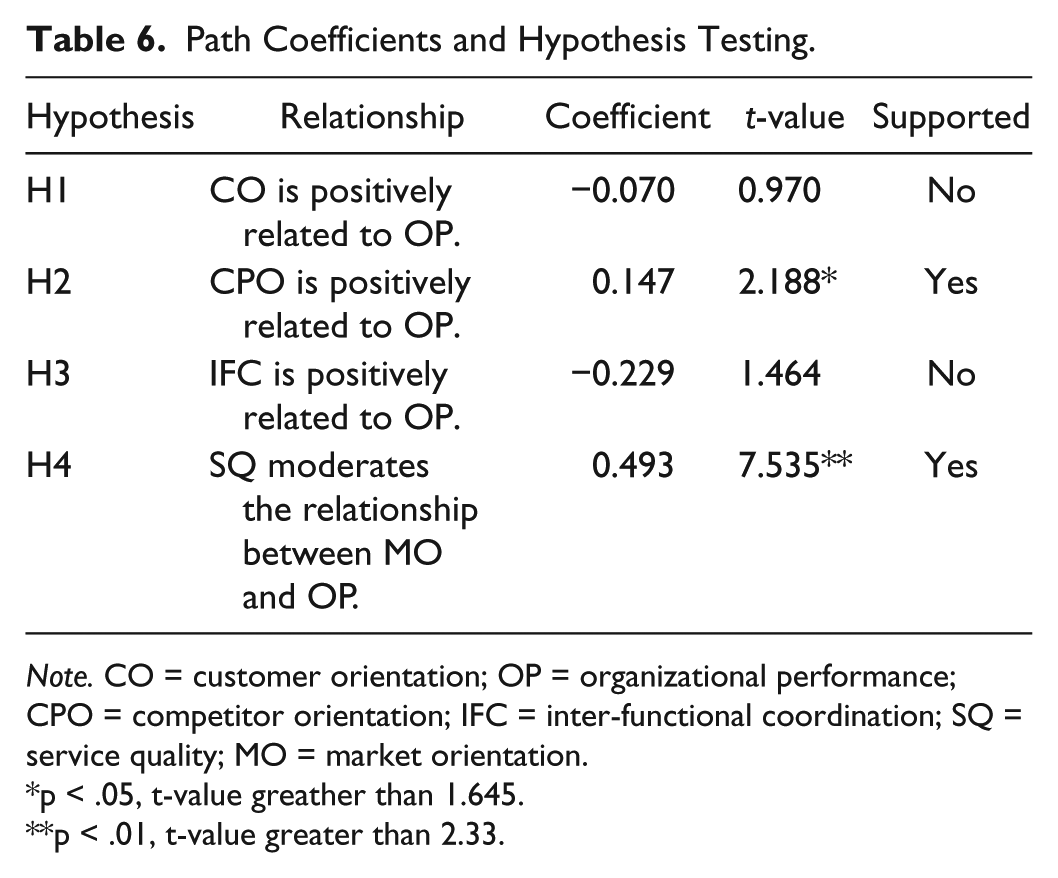
Note. CO = customer orientation; OP = organizational performance; CPO = competitor orientation; IFC = inter-functional coordination; SQ = service quality; MO = market orientation.
p < .05, t-value greather than 1.645.
p < .01, t-value greater than 2.33.
The researcher also conducted a global fit measure (GoF) to examine the global validation of PLS model (Amato, Esposito Vinzi, & Tenenhaus, 2004; Chin, 1998). The GoF was calculated (see Equation 1), and results of .661 (R2 was .612, average AVE was .714) exceeded the minimum large value of .36 and indicated that the GoF value was large enough to support the validation of PLS model globally (Wetzels, Schroder, & Oppen, 2009). As seen, the model has better explaining power in comparison with the baseline values (GoFsmall = .1, GoFmedium = .25, GoFlarge = .36; Akter, D’Ambra, & Ray, 2011).

Discussion
Resource-based view theory (Barney, 1991; Drnevich & Kriauciunas, 2011) highlighted that MO practice is essential for the organization to gain additional resources for competitive advantage and to be sustainable in the marketplace (Rodrigues & Pinho, 2010). Besides, SQ is equally important for an organization to achieve competitive advantage (Au & Tse, 1995; Shekarchizadeh et al., 2011). This study aims to examine the impact of MO practices on OP and the moderating factor of SQ in the relationship between MO and OP.
Interestingly, the results have demonstrated that SQ influenced the relationship between MO and OP such as FP and MP. MO often relates to external practices of providing value toward customers, and SQs are commonly used to influence or enhance the market-oriented services in fulfilling customers’ needs and wants (Lin, 2011). SQ is equally important to OP, especially those of the service organizations (C. Gronroos, 1998; Voon, 2005). The finding of this study showed similar results from past researches in which SQ positively affected MO and OP such as FP (Chang & Chen, 2004; Chao & Spillan, 2010; Shoham et al., 2005) and MP (Camarero, 2007; Lin, 2011). The existence of SQ is vital to fulfill customers’ needs and wants (Lewis & Mitchell, 1990) as SQ fills the gap between customers’ expectations and their perceptions with regard to the service providers’ performance (Carman, 1990; C. A. Gronroos, 1984). Hence, SQ can influence MO practices that could lead to a better firm performance such as FP.
In addition, past researchers (Gamage, Suwanabroma, Ueyama, Hada, & Sekikawa, 2008; Reeves & Bednar, 1994) had highlighted the importance of SQ to better serve their customers by adopting the concept of MO to fulfill customer’s needs (Samat, Ramayah, & Mat Saad, 2006) and to absorb competitors’ strengths to gain competitive advantage in the marketplace for better hotel’s marketing and FP (Sin et al., 2004). Apart from obtaining customer satisfaction, a superior SQ would lead to customer loyalty (Heskett, 2002), which would ultimately lead to improvements in a firm’s MP. Previous researches (Ahsan & Herath, 2006; Lainema & Hilmola, 2006) showed that SQ has significant influence on customers’ purchase intention. As firms provide better SQ to better serve their customers, this would increase the customers’ purchase intention as well as attract more customers through the positive word of mouth (WOM) generated by satisfied customers. In the long term, this will create customer loyalty, resulting in a larger base of customers who prefer to purchase products and services from this organization (Ahmadi & Bidarpoor, 2011). Providing good SQ would not only increase customer satisfaction but will also result in employee satisfaction (Lee, Chen, Chen, & Chen, 2010), which leads to superior firm performance. For employees to provide good quality of service to customers, the firm needs to provide the appropriate training that will generate a good, positive attitude that is equally important in service industries (Dennis, Chris, & Eli, 2005). In return, there will be an increase in employee satisfaction, which leads to a better implementation of IFC process and achievement of certain objectives (Peng & George, 2011).
On the other hand, CPO was found to be significantly related to OP such as FP and MP. This result is congruent with the findings of past researchers (e.g., Kara, Spillan, & DeShields, 2005; Salman & Zain, 2011), whereby competitor-oriented organization is able to create competitive advantage that leads to superior OP, specifically in hotel industry (Sin, Tse, Heung, & Yim, 2005; Zhou et al., 2009). Firms that successfully acquire competitor information are said to be able to create differentiation and gain value for their company (Zhang & Edward, 2007), and in return for superior OP. Thus, it is believed that competitor-oriented organizations are able to generate certain advantages for a better firm performance.
Surprisingly, the findings of this study showed that MO such as CO and IFC has no positive impact on the OP. The results are congruent with past studies whereby MO such as CO and IFC has no positive impact on the financial aspect of OP (Khamwon & Speece, 2005; Hult, Ketchen, & Slater, 2005; Langerak, Hultink, & Robben, 2000, 2004) and MP (Piercy, Harris, & Lane, 2002; Qu & Ennew, 2006; Susan, 2009). Thus, it is believed that there exist some barriers to MO practices on management behavior such as poor top management skills (Tomaskova, 2009) and lack of compensation and reward system (Hashim, 2011; Islam & Ismail, 2008) being in place, which point to the contrast in the findings of the study. Nonetheless, some of the researchers even highlighted that failure of MO practices is highly due to cultural differences (Anantatmula & Kanungo, 2010), lack of commitment (Trueman, 2004), and interdepartmental conflict (Kirca et al., 2005).
In short, the findings have noted that SQ is essentially important in determining the success of MO practices that lead to better OP. In contrast, the results revealed that there was no direct relationship between MO dimensions such as CO and IFC toward OP. However, CPO was found to be significantly related to OP. Hence, the results have provided evidence of SQ as an important key indicator in linking the relationship between MO and OP.
Implications
The present research has a number of theoretical and practical implications for scholars and practitioners. First, this study represented the theoretical study about MO, OP, and impact of SQ on hotel industry. In the past, there were limited studies on SQ in moderating the relationship between MO and OP. The present research offers a foundation for researchers who are concerned in this field to further investigate the use of SQ as a moderator in other industries. Second, this study is also believed to be able to provide useful guidelines for scholars in the study of SQ as a moderator in the relationship between MO and OP.
Certainly, the finding of this study can provide valuable information to hotel managers by adopting a more systematized view of their SQ, MO practices, and future development. Knowledge from this study can provide managers with an enhanced ability to design their services much more efficiently and can be used to shape their organizational operational strategy to create competitive advantage (C. A. Gronroos, 2007) and gain superior return. Besides, this study also increases managers’ understanding of the importance of MO practices and SQ orientation. At the organizational level, top management should always emphasize and provide training to employees to ensure that employees always put their customer first and satisfy customers’ needs in the most appropriate and efficient way. This is to ensure greater understanding among all employees and work together to achieve superior performance. This finding has suggested that SQ be incorporated as a tool to evaluate MO in the hotel industry. Hence, this can be used in determining the service firm’s marketing strategy in achieving better performance.
Limitations and Direction for Future Research
There are some restrictions and limitations during the development and implementation of this study as with any other study. First, this study was cross-sectional in which the data were collected in a limited time frame and this only offered a static perspective on fit. Second, vast numbers of respondents from middle and low level of management participated in this study. The participation from the top level of management may provide more accurate results for this study.
Footnotes
Declaration of Conflicting Interests
The author(s) declared no potential conflicts of interest with respect to the research, authorship, and/or publication of this article.
Funding
The author(s) received no financial support for the research and/or authorship of this article.