




Abstract
To evaluate the association between weight gain and psychological dimensions of appetite, a sample of 83 ethnically diverse first-year undergraduate females had body mass index (BMI) assessed and completed self-report measures of hedonic hunger, mindfulness, and intuitive eating. Positive associations between mindfulness and intuitive eating and negative links between intuitive eating and hedonic hunger and BMI were observed over time. BMI gainers experienced a significant decline in intuitive eating across the first college semester. No significant between-group effects for mindfulness or hedonic hunger were detected. Preliminary results suggest that changes in internally derived appetite- and consumption-regulating processes may underlie weight gain during the first-year college transition. Implications for optimizing college health promotion efforts for young women at this developmental juncture are discussed.
Evidence suggests that the increase in rates of overweight/obesity is especially rapid among first-year college students (Lloyd-Richardson, Bailey, Fava, Wing, & The Tobacco Etiology Research Network, 2009; Wengreen & Moncur, 2009) and that elevated body weight once achieved may persist throughout adulthood (e.g., Gordon-Larsen, Adair, Nelson, & Popkin, 2004). Consequently, a corresponding surge in contemporary public health science has sought to capture the magnitude and determinants of weight gain and other body composition changes occurring at this developmental juncture (e.g., Vella-Zarb & Elgar, 2009). Although data generated from an influential quantitative review revealed that the average weight gain observed during the first-year transition is considerably less than the popular notion of the “Freshman 15” (Vella-Zarb & Elgar, 2009), the weight increase still exceeds rates found in the general population (Levitsky, Halbmaier, & Mrdjenovic, 2004). Nevertheless, stemming the cumulative impact of even small increases in weight may mitigate risk for cardiometabolic morbidity in ensuing adulthood.
A major ecological contributor to the heightened vulnerability to overconsume and gain weight during the first year of college appears to be the relatively unlimited access to highly palatable, calorically dense yet nutritionally deficient foods (e.g., Levitsky et al., 2004). Indeed, studies have shown that entering college students consider the easy access to unhealthy foods served in “all you can eat” on-campus dining facilities, the close proximity of restaurants serving low-cost fast food in conjunction with the limited availability of healthier food options as key environmental barriers to optimal weight management (Greaney et al., 2009; Nelson, Kocos, Lytle, & Perry, 2009). Quantitative evidence further corroborates these qualitatively derived themes. Levitsky et al.’s (2004) prospective analysis showed that consuming evening snacks, high-fat junk foods, and eating meals in “all you can eat” dining halls accounted for significant variance in first-year weight gain.
Notably, this phenomenon also extends to students’ immediate residential environment. Researchers documented the presence of an average of more than 22,000 calories worth of food and beverage items per dorm room in a predominantly first-year undergraduate sample living on-campus (Nelson & Story, 2009). Interestingly, some of the unhealthier items discovered were actually procured from the “care packages” received from home (Nelson & Story, 2009). The constant media barrage of food and beverage product advertising targeting college-age youth serves as yet another environmental mechanism that further amplifies perceptions of the omnipresence and ready availability of a wide array of highly appetizing food for this at-risk population (Nelson, Story, Larson, Neumark-Sztainer, & Lytle, 2008).
Nonetheless, it is apparent that not all individuals are equally susceptible to overeating when exposed to the inescapable plethora of tasty albeit mostly unhealthy food options. The modern conceptualization of hedonic hunger has emerged to characterize variability in the sensitivity to the reward properties of highly palatable food present in the environment (Lowe & Butryn, 2007). Hedonically driven appetite processes reflect a psychological desire to consume food for pleasure and represent a salient preoccupation with food in the absence of true homeostatically driven physiological hunger (Lowe & Butryn, 2007). Scholars further contend that this extrinsically activated dimension of appetite is promoted by the ambient permissive social norms that encourage overconsumption in the United States’ excessively rich food climate (Lowe & Butryn, 2007). Hedonic hunger was shown to positively correlate with a range of maladaptive eating patterns (Finlayson, Cecil, Higgs, Hill, & Hetherington, 2012; Lowe et al., 2009; Stanton, Garcia, & Green, 1990) and was elevated among obese relative to nonobese individuals (Cappelleri et al., 2009). One earlier study found that college students who reported greater weight fluctuations tended to endorse lower efficacy in being able to resist the temptation to eat in the presence of palatable food versus their weight-stable peers (Toray & Cooley, 1997). Nevertheless, evaluating the contribution of hedonic hunger to risk for first-year college weight gain specifically is surprisingly underdeveloped in the scientific literature. Results from a single prospective analysis conducted with first-year students in the United Kingdom indicated that possessing a stronger appetitive drive stimulated by the presence of environmental food cues was predictive of changes in fat-free mass during this developmental transition (Finlayson et al., 2012). Researchers however did not specify whether changes in hedonic hunger were observed over time in relation to first-year weight gain status.
Alternatively, individual differences in mindfulness and intuitive eating may serve as internally derived appetite regulatory processes that counteract the potent desire to eat in excess of energy needs in the context of an overabundance of enticing high-calorie foods present on and in the vicinity of today’s college campuses. Indeed, the construct of mindfulness which has its historical roots in ancient Buddhist contemplative traditions invites individuals to adopt a nonjudgmental awareness to one’s present moment experiences (Kabat-Zinn, 1990). Mindfulness has been studied extensively in Western science in recent decades (Greeson, 2009) and of relevance to the present investigation has been innovatively integrated into psychological and behavioral interventions for eating disorders (see Wolever & Best, 2009, for a review), and for enhancing the regulation of weight and metabolism (e.g., Daubenmier et al., 2011). Therefore, when applied to the context of eating mindfulness invokes a discerning though relaxed awareness of the intricacies of the entire eating process by cultivating a multisensory engagement of the complex interplay between internal (e.g., thoughts, emotions, hunger, and satiety cues; Hepworth, 2011; Kristeller & Wolever, 2011) and external (e.g., the tastes, textures, aromas, and colors of foods; contextual triggers such as the influence of food advertisements and social situations involving tempting foods: Framson et al., 2009) factors that regulate appetite and food intake. Of note, Grinnell and colleagues were the first to explore the relationship between mindfulness, weight-related behaviors, and anthropometric parameters among first-year college students (Grinnell, Greene, Melanson, Blissmer, & Lofgren, 2011). In the authors’ cross-sectional analysis, mindfulness was negatively associated with emotional eating and external eating; less-mindful students exhibited marginally larger waist circumferences than their more-mindful peers (Grinnell et al., 2011). Although this research constitutes a unique contribution to the literature, the prospective association between changes in mindfulness and weight gain status among first-year college students has not yet been examined.
Akin to mindful eating, an intuitive eating style is an outgrowth of positive psychology and describes an approach to food intake that is characterized by the unconditional permission to eat, eating for physiological rather than emotional reasons, and trusting the wisdom of the body’s appetite signals to guide the process of eating (Tylka, 2006). Studies have cited positive relationships between intuitive eating and body appreciation (Augustus-Horvath & Tylka, 2011) as well as inverse associations with measures of eating pathology (Tylka, 2006). Although cross-sectional research has demonstrated a negative relationship between intuitive eating and body mass index (BMI) in a college female sample (Tylka, 2006), it remains to be clarified whether changes in this adaptive eating orientation are associated with weight gain status among first-year females specifically.
To address the aforementioned evidentiary gaps, the primary objectives of the present pilot investigation were (a) to examine the linear relationships between hedonic hunger, mindfulness, intuitive eating, and BMI at the beginning of the fall and spring semesters, and (b) to ascertain whether baseline levels as well as changes in these externally and internally mediated appetite and food intake regulating characteristics across the first college semester differed by BMI gain status in an ethnically diverse sample of first-year female undergraduates. Based on prior research (e.g., Finlayson et al., 2012; Framson et al., 2009; Grinnell et al., 2011), we anticipated observing positive relationships between mindfulness and intuitive eating as well as negative correlations between these variables and BMI and hedonic hunger irrespective of time of assessment. We further surmised that individuals who experienced an increase in BMI between the start of the fall and spring semesters would possess lower mindfulness and intuitive eating scores and conversely higher hedonic hunger scores at baseline relative to those who did not gain weight. Last, we predicted a significant decline in adaptive self-regulatory characteristics and an increase in the urge to eat in the presence of palatable food over time among weight gainers.
Method
Participants
The analyses reported here were generated from a larger initial-stage prospective cohort investigation seeking to elucidate biopsychosocial contributors to modifiable weight-related behaviors, weight gain, and other body composition changes among ethnically diverse first-year college women. In all, 134 first-time first-year female undergraduates (54 Black/African American [B/AA] and 80 White/European American [W/EA]; M age = 18.1, SD = 0.29) were recruited at the start of the fall semester in September (T1) of the year they entered college. Eighty-three participants (n = 39 B/AA students) returned to complete a second series of follow-up assessments in January (T2) as the spring semester commenced.
Measures
Demographic questionnaire and body composition measurements
Participants completed a standard demographic questionnaire at T1 and at both time points had the following body measurements taken: height, weight, waist and hip circumference, and percentage of body fat. For the purpose of the present analysis only BMI is reported here.
Mindfulness
The 12-item Cognitive and Affective Mindfulness Scale–Revised (CAMS-R; Feldman, Hayes, Kumar, Greeson, & Laurenceau, 2006) measures the construct of mindfulness with specific emphasis given to four domains: attention, present-focus, awareness, and nonjudgment. Items include, “I can tolerate emotional pain,” and “I am able to accept the thoughts and feelings I have.” Participants are asked to rate responses on a 4-point Likert-type scale. After reverse scoring Items 2, 6, and 7, higher scores indicate greater mindful qualities. The total scale showed acceptable levels of internal consistency when tested with two separate college-age samples (Sample 1 α = .74; Sample 2 α = .77) during the original series of validation studies. The Cronbach’s alpha coefficient derived from the present sample reached adequate levels (α = .71).
Intuitive eating
The 21-item Intuitive Eating Scale (IES; Tylka, 2006) is a composite measure of the construct assessing attitudes characterized by offering oneself the unconditional permission to eat, eating for physical versus emotional reasons, and trusting internal hunger and satiety cues to guide the eating process. Items include, “I can tell when I’m slightly full” and “I trust my body to tell me what to eat.” Greater endorsement of an intuitive eating style is indicated by higher scores. A high level of internal consistency for the total scale was observed in the original series of validation studies conducted in large samples of college women (αs ranged from .85-.89; Tylka, 2006). The internal consistency documented in the present sample exceeded adequate limits (α = .77).
Hedonic hunger
The 30-item Situational Appetite Measure–Urges (SAM-U; Stanton et al., 1990) is one of the two versions of the Situational Appetite Measure (SAM) that were created to assess urges to overeat in selected situations (SAM-U) and self-efficacy in controlling urges to overeat (Situational Appetite Measures-E; SAM-E). The present study only used one of the five subscales within the SAM-U. The 6-item Food Presence subscale was selected as a brief measure of hedonic hunger. Participants are asked to indicate whether they feel the urge to eat in specific situations on a 5-point Likert-type scale. Items include, “When I am around food or food is easily available” and “When I try to eat just a little of some good food.” Higher scores indicate the presence of a greater desire to eat. Adequate internal consistency was observed for the Food Presence subscale (females, α = .78; males, α = .75) among college students in the original validation studies. The Cronbach’s alpha for the current sample exceeded acceptable limits (α = .79).
Procedure
Human subjects’ approval was obtained from the appropriate university Institutional Review Board prior to participant recruitment. Participants provided written informed consent at the beginning of the fall semester. At both time points, participants completed a battery of psychosocial questionnaires after which anthropometric measurements were taken in a semiprivate lab space. At each visit, participants had the option of receiving either research credit in a participating Psychology course or a US$20 Visa debit card as an incentive.
Statistical Analyses
Preliminary descriptive statistics were computed to evaluate the distributional characteristics of all study variables. These initial data screening methods supported employing standard parametric analytic procedures. An alpha level of .05 was used to determine statistical significance though marginal trends (i.e., reaching an alpha level between .05 and .10) are presented to offer beneficial avenues for future research to further substantiate. The 83 participants who completed both assessments were stratified into BMI gain and nongain groups based on the difference between their T1 and T2 measured BMI values. ANOVA and chi-square analyses were conducted to compare BMI gain status groups on continuous and categorical sociodemographic and anthropometric variables at baseline, respectively. Pearson’s bivariate correlations were computed to evaluate the zero-order relationships between the primary study variables. A multivariate repeated-measures ANOVA (RM-ANOVA) model was performed to ascertain whether BMI gain status was associated with changes in hedonic hunger, mindfulness, and intuitive eating over time. The Bonferroni correction was used in post hoc analyses to minimize the occurrence of Type 1 error. Follow-up one-way ANOVA models and paired t tests were performed to clarify significant interaction effects. Analyses reported here were conducted using SPSS version 16.0 statistical software.
Results
Weight-Related Characteristics Among Completers
At baseline, 6.0% of completers were categorized as underweight, 60.2% were categorized as normal weight, 25.3% were categorized as overweight, and 8.4% were categorized as obese. Of the 83 completers, approximately 64% experienced an increase in BMI between T1 and T2. Only 2.5% of participants gained the “Freshman 15” of 15 pounds or more, whereas 15.4% of participants gained at least 5 pounds or more. Roughly 11.1% of the sample gained ≥ 5% of their initial body weight.
BMI Gain Status and Baseline Sociodemographic and Anthropometric Characteristics
Table 1 presents the baseline sociodemographic and anthropometric characteristics by BMI gain status. Weight gain in our sample was not strongly associated with any of these attributes at baseline. However, marginal associations were observed between BMI gain status and race/ethnicity (p = .07), marital status (p = .06), and campus residential status (p = .09).
Baseline Sociodemographic and Anthropometric Characteristics by BMI Gain Status (N = 83).

Zero-Order Intercorrelations
Table 2 shows all zero-order correlations. Analysis of correlations revealed that mindfulness and intuitive eating were moderately, positively correlated at T1 and T2 (p < .01). Mindfulness and BMI were negatively correlated at T2 (p < .01). Medium-sized negative effects were observed between intuitive eating and hedonic hunger at T1 and T2 (p < .01). Intuitive eating scores were also shown to negatively covary with BMI at T1 (p < .05) and T2 (p < .01).
Summary of Zero-Order Intercorrelations Between Primary Study Variables at T1 and T2.

Note. T1 = September, T2 = January.
p < .05. **p < .01.
BMI Gain Status and Changes in Hedonic Hunger, Mindfulness, and Intuitive Eating
A multivariate RM-ANOVA model produced a marginal main effect of Group, F(3, 75) = 2.61, p = .06, η2 = .09, in conjunction with a significant interaction effect between BMI gain status and Time, F(3, 75) = 3.18, p = .03, η2 = .11. Univariate effects indicated a significant relationship for BMI gain status and mindfulness, F(1, 77) = 4.49, p = .04, η2 = .06, as well as with intuitive eating, F(1, 77) = 5.02, p = .03, η2 = .06, over time (see Table 3). One-way ANOVA models further clarified that students who experienced an increase in BMI reported marginally higher levels of mindfulness at baseline, F(1, 81) = 3.51, p = .07, and significantly lower levels of intuitive eating at T2, F(1, 79) = 5.46, p = .02, relative to nongainers (see Table 3). Paired t tests denoted a significant decline in intuitive eating scores among BMI gainers between the two first-year assessments, t(51) = 2.97, p < .01 (see Table 3). Notably, significant effects for hedonic hunger were not detected with respect to this set of analyses.
Univariate Repeated-Measures ANOVA Effects for BMI Gain Status and Appetite and Food Intake Regulatory Variables Across the First College Semester (n = 79).
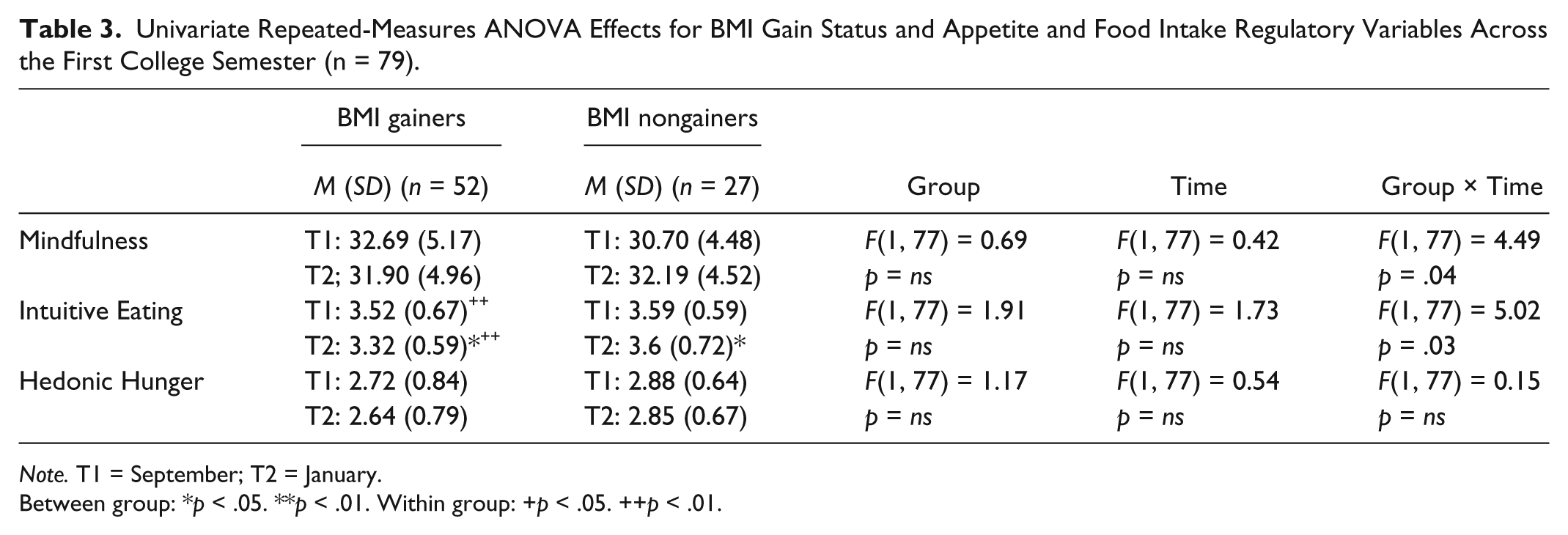
Note. T1 = September; T2 = January.
Between group: *p < .05. **p < .01. Within group: +p < .05. ++p < .01.
Discussion
The first year of college has been targeted as a period of heightened risk for excess weight gain among emerging adults and the mere presence of a vast array of highly palatable and often unhealthy food options is suggested to exert a powerful influence on these adverse changes in weight and body composition. While others have examined psychological and behavioral factors that differentiate between those who do and do not gain weight during the first-year transition (e.g., Hodge, Jackson, & Sullivan, 1993; Jung, Bray, & Ginis, 2008; Provencher et al., 2009; Serlachius, Hamer, & Wardle, 2007), our preliminary investigation was the first to explore the influence of variables reflecting adaptive dimensions of self-regulating appetite and food intake in this developmental context. Indeed, somewhat in accordance with initial predictions we found noteworthy effects for intuitive eating while statistical trends tentatively point to the utility of further evaluating individual differences in mindfulness and/or mindful eating in association with weight gain status among first-year college women.
Baseline sociodemographic and anthropometric characteristics did not strongly distinguish first-year BMI gainers from nongainers. Notably, those who experienced an elevation in BMI across the first college semester were not more likely to be overweight or obese. This is in contrast to research which concluded that starting college at a higher body weight is a risk factor for enhanced first-year weight gain relative to underweight/normal weight peers (Kasparek, Corwin, Valois, Sargent, & Morris, 2008; Webb & Hardin, 2012). Yet these previous analyses were based on examining mean changes in body composition. Conversely, the present comparisons were not based on stratifying the sample relative to a predetermined threshold of significant BMI gain, which may explain why the link to overweight/obesity status did not emerge.
Regarding the correlational findings, results partially supported initial hypotheses. Positive associations were observed between mindfulness and intuitive eating and the latter was shown to negatively correlate with BMI and hedonic hunger at both first-year assessments. These effects replicate and extend earlier research conducted in college (Tylka, 2006) and community-dwelling female samples (Augustus-Horvath & Tylka, 2011). Not surprisingly, higher levels of a constructive approach to appetite and food intake that is grounded in valuing the inner wisdom of the body (vs. food-relevant cues in the external environment, negative emotional activation, and/or rigid, internalized food rules), which prioritizes homeostatically driven eating behavior were indicative of espousing broader mindful self-regulation characteristics, lower BMIs, and less susceptibility to the pull of the availability of enticing foods.
Mindfulness however, was only modestly correlated in the negative direction with BMI at the beginning of the spring semester, whereas significant linear associations between hedonic hunger and mindfulness and BMI were not found. This pattern of results suggests that general mindful awareness may be more strongly linked with changes in BMI or specifically with overweight/obesity status (Framson et al., 2009). Moreover, variation in a mindful eating orientation could be of greater relevance to consider in relation to individual differences in the sensitivity to the reward properties of highly palatable foods present in the surrounding environment (Framson et al., 2009). It is also plausible that effects for hedonic hunger would have emerged in a larger sample with greater inclusion of young women with elevated body weights and/or dietary restraint as is suggested by previous research (Cappelleri et al., 2009; Stanton et al., 1990).
Our prediction that first-year women who possessed higher BMIs at the start of the spring semester versus the beginning of the fall semester would have entered college with lower levels of mindfulness and intuitive eating in conjunction with higher levels of hedonic hunger was not confirmed. In fact, BMI gainers reported a marginally higher level of mindfulness qualities at baseline though the validity of this finding is somewhat tenuous given the limited statistical power of the analysis. Collectively, these largely null results could stem from categorizing participants on a crude absolute increase in BMI rather than based on exceeding percentile cutoffs at extremes of the distribution for BMI gain (e.g., Wengreen & Moncur, 2009). Furthermore, recent work by Provencher and colleagues proffers the usefulness of accounting for individual differences in baseline scores on risk factors for eating disorders (e.g., dietary restraint) as a contributor to delineating weight gain status (Provencher et al., 2009). Thus, markers of greater disturbed (vs. adaptive) eating processes may be more indicative of baseline vulnerability for first-year weight gain. Alternatively, perhaps significantly higher scores on mindfulness (or mindful eating) and intuitive eating and lower levels of hedonic hunger at the outset of college are more predictive of enhanced weight maintenance and/or weight loss among first-year college women. Replicating our analyses in a larger sample and further classifying nongainers in this manner which is more closely aligned with the analytic approach cited in previous work (Hodge et al., 1993; Provencher et al., 2009; Serlachius et al., 2007) might lend support to this speculation.
However, we did find partial support for the hypothesized association between BMI gain status and changes in extrinsically and intrinsically mediated appetite and food regulatory characteristics during the first-year transition. More specifically, students who experienced an increase in BMI between the two assessments showed a significant decline in intuitive eating scores and on average reported engaging in intuitive eating to a lesser extent at the beginning of the spring semester than nongainers. The aforementioned statistical trend indicating marginally higher mindfulness scores at baseline among BMI gainers yet comparable means at the second time point in comparison with nongainers tentatively implies a potential reduction in this self-regulatory attribute, the presence of which could be more reliably detected in a larger and higher powered participant sample.
We also cannot rule out the possibility that individual differences in intuitive eating processes are sensitive to the naturally occurring changes that transpire in the early college adjustment period (Dyson & Renk, 2006; Nelson et al., 2008) as well as a result of engaging in a targeted behavioral intervention (Bacon, Stern, Van Loan, & Keim, 2005; Cole & Horacek, 2010; Young, 2011) among individuals spanning a diverse range of body weights and eating patterns. However, robust changes in arguably more stable appetite and food intake regulating qualities such as mindfulness and hedonic hunger may not emerge outside of the context of more focused and intensive psychological treatments for individuals with clinically significant levels of excess weight (e.g., Daubenmier et al., 2011) and/or eating pathology (e.g., Carter, McIntosh, Joyce, Frampton, & Bulik, 2006). Further disentangling these relationships certainly merits future scholarly attention.
These novel albeit preliminary findings should be interpreted cautiously in light of the following caveats. First, our modest-sized, exclusively female sample precludes generalizing results to male first-year students. Second, due to a sizable attrition rate analyses were underpowered to potentially detect a stronger moderating effect for mindfulness. Third, evaluating the contribution of hedonic hunger within this body of research would be further refined by incorporating a measure such as the Power of Food Scale (Lowe et al., 2009) that provides even broader coverage of the construct. Other suggestions for future analyses include exploring the presence of alternative moderators of shifts in these psychological appetite-regulating qualities in concert with weight gain status such as current dieting status/level of dietary restraint, race/ethnicity, and BMI status at college entry. Subsequent efforts would also benefit from elucidating whether declines in mindfulness and intuitive eating in fact mediate weight gain and changes in other markers reflecting heightened cardiometabolic risk (e.g., percentage of body fat, waist circumference, waist-to-hip ratio, etc.) among first-year college women.
In conclusion, the general urge to eat when highly palatable food is available in the environment (without considering elevations in dietary restraint and/or body weight concurrently) may not be a robust vulnerability factor associated with weight gain during the first-year college transition. Alternatively, declines in factors associated with an internally generated self-regulatory style specifically within the context of eating and perhaps more generally may contribute to first-year weight gain. College health promotion efforts aiming to enhance mindful acceptance and intuitive eating skills (e.g., Gow, Trace, & Mazzeo, 2010) may hold promise in counteracting the powerful influence of internal (e.g., negative emotions, food-relevant cognitions) and external (e.g., the omnipresence of highly appealing food) factors on appetite, food intake, and in turn weight during the early college transition period.
Footnotes
Declaration of Conflicting Interests
The author(s) declared no potential conflicts of interest with respect to the research, authorship, and/or publication of this article.
Funding
The author(s) disclosed receipt of the following financial support for the research, authorship, and/or publication of this article: This research was funded by both a UNC Charlotte Faculty Research Grant and an ADVANCE Grant Bonnie E. Cone Fellowship awarded to Jennifer B. Webb, PhD.