




Abstract
Fostering a sense of belonging and a positive atmosphere in tertiary education impacts student motivation and persistence, with campus environments playing a crucial role. Littering can disrupt this experience, making it important to address. This study used a quantitative approach to examine the effects of social norm interventions on littering at a Dutch university campus. Conducted in two buildings, the experiment included daily litter measurements. One building received a social norm intervention using persuasive communication, while the other served as a control. Litter levels were measured at baseline, post-intervention and seven months later, analyzed using logistic regression. Trashcan presence was noted. Littering decreased significantly in the treatment building (63% vs. 23% post-intervention, 28% follow-up). The treatment effect was significant at post and follow-up measurements, showing short- and long-term behavior change. Trashcan proximity affected the intervention at follow-up. Social factors play a key role in reducing littering. Future research should explore the dynamics with physical disposal opportunities further.
Plain Language Summary
Feeling like you belong and enjoying a positive atmosphere on campus can boost students’ motivation and success in university. However, littering can disrupt this environment, making it important to find ways to reduce it. This study explored whether social norms (unspoken rules about how people behave) could encourage students to litter less on a university campus in the Netherlands. The research focused on two campus buildings. In one building, signs with persuasive messages about keeping the area clean were placed as part of the intervention. The other building did not receive these signs and was used for comparison. Researchers counted litter every day in both buildings before the intervention, immediately after, and seven months later. They also noted where trashcans were located to see if proximity made a difference. The results showed that littering dropped significantly in the building with the signs. Before the intervention, 63% of the spaces had litter. This dropped to 23% immediately after the intervention and stayed low at 28% seven months later. The changes were less noticeable in the building without signs. The study also found that trashcans placed closer to where people walk made it easier for the intervention to succeed over time. These findings highlight that social norms can be a powerful tool for encouraging cleaner behaviors on campus. However, combining these strategies with practical solutions, like placing trashcans in convenient locations, can make them even more effective. Future research could explore how to balance these social and physical factors to create cleaner and more welcoming university spaces.
Keywords
Introduction
In the context of tertiary education, fostering a sense of belonging and a positive atmosphere significantly impacts student motivation and persistence, particularly among minority students (Krause-Levy et al., 2021; Tinto, 2015). The physical environment of university campuses plays a crucial role in facilitating student connections with peers, thereby serving as a critical predictor of a sense of belonging (Mulrooney & Kelly, 2023). Naragatti and Vadiraj (2023) suggest that environmental cleanliness, among other factors, can enhance social cohesion and ownership. With this in mind, preventing litter on campuses becomes increasingly important. Furthermore, there are practical considerations for preventing litter, such as its detrimental effect on the environment and promotion of high cleaning costs for universities, which at the Dutch university in the study, were 12.7% of total housing costs in 2023.
Littering is defined as the act of improperly disposing of small amounts of waste (Al-Khatib et al., 2008; Hansmann & Scholz, 2003). According to the Theory of Planned Behavior (Ajzen, 1991), attitudes toward a behavior, subjective norms and perceived behavioral control are key predictors of behavioral intention.
In the context of littering, perceived behavioral control—defined as the perceived ease or difficulty of performing a behavior—is arguably high, as proper waste disposal typically requires little effort, especially when trash receptacles are readily available. As such, actual littering behavior may depend less on a person’s capability and more on situational or normative cues in the environment. This aligns with findings from a systematic review by Chaudhary et al. (2021), who identified environmental factors such as the accessibility of trash cans as critical determinants of littering behavior.
When it comes to littering behavior, attitudes play an intriguing part because it has a different role in two distinct types of littering: Active and passive littering. Active littering is the overt act of discarding waste wrongly, for example, throwing food wrappers out of a car window (Sibley & Liu, 2003). This type of littering is seen most in passage spaces, such as hallways and exits of buildings (Liu & Sibley, 2004). Passive littering, on the other hand, occurs when an item is placed in the environment (for example, placing a food wrapper on the table while eating), and omitting to dispose of the item correctly (e.g., the wrapper is [accidentally] left behind on the table; Liu & Sibley, 2004). The duration of visits influences the type of littering significantly. Visitors, which are mostly students, typically spend extended periods on campus (>1 hr), which correlates with a higher incidence of passive, unconscious littering as opposed to active littering. Research indicates that passive littering increases with the time spent in an area and occurs mostly unconsciously (Liu & Sibley, 2004; Meekers, 1997). Therefore, while attitudes are relevant for active littering, they are less relevant in a university context where passive littering prevails. Thus, interventions targeting unconscious processes are deemed most effective for passive littering (Aarts & Dijksterhuis, 2000; Holland et al., 2005), such as the restructuring of the social environment with descriptive norms. Consequently, a third key determinant in the Theory of Planned Behavior—subjective norms, individuals’ perceptions of what others expect them to do—should be considered for intervention.
In addition to considering the type of littering, the high percentage of young adult visitors at campuses should be taken into account in this matter, as this demographic is notably prone to littering (Anderson & Krettenauer, 2021; Esteban & Tabernero, 2011; Freije et al., 2019; Maharoof et al., 2022; Nkwocha & Okeoma, 2010) and may be sensitive to specific behavior change techniques (BCTs; active components of behavior change interventions [Michie et al., 2020]).
Restructuring the social environment using peers and educators as sources may be a promising strategy for littering behavior change in youth. Educators and parents have previously been found to influence littering of youth through their own littering behavior and attitudes (Monroe et al., 2019). Moreover, young people are significantly influenced by their peers (Bester, 2007; Long et al., 2014). Albert et al. (2013) found that the brain’s reward system is more sensitive to social stimuli from peers during early adulthood (18–25 years) compared to later adulthood. Peers and educators have been effectively utilized as credible sources in behavior change interventions (BCIs) targeting youth. These interventions often include demonstrating the desired behavior and exhibiting positive attitudes towards it, which helps reinforce the behavior among young individuals. Hughes et al. (2019), for example, asked youth to create and spread social media content which suggested that the norm was “not littering” in the San Francisco Bay Area. Sagebiel et al. (2020) found that cleaning up cigarette buds on campus reduced subsequent cigarette litter, as cigarette litter signals a social norm of littering. In the Maui’s Dolphin Challenge, educators played a crucial role in vocalizing their positive attitudes toward the environment and picking up litter (Townrow et al., 2016). In summary, social norm interventions, both descriptive and injunctive, being communicated through credible sources, could be promising for reducing litter on university campuses.
Other socially oriented BCTs, such as reframing the perspective, social reward, and social support, have been applied effectively in littering interventions targeting youth. In the Maui Dolphin Challenge, schools engaged students in cleanup activities to help them grasp the impact of littering (Townrow et al., 2016), thereby reframing their perspectives on the issue. In the “Be the Street You Want to See” campaign, pre-emptive gratitude was given as a form of social reward to participants to reinforce non-littering (Hughes et al., 2019). In the same campaign, social support was employed by highlighting the collective responsibility for a clean neighborhood. These BCTs could be leveraged to enrich social norm interventions.
While prior studies have explored the use of social norms to influence littering behavior (e.g., Hughes et al., 2019; Sagebiel et al., 2020; Townrow et al., 2016), these interventions were often conducted in outdoor public environments or temporary event contexts. Furthermore, many previous efforts utilized either singular techniques (e.g., injunctive or descriptive norms) or relied on high-visibility interventions without examining their sustained impact over time. The present study adds to the literature by deploying a multi-faceted, low-salience social norm intervention in an indoor university setting, sustained over several months. It is one of the few field experiments to explore long-term effects (7 months post-intervention) and assess the effectiveness of a combination of social influence techniques (peer modeling, reframing, gratitude, and social support) under real-world conditions. These contributions aim to bridge identified research gaps and offer actionable insights for campus facility managers and behavioral scientists alike.
This study aims to evaluate the effects of enriched social norm interventions on littering behavior in a university building, compared to a control building. We hypothesize that:
Additionally, we seek to understand the impact of disposal opportunities on the effectiveness of the intervention. Chaudhary et al. (2021) identified a gap in understanding the effects of situational factors on norm interventions. Given that limited disposal opportunities can hinder proper waste disposal, we hypothesize that:
Materials and Methods
This study used a quantitative approach employing a quasi-experimental design to evaluate the effectiveness of a social norm-based intervention in reducing littering behavior.
Context
On an university campus in the Netherlands, two adjacent buildings were selected for a study on littering due to their similar structure, usage, and reported litter issues. These buildings, designed by the same architect and constructed in 2015 and 2022, respectively, feature numerous large windows and comparable interior designs (see Figure 1). Both buildings have six levels and are frequented by corresponding student population from various faculties. They primarily consist of study rooms and educational spaces, with additional foyers, lunchrooms, and public living rooms. While there are some differences in the distribution of rooms and trash receptacles (as indicated in Table 1), the buildings are visually very similar and attract the same type of students. Consequently, no significant differences in littering were anticipated between them.

Interior views of (a) treatment building and (b) control building.
Number of Rooms Per Building and Percentage Rooms Pertaining Trashcans.

Owing to the structural and functional congruence of the two buildings, a quasi-experimental design was adopted in which one building served as the treatment site and the other as the control, thereby attenuating temporal variation linked to the academic calendar. Such a naturally occurring pair of buildings is rare in real-world research, yet in this case, they were particularly well-suited for comparative study due to their similar construction years and shared architectural design and function. These conditions further justified our decision to implement the intervention as a bundled set of components, as it was not feasible to isolate and test each component separately over time without introducing uncontrolled temporal variation.
Cleaning staff perform cleaning services once in the morning and again in the afternoon for study rooms. Both buildings have experienced littering issues, as reported by the cleaning staff. The intervention strategy was formed in collaboration with the cleaning company responsible for maintaining the buildings and based on their experience, literature research and a brainstorm session.
Intervention
The intervention featured a series of communicative tools including posters, stand-up banners, and table-cards designed to persuade the target audience to clean up their trash. The materials, as depicted in Figure 2, had to follow the university’s house style rules and consequently blended into the environment. The research team identified the behavior change techniques to be applied, and the cleaning company played a key role in tailoring the interventions to the practical context. The strategy employed five specific BCTs to foster social norms toward maintaining cleanliness within the building. The selection of these BCTs was grounded in both theoretical and practical considerations, each informed by prior research in behavioral science. These techniques included:
(1) The demonstration of behavior by a credible source: Research has shown that individuals, particularly young adults, are significantly influenced by the behaviors of their peers. Therefore, a demonstration of clean behavior, depicting a student, aligning with the target audience’s peer group, was chosen to leverage this influence.
(2) Information about others’ approval by a credible source: Teachers or authority figures play a role in shaping student behavior, particularly in educational settings where students often look to authority for guidance on norms (Monroe et al., 2019). Given the university setting, we chose to portray a teacher as an authoritative figure, also in support of maintaining cleanliness, to invoke a sense of respect and adherence to norms.
(3) Reframing the perspective: Previous studies have indicated that when individuals feel a sense of empathy towards those affected by littering (e.g., cleaning staff), they are more likely to engage in the desired behavior (Hughes et al., 2019). Thus, we employed pictures of cleaning personnel aimed to personify them, thereby fostering empathy and a deeper understanding of the consequences of littering.
(4) Social reward: A pre-emptive expression of gratitude to readers for their contribution to keeping the environment clean was designed to positively reinforce desired behaviors. Social reward has been widely recognized as an effective nudge in promoting pro-environmental behaviors (Hughes et al., 2019).
(5) Social support: Messaging underscoring a collective effort with statements like “together we keep this classroom clean” promoted a shared responsibility for cleanliness. This BCT underscores the importance of group norms and creates a sense of community engagement, which has been shown to increase compliance with social norms (Monroe et al., 2019).
These nudges were selected not only because they are theoretically well-grounded, but also because they are practical for the university environment. They were easy to implement (i.e., posters, stand-up banners, table-cards) and could be seamlessly integrated into existing spaces without requiring significant structural changes. Moreover, they were cost-effective and aligned with the university’s institutional values of promoting a respectful, sustainable environment.
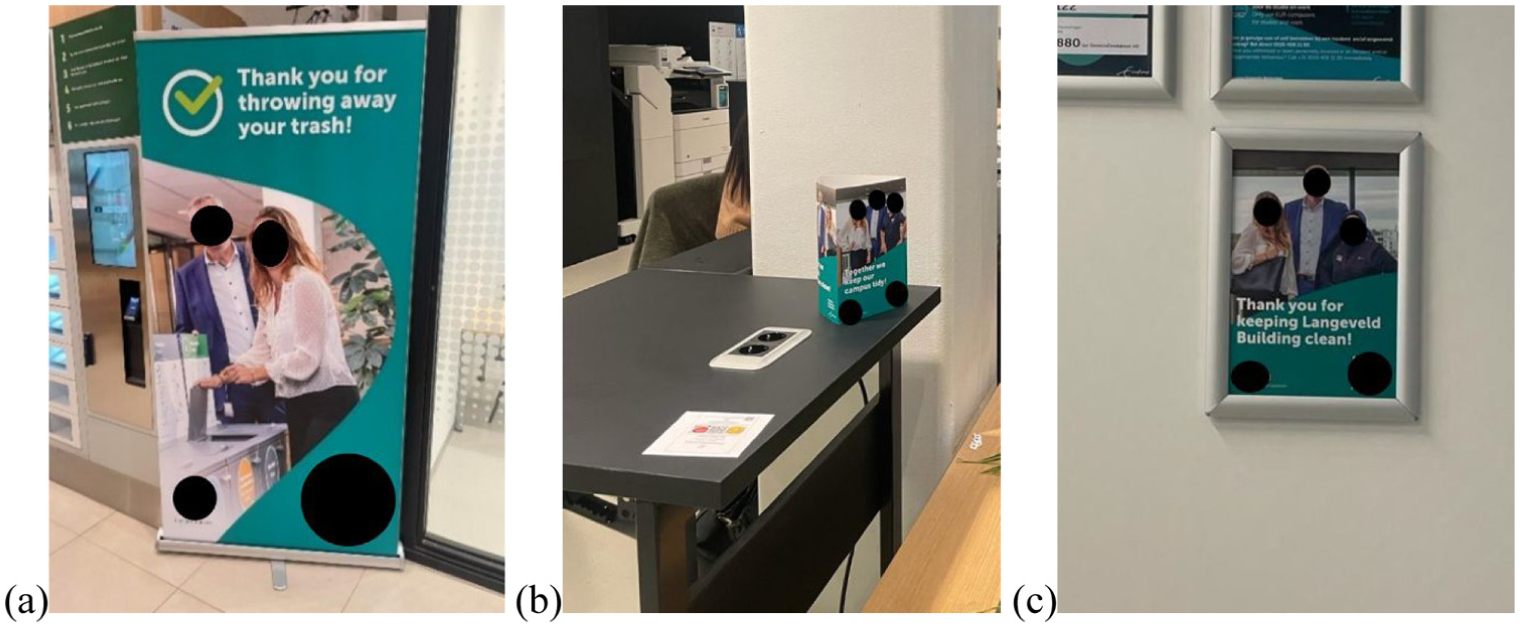
Depictions of the intervention materials in the university building.
The intervention was deliberately designed and implemented as a bundled set of social norm-based nudges, forming an integrated strategy rather than discrete components. This approach reflects the real-world conditions of the study, where introducing separate nudges sequentially or in isolation would have created uncontrolled time-based variability. As such, no component-level analysis was performed, and the intervention was assessed as a unified whole to ensure ecological validity and consistency across the intervention period.
Implementation
All intervention materials were implemented simultaneously. This intervention was piloted in the one building, referred to as “treatment building” to assess its impact, with the “control building” serving as a control, where no new measures were introduced. Roll-up banners were placed on each floor close to trash receptacles. Table cards were placed on tables in all study rooms and posters were present in all education spaces. The placement of trash receptacles was not manipulated through the experiment.
As noted before, the treatment and control buildings were located adjacent to one another and served the same population of students. Although the intervention was implemented exclusively in the treatment building, there is a potential for indirect exposure, especially among students who move between buildings during the day. For example, students who see the intervention materials in the treatment building may carry over that behavioral influence into the control building. However, most students tend to work or attend class in one building for extended periods rather than frequenting equally throughout the day, which may have limited the extent of spill-over. Nonetheless, the potential for contamination remains and is discussed in more detail in the Discussion section.
Data Collection Procedure and Outcome Measures
As visualized in Figure 3, the level of littering was measured 1 week before implementation of the intervention between November 20 and 24, 2023 (pre-period). On November 29th, 2023, the intervention was implemented, and a post-implementation measurement was performed the week after implementation December 4 to 8, 2023 (post-period). A follow-up measurement was performed from June 10th to June 14th (follow-up), while the interventions were still present in the buildings.
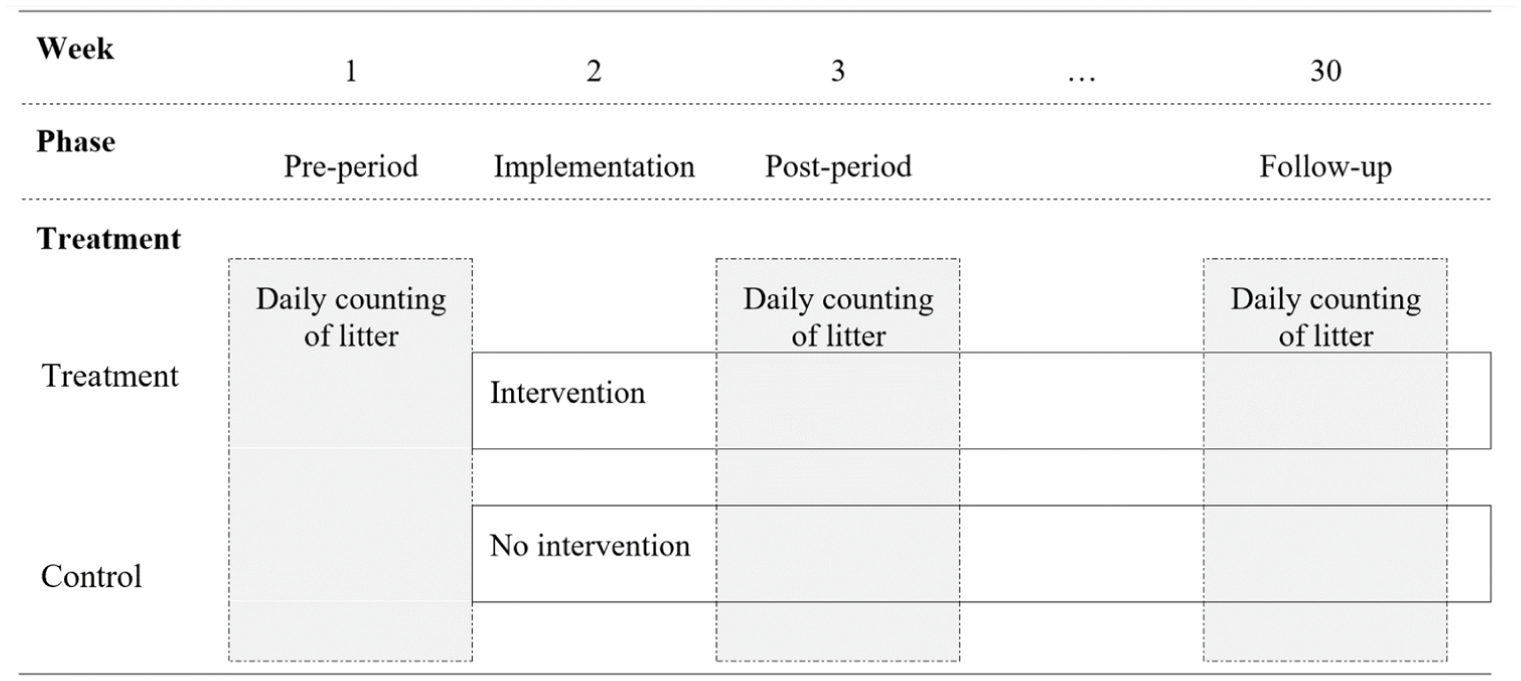
Research planning per week, phase and building.
To evaluate both immediate and sustained effects of the intervention, measurements were conducted directly after implementation and again 7 months later. The first measurement captured short-term behavioral changes, while the follow-up aimed to assess whether these changes had solidified over time. Verplanken and Wood (2006) argue that habit consolidation requires multiple months and should therefore be assessed on this timescale. The 7-month interval was selected to align with the end of the academic cycle, just before a new cohort of students would enter the university. This timing ensured that the follow-up measured persistence within the original population exposed to the intervention, avoiding confounding effects from new students encountering the intervention for the first time. Moreover, it represented the most extended time frame feasible for measuring longer-term effects within the constraints of the academic calendar. Other authors such as Hagger and Luszczynska (2014) have used similar timeframes to assess maintained behavior.
Littering data was collected for all 94 rooms in the treatment building as well as all 63 rooms in the control building (see Table 1). Every day for five consecutive days during pre, post and follow-up period the littering data was collected leading to 470 observations in the treatment building and 315 observations in the control building for each period. Littering was recorded on a form (see Supplemental materials) by trained cleaning personnel daily between 6 and 7 a.m. (shortly before the first cleaning round of the day). Records were gathered for each area separately by tallying different types of litter found. A distinction was made between (food)wrappings, food remains, non-wrapper paper materials such as flyers or toilet paper, cigarette butts and wetness or smeared surfaces. In case of doubt, personnel were instructed to count an item as litter if it needed any extra actions to clean it away. Litter was subsequently cleaned away; therefore, the same litter would not be recorded on subsequent measurement days. Additionally, it was recorded whether trashcans were in sight. The data collection form included a section for remarks, and data collectors were instructed to note any unusual events or anomalies in litter levels. The research team also cross-referenced the university’s calendar to identify any special events occurring after the pre- and post-intervention periods that might influence the findings. During the follow-up measurement period, festivities were held on Thursday evening June 13th on campus in front of the control building. An extra cleaning round was performed in the building that night, which caused the data of Friday morning to be distorted. We opted to omit all data gathered on Fridays of all data collection weeks in the analyses.
Data collection for this study was limited exclusively to observations regarding litter inside the buildings, with no collection of personal information. Ethical review and approval and informed consent were not necessary for this study according to local and institutional regulations. Consequently, there was no necessity for ethical approval or to obtain active consent from participants.
We chose to measure litter presence using a binary variable (i.e., whether or not a room contained waste) because it is closely tied to the behavioral change induced by the intervention. While a more complex weighted measure could offer insights into the quantity or composition of waste, we believe the binary variable sufficiently captures whether the intervention led to the desired behavioral shift of reducing littering. Additionally, we considered the complexity of quantifying litter amounts, as the type and quantity of litter (e.g., a few paper scraps vs. a larger quantity of food waste) can vary significantly and would require subjective judgment to determine the appropriate weight or severity. It allows for a clear and interpretable comparison across multiple spaces and time points, as is demonstrated previously by Merkelbach et al. (2021).
Data Analysis
To measure the effect size of our intervention we used a Difference-in-Difference (DiD) approach by estimating a logistic regression model using R (Angrist & Pischke, 2009). The dependent variable was binary and represented whether a room contained waste (1) or not (0). The independent variables were time and treatment. Treatment represented whether an observation was done in the treatment building (1) or in the control building (0). Time represented whether the observation was done before the intervention (0) or post/follow-up (1). An interaction term (treatment × time) was added to estimate the effect size of our intervention on the probability that a room contained waste.
For the second hypothesis, a binary variable was created for presence (1) versus absence (0) of a trashcan in the space. This variable was entered into a logistic regression analysis with time and treatment as predictors and waste as outcome. A DiD approach using a three-way interaction was used to estimate the interaction of disposal opportunity with the treatment effect on waste reduction.
Results
Baseline Waste Levels
At pre-period, the levels of waste were comparable between the buildings, with a week average of 76% of rooms per day in control building containing waste and 66% of rooms per day in the treatment building. Some weekday fluctuation was observed in the percentage of rooms containing waste, but the treatment building had consistently somewhat lower percentage of rooms that contained waste (Figure 4). For daily waste levels during post-period and follow-up, see Supplemental materials.

Percentage of rooms containing waste for different days of the week at pre-period.
Effect of Intervention on Waste Levels
A summary of waste levels and variance can be found in Table 2. At post-period, the week average percentage of rooms containing waste dropped to 70% in the control building and to 23% in the treatment building (see Figure 5). This suggests that the intervention was highly effective on waste levels right after the implementation. Model 1 in Table 3 shows a significant effect size of the intervention on waste levels of −1.606 (p-value < .01). Litter in the treatment building was reduced by 65% relative to baseline compared to 8% reduction in the control building.
Mean Waste Levels and Standard Deviations by Treatment and Time.


Week averages of percentage of rooms containing waste at pre-period, post-period, and follow-up period.
Regression Analysis Results of Treatment on Waste Levels. Model 1 Includes Pre-Period and Post-Period Data and Model 2 Includes Pre-Period and Follow-up Period Data.

Note. DiD approach estimated by a logistic regression model. Model 1 is the DiD estimated at post-period and model 2 is the DiD estimated at follow-up period. Dependent variable is a binary variable representing the probability a room contains waste. The constant coefficient depicts the probability a room contains waste for the control group at pre-period. The treatment coefficient depicts the effect of belonging to the treatment group at pre-period. The time coefficient represents the effect on the dependent variable of the time for the control group. The treatment × time coefficient represents the effect of the intervention on the dependent variable.
p < .05. ***p < .01.
At the follow-up period, the week average percentage of rooms containing waste was 50% for the control building and 24% for the treatment building (Figure 5). The waste reduction relative to the pre-period was 64% for the treatment building and 29% for the control building. The difference in waste levels between both buildings is smaller during follow-up compared to post-period, but results still show that the intervention is effective in reducing waste even in the long-term. Model 2 in Table 3 shows that the intervention is still significantly effective in reducing waste, since the effect size is estimated at −.650 (p-value < .05).
Effect of Availability of Trashcans
Table 4 shows two linear regression analyses, one for the data of pre-period and post-period (Model 1) and one for the data of pre-period and follow-up (Model 2). Model 1 in Table 4 reveals no significant effect of the interaction between trashcan, treatment and time. However, model 2 shows a significant effect size of the three-way interaction on waste levels of −1.742 (p-value < .01). This means that that the availability of a trashcan initially did not impact the intervention-effect, though did strengthen the intervention effect significantly at follow-up.
Regression Analysis Results of Interaction of Treatment and Trashcan Availability. Model 1 Includes Pre-Period and Post-Period Data and Model 2 Includes Pre-Period and Follow-up Period Data.

Note. DiD approach estimated by a logistic regression model. Model 1 is the DiD estimated at post-period and model 2 is the DiD estimated at follow-up period. Dependent variable is a binary variable representing the probability a room contains waste. The constant coefficient depicts the probability a room contains waste for the rooms that do not have a trashcan in the control group at pre-period. The treatment coefficient depicts the effect of belonging to the treatment group at pre-period waste for the rooms that do not have a trashcan. The time coefficient represents the effect on the dependent variable of the time for the control group waste for the rooms that do not have a trashcan in the control group. The trashcan coefficient depicts the effect for the rooms that have a trashcan in the control group at pre-period. The treatment × time coefficient represents the effect of the intervention on the dependent variable. The treatment × trashcan depicts the effect of the rooms that have a trashcan in the treatment group at the pre-period. The time × trashcan coefficient depicts the effect of the time of the rooms that have a trashcan in the control group. The treatment × time × trashcan coefficient depicts the effect of the time for the rooms that contain a trashcan in the treatment group.
p < .05. ***p < .01.
Discussion
This study evaluated the impact of social norm interventions on littering behavior within university educational buildings. The interventions were conducted in an environment predominantly occupied by young adults for extended periods. Social anti-littering norms were communicated through images of peers, teachers, and cleaning staff, accompanied by written messages advocating for a litter-free building.
The findings suggest that the implemented enriched social norm interventions were initially highly effective in reducing litter, decreasing waste levels with 65% compared to 8% reduction in the control condition. After 7 months, this effect remained significant. However, the intervention and control condition were not as dissimilar at follow-up compared to post-period, with 64% reduction in the treatment building compared to 29% reduction in the control building. This study demonstrates that enriched social norm interventions can be effective in reducing littering in campus buildings. Campus administrators may deploy similar strategies for the purpose of litter-free campuses, although efforts should be made to adjust these strategies to the local context and target population.
This study evaluated the impact of an integrated strategy combining multiple social norm-based nudges. While no component-level analysis was performed, this decision was deliberate due to both the real-world context and the practical constraints of implementation. Conducting separate interventions would have introduced time-related confounds and undermined the environmental consistency needed for valid comparisons. Therefore, we opted to assess the overall effectiveness of a bundled approach, acknowledging that future studies may disentangle individual components for more fine-grained analysis.
Social norm intervention techniques may be enhanced by additionally employing strategies to increase opportunity for disposal, although future research should reveal whether and under which circumstances this would be beneficial. We assessed the influence of physical disposal opportunity on the effectiveness of the intervention in a non-experimental set-up. Although results show no initial significant effect, at follow-up, the opportunity for disposal appeared to strengthen the intervention effect. We speculate that the intervention effect initially was very strong, suppressing the effect of physical opportunity. The absence of a moderating effect of trashcan presence immediately following implementation may be attributed to the initial salience and novelty of the intervention materials. According to Loewenstein and Chater (2017), behavioral interventions can exert such a strong immediate influence—especially when they are visually or socially prominent—that they temporarily suppress the effects of other contextual or situational factors. In this study, the intervention likely dominated attention and behavior shortly after implementation. However, over time, as participants habituated and the cues lost salience, the influence of structural supports such as trashcan availability became more apparent, enhancing the longer-term effectiveness of the intervention in those areas. These results should be interpreted with caution, as placement of trashcans was not controlled at an experimental level. We expect unobserved factors to play a role, such as time-effects and time-related changes in intervention-strength, variation in visitor numbers of the buildings, and physical opportunity, specifically size and function of spaces. These findings confirm a complex interplay of influencing factors and warrants additional research.
The application of social norm interventions on campus can reduce litter, thereby indirectly stimulating a healthy environment and promoting a sense of belonging among students (Mulrooney & Kelly, 2023; Naragatti & Vadiraj, 2023). This study indicates that even minimal interventions can have a substantial and lasting impact, although effects may diminish over time (Allcott & Rogers, 2014). The decrease in effect in our study may partly have been due to effects of the study design, such as spill-over between the adjacent testing buildings or floor-effects due to lower visitor rates in summer. However, design-independent effects are expected to be at play.
Repeated exposure to static nudges can be expected to cause environmental adaptation through habituation, which refers to a reduction in behavioral or cognitive response after repeated exposure to the same stimulus. Given that these interventions were static in a frequently visited environment, it can be anticipated that their salience will decrease as familiarity increases (Hummel & Maedche, 2019), leading to social norms being activated less frequently. Thus, it aligns with our expectations that the effect of the intervention decreases over time unless stimuli are changed to increase salience through periodic reinforcement in practical applications (Hummel & Maedche, 2019). Nevertheless, a long-term gradual shift in social norms among students may foster a self-reinforcing dynamic, leading to a cleaner campus environment with less litter.
The decrease in effect may also be interpreted through the lens of Self-Determination Theory (Deci & Ryan, 2000), which suggests that behaviors driven by extrinsic motivators—such as social rewards or approval—are more prone to motivational decay over time if not internalized. As the current intervention predominantly relied on extrinsic cues, some decline in motivation and subsequent behavior change are expected.
Another approach for long-term effectiveness is to combine several nudges, allowing them to reinforce one another. This synergistic effect has for example been demonstrated in research by Trujillo et al. (2021), showing that integrated norm nudges can lead to more substantial and lasting behavior changes. These strategies may maximize the long-term efficacy of these interventions, although it cannot be said whether the intervention effect decreased, or unobserved influences were masking a strong lasting effect.
Limitations
Several limitations should be noted. During the experiment, multiple interventions were implemented simultaneously, making it impossible to discern the individual effects of each behavior change technique. Information on the reasons and specifics of behavioral changes was not collected, as the study observed the presence of litter rather than the act of littering itself. Observing littering behavior could enhance understanding of the behavioral changes that occurred. Additionally, qualitative approaches could help interpret the quantitative findings and offer a more detailed understanding of how social norms influence behavior in different contexts, as well as how individuals perceive and react to the nudges implemented. Importantly, since the intervention aimed to reduce work pressure for cleaning staff and enhance the perceived cleanliness of the environment, conducting interviews with cleaning staff would have provided valuable insights.
Given that the test and control sites were in adjacent buildings, there was potential for treatment effects to spill over into the control site. Since the buildings are adjacent and serve the same student population, students exposed to the intervention in the treatment building may have internalized its social norms and unconsciously transferred this behavior into the control building. This non-independence between groups could lead to a conservative bias in our effect estimates—in other words, our observed treatment effect may underestimate the true impact of the intervention, as some of the intervention’s influence may have been exerted on the control group. While we attempted to minimize this risk by ensuring that no intervention materials were visible in the control building, we cannot rule out the possibility of behavioral diffusion across spaces. Despite this possibility, our treatment effect remained significant in both the post-period and follow-up measurements. In this case, a spill-over could have resulted in an underestimation of the true effect size. The impact of our intervention would benefit from a spillover effect, as this would result in a larger campus area being positively affected.
The levels of littering in both buildings exhibited significant fluctuations throughout the measurement periods. This variability is likely influenced by the changing number of visitors, which fluctuates considerably based on the academic calendar, including semester schedules, exam periods, and holidays. We controlled these temporal effects by simultaneously collecting data in two buildings with a similar location, visitor population, function and appearance. We additionally collected data on notable events which only took place in one of the buildings and excluded these data. Nonetheless, we must acknowledge the complex interplay of influencing factors which may have influenced our results.
Another significant limitation was the lack of diversity among the models depicted on the intervention materials. The selection of models was made by the cleaning company, and the research team had no influence over these design choices. The university under investigation is a diverse institution (among others in ethnic and cultural background, age and ability), and this diversity was not reflected in the intervention images, potentially alienating some students. Additionally, the materials adhered to the university's house style rules, possibly causing in a lack of visual salience. This may have resulted in the intervention materials not automatically attracting attention.
Future Research
Future research should delve deeper into how personal and situational factors influence the effectiveness of social norm interventions aimed at reducing littering behavior in young people. Understanding the nuances and temporal development of these effects can offer insights into how best to tailor strategies to various contexts and individual differences. Furthermore, researchers should co-create interventions with their target group to better meet their needs. This counts as a limitation for this intervention as well, as no co-creation took place in the development process.
The role of physical opportunity in the success of social norm interventions warrants thorough investigation with experimental control. By controlling for physical opportunity, researchers can more accurately determine its impact on the efficacy of these interventions. For example, exploring the effects of social norm interventions in scenarios where physical opportunities are severely limited presents a valuable avenue for research. Investigating these more extreme cases could shed light on the resilience and adaptability of social norms strategies under challenging conditions. This would offer valuable guidance for designing robust interventions for young people. Finally, the additions of observations such as the visitor number could show a more in-depth understanding of social norm interventions and their interplay with the environment.
In addition to the quantitative data presented, future studies could incorporate qualitative methods such as interviews, focus groups, or open-ended surveys to provide deeper insights into the psychological and social processes underlying littering behavior and the effects on the work of cleaning staff. This would also help to identify factors that quantitative measures might not capture, such as the emotional responses to the interventions, cultural differences in how individuals engage with cleanliness norms and conditions for leveraging impact on cleaning professionals.
Implications
While the focus of this research was on a specific academic setting, the findings have broader implications for waste management challenges and public behavior change initiatives in various contexts. The study highlights that social norm nudges, such as peer modeling, teacher endorsement, and reframing, can play a significant role in encouraging pro-environmental behaviors in public settings. These insights could be effectively translated to broader waste management strategies, particularly in urban spaces, public parks, and other community settings, where littering is a common issue.
Social norms-based interventions can be implemented at a policy level to foster community-wide behavior change regarding waste disposal and cleanliness. Policymakers could integrate similar nudges into urban planning, public spaces, and institutional settings, ensuring that nudges align with local culture and community values.
Additionally, educational campaigns and norm-based messaging should be considered a key component of waste management policies aimed at long-term behavior change, not just temporary compliance. This could involve collaborations between local governments, educational institutions, and community organizations to spread anti-littering norms.
Campus administrators and facility managers can utilize these findings to design interventions that encourage cleanliness and sustainability. By leveraging credible figures, such as faculty members or student leaders, and implementing low-cost, high-impact strategies, they can reduce littering on campuses, thereby fostering a more positive social atmosphere and improving the sense of belonging among students.
In public sector settings, such as parks, transportation hubs, or urban centers, simple yet effective interventions like posters, signage, and peer-based messages could be adopted to reinforce social norms of cleanliness. These interventions could be customized to fit the specific demographic and contextual characteristics of the target population.
Beyond university campuses, this research is highly relevant to broader waste management efforts in urban and rural areas. It provides evidence that low-cost interventions targeting social norms can be an effective strategy for reducing littering and improving public spaces’ cleanliness.
Conclusion
In conclusion, this study provides valuable insights into the effectiveness of social norm interventions in reducing littering behavior within university buildings. This study demonstrated that an integrated, multi-component social norm intervention can substantially reduce littering behavior in a university context, achieving an immediate reduction of 65% compared to 8% in the control building, with effects persisting—though attenuated—7 months later. The findings also revealed that while the initial intervention effect may overshadow other contextual factors (e.g., trashcan availability), these factors become more influential over time, highlighting the dynamic interplay between normative cues and physical opportunities for disposal. By adopting a bundled set of nudges in a real-world environment, this research contributes to the growing evidence base on how multi-faceted, low-salience interventions can achieve both short-term behavior change and partially sustained long-term effects. This study further advances the literature by exploring how intervention salience interacts with environmental supports across time, offering practical insights for campus facility management and broader public space interventions. Overall, these findings underscore the potential of strategically designed, context-sensitive social norm interventions to foster lasting pro-environmental behavior and contribute to cleaner, more sustainable public environments.
Supplemental Material
sj-docx-1-sgo-10.1177_21582440251406558 – Supplemental material for The Effect of Social Norm Nudges on Littering in Dutch University Campus Buildings
Supplemental material, sj-docx-1-sgo-10.1177_21582440251406558 for The Effect of Social Norm Nudges on Littering in Dutch University Campus Buildings by Evita Goossens, Elric Tendron and Inge Merkelbach in SAGE Open
Footnotes
Author Note
Data collection for this study was limited exclusively to observations regarding litter inside the buildings, with no collection of personal information.

Ethical Considerations
Ethical approval was not required for this study according to local and institutional regulations. Consequently, ethical approval was not obtained.
Consent to Participate
Informed consent was not required for this study according to local and institutional regulations. Consequently, informed consent was not obtained.
Funding
The authors disclosed receipt of the following financial support for the research, authorship, and/or publication of this article: The experiment described in this manuscript was funded by Facilicom Group N.V., located in the Netherlands.
Declaration of Conflicting Interests
The authors declared the following potential conflicts of interest with respect to the research, authorship, and/or publication of this article: The experiment described in this manuscript was funded by Facilicom Group N.V., located in the Netherlands.
Data Availability Statement
The data that support the findings of this study are available from the corresponding author upon reasonable request.
Supplemental Material
Supplemental material for this article is available online.
References
Supplementary Material
Please find the following supplemental material available below.
For Open Access articles published under a Creative Commons License, all supplemental material carries the same license as the article it is associated with.
For non-Open Access articles published, all supplemental material carries a non-exclusive license, and permission requests for re-use of supplemental material or any part of supplemental material shall be sent directly to the copyright owner as specified in the copyright notice associated with the article.
