




Abstract
Questions have arisen recently about the role of spiritual well-being in strengthening resilience of youth. To explore this association, this case study focused on the relationships and connectedness of young people who attend one religious organization as a means of enhancing their spiritual well-being. In line with the purposes of an instrumental case study, different sources of data (quantitative and qualitative) were collected on the phenomenon of interest—spiritual well-being. A theoretical purposive sample of 65 people participated in the study. A mixed methods research approach guided this case study, which incorporated both single- and multicase study techniques. Through an abductive analysis process, spiritual well-being and resilience were shown to be interrelated and ecologically bound. This mixed methods case study presents one possible explanation for the often observed yet poorly understood relationship between spiritual well-being and positive youth outcomes, such as resilience.
The Background to This Study
While the correlations between positive youth outcomes and spirituality are well established in research (Oser, Scarlett, & Bucher, 2006; Roehlkepartain, Benson, Scales, Kimball, & King, 2008), incongruent results remain concerning how spiritual well-being relates to positive youth development and resilience (Hyde, 2008; Maginness, 2007). The article reports on a case study of a large city church that investigates the spiritual well-being of young people and its relationship to resilience. Its purpose is to advance the theory related to spiritual well-being and its relationship to resilience of young people engaged with Christian spirituality. The article illustrates how a mixed methods research approach strengthens case study rigor.
In Australia, young people (in the age range of 12-25 years) identify with the Christian spirituality type more than any other spirituality type. In all, 46% of Australian young people classify themselves as Christian; however, only 17% of Australian youth engage with Christianity (Mason, Singleton, & Webber, 2007). This makes the group of young people engaged with Christianity a minority group within the Australian culture.
Bioecological Theory of Human Development
The bioecological theory of human development proposed by Bronfenbrenner (2001a) was the theoretical underpinning of the case study reported in this article. The bioecological theory of human development proposes that by strengthening relationships and environments, the extent of potential realized into positive developmental outcomes may be increased (Bronfenbrenner, 2001b; Bronfenbrenner & Ceci, 1994, p. 568). Bioecology promotes a holistic integration of interpersonal relationships with larger societal, cultural, and political forces in the developmental processes with the intent of empowering development and families through understanding their strengths and needs (Brendtro, 2006; Swick & Williams, 2006). The focus of the bioecological theory is on the importance of the individual–context relations and how these relations influence the individual’s quest for development.
Relationship Between Spiritual Well-Being and Resilience of Young People
Resilience is understood as a dynamic process by which individuals utilize available personal characteristics and ecological resources to successfully reflect on and negotiate life as it is faced (Masten, Monn, & Supkoff, 2011). Ahern (2006) proposed that adolescent resilience is an outcome derived from the interactions between personal attributes and characteristics, and available social support, community resources, and health-promoting interventions. Strengthening social capital, through strengthening family, friends, school, local community, governance, and cultural attributes, promotes resilience at the interacting systems level (Semo, 2011). Strengthening attributes of resilience can enhance competent functioning and life outcomes (Rutter, 2006).
Australian and international research identifies a relationship between spiritual matters and positive outcomes. Regular engagement with religious and spiritual activities strengthens social networks, connectedness to family and friends, and life satisfaction (Smith & Denton, 2005; Stoll, Michaelson, & Seaford, 2012). In a major review of the links between religious involvement and human flourishing, Myers (2008) found that people who engaged in religion experience greater happiness and life satisfaction, report less depression, and recover faster after loss and life crises than nonreligious people. Despite these reported connections between spiritual matters and positive outcomes, some authors conclude that the evidence linking religion and spiritual behavior to resilience remains inconclusive (Gartland, 2009) and the association to health is weak (Vilchinsky & Kravetz, 2005).
Despite a large body of work on religion and spiritual matters, consensus regarding terminology and operation into research is yet to be reached and a lack of definition clarity exists (Roehlkepartain et al., 2008). In this research, spiritual well-being was the measurable outcome that arises from the capacity of religious and/or spiritual beliefs and practices to fulfill the individual’s concern for meaning and connectedness with God, self, others, and the environment. From the emic perspective, spiritual well-being is derived from the subjective interpretation of experience related to spirituality and/or religion. A number of researchers have used spiritual well-being as a way of examining the relationship between spiritual matters and health outcomes. For example, adolescents with higher levels of spiritual well-being displayed fewer depressive symptoms and engage in less risk-taking behaviors (Cotton, Larkin, Hoopes, Cromer, & Rosenthal, 2005).
Research Questions
Two research questions guided the study.
Research Questions 1: Is there a relationship between spiritual well-being and resilience for the Australian youth who participate in this study?
Research Questions 2: Is there complementarity between the quantitative and qualitative data from this case study?
Case Study and Mixed Methods Research
Case study, as a research strategy, has an established pattern of embedding different methods into the study design. Mills, Durepos, and Wiebe (2010) concluded that a case study consists of a focus on the link between a specific entity and its supposed contextual interrelationships, and on what the link can tell us about either the uniqueness of the case or its generalizability to comparable relationships (with the) purpose of using those insights (of interactions between contextual relationships and the entity in question) to generate theory and/or contribute to extant theory. (p. xxxii, xxxiii)
Multiple sources of evidence are needed to increase case study depth, and a variety of methods can be employed that generate narrative, textual, and numerical data (Luck, Jackson, & Usher, 2006). Case studies can be a type of mixed methods research (Brannen, 2008), although not all case studies include mixed methods (Widmer, Hirschi, Serduly, & Vogeli, 2008). Eisenhardt and Graebner (2007) identified theory building case studies usually combine multiple data collection methods. Triangulation made possible through this technique strengthens the resulting constructs and hypotheses. Use of mixed methods research in a case study may be most appropriate in the study of complex phenomena where single research methodology limits the ability to understand the unique nuances and contextual interrelationships (Plano Clark, Huddleston-Casas, Churchill, O’Neil Green, & Garrett, 2008).
Utilizing case study and mixed methods research design, Habashi and Worley (2009) explored the geopolitical socialization processes of Palestinian children. The unit of analysis in this case study was children living in the West Bank, with the case defined as 1% of the children attending school Grades 5 to 7. In their case study, an interactive approach in research design is evident. Brazier, Cooke, and Moravan (2008) also implemented a mixed methods case study to examine the impact of a cancer care program on patients’ lifestyle, quality of life, and overall well-being. They reported two limitations in their study, “a small sample size, which limited power to detect quantitative changes on the questionnaires and a lack of a control group” (Brazier et al., 2008, p. 5). Although case study strategy does not advocate the use of a control group or fit well into the conventions of generalization (Grandy, 2010), the comparison case concept is the equivalent. As such, it has been argued that theory developed from one case study should be tested in a comparative case study (Campbell, 2010). Small sample size and validity through control and comparison are two areas the case study researcher needs to consider to enhance trustworthiness.
A number of objections against the rigor and validity of case study research strategy and findings challenge the ability of case studies to generate or contribute to theory. Two main objections noted are a concern for the lack of rigor of case study research and the lack of generalization of the findings (Yin, 2003). Integrating advances in mixed methods research into a case study through data collection and analysis, integration of the findings, and drawing inferences from both quantitative and qualitative elements can strengthen a case study addressing such concerns.
Case study strategy allow researchers to study phenomena in their real-life context, maintaining a holistic approach to understanding the events, organizations, relationships, and individuals associated with a phenomenon, with a focus on understanding the dynamics of the interacting systems. They are enhanced through incorporating the mixed methods research approach.
Research Design
Utilizing a mixed methods questionnaire, quantitative and qualitative data were collected concurrently and with equal weighting. The people included in this study identified as “Christian” and the church that these people attend is the Assemblies of God church (AOG). This church was purposively selected not based on its alignment to the denomination rather for access to a group of people for whom spiritual well-being was of major significance, that is, they are “engaged” with their spiritual type. The participating church in this study was a metropolitan church, which had a congregation greater than 1,000 members. As this study was about the participants and their spiritual well-being, the identity of the church is not necessary, beyond the fact that it was a Pentecostal church aligned with AOG in Australia. Consideration was given to disguising the denomination, but it was retained because it is integral for contextualization of the case study. Prior to administration, the questionnaire was evaluated against 13 principles of questionnaire construction outlined by Johnson and Turner (2003).
Theoretical sampling was designed to identify participants who have an association with the phenomenon of spiritual well-being and some homogeneity in terms of current church experience. Homogeneity was selected to allow similarities to emerge from the participants that may contribute to extant theory. Distribution technique allowed purposive sampling while maintaining anonymity. Publically available documents related to the AOG denomination were analyzed. Observation of the church services was conducted over one weekend. A research journal was also maintained, which assisted reflection and interpretation of the data through a more personal lens.
Instrumentation
A self-administered questionnaire was distributed to the purposively selected church members. The questionnaire contained 164 items. Twelve open-ended questions asked participants to document stories that illustrated their journey toward their current spiritual well-being and practices they found helpful in enhancing their spiritual well-being. Family stories documented by participants exploring various factors related to the phenomenon were collected from both young and older participants. The questionnaire also contained 138 Likert-type scale questions and 14 multiple-choice questions. The quantitative questions were constructed from three standardized scales: 10-item Family Satisfaction Scale (FSS) developed by Olson, Gorall, and Tiesel (2006); 20-item Spiritual Well-Being Scale (SWBS; Paloutzian & Ellison, 1991); and 88-item Adolescent Resilience Questionnaire (ARQ-Rev2; Gartland, 2009). Three other scales were also included: Family Spiritual Practices Scale (FSP) and Personal Spiritual Practices Scale (PSP) based on Mason et al. (2007), and Church Family Strengths Scale (CFS) based on the international family strengths model by DeFrain and Asay (2007). Questionnaires were returned in sealed envelopes, via reply paid mail. Embedded in the questionnaire were two well-being outcomes measures—spiritual well-being and adolescent resilience. Numerous variables effectively measuring the influence of the interacting systems were included in the questionnaire. The following number of participants completed the various scales within the questionnaire: 65 completed the SWBS, FSS, FSP, PSP, and CFS; 22 adolescents completed the ARQ-Rev2; and 31 completed the open-ended questions.
Demographics of the Participants and Data Sets
The complete intergenerational group of participations can be broken into two data sets—the Generation Y (Gen Y) data set and the older participants data set. The first data set is constructed from 40 Gen Y participants (year of birth 1981-1995) from which two subgroups were identified. The first subgroup consists of the adolescent participants (year of birth 1988-1995) identified by n = 22 when utilized as a discreet group in the quantitative analysis. The second subgroup made from 6 Gen Y participants was utilized for the multicase style analysis. These 6 Gen Y participants are given a pseudonym to identify their comments.
The second data set of older participants was constructed from 25 participants born before 1981. The data from these participants were utilized in the qualitative data analysis and a case number identified the comments from these older generation participants.
Data Analysis
Data analysis from the case study was based on abduction. An abductive data analysis method effectively explores complex, unstructured data from both qualitative and quantitative sources while creating new ideas and theories (Locke, 2010; Morgan, 2007). This encouraged free movement between the thematic and statistical analysis of the data. To identify associations useful in answering the research questions, bivariate, one-tailed correlations using SPSS were explored. One-tailed was selected due to the descriptive theory allowing a predictive element to the statistical analysis and adoption of the more cautious approach requiring a smaller statistic to find a significant result (Field, 2005). For the sample size used in this study, correlation calculations reported are moderate to large (n = 22-56; df = 20-54). In all parametric testing undertaken, a significance level of <.01 was used. This strict significance level was established to account for the possible bias resulting from small sample size.
A multicase study analysis for common themes across six Gen Y participants (cases) was then completed, identifying common themes relevant to these participants (Paterson, 2010; Stake, 2006). Finally, the themes and statistical results were considered in light of the available literature (called a descriptive theory in case study research), and analysis progressed to the development of a model.
Combining all 65 participants’ results is acceptable power for some quantitative analysis, although this remains a small-N study. At the same time, the study generated a smaller subsample within the quantitative analysis in relation to adolescent resilience (n = 22). Small subgroups of variables of interest often occur within larger mixed methods studies and samples (for example, see Churchill, Plano Clark, Prochaska–Cue, & Creswell, 2007). Understanding the limitations of statistical results generated through a small-N study is important to ensure credible interpretation, and comments throughout this report related to small-N study are provided to assist the reader.
Ethical Considerations
The research study gained approval from the Human Research Ethics Committee of the Australian Catholic University. The questionnaire fulfilled the requirement for obtaining assent from minors by only containing questions that minors could competently understand and complete.
The Case Study Report
The major association of interest identified from the correlation coefficient analysis showed that there was a clear association between adolescent spiritual well-being and adolescent resilience, r = .769, p (one-tailed) < .001, n = 22. Although it is common practice to attest significance to correlation coefficients, they do not demonstrate direction of causality (Field, 2005). This directional causality may be assumed theoretically; however, there is no statistical reason to support such theoretical conclusions. Field (2005) stated that regression analysis can accommodate directional causality. Regression analysis seeks to describe the relationship between the dependent variable and one or more independent (or predictor) variables in a specific data set (Stolzenberg, 2004). Some however, dispute the claim that regression models strengthen the ability to determine directional causality; rather regression techniques simply reflects an assumed direction of causality (Maxwell, 2008).
The research resulted in a large array of variables within the data that demonstrated relationships through correlation coefficients (see Table 1). Regression was identified as an appropriate means of exploring associations among these variables. The analysis required an appropriate strategy to deal with the selection of logical predictors and the small sample size, restricting the number of variables (predictors) regression equation could accommodate to two predictors. To allow more than two independent variables to inform the regression modeling, composite variables were created as the predictor variables from the following four scales: CFS, FSP, PSP, and FSS.
Correlations Table.

Correlation is significant at the .05 level (one-tailed).
Correlation is significant at the .01 level (one-tailed).
An exploratory analysis using the principal components extraction method and varimax rotation of the above four summated scales was conducted to determine two composite variables (Table 2). Principal components analysis is useful “to reduce a data set to a more manageable size while retaining as much of the original information as possible” (Field, 2005, p. 619). Sample size has reported influence on the reliability of factor analysis and Field (2005) recommended conducting primary analysis with Eigenvalues above 1. Using the retention criterion of Eigenvalues greater than 1.0, a two-factor solution provided the clearest extraction. These two factors accounted for 76% of the total variance.
Rotated Component Matrix.
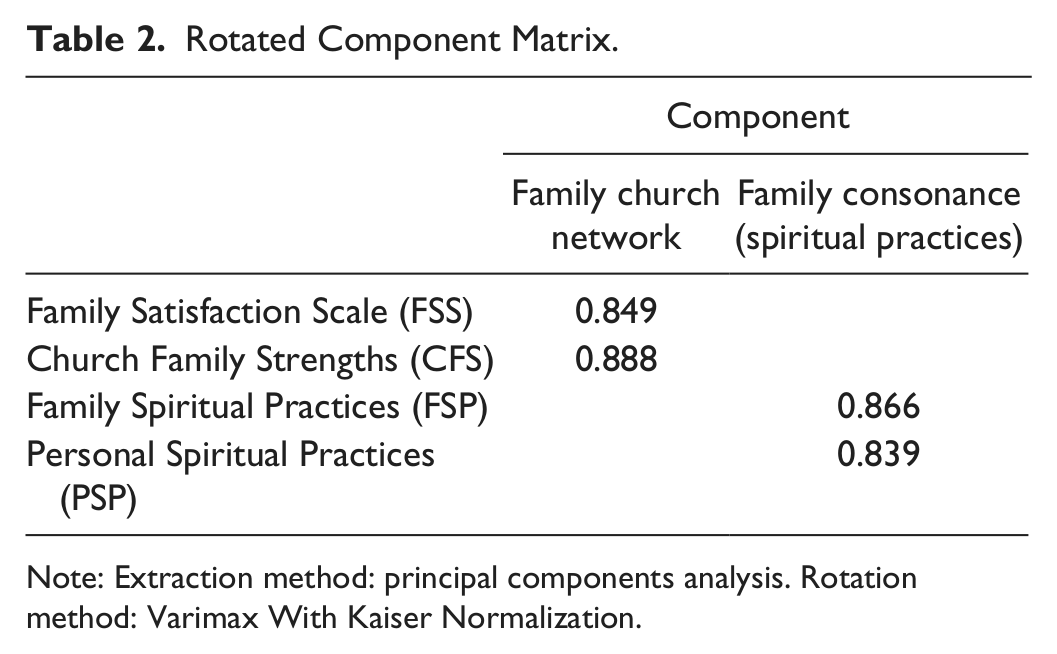
Note: Extraction method: principal components analysis. Rotation method: Varimax With Kaiser Normalization.
The first composite variable (factor) was labeled family church network in the regression model. The second composite variable was labeled family consonance (spiritual practices) in the regression model. Forming composite variables as predictor variables in the regression analysis reduced the data set to a workable size while retaining the interconnectedness and contextual influences evident in the original data associated with spiritual well-being and adolescent resilience.
The composite variable family church network is defined as the individual’s satisfaction with the relationships he or she had with members of his or her family and with other church members. Family church network composite variable reflects the connectedness between the adolescent, his or her family, and his or her church through assessing functional strengths in these interrelated systems. The composite variable family consonance (spiritual practices) is defined as the degree to which the family and the individual practiced spiritual activities together. Family consonance (spiritual practices) reflects the harmony between the individual and his or her family through his or her spirituality.
Regression Analysis
Path analysis using a series of multiple regressions was conducted following the procedure outlined by Barron and Kenny (1986) to evaluate the interconnections that arise through relationships within the independent variables—family and church—and the dependent variables—spiritual well-being and adolescent resilience. In path analysis, the researcher stipulates the causality of the relations in the theorized model and demonstrates the effect through standardized regression coefficients (β weights). These are numerical representations of the strength of the relations between variables in the path when all other variables are held constant (Meyers, Gamst, & Guarino, 2006).
Assumptions of path analysis using multiple regression identified by Meyers et al. (2006) were examined using the SPSS explore function and adequately met. In regression equations, outliers can have a marked influence on the accuracy of the results, so the two composite variables were explored for outliers. All assumptions were adequately met and all participants were included. Multicollinearity violation was not evident with tolerance values far in excess of .01.
Adjusted R 2 is used to interpret the regression results when the sample size is <60 and the independent variables are numerous (Meyers et al., 2006). Adjusted R 2 is a more conservative indicator of the variance in the dependent variable accounted for by the independent variables.
Regression analysis is also sensitive to highly correlated independent and dependent variables. A potential overlap between one domain in the compound variable family church network and one domain in the ARQ was explored. All alternative modeling failed to demonstrate any significant difference. This suggests that the ARQ domain of family connectedness and family availability does not overlap significantly with the family satisfaction domain of the family church network entered into the model.
As the path coefficients leading to adolescent resilience are generated from different regression analyses to the path coefficients leading to spiritual well-being, it is important that the same cases are captured in all regression analyses (Meyers et al., 2006). The data in this study were carefully managed to ensure only the adolescent participants whose resilience was assessed are included in this presented modeling.
Markstrom et al. (2010) recommended, to establish a mediator model, the following steps must be established: (Step a) the independent variable (IV) significantly predicts the mediator, (Step b) the IV significantly predicts the dependent variable (DV) and (Step c) the mediator significantly predicts the DV, and the IV is either non-significant or takes a lesser role in the equation [when the mediator is present]. (p. 68)
Step a: Multiple regression was initially conducted with adolescent spiritual well-being as the dependent variable and family consonance (spiritual activity) and family church network as predictor variables. Regression results, adjusted R 2 = .49, F(2, 19) = 11.05, p < .01, indicate that a clear association exists between the weighted linear composite of the predictor variables as specified in the model and the dependent variable (Table 3 and Figure 1). Both independent variables (family consonance and family church network) contributed significantly to the prediction of adolescent spiritual well-being. The independent variables family consonance (spiritual activity) and family church network were demonstrated to contribute significantly to the prediction of adolescent spiritual well-being, the mediator variable in the model.
Multiple Regression Table of Results for Spiritual Well-Being.
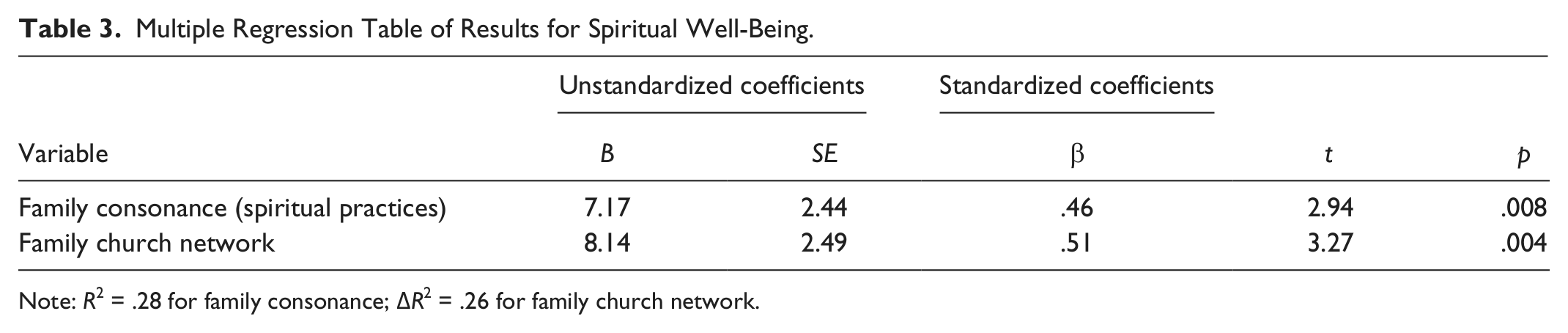
Note: R 2 = .28 for family consonance; ΔR 2 = .26 for family church network.

Multiple regression model for adolescent spiritual well-being with data values .46 and .51.
Step b: Multiple regression was conducted with adolescent resilience as the dependent variable and family consonance (spiritual activity) and family church network as independent variables. Adjusted R 2 = .64, F(2, 19) = 19.24, p < .001, indicate that a clear association exists between the weighted linear composite of the independent variables as specified in the model and the dependent variable. Both independent variables (family consonance and family church network) contributed significantly to the prediction of adolescent resilience, the dependent variable in the mediator model (see Table 4 and Figure 2).
Multiple Regression Table of Results for Adolescent Resilience.

Note: R 2 = .30 for family consonance; ΔR 2 = .37 for family church network.

Stepwise multiple regression model for adolescent resilience .47 and .61.
Step c: Spiritual well-being was then hypothesized to be the mediator between the independent variables— family consonance (spiritual activity) and family church network—and the dependent variable, adolescent resilience. The mediator adolescent spiritual well-being significantly predicted the dependent variable adolescent resilience (see Figure 3). Stepwise multiple regression was used to examine the influence of the various combinations necessary to demonstrate mediation by spiritual well-being (see Figure 4). These regression models demonstrate that both the independent variables, family consonance (spiritual activity) and the family church network, were no longer significantly related to adolescent resilience at p < .01.

Untrimmed model for adolescent resilience.

Visual depiction of mediational models.
Family church network predicted adolescent resilience at p < .05 level (β = .34, p < .05); however, the more conservative p < .01 level was retained. As a result, the direct pathways between family consonance (spiritual practices) and family church network on adolescent resilience were removed from the final model.
The final multistage respecified mediation model after trimming of nonsignificant paths from the hypothesized model is displayed in Figure 5. All regression analyses utilized the standard method. All path coefficients achieved practical significance as the beta weights are above .3 (Meyers et al., 2006). Statistical significance was set at <.01 to ensure that possible bias resultant from the small data set utilized is minimized. The results of this structural equation yielded a significant adjusted R 2 = .69, F(3, 18) = 16.40, p < .001.

Mediation model for adolescent resilience with data values.
The path analysis demonstrated spiritual well-being acts as a dominant mediator between family consonance (spiritual practices) and adolescent resilience and between family church network and adolescent resilience, as depicted in this model. Spiritual well-being fulfills the conditions necessary for a variable to function as a mediator (Barron & Kenny, 1986). The conditions demonstrated are as follows:
When the pathway between the independent variables and spiritual well-being are controlled, the previously significant relationship between the independent variable, family consonance (spiritual practices), and the dependent variable, adolescent resilience, is no longer significant. Likewise, the previously significant relationship between the independent variable, family church network, and the dependent variable, adolescent resilience, is also no longer significant. This effect demonstrates that spiritual well-being acts as a mediator between the independent variables and adolescent resilience.
Variations in independent variables account for variations in the proposed mediator, spiritual well-being.
Variations in the proposed mediator, spiritual well-being, significantly account for variations in the dependent variable, adolescent resilience.
Thematic Analysis
The second stage of data analysis was the thematic analysis of the open-ended questions. Initially, two major themes were identified through the thematic analysis. These two themes were as follows:
Theme 1, participating together in spiritual practices— a spiritually aware family, and
Theme 2, connected to a spiritual family—a spiritually aware community.
Participating Together in Spiritual Practices— A Spiritually Aware Family
“Spiritually aware” families, in this report, are families that implemented spiritual practices together and that actively promoted spiritual well-being within their families. The term is not a comparison against any other parental behavior. Rather, these families have indicated their own spiritual awareness. Spiritually aware family is an apt term to describe this attribute of these families in this study. The term may have no relevance to other families not in this study. Spiritually aware families encouraged the development of spiritual awareness in their children and being raised in a spiritually aware family influenced spiritual well-being and resilience for the Gen Y participants. Spiritually aware parents hoped that they could positively influence spiritual development in their children from an early age through performing spiritual practices together. These parents spoke about how they strove to demonstrate their beliefs and practices so that their children could become spiritually aware, as these two parents revealed: We all gather to have a time of family prayers nightly. This is an opportunity to check how family members are going spiritually. (Case No. 234) We all talk about correct behavior and how things should be handled and pray together about issues of life and for blessing for our family. We encourage reading the word and praying and trusting God. (Case No. 70)
Parents recognized that one day their children would need to decide for themselves whether to accept the family’s spirituality type and commitment level, as this parent revealed: My hope is that my children would understand why we pray and why we are committed to God and they would choose at some stage to build their own personal relationship with God. (Case No. 96)
In a study exploring the association between family processes and adolescent religiosity, Day et al. (2009) found that adolescents who had good relationships with both their parents and who attended church services at least once a week with their family at the age of 16 were most likely to attend regular church services at the age of 20. When children independently continued to follow the family’s spirituality, spiritually aware parents were pleased. One of the highlights in this parent’s life was to see their children and grandchildren continuing in the family’s spirituality they had taught: [A highlight of my life is] seeing my daughter and son-in-law and grandchildren knowing and serving God and His son Jesus Christ. (Case No. 30)
The young people raised in a family where spiritual matters were recognized credited their family upbringing as the earliest and most influential factor in helping them develop their spiritual awareness. Participating in spiritual practices together for these families was an important aspect of the spirituality that also strengthened family connectedness and cohesion. Joshua has identified that implementing spiritual practices had a benefit of strengthening his family connectedness through creating some vulnerability with one another, an element that Joshua enjoyed: I have always loved praying as a family. It is the communal side of this that I think draws me to it. A common understanding and almost that vulnerability of letting out our spiritual side in front of each other.
Participating together in spiritual practices was especially important during times of crisis and stress, because it built resilience, as Jaimie recalled: Through the hardest time in my life, my family were praying for me. I knew they were and I believe it was their prayers that got me through that time. They took the time to drive me to church and youth group and camps and (other church) groups.
When the young people experienced times of personal and family crisis, they believed that the family spiritual practices assisted them to overcome the crisis.
Connected to a Spiritual Family—A Spiritually Aware Community
The language of the Christian community is one of family. The biblical worldview has a fundamental belief that Christians are members of God’s family (Ephesians 2:19b). The term church family is commonly used by people who are members of the AOG denomination when talking about members of their church. Evidence of the term church family is found in the teachings of the church. No participant expressed any hesitation with the term. Another term, my spiritual family, was introduced by the participants, which expresses their deep connectedness to other church members.
Participants used the term my spiritual family when talking about church members with whom they had close relationships. Participants repeatedly indicated that they considered God as their father and other members of the church as brothers and sisters. In exploring the relationships between spiritual family members, it is salient to include God in this spiritual family, as the relationship with God is of great importance to the participants. This concept is consistent with the church teaching and with the biblical worldview and is a held belief of these participants as Vicky and other older participants expressed: Vicky . . . I will take my spiritual family. Knowing that I am loved and am a daughter of the King [God], having access to God’s throne room at all times—this has completely transformed my relationship with God. (Case No. 247) . . . my brothers and sisters at church. (Case No. 15)
For these people, being a member of this church was about being a member of a connected community of people. This family style of relating to one another in the church had a relationship to spiritual well-being. There was a clear association between the demonstration of church family strengths and spiritual well-being, r = .435, p (one-tailed) < .001, n = 56. The relationships between young people and church members also had an association to adolescent resilience. There was a clear association between church family strengths and adolescent resilience, r = .644, p (one-tailed) < .01, n = 22.
For most participants, their spiritual high point was an activity involving other people in their spiritual family. They enjoyed spending time together with others in their spiritual family, which involved attending youth camps, being involved in the activities and organization of the church, and doing things for others, as Sam recalled: The high point for me has been serving as a leader in our youth group. I feel I have a positive influence over some teenagers and I feel that we are an encouragement to each other.
Likewise, in their research with rural low-income families, Churchill et al. (2007) reported participants identified that “community-based locations for fun included libraries, community centers, and churches. Some mothers stated that that community-based entertainment had the advantages of being lower cost and supporting the values that they felt were important for their children” (p. 273). For participants in this study, a strong connection to a spiritual family at their local church offered meaningful and enjoyable social opportunities. Being connected to a spiritual family was a strength for them. The church was an important community where these young people feel that they belong. Positive youth outcomes are enhanced through such accumulated ecological assets consistently over time (Benson, Scales, Hamilton, & Sesma, 2006). The connectedness and cohesion between important ecologies in the lives of these young people provided sources of assets that strengthened spiritual well-being and resilience.
Exploring Gen Y Participants’ Experience of Spiritual Well-Being
Following the multiple regression modeling and the thematic analysis, further exploration of the phenomena was undertaken. This section reports on the findings based on a multicase thematic analysis of the lived experience of six Gen Y participants. Two themes that have high importance for illuminating spiritual well-being in the lives of these six young people are identified: living in a relationship with their God and enjoying a sense of spiritual well-being, which contained a subtheme of developing spiritual awareness from a young age.
Theme 1: Living in a Relationship With Their God
The young people reported a complex relationship with their God. Their relationship with God was viewed as being the most important relationship in their lives, providing meaning to spiritual awareness and a major source of direction and purpose. This appeared consistent across the generations for participants in this study. Ben illustrated this held belief:
God is everything. He is the only reason I have experienced peace and understanding.
One of the strong beliefs of the participants is that the God with whom they have a relationship is a God who cares for them and acts in their best interest. These young people believed that they had experienced deeply a personal relationship with their God, as Vicky illustrated:
Gemma prayed for me and she told me God is smiling at me. And she also told me that the Holy Spirit [God] will be with me. After that, I knew I was in God’s presence and I just fell in love with Him again.
For these young people, God inspired, empowered, healed, comforted, prompted, taught, and corrected, as these comments stated:
God inspires, empowers, and instills a sense of great peace when we relate to Him.
God has healed my broken heart to whole. He has comforted me when I feel lonely or sad. At times the Holy Spirit [God] will prompt me on certain areas of my life. He also teaches me and corrects my wrong attitudes and character.
God was not expected to remove all of life’s challenges. Rather, God was seen as helping overcome the normal challenges of day-to-day life. God’s interventions were supportive and comforting throughout life’s challenges. This relationship supported young people when things in life were stressful, as Ben’s comments illustrated: When my mum passed away, I felt a real sense of God’s strength and touch on my life. Even in the midst of pain and disaster, the presence of the Holy Spirit [God] impacted my life in an incredible manner.
Participants acknowledged their dependence on a superior God who required their active participation to maintain and flourish the relationship. God was recognized as the predominate instigator, as the provider, and as the source of supernatural events. Participants stated that if they did not undertake spiritual activities they believed to be important for developing and maintaining the relationship with God, their well-being was diminished. Their relationship with God, their ability to succeed in everyday activities, and their relationships with other people, all suffered. Vicky recalled what it was like for her during such times in her life:
There were periods of time when I didn’t pray or read the Bible. I felt so dry on the inside. I tend to be very angry and frustrated at the people around me. When I never commit my daily life to God, my day will not run smoothly.
Living in a relationship with God was viewed as a strength by the six Gen Y participants who choose to please God and conduct themselves as they believed God required of them. They developed this relationship by practicing spiritual activities. Their relationship with God was based on their understanding that God looked favorably toward them and acted in their best interest.
Theme 2: Enjoying a Sense of Spiritual Well-Being
These Gen Y individuals expressed their understanding of spiritual well-being as being connected to God and as an outcome they experience. For the young people, these two common elements were used to describe what spiritual well-being is and its benefits to them. Ben, Joshua, and Jordan illustrated the psychological outcomes they experienced.
To have spiritual well-being is to have inner peace and a sense of connection with our creator [God].
The high point in my spiritual life is the constant joy I have in my life. That I have a feeling inside me that I am on the right track and have somewhere to go when I die. I know that when I have been in contact with God regularly, I feel satisfied and confident that I am leading a pleasing life.
Spiritual well-being is important as I’m more peaceful and happy.
This understanding that spiritual well-being is an experienced outcome may be important for incorporating spirituality into health and welfare services for young people. Young people may not respond to words that describe spirituality, religiosity, or be able to talk easily about their spiritual well-being. Yet young people may recognize their level of spiritual well-being in terms of their satisfaction with life or the peace they experience in life. In health care interactions with young people, inquiring about peace or satisfaction with life the young person is feeling may facilitate conversations on spiritual matters.
One of the most striking features about these young people was their acute awareness of their spiritual journey and their active efforts to enhance their spiritual well-being. For all six of these Gen Y participants, spiritual matters were important and acted as a regulator of behavior in their lives. The awareness of spiritual matters allowed these young people to understand their life in terms of how their choices affected their spiritual well-being. These young people believed that modification of personal behavior contributed toward enhancing their spiritual well-being. Sam’s comment illustrated the choices he was prepared to make for the sake of developing his spiritual well-being and relationship with God: I am prepared to sacrifice other things to focus on my spiritual well-being. I will skip going to the movies and cafés to make sure I have time to focus on my spiritual walk with God.
Dollahite, Layton, Bahr, Walker, and Thatcher (2009) reported that youth gave the following reasons for being willing to make sacrifices [for their spiritual beliefs]: connecting to a higher meaning or purpose, connecting to God, connecting to the faith tradition or community, fulfilling expectations, feeling affective benefits, and avoiding problems. (p. 691)
The documented sacrifices predominately required a reduced participation in social activities so that time could be spent participating in spiritual activities.
The Gen Y participants in this study also made sacrifices and undertook spiritual practices to develop their relationship with God and, as a result, they believed that they enjoyed the affective benefits of peace and satisfaction in life. Such benefits may act as motivation to undertake spiritual practices that often require sacrifices to be made. Smith and Denton (2005) identified that central to modern American youth participation in religion is feeling good, happy, secure, and at peace. Similarly, the Gen Y participants in this study reported feeling peace and life satisfaction as major affective benefits. Smith and Denton however, considered that such an emphasis in youth spirituality reflects a cultural norm of individualism and self-gratification. In contrast, the central concern of participants in this study was a desire to develop their relationship with God.
Developing Spiritual Awareness From a Young Age
Participants stated that developing spiritual awareness was about learning to recognize a spiritual rather than the corporeal element in life and what actions, if any, could be implemented as a response. The following comments by two participants illustrated this emphasis: Actually acknowledging that you have a spiritual side. I think this, let alone what you believe, is the root of spiritual well-being. I think that people who are open to this side of their life are spiritually well at a basic level. From this first step then they are free to be able to find the truth behind their spiritual feelings. (Joshua) I guess when we say we are made up of body, mind, and spirit, we are talking about our spirit, our spiritual side. (Ben)
These six young people were acutely aware of spiritual matters and their spiritual awareness was clearly demonstrated through their willingness and devotion to spiritual practices. Roehlkepartain et al. (2008) found that for Australian youth who are spiritually aware, spiritual understanding remains underdeveloped compared with youth in other countries. Recognizing and understanding spiritual matters in life is not as easy as recognizing and understanding physical matters for young people, as Sam illustrated: I guess I’m not totally sure what spiritual well-being is. It’s easy to see if there are problems with the body but our spirit is a deeper issue.
The recent literature indicates that people often experience a spiritual awakening; a period following which they are spiritually aware. Roehlkepartain et al. (2008) identified this as “experiencing enlightenment, awakening, liberation, salvation, or other experiences of transcendence or deepening” (p. 44). As much as a spiritual awakening is seen by some researchers as an important part of spirituality for some people, it appears that for five of the six Gen Y participants, they could not remember a time when they were not spiritually aware, as they indicated through these quotes that are from reflections on their childhood:
My family always brought me and placed me in an environment to experience God for myself. I have always been in and around church. This has helped me to encounter God for myself.
We [my family] talked freely about spiritual things and discussed issues when they came up.
In contrast, Vicky was the only Gen Y participant raised in a family where her current spiritual beliefs were not aligned to those of her parents. Vicky identified that she and one sister both follow the same type of spirituality—Christianity. In doing this, Vicky aligned herself and her sister as different to other members in the family in spiritual matters: My family, except for my second sister, they are not Christians.
Although Vicky does not identify a specific time when she became spiritually aware, she regretted that she was not raised to be spiritually aware as she looks back on her journey toward spiritual awareness: I would like to have been told about spiritual well-being at an earlier time in my life.
Although Jaimie recounted that she was spiritually aware from a young age, of these six participants, only Jaimie identified a point in time that may be considered a type of spiritual awakening, similar to that identified by Roehlkepartain et al. (2008). Being raised in a spiritual family may negate the salience of a spiritual awakening where young persons become spiritually aware compared with a time in their life when they were not spiritually aware. Conversely, Jaimie indicated that there was a salient period in her life when she confirmed her beliefs independently.
For young people who are raised in a spiritually aware family, a spiritual awakening “moment” may not be an important issue, due to their familiarity with spiritual matters for as long as they can remember. Instead, it may be more appropriate to recognize their spiritual awakening as a point or a short period of time during which they become consciously aware of the implications of spiritual matters in their own life. For people with a spiritually aware family experience, this progression toward a personalized spiritual awareness may be a more significant concept for research and an applied health application. Engagement in spirituality may prove to be an important construct for health researchers and practitioners when exploring the links between spirituality and health outcomes.
Discussion: Spiritual Well-Being and Resilience
The study demonstrated a complementarity between the quantitative and qualitative results and illustrated a clear association between spiritual well-being and adolescent resilience for these young people. It explored the lived experience of participants, all of whom demonstrated their spiritual development through attesting to their spiritual understanding and to their experience of spiritual well-being. Although all participants in this study reported that they have developed spiritual awareness throughout their lives, there is no comparison case. The findings from this case study therefore may relate only to the experiences of these spiritually aware people.
The participants reported clearly their efforts to address transcendent issues through their efforts to implement spiritual practices in line with the beliefs of their religious denomination. As a result of their efforts, the participants experienced a state of spiritual well-being and affective benefits of peace and life satisfaction. Life satisfaction has been identified as an important indicator of positive youth development (Hawkins, Letcher, Sanson, Smart, & Toumbourou, 2009). This research demonstrated that the interconnected and cohesive relationships between these young people, their family, and their spiritual family enhanced their spiritual well-being. This strong consonance between the relationships and ecologies in the lives of these young people assisted them to make sense of their world and for their spiritual beliefs to be plausible (Rymarz, 2009). Through this plausibility, the espoused worldview becomes a lived out worldview (Garber, 2007).
The application of the bioecological theory of human development to spiritual development proved to be a suitable framework for the research and encouraged a holistic and naturalistic approach to this study. The bioecological theory of human development proposes that human development is enhanced through strengthening recurring bidirectional proximal relationships. Positive affects arising from these relations are reinforced when interconnecting systems are supportive of each other. This theory predicts that enhancing bidirectional proximal processes (relationships) and strengthening the ecology will promote positive development and outcomes. This study has demonstrated that the spiritual well-being of the participants was enhanced through strong proximal process within the family and the community, thus supporting the bioecological model.
This study also found that for the young people who demonstrated engagement with their spirituality type, there is a clear association between adolescent spiritual well-being and adolescent resilience. This significant correlation supports the previous research findings of an association between the two variables. By itself, a correlation does not indicate the direction or causation of the association. Path modeling based on regression analysis is a powerful means of practically illustrating meaningful associations and pathways. Such pathways in studies with relatively small numbers (small-N studies) are not deterministic/causative, rather probabilistic in their assertion (Lieberson, 2000). Examination of the independent composite variables—family church network and family consonance (spiritual practices)—spiritual well-being acting as a mediator variable, and the dependent variable adolescent resilience demonstrated a pathway of spiritual well-being strengthening adolescent resilience.
For the participants in this study, their spiritual well-being, and more importantly their relationship with their God, drove their behaviors and connections that act as protective factors leading to enhanced resilience. Based on the results of this case study, a possible explanation for the association between spiritual well-being and resilience is presented in Figure 6.

Possible explanation for the association between spiritual well-being and resilience.
This study utilized people belonging to one spirituality type to illustrate how a range of spiritual practices adopted by these individuals, their families, and other members of their church related to their spiritual well-being and resilience.
Spiritual well-being of participants was seen to exert a protective influence on behavior. Their spiritual well-being was seen to generate a powerful influence toward positive developmental health outcomes through strengthening personal attributes of peace and life satisfaction and enhancing bidirectional proximal processes (relations and spiritual practices) within the family and within the spiritual family. When spiritual well-being was present, the attractiveness of risk-taking behavior was weakened; spiritual well-being was a protective factor that strengthened resilience. Results indicate that spiritual well-being and resilience are interrelated and ecologically bound for this group. The priority for these participants was not how their spirituality and religiosity restricts their lives rather on how their life affects their spiritual well-being.
Spiritual Strengths Model
This case study report has demonstrated that different spiritual strengths, presented through the themes in this report, are operant in the lives of the young people in this case study. These spiritual strengths operate across the personal, family, and community domains of resilience offering an alternative explanation to the relationship between spirituality and positive health outcomes/resilience. These five spiritual strengths are as follows:
Participating together in spiritual practices-a spiritually aware family;
Connecting to a spiritual family—a spiritually aware community;
Living in a relationship with God;
Enjoying a sense of spiritual well-being; and
Developing spiritual awareness from a young age.
Spiritual strengths within the system of the individual are spiritual awareness, enjoying a sense of spiritual well-being, and living in a relationship with God. The spiritual strengths within the system of the family is participating together in spiritual practices-a spiritually aware family. The spiritual strength evident within the system of the community is connecting to a spiritual family—a spiritually aware community. Contextualization of the regression model presented earlier can be achieved through mixed modeling that incorporates the qualitative and quantitative findings related to spiritual well-being. This process resulted in a proposed model that illustrates these five spiritual strengths and their associations with adolescent resilience (Figure 7). This model illustrates the interconnectedness and the synergy that develops between the five spiritual strengths, which provide a protective factor for the young people. In this model, the lines are not indicating causal pathways or direction of influence.
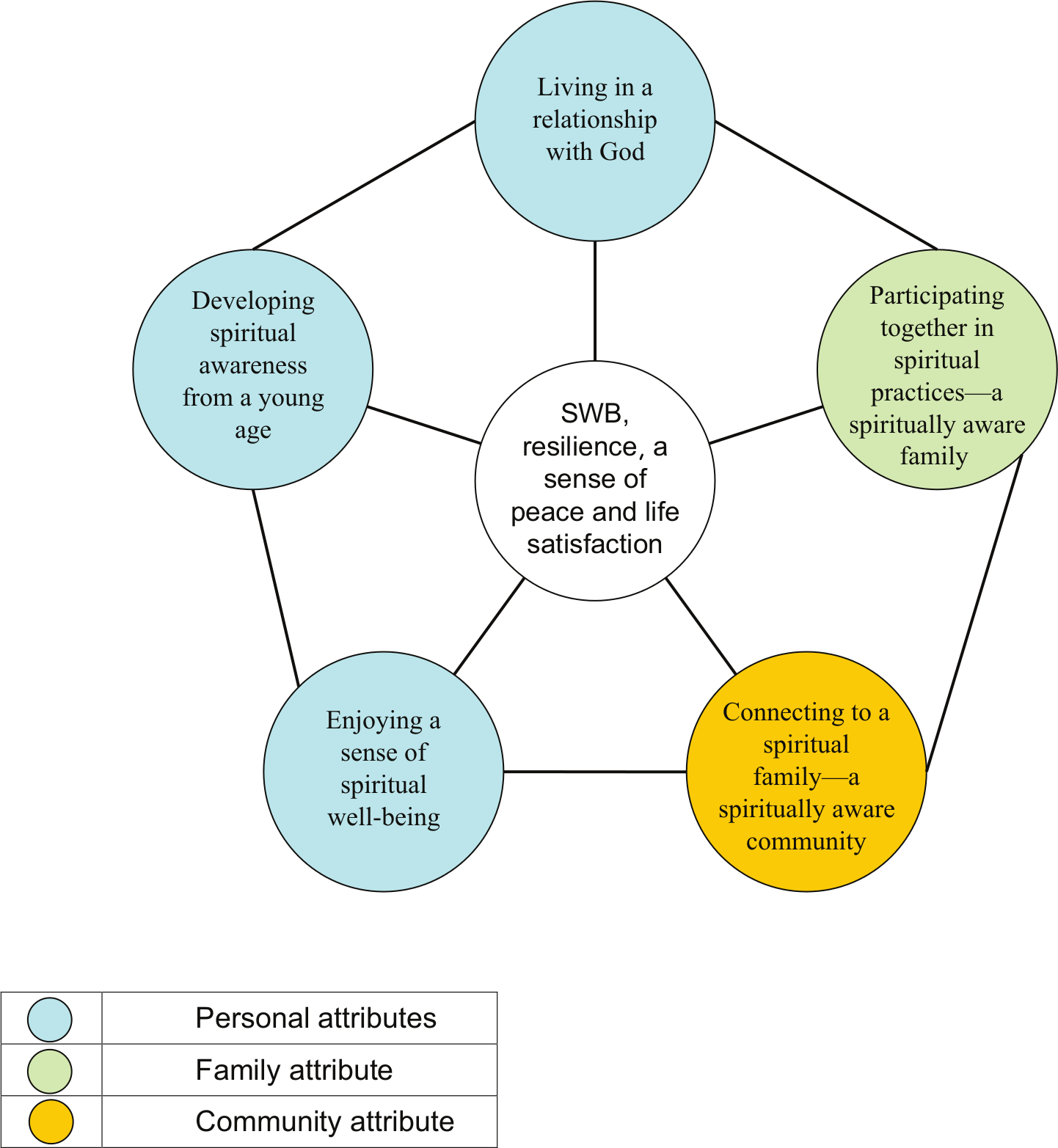
A proposed model of five spiritual strengths.
Figure 7 illustrates that participating together in spiritual practices in a spiritually aware family and connecting to a spiritual family in a spiritually aware community may assist in developing spiritual awareness from a young age and encourage living in a relationship with God. The young people who lived with these spiritual strengths enjoyed a sense of spiritual well-being that provides a sense of peace and satisfaction in life. The five spiritual strengths identified within this case study are interconnected and the relationships between the spiritual strengths are bidirectional. These spiritual strengths acted as protective factors, through moderating risks for developmental health outcomes, and were associated with enhanced adolescent resilience for the participants.
Limitations and Recommendations
This case study does not attempt to compare the findings from this group of people with findings from people with other worldviews. Nor does this research propose that the findings from the participants attending this local church following a Judeo-Christian worldview are transferable to people with other worldviews, or the findings from the participants following Pentecostalism transferable to people following other Christian denominations. Comparison case studies with people who belong to other spirituality types, which operate as both dominant and marginalized within the community and incorporate differing spiritual practices to test the associations and emergent model arisen from this study, are required. It is also recommended that further research is required that considers how best to incorporate spiritual well-being into both resilience measures and health-promoting strategies.
Conclusion
Health promotion activities and services focused on reducing risk has not provided the gains commensurate with the economic and democratic prosperity of Australia, and an unacceptable percentage of young people continue to experience lives that impact negatively on their developmental health outcomes. A bioecological perspective incorporating spiritual strengths offers hope that young people can thrive. Understanding the role of spiritual well-being in pathways that influence developmental health outcomes of young people will inform families, health professionals, and policy makers, enhancing their effort to reverse negative trends. This study illustrates that for this cohort, the ecological background and influences of the family and the community in which a young person resides strengthened the young person’s resilience and spiritual well-being.
The results indicate that for this group of young people, when spiritual well-being was present, the attractiveness of risk-taking behavior was weakened. The study adds weight to previous studies that also found that spiritual well-being and resilience are interrelated and ecologically bound.
Footnotes
Declaration of Conflicting Interests
The authors declared no potential conflicts of interest with respect to the research, authorship, and/or publication of this article.
Funding
The authors received no financial support for the research and/or authorship of this article.
Author Biographies