




Abstract
The present study covers the knowledge management (KM) in institutions of higher technical education (IHTEs) from the perspective of thought leaders and junior academia to identify whether there is a difference of opinion regarding KM strategies, including knowledge technologies, knowledge acquisition, knowledge storage, knowledge dissemination, and KM-based framework for research and curriculum development (CD). Data have been collected through structured questionnaire from 141 respondents covering 30 higher educational institutions in India, including national- and state-level institutions—Designations of the targeted respondents in the IHTEs have been categorized into (a) senior academia, that is, professors, heads, and associate professors occupying senior management positions, considered to be the institute overseers and thought leaders of KM and (b) junior academia consisting of assistant professors and lecturers who are using and also contributing to the KM system. ANOVA has been used to see whether there is a significant difference of opinion among the two groups of knowledge users. The results of the study highlight a significant difference among the two groups regarding knowledge technologies, knowledge acquisition, knowledge storage, and knowledge dissemination. But, there is a consensus regarding KM-based framework for research and CD.
Keywords
Introduction
A profound revolution based on information and knowledge is occurring within society, which is led by developments in computing and communications technology. According to Drucker (1993, p 07), “We are entering (or have entered) the knowledge society where the knowledge worker will play a central role.” Knowledge leaders play a vital role in enhancing research and curriculum development (CD) in educational institutes. Over the years, an organization’s employees attain knowledge while performing their specific tasks. This knowledge resides in their minds and has not been put in structured, documented based form. The knowledge has been acquired along the years while taking the decisions in crucial situations, solving the problems. It is one of the most difficult task to transfer this knowledge to others but, however, this knowledge is one of the most valuable asset for any organization to lose. Knowledge management (KM) facilitates the retention and distribution of knowledge within an organization to gain competitive advantage. Organizations are implementing KM to reserve and utilize this knowledge.
KM is a broad concept that addresses the full range of processes by which an organization deploys knowledge. These involve the acquisition, retention, storage, distribution, and use of knowledge in an organization.
The basic components of educational institutions are CD and research and human resource, namely, the knowledge workers can play a vital role for improving CD and research. The growth in the number of internet users has given an added impetus to globalization. Information patterns have transformed the electronic information systems by the use of cyber technologies. As a result of this, knowledge transmission patterns within academic organizations must develop and change the education systems for information to be effectively transmitted. Consequently, KM method is becoming a perfect education development pool for all academic levels (Thitithananon & Klaewthanong, 2007). The present study based on the survey of academia of institution of higher technical education (IHTE) tries to identify the key KM strategies acceptable to the two groups of knowledge users—the senior academia, namely, professors, associate professors, and the thought leaders of KM, and junior academia consisting of assistant professors and lecturers. The study also tries to identify the key factors for KM-based portal for CD and research.
Literature Review
The forces of technology, globalization, and the emerging knowledge economy are creating a revolution that is forcing organizations to change. The knowledge revolution has invaded India, and higher education institutions are recognized to be in the knowledge business. The higher educational institutes are being increasingly exposed to marketplace pressures and have to focus on new competitive strategies to remain ahead. Drucker (1993) has described knowledge, rather than capital or labor, as the only meaningful economic resource in the knowledge society. Thus, there is a need to focus on knowledge and KM. Organizations that succeed in KM are likely to view knowledge as an asset and to develop organizational norms and values that support the creation and sharing of knowledge (Davenport, DeLong, & Beers, 1998). KM is generally about the gathering, storing, disseminating, and application of knowledge via the know-how and creation of work by the individuals in an organization (Miller, 1999). KM as a discipline encourages a mutually supported method to create, capture, organize, and use information (Bair, 1999; Duffy, 2000). This includes information that is easily measurable as well as more difficult to measure information that is either unspoken or informal.
Knowledge is a gradual transition from data to information. According to Japanese author Nonaka (1994) with enough preparation, we should be able to tap into that reservoir—and ride the wave—by utilizing new ways to channel raw data into meaningful information. That information, in turn, can then become the knowledge that leads to wisdom. Information is a relationship between data and, quite simply, what it is, with great dependence on context for its meaning and with little implication for the future (Alberthal, 1995; David, 2000).
KM is defined as the process of transforming information and intellectual assets into enduring value. KM connects people with the knowledge that they need to take action when they need it (Kidwell, Karen, & Johnson, 2000). KM consists of explicit knowledge and tacit knowledge (Tiwana, 2000). KM is generally about the gathering, storing, disseminating, and application of knowledge via the know-how and creation of work by the individuals in an organization (Miller, 1999). Knowledge refers to the sum of what is known: A familiarity, awareness, or understanding gained through experience that, in a business context, guide operations and administrative processes (Coukos & Eleni, 2003). Knowledge represents a pattern that connects and generally provides a high level of predictability, for example, if the humidity is very high and the temperature drops substantially, the atmosphere is often unlikely to be able to hold the moisture, so it rains (Bateson, 1988).
A common way to discuss knowledge is by dividing it into two dimensions, explicit knowledge and tacit knowledge. Explicit knowledge can be expressed in words and numbers and is shared in the form of data, manuals, copyright, and patents (Nonaka, 1991; Smith, 2001). The advantage of this type of knowledge is that it is easily accessible for other people, and can therefore be reused to solve similar problems (Smith, 2001). Explicit knowledge is documented information that can facilitate action. It can be expressed in formal, shared language (Kidwell et al., 2000).
Tacit knowledge is often seen as the iceberg below the surface of the water, that is, unseen and embedded in our social identity and practice (Spender, 1996). Tacit knowledge is deeply rooted in actions and experiences as well as in the ideals, values, or emotions that an individual embraces (Nonaka & Nishiguchi, 2001). Most business actions require the guidance of explicit knowledge and tacit knowledge (Kidwell et al., 2000).
Management consulting firms, which are considered as knowledge-based companies, have a high level of interest in KM because their capacity to compete on the basis of accumulated knowledge is important for their industry (Dunford, 2000).
The management consulting industry has experienced a constant growth during the 20th century (David, 2000). The ultimate goal for a company is to ensure that the knowledge “does not go home at night,” that is, knowledge should become a part of the organization as a whole (Kreiner, 2002). The aim of KM, for an organization, is to create a capable organization that measures, stores, and turns knowledge into a capital, in other words, to create a learning organization (Bollinger & Smith, 2001). Researchers claim that the key for this process of making individual knowledge a part of the organization is personal commitment (Goh, 2002; Nonaka, 1994).
KM and Higher Education
KM in education can therefore be thought of as a framework or an approach that enables people within the institution to develop a set of practices to collect information and share what they know leading to actions that improve services and outcomes (Petrides & Nodine, 2003).
Implementing KM practices wisely is what smartest organizations are learning all over again (Kidwell et al., 2000). According to Coukos and Eleni (2003), in business sector, knowledge is now being perceived as a valuable asset. Organizational knowledge refers to knowledge of the overall business the organization is in, the organization’s strengths and weaknesses, the markets it serves, and the factors critical to organizational success. Universities also rely on faculty-generated knowledge and traditional means of discovery and transmission of knowledge. KM in higher education supplies us with a framework for understanding how good assessment practice, in fact, depends on effective information system (Kumar & Kumar, 2005).
KM system can create a common gateway to the data, information, and knowledge. People throughout the higher educational institutions need to effectively share information and work together on projects. When employees use KM system, best practices are stored throughout the organization, and each employee accessing the system has power similar to the best employee (Markus, 2002). In academia, most of the tacit knowledge associated with an area of study lies with the faculty who study it. The tacit knowledge of literature may be what characterizes much of the informal, side-conversations at academic conferences, in discussions between graduate students and their mentors (Hawkins, 2000).
The objectives of the present study are to
identify the key KM strategies acceptable to the two groups of knowledge users—the senior academia, namely, professors, associate professors, the thought leaders of KM, and junior academia consisting of assistant professors and lecturers, regarding KM strategies;
identify the key factors for KM-based portal for CD acceptable to senior and junior academia;
identify the key factors for KM-based portal for research acceptable to senior and junior academia; and
assess the benefits of the proposed KM framework for CD and research.
Design and Method
Data have been collected through a survey questionnaire based on Likert-type scale and supported by personal interviews. The questionnaire has been designed according to the following research objectives and it contains these sections:
Information and communication technologies (ICTs) status of IHTE
KM implementation and knowledge-based techno- logies
KM portal for CD
Benefits of KM-based portal for CD
KM portal for research
Benefits of KM-based portal for research.
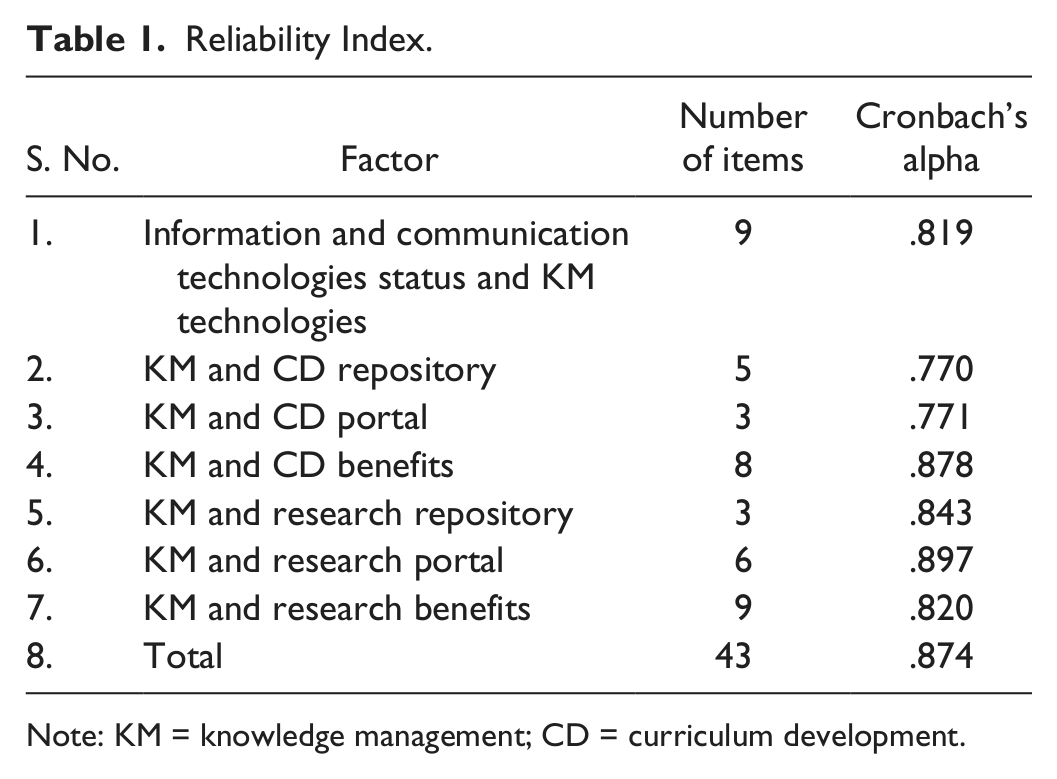
As seen from the results, the Cronbach’s alpha values vary from .770 to .897 and overall reliability is .874. Reliability depicts internal consistency of questionnaire. According to Nunally (1978), the generally accepted standard for reliability estimates are values greater than .70. Thus, the results highlight the internal consistency of the questionnaire (see Table 1).
Reliability Index.
Note: KM = knowledge management; CD = curriculum development.
Results and Findings
ICT Scenario and Need for ICT
The initial part of research focused on knowing the ICT infrastructure of the institutions (see Table 2).
ICT Scenario and Need for ICT.

Note: ICT = information and communication technology; URL = uniform resource locator.
Regarding ICT status of IHTEs surveyed, there was almost consensus among the senior and junior academia regarding ICT skills and applications needed to keep the pace with world in the knowledge age and this got the first rank. The usage of ICT to improve knowledge sharing among educator and students was placed at second rank. There was a difference of opinion regarding whether educators could use the new technology to improve their teaching, to give it more variety, for example, PowerPoint shows, web discussions, uniform resource locator (URL) collections, and websites. As most of the institutions are in the implementation stage of KM and have not switched to complete KM adoption, the levels of infrastructure at many IHTEs could be a reason for this.
KM Policies
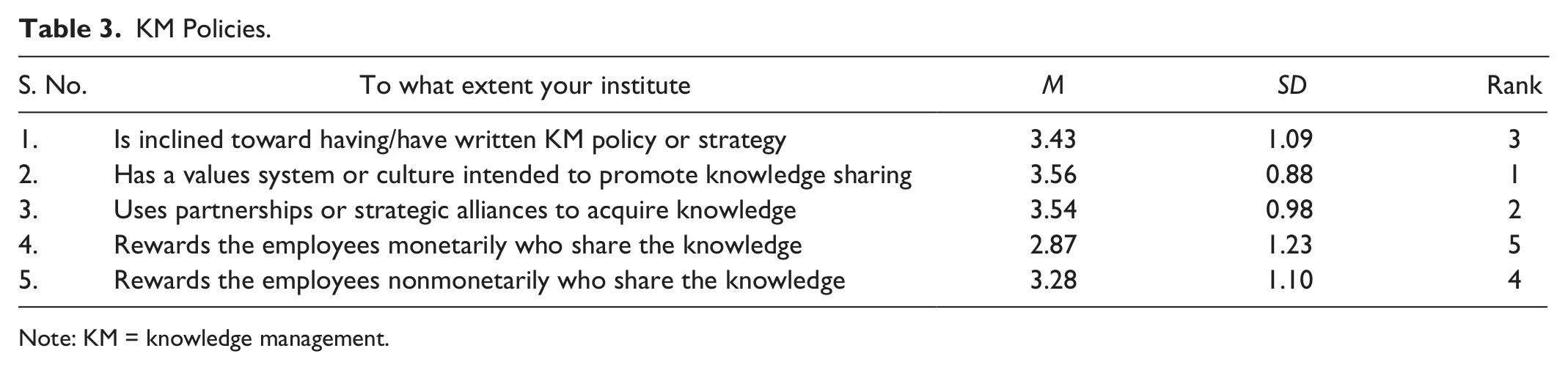
Before turning to KM portal for research and CD, it is essential to know about the institute culture toward KM strategies. Regarding KM system in IHTEs, topmost priority by junior and senior academia has been given to values system or culture intended to promote knowledge sharing, followed by using partnerships or strategic alliances to acquire knowledge. Least priority has been given to rewarding the employees monetarily or nonmonetarily (see Table 3).
KM Policies.
Note: KM = knowledge management.
Knowledge Acquisition
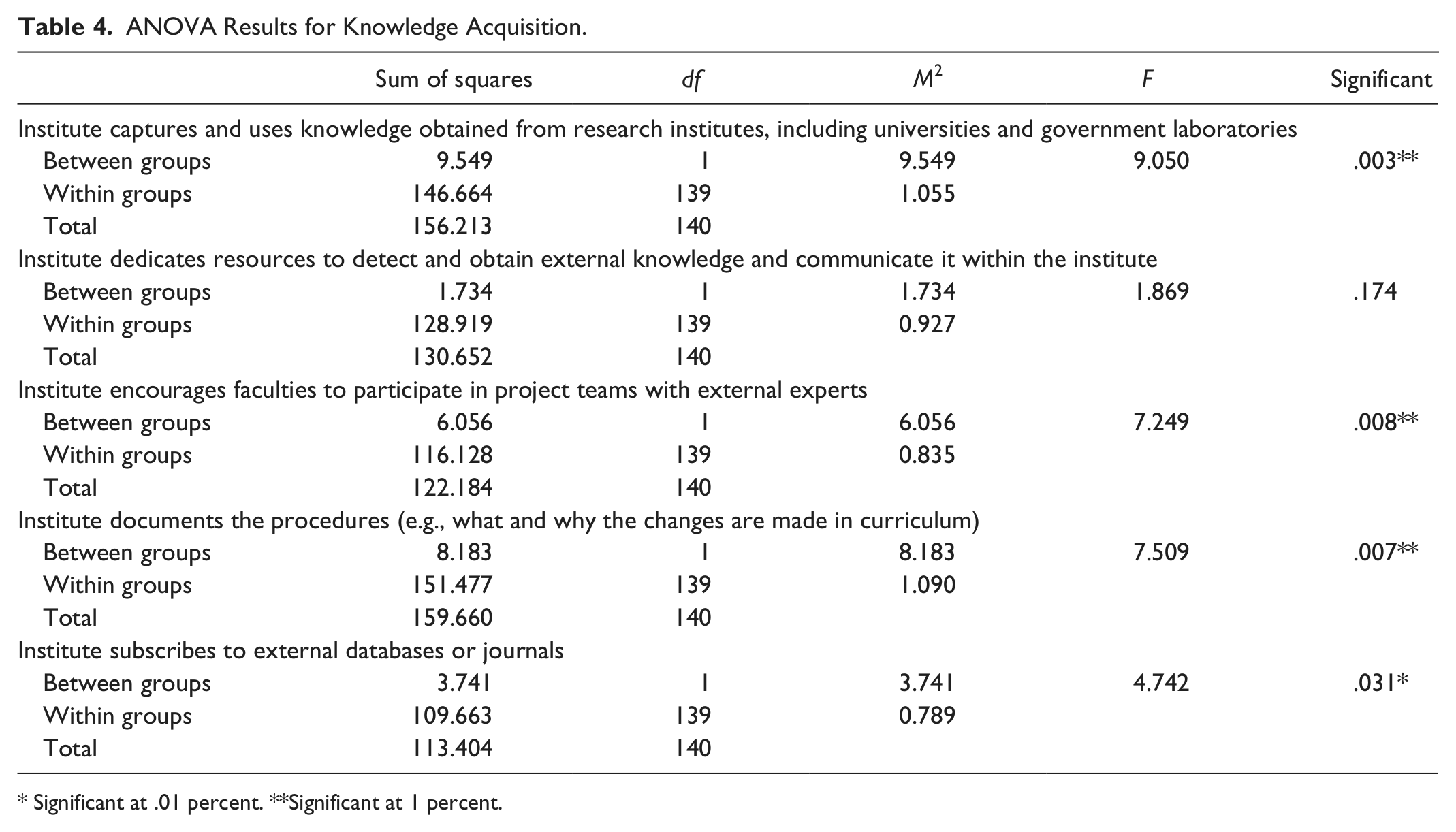
IHTEs by nature are the power house of knowledge. The organization should make an effort to acquire explicit knowledge and tacit knowledge that exists inside and outside the IHTE. It can be accomplished by dedicating resources to detect and obtain external knowledge. IHTE’s interest to acquire knowledge and methods used is investigated to find out whether there is an acceptance regarding knowledge acquisition among the senior and junior academia (see Table 4).
Hypothesis 1: There is a significant difference among the senior academia, namely, professors, associate professors, the thought leaders of KM, and junior academia consisting of assistant professors and lecturers, regarding KM acquisition.
ANOVA Results for Knowledge Acquisition.
Significant at .01 percent. **Significant at 1 percent.
For KM strategies, knowledge technologies, knowledge acquisition, knowledge storage, and knowledge dissemination of IHTEs have been considered.
ANOVA results for knowledge acquisition highlight that there is a significant difference between senior and junior academia, which is significant for all but one item of knowledge acquisition.
Knowledge Storage
To utilize the acquired knowledge for future use, it should be stored systematically. The study attempts to inquire whether there is a difference in opinion of senior and junior academia regarding the methods for storing knowledge (see Table 5).
Hypothesis 2: There is a significant difference among the senior academia, namely, professors, associate professors, the thought leaders of KM, and junior academia consisting of assistant professors and lecturers, regarding knowledge storage.
ANOVA Results for Knowledge Storage.

Significant at .01 percent.
For KM storage, there is a significant difference between senior and junior academia regarding knowledge storage by using the portal system. Knowledge storage by having the department-wise database and knowledge storage by maintaining “best practices and lessons learned” database are not significant as seen from p ratio. Thus, the above hypothesis has been partially accepted.
Knowledge Dissemination
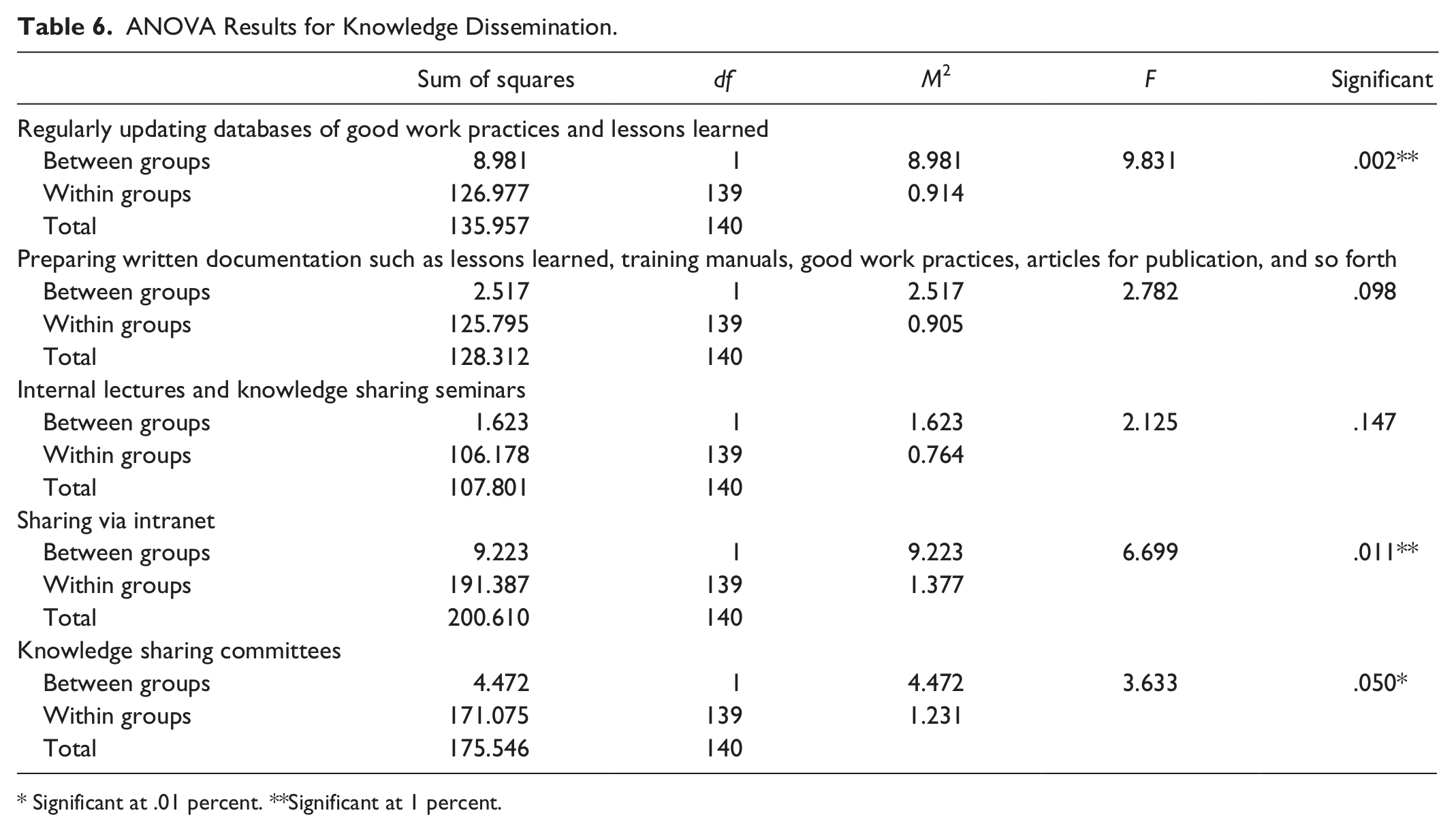
The process described so far encompasses the collection and storage of knowledge generated, information gathered, and lessons learned to allow an organization to capitalize on its experience and improve its performance. The stored knowledge has to be disseminated effectively for sharing the benefits. Knowledge can be shared in traditional ways and also with technology-driven modes (see Table 6).
Hypothesis 3: There is a significant difference among the senior academia, namely, professors, associate professors, the thought leaders of KM, and junior academia consisting of assistant professors and lecturers, regarding knowledge dissemination.
ANOVA Results for Knowledge Dissemination.
Significant at .01 percent. **Significant at 1 percent.
ANOVA results for job status and knowledge dissemination highlight that (a) regularly updating databases of good work practices and lessons learned, (b) sharing via intranet shows significant difference, and (c) knowledge sharing committees. Thus for three items out of five, there is a significant difference of opinion; thus, the above hypothesis has also been partially accepted.
KM Technologies
The critical role that information technology (IT) can play is in its ability to support communication, collaboration, and those searching for knowledge and information (McCampbell et al., 1999). IT and the advent of the personal computer have greatly enhanced organizational effectiveness, interorganizational deployment, and cognitive advance (Grover & Davenport, 2001). In the age of technology, one has many options to opt from the available ICTs. KM technologies considered in the present study are as follows:
Internet: It is a worldwide system of computer networks—A network of networks in which users at any one computer can, if they have permission, get information from any other computer.
Intranet: It is a privately maintained computer network that can be accessed only by authorized persons, especially members or employees of the organization that owns it.
Extranet: It is an extension of an institution’s intranet, especially over the world wide web, enabling communication between the institution and people it deals with, often by providing limited access to its intranet.
Data warehousing: It is a large specialized database, holding perhaps hundreds of terabytes of data. A database is specifically structured for information access and reporting.
Document management: It is the process of handling documents in such a way that information can be created, shared, organized, and stored efficiently and appropriately.
Blog: It is a frequent, chronological publication of personal thoughts and web links.
Decision support system (DSS): It is an interactive software-based system intended to help decision makers compile useful information from raw data, documents, personal knowledge, and/or business models to identify and solve problems and make decisions.
Artificial intelligence (AI): It is the study and design of intelligent agents where an intelligent agent is a system that perceives its environment and takes actions that maximize its chances of success.
Groupware: It refers to programs that help people work together collectively while located remotely from each other. Groupware services can include the sharing of calendars, collective writing, email handling, shared database access, electronic meetings with each person able to see and display information to others, and other activities. Groupware provides a mechanism that helps users coordinate and keep track of ongoing projects together.
Hypothesis 4: There is a significant difference among the senior academia, namely, professors, associate professors, the thought leaders of KM, and junior academia consisting of assistant professors and lecturers, regarding KM technologies.
ANOVA results highlight that there is a significant difference between senior and junior academia as regards five out of eight KM technologies. These are (a) intranet (such as internal portals), (b) document management, (c) blogs, (d) DSS, and (e) groupware (see Table 7).
ANOVA Results for KM Technologies.

Note: KM = knowledge management.
Significant at .01 percent. **Significant at 1 percent.
Thus, the present hypothesis has been accepted.
KM Framework for Research
The study considered opinions of senior and junior academia on the following features for research framework:
Research interests within an institution or affiliated institutions
Research results and funding organizations
Commercial opportunities for research results
Funding opportunities
Prepopulated proposals, budgets, and protocols
Proposal routing policies and procedures
Award notification, account setup, and negotiation policies and procedures
Contract and grant management policies and procedures
Technical and financial report templates and policies and procedures.
Hypothesis 5: There is a significant difference among the senior academia, namely, professors, associate professors, the thought leaders of KM, and junior academia consisting of assistant professors and lecturers, regarding knowledge framework for research.
ANOVA results highlight that there is no significant difference among the thought leaders and junior academia for the features of KM-based portal for research. Thus, the above hypothesis has not been accepted (see Table 8).
ANOVA Results for KM-Based Research Portal.

Note: KM = knowledge management.
Thus, the next section of the survey related to finding out from the academia the areas of education that will benefit the most with the implementation of KM. The factor analysis method has been applied on the data. Principal components factor analysis with varimax rotation and Kaiser normalization has been applied.
The results highlight three factors, namely (a) reduced turnaround time and cost of research and administrative tasks, (b) better curriculum and interdisciplinary research, and (c) improved services to cultivate future scientists’ account for 67.134 of total variance.
These factors are explained below:
Reduced turnaround time and cost of research and administrative tasks: This factor has emerged as a most important factor with a total variance of 42.020. The major components of this factor include the following:
Reduced turnaround time for research (0.792)
Minimized devotion of research resources to administrative tasks (0.808)
Reduced administrative costs (0.822).
Better curriculum and interdisciplinary research: This factor has emerged as another important factor with a total variance of 13.668. The major components of this factor include the following:
Latest research can give good inputs to improve the CD process (0.711)
Facilitation of interdisciplinary research (0.792)
Leveraging of previous research and proposal efforts (0.688).
Improved services to cultivate future scientists: This factor has emerged as another important factor with a total variance of 11.449. The major components of this factor include the following:
Quality research at the institution level will cultivate future scientists (0.855)
Improved internal and external services and effectiveness (0.871).
The mean score of Factor 1—reduced turnaround time and cost of research and administrative tasks—is 4.12, the mean score of Factor 2—better curriculum and interdisciplinary research—is 4.45, and the mean score of Factor 3—better improved services to cultivate future scientists—is 4.41, as is explained in Table 9.
Factors for Benefits of Implementing KM in Research Process.

Note: KM = knowledge management; CD = curriculum development.
According to Kidwell et al. (2001), the KM portal will improve the efficiency of knowledge exchange and deliver a set of shared business objectives that include communications around best practices, a gateway to research on the use of teaching and learning through technology, professional development, policy development and review, and resource development. The portal provides the faculty members at the individual campuses with efficient, direct links to current knowledge about teaching and learning through technology among the campuses of the university system, nationally and internationally.
KM Framework for CD
The present study has included the following features to be considered for CD:
Curriculum revision efforts that include lesson plan, content sequencing, reference of contents, and so forth
Content modularized and arranged to facilitate interdisciplinary curriculum design and development
Assessment techniques, including best practices, outcomes tracking, faculty development opportunities, and research
Analyzed student evaluations updated each semester for lessons learned and best practices for all faculty
Corporate relationships to identify curriculum design advisory task forces, guest speakers, adjuncts, case study sites, and so forth
Information related to teaching and learning with technology, including faculty development opportunities, outcomes tracking, technology overviews, and so forth
Information in each disciplinary area, including updated materials, recent publications, applicable research, and so forth
New faculty with guides for developing curriculum, working with senior faculty, establishing effective teaching styles, advising do’s and don’ts, supervising PhD students, and so forth.
Hypothesis 6: There is a significant difference among the senior academia, namely, professors, associate professors, the thought leaders of KM, and junior academia consisting of assistant professors and lecturers, regarding knowledge-based framework for CD.
The ANOVA results highlight that there is no significant difference among the thought leaders and junior faculty regarding the features for KM-based portal for CD (see Table 10). Thus, the present hypothesis has not been accepted.
ANOVA Results for KM-Based Framework for Portal for CD.

Note: KM = knowledge management; CD = curriculum development.
Benefits of KM Portal for Curriculum
Thus, the next section of the survey related to finding out from the academia that the areas of education will benefit the most with the implementation of KM.
The factor analysis method has been applied on the data. Principal components factor analysis with varimax rotation and Kaiser normalization has been applied. The results highlight that two factors, namely (a) curriculum improvisation and (b) faculty development and reduced turnaround time of CD account for 77.35 of total variance. These factors are explained below:
Curriculum improvisation: This factor has emerged as a most important factor with a total variance of 34.51. The major components of this factor include the following:
Good curriculum will enhance the research (0.882)
An industry oriented and latest curriculum will produce competent professionals (0.763)
Enhanced quality of curriculum and programs by identifying and leveraging best practices and monitoring outcomes (0.816).
Faculty development and reduced turnaround time of CD: This factor has emerged as another important factor with a total variance of 32.37. The major components of this factor include the following:
Improved speed of curriculum revision and updating (0.727)
Enhanced faculty development efforts especially for the new faculty (0.649)
Improved administrative services related to teaching and learning with technology (0.805)
Improved responsiveness by monitoring and incorporating lessons learned (0.768)
Interdisciplinary curriculum design and development (0.646).
The mean score of Factor 1—curriculum improvisation—is 4.44, and the mean score of Factor 2—faculty development and reduced turnaround time of CD—is 4.286, as is explained in Table 11.
Factors for Benefits of Implementing KM in CD.

Note: KM = knowledge management; CD = curriculum development.
According to Kidwell et al. (2001), the KM portal can be a gateway to research on the use of teaching and learning through technology, professional development, policy development and review, and resource development. The above results of factor analysis based on the perception of academia of IHTE support that KM portal for research will lead to better curriculum and interdisciplinary research help in providing improved services to cultivate future scientists. These two factors are important benefits of research. The last factor, that is, reduced turnaround time and cost of research and administrative tasks, has lower mean compared with other two factors and is relatively low on priority list of academia. Thus, there has been an overwhelming support from the academia for the implementation of KM in research as seen from the results of survey.
Conclusion
The first objective of the research has been to identify the key KM strategies acceptable to the two groups of knowledge users, the senior academia, namely, professors, associate professors, the thought leaders of KM, and junior academia consisting of assistant professors and lecturers, regarding KM strategies. The results of the study highlight that there is a significant difference among the two knowledge groups of users, the senior academia/thought leaders and junior academia/followers, regarding knowledge technologies, knowledge acquisition, knowledge storage, and knowledge dissemination.
The next objective has been to identify the key factors for KM-based portal for CD acceptable to senior and junior academia. The results indicate that there is no significant difference regarding KM-based framework for CD.
The third objective has been to identify the key factors for KM-based portal for research acceptable to senior and junior academia. A positive finding has been that here also the two groups have accepted the features of research to be included in KM framework for research. Thus, the features chosen by researchers for KM-based framework for CD and research are acceptable to both the groups.
The last and most important objective has been to assess the benefits of the proposed KM framework for CD and research. The researchers also tried to assess the perceived benefits of KM-based framework for CD and research. Regarding CD benefits, curriculum improvisation and faculty development and reduced turnaround time of CD are able to explain 77.35% of variation. Curriculum improvisation is considered more important as it has higher factor loadings and mean. The results highlight three factors, namely (a) reduced turnaround time and cost of research and administrative tasks, (b) better curriculum and interdisciplinary research, and (c) improved services to cultivate future scientists’ account for 67.134 of total variance. Better curriculum and interdisciplinary research had higher loadings and higher mean score than other factors and is thus more important than other factors.
Significance of the Study
This study is useful for academicians as well as thought leaders involved in policy making in academic institutions as it relates to identifying the factors for research and curriculum portal in IHTE. Dimensions used for knowledge acquisition, knowledge storage, and knowledge dissemination have been identified by the study. The study helps in analyzing the important KM technologies used for KM sharing by existing IHTE. The study is a successful attempt in revealing the factors of research and CD that require more attention for knowledge sharing.
Footnotes
Declaration of Conflicting Interests
The author(s) declared no potential conflicts of interest with respect to the research, authorship, and/or publication of this article.
Funding
The author(s) received no financial support for the research and/or authorship of this article.
Author Biographies