




Abstract
This study confirmed a hypothesis from the Emotion-in-Relationships conceptual model, which predicts that greater interdependence between relationship partners—or closeness—creates the potential for jealousy. The study also sought to better define the positive side of romantic jealousy in addition to its more negative attributes. College students in premarital relationships (N = 229) completed a questionnaire, including 27 different measures and the Multidimensional Jealousy Scale. Select data were obtained from 122 cases at 3-month follow-up. Each jealousy scale was tested for associations with demographic (age, sex, and race), person (life satisfaction, loneliness, romantic attachment styles, love styles, and romantic beliefs), and relationship (affective, closeness, and social exchange theory) constructs. Results clearly distinguished emotional/reactive jealousy as mostly “good” and cognitive/suspicious jealousy as “bad.” Behavioral jealousy was associated with few measures. Implications are discussed for the interdependence model of relationships and the transactional model of jealousy.
A common thread among most definitions of jealousy is that it is an emotional response to the real or imagined threat of losing something of value from a romantic relationship (Salovey & Rodin, 1985; White & Mullen, 1989). Jealousy is commonly experienced at some point in most romances (Harris, 2009). It is a complex emotion that is considered to have mainly negative qualities—even to be a personal deficiency when at its most extreme expression. According to Berscheid’s (1983) “Emotion-in-Relationships” conceptual model, feeling jealous is a natural and entirely expected result of a situation in which a close relationship is threatened by a partner’s potential or actual involvement with someone outside of the relationship. From this perspective, jealousy need not be viewed so negatively when it is as a justifiable emotional response to potentially losing a valued relationship.
Jealousy and Relationship Closeness
To understand why this prediction makes sense, we must first understand relationship closeness. Some scholars consider relationship closeness to be equivalent to the degree of interdependence between partners in a relationship (Kelley et al., 1983). The extent to which one person’s behavior is likely to produce changes in the other person’s thoughts, feelings, and behaviors marks the degree to which the person is dependent on the other. The level of change in the other signifies the degree of interdependence, or mutual influence, between the two individuals in a relationship. This definition of closeness includes four different characterizations of the relationship, including the strength, frequency, diversity, and duration of influence within the relationship (Berscheid, Snyder, & Omoto, 2004). The first dimension of closeness is the strength of influence within the relationship. This is evident in how powerfully one partner influences, either directly or indirectly, the other partner’s thoughts, feelings, and behaviors. Frequency of closeness corresponds to the idea that partners have more influence on each other the more time that they spend interacting with each other. The diversity aspect of closeness refers to the range of different life domains in which one partner influences the decisions and behaviors of the other partner. The last dimension of closeness—duration or relationship longevity—is based on the idea that the longer that two people are interdependent, the closer they will be.
The interdependence model of relationship closeness forms the conceptual basis for predicting when one is most likely to be jealous. In this view, one is unlikely to experience jealousy when the exclusivity of an unimportant relationship is threatened, but rather to become appropriately jealous when a highly valued and close relationship is questioned (Berscheid & Fei, 1977). This dynamic is described more specifically in the “Emotion-in-Relationships” model of emotional functioning processes in close relationships (Berscheid, 1983, 1991). This model suggests that emotion in relationships results from the disruption of interpersonal cognitive scripts, that is, instances in which behavioral interactions between relationship partners differ from an expected pattern. This disruption creates basic autonomic nervous system arousal, and a variety of emotional experiences is possible. Being in a close relationship that has been influenced by a history of shared interdependent experiences between the partners thus makes one more likely to become aroused and to experience jealousy when the rewarding patterns of these shared activities become disrupted (or could be disrupted) by a rival to the relationship.
Jealousy As Bad
Much of the literature on jealousy has not focused on the relationship closeness perspective and has instead cast jealousy in a primarily negative light when considering how it is defined, how it is conceptualized, and how it is associated with other individual difference and relationship constructs.
Definitions of Jealousy As Bad
According to Barelds and Dijkstra (2006), “Jealousy has a negative connotation in Western culture and is often looked upon as a socially undesirable emotion” (p. 184). Most empirical studies also have found that lay people tend to define jealousy in mostly negative terms. For example, using a prototype analysis, Sharpsteen (1993) found that when individuals were asked to identify features of jealousy, virtually all of the features were negative (e.g., hurt, threatened, bad thoughts about other man/woman).
Conceptual Approaches to Jealousy As Bad
Most conceptual approaches to jealousy also emphasize its negative side (Bevan, 2008; Harris & Darby, 2010). C. Hendrick and Hendrick (1983) noted that some people contend that “jealousy is unhealthy and a sign of deficit” (p. 121). Buunk and Bringle (1987) argued that jealousy is a potentially destructive emotion in intimate relationships. White and Mullen (1989) suggested that jealousy is most closely associated with the love style of “mania,” which is characterized by uncertainty about the partner’s love and by extreme emotional reactions often in an obsessive fashion.
Bad Individual Difference Correlates of Jealousy
Research shows that jealousy is associated with a variety of individual difference factors usually considered as negative or “bad.” Jealousy has been associated with low self-esteem, low self-confidence, low generalized trust, low empathy for others, loneliness, a need for approval, neuroticism, depression, and generalized hostility (Bringle, 1981; Buunk, 1997; Buunk & Dijkstra, 2000; Radecki-Bush, Farrell, & Bush, 1993; Rotenberg, Shewchuk, & Kimberley, 2001; Salovey & Rodin, 1985, 1989; Stieger, Preyss, & Voracek, 2012; Tarrier, Beckett, Harwood, & Ahmed, 1989; Thomas, Miller, & Warner, 1988). Evidence also has linked jealousy with differences in adult romantic attachment style, such that insecurely attached individuals (particularly the anxious insecure type) are more prone to experience jealousy than those with a secure attachment style (Guerrero, 1998; Harris, 2009; Sharpsteen & Kirkpatrick, 1997; White & Mullen, 1989).
Bad Relationship Functioning Correlates of Jealousy
Jealousy has also been linked to several aspects of relationship weakness. Jealousy is associated with being emotionally dependent on one’s partner (Buunk, 1995; White, 1981; White & Mullen, 1989). Jealousy is found more often among those who are in relationships characterized by low commitment and sexual nonexclusivity (Hansen, 1983; Pines & Aronson, 1983; Salovey & Rodin, 1985). Jealousy is associated with greater dissatisfaction with the relationship in general (Anderson, Eloy, Guerrero, & Spitzberg, 1995; Guerrero & Eloy, 1992) and with sexual aspects of the relationship in particular (Hansen, 1983; Pines & Aronson, 1983).
Bad Behavior and Jealousy
At its worst embodiment, jealousy is associated with aggression and violence. Jealousy has been reported as a factor in aggressive behaviors toward romantic rivals (DeSteno, Valdesolo, & Bartlett, 2006; Paul, Foss, & Galloway, 1993) and in contributing to intimate partner violence (Chiffriller & Hennessy, 2007; Harris, 2003; Mullen, 1995). Extreme jealousy—called “pathological or morbid jealousy”—has been observed in some homicidal “crimes of passion” (Mullen, 1993; Wilson & Daly, 1996).
Jealousy As Good
While recognizing the abundance of evidence for the dark side of jealousy, other scholars argue that although the experience or expression of jealousy may indeed be negative, its function can nonetheless be positive or good for the survival of the relationship (Berscheid, 1983; Knox, 1988; Salovey & Rodin, 1985). In response to a jealous partner, one may avoid forming other relationships or no longer take his or her current partner for granted. In their literature review, Harris and Darby (2010) concluded, “Despite its destructive side, jealousy also may have some positive effects for individuals and relationships. For example, it alerts one to relationship threats and can motivate behaviors that protect the relationship” (p. 547).
Good Relationship Functioning Correlates of Jealousy
Jealousy has been found to be positively associated with several relationship-sustaining qualities. More specifically, jealousy is associated with greater love for the relationship partner (Dugosh, 2000; Mathes & Severa, 1981; White, 1984), with feelings of being more “in-love” with the partner (Bringle, Renner, Terry, & Davis, 1983), and with greater relationship stability (Mathes, 1986).
Evolutionary Psychology and Jealousy
Considering jealousy as a protective (i.e., good) response to relationship threat coincides with the evolutionary psychological perspective on relationships. From this approach, romantic jealousy is an adaptive emotion that is necessary to aid those who are in danger of losing their relationship partner to a rival and thus must act to prevent the potential loss of their partner’s sexual reproductive benefits (Buss, 2000). This may be due to a collective history that shows that attempts at mate poaching do occur and are sometimes effective in stealing away a sexual partner (Schmitt & Buss, 2001). Jealousy may have evolved to deter a partner’s infidelity. Thus, in this view, jealousy is central to relationship-enhancing goals of mate guarding and mate retention, and is therefore not a personal failing or pathology, despite its sometimes negative consequences.
Evolutionary psychology also has a prediction for who is most likely to be jealous. In some couples, one partner has the ability to attract potential replacement partners more easily than the other partner (i.e., what is called “fluctuating asymmetry” in mate value, such as physical attractiveness, good health, and resources—see Gangestad & Thornhill, 1997). In this context, it is considered adaptive for those who are relatively less attractive (compared with other potential rivals) to become jealous within their own relationships as a way to keep the relationship intact. Brown and Moore (2003) found evidence for this argument in a study that correlated a self-report measure of fluctuating asymmetry with the level of romantic jealousy. This imbalance in attractiveness to others outside the relationship may then influence the use of romantic jealousy as an adaptive response rather than as a personal negative trait.
A Multidimensional Approach to Jealousy
This review of the literature has produced evidence for negative and positive sides of romantic jealousy. Perhaps this paradoxical pattern of findings is due to the use of research methodologies and measurement approaches that did not capture the true complexity of romantic jealousy. Indeed, most scholars now favor a multidimensional approach to better understand how jealousy is conceptualized and experienced (Bevan & Samter, 2004; Buunk, 1991, 1997; Buunk & Dijkstra, 2006; Harris, 2009; Pfeiffer & Wong, 1989; Salovey, 1991; Sharpsteen, 1991).
The transactional model of jealousy offered by Bringle (1991; Rydell & Bringle, 2007) is an influential multidimensional approach that specifies two types of jealousy. The “suspicious” type involves primarily thoughts, behaviors, and feelings that are usually experienced in the absence of any major jealousy-evoking events. The person having high levels of anxiety, doubt, suspiciousness, personal insecurity, and also insecurity about the relationship further characterizes suspicious jealousy. In contrast, the “reactive” type of jealousy occurs most strongly when concrete transgressions (e.g., sexual flirting or affairs) violate critical aspects of the relationship bond between partners (e.g., expectations of sexual exclusivity). Thus, reactive jealousy is in direct response to the discovery of actual events that threaten the stability of the relationship. The transactional model of jealousy considers these two types of jealousy as having distinct antecedents. A prime distinction is that suspicious jealousy is related more to endogenous or internal individual factors (e.g., personal fears of insecurity or low self-esteem) whereas reactive jealousy is related more to exogenous factors that come from the social context and the relationship (e.g., actions of others in the situation or betrayal of relationship trust).
Other multidimensional approaches to jealousy put forth by Buunk (1991, 1997) and by White and Mullen (1989) identify three general manifestations of jealousy: emotional, cognitive, and behavioral. Pfeiffer and Wong (1989) developed the Multidimensional Jealousy Scale (MJS) to assess these three aspects of jealousy. Their initial report on the MJS presented evidence from three studies that it had good internal reliability, clean factor structure, and adequate validity (i.e., positive correlations between the scales and other measures of jealousy used in past studies). Subsequent research has further supported the validity and reliability of the MJS (Brewer & Riley, 2009, 2010; Clarke, DeCicco, & Navara, 2010; Elphinston, Feeney, & Noller, 2011; Ginkel, 1992; Guerrero & Eloy, 1992; Guerrero, Eloy, Jorgensen, & Anderson, 1993; Knoblach, Solomon, & Cruz, 2001; McGuirk & Pettijohn, 2008; E. B. Russell & Harton, 2005; Southard, 2010; Stieger et al., 2012; Teranishi, 2006). Pfeiffer and Wong described how the dimensions differ in the following way: “Although emotional jealousy is a fairly common experience in reaction to threats from rivals to a valued relationship, cognitive and behavioral jealousy may be pathological, especially when they are not justified by reality” (p. 194). Applied to Bringle’s (1991) transactional model of jealousy, the cognitive and behavioral scales of the MJS represent different aspects of the “suspicious” type of jealousy, whereas the Emotional Jealousy scale represents the “reactive” type of jealousy.
Assessing these different dimensions of jealousy allows the opportunity to explore how jealousy relates in different ways to other factors and thus helps to clarify some of the paradoxical findings in past studies. Pfeiffer and Wong (1989) found that love for the relationship partner was positively correlated with emotional jealousy but negatively correlated with cognitive jealousy. Another study found similar results with emotional jealousy being associated with greater relationship intimacy, whereas cognitive jealousy was associated with uncertainty about the relationship (Knoblach et al., 2001). Rydell and Bringle (2007) also found a similar pattern of results in a pair of studies using the MJS to test predictions based on the transactional model of jealousy. They found that greater emotional/reactive jealousy was related to greater relationship dependency and greater trust in the relationship partner. In contrast, they also found that greater suspicious jealousy (as measured by a combined index of the cognitive and behavioral subscales of the MJS) was related to greater insecurity about the relationship, lower trust in the relationship partner, and to several negatively valued individual difference measures (i.e., anxious romantic attachment style and lower self-esteem). All of these findings support the transactional model of jealousy.
Other researchers have also found similar divergent patterns of results for these different dimensions of jealousy. In a study of both homosexual and heterosexual relationships, when jealousy was in response to a threat to the relationship (i.e., emotional reactive jealousy), it was positively related to relationship quality, whereas anxious (i.e., suspicious) jealousy was negatively related to relationship quality (Barelds & Dijkstra, 2006). Three other studies conducted by these same researchers replicated this pattern of findings using data from community samples of almost 1,000 cohabitating and married heterosexual couples and different measures of relationship quality (Barelds & Barelds-Dijkstra, 2007). In all three studies, emotional reactive jealousy was related to higher relationship quality, and anxious types of suspicious jealousy were associated with lower relationship quality. In all four of these studies, a third, more severe, form of jealousy—possessive jealousy—was not associated with relationship quality.
The careful reader will note that these findings with the MJS and similar multidimensional measures of jealousy are all consistent with the different divergent findings presented earlier for studies linking simpler measures of jealousy with a range of bad and good aspects of relationship functioning. To the extent that relationship-enhancing elements such as relationship quality and feelings of intimacy and love are all positively associated with relationship closeness, it is reasonable to make an additional prediction based on these findings. Thus, not only should greater relationship closeness be positively associated with emotional/reactive jealousy but we can also predict that greater relationship closeness should be negatively associated with suspicious jealousy.
Overview of the Measures Used in This Study
In this study, young adults involved in premarital relationships completed a questionnaire with a large battery of self-report measures that assessed different kinds of jealousy as well as a variety of individual difference and relationship constructs.
Individual difference measures were included that represent some of the major personological factors in the study of close relationship. These include romantic attachment styles, six different romantic love styles, romantic beliefs, and loneliness.
The emotional or affective aspects of romantic relationships are important to consider in studying jealousy—as jealousy is considered an emotion. This study included several different affective relationship measures, including feelings of love, being in-love, and recent positive and negative emotional experiences in the relationship.
The behavioral aspects of romantic relationships are important to consider as well. This study included several different behavioral relationship measures, including the exclusivity of the relationship, the behavioral interdependence or closeness of the relationship, and the longevity of the relationship.
The social exchange model is a major conceptual approach used to forecast relationship development and future stability (Attridge & Berscheid, 1994; Kelley et al., 1983). The core components of the model include satisfaction with the relationship, comparison level for alternatives with the current relationship partner, and barriers to leaving the relationship. Generally, relationship stability is enhanced when both partners are satisfied with the relationship, perceive few good alternatives, and have strong barriers to leaving. Past research has linked jealousy with social exchange constructs (Berscheid & Ammazzalorso, 2001; Buunk, 1991).
Each of the measures was categorized by the study author as being “bad” or “good” for the person or for the relationship. The “bad” factors included interpersonal loneliness, insecure romantic attachment style, the mania (possessive) and ludus (game-playing) romantic love styles, negative emotions experienced in the relationship, and perceiving that one’s relationship alternatives are better than the current partner. Conversely, the “good” factors included overall life satisfaction, secure romantic attachment style, the agape (altruistic) and eros (passionate) styles of romantic love, positive emotions experienced in the relationship, exclusive relationship status, relationship closeness, satisfaction with the relationship, and longitudinal outcomes of continued relationship stability and—among those who had remained together—the level of current satisfaction with the relationship at the follow-up.
Research Hypotheses
Hypothesis 1: Greater relationship closeness will be positively associated with emotional reactive jealousy and negatively associated with suspicious jealousy.
Hypothesis 2: The reactive type of emotional jealousy will have a profile that features positive associations with the “good” person and relationship factors and negative associations with the “bad” person and relationship factors.
Hypothesis 3: The suspicious types of cognitive and behavioral jealousy will have a profile that includes positive associations with “bad” person and relationship factors and negative associations with “good” person and relationship factors.
Method
Procedure and Sample
A convenience sample of undergraduates (N = 229) from an introductory psychology course participated in the study in exchange for extra credit. The criterion for participation was being currently involved in a romantic relationship. All procedural aspects of the study methodology were approved by the Institutional Review Board at the University of Minnesota and by the faculty in the Department of Psychology as ethical for use with human subjects.
The sample included female (62%) and male (38%) participants. The mean age was 19 years old (range = 18-33). The racial composition of the sample was mostly Caucasian (78%) with several other races represented as well (10% Asian American, 4% African American, 3% Native American, and 5% Other). The sample included a range of relationship commitment, with most dating only their current partner (71% exclusive dating, 22% dating nonexclusivity, 4% cohabitating, and 4% engaged). All of these individuals were in heterosexual relationships. Most respondents had known their relationship partner for more than 2 years (M = 26.9 months, range = 1-144 months).
Time 1 Measures
Measures of jealousy, demographic, person, and relationship factors assessed at Time 1 are described in this section.
Jealousy Scales
The MJS (Pfeiffer & Wong, 1989) was used to assess emotional, cognitive, and behavioral aspects of romantic jealousy. Each scale of the MJS has eight items. The Emotional Jealousy scale used the instructions of “How would you emotionally react to the following situations?” (example items: “Your partner is flirting with someone of the opposite sex” and “Your partner hugs and kisses someone of the opposite sex”). The Cognitive Jealousy scale used the instructions of “How often do you have the following thoughts about your partner?” (example items: “I think my partner is secretly developing a relationship with someone of the opposite sex” and “I am worried that someone of the opposite sex is trying to seduce my partner”). The Behavioral Jealousy scale included instructions of “How often do you engage in the following behaviors?” (example items: “I question X about his or her telephone calls” and “I look through my partner’s drawers, handbag, or pockets”). A 7-point rating scale was used for all items—responses to the Emotional Jealousy scale ranged from 1 (very pleased) to 7 (very upset), whereas responses to the Cognitive and Behavioral Jealousy scales ranged from 1 (never) to 7 (all the time). Item scores were appropriately combined and averaged to yield an Emotional Jealousy scale (α = .84), a Cognitive Jealousy scale (α = .88), and a Behavioral Jealousy scale (α = .82). Higher scores on each scale indicate a higher level of jealousy.
Self-Report Jealousy
As a complement to these multi-item jealousy measures, the experience of jealousy in the relationship was also assessed using a single self-report item. Mixed in among a set of 12 emotion terms (described in the following sections), the term jealousy was rated for “how frequently in the past week have you felt that emotion concerning your partner and/or the relationship.” The Likert-type rating scale ranged from 1 (never) to 7 (almost always).
Demographic Factors
Respondent age, sex, race, and college grade point average were assessed using single-item measures. For the purposes of analyses, race was dichotomized to be 1 = Caucasian and 0 = all other racial groups.
Life Satisfaction
A five-item measure was used to assess global life satisfaction (Deiner, Emmons, Larsen, & Griffin, 1985). The Satisfaction with Life Scale was psychometrically developed and has good internal reliability, test–retest reliability, and construct validity. A 7-point response scale was used, ranging from 1 (strongly disagree) to 7 (strongly agree). Item scores were averaged to create an index with higher scores indicating greater life satisfaction (α = .83).
Loneliness
The 20-item revised UCLA Loneliness Scale (D. Russell, Peplau, & Cutrona, 1980) was used to assess interpersonal loneliness. This measure of loneliness is of a general nature that is not specific to loneliness in the current romantic relationship. Sample item: “I feel isolated from others.” Used in many past studies, this scale has high levels of measurement reliability and validity. The instructions asked respondents to “indicate how often you feel the way described in each of the following statements” using a 4-point response scale, ranging from 1 (never) to 4 (often). After reverse scoring of appropriate items, all items were averaged to form an index with higher scores indicating greater loneliness (α = .90).
Romantic Attachment Style
A 13-item measure developed by Simpson (1990) was used to assess adult romantic attachment style. The instructions for this measure asked respondents to rate their level of agreement on a 7-point scale (with anchors of 1 = strongly disagree and 7 = strongly agree) with each item for how they “typically feel toward romantic partners in general.” After reverse scoring of appropriate items, scores were averaged and used to create two summary indexes. Based on previous factor analytic findings (Simpson, 1990; Simpson, Rholes, & Nelligan, 1992), one index was based on 8 items and reflected a “secure versus avoidant” attachment style (sample item: “I find it relatively easy to get close to others”) and the other index was based on 5 items and represented an “anxious versus nonanxious” attachment style (sample item: “I rarely worry about being abandoned by others” [reversed]). Higher scores on the first index represent a more secure attachment style (α = .73) and higher scores on the second index represent a more anxious attachment style (α = .61) of relating to romantic partners. Past research (Attridge, 1995; Simpson et al., 1992) has found these two indexes to have adequate validity and reliability.
Romantic Love Styles
The 42-item Love Attitudes Scale (C. Hendrick, Hendrick, Foote, & Slapion-Foote, 1984) was used to measure six kinds of romantic love styles. Prior research has confirmed the internal reliability, temporal stability, and construct validity of these measures (Davis & Latty-Mann, 1987; S. S. Hendrick & Hendrick, 1992). Agape reflects an altruistic and selfless style of love (sample item: “I try to always help my lover through difficult times”; α = .85). Eros represents the passionate sexual style of love (sample item: “My lover and I were attracted to each other immediately after we met”; α = .72). Ludus represents a game-playing and uncommitted love style (example item: “I try to keep my lover a little uncertain about my commitment to him or her”; α = .78). Mania is the overly emotional and obsessive style of love (sample item: “Even though I don’t want to be jealous, I can’t help it when my lover pays attention to someone else”; α = .76). Pragma is the pragmatic and rational love style (sample item: “I considered what my lover was going to become in life before I committed myself to him or her”; α = .81). Storge is the friendship and companionate style of love (sample item: “The best kind of love grows out of a long friendship”; α = .63). The instructions for these measures asked respondents to rate their level of agreement on a 7-point scale, ranging from 1 (strongly disagree) to 7 (strongly agree). Item scores were averaged to form a summary index for each love style, with higher scores indicating greater endorsement.
Romantic Beliefs
The 14-item Romantic Belief Scale (Sprecher & Metts, 1989) was used to assess the degree of romanticism and idealization of the relationship. Four beliefs comprising the scale were as follows: Love Finds a Way, One and Only, Idealization, and Love at First Sight. Sample item: “I believe that we are truly in-love and that we will be in-love forever.” Each item was rated on a 7-point scale, with anchors of 1 (strongly disagree) and 7 (strongly agree). Item scores were averaged to create a total index (α = .82), with higher scores indicating greater romanticism.
Feelings of Love and In-Love
The item “I love X” was to assess how much the person loved his or her current relationship partner. This item was rated on a 9-point response scale, ranging from 1 (not at all true/disagree completely) to 9 (completely true/agree completely). “I am in-love with X” was used to assess how much the person was in-love with the partner. This item was rated on a 7-point scale, ranging from 1 (strongly disagree) to 7 (strongly agree). As expected, these two items were positively correlated (r = .67, p < .001).
Relationship Emotional Experiences
The emotions experienced in the relationship were assessed using specific terms representing positive emotion (excited, joyful, passionate, content, happy, and needed) and negative emotion (angry, fearful, frustrated, lonely, and sad). These 11 terms are a subset of 27 terms used in prior studies of romantic relationships (Attridge, Berscheid, & Simpson, 1995). Items were listed in alphabetical order and each was rated using a 7-point scale with anchors of 1 (never) and 7 (almost always). The instructions were to indicate “how frequently in the past week you felt that emotion concerning your partner and/or the relationship.” Ratings were averaged to form two summary indexes, one for positive emotion (α = .86) and the other for negative emotion (α = .78), with higher scores on each index representing greater frequency of experience.
Relationship Closeness
The three subscales of the Relationship Closeness Inventory (RCI; Berscheid et al., 2004; Berscheid, Snyder, & Omoto, 1989a, 1989b) were used to assess different aspects of partner interdependence. The RCI Frequency subscale measures the number of hours the partners spent alone together in the morning, afternoon, and evening of the past week (α = .72). The RCI Diversity subscale measures how many of 38 different specific activities (e.g., ate a meal, did laundry, engaged in sexual relations) the partners had done alone together during the past week (Kuder–Richardson Formula 20 [KR-20] = .91). The RCI Strength subscale uses 34 items to assess the perceived level of influence that the partner exerts on their current decisions and activities as well as future plans and goals (α = .88). Unlike the other subscales, the RCI Strength subscale includes cognitive aspects of current and future closeness rather than reports of purely behavioral events recently experienced in the relationship. Each subscale has a score that can range from 1 to 10, with higher scores indicating greater closeness. The total RCI adds the three subscales together for a score that can range from 3 to 30 (α = .76). Previous research has demonstrated the construct and predictive validity, as well as the internal and test–retest reliability, of these scales (see Attridge, 1995; Attridge et al., 1995; Berscheid et al., 1989b, 2004; Hurlbert, Apt, & Rabehl, 1993).
Relationship Duration
The fourth component of the closeness model of partner interdependence is the duration or longevity of the relationship (Berscheid et al., 1989a, 2004). This component was assessed with a single item (Berscheid et al., 1989b)—“How long have you known this person? Please indicate a number in years and/or months (e.g., 3 years and 8 months).” Due to the skewed distribution of this measure (i.e., many low values), a square root transformation was conducted and the transformed values were used in all analyses.
Relationship Exclusivity
The item, “which one of the following best describes your relationship,” was used to assess the stage of relationship development. The response categories included dating this person and others, dating only this person, living together, engaged, or married. A dichotomous measure of relationship exclusivity was created by coding the first category as “nonexclusive” (0; 22% of the sample) and the remaining categories as “exclusive” (1; 78% of the sample).
Relationship Satisfaction
The seven-item scale developed by S. S. Hendrick (1988) was used to assess overall satisfaction with the relationship. Sample item: “How good is your relationship compared with most?” The items were responded to on a 7-point scale with anchors of 1 (low) and 7 (high). After reverse scoring of appropriate items, the responses to all items were averaged to form a total index (α = .87) with higher scores indicating greater relationship satisfaction.
Comparison Level of Alternatives
A measure adapted from Simpson (1987) was used to assess how the outcomes obtained from the current partner compared with the respondent’s estimates of the level of positive “outcomes” that could be obtained from his or her best available alternative partner. Eleven attributes (e.g., financial resources, physically attractive, and emotionally supportive) were rated on a 7-point response scale, ranging from 1 (alternative much WORSE than my partner), to 4 (alternative EQUAL to my partner), to 7 (alternative much BETTER than my partner). Item scores were averaged to create a total index (α = .97), with higher scores indicating greater alternative outcomes.
Barriers to Relationship Breakup
Barriers are personal and social factors that make it more difficult to leave a relationship. Barriers are considered to be most important when one is dissatisfied with the relationship partner and feels that the alternatives are better than staying in the relationship (Levinger, 1976). Internal psychological and external social barriers to relationship breakup were assessed using scale items representing 11 areas (Attridge, 1994, 2009), including personal commitment to maintaining the relationship, the relationship as an important part of self-identity, sharing a living space, financial dependence on partner, and social network support for relationship. This scale used the item-response stem of “Is this a part of your relationship right now?” and used a 4-point response scale (1 = no, 2 = a bit, 3 = somewhat, and 4 = yes). Item ratings were averaged to yield a total index (α = .67), with higher values indicating greater barriers to relationship breakup.
Time 2 Sample and Measures
On the initial questionnaire, all participants were asked whether they would consent to being in a follow-up study of their relationship, and 122 (53%) agreed to do so. Approximately 3 months later, these individuals were mailed a questionnaire and a postage-paid return envelope. In all, 75 usable questionnaires were returned (a return rate of 62%). 1 These 18 males and 57 females participated voluntarily and did not receive any direct compensation.
Relationship Stability
At the follow-up, participants were asked, “When you completed the questionnaire last October, you were dating a person with the initials of __. Are you still dating this person? Yes or No.” This variable was dichotomously coded as 1 = still dating or 0 = no longer dating. Results were that 54 of the 75 respondents (72%) were still dating their same partner and 21 respondents were no longer in the same relationship.
Later Relationship Satisfaction
Those who were still dating their partner completed the same measure of relationship satisfaction again at the follow-up (Time 2 α = .87). Respondents tended to have similar levels of satisfaction at both time points (test–retest r = .57, p < .001).
Analytical and Statistical Considerations
To test conceptual model predictions, emotional, cognitive, and behavioral aspects of jealousy are examined for their correlations with a measure of relationship closeness. Other conceptually relevant sets of positively and negatively valued individual difference and relationship functioning measures are also assessed and tested for possible associations with the different jealousy measures.
Analytical Strategy—Time 1 Data
To control for the experiment-wise error rate in hypothesis testing associated with conducting a large number of statistical tests (Kirk, 1982), the criteria for statistical significance for tests conducted in the total sample at Time 1 were set at p < .01 level rather than the typical p < .05 level. With 229 cases, the level of statistical power (1 − β) was very high at .99 (calculations derived from Howell, 1982; based on parameters of detecting a medium size effect, that is, r = .30, and a two-tailed test with a critical significance level of p < .01). Note that .80 or higher is considered an adequate level of statistical power (Cohen, 1988).
Analytical Strategy—Time 2 Data
Because of the smaller size of the Time 2 subsamples, a more lenient critical level of p < .10 was used. The level of the statistical power, based on parameters of detecting a medium size effect (r = .30) and a two-tailed test with a critical significance level of p < .10, was approximately .83 for analyses conducted in the Time 2 total sample (n = 75) and .71 for analyses conducted in the still dating subsample (n = 54; calculations derived from Howell, 1982). Although data were available, analyses of other longitudinal outcomes experienced by those in the breakup subsample (i.e., distress over the end of the relationship) are not presented due to the measurement unreliability and low statistical power (.37) based on a small sample size (n = 21).
Results
The results are presented in five parts. Part 1 examines the construct validity of the measures of jealousy. Part 2 provides a descriptive profile of the sample. Part 3 presents findings relevant to Hypothesis 1 for jealousy and relationship closeness. Part 4 presents findings relevant to Hypothesis 2 and the profile of emotional reactive jealousy. Part 5 focuses on findings relevant to Hypothesis 3 and the profile of the two suspicious kinds of jealousy.
Part 1: Construct Validity of Jealousy Measures
Factor analysis of the 24 MJS items was conducted using the principal components method of factor extraction with varimax rotation for orthogonal factors. This analysis produced, as expected, three factors. The pattern of item factor loadings indicated three unidimensional and orthogonal factors. All eight items from a particular scale loaded on only one factor and not on the other factors (i.e., loading criteria of ≥.40). Specifically, the first factor (all the cognitive scale items loaded above .68) had an eigenvalue of 6.20 and accounted for 25.8% of the total variance, the second factor (all emotional scale items loaded above .58) had an eigenvalue of 3.86 and accounted for 16.1% of the total variance, and the third factor (all behavioral scale items loaded above .52) had an eigenvalue of 2.27 and accounted for 9.5% of the total variance. These factor analysis results indicate that this set of items measured three distinct dimensions of jealousy.
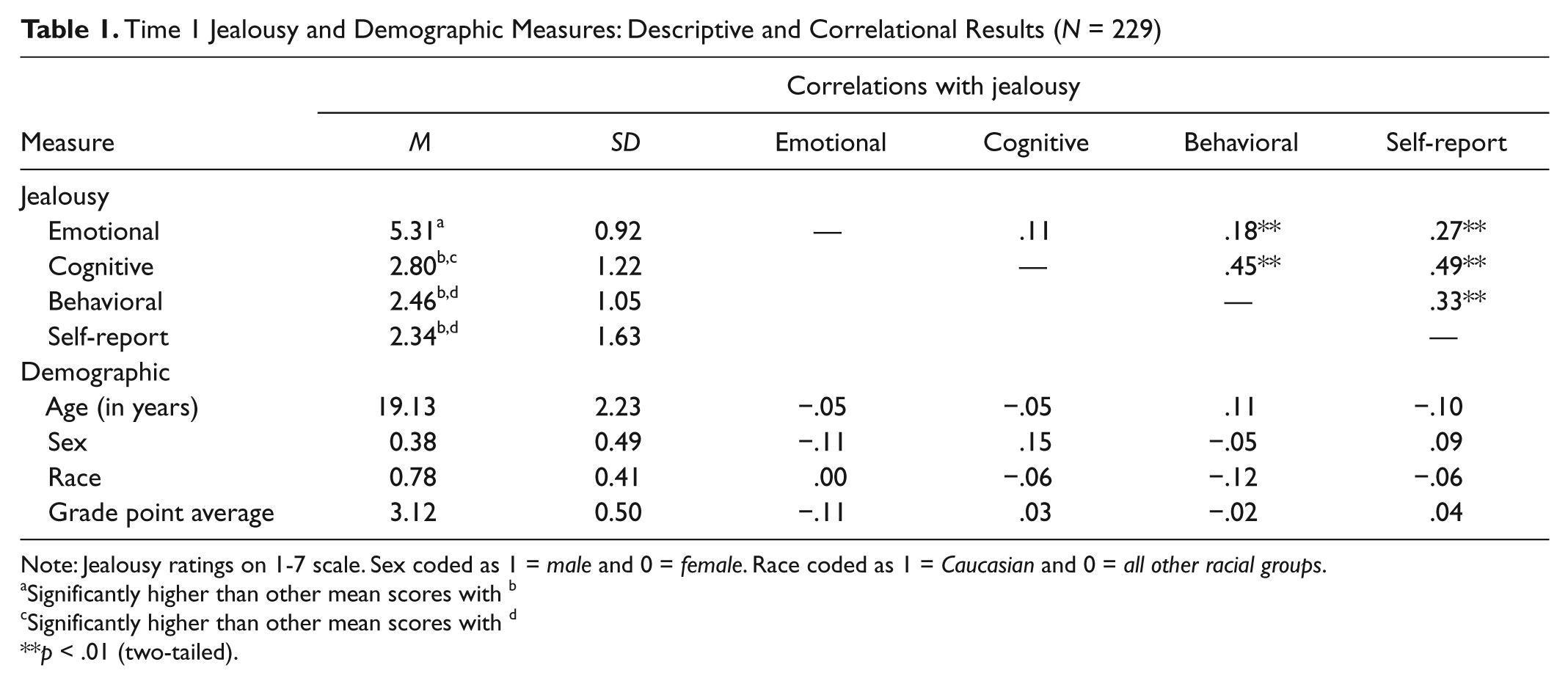
It is also valuable to examine the shared variance among the jealousy measures. If these scales are valid measures of distinct dimensions of the same underlying jealousy construct, they should be positively associated with each other but not share too much variance as to be redundant. The test results (see Table 1) reveal that emotional and cognitive jealousy were uncorrelated, emotional and behavioral jealousy were positively correlated, and cognitive and behavioral jealousy were positively correlated. Although some of these measures of jealousy had modest overlap, over three fourths of this variance was not shared. Thus, these measures successfully represent different dimensions of romantic jealousy.
Time 1 Jealousy and Demographic Measures: Descriptive and Correlational Results (N = 229)
Note: Jealousy ratings on 1-7 scale. Sex coded as 1 = male and 0 = female. Race coded as 1 = Caucasian and 0 = all other racial groups.
Significantly higher than other mean scores with b
Significantly higher than other mean scores with d
p < .01 (two-tailed).
To further establish construct validity, all three of the jealousy scales should be positively associated to some degree with the level of jealousy recently experienced in the relationship. Results indicated that experiencing higher levels of “jealousy” in the context of the relationship during the past week was positively correlated with each of the three jealousy scales (see Table 1; average r = .37). 2
In addition, examination of the average ratings for the jealousy measures (see Table 1) reveals that emotional jealousy had the highest mean score, followed by cognitive, behavioral, and self-report jealousy. However, only emotional jealousy was endorsed at a level higher than the scale midpoint (i.e., above 4 on the 1-7 scale). These results for average levels of these kinds of jealousy are consistent with many other studies using the MJS. Tests comparing these mean scores indicated that emotional jealousy was significantly (p < .001) higher than all of the other types of jealousy, cognitive jealousy was significantly higher than both behavioral and self-report jealousy, and behavioral and self-report jealousy did not differ from each other.
Evidence of discriminant validity was found in that none of the jealousy scales or the single item of jealousy experience were significantly associated with the demographic factors of age, sex, race, or a proxy for general intelligence (college grade point average; see Table 1). Note that finding a lack of a sex difference in jealousy is consistent with most other research (Harris, 2005; Wade, Kelley, & Church, 2012).
Part 2: Descriptive Profile of the Sample
Examination of the mean score for each measure presented in Tables 2 and 3 compared with the midpoint of the respective rating scales offers a descriptive profile of characteristics of the individuals in the study sample and their relationships. For the person factors, most of the individuals in the study were moderately satisfied with life, were not lonely, had a romantic attachment style that was more secure than insecure, were highest in the eros (passionate) and agape (selfless) love styles, lowest in the ludus love style, and had moderate levels of the storge, mania, and pragma love styles. The sample was characterized by scores that were higher than the rating scale midpoints for feelings of love for the partner, being in-love with the partner, experiencing positive emotions frequently the past week concerning the relationship partner, the frequency of interacting with the partner in the past week, being satisfied with the relationship, and having barriers to breakup. The scores for romantic beliefs, diversity and strength of relationship closeness, overall closeness, and comparison levels of alternatives were approximately at the scale midpoints.
Correlations of RCI Scores With Jealousy Measures (N = 229)

Note: RCI = Relationship Closeness Inventory. RCI total index has a 3-30 range and the RCI subscales have a 1-10 range, each with higher scores indicating more of each construct.
Square root transformation of number of months known partner.
p < .01 (two-tailed).
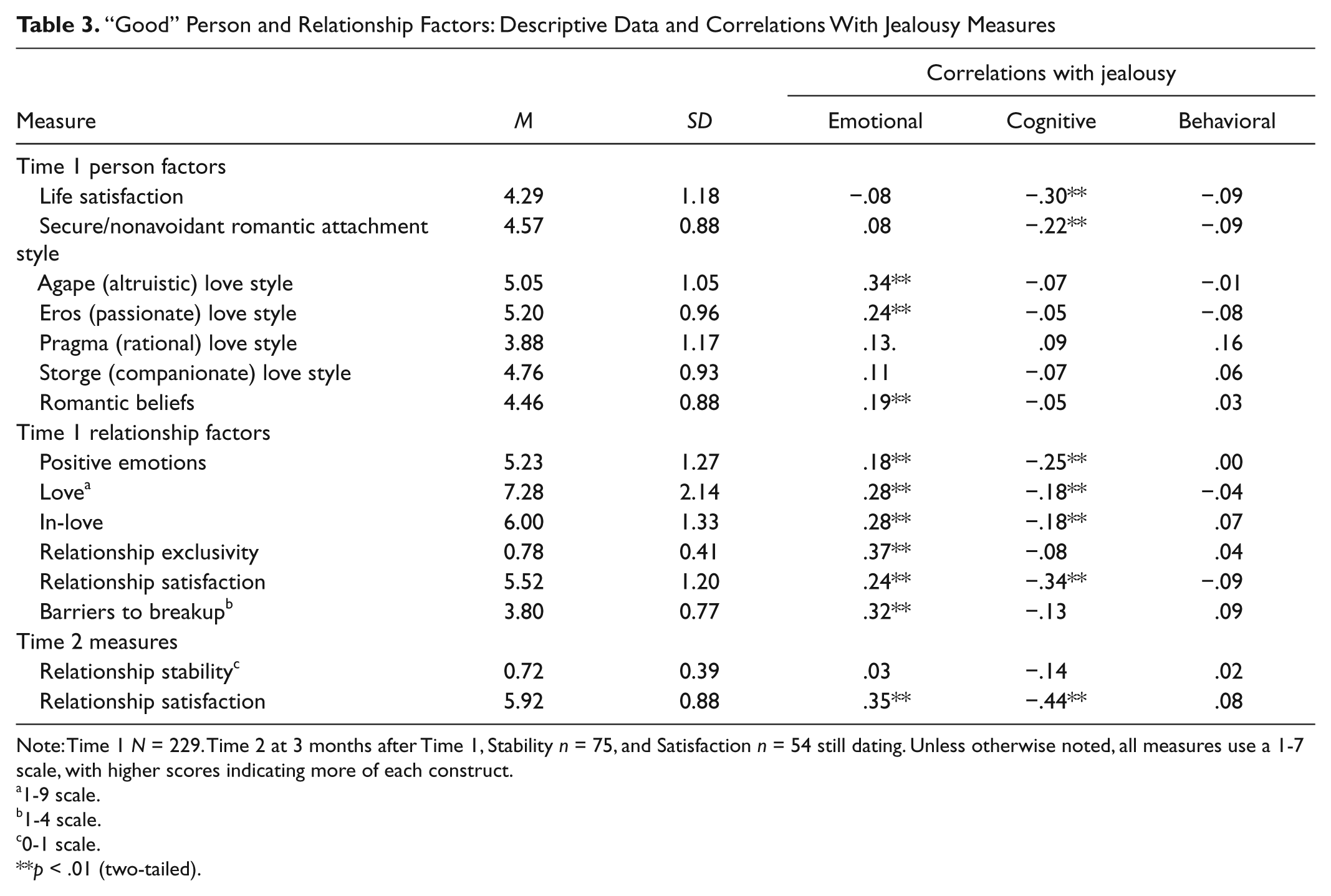
“Good” Person and Relationship Factors: Descriptive Data and Correlations With Jealousy Measures
Note: Time 1 N = 229. Time 2 at 3 months after Time 1, Stability n = 75, and Satisfaction n = 54 still dating. Unless otherwise noted, all measures use a 1-7 scale, with higher scores indicating more of each construct.
1-9 scale.
1-4 scale.
0-1 scale.
p < .01 (two-tailed).
Thus, the relationships in this study were largely positive in nature, mostly of exclusive dating status, and they had been together for an average of more than 2 years. These are conditions that should offer a good opportunity to test how jealousy relates to these person factors and relationship qualities—particularly for the emotional reactive positive form of jealousy as many of these relationships have high or moderate value. However, having some relationships in the sample that were nonexclusive and lower in relationship-enhancing factors offers the range needed to properly test for the negative side of jealousy.
Part 3: Tests of Hypothesis 1
Based on Berscheid’s (1983) conceptual model and other more recent studies of similar relationship qualities, greater relationship closeness was expected to be positively associated with emotional reactive jealousy and negatively associated with suspicious jealousy. Table 2 provides the results of correlational tests between the RCI; its three subscales of Frequency, Diversity, and Strength; and relationship duration with the three MJS measures of jealousy. 3
As predicted, the overall RCI closeness measure was positively correlated with emotional/reactive jealousy. But this finding was driven mostly by the more psychologically based strength of closeness subscale, as the other two RCI subscales that refer to frequency and diversity of behavioral interaction were not correlated with emotional jealousy. Thus, the more that the relationship partner was considered to be important to one’s decisions, plans, future goals, and sense of self-identity (i.e., scored higher on the RCI Strength subscale), the more the person was ready to react jealously (i.e., scored higher on the Emotional Jealousy scale).
In addition, cognitive/suspicious jealousy was negatively correlated with overall closeness, mainly due to the RCI Frequency subscale. Thus, the less time that the couple spent together, the higher the level of cognitive jealousy and suspicion about the partner’s fidelity.
Finally, the other kind of suspicious jealousy, behavioral jealousy, was not significantly correlated with any of the measures of relationship closeness. How long the partners had known each other (duration of closeness) also was not correlated with any of the jealousy measures.
Part 4: Tests of Hypothesis 2
For Hypothesis 2, it was expected that the emotional/reactive type of jealousy—as represented by the MJS Emotional Jealousy subscale—would have a profile that featured positive associations with the “good” person and relationship factors and negative associations with the “bad” person and relationship factors. Table 3 displays the results of correlational tests of the “good” person and relationship factors with the three jealousy measures. Table 4 displays the results of correlational tests of the “bad” person and relationship measures with the jealousy measures.
“Bad” Person and Relationship Factors: Descriptive Data and Correlations With Jealousy Measures (N = 229)

Note: All measures use a 1-7 scale, with higher scores indicating more of each construct.
1-9 scale.
p < .01 (two-tailed).
The findings largely confirm this prediction. Emotional jealousy was correlated in the expected directions with some of the person factors and with many of the relationship factors. Specifically, as can be seen in Table 3, emotional jealousy was positively associated with “good” person factors of the agape and eros love styles, having more romantic beliefs about the partner, the “good” relationship factors of experiencing positive emotions more frequently in the relationship, feeling love for the partner, being in-love with the partner, having an exclusively committed relationship, stronger barriers to breakup, and higher satisfaction with the relationship at Time 1 and again at Time 2, three months later. As can be seen in Table 4, emotional jealousy was also negatively correlated with the ludus love style.
The unsupportive findings were that emotional jealousy was associated with two of the “bad” measures. It had positive correlations with the mania love style and with experiences of negative emotions in the relationship.
Finally, emotional jealousy was not correlated with life satisfaction, loneliness, either of the romantic attachment styles, the pragma and storge love styles, relationship duration, level of alternatives to the current partner, and longitudinal relationship stability. 4
Part 5: Tests of Hypothesis 3
For Hypothesis 3, it was expected that the suspicious types of jealousy—as represented by the MJS Cognitive and Behavioral Jealousy subscales—would have a profile that included positive associations with “bad” person and relationship factors and negative associations with “good” person and relationship factors.
Cognitive Jealousy
Cognitive jealousy had many significant correlational findings. As can be seen in Table 3, it was inversely correlated with most of the “good” person and relationship factors. Specifically, cognitive jealousy had negative correlations with the secure romantic attachment style, experiencing positive emotions frequently in the relationship, love for the partner, being in-love with the partner, both current relationship satisfaction and relationship satisfaction at 3 months later at follow-up, and barriers to relationship breakup. As can be seen in Table 4, it was also positively associated with many of the “bad” measures. More specifically, cognitive jealousy was positively correlated with loneliness, insecure/anxious romantic attachment style, and the ludus “game-playing” and mania “obsessive” love styles. It was also negatively correlated with life satisfaction. Cognitive jealousy was also positively correlated with the “bad” relationship factors of experiencing negative emotions frequently in the relationship and perceiving better alternatives to the partner.
However, cognitive jealousy was uncorrelated with certain measures, including all the four “good” love styles, romantic beliefs, relationship exclusivity, relationship duration, barriers to relationship breakup, and relationship stability at 3 months later.
Behavioral Jealousy
Behavioral jealousy was unrelated to most measures. However, the four significant correlates that were observed for behavioral jealousy were all similar to those found for cognitive jealousy. Behavioral jealousy was positively associated with the two “bad” love styles of ludus and mania, with the frequency of experiencing negative emotions recently in the relationship and with having more alternatives to the relationship.
Discussion
This study examined how different dimensions of romantic jealousy were associated concurrently and longitudinally with conceptually relevant person and relationship constructs as well as demographic factors. Reliable and valid self-report instruments were used to collect questionnaire data from 229 young adults in premarital romantic relationships. The scales used to assess emotional, cognitive, and behavioral jealousy were found to represent empirically distinct dimensions and each scale had high internal reliability. In addition, each jealousy scale had both convergent and discriminant forms of validity. These psychometric findings strongly support a multidimensional model of romantic jealousy. More importantly, the present study determined that these different dimensions of jealousy relate in divergent ways to a host of other conceptually relevant variables, including relationship closeness.
Hypotheses Revisited
The study made three predictions, each of which was largely confirmed by the findings. Results for each of these major hypotheses are now discussed.
As predicted by Berscheid’s (1983) conceptual model, greater relationship closeness was indeed associated with greater emotional/reactive jealousy. Even though this result was found using the total RCI measure, this association is attributed mostly to the strength of closeness subscale. Thus, the more that the relationship partner was considered to be important to the person, the more that person was ready to react jealously. It was also found that overall closeness and the frequency dimension of relationship closeness were inversely associated with cognitive/suspicious jealousy. This second finding indicates that the more time that the couple had spent together, the less suspicion there was about the partner’s fidelity.
The second prediction was that the emotional/reactive type of jealousy would have positive associations with the “good” person and relationship factors and negative associations with the “bad” person and relationship factors. This prediction was also largely confirmed as it had 10 positive correlations with good factors. And yet, emotional jealousy was not all “good” as it was also associated with the mania love style and with experiencing negative emotions in the relationship (as were both the cognitive and behavioral forms of jealousy).
The third hypothesis was that suspicious types of cognitive and behavioral jealousy would have a profile that included positive associations with the “bad” person and relationship factors and negative associations with the “good” person and relationship factors. This prediction was largely confirmed, especially for the cognitive form of suspicious jealousy, which had six positive correlations with “bad” factors and seven negative correlations with “good” factors. However, the behavioral kind of suspicious jealousy had few associations overall—only 4 of 26 possible tests were significant—but these were all with “bad” aspects, which was what was expected.
Implications
The results of this study offer further empirical evidence in favor of a multidimensional model of jealousy. Common to all three multidimensional jealousy (MJS) scale measures was a positive association with the mania love style (which is the overly emotional and obsessive style of love) and with experiencing negative emotions more often in the relationship. Thus, these two attributes seem to define jealously regardless of the reactive–suspicious dimensions. Although this base element of jealousy is of interest, the more significant findings to consider from this study are the large number of other results that clearly distinguished emotional/reactive jealousy as mostly “good” and cognitive/suspicious jealousy as “bad.” The emotional/reactive kind of jealousy was also much more commonly experienced (more than twice as much on the same 1-7 rating scales) as the other kinds of jealousy. Thus, being ready to respond with jealousy was a more normative feature of close romantic dating relationships in which the partners are mostly satisfied and functioning well, whereas thinking suspiciously and behaving in a jealous and suspicious manner were not as common.
This study makes several contributions that inform relationship closeness theory and is one of the few studies to test aspects of the Emotion-in-Relationships conceptual model (for other works, see Attridge, 1995; Beckes, 2009). Overall closeness and the more cognitive aspect of relationship closeness (i.e., how one thinks about his or her relationship and how important it is to one’s self-concept) were associated with a higher potential to react emotionally and get jealous. In addition, overall closeness and the behavioral aspect of closeness concerning purely the (infrequent) amount of time recently spent together interacting with the partner were associated with the cognitive/suspicious form of jealousy. Taken together, these findings suggest that when one partner is strongly connected to the other in terms of that person being important to their self-concept and to their future plans then one is prone to react with emotional jealousy when the relationship is threatened. The flip side of the closeness coin is that when relationship partners are not spending enough time together then there is a greater chance of having suspicious thoughts about the fidelity of one’s partner. Both of these findings are consistent with the interdependence model of relationship closeness.
It is also of interest to note that the diversity dimension of closeness had findings that were in the same direction of influence with emotional and cognitive jealousy as was found for the strength and frequency dimensions of closeness, but these correlations did not reach statistical significance. This diversity factor thus did have some contribution to the total RCI score being positively correlated with emotional/reactive jealousy and negatively correlated with cognitive/suspicious jealousy. In contrast, the fourth factor of the relationship closeness conceptual model—the duration of relationship—had near zero correlations with jealousy.
The contrasting pattern of results found for relationship closeness with emotional/reactive and suspicious/cognitive jealousy is similar to what has been found in other studies that have used other multidimensional assessments of reactive and suspicious jealousy and correlated these measures with various other measures akin to strength of relationship closeness, including relationship dependency (Rydell & Bringle, 2007), relationship intimacy (Knoblach et al., 2001), and relationship quality (Barelds & Barelds-Dijkstra, 2007; Barelds & Dijkstra, 2006). As these relationship factors are often positively intercorrelated and thus may be tapping a more basic underlying theme of relationship functioning, one could argue that it is the level of personal connection to one’s romantic partner—broadly defined to include aspects of closeness/interdependence, dependency, intimacy, and quality—that makes one more prone to become emotionally jealous concerning the relationship. In this way, the study findings are also supportive of the general prediction from evolutionary psychology that reactive jealousy will be more likely for relationships that are worth protecting (i.e., those high in closeness and that are needed for survival).
These findings also have implications for further refining the more general conceptualization of jealousy. This study included four measures of jealousy. Emotional jealousy was assessed with items that asked how one would act in regard to potential future events concerning partner infidelity or interest from a romantic rival. In contrast, the cognitive, behavioral, and self-report forms of jealousy were based on items that referred to recently experienced real events. The difference in time orientation and the “potential versus reality” difference of how jealousy was measured in this study may help to interpret the divergent patterns of results for the different dimensions of jealousy. It appears that a willingness to react emotionally to relationship-threatening situations is something quite different from actively thinking about one’s partner in a jealous manner at the present time or from actually behaving in a jealous and suspicious manner at the present time.
This clarification concerning potential versus actual jealousy is also conceptually important because it extends the transactional model of jealousy (Bringle, 1991; Rydell & Bringle, 2007), which considers the reactive type of jealousy as being an emotional response to a relationship-threatening event after it has occurred—not before. To broaden the concept of reactive jealousy to include the potential for reactive emotional jealousy, as well as when it is the “after the fact” makes sense, especially if one is satisfied with relationship, is exclusively committed to their partner, has important plans and goals that involve their partner (i.e., strength of relationship closeness), feels love for their partner, is in-love with the partner, has barriers to leaving the partner and has other rewarding qualities of the relationship.
Thus, the key lesson from this study is that being ready to become jealous over relationship-threatening events is itself a signal that the relationship is worthy of such a strong emotional reaction. This is essentially the prediction from Berscheid’s (1983) Emotion-in-Relationships model linking closeness and jealousy that was confirmed in this study. Salovey and Rodin (1989) described this point more eloquently when they wrote that “jealousy . . . helps us to identify those relationships . . . that are truly important to us. Without jealousy, close relationships might be more pleasant, but would they be as meaningful?” (p. 242).
Limitations
Taken together, the findings from this research reveal that romantic jealousy is a multidimensional construct with different elements that are both bad and good. There are, however, certain limitations to these findings. This study was conducted on nonmarried college students who were generally quite happy in their relationships. Although there is no reason to expect otherwise, it is unknown whether these findings can be replicated in other more diverse samples. The causal mechanism of how emotional reactive jealousy is linked to relationship closeness requires more study. That emotional jealousy was unable to predict longitudinal relationship stability is troublesome, though, for the argument that it is good for a relationship. However, this period was only 3 months and may have been too brief to offer a solid test of impact on future relationship stability. Other studies have examined how actual experiences of infidelity relate to jealousy (see review in Harris, 2009), but this element of jealousy was not specifically measured in the present study. Another limitation is that only one partner from each couple participated in the study, hence a relationship-level analysis of closeness and jealousy was not possible. For example, White (1981) has proposed a general hypothesis that within a couple, it is the partner who is relatively more involved (i.e., higher in closeness) who is more likely to be jealous. Hopefully, future investigations can continue this work in ways that overcome these limitations.
Footnotes
Acknowledgements
The author is grateful to Dr. Ellen Berscheid of the University of Minnesota, Dr. Kathryn Dindia of the University of Wisconsin–Milwaukee, Dr. Susan Sprecher of Illinois State University, and Dr. Kara Witt of Ramsey County Mental Health (St. Paul, Minnesota) for their insightful comments during the preparation of this manuscript.
Authors’ Notes
The data for this study were collected in collaboration with the psychology department at the University of Minnesota.
Declaration of Conflicting Interests
The author(s) declared no potential conflicts of interest with respect to the research, authorship, and/or publication of this article.
Funding
The author(s) received no financial support for the research and/or authorship of this article.