




Abstract
This article attempts to compare aspects of discourse and sociolinguistic competence among speakers of American English (AE) and Tunisian learners of English with regard to the communicative act of compliment response (CR). The two participant groups’ CR strategies were found to be cross-culturally different and were found to be dependent on the participants’ respective cultural backgrounds. In addition, the data collected emphasize the fact that cross-cultural communication is a transactional mutual process and that both native and nonnative speakers of English are equally required to adjust their communicative behaviors to develop intercultural communication. The 30 American students and 30 Tunisian students filled a Discourse Completion Test (DCT) with 8 contextualized situations and sat after that for a semistructured interview. Interviews were audiotaped and transcribed for analysis.
Keywords
Introduction
The fascination that I hold for cross-cultural communication emanates from a moment of distress that I experienced when on a linguistic stay in Britain. While I was waiting for a friend at a clothing store, a British woman stopped me and said, “You look very beautiful in pink!” This utterance might sound simple but, for me it was confusing and problematic. The answer in my mind was, “What does she want?” But I did not reply. She went on and added, “I like the way you dress.” What I thought about at that moment was that her utterance was an indirect question about the place from which I bought my clothes as it was very common in a Tunisian context to say, “I like your outfit; where did you get it from?” However, for fear that this would not be the appropriate response, I remained silent and perplexed. The woman then left with a strange look on her face and kept turning behind looking my way as she made her way outside. I felt so embarrassed and I remember even trying to avoid encounters and possible interactions with native speakers (NSs). The puzzling question, however, was, “Why, in spite of my ability to utter grammatically correct sentences, was I unable to communicate effectively with a NS?”
When engaging in conversations with NSs syntactic accuracy alone does not guarantee an effective communication for a nonnative speaker (NNS). Trosborg (1995) claimed, “No error of grammar can make a speaker seem so incompetent, so inappropriate, so foreign, as the kind of trouble a learner gets into when he or she does not understand or otherwise disregards a language’s rules of use.” (p. 3). In fact, such errors are often evaluated as signs of impoliteness on the part of second or foreign language users involved (Barron, 2003). Even advanced learners can face difficulties when attempting to interpret NSs’ intentions. Indeed, NNSs, who may understand only the literal meaning of words, can experience cross-cultural pragmatic failure.
Pragmatic failure is defined as, “the inability to understand what is meant by what is said” (Thomas, 1983). To put it differently, pragmatic failure is the inability to interpret utterances the way the speaker intends them. In fact, pragmatic failure can generate frustration, misunderstandings, and cross-cultural communication breakdowns (Wolfson, 1989). This article is based on acknowledging that people from different cultural backgrounds may behave differently and that perceptual differences can make communication between members of different cultures challenging (Wolfson, 1981). The compliment response (CR) speech act is selected given the fact that compliments may occur at almost any point within a speech event (Wolfson & Manes, 1980). This frequency is not the same across the world, and as a result, interlocutors can find difficulties responding to compliments in intercultural conversations.
The present article aims at accomplishing two major goals. First, it examines the CR strategies used by speakers of American English (AE) and Tunisian learners of English. Second, it explores the reasons behind the way the two participant groups respond to compliments. Following the examination of these two goals, the researcher hopes to propose ways to facilitate communication between the two groups based on the assumption that communication is transactional and that it is not the responsibility of one party to be aware of cross-cultural differences and to make adjustments to successfully communicate with the other.
Pragmatics Across cultures
This research is grounded in three main fields, namely, contrastive pragmatics, cross-cultural pragmatics (CCP), and interlanguage pragmatics (ILP). Contrastive pragmatics’ major principle is to make a particular language the object of study and then compare its linguistic realizations to other languages (Riley, 1981). It investigates how communicative functions are realized in different languages. Wierzbicka (1991), however, suggested that people from different cultures speak differently not because they have different linguistic codes, but because these linguistic codes are used differently. In other words, people from different cultures speak differently because of the influence of some cultural norms that are reflected in speech acts. The field CCP, thus, has developed out of the field contrastive pragmatics. The ideas of the field of CCP can be summarized as follows: People in different countries speak differently and their different ways of speaking can be accounted for in terms of independently different cultural norms. To put it differently, the way people from different cultures produce and perceive speech acts is determined by the underlying cultural norms and values. Investigations of pragmatics across cultures have led to the question of how language learners identify, perceive, and produce a particular speech act in a second or foreign language, hence, the field ILP. ILP is defined as “the investigation of NNSs’ comprehension and production of speech acts, and the acquisition of L2-related speech act knowledge” (Kasper & Dahl, 1991, p. 215). It focuses on how learners realize speech acts and demonstrates that even advanced learners can fail to convey or comprehend intended meanings (Thomas, 1983).
Universality Versus Culture Specificity
The conceptualization and production of speech acts is not identical across cultures and languages and the strategies used to perform a particular speech act are not governed by determined universal principles. Austin (1962), Searle (1975) and Brown and Levinson (1978) suggested that the conceptualization and realization of a specific linguistic behavior was identical across cultures and languages and that the strategies used to perform a particular speech act were governed by determined universal principles. Fraser, Rintell, and Walters (1980) expressed the view that “Every language makes available the same set of strategies—semantic formulas—for performing a given speech act” (p. 79) suggesting that people in different cultures used the same strategies in performing speech acts. In other words, culture may not have an impact on the way speech acts are performed. A similar belief is displayed by Clark and Shunk (1980) on the production of the speech act requesting “when people make requests, they tend to make them indirectly. They generally avoid imperatives like tell me the time” (Clark & Shunk, 1980, p. 111).
Although the studies mentioned above were conducted only on English speakers’ performance of speech acts, the findings were, for ill or for good, extrapolated to all cultures and languages. Clark and Shunk’s use of the adverb “generally” implies that because English people do not use the imperatives in their requests, people in the entire world are expected to do the same. Indeed, the universalistic stance projected by authors like the ones mentioned above was rejected by Wierzbicka (1985) who contended that the universality of speech acts was a mere illusion and that researchers who thought that speech acts were governed by universal mechanisms seemed to “take it for granted that what seems to hold for the speakers of English must hold for people generally” (p. 145). Wierzbicka (1985) discussed a number of differences between Australian English and Polish in the production of different speech acts. She gave the example of a Polish woman who greeted an English visitor using the imperative “Mrs. Vennisa! Please! Sit! Sit!” (p. 147).
Wierzbicka (1985) then noted that the use of the imperative made the utterance, when heard by a NS of English, sound like a command to a dog because English people would avoid the use of the imperative and substitute it with interrogative forms like “will you sit down?” (p. 147). The conceptualization and production of speech acts are, therefore, not universal but determined by the specific cultural norms embedded in each society. When studies compare the performance of speech acts of two different cultures, strategies used to perform a certain speech act seem to differ. Accordingly, the present study on the CRs of speakers of AE and Tunisian learners of English is a culture-specific study as it compares the speech act CRs in two different cultures.
CRs
A CR is a “verbal acknowledgement that the recipient of the compliment heard and reacted to it” (Nelson, Al-Batal, & Echoles, 1996, p. 413). CRs have been referred to as adjacency pairs, action chain events (Pomerantz, 1978), interchanges (Herbert, 1990), and sequences (Wolfson, 1989). These different expressions evolve around the idea that the compliment event is a two-unit turn in which Utterance 1 and Utterance 2 are linked by both temporal and relevancy conditions (B is conditionally relevant and sequentially dependent on A).
A. That’s a beautiful sweater.
B. Thanks, my sister made it for me (Herbert, 1990, p. 201).
The earliest study on American CRs was written by Pomerantz (1978). She collected compliments as naturally occurring by speakers of AE in different situations. Pomerantz claimed that speakers of AE face two conflicting conditions when responding to compliments:
A. Agreeing with the speaker
B. Avoiding self-praise
She observes that compliments have the function of “supportive actions” (Pomerantz, 1978, p. 82) and that, as a result, their preferred next action is accepting the compliment. However, this first constraint conflicts with another constraint, which is that of self-praise avoidance. In other words, the complimentee tries to avoid praising himself or herself by not agreeing with the complimenter because agreeing strategies may lead the complimenter to criticizing the complimentee’s response. Wolfson and Manes (1980), in their turn, studied the CR behavior of speakers of AE and claimed that one function of CRs was that of negotiating solidarity. For Wolfson and Manes, the solution lies in downgrading the compliment and referring the compliment to another person or to another characteristic of the object. This allows receivers to mitigate the compliment without disagreeing with the speaker and without praising themselves. Farghal and Haggan (2006) studied the CRs of 79 Kuwaiti Bilingual students. The study showed instances of grammatically inaccurate and pragmatically inappropriate utterances. Grammatically inaccurate responses accounted for 45.3% in compliments and 20.7% in responses, while pragmatically inappropriate utterances accounted for 13% in compliments and 21% in responses. The high percentage of inaccurate utterances in responses implies that NNSs experienced pragmatic failure in responding to compliments more than in paying compliments. Al-Falasi (2007) conducted a research on Emirati and American CRs. She divided her participants into three groups: Ten NS of AE, 10 Emirati NNSs of English, and 10 Emirati nonspeakers of English. She used a Discourse Completion Test (DCT) and interviews as data elicitation methods and based her classification of responses on Herbert’s (1990) taxonomy. The six scenarios in the DCT were on food, a good essay, nice skirt, nice clock, and a nice shirt (a compliment given by a friend and a stranger). Although the three groups showed similarities in the use of acceptance strategies, NNSs of English and nonnative nonspeakers of English brought some L1 expressions. Expressions like “really!” “swear!” were frequently used by Emirati participants. Such expressions can be interpreted on the face of it, as questioning the sincerity of the compliment, but the interview data revealed that the Emirati participants just wanted to receive another compliment. In addition, on being complimented by her teacher, the complimentee responds by “I’m ashamed,” which was an expression borrowed from Arabic. The study on Emirati and American CRs shows that, although the two groups opted for acceptance strategies, the Emirati responses proved to be borrowed from their mother tongue.
Method
Participants
The basic design of this research article concentrated on two groups of participants. The first group was composed of 30 speakers of AE, half of whom were females and half males. Their ages ranged between 18 and 28 years. Most were undergraduate students at Kennesaw State University and The Catholic College in Atlanta, Georgia; others were enrolled at different colleges in the surrounding areas of Atlanta, Georgia. The number of participants was determined according to Kasper and Dahl’s (1991) recommendations that in a cross-cultural study, each group should contain approximately 30 participants to obtain a representative sample.
The second group was composed of 30 Tunisian learners of English comprising 17 females and 13 males. All were 3rd- and 4th-year students at the English Department of the Faculty of Arts and Humanities in Sfax, Tunisia. It was assumed that 3rd- and 4th-year students majoring in English were proficient enough in English to be able to understand the situations and respond to them in English and express their ideas and the rationale behind their choices of CR strategies in English. Participants’ ages ranged between 21 and 28. The type of sampling used in this study was that of convenience; that is to say, participants from the 3rd- and 4th-year English who were available for the research qualified for participation. Confidentiality measures were taken to maintain students’ privacy.
A consent form was distributed before starting the research. Students were informed about the instruments that would be used in the research, the aim of the research, and the timing. They were asked to sign two copies, keep one with them, and give the other to the researcher.
Research Instruments
The data elicitation methods used in this study are the DCT and the semistructured interview. DCTs are questionnaires that contain a set of briefly described situations designed to elicit a particular speech act (Billmyer & Varghese, 2000). The Open-Item Free Response format was used. This means that no predesigned options were given to participants. Rather, participants were asked to write down whatever responses they thought were appropriate. They were provided with much space in which they could include their responses as well as any comment or nonverbal response. They were also told in the instructions that if they would say nothing in a particular situation, they should write “I would keep silent.”
The situational prompts designed for the DCT of the present study were built to reflect in as much as possible realistic situations and situational variations. To obtain realistic situations, the frequency of occurrences of the topics of compliments and the degree of participants’ familiarity with the situations were taken into consideration. The choice of topics in the present DCT was based on the findings of previous studies that showed that topics of compliments focused mainly on appearance and ability, while few compliments were given on possession and personal traits. Wolfson (1983) advanced that, “with respect to topic, compliments fall into two major categories: those having to do with appearance and those which comment on ability” (p. 90). In her study of CRs, Holmes (1988) found that among 517 compliments, 92% were about appearance, ability/performance, and possessions. Thus, the eight situations were distributed along the four topics according to the frequency of occurrences of each topic as found in previous research on American CRs. In fact, selecting situations that fall into one of the most frequent topics used among speakers of AE can capture a relatively full picture of compliments. The situational prompts used in the present study were also based on cultural familiarity, that is, on whether participants were familiar with the context in which the situations took place or not. The degree of familiarity was guaranteed by referring to other DCTs on CRs, and to a pilot test that was conducted prior to the administration of the DCT. The situations were as much as possible varied in terms of gender, social status, and closeness.
The second data elicitation method used in this study was the semistructured interview. Semistructured interviews aim at understanding the reasons behind the use of a particular CR strategy. First, demographical questions were asked including the age and level of students. The students were then asked to account for the use of each response. The interview was conducted in English for the two groups of participants.
Procedures
The DCT administered to speakers of AE took place in the United States at Kennesaw State University and at the Catholic College in Atlanta, Georgia. For the Tunisian English learners, the elicitation was conducted in Sfax, Tunisia, at the University of Arts and Humanities. Participants were asked to respond to eight contextualized situations in the way they would respond if they really encountered those situations. Immediately after responding to the DCT prompts, the 30 American and 30 Tunisian students were asked to sit for an interview and justify the use of their responses in each situation. A tape recorder was used so that the researcher could concentrate fully on the interview. Participants were induced to talk about what prompted them to produce a particular response in a particular situation, how they interpreted the compliment in each situation, and what factors in the situation made them respond in a particular way. During the interview, the researcher was careful not to interrupt the participants and to induce them to talk about their own experiences in responding to compliments to have as much information as possible. Participants were tested individually to maintain confidentiality and because it was impossible to have two people fill in the DCT and sit for the interview at the same time. The time devoted to each student was 30 min: 15 min for the DCT and 15 min for the interview.
Coding Scheme
This section identifies the framework under which the data coming from the DCT were classified. The coding scheme is based mainly on previous classifications of the speech act CRs in empirical research. Herbert’s (1988, 1990) classification of CRs is selected because it presents a general classification of CRs. However, the major strategies were divided into five instead of three (as in Herbert’s classification) because the request interpretation and no-response strategies can be major strategies themselves. For the sake of the readability of the article, some terms used by previous researchers were replaced by simpler terms. The new terms have the same meaning as the replaced ones, but they may be too complicated for some readers to understand. For example, the strategy “appreciation token” was replaced by “thanking,” “deflecting informative comments” was replaced by “explaining,” and “praise upgrade” was replaced by “agreeing.” As proposed by Herbert (1986, 1988, 1990) CRs were classified into five main strategies (accepting, mitigating, rejecting, request interpretation, and no-response). These strategies were used because all the responses given by the American and the Tunisian participants fit in one of these strategies. Substrategies, however, were modified according to participants’ responses. For example, the expressing gratitude and expressing gladness strategies were added to the classification used in this study because they existed in the participants’ responses. In addition, the expressing embarrassment responses and the invoking strategies were added because they occurred in the Tunisian responses. As for the strategy “mitigating,” the “encouraging” strategy was added because it was used by the Tunisian participants while the “joking” strategy was added because it existed in the CRs of both groups (Table 1).
Classification of CRs

Note: CR = compliment response.
Results and Discussion
CR Strategies Used by the Two Participant Groups
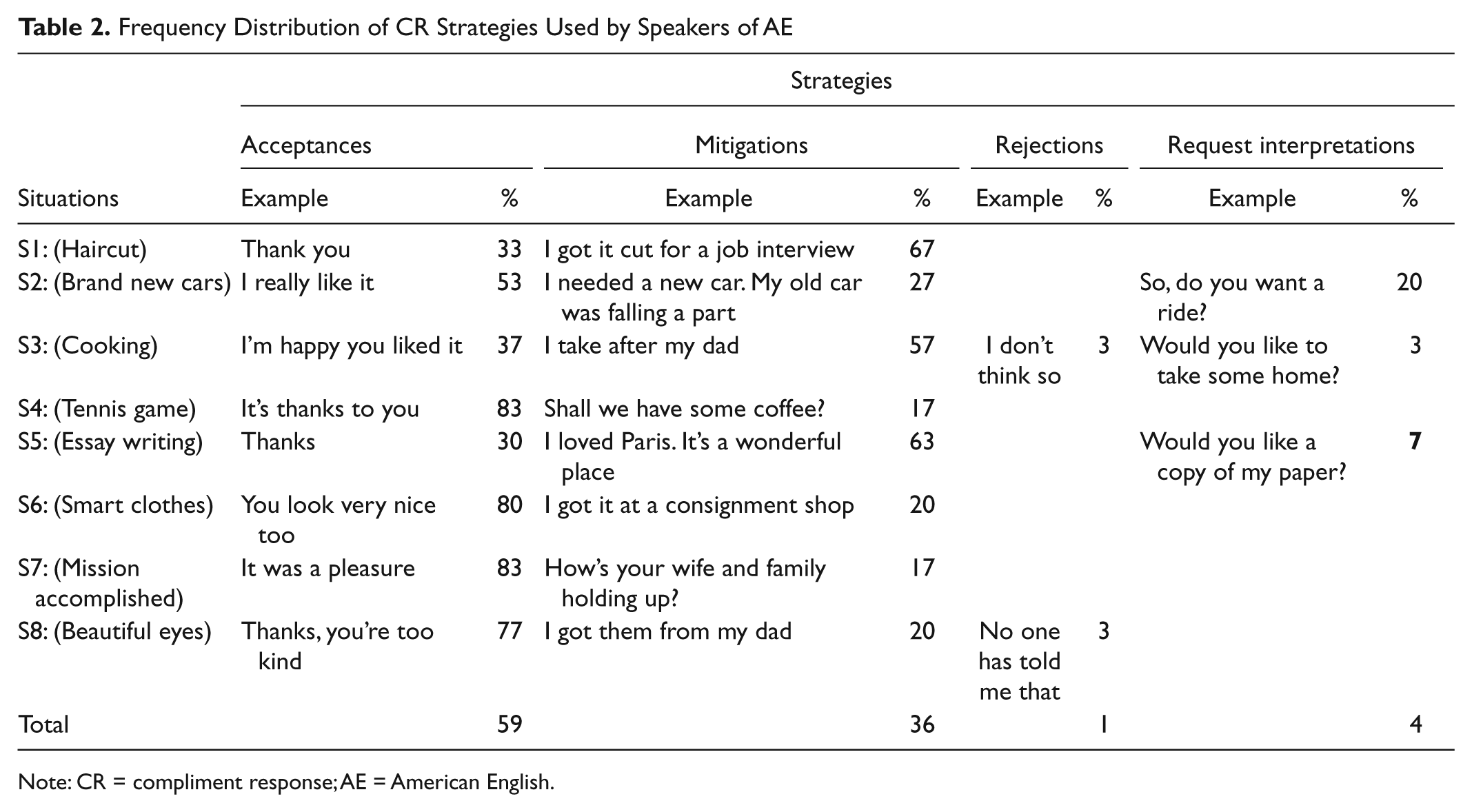
Results from the DCTs showed that the most frequently used strategy among the American participants was accepting. They also indicate that CRs can be placed between accepting the compliment (59%) and mitigating it (36%). Table 2 below describes the frequency occurrences of the CR strategies used by speakers of AE.
Frequency Distribution of CR Strategies Used by Speakers of AE
Note: CR = compliment response; AE = American English.
Table 2 showed that the most frequently used strategies among speakers of AE were the accepting and mitigating strategies while the rejecting and request interpretation strategies accounted for 1% and 4%, respectively. Looking at the table vertically, we can see that the acceptance strategy was the most frequently used strategy in five out of the eight situations (53% for Situation 2 [S2], 83% for S4, 80% for S6, 83% for S7, and 77% for S8). However, opting for mitigating strategies showed that the American participants tended to denigrate the praiseworthiness of the object of compliment. Opting for mitigating responses was frequent across the situations (36%) and in each situation as well. Table 2 shows that in three situations, the mitigating strategy scored higher than the other strategies (67% in S1, 57% in S3, and 63% in S5).
The interview data confirm the DCT findings. Out of 30 American participants, 20 reported that accepting the compliment was the best way to respond to compliments because it was the way they had been raised, while 10 Americans reported to have problems in responding to compliments. This means that they have to find something to say to meet the social expectations. A plausible explanation for the tendency among speakers of AE to use the accepting strategy is their tendency to adhere to Leech’s (1983) Agreement Maxim (minimize disagreement between self and other; maximize agreement between self and other).
According to the DCT data, the American participants tended to make comparatively greater effort to agree with the complimenter by accepting compliments (Pomerantz, 1978). In fact, the high frequency of the acceptance strategy has been underscored by other researchers of the CR behavior of speakers of AE. The percentages of accepting strategies have ranged between 50% and 66% in Nelson et al. (1996), Chen (1993), and Herbert (1988). Nelson et al. (1996) found that 50% of American participants used the accepting strategy.
Chen (1993) found that 58% of American participants used this strategy and Herbert (1988) found that 66% of the American participants used this strategy. These researchers claimed that accepting the compliment was the most expected second turn.
However, the percentage of mitigating responses used by the American participants in this study can also be considered high (36%). Leech’s (1983) Modesty Maxim (minimize praising of self, maximize dispraise of self) explains the responses of the American participants in the study. By using mitigating strategies, according to this explanation, the complimentee mitigates the force of the compliment without disagreeing with the complimenter and without praising himself or herself, and so he or she may find solution to the dilemma claimed by Pomerantz (1978) whereby the complimentee should respond to the compliment in a polite and supportive manner while avoiding self-praise.
In addition, the data showed that the American participants explained the use of certain CRs by stating that they were common and expected expressions. The data indicated that responses to compliments might be ritualistic in nature reminding of Wolfson’s (1989) “formulaic speech routines” (p. 155), which she used to mean formulaic expressions shared between members of the same speech community within a given culture. Wolfson and Manes (1980) have pointed out that producing formulaic expressions as responses to compliments contributes to establishing friendly relationships between interlocutors.
As for the Tunisian participants, the results reported indicate that they tended to accept compliments (55%) much more readily than to mitigate them (33%). Table 3 summarizes the frequency distribution of the CR strategies used by Tunisian learners of English. Accepting and mitigating strategies were the most frequently used strategies while the rejecting strategy accounted for 8% and the request interpretation and no-response strategies accounted for 2% each.
Frequency Distribution of CR Strategies Used by Tunisian Participants

Note: CR = compliment response.
This tendency to accept compliments (55%) indicates that the Tunisian participants are directed toward accepting the praiseworthiness of the compliment. Employing the rejecting strategy, however, is considered as an instance of adhering to the Modesty Maxim (minimize praise of self, maximize dispraise of self). This means that the Tunisian participants seemed not to have in their schema that damage can be done to the complimenter due to their rejection of the compliment. They rejected the compliment as a way of showing modesty and believed that this response was expected by everyone. The high percentage of this type of strategies matches the findings of research on Arab CRs. Nelson et al. (1996), for instance, found that acceptance strategies accounted for 67% among Syrian students and Farghal and Al-Khatib (2001) found a higher percentage reaching 83.85% among Kuwaiti students. More recently, Farghal and Haggan (2006) recorded a similarly high percentage, 73.53% among Jordanian students. Nelson et al. (1996) explained the frequent use of acceptance strategies by Syrian NNSs of English by a tendency to establish friendly relationships with the complimenter, whereas Farghal and Haggan explained this tendency to accept compliments by a preference on the part of Jordanian students to use positive politeness strategies.
Conversely, the rejecting CR strategy accounted for 8% as recorded in the data coming from the DCTs of the Tunisian participants in this study. Thus, this strategy was not used by participants in the earlier mentioned studies on Arab CRs. Farghal and Haggan (2006), for example, did not find any rejections among Kuwaiti students and attributed the absence of rejecting CR strategies to a tendency among Kuwaiti students to adopt positive politeness and, thus, to give more weight to preserving the complimenter’s positive face. They even went as far as to claim that attending to the complimenter’s positive face was a general feature of Arab CRs. This conclusion, however, may not be applicable to the Tunisian English learners participating in this study because using rejecting strategies is considered an instance of adhering to the Modesty Maxim as they explained, which means that the complimentee tries to attend to his or her own positive face so that his or her behavior can be regarded as polite and not to save the complimenter’s positive face.
In fact, the DCT data revealed that rejecting strategies were used in 7 out of the 8 situations in the Tunisian data. Moreover, 20 Tunisian participants opted for rejecting strategies and 10 of them reported that they disagreed with the complimenter to show modesty and appear as behaving appropriately. The CR strategies used by the two participant groups proved to be embedded in their respective cultural backgrounds. The impact of culture on the participant’s CR strategies is further confirmed by the students’ explanations of their own CR strategies in the interviews.
The Impact of Culture on the Participants’ CRs
The results showed that the location of compliments may have an influence on the two groups’ CRs. In the interview data, 17 out of the 30 Tunisian participants reported that they did not expect the compliment to be given at the beginning of the conversation. Their explanations revealed that the normal way of talking to a friend, in their experiences, was by greeting him or her and not by giving a compliment. In American culture, compliments about appearance were more likely to be given at the beginning of the conversation. The findings showed that giving a compliment at the beginning of a conversation serves as a conversation starter for the American participants. Furthermore, data obtained from the Tunisian participants show that in the cooking (S3) and smart clothes (S6) situations, utterances were not interpreted as compliments but as points of view (see the appendix). This explains why in those situations, 20 Tunisian students interpreted the utterance as insincere and, accordingly, used the joking, no-response, and disagreeing strategies. These results showed that the Tunisian students seemed more interested in assessing the truthfulness of the content of the language than in its social function. In other words, if the complimentee believed in the truthfulness of the compliment and of its assertion, she or he would accept it. If not, she or he would reject the compliment or question its truth value. In their attempts to define the word compliment, the Tunisian students resorted to its translation in Arabic, which means that the way they defined a compliment reflected an idealized perception of their own language in use. This may imply that a compliment by definition includes untruthful information as far as the Tunisian participants are concerned.
In fact, the Tunisian students included words in the interviews which were taken from standard Arabic such as mojemalah (compliment) and ramyi worood (flattering) to explain the pragmatic rules that governed their perceptions and interpretations of compliments. These words imply that the Tunisian students perceived an attempt to compliment as just doing face work and that the utterance was not sincere. This leads to the conclusion that the Tunisian participants may have behaved according to what Lord (1996) called “frankness to a fault” (p. 50), which means that the complimentee will accept the compliment only if she or he believes in its truthfulness. Otherwise, she or he may disagree or criticize the complimenter for not telling the truth. This finding matches that of Golato (2002), who studied the CR behavior of 27 Germans in dinner-table and telephone conversations. She claimed that Germans did not engage in complimenting behavior to do face work, but only if they believed that what had been said was a compliment, then they were engaging in complimenting behavior. The impact of culture on the CRs of the two groups was also clear in the force toward which victory was directed. The results showed that the words used among the American participants to respond to compliments about the tennis game situation revolved around effort, hard work, improvement, and practice, while the Tunisian participants used lexis related to both effort and natural talent.
Literature on American CRs showed that, in the content area of skill, the American participants tended to redirect achievement and victory to the result of a particular action rather than to the talent of the participant. This is because natural talent in Western cultures is considered an exceptional attribute and referring to it as the result of one’s achievement may be socially unaccepted (Lorenzo-Dus, 2001; Wolfson, 1989). Because the area of work and skill contains both talents and hard work (Wolfson & Manes, 1980), the Tunisian participants feel that both areas should be emphasized. Another culture-specific finding emerges from the two groups’ perceptions of the compliment about smart clothes (S6). In the Tunisian context, formal dress is required in business-related receptions, and so, when a party is organized, guests are required to attend to the expected conventional behavior—which is to dress up. For the Tunisian participants, in such a party one should be dressed formally whereas for the American participants, employees have the option of dressing semiformally and the invitation is expected to indicate a formal dress code if one is in place.
In addition, some contextual variables have influenced the CR behavior of the two groups. For example, in S7, mission accomplished, the contextual variables closeness, age, and specificity of the event carry different weight in the responses of the two groups. Whereas American responses are more influenced by the age of the complimenter and the specificity of the event, Tunisian responses are influenced by Arab-Muslim values in connection to treatment of relatives, whoever they may be. This explains why the social variable closeness proves to be more important than that of age.
Gender also affects the two participant groups’ perceptions of the particular compliment about eyes. The analysis showed that the American and Tunisian females participating in this study tended to describe compliments about eyes as sincere or insincere (in terms of truthfulness), whereas the American and Tunisian males tended to describe compliments about eyes as innocent or not innocent (innocent as opposed to flirtatious). The data revealed that 9 American female participants reported that a compliment about eyes was more sincere when it was offered by a female rather than by a male whereas 10 female Tunisian participants reported that this type of compliment was more sincere when it was offered by a male rather than by a female. Female American participants thought that it was unusual that a female complimented a female on her eyes, especially when they were of the same age.
As for Tunisian female participants, 10 reported that a compliment from a male was both more sincere and more common. These 10 Tunisian female participants also reported that females were envious and they gave compliments about appearance to bring evil to other females. The perception of compliments about eyes among the American and Tunisian participants’ males was also different. As for male participants, the results showed that while 10 American male participants reported that a compliment from a female on eyes was innocent, only 4 Tunisian male participants reported that it was innocent. For American male participants, compliments about eyes could be common in American society and it could be taken as a way to open a conversation with the complimentee. Tunisian male participants, however, reported that a compliment from a woman about eyes could not be innocent even when coming from an elderly woman.
The results have also shown that there are four CR strategies which were used by the Tunisian participants but did not feature in the American data. These strategies are the invoking, encouraging, expressing embarrassment, and no-response strategy. The use of the invoking strategy is a clear instance of transfer from the Tunisian culture as whishing good health for elderly people is very common in a Tunisian context. The Tunisian participants may have resorted to their background cultural schema by using the invoking strategy. The expressing embarrassment strategy used by Tunisian participants is seen as a self-denigrating strategy (Chen, 1993). In other words, the complimentee lowers himself or herself by verbalizing his or her embarrassment. The absence of this strategy in the American data may be explained by the fact that the American participants do not want to think poorly of themselves. In a study of Emirati CR behavior, Al-Falasi (2007) found out that the expressing embarrassment strategy was used by Emirati female students and argued that the use of the expression “I am embarrassed” may strike a NS as out of place and that this expression would be more appropriate when an offense is committed.
The encouraging and no-response strategies can also be considered as culture-specific strategies, as they were used only by the Tunisian participants. The use of the encouraging strategy may be explained by an attempt to downplay the compliment and not to make the complimenter feel bad about himself or herself. The use of the no-response strategy, however, indicates that the complimentee may not have interpreted the utterance as a compliment, and this explains why she or he preferred not to respond.
The cultural impact was also clear in the negative reactions the two groups had toward responses which were different from theirs. The interview data showed that 20 of the American participants reported that the use of rejecting responses was rude and impolite because disagreeing with the complimenter implied that she or he was not able to make judgments or that his or her opinion did not matter. A negative evaluation was also used by the Tunisian participants on the structure of the compliment in S8 (beautiful eyes). They thought that the sentence “Has anyone ever told you that you have beautiful eyes? They are so nice and big” needed to be softened by including a word such as tbarkallah (blessed be God) so that the complimentee would not say that the complimenter was envious. Including softening words in compliments was necessary for the Tunisian students because they believed that these words would protect them from the evil eye. In other words, according to the Tunisian students, complimenting them on their big beautiful eyes could do harms to their eyes. In fact, one Tunisian student reported that she was once complimented on her beautiful eyes without including a softening word and on the following day her eyes swelled and reddened.
Likewise, 18 of the American participants reported that agreeing with the complimenter would be considered a sign of arrogance; the Tunisian participants employed the agreeing strategy in 25 of their responses. Therefore, it can be claimed that each group tended to evaluate the different behavior from its own perception of pragmatic rules. In all, 12 of the American participants explained that they would not expect the complimentee to compliment them back on their eyes, on their being good writers or good cooks because they would think that she or he was just saying that to be polite and that it was kind of hypocrisy to tell someone that his or her eyes were nice too if they were not.
In contrast, the Tunisian participants evaluated certain responses which were different from theirs as instances of hypocrisy and artificiality. Nine students implied in their comments that Tunisians do not give compliments frequently especially to strangers and that if someone was known as a person who gave a lot of compliments, she or he would be known as a hypocrite, or people would tell others not to believe him or her as this was what she or he would tell everyone regardless of the situation.
The results discussed above revealed that the CR strategies used are deeply entrenched in the participants’ own cultural values. They have also shown that two participant groups are not aware of cultural differences in responding to compliments and this explains their negative evaluations to CR strategies that were different from theirs. In the next section, we try to propose ways to facilitate cross-cultural communication.
Ways of Facilitate Cross-Cultural Communication
Ned (1996) stated that on
engaging in a conversation with someone from another culture, one might get the impression
that the other person is rude, or stupid, or cold. But instead of stopping at this
negative observation, one could use the negative reaction as a signal that one might be in
a situation in which there were cultural differences in what was considered an appropriate
behavior. Moreover, solving intercultural difficulties should be cooperative, with the aim
of stopping the attribution of differences to negative evaluations. Adler and Rodman (2003) suggested that one step
toward successful intercultural communication was having the skill of “perception
checking.” They defined this skill as a cooperative approach to communication that helped
us understand others accurately instead of assuming that our first interpretation was
correct and that the other person was misbehaving. Instead of jumping to conclusions about
other people’s thoughts, the perception checking skill may help control negative
evaluations. A complete perception check has three parts; a description of the behavior
that is thought to be different, a possible interpretation of the behavior, and a request
for clarification about how to interpret the behavior. Based on the topic of the present
article, a perception check for the negative evaluations of the American and the Tunisian
participants would look like this: E.g., you did not respond to my compliments (behavior), I wonder if
you did not hear me (first interpretation), or if there is something
wrong with it (second interpretation), why did you do that?
(request clarification) E.g., you told me that my suit looks nice (behavior), I can’t tell
whether you are kidding me or if you are serious (interpretation),
how do you really feel? (request clarification)
By doing so, the complimenter and the complimentee may negotiate areas of differences without assuming that the other person is wrong. This solution can solve possible miscommunication and lead to successful intercultural communication.
This article calls for an attempt at solving cross-cultural communication that is mutual and not confined to just one party. To put it differently, it is not the responsibility of just one group to abide by the cultural norms of the other group to maintain a successful communication. Behaving differently does not mean that this behavior is wrong and visiting another country does not mean that the visitor has to abide by the cultural norms of that country. Explaining and negotiating cultural differences may be the solution for successful cross-cultural communication.
Implications and Contributions to CCP and ILP Research
The findings of this study underscore the importance of taking into consideration the pragmatic aspects of language. To increase interlocutors’ awareness of cross-cultural differences, some methods and teaching techniques need to spillover into pragmatics. For example, teachers can use presentations and discussion techniques. Teachers can give a presentation on the CR behavior of people from different countries and ask their students to respond and discuss it together. This activity can draw students’ attention to the CR strategies used to respond to compliments in other cultures. Moreover, teachers can ask students to practice with paying compliments and responding to them the way they thought appropriate and then have them watch a sequence of a movie including exchanges of compliments and CRs given in another culture. Students can in pairs or in groups take notes and compare CR in different cultures to their own responses. The purpose of this activity is to alert students to the fact that people in different countries respond differently to compliments and that certain responses can be face threatening or not conducive to sustaining conversation. This article contributes to an understanding of why and how communication may breakdown between the American and the Tunisian participants. Analyzing the instances of cross-cultural differences may help interlocutors avoid slipping unconsciously into wrong judgments and react negatively to cultural differences.
Conclusion
The aim of this study was to investigate the CR behavior of speakers of AE and Tunisian English learners. The results reveal several cross-cultural similarities and differences between the two groups. The American as well as the Tunisian participants tend to accept compliments much more than mitigate them. The results have also teased out some cross-cultural differences between the two groups in responding to compliments. A major difference is in the functions CRs serve in the two societies. First, the two groups prove to have different perceptions on when a compliment about appearance should be said. Whereas the American participants tend to give compliments at the beginning of the conversation as part of the greeting exchange, the Tunisian students think that a conversation should start with greeting the other person by asking about his or her health and not by giving a compliment.
Moreover, the results show that the two groups tend to redirect the force of the compliment about achievement to different sources. Whereas speakers of AE tend to redirect the praise force to the result of a particular action, namely, hard work, Tunisian English learners tend to redirect the achievement to both hard work and natural talent. The data discussed showed that the two participant groups’ CRs are embedded in their own cultural backgrounds.
For example, the analysis of the CR strategies used by the two groups has shown that the perception of a compliment about eyes is different across genders. For American female participants, a compliment is believed to be more sincere when offered by a female whereas, for responses coming from Tunisian females, it is perceived to be more sincere when offered by a male. As for American male participants, it is common to receive a compliment about eyes from a woman; whereas for Tunisian male participants, a compliment about eyes given by a woman was believed to have other implications. The analysis and discussion of gender perception across cultures show that the two participant groups’ CR strategies are perceived and interpreted within the framework of their own language in use.
In conclusion, the CR behavior of the American and the Tunisian participants has several cross-cultural similarities and differences. The two groups’ responses seem to be dependent on their respective cultural backgrounds.
The discussion of the results also shows that cross- cultural differences between the American and the Tunisian participants can be divided into two sets. Some cross-cultural differences may sound strange or different for the complimenter, but may not lead to communication breakdown. Starting the conversation with a compliment, although unusual and unexpected for the Tunisian participants, may not make communication with the American participants challenging. Also, the use of the invoking strategy by the Tunisian students may sound different, but American participants may not decide not to engage in a conversation with a Tunisian participant just because she or he wishes him or her good things. However, some cross-cultural differences may be problematic. Differences which result in misunderstandings or in which the compliment is taken as an offense or a sign of rudeness, hypocrisy, or arrogance may lead to communication conflicts. The use of disagreeing or no-response strategies on the part of the Tunisian participants can make communication challenging. Moreover, giving a compliment about appearance without including a softening expression can be considered rude for the Tunisian participants, and therefore, they may choose to ignore the compliment.
The different perceptions the two groups have about how to interpret and produce a response may make communication between them challenging. People from different cultures, therefore, may need to be more open to cross-cultural differences in order not to jump to wrong conclusions about people who behave differently and hence contribute in developing a mutual relational intercultural communication. My experience in the United Kingdom, for example, would have been positively evaluated if I had been aware that a simple smile or “thank you” would have transformed the interaction into a successful exchange.
Footnotes
Appendix
Declaration of Conflicting Interests
The author(s) declared no potential conflicts of interest with respect to the research, authorship, and/or publication of this article.
Funding
The author(s) received no financial support for the research and/or authorship of this article.