




Abstract
The main purpose of this study was to determine the factors that affect the career decision-making intention of agriculture students of Kermanshah University based on Social Cognitive Career Theory (SCCT), by using Artificial Neural Network (ANN). The research population included agriculture students (N = 1,122). Using stratified random sampling, a sample of 288 was constituted. Data were collected using a questionnaire, which consisted of four parts: Career Decision-Making Self-Efficacy (CDMSE), Career Decision-Making Outcome Expectation (CDMOE ), Career Exploratory Plans or Intentions (CEPI), and NEO Five Factor Inventory (NEO-FFI). Back translation was used for validity, and reliability was assessed using Cronbach’s alpha coefficient. To analyze the data, statistical methods and ANN with MATLAB software were used. On the basis of trial and error, a network, including three layers with one hidden layer with 20 neurons, Levenberg–Marquardt training algorithm, and sigmoidal transfer functions, was selected to construct the network of career decision-making intention. After training and simulation, the validation of the network was tested by linear regression (R = .999). For assurance of the generalization, the network was tested again. Finally, analysis of variance was used to compare the network output.
Keywords
Introduction
One of the parameters that results in the improvement of career decision making of students is the determination of career goals. In Social Cognitive Career Theory (SCCT), career goals determination is considered as the personal intentions in favor of the improvement of some impressive career behaviors (Lent, Brown, & Hackett, 1994). Based on this concept, Betz and Voyten (1997) also presented the intentions of emerging impressive behaviors in career decision making, such as consultancy with experts, acquirement of the required abilities, and taking advantage of the required education and tutorials, as the career decision-making determination. Considering the high importance of intention in the process of career decision making, researchers have always been looking for solutions and ideas to investigate the mentioned parameters. Based on this idea, SCCT of Lent et al. (1994) was used to investigate the mentioned intention. The principal assumption of this theory is based on the interconnection between the personal, cognitive, and environmental parameters. Therefore, the behavior is considered to be a function of personal factors, learning experiences, self-efficacy belief, outcome expectation, interests, environmental norms and values, and intention. Moreover, in accordance with SCCT, self-efficacy belief and outcome expectation have a direct influence on intention, which therefore can be changed due to the effects of self-efficacy belief and outcome expectation (Gainor & Lent, 1998). Therefore, the selection of SCCT to investigate the career decision-making intention is a reasonable framework to study the issue.
The importance and necessity to evaluate the mentioned issue more closely comes from the fact that in the previous years, career decision making has always been one of the most important challenges faced by Iranian students. Uncertainty in career decision making along with the worry of career acquirement in the future after graduation is one of the problematic thoughts of the students especially in the last year of the study. It seems that most career problems such as uncertainty and doubt in career acquirement of the students in the future is due to the lack of motivation, goals, skills, and the required preparation, which are to be obtained from education. Because most Iranian universities organize the aim of their education on the basis of students’ intelligence and not on professional and career preparation, the students encounter various problems. However, researchers consider intention improvement and necessary readiness acquirement for career decision making during education as solutions to the mentioned problems. In addition, they propose that the chance of a proper job selection and career success in the future relies on the mentioned parameters (Creed & Patton, 2003; Creed, Prideaux, & Patton, 2005); unfortunately, such problems are not paid much attention in the universities and institutes of higher education in Iran. Underestimation of the mentioned issues will most probably result in some unrecovered disasters because the students will not have successful career prospects due to the lack of career goals and intentions. Therefore, better knowledge of some areas such as career decision-making intention and the factors affecting them is essential in Iranian higher education. Obviously, the findings of this study will be useful to the more proper introduction of the mentioned concepts, their influencing factors, and remedial measures. Therefore, the relevant authorities will be able to contribute to the more stable and sustainable success of the students and the graduates in the future about the mentioned issues.
Finally, the milestone of this study is its novelty regarding the method of data analysis by using Artificial Neural Network (ANN). In addition to the large number of studies that were carried out on the issue of career behaviors of the students using SCCT, most of the studies were related to engineering students (Lent et al., 2005; Lent et al., 2008), art and social sciences (Fouad, Smith, & Zao, 2002), and subjects such as rudimentary sciences, technology, and mathematics (Lent, Lopez, & Bieschke, 1993). A limited number of these studies were relevant to the conditions of agriculture students. Moreover, this is the first study that investigates the career decision-making intention by using SCCT in Iran and among the Iranian students.
Literature Review
As mentioned earlier, career decision making has always been one of the most important challenges of students of universities and institutes during the recent years (Jin, Watkins and Yuen, 2009). Commonly, career decision making is a process in which the individual chooses a job along with the commitment of a collection of some essential behaviors, which results in a certain degree of preparation to enable the individual to apply for selection (Paivandy, 2008). Some of the essential behaviors, the functioning of which results in career decision-making preparation of the individuals, are the acquirement of abilities and skills of the career, self-recognition, determination of career goals and interests, consultancy with the experts, and attendance at the required educational and training activities. Therefore, because the students are always trying to develop their career and personal identities while determining their career and scientific goals during their studies (Gordon, 1981, 1998), the universities and the institutes can contribute to the students’ success by making use of the mentioned issues. We relied on the belief of most researchers, but to define and determine the goal that inspires the individuals in the scope of the relevant activity and builds the motivation to guide them to select and apply more properly on the basis of organized framework was considered intention by some researchers (Ochs & Roessler, 2004). Thus, better recognition of career decision-making process and some issues like career decision-making intention and its influential parameters seem vital at the higher education level (Jin, Watkins and Yuen, 2009).
SCCT
The basis of the SCCT is actually the Social Cognitive Theory of Bandura (1986). The essential belief and idea of the theory is based on the interconnection between the personal, cognitive, and environmental parameters in the determination of the performance. The social cognitive theory emphasizes the role of cognitive parameters; Lent et al. (1994) believe that the three social cognitive variables of self-efficacy belief, outcome expectation, and goal choice have outstanding effects on the SCCT.
Mostly, individuals define some criteria for behaviors on the basis of their own expectations and beliefs and these criteria are called goals. Goal selection or intention on the basis of Lent et al.’s (1994) definition is another social cognitive variable, which leads to more activity by the individual in the relevant area inspiring the individual to move toward action choice and its execution more energetically through organized planning. Intention is the aware state of the mind that emerges before the action (Bird, 1988) and it is considered as the principal motivator and the guide of the behavior. Intention is the symptom of individuals’ decision and purpose for special behaviors to get a desirable outcome (Bandura, 1977; Lent et al., 1994). Also, Lent et al. believe that goal and intention determination contribute to the organization and guidance of the behavior so that despite the lack of environmental improvement, the individual shows more stable behavior and feels more confident to have access to the desirable outcome. Betz and Voyten (1997) have also considered career decision-making intention as the purpose of the individuals to present effective behaviors on career decision making such as intention for consultancy with experts in decision making, acquirement of career abilities and skills, and obtaining the required education. In SCCT, Lent et al. introduce the intention as a function of outcome expectation and self-efficacy belief that are very momentous in the formation of the final behavior. As mentioned earlier, self-efficacy belief and outcome expectation have a direct effect on goal selection (Gainor & Lent, 1998), and therefore, the goals can be changed due to the influence of self-efficacy belief and outcome expectation. Generally, based on many researchers’ personal inputs, self-efficacy belief and outcome expectation can predict the intention and behavior properly (Betz & Hackett, 1983; Fouad & Smith, 1996; Gainor & Lent, 1998; Hackett, Betz, Casas, & Rocha-Singh, 1992; Lapan, Boggs, & Morrill, 1989; Lent, Brown, & Larkin, 1984; Lent et al., 1993).
The personal expectations toward some special behaviors affect tendency or avoidance of behavior, which are called outcome expectations (Lent & Brown, 2006). Outcome expectations are more influential as the individuals expect positive results from the behavior and this is the reason the individuals are interested in presenting the behavior. For instance, if the students realize that the goals determination helps them in their career decision making, they will be more willing to be part of the mentioned issues. Based on Bandura’s (1977) viewpoint, outcome expectation always causes behavior stimulation and it means personal belief toward probable and expectable results originate from the behavior. The expectation of career decision-making outcome also points out the personal belief toward the success resulting from career decision making, which consists of career and academic outcome expectation (Betz & Voyten, 1997). The academic outcome expectation is the relation between scientific performance (like studying hard and acquiring great average grade) and career prospect (like having preference of better and more career choices). The career outcome expectation also emphasizes the relation between convenient career behaviors (better knowledge of jobs, interests, and personal abilities) and career success in the future (better career decision making). The outcome expectation has a direct effect on the goals and intentions (Ochs & Roessler, 2004).
The other cognitive parameter which is emphasized is called self-efficacy belief. It always plays a significant role in the improvement of the behavior. Commonly, individuals who have more self-efficacy belief are more stable and consistent against problems because they believe that they possess the required competency and efficacy to get the necessary results (Bandura, 1977). Self-efficacy belief might improve or weaken through different ways. For instance, students who have never experienced career decision making will most probably have lower self-efficacy belief in career decision making. Career decision-making self-efficacy (CDMSE) implies the efficacy of the individuals to fulfill the duties and relevant behaviors of the career decision making more successfully (Betz & Hackett, 1981; Taylor & Betz, 1983).
Regarding the personal inputs or factors, it should be necessarily stated that personal and contextual factors are two basic concepts in SCCT that are considered as the effective parameters of social cognitive variables (Lent et al., 1994). Personal factors embrace the variables like gender, race, age, education field, and personality (Bishop & Bieschke, 1998), which differentiate the people from each other. Personal factors have impressive influence through the relation with learning experiences and then self-efficacy belief and outcome expectation over interests, goals choice, action choice, and the outcome of personal performance (performance attainments) (Lent et al., 1994). However, some researchers present the indirect role of personal factors over self-efficacy belief, outcome expectation, and intention (Fouad & Smith, 1996; Lapan, Shaughnessy, & Boggs, 1996; Schaub & Tokar, 2005; Turner, Steward, & Lapan, 2004). Rogers, Creed, and Glendon (2008) also insist on the interconnection role of self-efficacy belief among personality characteristics as one of the personal factors and career behaviors.
SCCT was devised on the basis of three interrelated models comprising personal inputs, learning experiences, interests, goals choice, actions choice, and performance attainments. On the basis of the theory, basic and personal factors, self-efficacy belief, and outcome expectations are effective on the career interest, career goals choice, actions choice, and performance execution (Lent et al., 1994). In this study, choice model was selected for the study fulfillment.
Regarding the importance of SCCT in the investigation of the career behaviors of students and even learners, many researchers have taken advantage of the theory in their studies so far. For instance, Jin, Watkins and Yuen (2009) studied the effects of the parameters like personality characteristics, and self-efficacy belief on the career decision making of Chinese students. On the basis of their viewpoint, as the students do not get any experience regarding career decision making during their 4-year education, they propose to study in graduate levels as their preferred choice. Therefore, relying on Jain et al.’s opinion to recognize the parameters resulting in the students’ willingness toward career decision-making process required that preparation acquirement is vital. The main emphasis of the mentioned researchers is on the CDMSE belief, personality characteristics such as extraversion, openness, agreeableness, and conscientiousness. Lent et al. (2008) studied the relation among the variables such as self-efficacy belief and outcome expectation, interests, and intentions of engineering and technical students by using the choice model and path analysis. Also, Rogers et al. (2008) extended the choice model of social SCCT to the scope of career decision making and examined the role of personality characteristics, social support, self-efficacy belief, outcome expectation, and intentions explaining the career readiness actions of career planning and exploration of the students. Tang, Fouad, and Smith (1999) also investigated the determination of effective factors on the students’ career choice by using SCCT. Esters and Knobloch (2007) used the SCCT to study the degree of intention and career interests of Korean agriculture students. The results of their study indicated that gender, self-efficacy belief, and outcome expectation explain 45% of the role of students’ career intention variable. Paa (2001) made use of SCCT to study the student’s career decision-making intention in his thesis. Also, Ochs and Roessler (2004) investigated the influential factors on career exploration intentions by using the mentioned theory and concluded that career outcome expectation and self-efficacy belief play a significant role in the explanation of the intention. Generally, a lot of research has been carried out to analyze the students’ career behaviors by using the mentioned theory, which focuses on the described issues.
Depending on the carried out review, none of the studies related to the career decision making and SCCT used ANN analysis. Due to the many advantages of ANN compared with other methods, they are being utilized by researchers of many fields such as social and psychological sciences and agriculture to analyze different problems such as functions approximation, pattern cognitive, prediction, optimization, and control (Haykin, 1994; Jain, Mao, & Mohiuddin, 1996). On the basis of Garson’s (1998) viewpoint, the researches of social and psychological sciences can take advantage of ANN, either as a statistical tool for data analysis or as a model for cognitive and decision-making processes. Thus, one of the common advantages of ANN, which made us use it as a modeling and statistical tool is that it provides fast results for different problems and significant generalization ability more properly and sufficiently (Demuth, Beale, & Hagan, 2008).
After carrying out the literature review and considering the general model of ANN, the conceptual framework has been structured as the basis of the study (Figure 1).

Conceptual framework of study
Method
The main purpose of this quantitative study was to determine effective factors on the career decision-making intention of Kermanshah Razi University’s agriculture students based on SCCT, by using ANN. The study population consisted of agriculture students in the year 2010 (N = 1,122). These students were studying agricultural extension and education, animal science, water engineering (irrigation), plant protection, agronomy, and agricultural machinery. According to Cochran’s formula, sample size was 288 students (n = 288). Stratified random sampling was used so that the students were selected on the basis of year of entrance to the university and their major (Table 1). Considering Table 1, about 17% of the sample related to agricultural extension and education, 17.4% of the sample to animal science, 16.7% to water engineering, 18.4% to agronomy, 18.4% to plant protection, and 12.1% to agricultural machinery. Also, 153 people of the statistical sample were the students of the 3rd and 4th year (the year of entrance 2007 and 2008) and 135 people of the sample were the students of the 1st and 2nd year (the year of entrance 2009 and 2010).
Frequency of Sample Based on Year of Entrance and Major

In this study, career decision making was selected as a dependent variable. In addition, SCCT was used to figure out the influential parameters on this process. Therefore, the factors such as gender, average grade, and major, and personality characteristics like neuroticism, extraversion, openness, agreeableness, and conscientiousness, and cognitive variables such as self-efficacy belief and career outcome expectation were chosen as independent variables.
Data collection tool was a questionnaire including four sections that are explained briefly as follows:
Career Decision-Making Self-Efficacy–Short Form (CDMSE-SF)
This instrument includes 25 items that have been designed to assess career decision self-efficacy by Betz, Taylor, and Klein (1996). The CDMSE-SF’s response scale used a 5-point confidence continuum, ranging from 1 (no confidence at all) to 5 (complete confidence) to assess the efficacy of the individuals in their abilities related to their successful completion of the responsibilities and the behaviors related to career decision making, which are Self-Appraisal, Occupational Information, Goal Selection, Planning, and Problem-Solving. Subscale mean scores are computed by summing the responses to each scale’s items, ranging from 5 to 25 and dividing by the number of statements. The total mean score is the sum of the five subscale scores, ranging from 25 to 125 and dividing by the number of statements. Back translation (Sperber, Devellis, & Boehlecke, 1994) was used to evaluate the validity of the instrument. In this method, the questionnaire was translated to Persian and then translated to English and compared with the original copy, and it was finally approved by the Department of Agricultural Extension and Education in the College of Agriculture at Razi University and its reliability was determined through Cronbach’s alpha. The coefficient alpha varies from .73 to .83 for each subscale. Also, the coefficient alpha was reported as .87 by Betz et al. The coefficient alpha value for the total scale was .94. A test–retest reliability coefficient at 6 months was reported by Betz and Taylor (2001) to be 0.83, which reveals the sufficiency of the instrument.
Career Decision-Making Outcome Expectation (CDMOE)
The CDMOE consists of nine items, which are utilized to assess the personal belief toward the accomplishments of career decision making designed by Betz and Voyten (1997). Career Outcome Expectation and Academic Outcome Expectation are two subscales of this instrument. In this study, Career Outcome Expectation subscale has been used to assess the personal belief related to the career decision-making behaviors. This subscale uses a 5-point response continuum, ranging from 1 (strongly disagree) to 5 (strongly agree). Back translation (Sperber et al., 1994) has been used to evaluate the validity of the instrument. It was finally approved by the Department of Agricultural Extension and Education in the College of Agriculture at Razi University and its reliability was determined through Cronbach’s alpha. The coefficient of alpha was estimated to be about .8 for Career Outcome Expectation. In addition, Betz and Voyten reported the value at .79 for this subscale.
Career Exploratory Plans or Intentions (CEPI)
The CEPI includes five items, which have been designed by Betz and Voyten (1997) to assess the personal plans and intentions for effective behaviors of career decision making (e.g., I have intended to spend more time to learn and acquire more information related to different careers) using a 5-point response continuum, ranging from 1 (strongly disagree) to 5 (strongly agree). Back translation (Sperber et al., 1994) has been used to evaluate the validity of the instrument. It was finally approved by the Department of Agricultural Extension and Education in the College of Agriculture at Razi University and its reliability was determined through Cronbach’s alpha, which was calculated as .75. Betz and Voyten reported the coefficient of alpha as .73 for this instrument.
NEO Five Factor Inventory (NEO-FFI)
The NEO-FFI is a 60-item, 5-point (ranging from 1 = no confidence at all to 5 = complete confidence) instrument used to measure five important factors of personality—Neuroticism (N), Extraversion (E), Openness (O), Agreeableness (A), and Conscientiousness (C)—based on the long questionnaire of NEO designed by Costa and McCrae (1992). Also, Costa and McCrae reported the coefficients of alpha related to Extraversion, Neuroticism, Openness, Conscientiousness, and Agreeableness scales as .77, .86, .73, .81, and .71, respectively. Back translation (Sperber et al., 1994) was used to evaluate the validity of the instrument. It was finally approved by the Department of Agricultural Extension and Education in the College of Agriculture at Razi University.
In addition to the statistical methods, ANN analysis was also used to examine the data. One of the known structures of ANN is Multilayer Perceptron (MLP), which is utilized to predict the functions and to categorize the data.
Levenberg–Marquardt is one of the most applicable backpropagation learning algorithms generally used in ANN. Levenberg–Marquardt algorithm is one of the numerical optimal techniques that are mostly used to approximate the functions due to its high speed in convergence (Demuth et al., 2008). In this kind of networks, sigmoid transfer functions and linear transfer functions are usually used in the hidden layer and output layer, respectively, and it has been verified that such a construction is able to predict each function (Hornik, Stinchcombe, & White, 1989) on the condition that there are enough neurons in the hidden layer. After introducing input and output vectors into the network, some outputs are produced, which are compared with the targets to estimate some errors that are used in the following procedure of the training. Therefore, the training process has two forward and backward paths; a path from input layer to output layer to calculate the outputs and errors and a backward path to modify the weights to decrease the errors in the following forward path. This process continues to reach the minimum errors in the training procedure. The acceptable performance of the trained network can be determined by using the errors, but to improve the performance of the network more closely, it is suggested to make use of regression analysis, which is used after simulation step (Demuth et al., 2008). The aim of regression in ANN is to find an acceptable convergence between the simulated results, network outputs, and the targets, real outputs. If the regression calculated is more than 0.9, the performance of the network is very sufficient (Kia, 2008).
First, for analysis of the collected data by using the mentioned tool, the raw data were introduced into SPSS 15 software. Then, after analyzing the data, the independent and dependent variables were found and transferred into Microsoft Excel, so that each column was allocated to one variable to introduce it as a vector to MATLAB software (Version 2008b). Therefore, SPSS and MATLAB software were used in this study.
To start modeling, it is required to determine the effective inputs that are closely related to the outputs. To do this, the results of correlation between independent variables as inputs and dependent variables as outputs has been used to determine whether the inputs can influence the outputs and how much they are able to predict them. Regarding correlation, it is required to mention how vital it is to have a relation between inputs and outputs to model a system by ANN; the existence of correlation and internal relation among the inputs or independent variables is the weak point of the procedure. Therefore, in the case of strong correlation between the inputs, it has to be omitted from the process of modeling. However, this is another reason to make use of correlation results at the beginning. Thus, after determining proper inputs, the data of the students of the 3rd and 4th years were separated from those of the students of the 1st and 2nd years as a first step in the design of ANN to take advantage of them in the modeling. After defining the inputs and the targets or real outputs in MATLAB medium, the normalization of the data was carried out by using preprocessing and postprocessing functions (mapminmax) (Demuth et al., 2008) and arranged from 1 and −1. In the next step, the data were randomly divided into three groups as training set (60%), validation set (20%), and test set (20%). The aim of this method of dividing is to improve the generalization of the network and refrain from its overtraining. It means that when the error of validation section is increasing, the training will be stopped. A multilayer network with backpropagation error algorithm was used to design the network. Trial and error method was used to define the number of inner layers and their neurons. After training and validation, the designed network was tested by using the data related to the students of the 1st and the 2nd years to predict the intention and preparation of their career decision making and to make sure of the effective performance of the network as well. The criteria of mean square error (MSE) and linear regression coefficient between real data and predicted data were used to compare the performance of the networks. In the final step, one-way ANOVA was used to investigate the difference mean of decision-making intention and preparation of the students with different majors. It should be mentioned that due to the importance of personality characteristics among the students, descriptive data were used for more evaluation.
Results
To analyze the data to investigate the effective and relevant factors on the career decision-making intention, correlation and hierarchical multiple regression were used and then ANN analysis was utilized to determine the model of career decision-making intention. Finally, ANOVA was used to compare the mean of career decision-making intention of the students. As mentioned earlier, the methods such as correlation were initially used to determine the influential factors on the intention, because modeling by using ANN is implemented just by examining the inputs that are closely related to the outputs.
Investigation of the Relationship Between Cognitive and Personal Factors With Career Decision-Making Intention
To consider and determine the cognitive and personal factors related to the career decision-making intention of the students of the 3rd and the 4th years, which has been used in the next steps of the study and modeling, Pearson correlation analysis was used. Based on the results (Table 2), there is no meaningful relation between career decision-making intention and the variables of gender, major, average grade, and neuroticism. Therefore, these variables will play no role in the following steps, and the remaining independent variables—extraversion, openness, conscientiousness, agreeableness, self-efficacy belief, and outcome expectation—have significant relationship with career decision-making intention and they will be considered in the following steps. To clarify the effect size on the variables, the explained variance of each variable will be analyzed.
Correlation Between Independent Variables and Career Decision-Making Intention

p < .05. **p < .01.
From Table 3 it is seen that there is a positive and significant relationship between career decision-making intention and extraversion. Based on the findings of this study, the students with extrovert characteristic will possess higher career decision-making intention (r = .23, p = .003). The effect size is 0.23 in this relation, which is low based on Cohen’s (1988) table. The explained variance was calculated to be .05 (r2 = .05). This value signifies that only 5% of the variance of career decision-making intention is determined by the extrovert characteristic. Also, there is a significant relationship between career decision-making intention and openness; decision-making intention of the students is influenced by their experience (r = .29, p = .000). The effect size is 0.29 in the mentioned relation, which is rated as low. The explained variance is estimated to be .08 (r2 = .08) implying that just 8% of the variance of career decision-making intention is determined by openness. In addition, there is a positive and significant relationship between career decision-making intention and agreeableness (r = .19, p = .016). In this relationship, the effect size is 0.19, which is not a powerful value. The explained variance is estimated to be .03 (r2 = .03). This value denotes that just 3% of the variance of career decision-making intention is explained by the agreeableness trait, which has the least value in comparison with the other personality traits.
Pearson Correlation Results

p < .05. **p < .01.
Based on the results of the study, there is a notable relationship between career decision-making intention and conscientiousness indicating that if the students have noticeable responsibility, their intention toward career decision making will be more effective (r = .34, p = .000). The effect size is 0.35, which is rated as moderate. The explained variance was calculated as .11 (r2 = .11). In other words, 11% of the variance of career decision-making intention is explained through conscientiousness. In addition, there is a positive and significant relationship between career decision-making intention and self-efficacy belief (r = .4, p = .000). The effect size is 0.4 in the mentioned relation and its effectiveness is higher than moderate. The explained variance was calculated to be .16 (r2 = .16). It means that self-efficacy belief explained about 16% of the variance of career decision-making intention. Finally, there is a positive and considerable relationship between career decision-making intention and career outcome expectation implying the students having more proper career outcome expectation possess higher motivation in career decision-making intention (r = .76, p = .000). The effect size in this relation is 0.76, which is very high. The explained variance was calculated to be .57 (r2 = .57). It can be concluded that 57% of the variance in career decision-making intention is explained by career outcome expectation, which is very impressive among the other variables and it is also the most effective factor to predict career decision-making intention. Table 3 gives a summary of the mentioned results.
Hierarchical multiple regression analysis was used to determine the effective variables in the prediction and explanation of changes in career decision-making intention. The hierarchical multiple regression analysis was used to investigate the relation between the predictor variables such as extraversion, openness, conscientiousness, agreeableness, self-efficacy belief, and outcome expectation with career decision-making intention as the dependent variable (Table 4) because hierarchical multiple regression is able to identify the impression share of each predicting variable over the dependent variable. In addition, in this way, changes of standard beta weights of the predictor variables are known. Regarding the prediction of career decision-making intention, the predictor variables have significant relationship with the intention (Table 3). In the first step of regression analysis, the personality characteristics of extraversion, openness, conscientiousness, and agreeableness involved in the analysis explained 18% of the intention variance, r2 = .18, p = .000, F(4, 148) = 8/38. Thus, the students holding more conscientiousness (β = .26, p = .001) and higher openness to experiences (β = .18, p = .022) take possession of more effective career decision-making intention. In the second step, self-efficacy belief was added to the regression analysis allocating 8% of the variance of career decision-making intention, p = .000, F change (1, 147) = 17/78. In other words, if the students improve their self- efficacy belief (β = .31, p = .000), they will obtain better career decision-making intention. It should be mentioned that after adding self-efficacy belief to the analysis, the effect of openness specialty decreased significantly and only conscientiousness and self-efficacy belief had influential effects on the intention. In the third step, career outcome expectation variable was involved in the multiple regression analysis and it was concluded that this variable solely explained 34% of the variance of career decision-making intention, p = .000, F change (1, 146) = 134/12. In other words, if the career outcome expectation specialty of the students makes progress (β = .68, p = .000), their ability of career decision-making intention will improve. Also, after incorporating the career outcome expectation into the analysis, the influence of conscientiousness and self-efficacy belief declined dramatically. It can be generally said that the predictor variables explain about 60% of the variance of career decision-making intention figuring out that they are capable of predicting the career decision-making intention (adjusted R2 = .60). Table 4 gives a summary of the results of regression analysis.
Hierarchical Multiple Regression Analysis

p < .05. **p < .01. SEB = Standard Error of the B
Modeling of the Career Decision-Making Intention
After determining the input variables as the first step in the ANN design, the data related to the students of the 3rd and 4th years were separated from those of the students of the 1st and the 2nd years to make use in modeling. After determining the inputs and targets or real outputs in MATLAB medium, all data were normalized by using the preprocessing and postprocessing functions and arranged from −1 to 1. In the following, the data related to the students of the 3rd and the 4th years were randomly divided into three groups as training set (60%, about 91 people), validation set (20%, about 31 people), and test set (20%, about 31 people), which is a good policy in the improvement of the network generalization and refraining from overtraining of the network. In this study, error backpropagation algorithm was used to train the ANN to investigate the effective factors on the career decision-making intention of the students of the 3rd and the 4th years. Selection of appropriate training algorithm from the backpropagation algorithms such as gradient descent algorithm, resilient backpropagation algorithm, scaled conjugate gradient algorithm, quasi-Newton algorithm, and Levenberg–Marquardt algorithm was carried out on the basis of trial and error, comparison of networks performance, and high convergence rate. The results indicated that the structured network by using Levenberg–Marquardt algorithm gives the best outcome in the lower epochs and errors. In other words, the speed and power of the mentioned algorithm was better than the other algorithms to produce less error value and more stable network. After determining the proper algorithm, the number of inner layers and its neurons were selected by trial and error method. The network was tested by using one and two layers with the neurons in the range of 2 to 30 and, finally, a network with one inner layer and 20 neurons was chosen based on the comparison of the performance of the networks. Regarding the used transfer functions, sigmoidal function for the inner layer and linear function for the outer layer were recognized to be the proper ones, and as mentioned earlier, this structure is suitable for function approximation (regression). After determining the proper learning parameters, a network with Levenberg–Marquardt algorithm, one inner layer with 20 neurons, tan-sigmoid transfer function in the inner layer, and linear function in the output layer were approved and studied more precisely. In the training step, the performance stopped after 79 epochs due to the increase of network error (Figure 2). As it can be figured out from the figure, the result of training is appropriate and acceptable owing to the minor value of MSE (the error of training set is about 0.000005, the error of validation set is 0.00001, and the error of test set is about 0.00002). The error values of validation set and test set are close to each other and no overfitting took place. After training step, this network was saved as the suitable one.

Performance of the network in training step
The next step was to analyze the response of the favorable network. It means that after simulating and getting outputs of each set of training, validation, and test, a linear regression was created between the outputs of the network and the targets (Figure 3). In fact, regression analysis examines the performance of the network more precisely. There are three parameters as outputs of the regression analysis figures, which are related as shown in the following equation:

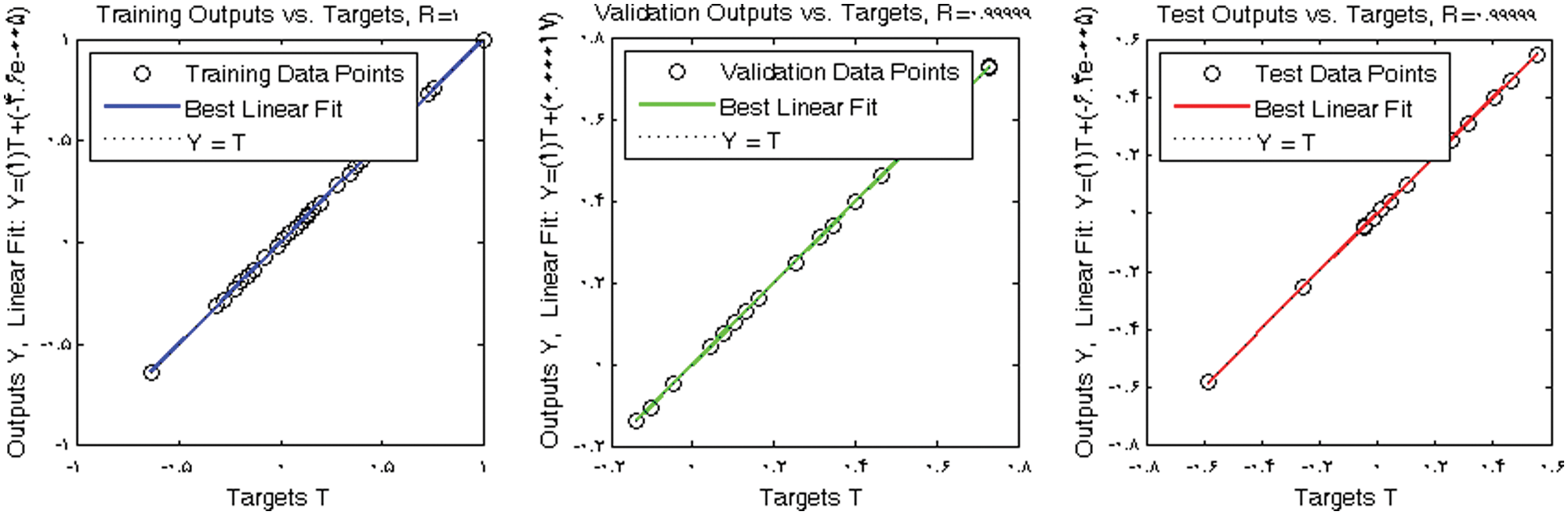
Linear regression between the outputs of the network and the targets for set of training, validation, and test
If there is a perfect proportion between the network outputs and the targets, the value of slope (m) and Y will be 1 and 0, respectively. On the basis of Figure 3, there is a similar outcome from this study. As the linear regression coefficient is very close to 1, there is a very good proportion as the differentiation between the best linear proportion and perfect linear one (Y = T) is very difficult.
Therefore, after a precise and lengthy process of data processing and design, training, simulation, and test of the network, a model named career decision-making intention was invented, which predicts the intention of students’ decision making in every time and every place. In the following, some data of the students of the 1st and 2nd years were collected to get more assurance, which will be analyzed by using the model of career decision-making intention.
The Prediction of the 1st Year and 2nd Year Students’ Career Decision-Making Intention
As mentioned earlier, after the process of design, training, and test of the network, the model of the prediction of career decision-making intention was obtained. Thereafter, this model was used to predict the 1st and 2nd year students’ intention and to test the network once more to make sure of its generalization ability as well. In this step, the data related to the mentioned students, which were not involved in the previous steps were introduced into the model as new samples (these data are related to 135 students of the 1st and the 2nd years) to be analyzed. The obtained outputs are the simulated or predicted data of the network. After simulation of the network outputs or, in other words, the prediction of the career decision-making intention of the students, the performance of the network is validated by the regression analysis for the second time. The results of the performance capability show that the values of slope (m), Y, and linear regression coefficient are 0.96, 0.0066, and 0.987, respectively. As a result, there is a very good agreement between the real outputs as targets and the network outputs implying the great capability of the network performance to predict the career decision-making intention of the students and its acceptable generalization power.
The Comparison of the Mean of the Students’ Career Decision-Making Intention
There is a final question, “Is there any significant difference in the career decision-making intention of the students of the 1st and the 2nd year of agriculture faculty with different majors?” In this case, one-way variance analysis is utilized. It is essential to mention that the data relevant to the 1st and 2nd year students’ career decision-making intention are those predicted by the ANN designed in the previous steps. The results signify that there is no significant difference in the career decision-making intention of the students of the 1st and 2nd years with different major (p = .062, F = 2.16). In other words, the students of the 1st and 2nd years have nearly similar career decision-making intentions. In addition, based on the carried out investigations, there was no significant difference in the career decision-making intention of the students of the 3rd and 4th years with different majors (p = .147, F = 1.66) and this group of students have almost similar intentions.
Discussion and Conclusion
Pearson correlation analysis and hierarchical multiple regression were used to investigate the personal and cognitive factors affecting the career decision-making intention. Based on the results, there is no significant relationship between career decision-making intention and personal factors like gender, major, average grade, and neuroticism. In other words, there is close to identical career decision-making intention in the male and female students of the different major of agriculture faculty of Razi University, which is in contrast with the findings of Esters and Knobloch (2007), which indicate that gender is one of the influential parameters on the career intention of agriculture students. In addition, the factor of the average grade of the students does not have much relation with their career decision-making intention. Moreover, the neuroticism trait of the students has no considerable relation with their intention. It seems that the high degree of positive personality traits of the students influenced the annoyance characteristic and reduced its negative effects on career decision-making intention.
Moreover, the results of the study indicate that there is a significant relationship between career decision-making intention and the characteristics of extraversion, openness, conscientiousness, and agreeableness along with self-efficacy belief and career outcome expectation variables. In other words, in spite of a lack of relation between neuroticism and career decision making, the other four personality characteristics have a significant relationship with the intention. The studies of Lounsbury, Hutchens, and Loveland (2005) and Reed, Bruch, and Haase (2004) signified that the characteristics of extraversion and conscientiousness are the outstanding traits that have a direct relation with the career decision-making behaviors, and their findings are in an agreement with this study’s results to some extent. Based on the investigations of Tokar, Fischer, and Subich (1998); Savickas, Briddick, and Watkins (2002); and Judge and Ilies (2002), the individuals who have higher degree of the characteristics of extraversion, openness, and conscientiousness are more interested in presenting the career behaviors. Rogers et al. (2008) insisted on the relationship between conscientiousness and the choices of goals and intention in their studies, which contradicts with this study’s findings. In addition, it can be implied from the study results that the students having a higher level of self-efficacy belief and career outcome expectation show more willingness in determining their goals and career intention, which are in agreement with the findings of Rogers et al. Betz and Voyten (1997) emphasized the significant relationship between self-efficacy belief and career outcome expectation with the intention. Also, Betz, Hammond, and Multon (2005) believed that the students who have a higher degree of self-efficacy belief are more stable in the career goals and intentions. The other researchers who pointed out the significant relationship between self-efficacy belief and career outcome expectation are Fouad and Spreda (1996), Lent et al. (2005), and Ochs and Roessler (2004) whose findings are consistent with this study. It should be mentioned that based on the findings of this study, career decision-making intention has the lowest degree of relationship with the agreeableness (effect value is 0.19) and the highest degree of relationship with the career outcome expectation (effect value is 0.76). Moreover, the results of the hierarchical multiple regression signify that the predictor variables explain 60% of the variance of the career decision-making intention in which career outcome expectation variable has the maximum share in the explanation of the variance with 34%. In addition, openness and conscientiousness decide totally 18% and the self-efficacy belief affects 8% of the mentioned variance. This finding is in direct agreement with Ochs and Roessler’s findings. They found the effective influence of career outcome expectation on the explanation of the career-seeking intention. However, Rogers et al. had no idea of the signification of career outcome expectation as a predictor variable. Overall, many researchers consider the personal factors, self-efficacy belief, and outcome expectation as appropriate predictors of the intention and behavior (Betz & Hackett, 1983; Fouad & Smith, 1996; Gainor & Lent, 1998; Hackett et al., 1992; Lapan et al., 1989; Lent et al., 1984; Lent et al., 1993).
To construct the model of career decision-making intention, ANN was used. To do this, a network consisting of three layers with error backpropagation algorithm with an input layer of 6 neurons (the number of independent variables), a hidden layer with 20 neurons and sigmoidal transfer function (selected based on trial and error), and output layer of 1 neuron (the number of dependent variable) and linear transfer function were considered and it was designed and trained with Levenberg–Marquardt learning algorithm. The performance of the study was analyzed by using the criterion of MSE and linear regression coefficient comparing the simulated results and real outputs (targets). Based on the calculations, the error of the network is very little and the proportionality and convergence among the outputs is very significant. Thus, the network is capable of the prediction of the student’s career decision-making intention. But, in the next step, to test the designed network once more, the career decision-making intention of the students of the 1st and 2nd years of the agriculture faculty was predicted. The results verified that the model of the career decision-making intention of the students had great generalization ability. It seems that the trained ANNs with the ability to simulate and predict the variables like career decision-making intention of the students might be a potential tool for superior teaching institutes to propose proper plans and policies to improve the mentioned variables considering the present value of career decision-making intention of the students especially, the freshers.
However, regarding the comparison of the mean of students’ career decision-making intention, the findings of the study imply that the mentioned intention of the students with different majors was almost the same. Moreover, the career decision-making intention of the students of the 3rd and 4th years with different majors was also nearly the same. In other words, the career decision-making intention of the students with different majors in their early years is almost the same. In addition, the result is identical for the students in their final years of education and it can be concluded that the students’ major has no significant effect on the increase or decrease of their career decision-making intention. This result is in very good agreement with the output of the regression analysis. Therefore, it is evident that the authorities of the agriculture faculty have not got much success in increasing and improving the students’ career decision-making intention implying their lack of efficient understanding of the important phrase such as intention.
Eventually, considering the determination of the influential factors on the career decision-making intention and readiness and the establishment of the prediction model of the career decision-making intention, it is suggested that a career consultancy center is organized in the agriculture faculty so that the consultants know the intention degree of the students by using the created model and the basic information received from the students, especially the freshers. Thereafter, they can improve the students’ career decision making by using the appropriate methods based on the condition of each student. This process can continue during the education period.
Footnotes
Declaration of Conflicting Interests
The author(s) declared no potential conflicts of interest with respect to the research, authorship, and/or publication of this article.
Funding
The author(s) received no financial support for the research and/or authorship of this article.