




Abstract
Research on implicit intelligence has conceptualized students’ beliefs about the nature of intelligence as either fixed or malleable. This research has largely not included African American adolescents, a group for whom beliefs about intelligence have a cultural historical complexity related to both scientific racism and master narratives of race and intelligence. The purpose of this study was to investigate the nature of implicit theories of intelligence for 63 African American adolescents who are seventh and eighth graders in a public charter school. The two-way ANOVA revealed that these adolescents held a malleable view of intelligence, which did not vary by gender or grade. Exploratory correlation analysis showed some consistent relationships with achievement motivation variables found in other studies. These findings may be explained by African American cultural values and the personality characteristic adaptations that they make living within a racialized society.
I’m just dumb. I had no doubts about that statement, and everybody else knew it too. Although no one specifically said anything to me about my being Black, I think my poor record reinforced my general impression that Black kids just were not as smart as White ones. I shrugged, accepting the reality—that’s just the way things were supposed to be. . . . I could easily have decided that life was cruel, that being Black meant everything was stacked against me. And I might have gone that way except for two things that happened during fifth grade to change my perception of the whole world. (Carson & Murphey, 1990, pp. 29-31)
It is almost impossible to conceive that these were the initial internalized beliefs of a 10-year-old child who would grow up to receive a full scholarship from Yale University, graduate from the University of Michigan School of Medicine, become the director of pediatric neurosurgery at the Johns Hopkins University at the age of 32, and receive the Presidential Medal of Freedom Award in 2008 (Carson & Murphey, 1990). Dr. Carson’s autobiographical memory, described above, illustrates that for a period in his childhood, he believed in society’s master narrative of race and intelligence that casts Black children as being less smart than White children. Two critical life events in the fifth grade, however, led to a radical shift in the way he viewed his intelligence and his social environment. These experiences served as the catalyst in preventing his maladaptive thoughts from becoming a destiny hampered by limitations. As a result, Dr. Benjamin Carson was able to conquer his beliefs of the intellectual inferiority of Black students. Dr. Carson’s narrative provides a clear example of one of the ways in which African Americans’ conceptions of intelligence may be shaped by the psychological significance of the meaning of race. What is less clear from Carson’s narrative is whether he viewed his own intelligence as an innate entity that is fixed or as one that is malleable and can be altered by effort.
The concept of implicit intelligence that is examined in this study refers to a person’s beliefs about the nature of intelligence. These beliefs can range from fixed to malleable. Individuals with the fixed or “entity” view of intelligence place the primary focus on their ability. They believe their intelligence is innate, with little opportunity for change. Conversely, individuals with the malleable or “incremental” view of intelligence believe that intelligence can be developed and that increasing their effort can boost their intelligence (Dweck, 2000, 2006; Dweck & Leggett, 1988). This belief system has contextual specificity as a result of an individual’s cognitive processing of information from life experiences within his or her social environment (Dweck, 2000). In previous studies, implicit intelligence theory has been used to explain why students adopt different types of achievement goals that produce related patterns of achievement behavior (Dweck, 2000; Dweck & Molden, 2005).
To date, there has been a paucity of implicit intelligence studies that have investigated the beliefs of non-White American racial groups (Aronson, Fried, & Good, 2002; Blackwell, Trzesniewski, & Dweck, 2007; Quihuis, Bempechat, Jimenez, & Boulay, 2002). Furthermore, the research that has been conducted with predominately African American and Hispanic samples is too small to draw meaningful generalizations. These studies do allow, however, some theoretical propositions to be explored in the present study.
Quihuis et al. (2002) applied a mixed-method approach to the examination of the implicit theories of intelligence for a group of Mexican American adolescents. The survey findings revealed that these high school students adopted domain-specific (e.g., math, science) implicit views of intelligence, while the qualitative interviews suggested that they concurrently held characteristics of both views. Similar to the Mexican American students in this study, the views of African Americans and other students of color may be influenced by cultural values that reflect their racialized experiences within American culture as a result of having to negotiate society’s master narratives of race and intellectual capacity that have evolved over time (see Winston & Winston, 2012).
The studies that have been conducted with African Americans did not seek to examine the nature of these students’ implicit intelligence theories. Instead, they focused on manipulating the participants’ views of intelligence to promote malleability. The only experimental study that utilized a predominately African American adolescent sample was conducted by Blackwell et al. (2007). In this study, the incremental theory of intelligence was taught to a group of seventh graders over an 8-week period. This intervention resulted in students’ increased mathematics achievement and classroom motivation. One of the limitations of this study was that the data were not disaggregated by race, and therefore, the specific nature of implicit theories of intelligence for African American adolescents is still unknown. Another experiment by Aronson et al. (2002) was conducted with an equivalent number of African American and Caucasian college students and investigated the impact that promoting an incremental view of intelligence would have in reducing stereotype threat and, subsequently, increasing academic performance. The short-term effects of the manipulation showed that the African American students’ experienced increased academic performance and more strongly embraced the incremental view of intelligence over time.
There are several reasons why understanding the nature of implicit intelligence theories of African American adolescents is important. First, during the middle school transition, there is a well-documented drop in students’ grades, achievement motivation, and overall psychological well-being (Eccles & Midgley, 1989; Good, Aronson, & Inzlicht, 2003). In addition to the change in academic environment, adolescents are adapting to the numerous biological changes that occur during puberty, cognitive shifts associated with an increased capacity for abstract thinking, and increasingly complex relationships with peers, parents, and teachers (Wigfield & Wagner, 2005).
Given the link between implicit theories of intelligence and achievement motivation found in previous studies (Dweck, 2000, 2002; Dweck & Leggett, 1988; Dweck & Molden, 2005), it is important to examine the nature of African American students’ implicit theories of intelligence and their relation to adaptive patterns of achievement motivation during this critical developmental period. Research on implicit theories of intelligence has shown that students’ theories about intelligence are related to their achievement motivation and academic performance (Dweck, 2000). For example, a malleable view of intelligence has been found to be positively related to mastery goals, but negatively associated with both performance-approach and performance-avoidance goals (Fonseca, Cury, Bailly, & Rufo, 2004).
An additional reason why studying the implicit theories of intelligence among African American adolescents is important is that there is very little research that focuses on African Americans and intelligence (see Cokley, Caldwell, Miller, & Muhammad, 2001). Furthermore, that which does exist focuses almost exclusively on intelligence testing (see Butler-Omololu, Doster, & Lahey, 1983; Graves & Mitchell, 2011; Grubb, 1987; Hilliard, 1994; Kwate, 2001; Price & Cutler, 2001; Schiele, 1991) despite the growing awareness among scholars (Dweck, 2000, 2002; Dweck & Leggett, 1988; Dweck & Molden, 2005) about the importance of students’ beliefs about intelligence in shaping their achievement motivation and success.
Finally, examining African American adolescents’ personal beliefs about intelligence is both interesting and important due to the cultural historical debates, symbols, and stereotyped expectations in American society about race and the intellectual capacity of African Americans (see Winston & Winston, 2012). For example, Robert Bennett Bean (1906), a professor of anatomy at the University of Virginia Medical School, asserted that the “Negro brain” developed normally as far as perception, memory, and motor responses were concerned, but logical critical thinking or the comprehension of abstract ideas were beyond its grasp because of “arrested physiological development” (pp. 353-354). Almost 60 years later, Arthur Jensen’s (1969) popular article, “How Much Can We Boost IQ and Scholastic Achievement?” argued that genetic factors are more meaningful than environmental factors in assessing IQ differences. More recently, Herrnstein and Murray’s (1994) book, The Bell Curve: Intelligence and Class Structure in American Life, continued this line of ideology, arguing that there were intellectual differences across racial groups that resulted from the innate genetic inferiority of Blacks and superiority of Whites.
This type of racist ideology is deeply entrenched in society’s master narratives of race and intelligence on the one hand, but on the other hand, it is resisted and countered in Black culturally responsive contexts (Burrell, Winston, & Freeman, in press). Given that African American adolescents’ beliefs about intelligence develop in multiple racialized societal contexts, their psychological development is particularly complex. In sum, these dual contexts serve to socialize African American adolescents’ beliefs about the general nature of intelligence. Schunk (1991) has emphasized the importance of context in shaping students’ beliefs about their ability and competence. Social contexts may likely influence students’ development of more specific beliefs about intelligence as either malleable or fixed.
Purpose of the Study
The purpose of this study was to investigate the nature of implicit theories of intelligence held by African American adolescents. The study also examined within-group variations in the nature of these beliefs, as well as explored other achievement motivation correlates that have been found to be related to implicit theories of intelligence in other studies (Aronson et al., 2002; Blackwell et al., 2007; Dweck, 2000; Henderson & Dweck, 1990). The primary research question addressed in this study was as follows: What is the nature of African American adolescents’ implicit theories of intelligence?
Theoretical Framework
The theoretical framework for the present study is grounded in several tenets of implicit intelligence theory. At its core, implicit intelligence theory describes individual’s beliefs about intelligence as ranging between being fixed, innate, static, trait-like, and relatively unchanging (the “entity” view) or being malleable, dynamic, and developable (the “incremental” view) such that an increase in effort can promote intellectual growth (Dweck, 2000, 2006; Dweck & Leggett, 1988).
One central tenet of implicit intelligence theory that is directly explored in this study is that there is a relationship between malleable views of intelligence and achievement motivation. During adolescence, the transition from the more mastery-oriented learning style taught in elementary school to the more performance goal orientation that is promoted in middle school has been found to be quite challenging for students with an entity view of intelligence (Dweck, 2002). Students with a malleable view of intelligence have more adaptive achievement motivation, and challenges are viewed as an opportunity for growth. Furthermore, setbacks are not internalized as failures by students with a malleable view of intelligence. Since the focused goal is on mastering the information, there is not a concern about looking either “smart” or “dumb” to others.
During middle school, students who view their intelligence as being fixed feel that their intelligence is threatened when they are faced with tasks that confront their professed abilities and demonstrated success from elementary school (Dweck, 2000). This opposition to their preconceived belief system can lead to a decrease in self-esteem, motivation, and the development of maladaptive behaviors such as task avoidance, self-handicapping, and classroom disengagement. Dweck (2000, 2006) asserts that sending messages of praise to young children when they succeed at tasks (especially simple ones) can promote an entity view of intelligence and produce maladaptive effects at later stages in their development. The present study adopted the theoretical view that the more malleable African American students’ views of intelligence, the more adaptive their achievement motivation.
A second tenet of implicit intelligence theory is that there is an intersection of individuals’ beliefs and the classroom setting. According to Blackwell et al. (2007), “children’s beliefs become the mental ‘baggage’ that they bring to the achievement situation” (p. 259). Unlike entity theorists, persons holding an incremental view of intelligence are less inclined to form judgments about the intelligence of others based solely on their successes or failures; however, they are more likely to apply their belief in change potential to other individuals (Dweck, 2000). This can be very critical to academic achievement in a classroom setting when the teacher holds an incremental view of intelligence and applies this belief to the student. Dweck (2006) cites a personal example of the detriment of having a sixth-grade teacher who
believed that people’s IQ scores told the whole story of who they were . . . we were seated around the room in IQ order . . . she was creating a mindset in which everyone in the class had one consuming goal—look smart, don’t look dumb. (p. 6)
In the present study, the theoretical view is adopted that African American students whose learning is socialized within a classroom setting and school context that emphasizes Black cultural values and beliefs will adopt a more incremental view of intelligence. That is, this view of intelligence is consistent with the African American cultural value of persistence and adopting a strong work ethic to achieve success. Previous research supports this view of the importance of culture as shaping views of intelligence and has found that cultural values of Mexican Americans and Koreans influence these students’ implicit intelligence theories (Quihuis et al., 2002; Woong, Plucker, & Im, 2002).
The Present Study
In sum, the present study investigates the nature of African American adolescents’ implicit intelligence theories. As with prior work, we adopt the perspective that these beliefs are particularly important to examine during middle school because of the myriad of psychological changes within the individual and the transitional characteristics of students’ learning environments. In addition, this study aims to explore the psychological correlates of these adolescents’ implicit intelligence theories as a mechanism to gain more insight into the nature of these beliefs.
This is the first study of implicit intelligence to argue that it is important to examine the nature of implicit intelligence in African American adolescents, because their intelligence beliefs develop in a racialized social and cultural environment. Furthermore, it is within this social environment that master narratives of race and intelligence have been pervasive. Although this study does not examine race meaning directly, it does extend knowledge about the nature of intelligence for African American adolescents. This is a group for whom master narratives of race and intelligence, as inaccurate as they may be (see Winston & Winston, 2012), can inform the psychological negotiation that the individual must engage in when trying to develop implicit intelligence beliefs.
Method
Participants
The participants in this study are part of a larger mixed-methods study examining the role of students’ achievement motivation, identity, social relationships, and perceptions of school culture in mathematics and science success. The participants included 63 African American seventh and eighth grade students enrolled in an urban, predominately African American, public charter middle school with an academic curriculum that is focused on science and mathematics. The school is located in the Mid-Atlantic region of the United States. In all, 51% of the participants are female, with 48% of the sample in the seventh grade and 52% in the eighth grade.
Measures
The Middle School Experiences (ME) Survey (Freeman, Winston, & Wynn, 2007) was administered to the participants. This survey included several well-established scales measuring achievement motivation, identity, perceptions of school culture, and social relationships. Dweck’s (2000) Implicit Theories of Intelligence Scale for Children–Self Form (For Age 10 and Older) was used in its entirety in this study as a measurement of implicit intelligence views. This is a six-item scale with a 6-point Likert-type response scale ranging from 1 (strongly agree) to 6 (strongly disagree). A sample item is, “You can learn new things, but you can’t really change your basic intelligence” (see Appendix A). The scale provided a mix of entity and incremental response questions and the three entity items were reverse-coded for analysis, thus higher scores indicate more malleable views of intelligence. The reliability for this scale was .81.
The achievement motivation variables were measured using the Patterns of Adaptive Learning Scales (PALS) developed by Midgley et al. (2000). This study examined correlations between implicit intelligence beliefs and personal achievement goals, classroom goal structures, and achievement beliefs and strategies. Personal Achievement Goal Orientations comprised four scales (task goal orientation, ability/approach goal orientation, ability/avoidance goal orientation, and extrinsic goal orientation) for both mathematics and science domains. Achievement goals are the reason students engage in particular academic behaviors and tasks. Different types of achievement goals elicit different response patterns.
Students oriented toward task goals are focused on mastering the information and aim to develop their competence and understanding in a subject area. These four items comprised a 5-point Likert-type response scale ranging from 1 (not at all true) to 5 (very true). A sample item is, “An important reason I do my math work is because I like to learn new things.” The reliability for this scale was .83 for the mathematics domain and .86 for the science domain.
An ability/approach goal orientation involves engaging in schoolwork to display competence. These five items had a 5-point Likert-type response scale ranging from 1 (not at all true) to 5 (very true). A sample item is, “I would feel successful in science if I did better than most of the other students in the class.” The reliability for this scale was .79 for the mathematics domain and .83 for the science domain.
An ability/avoidance goal orientation is focused on performance and trying to avoid looking incompetent. Research has found this type of goal orientation to be primarily associated with maladaptive learning patterns. These six items comprised a 5-point Likert-type response scale ranging from 1 (not at all true) to 5 (very true). A sample item is, “An important reason I do my math work is so that I won’t embarrass myself.” The reliability for this scale was .84 for the mathematics domain and .81 for the science domain.
Extrinsic goal orientation focuses on students’ engagement in schoolwork for the purpose of obtaining an outcome or reward such as a good grade, passing a test or promotion to the next grade level. These four items had a 5-point Likert-type response scale ranging from 1 (not at all true) to 5 (very true). A sample item is, “I do my work in science so that I can pass the class.” The reliability for this scale was .68 for the mathematics domain and .69 for the science domain.
Perception of classroom goal structure refers to the students’ perceptions of the teacher’s specific emphasis on different types of achievement goal structures. These types of goals were measured using three scales (task-focused, ability-focused, and extrinsic focused). Task-focused goals of the teacher place emphasis on developing competence and mastery in a particular subject area. These five items had a 5-point Likert-type response scale ranging from 1 (not at all true) to 5 (very true). A sample item is, “My math teacher thinks mistakes are ok as long as we are learning.” The reliability for this scale was .84 for the mathematics domain and .87 for the science domain. Ability-focused goals differ from task goals because the student perceives the teacher to be focusing on the students demonstrating their competence and outperforming others. These six items had a 5-point Likert-type response scale ranging from 1 (not at all true) to 5 (very true). A sample item is, “My science teacher tells us how we compare to other students.” The reliability for this scale was .69 for the mathematics domain and .72 for the science domain. Extrinsic classroom goal structures of the teacher focus on students’ engagement in schoolwork for the purpose of obtaining an outcome or reward such as a good grade, passing a test, or promotion to the next grade level. These three items had a 5-point Likert-type response scale ranging from 1 (not at all true) to 5 (very true). A sample item is, “My math teacher tells us we need to learn our math work because we will be tested on it.” The reliability for this scale was .65 for the mathematics domain and .79 for the science domain.
Academic-related perceptions, beliefs, and strategies refer to students’ perceptions of their competence to do their class work and specific learning strategies. These types of constructs were measured using self-efficacy and self-regulation scales. Self-efficacy refers to students’ judgment perception of their ability to perform well in their class work. These seven items had a 5-point Likert-type response scale ranging from 1 (not at all true) to 5 (very true). A sample item is, “I’m certain I can master the skills taught in math this year.” The reliability for this scale was .83 for the mathematics domain and .80 for the science domain. Self-regulation refers to students’ control and direction of their engagement in academic work. It includes behavioral (rechecking work, designating study space) and cognitive (monitoring understanding, concentrating) dimensions (Pintrich & De Groot, 1990). These six items had a 5-point Likert-type response scale ranging from 1 (not at all true) to 5 (very true). A sample item is, “When I notice that I haven’t been listening to my science teacher, I try to concentrate harder.” The reliability for this scale was .76 for the mathematics domain and .81 for the science domain.
Procedure
All students in the middle school were invited to participate in the study via informational letters and consent forms that were sent home to parents to explain the purpose of the study and to request written consent for their children’s participation. The present study uses data collected in spring of 2009. Participants were administered the ME Survey (Freeman et al., 2007) in groups, during their regular school day. Survey administration took approximately 45 min. The survey questions were read aloud to the participants by a survey administrator while additional survey administrators walked around the room to answer questions and to ensure that the participants stayed on course with the reader. When students completed the survey, the research team leader debriefed them as a group and gave them a 10-dollar gift card for participation in the study.
Data Analysis
As the initial step in the data analytic approach, a reliability analysis was conducted to test the consistency of the items in the implicit intelligence scale. Second, descriptive analysis was utilized to describe the implicit intelligence beliefs of the study sample. Third, a two-way between-groups ANOVA was performed to determine whether there were any significant statistical differences in implicit intelligence by gender and grade level, and to also test whether there was a significant interaction between gender and grade level on implicit intelligence. Finally, an exploratory correlation analysis was conducted to examine the relationship between implicit theories of intelligence and achievement motivation variables.
Results
The research question that guided this study was, “What is the nature of African American adolescents’ implicit theories of intelligence?” On average, adolescents in this sample held a malleable view of intelligence. As shown in Figure 1, an item response analysis specifically revealed that no student in the sample strongly disagreed with the belief that intelligence is malleable. The descriptive analysis in Table 1 illustrates that students’ average implicit intelligence theory score during the fall was 4.37 on a 6-point scale, with an increase to a 4.60 in the spring. This malleable view also increased slightly over the academic year by both gender and grade level, with both girls and eighth graders possessing higher levels of malleability. The ANOVA showed that these views did not vary significantly by adolescents’ gender or grade level (see Tables 2 and 3), and there was not a significant interaction between gender and grade level.

Mean frequency distribution of participants’ endorsement of a malleable view of implicit intelligence
Mean Differences in the Malleable View of Intelligence by Gender and Grade Level Over the Academic Year

Note: Malleability was determined using a 6-point scale (1 = strongly disagree, 6 = strongly agree).
Two-Way Analysis of Variance for Gender and Grade Level Conditions on the Malleable View of Intelligence in the Fall
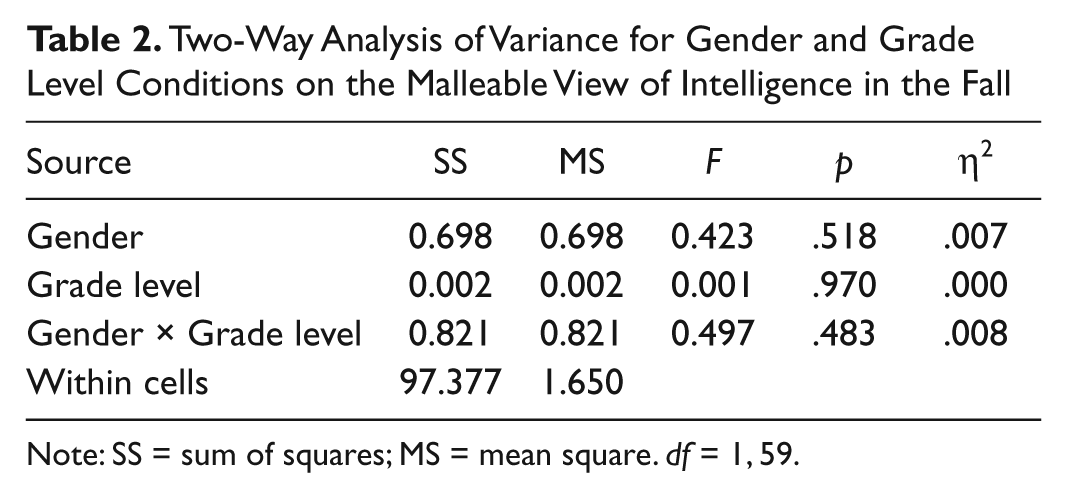
Note: SS = sum of squares; MS = mean square. df = 1, 59.
Two-Way Analysis of Variance for Gender and Grade Level Conditions on the Malleable View of Intelligence in the Spring

Note: SS = sum of squares; MS = mean square. df = 1, 56.
The nature of implicit theories of intelligence was also examined in terms of their bivariate relationships with other achievement motivation variables. As shown in Tables 4, 5 and 6, two achievement motivation variables were significantly correlated with a malleable view of intelligence. Students with more malleable views of intelligence were more likely to have higher science efficacy beliefs than students with more fixed intelligence beliefs. In addition, students who perceived an ability focus in their science classrooms held less malleable views of intelligence than students who perceived less of an ability focus in their science classrooms.
Correlation Between Implicit Intelligence and Achievement Motivation Variables (Personal Achievement Goal Orientations, N = 62)

p < .05. **p < .01.
Correlation Between Implicit Intelligence and Achievement Motivation Variables (Perception of Teacher’s Goals, N = 62)

p < .05. **p < .01.
Correlation Between Implicit Intelligence and Achievement Motivation Variables (Academic-Related Perceptions, Beliefs and Strategies, N = 62)
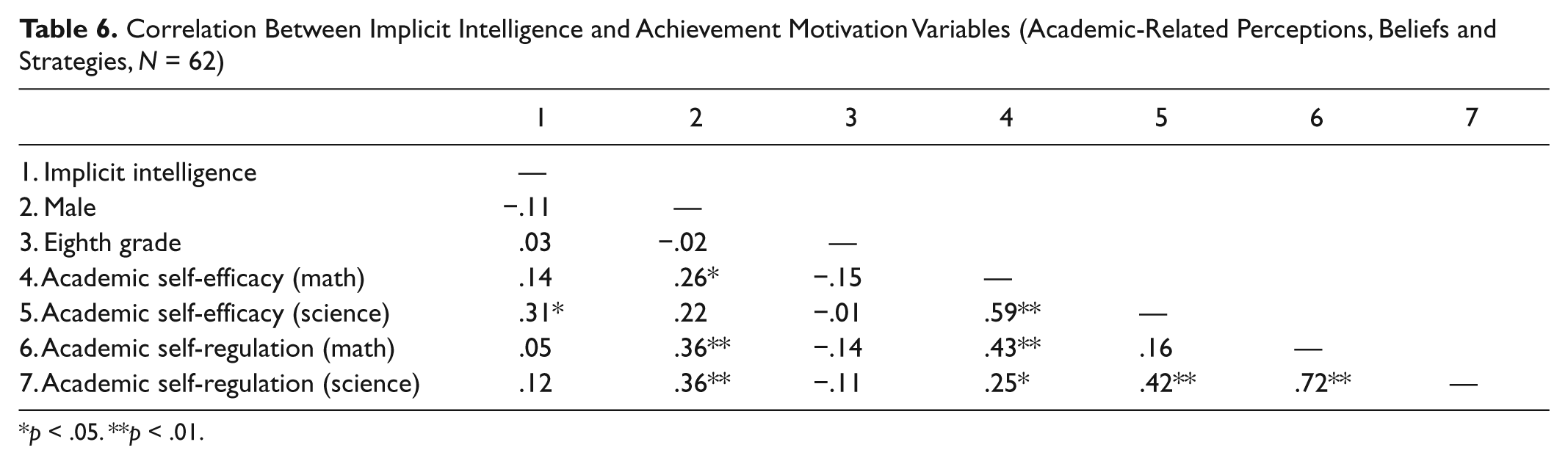
p < .05. **p < .01.
Discussion
The goal of this study was to gain insight into the nature of implicit theories of intelligence for African American adolescents utilizing a sample of African American seventh and eighth grade students from an urban public charter middle school. In general, the implicit theories of intelligence for African American adolescents in this study were malleable for both boys and girls, as well as seventh and eighth graders. Consistent with extant research and theory, students with more malleable views of intelligence were more likely to have other positive motivational characteristics than students with more fixed views of intelligence. The motivation patterns among this sample are consistent with other research findings on the achievement motivation of African Americans. For example, other studies have found that a classroom ability focus can be especially negative for African American youth (Gutman, 2006), and in this study, it was associated with more fixed views of intelligence. In addition, high academic efficacy beliefs have been suggested to be a cultural strength of African Americans (Anderson, Freeman, & Winston, 2011; Graham, 1994; Nicolas et al., 2008), and in the present study, science efficacy beliefs were positively correlated with malleable views of intelligence. Similar to the findings with positive efficacy beliefs, we posit that malleable views of intelligence are also a cultural strength of African Americans given omnipresent negative master narratives and stereotype threats.
We suggest two possible interpretations for why these adolescents held more malleable views of intelligence. One explanation is that these adolescents may adopt the theory that intelligence is malleable because of their cultural values and racial socialization. It is well established that the cultural values of African Americans include a strong achievement orientation, as well as endorsement of effort and hard work, as a means of upward mobility (Bowman & Howard, 1985; Hill, 1972; Hughes, 2003; Hughes et al., 2006; Nobles & Goddard, 1984). These values, like other Afrocultural values (see Tyler et al., 2008) have been generationally transmitted from parent to child through the process of racial socialization. This may shape an adolescent’s view of intelligence as varying with hard work, thus translating into socialization around education. In addition, the middle school is located on the campus of a Historically Black University. This may be why many of the parents chose to send their children to the school, and it could be that these students’ families promote cultural pride socialization.
A second possible interpretation of these adolescents’ malleable views of intelligence may result from their immersion in a unique learning environment. The school that these students attend has a specialized focus on science and mathematics and a mission of academic excellence that includes promotion of the intellectual, social, and emotional growth of its predominately African American student body. Matriculation in a school where students are exposed daily to a principal, and staff and teachers who are predominantly African American and in an atmosphere where academic excellence is not only encouraged but also expected provides a unique context for learning and positive psychological development. These experiences may be guided by teachers who encourage hard work and growth in their socialization practices as a proactive method to counter society’s master narratives of race and intelligence. The teachers in this school also engage in cultural pride socialization of the students (Freeman, 2010).
One of the most important findings within existing research on implicit theories of intelligence is the positive relationship between malleable theories of intelligence and achievement motivation variables. Within the present study, the correlations found between self-efficacy and implicit theories of intelligence suggest adaptive motivational characteristics of these African American adolescents. Students who are more self-efficacious are confident in their ability to overcome challenges and to persist when faced with obstacles, which would explain the positive relationship with a malleable view of intelligence.
Limitations
There are a few limitations to the present study that are important to consider. First, the quantitative method in which implicit views of intelligence were measured in the present study does not account for the possibility that persons can hold both views simultaneously or have views of intelligence that are domain specific. Second, the sample may not be generalizable to the larger population of African American adolescents due to the small sample size and the unique learning environment of the sample. Although there was a relationship found between some of the achievement motivation variables and implicit views of intelligence, a causal influence of these beliefs on achievement motivation cannot be determined. In addition, these participants were enrolled at a school with a commitment to success in the highly specialized domains of science and mathematics. This specialized curriculum may attract students who possess more growth-oriented mindsets.
Future Directions
The present study was effective in capturing the nature of implicit theories of intelligence for African American adolescents, which had not been addressed in previous research. Future research should investigate the way in which implicit intelligence beliefs operate in different academic domains to determine the contextual specificity for this group. Employing a mixed-method research strategy that includes interviews and focus groups could provide greater knowledge of the underlying meaning-making process in the development of implicit theories of intelligence. Understanding the ways in which these students conceptualize their academic identity may provide valuable insight into the impact on subsequent behavior patterns that these students adopt in challenging academic situations. It may also provide insight into why differential relations were found in the present study between students’ view of intelligence and different domains of achievement motivation. To expand the generalizability of the findings from the present study, future research on the nature of African American adolescents’ implicit views of intelligence should include students from diverse academic and socioeconomic backgrounds. In addition to increasing the sample size, it would also be important to include sixth graders to explore implicit theories of intelligence during adolescents’ initial transition from elementary school to middle/junior high school.
Conclusion and Implications
It is not absolutely clear from this study whether these students’ malleable views of their intelligence mean that they do not endorse the master narrative of race and intelligence plotline that African Americans are inherently or innately intellectually inferior. However, the findings from the present study do strongly suggest that students in this sample believed that intelligence can be developed. This may mean that these adolescents were able to utilize their lived experiences within a racialized society to create counter narratives about race and intelligence that produce more adaptive adolescent development.
This cultural historical complexity of the meaning of master narratives of race and intelligence makes it challenging to make interpretations about the meaning-making process an African American adolescent may engage in when trying to develop a person theory of intelligence as either fixed or malleable. Winston and Winston (2012) theorize that when African Americans are asked to define what intelligence means, the pervasiveness of master narratives of race and intelligence within racialized societies cause most to psychologically negotiate the racist ideology associated with these master narratives of race to decide to what extent they endorse or reject such beliefs as self-relevant. What is less clear, however, is how specifically these master narratives of race evolve and are responded to among African American adolescents due to the relative immaturity of their cognitive experience and the variable intensity of their exposure to American culture’s racist ideology. Nonetheless, because these master narratives of race and intelligence are so theoretically pervasive within racialized cultures, it is likely that by adolescence, African Americans have some exposure and in some situations have to make sense of their meaning. There is also some evidence from a study conducted by Burrell et al. (in press) with students drawn from the same sample as the present study, that these adolescents have developed personal beliefs about intelligence in the form of how intelligence characterizes what it means to act Black and to act White.
For Dr. Benjamin Carson, his counter narrative construction about race and intelligence was initiated by two life-changing events in the fifth grade. First, unbeknownst to him, a schoolwide vision examination revealed that his eyesight was so abysmal that he almost qualified for handicapped status. Second, the engaged parenting approach of his mother led to a more forceful hands-on intervention regarding his education. Young Ben Carson was now literally seeing the world more clearly through his new glasses. Also, due to an almost immediate improvement in grades, he saw himself as a more capable learner who was able to recognize the ongoing support of his teacher, as well as the high expectation beliefs that his mother possessed for him.
Seeing that passing grade made me feel good. I thought, I made a D in math. I’m improving. There’s hope for me. I’m not the dumbest kid in school. When a kid like me who had been at the bottom of the class for the first half of the year suddenly zoomed upward—even if only from F to D—that experience gave birth to hope. (Carson & Murphey, 1990, p. 33)
Dr. Carson had finally begun to develop his “adaptive” lens, a counter internalized narrative of self about his intelligence that would lead to one of the most successful careers in American medicine.
Footnotes
Appendix A
Acknowledgements
The authors would like to thank the following people for their comments on drafts of this manuscript: A. Wade Boykin, Michael Winston, and IMERG.
Authors’ Note
Any opinions, findings, conclusions, or recommendations expressed in this material are those of the author(s) and do not necessarily reflect the views of the funders.
Declaration of Conflicting Interests
The author(s) declared no potential conflicts of interest with respect to the research, authorship, and/or publication of this article.
Funding
The author(s) disclosed receipt of the following financial support for the research and/or authorship of this article: This research was supported in part by grants to the third author from the Howard University School of Education Walter and Theodora Daniel Endowed Educational Research Fund and the Howard University New Faculty Start-Up Research Fund.