




Abstract
About 100 teachers participated in a study and helped to understand how new reforms are faced by those who work in the field, in the particular case of the discipline of geography. The study that was done with geography teachers after 10 years of national curriculum revealed many gaps in terms of what teachers are expected to do. Only recently, some legislation has been issued to regulate the kind of training teachers do as they progress in their teaching careers. The national curriculum for basic education is a huge step in terms of being a part of the world agenda in what concerns a modern teaching and a new vision of what schools should prepare students to, but the instruments of that change (teachers) have been neglected.
Brief Overview of the Organization of the Portuguese Educational System
The Portuguese educational system is governed by the constitution of 1976. The constitution guarantees the right to create private schools. It proposes to eliminate illiteracy, to provide special education to those children who need it, and to preserve the autonomy of the universities. It guarantees the rights of teachers and students to take part in the democratic administration of the schools. In addition to the constitution, Portuguese education is governed by decree laws promulgated by the executive branch. The one that presently regulates the educational system (General Law of Education, Decree Law 46/86) was issued in 1986 and sets the main goals of the educational system in general and particular cycles of schooling.
The Portuguese educational system is highly centralized. Despite some efforts at decentralization in the constitution of 1976, the Ministry of Education in Lisbon sets education policy for the entire nation. Local and regional districts have little autonomy to introduce changes in this centralized educational system. The Portuguese educational system covers preschool education; school education, including basic and secondary education; and extracurricular education.
The Portuguese General Law of Education establishes the following stages for basic education: a first cycle of 4 years, a second cycle of 2 years, and a third cycle of 3 years (Table 1).
Organization of Portuguese stages for Basic School

Note: Adapted from http://www.apecv.pt/anexos/Projectos/educationportugal.PDF
After basic education, students continue to secondary education for 3 more years (15 to 18 years old). Secondary regular education is arranged into general courses, designed mainly for pupils who want secondary-level instruction, with a view to pursuing higher education, and technological courses, designed mainly for pupils who want an intermediate-level vocational qualification that will give access to the labor market; secondary education also leads to a diploma of secondary education and, in the case of technological courses, to a Level 3 vocational qualification. Compulsory education in Portugal lasted 9 years, involving pupils from the age of 6 to 15, till 2009 when the Law 85/2009 that extended compulsory education to the age of 18 for students who entered the school system in 2009/2010 was issued. This means that secondary school is now included in compulsory school.
In 2001, the Ministry of Education and the Parliament approved a curricular reorganization of basic school that was being implemented since the beginning of the 1990s. Several reasons were presented for the need of a curricular reorganization (Decree Law 6/2001, August 18), namely, the need to overcome a vision of the curricula based in a set of rules to be followed in every classroom, having in view a growing autonomy of schools and the development of new practices of school management. So, the mentioned decree established the guidelines of the organization and management of basic school, as well as the assessment methods and the process of development of a national curriculum.
This national curriculum should be seen as the set of knowledge and skills, including specific knowledge, skills, attitudes, and values to be developed by the student in harmony with the purposes present in the General Law of Education to this level of studies. This document includes the guidelines of the organization of the curricula taught in all Portuguese schools and represents an important shift from an educational system based in the importance of contents to an educational system based in the development of a set of competences (understood as the acquisition of knowledge, skills, and values/attitudes at a level of expertise sufficient to be able to perform in an appropriate work setting) that should be developed by all students before entering secondary education.
Portuguese National Curriculum for Basic Education—A New Vision of Teaching and Learning in Portuguese Schools
The national curriculum is a document that intends to be a guideline for curriculum planning and development in national terms and for curriculum projects at school and class level (DEB, 2001).. So, it presents a set of competences that should be transversal to the three cycles of basic education and also to all the subjects taught at schools (which would also give their contribution with specific competences development). These transversal (or general/essential) competences to be developed by students during the attendance of the third cycle of basic school are as follows:
To mobilize cultural and scientific knowledge to understand reality and deal with daily life situations and problems.
To suitably use languages from the different areas of cultural, scientific, and technological knowledge to express himself or herself;
To correctly use the Portuguese language to communicate in a suitable manner and to structure his or her own thinking;
To use foreign languages to effectively communicate in daily-life situations and for the appropriation of information;
To adopt personalized work and learning methods appropriated to the intended objectives;
To research, select, and organize information so as to turn it into transferable knowledge;
To adopt appropriated strategies to problem solving and decision making;
To carry out activities in an autonomous, creative, and responsible manner;
To cooperate with others in common tasks and projects;
To harmoniously relate body with space, from a personal and interpersonal perspective, promoting health and quality of life.
The development of such competences implies that all curriculum areas should be interconnected. So, the different curriculum areas were invited to clarify how this transverse competences were to be achieved and developed within each scientific field of knowledge and according to each student’s learning context. To give its contribution to the necessary changes in classroom practice to allow the implementation of activities aiming at the development of the transversal competences, the national curriculum also proposes particular actions related to each competence. They will be addressed in the following section.
Main Changes Introduced As to the Kind of Experiences Teachers Should Promote in Classrooms and Schools
For each general competence, a set of actions regarding teaching practices is presented considering that they are essential to the development of that particular competence across the different areas and dimensions of the basic education curriculum (Table 2).
General Competences: Actions That Should be Developed by Each Teacher
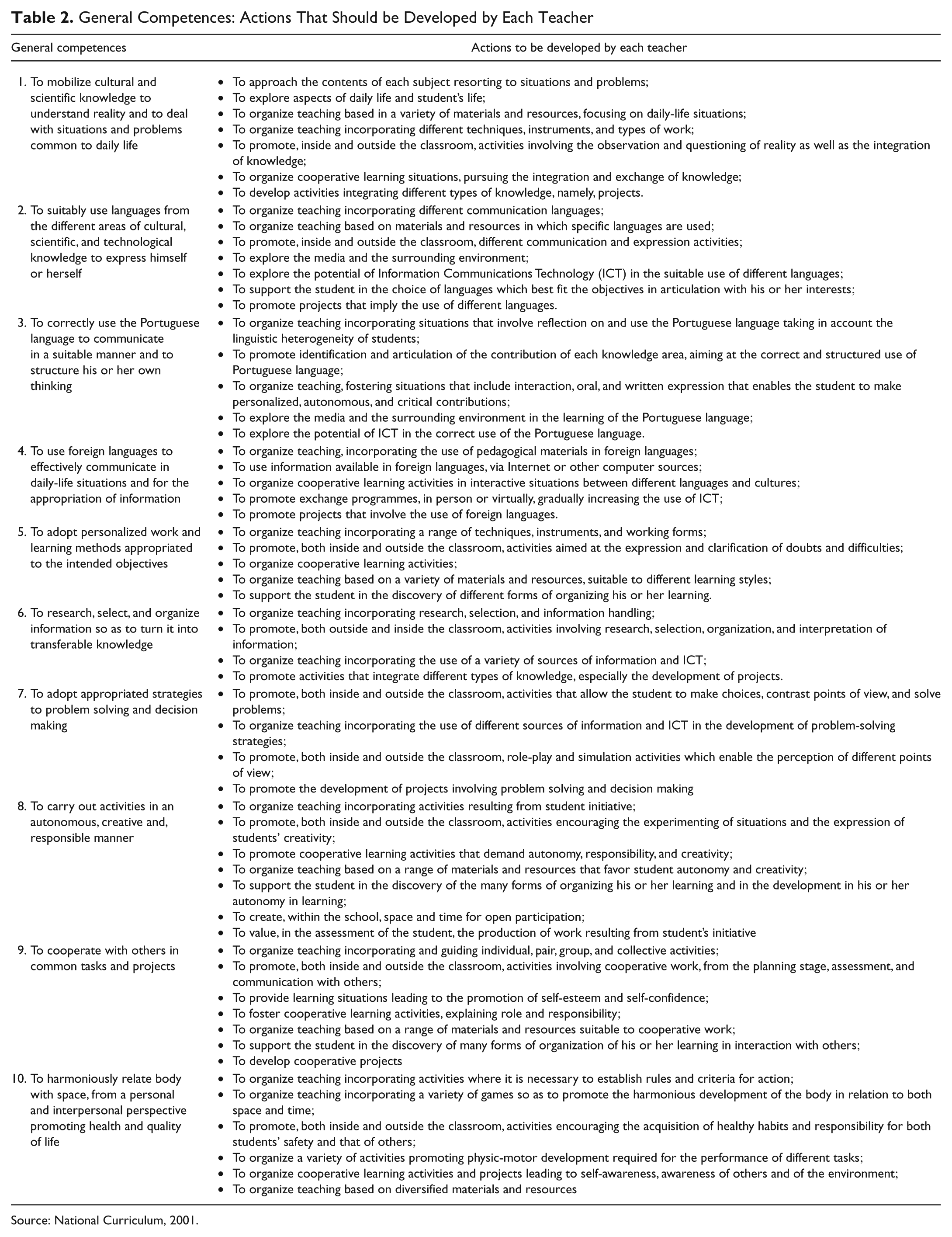
Source: National Curriculum, 2001.
An analyses of the actions to be developed by each teacher shows a clear concern with the implementation of activities clearly centered in the development of students’ competences and less centered in the specific contents of the several disciplines of basic education—they will of course give their contribution to the acquisition of a body of knowledge but also will be responsible for the development of specific competences, now related to the curricular contents.
It could be said that the actions to be developed by teachers according to the national curriculum are related to the teaching to facilitate the process of learning. This analysis was based in each competence-suggested action, and some of the most relevant aspects are presented in Table 3.
Actions to Be Implemented by Each Teacher: Teaching and Learning in the National Curriculum

The national curriculum’s vision is to develop a concept of competence close to the concept of literacy. Through basic education all students should be able to achieve a certain degree of knowledge and develop thinking skills and attitudes. In the following section, the contribution of geography to the general competences will be analyzed as well as the specific competences of this school subject taught in the third cycle of basic education.
The Particular Case of Geography Subject—The Creation of the Geographical Competent Student
The contribution of different subjects in terms of content and competences organization was diverse and only two underwent a profound reorganization of their contents to allow teachers a change in their practices having in mind the new vision of education set by the national curriculum. Geography, taught in the third cycle of basic education, was one of these. The definition of geographical competences to be addressed by the specific subject was carried out to give its contribution to the development of general competences (M. E., 2002).
Geography introduces the notion of the “geographically competent student” as the student who will master special skills and show his or her capacity to spatially visualize facts. He or she will be able to integrate these facts, correctly describe the environment where he or she lives or works, make a mental map of that environment, use maps of a wide range of scales, understand spatial patterns, compare them, and locate himself or herself on the surface of the Earth. In addition, this geographically competent student will also be capable of interpreting and critically analyzing geographical information, and understanding the relationship between territorial and cultural identity, heritage, and regional individuality.
So as to contribute to the development of this geographically competent student, the geography teachers should be able to form a geographically informed citizen, which involves a set of teaching and learning experiences that all students should go through, some of which are presented in Table 4.
Characteristics of the Geographically Informed Citizen

Geography-specific competences can in fact be summarized in three main domains: location, knowledge of places and regions, and dynamic of the interrelationships among spaces.
During the third cycle, geography teachers should implement learning experiences that will contribute to the development of national curriculum competences as well as geographical competences. These experiences include a vast range of activities that are suggested to teachers and should be viewed as guidelines to be followed to cut effectively with old classroom practices and favor the implementation of new practices in what geography teaching is concerned. In terms of what students should do, the national curriculum is very clear: They should identify, observe, create, make, plan, participate, and organize, among other actions clearly related to an active classroom involved in active tasks.
This means that some type of work is to prevail: direct and indirect observation, simulations, games and role-play, group work, participation in debates, doing case studies, undergoing fieldwork, and organizing exhibitions as to disseminate their doings and findings in the learning community. The preparation of these learning activities implies serious training for teachers to be ready to answer the challenges the new curriculum brought to their classrooms. In the following section, some of the problems faced by teachers in doing this will be analyzed to understand why often it is so difficult to change classroom practices in the specific context of the Portuguese school system.
Challenges Faced by Teachers Toward These New Curricula Aims
When this article was prepared, a study about the adaptation of geography teachers to the challenges of the new national curriculum was being done, and some of these findings will be presented to understand the kind of challenges teachers face when confronted with a curricular reform. About 100 teachers participated in the study and helped to understand how new reforms are faced by those who work in the field with the implementation of new visions of teaching and learning often prepared by the central bodies of the Ministry of Education. It will be possible only to present some of the most relevant findings.
In an initial moment, the teachers were questioned about specific training courses they had attended to prepare to the implementation of the curricular reform of 2001. It was necessary to know if they had been given the opportunity to improve not only their scientific knowledge but also their pedagogical skills, Information Communications Technology (ICT) skills, or any other skill considered relevant to the implementation of the new challenges a geography teacher should face in the light of the national curriculum.
In what concerns the attendance of any kind of training related to the implementation of the curricular reorganization, 60% of the teachers involved in the research referred that they had attended none. More than 40% referred that usually they prepared individually for curricular changes (doing bibliographic research, research in the Internet, or attending seminars) whereas about 35% had worked with colleagues (planning activities and classes, building teaching resources, and participating in debates) to prepare for the new curricula of geography. Despite the fact that career training courses are compulsory in the teaching career, only 63% revealed to have attendant formation relevant to the teaching of geography (in the Portuguese system, the range of training areas is quite wide—only recently it was legislated that 50% of the training of the teachers should be done in the scientific areas).
In what concerns the difficulties teachers face every day to implement the orientations of the national curriculum, some aspects were mentioned: For almost 70% of the teachers, the learning experiences are particularly difficult to implement due to several aspects, such as the lack of resources in the classroom, in the schools, and the difficultly in organizing activities outside the classroom. Some teachers added the lack of interest of the students for these activities, behavior problems of the students, and also the little time they spend weekly with each class (in the case of geography, 90 min/week).
In view of these facts (lack of specific training and difficulties in implementing learning activities adapted to the orientations of the national curriculum), it was interesting to know how teachers prepare their activities. And surprisingly, or maybe not, teachers prepare their activities researching the Internet, using the text books of the previous curricular reform (that dates from 1991 and ended with the implementation of the reorganization of 2001), resorting to colleagues and the new text books edited for this curricular reorganization. In other words, teachers act alone in the understanding of the meaning of all the changes that were asked in terms of curricula and practices and most probably keep teaching exactly how they were teaching before the national curriculum.
Some Reflections About Almost 10 Years of the New National Curriculum in Portugal
This article intended to present the new vision of education that Portuguese schools have since the beginning of the 21st century and demonstrate that the educational system is trying to adapt to the unclear challenges that students today will face in a near future when entering the work market or pursuing their studies to higher education. Basic education, that was compulsory till 2009 to all students, was now enlarged to 3 more years and includes secondary education.
This new compulsory education of 12 years will add some new problems to Portuguese schools and the most important is the curricular reorganization that needs to be done to the secondary level of education in terms of the new setting of final competences to be developed by students before entering university or the work market. This new compulsory education was a political decision and the Decree Law 85/2009 of August 27 clearly states that from now on all children should be in school till the age of 18 (even if they do not finish secondary education). This modification of the General Law of Education (existing since 1986) will probably mean a new curricular reorganization—at least for secondary education.
The study that was done with geography teachers after 10 years of national curriculum revealed many gaps in terms of what teachers are expected to do and what is done to prepare them to do so. This has been a huge problem in terms of professional development and only recently some legislation has been issued to regulate the kind of training teachers do as they progress in their teaching careers. The national curriculum for basic education is a huge step in terms of being a part of the world agenda in what concerns a modern teaching and a new vision of what schools should prepare students to, but the instruments of that change (teachers) have been neglected.
In fact, the reorganizations should be done with the teachers and not in spite of the teachers. They are the ones working every day with the classes, the students, the school, and their colleagues, in multiple tasks, not just teaching, and the right attention has not been paid to the need of viewing them as an important part of the process. This shift from centering teaching in competences and not just in contents, which was generalized to all curriculum subjects, was not accompanied of a serious investment in teacher training. This is not new in the Portuguese school system; on the contrary, it is always expected from teachers to adapt to changes, although the specific training is promised but hardly implemented.
Only this year, the Ministry of Education is organizing research groups to define the “attainment targets” measured by “learning outcomes” to be accomplished by students at the end of each cycle, school year, and subject. This definition will be made after consideration of the international patterns, Portuguese experience, and the results of the research about the factors that determine the efficiency of educational systems. The final purpose will be to create an orientation and control framework for teachers, families, and students themselves, and will allow adapt the teaching that is being done in schools to the common goals set by the national curriculum and the European Qualifications Framework.
Maybe then, teachers will clearly have a relevant role in the process as once more; they will be the implementers of these targets and the evaluator of the process. This should have started 10 years ago—one way to look at it is to believe that, in Portugal, we still are in the process of setting the New Curriculum goals. Education is hardly a finished process; every day new issues can be introduced to improve the school system, but it is important not to forget that teachers are the ones who can make a difference in terms of the success of the implementation of any reform or reorganization.
Important sites
http://www.gepe.min-edu.pt/np4/9.html
http://www.dgidc.min-edu.pt/ensinobasico/index.php?s=directorio&pid=2
http://www.metasdeaprendizagem.min-edu.pt/ensino-basico/metas-de-aprendizagem/
Footnotes
The author(s) declared no potential conflicts of interest with respect to the research, authorship, and/or publication of this article.
The author(s) received no financial support for the research and/or authorship of this article.