




Abstract
The languages, attitudes, experiences, and interests of groups of people are often interconnected through discourses. Within collegiate courses, systems of connected individuals progress through learning opportunities, often led by their professors. During one graduate course at Louisiana State University, two students acted as research investigators studying the unique characteristics of a collegiate discourse. The findings indicate that authors of the study were members of the discourse, topics of discussion were guided by only those students in attendance, and there was reciprocity in teaching and learning between active members of the discourse.
The languages, attitudes, experiences, and interests of groups of people are often interconnected through discourses. These social structures are, as Gee (1989) explained, a “sort of ‘identity kit’ which comes complete with the appropriate costume and instructions on how to act, talk, and often write, so as to take on a particular role that others will recognize” (p. 7). As its members shape a discourse, one can determine many unique aspects of one’s own discourse by taking a step back and studying its uniqueness. Palmquist (n.d.) pointed out that “the new perspective provided by discourse analysis allows personal growth and a high level of creative fulfillment” (p. 1). Thus, the context of the discourse becomes more evident and conceivably meaningful.
Understanding these networks on a theoretical level though is limiting. Assigned with the task of finding and studying any discourse, two graduate students set out to investigate their own class as a system of connected individuals or discourse. They acted as research investigators studying the characteristics of a collegiate discourse without anyone being the wiser. What follows is a depiction of this specific discourse in an attempt to specify what makes this discourse distinctive.
Since the initial class meeting of EDCI 7910, the participants have been fascinating to both inquirers. Members of EDCI 7910 are PhD candidates with three exceptions, the professor, and two students seeking a master’s degree. These participants come from a variety of backgrounds, including educational administration, nursing, special education, literacy education, and several other fields. Even though members have different career-oriented interests, they share the desire to be part of the EDCI 7910 discourse community. This allows the community to have the opportunity to learn from all participants, which is significantly exceptional.
Through discourse analysis, one should act as an outsider to identify characteristics of one’s own discourse community. Often, people are part of many discourses at a time but function unaffectedly because of their quiet membership. Looking at one’s own discourse can be beneficial for several reasons. First, identifying acceptable and unacceptable behavior within the discourse can lead to continued belonging to the faction. Once it is known that certain behaviors are looked down upon, one would likely act in accordance. Second, one may determine, after analyzing a discourse community, whether to associate or disassociate with it. Many times, certain attitudes and rules of conduct are required of the participant. In addition, being identified with one discourse may be assumed to be unacceptable by another discourse to which one belongs. All of these rationales are at the basis for the analysis of the discourse community, EDCI 7910.
Method
Being part of the discourse, it was somewhat simple to record specific aspects of the community. Initially, recorders took notes on observed data of various information, including member eating habits, posture, speech patterns, and much more. As repetitive behaviors were noticed, informal question and answer surveys served to solicit student feedback and eliminate observational bias. For specific student comments, see Figure 1.

Interview responses
Once several characteristics of the discourse were determined from analyses of student surveys and other collected data, a chart permitted recorders to tally each time a particular action occurred. For 5 weeks, recorders collected data by writing tally marks of members’ attendance, participation, cellular phone usage, and dialogue styles. These characteristics were the foci of analysis because “the professional language … of a disciplinary group plays a key role in establishing its cultural identity” (Becher, 1989, p. 24).
Data were gathered using Spradley’s (1980) ethnographic research cycle, beginning with broad ethnographic questions while collecting data through observation in the classroom, speaking with students before and after class, and observing their interactions with each other. Several key findings emerged from these data analyses. Participants were asked the following three questions and invited to make any additional comments:
What do you enjoy about being part of the EDCI 7910 discourse community?
What do you dislike about being part of the EDCI 7910 discourse community?
What are your perceptions of the investments of other members of the discourse community?
The responses to these three questions varied. When asked the first question about their likes, some felt they most enjoyed Dr. Kellen’s willingness to help. Others found the humor of the class refreshing. One student even responded that “we are encouraged to say something smart, and I like that it is important to the professor that we come prepared and ready to discuss the material.”
When asked what they disliked, some respondents stated they did not appreciate the chatting because it seems to be a constant conversation, and people are, at times, digressing or off task. Others answers included a problem with cell phones ringing during classes and the tardiness of some of the classmates. In fact, one student shared, “I feel like the project was hard because people kept trickling in. It reminded me of being an undergrad.”
The third question, regarding the students’ perceptions of their classmates’ investments in the course, provoked a strong variance in responses. Some students were unsure of their opinion on the matter but felt that some students expect a certain grade without working for it. Other students felt that although their classmates may never say that they think the material is unimportant, they clearly show through their behavior that they do not see the importance. For example, they read the newspapers and eat during class and do not pay attention to the person who is speaking. Those students who feel this way about their classmates believe their sense of apathy toward the course is especially noticeable when the apathetic students have trouble expressing themselves in class. Another group of students responded that they feel everyone is nice, and they feel people really want to help them do well.
Additional comments made by the participants included,
There is a strong sense of work ethic. For years, I was in retail and I learned that we could tell about a person and their ability by their ethic. I want the class to see that the discourse members are willing to make others be ethical and report when they feel as though results or work is not presented fairly. I think some people should look at character education. Some of the behaviors in the class are rude. You do not cough on others, use poor language, or disrespect the teacher. Maybe this is a bit old-fashioned, but this teacher is an expert and we need to gain as much as we can from her.
Using Glaser and Strauss’ (1967) constant comparative method, data were collected and analyzed simultaneously, which included inductive behavior-category coding with a comparison of all incidents observed. To reduce premature assumptions derived from these transcriptions, we analyzed the data from these sources (Erickson, 1986). After the transcription of the raw notes from observations, associations were sought between multiple observers.
Results
Findings indicate that the leader, Nancy Kellen, scaffolds members of the class who have not already mastered the discourse. All members are encouraged to maximize learning opportunities by engaging actively in the community. This is unusual in that “tribes of academe … define their own identities and defend their own patches of intellectual ground” (Becher, 1989, p. 24). Through this “enculturation into social practices,” students can acquire a new discourse: academia (Gee, 1990, p. 7). According to a data analysis of recorded dialogue patterns, Kellen often states, “OK. I think we will start by” to lead conversations in regard to specific topics. At other times, she poses the question, “Well, what did you all think about?” to stimulate topical discourse. Through sharing her insight with other nonelitists of academia, students can learn from her experiences. Furthermore, Kellen gently maintains authority by halting off-topic discussions to facilitate effective use of discourse time.
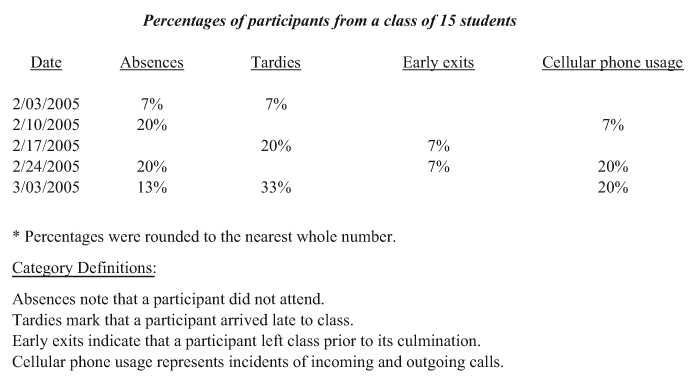
Nonetheless, some members of the class discourse often do not attend the seminar. Perhaps, they have other duties that take precedence over the class meeting (see Figure 2). Nevertheless, these members miss ideal opportunities to learn from the discourse’s insights and experiences. The leader, Kellen, is one of the members’ most valuable resources; yet, many of the members do not reach this realization. They apparently skip class when they wish and participate at their convenience. In addition, those members who attend regularly also suffer from not having the entire class present. Those in attendance cannot always discuss, question, and engage in discourse with others from their particular fields of study (i.e., literacy, curriculum theory, and mathematics). Thus, some students’ hidden motivations cause the entire class discourse not to reach its potential.
Studied behaviors
Along with many unseen members, authors from various sources (e.g., Becher, 1989; Gee 1989; Porter 1992), nonclass members are welcomed into the discourse community to share their insights from other academic discourses. A guest panel on publication, consisting of three academics, changed the makeup of the discourse as they shared ideas on publication. EDCI 7910 members took on a listening role within the discourse, as the guests spoke uninterruptedly. Following each panelist’s speech, class members asked questions. Based on informal conversations with discourse participants, some members view the guests as role models; thus, they will likely use some of the panelists’ suggestions in an attempt to become published. Guests like Madeline Grumet and the publishing panel transform the discourse, bringing new insights and thus, alter the knowledge and sense of academic direction of the discourse community—EDCI 7910.
Through the analysis of EDCI 7910, it is evident that the majority of the discourse does not prioritize attending class for 3 hr per week for the sake of its members. If one is to be considered part of the discourse community, one must fulfill certain prescribed obligations, as outlined in the course syllabus, including attending, participating, and completing coursework, both in class and outside of class. Although these duties may seem daunting to some, EDCI 7910 is a graduate-level education class in which considerable effort is necessary for one to become indoctrinated in traditions of theory. Every participant has outside duties, obligations, and concerns; nevertheless, most members still fulfill their roles. Essentially, members of EDCI 7910 can only expect to learn as much as they put forth effort.
The following recorded results are percentages of participants from a class of 15 students. All the percentages reported in the results were rounded to the nearest whole number. Absences note that a student did not attend the class at all. Tardies mark that a participant arrived late to class on that day. Early exists indicate that participants left the class prior to its designated culmination. Cellular phone usage represents incidents of incoming or outgoing calls that occurred during the class period.
On February 3, 7% of the students were absent or tardy. On February 10, 20% of the students were absent, and 7% used their cellular phones at some point during the class period. On February 17, 20% of the students were tardy to class, and 7% left the class period early. On February 24, 20% of the students were absent, 7% left the class period early, and 20% used their cellular phones at some point during the class period. On March 3, 13% of the students were absent, 33% of the students were tardy to class, and 20% of the students used their cellular phones at some point during the class period.
Footnotes
The author(s) declared no potential conflicts of interest with respect to the research, authorship, and/or publication of this article.
The author(s) received no financial support for the research, authorship, and/or publication of this article.