




Abstract
Cardiovascular diseases are major health complications currently in various societies. Management of heart diseases as a prevention step or as treatment with low-cost procedures like lifestyle modifications including nutrition are important current trends. Although the term nutrition dates back to 2 past centuries, Persian physicians contributed to this term at least from 1000 years ago. Rhazes (865-925 AD) was one of the pioneers in this field. He preferred using foods in treating illnesses. “Foods and drinks” were 1 subject from 6 principles (Setteh Zarorieh) that Persian physicians believed can affect human health. In this review, we described some medieval Persian views on the role of nutrition in heart diseases and compare their prescriptions with current findings. Interestingly, current investigations mostly support Persian medicine principles. Historically, this work shows that the concept of nutrition in heart diseases has had a successful background at least from 1000 years ago in Persia.
Introduction
Cardiovascular diseases as well as heart diseases are major health complications currently in various societies. Management of heart diseases as a prevention step or as treatment with low-cost procedures like lifestyle modifications are important current trends. 1,2
Before 1900, infectious diseases and malnutrition were the most prevalent reasons of death in the world. It was about 40% in high-income countries and 28% in low- to moderate-income countries. One fourth of these was sudden deaths. Changing diseases and death factors in the 20th and 21st centuries has caused a global increase of heart diseases. Nowadays, heart diseases are the most widespread and serious diseases in developed societies and their prevalence in underdeveloped countries is increasing very fast. This change is mainly because of rapid industrialization, civilization, and, as a result, changing lifestyles across the entire world, including all races, family groups, and cultures. One of the most important changes is people’s diet. 3 In fact, heart diseases are rooted in people’s lifelong unhealthy diet. 4
Development increases the use of processed food and hydrogenated vegetable oil and also low level of natural food and vegetables utilization, which is the basis for heart diseases. It may affect people in families not only because of genetics but also as a matter of family’s behavioral routine and nutritional habits. 3
Heart disease complications are not only burdensome for the person himself/herself but also increase emotional and economic burden for the family and the society. One of the most important strategies for reducing these consequences is to correct unhealthy family diets. 3,5,6
Although attention to the importance of diet as a preventive factor in heart diseases dates back to past decades, 7 historically, nutrition and diet were important subjects for Persian physicians during the medieval age. Rhazes (865-925 AD) was one of the first pioneers in this field (Figure 1). 8 He wrote many special manuscripts on nutrition and dietary regimen in medicine, such as Manfe’ al aghzie va mazareha (Benefits of Food and Its Harmfulness), Ata’me al marza (Food for Patients), Ma iaghdam men al favakeh va al aghzieh va ma yoakhar (Fruits Before or After Meal), Keifiat al eghteza (Temperament and Quality of Foods), and Al aghziat al mokhtasareh (Brief Facts About Foods). 8,9 A thousand years ago, he advised physicians as follows: “If a physician can treat a patient with food he has been fortunate; if patient was not cured, he should use simple drugs and as last line use compound drugs,” or “If physician can treat a patient with food, he achieves bliss!” 10 After him, attention to nutrition was one of the important principles to keep health in Persian medicine. Overall, Persians believed that 6 main subjects (called as Sette Zaroorieh, or 6 principles) can affect body health including air (cleanness, temperature, and geographical situation), nutrition (food and drinks), exercise, sleep and wake, exertion of unnecessary materials from the body, and finally physiological concepts (Figure 2). Persian physicians believed prevention of diseases is in following the principles well. 11

A romanticized image of Rhazes (865-925 AD) visiting sick children.

Sette Zaroorieh (6 principles to keeping health) in traditional Persian medicine.
Regarding to this brief explanation about the importance of nutrition to prevent diseases, we aim to consider Medieval Persian physicians views about the role of nutrition in prevention of heart diseases.
Medieval Persian physicians such as Ibn Sina (Avicenna) and Zakaria Razi (Rhazes) believed that the heart is one of the most important body organs. Also in historical Persian medicine references, it is mentioned as one of the chief organs in the body. Its action is to supply vita to the whole body. The body’s health, strength, and equability is dependent on the health of the heart, because it is the base of human creation and the body is alive and stabled with. 12,13
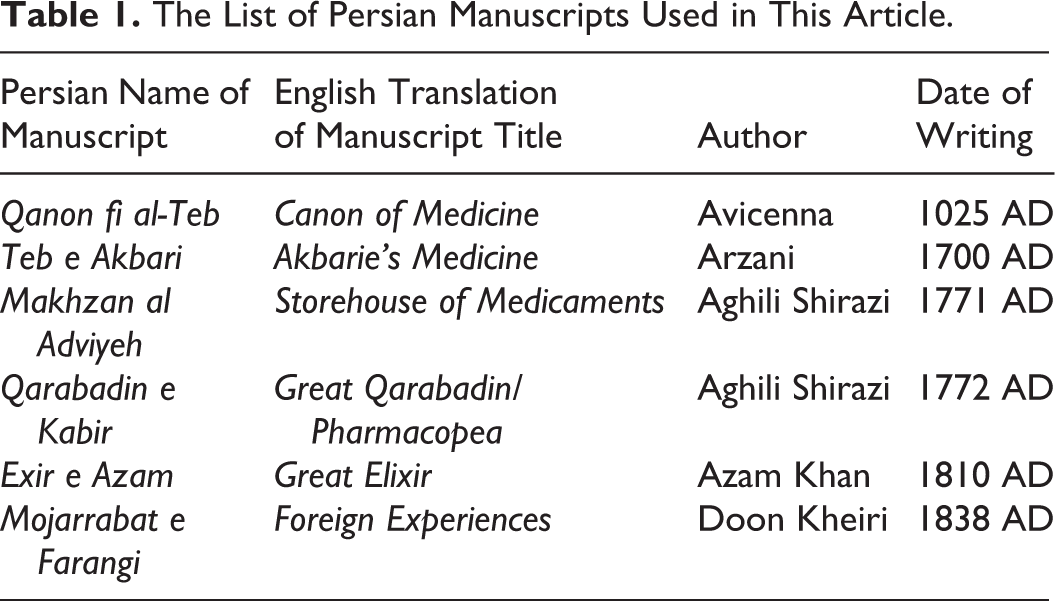
In this study, we provide a description of heart diseases, complications, nutritional facts related to 2 aspects of heart health and heart disease treatment, and also the mechanisms affecting the heart in Persian medicine references such as Qanon fi al-Teb (Canon of Medicine), 12 Exir e Azam (Great Elixir), 13 Teb e Akbari (Akbarie’s Medicine), 14 Mojarrabat e Farangi (Foreign Experiences), 15 Qarabadin e Kabir (Great Qarabadin/Pharmacopea), 16 and Makhzan al Adviyeh (Storehouse of Medicaments) 17 (Table 1). Also their useful and harmful components from different nutritional groups are discussed and compared with current findings in medicine. Furthermore, nutritional strategies to prevent and treat heart diseases are being evaluated and then useful and harmful nutritional components are discussed based on traditional Persian medicine.
The List of Persian Manuscripts Used in This Article.
Persian Medicine
The history of Persian medicine is divided into 2 main parts: ancient era (before Islam, from the beginning of history to 637 AD) and Islamic period (medieval age). 18,19 Persian medicine started from ancient times. 20 It seems that Persians started the paradigm of humorism for the first time and then it became a worldwide theme of medicine in ancient age and later in medieval age. 21 This paradigm was based on 4 temperaments including blood, phlegm, black bile, and yellow bile (Table 2). Ancient Persia was the time of great empires. Achaemenids (550-330 BC), Parthians (247 BC-224 AD), and Sassanids (224-637 AD) were the main ancient Persian dynasties. They were the main civilized and powerful governments in the ancient world. Medicine was well organized in these empires, especially in the Sassanid period. Advanced medical organizations and laws, medical councils, hospitals, medical universities, and so forth, are some examples of advanced structures in ancient Persian times. 21,22 In the Sassanid dynasty, Jundishapour University and Hospital in south west Persia was the main medical center in the whole world. 23 In the early Islamic period, when Persians lost their political strength, they showed more interest toward science, especially medical knowledge. Medical science was popularized and spread by Persian scientists such as Akhawayni, Rhazes, Avicenna, Hally Abbas, Jorjani, and others during 9th to 12th century AD. 24 –29 During later centuries, the growth of medical sciences decreased but continued in Persia until Renaissance. After Renaissance, gradually the Persian holistic paradigm of medicine (humoral theory) was replaced by the current concept of medicine (molecular paradigm) worldwide. 30
Four Temperaments in Persian Languages.

Result
Nutritional Strategies for Heart Disease Treatment
In medieval Persian manuscripts, we can find some main strategies about using foods and drinks in heart-related complications. Some of these strategies are listed below. 1. Sometimes after hunger and insufficient food intake for some days, low-quality blood will be made in the body, which causes body weakness. Then we have to use the foods that strengthen the heart such as meat gravy, soft boiled egg, apple (Malus domestica Borkh., 1803), pear (Pyrus syriaca L.), quince (Cydonia oblonga Mill.), basil (Ocimum basilicum L.), peppermint (Mentha × piperita L.), rose water, pistachio (Pistacia vera L.), and saffron (Crocus sativus L.).
13
Also, we can see some combination foods such as formulations given below:
Apple regimen: 7 to 8 glasses of apple juice, or couple of cups from apples faloodeh (a traditional formulation) or 10 to 15 apples per day. Saffron syrup is very useful for heart diseases and body weakness. Put 1 teaspoon of saffron in 2 glasses of hot water and let it infuse. Then add some water, rosewater, honey, or sugar and drink it.
2. Persian physicians believed that sometimes heart vessel obstruction occurs following ingestion of foods that make low-quality blood in the body. So for resolving the obstructions and also treating high blood pressure, the instruction given below was suggested by the Persian physicians:
Add 30 garlic (Allium sativum L.) beans to 5 fresh limes (Citrus × latifolia Tanaka) (with peels having some cuts on them) and mix them until a paste was formed. The resultant paste must be added to 1 liter of water and boiled on a low flame. Let the mixture get cold. Then filter and keep it in the refrigerator. Drink 50 cc before breakfast for 40 days. Repeat it every 6 months to 1 year. 15
3. Patients who have heat temperament on heart, with symptoms of palpitation, restlessness, thirst, and feel the need for breathing in cold air. 14
Avicenna said the following: Eating fruit sauce, especially apple and quince sauce, is the treatment for such patients. 22
Drinking apple, pomegranate (Punica granatum L.), quince, and lime syrup with rosewater and sugar is useful. Barberry (Berberis vulgaris L.) and verjuice are also helpful. 13 –15
Lime syrup: Pour some sugar in a jar and add as much as lime juice to cover it up. Then close the jar and put it in room temperature for 24 hours. Then filter the resultant mixture and boil with some more lime juice. Dilute it with water on administration.
Sour orange (Citrus × aurantium L.): Boil the sour orange juice (400 g) with 2/3 of that from sugar and some rosewater on a mild flame. 16
Pomegranate syrup: Boil the pomegranate juice with rock candy.
Rice and chicken, flavored with lime juice, verjuice, and barberry.
Chicken soup with pomegranate juice, verjuice, or lime juice. 13 –15
4. Patients who have cold temperament on heart with symptoms of slow pulses, shallow breathing, pallid skin, and total body weakness, anxiety, and phobia. 14 Persian physicians suggested the following:
Patient has to avoid eating cold temperament foods and cold water as much as possible.
Bird’s meat such as partridge, pet hen, pigeon, sparrow, and francolin cooked with hot temperament spices such as cinnamon (Cinnamomum verum J. Presl), saffron, cumin (Cuminum cyminum L.), clove (Syzygium aromaticum (L.) Merrill & Perry), and cardamom (Amomum subulatum Roxb.).
5. Patients who have moist temperament on heart and symptoms such as excitement rapidly influencing the patient the effect disappearing soon. 14 In such diseases the most important strategy is decreasing the amount of food intake. Some simple foods suggested by Persian physicians are the following:
Chicken soup with bread
Grilled chicken meat
Apple syrup
Minted pomegranate syrup
Sekanjabin (Oxymel): Mix the same amount of honey and vinegar. Then boil it on mild flame for 15 seconds to be homogenous. 12 –15,17
6. Patients who have dry temperament on heart and the symptoms are leanness, insomnia, and dry cough and also can be explained as excitement not easily affecting the patients, but if they do, the effect remains for long time. 14
In such conditions, Persian physicians believed that patients have to eat moisturizing foods, and if coldness is also there with dryness, they must avoid cold water. Some of suggested foods and drinks are the following: Fresh milk (in case of no fever) Pineapple (Ananas comosus (L.) Merr.) juice Spinach (Spinacia oleracea L.), potage, pumpkin (Cucurbita pepo L.), kid or lamb meat cooked with onion (Allium cepa L.), and dried vegetables with spices useful for heart Peeled vetch (Vicia spp.) with almond (Prunus amygdalus Batsch) oil, spinach, and cucurbit. Porridge cooked from wheat flour, almond oil, milk, and sugar.
12,13,15
Even in favor of heart health or regarding heart disease treatment, laxatives have to be taken to avoid constipation, so that accumulation of harmful substances and their vapors cannot harm the heart.
12,13
7. Prohibiting advices for general heart complications. People have to avoid the conditions listed below, even for retaining heart health or to treat heart diseases:
Some Examples of Nutrients Effective in Retaining Healthy Heart
Hakim Azam Khan, one of the last medieval Indo-Persian physicians, categorized some of the nutrients that are suggested to be effective in heart health in his great medical encyclopedia Exir Azam:
Meats: Fat-less lamb or young kid, small fishes, birds with soft meat such as pet hen, sparrow, francolin, pigeon, and the heart of halal animals
Fruits: Sweet and ripe apple and pear, quince, pomegranate, lime, sour orange, citron (Citrus Medica L.), tamarind (Tamarindus indica L.), and pineapple
Vegetables: Peppermint, basil, coriander (Coriandrum sativum L.)
Others: Lamb, kid or above-mentioned bird’s meat gravy, soft boiled yolk, rose water, saffron, cardamom, cinnamon, pistachio, fruit juices, syrups, and jams made from aforementioned fruits.
13
Some examples of useful foods frequently advised by Persian physicians for heart that are made from above-mentioned materials are as follows:
Medical Jollab syrup: Boil 1 kg of sugar with 3 kg rosewater on a mild flame; put the foam away until it reaches half its size. Then add 1 g powdered saffron. Keep the resultant mixture in a jar; dilute it with water at the administration time and drink.
Apple Faloodeh: Mix grated apples with little bit of rosewater and honey.
Apple syrup: Put some apple juice on the flame to reach half in volume. Then filter and put it aside for 1 night. Then again put it on the flame to be concentrated. Filter it again and pour it in a jar. If it is summer time, expose it in sunshine for some days to vaporizing its water. Keep it in a glass bottle. If you want it sweet, add 450 g sugar per 3 kg apple juice and consolidate it.
12
–17
All the plants mentioned in this article listed in Table 3.
The List of Medicinal Plants Mentioned in the Article.

Discussion
From the medieval Persian physicians’ point of view, heart cannot tolerate regular diseases because of its sensitivity and key function, and therefore, its affliction to some of these diseases causes death. So it deserves to have the physicians’ highest attention toward its health and diseases prevention. 12,13
Modern medical references concede that general health was mainly based on primary prevention (health improvement) and in next level on secondary prevention (treatment and rehabilitation) in prior time. 4
Persian scholars have mentioned some facts useful to retain heart health, such as avoiding awful odors and smelling aromatic plants and fruits instead and stopping anger, sorrow, obsessive thoughts, sudden excitements, longsome awakening, excessive activities, massive sports, and also paying attention to the nutritional facts, which is very important. 12 –14
Foods affecting the heart can prevent heart diseases with different mechanisms. From Persian traditional medicine point of view, useful meats for heart health such as young lamb and chicks contain different nutrients, can be digested fast and easily, and cause good blood production in the body.
Persian physicians believed that eating the heart of animals used regularly for their meat causes merriment in patient and so is useful for the heart. The aforementioned fruits and vegetables also contain nutrients and vitamins, reinforce the heart, and avoid the accumulation of harmful substances in heart and vessels. 12 –17
From traditional medicine point of view, eating apples is joyful and is heart reinforcing, especially if used with rosewater. 12,13,17 Modern medicine articles also claimed that eating apple and apple juice reduces the low-density lipoprotein oxidation in a healthy person 31 and prevents hypercholesterolemia, oxidative stresses, 32 and arthrosclerosis, 33 and so reduces risk of heart diseases.
According to Persian medicine, sweet pear also regulates the blood and is breezy and heart reinforcing agent. 17 A study in Mexico in 2010 claims that having a pear every day will decrease the cholesterol level in smoking people 34 and so prevents heart diseases in people who have 2 risk factors of smoking and high cholesterol level.
Aghili Shirazi mentioned that pistachio is also very aromatic and so heart reinforcing in his manuscript. 17 A study in United States in 2012 showed that pistachio decreases systolic blood pressure in dyslipidemic patients. 35 Another study claimed that pistachio decreases the plasma level of oxidized low-density lipoprotein in hypercholesterolemic patients. 36 Also, smelling aromatic fruits and vegetables such as apple, quince, and basil is effective in heart reinforcement.
Although all the mentioned food substances are good for keeping the heart healthy, different foods will be chosen depending on the nature of the patient and disease and also the patient’s temperament (individual medicine).
Among the foods effective in retaining health and also for cardiac patients, saffron has a special role. From the traditional medicine point of view, saffron increases the tendency and penetration of nutrients and medicines to the heart. Also, it is breezy and a heart reinforcing agent. Avicenna and other Persian scholars recommended adding saffron to the combination of medicines for patients with heart diseases so that leading and penetration of medicines to the heart will be better. 12,13
From the modern medicine perspective, saffron prevents cholesterol, triglycerides, and low-density lipoprotein elevation and also avoids their residuum in vessels. 37
Also in patients who have a history of cardiac infarction, saffron decreases the size of the infarcted area and prevents myocardial ischemia-reperfusion damage. 38 Also, it retains hemodynamic balance and protects left ventricle action against myocardial defection. 39 Antihypertensive effects of saffron have also been proved in some investigations. 40
Persian physicians believed that to eliminate cardiovascular obstructions and also reduce blood pressure, a mixture of garlic and lime can be used. From the traditional medicine point of view, garlic is blood diluter and eliminator of harmful and thick substances. 17 Lime is also an anti-inflammatory agent and the eliminator of improper and harmful substances. 17 In current medicine, the efficacy of garlic in reducing blood pressure has been shown. 41 –43
Medieval Persian physicians believed that aforementioned fruits such as apple, pomegranate, and citrus are effective in heart with hot temperament, and are also anti-inflammatory, heart heat eliminator, and anti-thirst agent. 12 –17 In modern medicine, eating pomegranate is very effective on the vascular system. It decreases atherosclerotic area and also intima-media thickness in cardiac patients’ vessels under medical treatment. 44 Pomegranate decreases systolic blood pressure, 45 and citrus will prevent negative oxidative stresses on myocardium. 46
Aghili Shirazi mentioned that barberry and verjuice as food spices can be used in these diseases, reliving thirst and resolving the heat temperament heart symptoms. 17 In current studies, antihypertensive and vessel dilating effects of barberry have been reported. 47 Also, barberry has been shown to prevent myocardial ischemic-reperfusion defects. 48 According to Persian medicine, in food regimen for patients with cold temperament on heart, hot tempered spices such as cinnamon, saffron, cumin, and cardamom should be included, which are effective for treatment. 17
One of the important suggestions in moist temperamental heart diseases is to use Sekanjabin (Oxymel). In traditional medicine, Sekanjabin is moderately hot tempered (moderate heat) and is useful to eliminate excessive moist. 16 In dry tempered heart diseases, suggested foods to return moistness to the body are milk, spinach, vetch, almond, and cucurbit. According to Persian medicine, fresh milk is body reinforcing and fattening agent and also can retain body moisture. Spinach is fast digested and can produce high-quality blood in the body and returns the moisture to the body. Cucurbit also produces good humors and substances in the body if being cooked with vetch and other mentioned spices and is also a moisturizing agent. 12 –17
Also, it is mentioned that vetch is very nutritious, produces high-quality blood in the body, and is less flatulent than other beans. Almond oil is moderate temperament and is very moisturizing. 17 In current findings, it is mentioned that using spinach in myocardial infarcted mice can regulate inflammatory factors and protein profile. 49 Almond is effective in reducing blood cholesterol 50,51 and preventing lipid oxidation. 52
According to Persian medicine, one of the most harmful factors in cardiac heath is constipation. Laxatives must be considered for cardiac patients. Persian physicians believed that if constipation happens, accumulation of substances and toxins in the body will cause several complications such as cardiac symptoms. Ignoring these complications especially in the intestine will not allow the patient to be cured. 12,13
Conclusion
In prevention and treatment of heart diseases, diet revision and returning back to natural food substances, and choosing right foods from all different nutritional groups based on individual temperament are highly recommended by Persian physicians of the medieval age. Many of their recommendations also are confirmed by current medical findings. Their medical views on the role of nutrition in heart diseases are historically important and can show a part of history of cardiology in medieval time. Also, by comparing them with current findings, some new ideas can be formed to help current approaches to prevent heart diseases using natural foods and drinks.
Footnotes
Authors’ Note
This work is a part of a PhD thesis (No. 101) presented in the School of Traditional Medicine, Tehran University of Medical Sciences.
Author Contributions
GK, HMK, and MM wrote the preliminary draft and contributed in data gathering and first idea of starting this project. AZ rewrote the draft and contributed in data gathering and writing the final version of the article. The other coauthors contributed in the guidance, revision, and correction of the article.
Declaration of Conflicting Interests
The authors declared no potential conflicts of interest with respect to the research, authorship, and/or publication of this article.
Funding
The authors received no financial support for the research, authorship, and/or publication of this article.
Ethical Approval
Ethical approval is not required for this study as no human subjects were involved.