



Abstract
Following the Ewert v. Canada case, concerns have emerged regarding the cultural fairness of actuarial risk assessment tools used with Indigenous offenders in Canada. These instruments, largely developed using non-Indigenous samples, may not accurately reflect Indigenous realities and could contribute to systemic bias. This study examined two tools used in Quebec, the ORAC-PCQ and the LS/CMI, to assess potential cultural bias through differential item functioning (DIF) analysis using Raju's method within a Rasch modeling framework. Although both tools showed strong overall predictive validity, several items displayed significant DIF, suggesting possible measurement bias. These findings raise important concerns about the fairness of risk classification for Indigenous individuals. The study recommends adapting these instruments and complementing them with clinical approaches that better account for the historical and systemic factors affecting Indigenous populations. Such adaptations could help ensure more culturally responsive assessment practices and avoid reinforcing long-standing inequities within the Canadian justice system.
Keywords
Assessing the risk of recidivism is a critical responsibility within criminal justice and correctional systems, and various approaches are available to support this task. Comparative research has shown that structured, standardized methods such as actuarial assessments tend to yield more accurate predictions of recidivism than unstructured clinical judgments (Grove & Meehl, 1996). In addition to informing risk assessments, these tools are commonly used to guide decisions related to sentencing, parole, supervision levels, treatment planning, and correctional interventions. Their standardized nature contributes to greater consistency in assessment practices and supports more effective case management strategies. As a result, actuarial tools have become the predominant approach in many correctional settings for determining supervision needs and assisting probation officers (Ægisdóttir et al., 2006; Bonta & Andrews, 2017; Byrne & Pattavina, 2006; Dawes et al., 1989; Grove & Meehl, 1996; Hanson & Morton-Bourgon, 2009).
Despite their evidence-based strengths, actuarial tools have been subject to several critiques. One major concern is that these instruments were primarily developed using samples of North American, White, male individuals involved in the justice system, which limits their relevance for other populations (Hannah-Moffat & Shaw, 2001). Moreover, core criminological theories underpinning these tools, such as social learning and control theories, have been critiqued for reflecting androcentric assumptions. Beyond sampling limitations, scholars have also emphasized that contemporary risk assessment practices emerged from Western systems of governance and knowledge production, where early classificatory techniques were embedded in broader colonial projects of population management. Although often presented as neutral and technical, actuarial tools inherit these historical logics, shaping how concepts such as risk, deviance, and prosocial behavior are operationalized (Barmaki, 2025). As a result, actuarial tools developed from predominantly non-Indigenous male samples may lack validity and generalizability when applied to individuals from other cultural backgrounds, particularly Indigenous populations (Lowenkamp et al., 2001; Manchak et al., 2009; van der Knaap et al., 2012).
Applicability of Actuarial Tools to Indigenous Populations
Research has examined the relevance of the eight risk factors in Bonta and Andrew'’s (2017) General Personality and Cognitive Social Learning (GPCSL) model across diverse populations, with evidence supporting their applicability to women, youth, individuals with mental health disorders, and people convicted of sexual offenses (Bonta et al., 1998; Hanson & Morton-Bourgon, 2005, 2009; Schwalbe, 2008; Smith et al., 2009). However, their generalizability to Indigenous 1 individuals remains unclear.
A meta-analysis by Wilson and Gutierrez (2014) assessed the predictive validity of the Level of Service Inventory (LSI) with over 21,000 Indigenous and 42,000 non-Indigenous individuals. While the tool significantly predicted recidivism in both groups, it was more predictive for non-Indigenous individuals on most subscales. The authors proposed several explanations, including systemic discrimination, differential exposure to risk factors due to historical marginalization, limitations in how items reflect Indigenous realities, and the potential existence of distinct culturally specific risk factors not captured by the tool.
These findings raise concerns about the cultural validity of GPCSL-based actuarial tools (Ahmed et al., 2023). Some scholars argue that such instruments may reinforce systemic biases by overestimating risk for Indigenous people (Ahmed et al., 2023; Barmaki, 2023; Gutierrez et al., 2017; Hannah-Moffat & Shaw, 2001; Viens, 2019), and have called for the development of risk assessment tools tailored specifically to Indigenous contexts (Hart, 2016; Haag et al., 2016; Kroner, 2016).
Overrepresentation of Indigenous Individuals in the Canadian Correctional System
Another longstanding reality in relation to Indigenous involvement in the justice system is the overrepresentation of Indigenous individuals in both federal and provincial correctional facilities. For example, in his 2017–2018 annual report, the Correctional Investigator of Canada, Ivan Zinger (2018), noted that over the past three decades, no government, regardless of political affiliation, has succeeded in reversing the trend of Indigenous overrepresentation in Canadian jails and prisons: In the ten-year period between March 2009 and March 2018, the Indigenous inmate population increased by 42.8% compared to a less than 1% overall growth during the same period. As of March 31st, 2018, Indigenous inmates represented 28% of the total federal in-custody population while comprising just 4.3% of the Canadian population. The situation continues to worsen for Indigenous women (p. 61).
Among these unique circumstances, the report observed that Indigenous inmates tend to be younger, have lower levels of education, and present higher rates of significant mental health issues. More importantly, the investigation highlights the relationship between substance use and specific childhood experiences that increase the likelihood of criminal justice involvement. According to the report, over 70% of Indigenous inmates have been involved with the child welfare system (either through foster care or group homes); many have family histories tied to the residential school system; have relatives struggling with alcohol or drug addiction who have also experienced incarceration; and face more general collective trauma leading to health issues starting in early stages of their life (McKay, 2018).
Childhood Experience and the Criminal Justice System
The effects of colonization on the childhood experiences of many Indigenous people in Canada are multidimensional and closely linked to the country's high rates of Indigenous incarceration. While an exhaustive overview of colonial policies is beyond the scope of this article, key structural elements such as the residential school system, the child welfare system, and the intergenerational trauma they have produced must be acknowledged as central to understanding the victimization and justice system involvement of Indigenous individuals.
One major example is the child welfare policy during the period known as the Sixties Scoop, during which Indigenous children were disproportionately removed from their families by social services, often without sufficient cause, and placed in foster care or adopted into non-Indigenous families (Sinclair, 2007). The Truth and Reconciliation Commission of Canada documented the significant trauma these children experienced due to separation from their families and culture, as well as exposure to racism and abuse. These experiences increased their likelihood of encountering the criminal justice system early in life (Truth and Reconciliation Commission of Canada, 2015). A 2005 study conducted by Correctional Service Canada found that 63% of Indigenous offenders had been adopted or placed in foster or group homes during childhood, compared to 36% of non-Indigenous offenders (Trevethan et al., 2005). The Truth and Reconciliation Commission of Canada also reported the continued overrepresentation of Indigenous children in the child welfare system. Based on 2011 census data, 3.6% of all First Nations children aged 14 and under were in foster care, compared to just 0.3% of non-Indigenous children (Truth and Reconciliation Commission of Canada, 2015).
Canada's colonial legacy has also had serious consequences for the health of Indigenous peoples. Racism and intergenerational trauma linked to colonization are recognized as significant determinants of both mental and physical health. Social determinants of health specific to Indigenous peoples include geographic, economic, historical, narrative, genealogical, and structural factors, which reflect the unique impacts of colonization in Canada (McKenzie et al., 2016). Understanding addiction and related problems as collective and historical phenomena—rather than solely as individualized risk factors—enables more comprehensive responses to these challenges, including interventions at the structural rather than individual level to help prevent recidivism.
Intergenerational trauma is directly tied to the prevalence of substance use disorders and is one reason Indigenous peoples in Canada continue to experience significant health disparities. The Royal Commission on Aboriginal Peoples referred to this as a crisis of illness and distress (Royal Commission on Aboriginal Peoples, 1996). Alcohol-related harm in particular remains a pressing issue. Firestone et al. (2015), in a literature review spanning 2000 to 2014, concluded that although rates of alcohol abstinence are higher among Indigenous populations than among the general Canadian population, the burden of alcohol-related harms is disproportionately high. Specifically, the mortality rate related to alcohol use was nearly twice as high among Indigenous people.
Another critical example of intergenerational trauma affecting both mothers and children is the disproportionate prevalence of Fetal Alcohol Spectrum Disorder (FASD) among Indigenous populations. Research has shown that Indigenous children are significantly more exposed to FASD than non-Indigenous children, which contributes to a complex web of vulnerability involving substance abuse, childhood victimization, educational difficulties, and environmental instability (Rojas & Gretton, 2007). Individuals with FASD are more likely to experience multiple neurodevelopmental impairments, which may result in behaviors that become criminalized. As such, FASD represents an additional social determinant of health that must be considered within the justice system (Sessa et al., 2022).
The relationship between colonization, racism, and intergenerational trauma has only recently become a recognized subject of research in Canada, with significant attention emerging over the past 15 years (Mitchell, 2019; Quinn, 2007; Wesley-Esquimaux & Smolewski, 2004). Much work remains to be done within the penal system to better understand and respond to the complexity of these realities. In light of Canada's legacy of assimilation policies and structural violence toward Indigenous peoples, there is growing concern that risk assessment tools, if applied without cultural scrutiny, may perpetuate existing disparities within correctional settings. Although these tools are generally used post-sentencing, they play a central role in determining security classifications, program eligibility, and parole decisions. Thus, they can contribute to differential treatment that, rather than mitigating the structural factors behind the overrepresentation of Indigenous peoples in the correctional system, may actually reinforce them.
The Ewert v. Canada Case
For Canada's federal, provincial, and territorial correctional services, evaluating the applicability of actuarial risk assessment tools to Indigenous individuals remains a significant challenge, particularly given their overrepresentation in the correctional system and the implications of the Ewert v. Canada (2018) decision.
In this landmark case, Jeffrey Ewert, a Métis individual in federal custody, challenged Correctional Service Canada (CSC) over its use of risk assessment tools that had been developed and validated primarily on non-Indigenous populations. He argued that CSC had no scientific basis to assume these tools were valid for Indigenous individuals and that their use violated section 24(1) of the Corrections and Conditional Release Act (CCRA), which requires CSC to ensure that the information it uses is accurate, complete, and up to date. While the Federal Court initially ruled in Ewert's favor, the decision was overturned by the Federal Court of Appeal. Ewert subsequently appealed to the Supreme Court of Canada, which ultimately ruled that CSC had failed to demonstrate that the tools produced valid and unbiased results for Indigenous individuals. The Court issued a declaratory judgment stating that CSC was not in compliance with the law.
By challenging the validity of five risk assessment tools used by CSC with Indigenous individuals, the Ewert case marked a turning point in the debate over the use of actuarial instruments in federal custody. The Supreme Court's decision acknowledged that these tools may contain cultural biases, though it did not determine whether those biases were subtle and tolerable or profound and intolerable. The ruling also emphasized that these biases could stem from the failure of tools to account for systemic, historical, and discriminatory factors unique to Indigenous peoples in Canada, potentially inflating assessments of recidivism risk or the odds of being diagnosed with constructs such as psychopathy.
Although the Court did not prohibit the use of these tools—citing the lack of existing research on their impact—it emphasized CSC's responsibility to evaluate whether their continued use could result in the overestimation of risk and discriminatory outcomes. As the Court stated (Ewert v. Canada, 2018): Thus, any overestimation of the risk posed by Indigenous offenders would undermine the purpose of s. 4(g) of the CCRA of promoting substantive equality in correctional outcomes for Indigenous inmates and would also frustrate the correctional system's legislated purpose of providing humane custody and assisting in the rehabilitation of offenders and their reintegration into the community. (Para. 65)
While Gladue and Ipeelee shaped sentencing practices, Ewert extended the principle of substantive equality into the correctional phase, where actuarial tools are most often employed. The Supreme Court's ruling underscored that these tools must be critically examined for cultural validity, as when such tools fail to reflect the lived realities of Indigenous peoples or account for systemic discrimination, they risk reinforcing unequal outcomes, particularly in areas like security classification, access to programs, parole eligibility, and reintegration planning. As the Court affirmed, formal equality is not sufficient; identical treatment may deepen existing disparities if it overlooks structural disadvantage (Ewert v. Canada, 2018).
Risk Assessment in Quebec's Correctional System
The Quebec correctional system differs in important ways from the federal Canadian system, particularly with regard to sentence lengths, assessment tools, and administrative procedures. In Quebec, the Ministry of Public Security is responsible for individuals serving sentences of less than two years, whether in custody or under community supervision. This context of shorter sentences prompted the replacement of the Level of Service/Case Management Inventory (LS/CMI; Andrews et al., 2004), an assessment tool developed for use across Canada, with a Quebec-specific instrument: the ORAC-PCQ (Outil d’évaluation du risque et de l’analyse clinique des personnes contrevenantes du Québec [Risk Assessment and Clinical Analysis Tool for Convicted Persons in Quebec]; Author, 2025), which has been in use since 2017. Designed to be more concise than the LS/CMI while maintaining a structured approach to assessing criminogenic needs and recidivism risk, the ORAC-PCQ reflects the operational realities of the provincial correctional system. Quebec's correctional system benefits from a degree of legal autonomy that enables the development of regionally adapted tools and practices. For individuals who have committed sexual offenses, specialized instruments such as the Static-99R (Helmus et al., 2012) and the Stable-2007 (Hanson et al., 2007) are used. The use of all these actuarial tools is grounded in the Risk–Need–Responsivity model (Andrews et al., 1990), which promotes a targeted, individualized, and evidence-based approach to managing sentenced individuals. Furthermore, the Quebec Parole Board considers the results of these assessments when making decisions about conditional release.
Although First Nations fall under federal jurisdiction in many areas, Indigenous individuals who receive provincial sentences are supervised within the Quebec correctional system. In this context, it is essential to examine potential sources of bias within the ORAC-PCQ and assess its predictive validity with Indigenous populations. Doing so is crucial to ensure that the instrument supports equitable correctional outcomes and does not reproduce the structural disparities already observed in the justice system.
To this end, this study aims to evaluate whether the ORAC-PCQ—and, for comparative purposes, the previously used LS/CMI—functions equitably with Indigenous and non-Indigenous men in Quebec. More specifically, we examine (1) whether certain items in these tools exhibit DIF and (2) whether their predictive validity differs across cultural groups. By identifying potential sources of bias, the study seeks to inform the responsible use of actuarial tools in correctional settings and contribute to more culturally responsive practices in risk assessment and case management.
Method
Sample and Data Collection
Our analyses were conducted using data from all men assessed in Quebec's correctional system between March 2008 and October 2015 with the LS/CMI (n = 44,837), and between January 2019 and December 2022 with the ORAC-PCQ (n = 20,517). All data were drawn from an official and reliable institutional database maintained by Quebec's Ministry of Public Security, which oversees the registration of all assessments completed by probation and correctional officers.
Women were excluded from the analyses due to the limited number of Indigenous women represented, which precluded meaningful statistical comparisons. No distinction was made between individuals serving custodial sentences and those under community supervision. Although the number of Indigenous individuals was relatively small (n = 1168 in the ORAC-PCQ sample; n = 760 in the LS/CMI sample) compared to non-Indigenous persons (n = 19,349 and n = 44,077, respectively), the analyses remained viable. The calibration method (Rasch modeling)can yield stable estimates with as few as 30 participants per group (Linacre, 1994). Individuals who appeared more than once in the dataset (e.g., due to multiple justice system entries) were included only once, using their most recent assessment.
Measures
The ORAC-PCQ
In 2012, Quebec's correctional authorities initiated the development of a new risk assessment tool for individuals serving sentences longer than six months but less than two years. The objective was to design an instrument suited to the provincial context while meeting psychometric standards for actuarial assessment. A committee of experts in justice assessment and intervention developed the tool through an iterative process, refining its items to ensure relevance and content validity. Data collection took place between 2015 and 2016, supported by standardized training and technical assistance for correctional officers across all regions of Quebec. These data informed the development of the ORAC-PCQ, which was officially implemented in 2017, replacing the LS/CMI. A province-wide training program accompanied its rollout.
The current version of the ORAC-PCQ (Giguère et al., 2025) consists of three sections. Section 1, Sociocriminological Portrait (SC; 8 items), includes static background factors such as criminal history, early substance use, and childhood family environment. Section 2, Criminogenic Needs (CN; 16 items), focuses on dynamic risk factors, including interpersonal conflict, employment issues, and substance use. Section 3, Clinical Information (26 items), provides a responsivity profile across five domains: individual characteristics (e.g., long-term sentence, gang involvement), victimization history, readiness for intervention, and physical and mental health concerns (e.g., depression, suicide risk, personality disorders). The recidivism risk score is derived from the combined total of Sections 1 and 2, yielding a score from 0 to 24.
Since its implementation, the ORAC-PCQ has been used to support both recidivism risk assessment and individualized intervention planning. The tool has undergone multiple refinements based on analyses using classical test theory and item response theory. Items were retained, revised, or removed according to their statistical performance, resulting in the finalized 2022 version. The tool is now integrated into a computerized assessment and monitoring system, which automatically calculates scores and stores data in a secure, anonymized format.
The LS/CMI
The Level of Service/Case Management Inventory (LS/CMI; Andrews et al., 2004) is a risk assessment and case management tool designed to evaluate the risk and criminogenic needs of late adolescent and adult individuals who have been convicted. It was used by Quebec's Correctional Services between December 2006 and April 2017. The section relevant to this study is the “General Risk/Need Factors,” which includes 43 items grouped into the following dimensions: Criminal History (CH; 8 items); Education/Employment (EE; 9 items); Family/Marital (FM; 4 items); Leisure/Recreation (LR; 2 items); Companions (CO; 4 items); Alcohol/Drug Problem (ADP; 8 items); Procriminal Attitude/Orientation (PA; 4 items); and Antisocial Pattern (AP; 4 items). Each item is rated on a binary scale (present or absent) by a probation officer or prison counselor, based on an interview with the individual and a review of their criminal record. The total score ranges from 0 to 43. Both total and dimensional scores are used to guide supervision, inform release conditions, support intervention planning, and determine the appropriate intensity of services.
The French version of the LS/CMI used in Quebec was produced through a cross-cultural adaptation process. It was translated into French, then back-translated into English, and both versions were reviewed and approved by the original LS/CMI developers (Guay, 2016).
Criminal Recidivism
Official criminal recidivism data maintained by Quebec's Ministry of Public Security in an institutional database were used as the outcome measure to assess the predictive validity of the ORAC-PCQ and LS/CMI. In this study, recidivism was defined as the occurrence of at least one new conviction for a criminal offense during the follow-up period; breaches of conditions were excluded from this definition. The follow-up period was one year for ORAC-PCQ participants and two years for those assessed with the LS/CMI. Follow-up began at the point when individuals became at risk of reoffending, that is, upon their release into the community. Given the relatively short follow-up windows, particularly for the ORAC-PCQ, the data were subject to right censoring, meaning some individuals who may have reoffended later were classified as nonrecidivists within the study period.
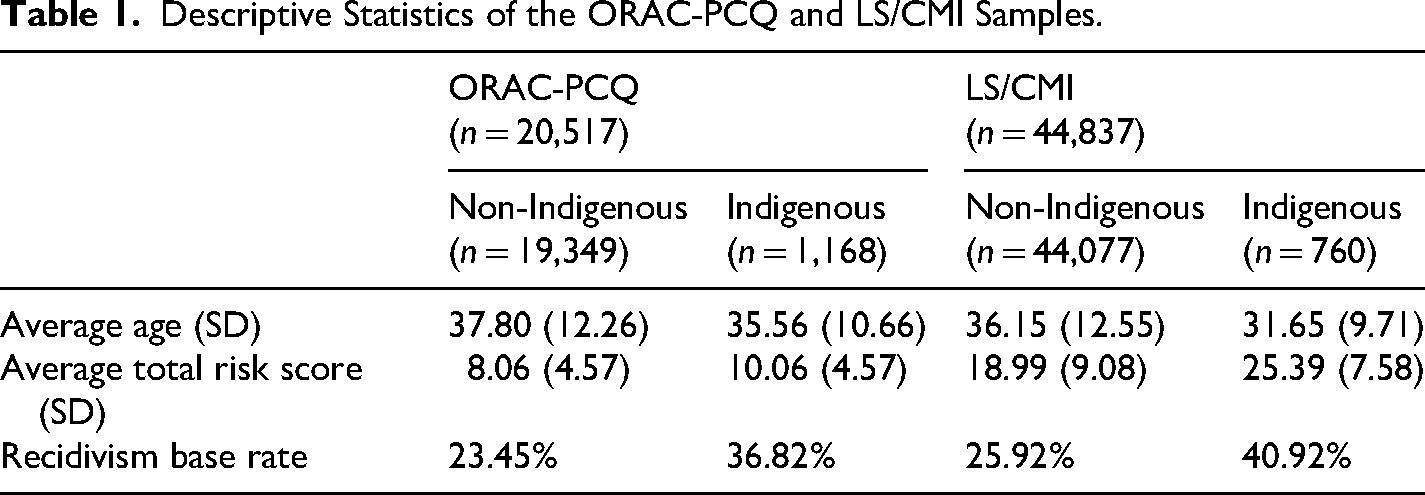
Table 1 presents descriptive statistics for individuals assessed with the ORAC-PCQ and the LS/CMI, disaggregated by Indigenous identity. Across both tools, Indigenous individuals were, on average, younger than their non-Indigenous counterparts, had higher total risk scores, and exhibited higher rates of recidivism.
Descriptive Statistics of the ORAC-PCQ and LS/CMI Samples.
Analytical Strategy
Differential Item Functioning
The primary goal of this study was to examine whether items from the ORAC-PCQ and LS/CMI functioned differently for Indigenous and non-Indigenous individuals, potentially introducing bias, particularly in terms of predictive validity. To this end, we conducted a DIF analysis using Raju's method (Oshima & Morris, 2008; Raju, 1988), which requires data fitting to an Item Response Theory (IRT) model to generate item parameters for comparison. We opted for the Rasch model over more complex IRT models (e.g., 2PL or 3PL) due to its simplicity, ease of interpretation, and robustness with smaller subgroup samples, making it well suited to comparative DIF studies with imbalanced group sizes.
DIF occurs when individuals from different groups, despite having similar underlying risk levels (proficiency), have systematically different probabilities of endorsing an item. “Endorsing an item” means exhibiting the described characteristic or behavior; when an item is “easier to endorse for Indigenous individuals,” it indicates that they were more likely to exhibit these characteristics. This suggests the item may advantage or disadvantage some groups (Sireci & Rios, 2013). However, not all DIF indicates bias. As Bertrand (2001) explains, for an item to be considered biased, it must both (1) function differently between groups of equal ability and (2) reflect differences unrelated to the intended construct. If differences in item performance are attributable to meaningful, construct-relevant factors—such as those linked to social conditions shaped by colonialism—then such DIF may reflect valid variation rather than psychometric bias (Ahmed et al., 2023). Indeed, research has shown that mean score differences between cultural groups on risk tools do not necessarily indicate measurement failure if they correspond to real-world disparities rooted in structural inequities (e.g., Hannah-Moffat & Shaw, 2001; Martel et al., 2011).
Raju's Method
Several methods exist to detect DIF (e.g., Mantel-Haenszel, logistic regression, SIBTEST), but we employed Raju's area method, which calculates the space between two items characteristic curves (ICCs; one from each group). In the Rasch model, ICCs are parallel and differ only in horizontal location, making the DIF contrast directly interpretable as the distance between them on the latent scale.
To determine effect size, we used Raju's delta, calculated by multiplying the DIF contrast by −2.35 (Magis et al., 2020). Values below 1.0 indicate negligible DIF; values from 1.0 to 1.49 indicate moderate DIF; and values of 1.5 or above indicate large DIF (Holland & Thayer, 1986). Because large sample sizes can produce statistically significant DIF even when the magnitude is trivial, both statistical significance and effect size were considered in interpreting findings. Data were processed in Winsteps (Linacre, 2024) to estimate Rasch parameters, and the difR R package (Magis et al., 2020) was used to compute Raju statistics and delta values for each item.
Rasch Model
The Rasch model estimates the probability that an individual with a given level of the latent trait (θ) will endorse an item of given difficulty (b), as follows:
Parameters for both individuals and items are estimated iteratively, allowing them to be placed on a common logit scale. Items that are difficult for individuals with lower proficiency may be easier for those with higher proficiency, and vice versa. However, when individuals of similar proficiency from different groups respond differently to the same item, this may signal DIF and, potentially, item bias.
To ensure the validity of Rasch modeling in our context, we relied on prior studies demonstrating that the ORAC-PCQ and LS/CMI meet Rasch assumptions of approximate unidimensionality and local independence in these samples (Giguère et al., 2024, 2025). These studies support the interpretability of item parameters across groups and the appropriateness of applying Rasch-based DIF methods to these instruments.
Predictive Validity
The predictive validity of the ORAC-PCQ and LS/CMI was evaluated using the Area Under the Receiver Operating Characteristic Curve (AUC), computed separately for each instrument and sample. AUC represents the probability that a randomly selected recidivist will have a higher score than a randomly selected non-recidivist. As an ordinal statistic, AUC is robust to differences in predictor scaling and is widely used in criminological research. Following Rice and Harri'’s (2005) guidelines, AUCs of .556, .639, and .714 correspond to small, moderate, and large effect sizes, respectively, aligning with Cohen's d values of .20, .50, and .80. AUCs were considered statistically significant when their 95% confidence intervals did not include .50.
To test for statistically significant differences in predictive validity between Indigenous and non-Indigenous individuals, we used DeLong's test (DeLong et al., 1988), as implemented in the R package pROC (Robin et al., 2011). This nonparametric method accounts for correlations between predictive models and was applied to both instrument-level and dimension-level AUCs.
Results
The four Rasch models generated for Indigenous and non-Indigenous individuals using the ORAC-PCQ and the LS/CMI all exhibited acceptable fit, with infit and outfit statistics falling within the recommended thresholds for clinical observations (Wright & Linacre, 1994). Accordingly, the item parameters and their respective standard errors were used to compute Raju's statistics, identifying which items exhibited DIF. In the following sections, DIF is reported only when it is statistically significant, and its effect size is classified as moderate (B) or large (C). Additionally, AUCs were calculated at both the dimension and instrument levels, and DeLong's test was performed at each level to assess whether differences in predictive validity were statistically significant (p < .05).
DIF and Predictive Validity of the ORAC-PCQ
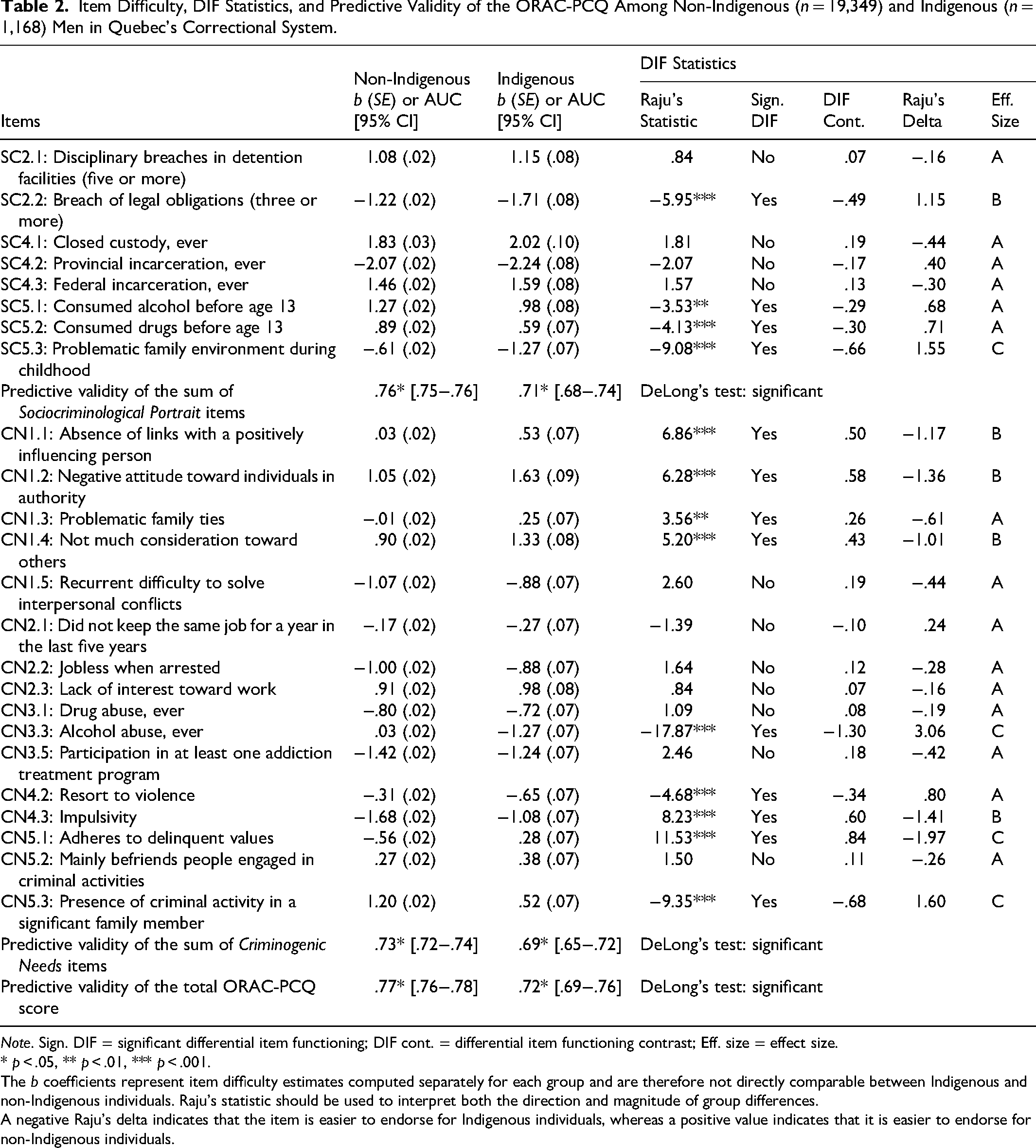
Item difficulty, DIF statistics, and predictive validity metrics for the ORAC-PCQ are presented in Table 2.
Item Difficulty, DIF Statistics, and Predictive Validity of the ORAC-PCQ Among Non-Indigenous (n = 19,349) and Indigenous (n = 1,168) Men in Quebec's Correctional System.
Note. Sign. DIF = significant differential item functioning; DIF cont. = differential item functioning contrast; Eff. size = effect size.
* p < .05, ** p < .01, *** p < .001.
The b coefficients represent item difficulty estimates computed separately for each group and are therefore not directly comparable between Indigenous and non-Indigenous individuals. Raju's statistic should be used to interpret both the direction and magnitude of group differences.
A negative Raju's delta indicates that the item is easier to endorse for Indigenous individuals, whereas a positive value indicates that it is easier to endorse for non-Indigenous individuals.
Within the Sociocriminological Portrait (SC) dimension, only 2 of the 8 items showed DIF. Both were easier to endorse for Indigenous individuals: Breach of legal obligations (three or more) (SC2.2) with a moderate effect size, and Problematic family environment during childhood (SC5.3) with a large effect size.
Within the Criminogenic Needs (CN) dimension, 7 out of the 16 items exhibited DIF. Two items were easier to endorse for Indigenous individuals and showed large effect sizes: Problems related to alcohol consumption (CN3.3) and Family members involved in a criminal activity (CN5.3). One item, Adheres to delinquent values (CN5.1), was harder to endorse for Indigenous individuals, also with a large effect size. Four additional items were also more difficult to endorse for Indigenous individuals, each with a moderate effect size: Absence of links with a positively influencing person (CN1.1), Negative attitude toward individuals in authority (CN1.2), Not much consideration toward others (CN1.4), and Impulsivity (CN4.3).
In terms of predictive validity, both the Sociocriminological Portrait and Criminogenic Needs dimensions were significantly more predictive of recidivism for non-Indigenous individuals than for Indigenous individuals, as determined by DeLong's test. Similarly, the total ORAC-PCQ score demonstrated greater predictive validity for non-Indigenous individuals than for Indigenous individuals, with a statistically significant difference in AUC between groups. Nevertheless, predictive validity was high for both populations according to Rice and Harri'’s (2005) thresholds. Importantly, all AUCs were statistically significant, as none of their 95% confidence intervals included .50, suggesting that the tool performed meaningfully above chance across both groups.
DIF and Predictive Validity of the LS/CMI
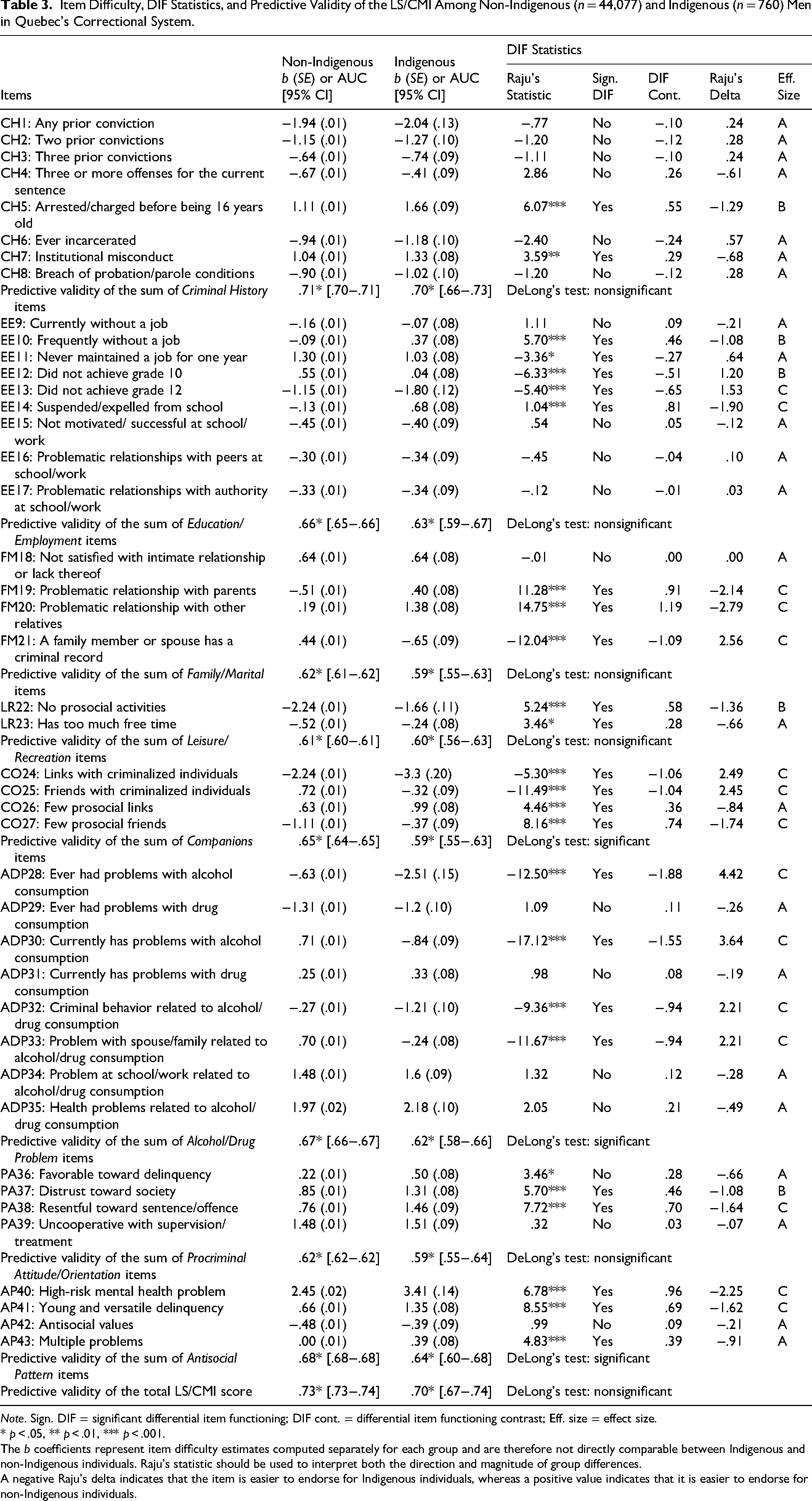
Item difficulty, DIF statistics, and predictive validity metrics for the LS/CMI are presented in Table 3.
Item Difficulty, DIF Statistics, and Predictive Validity of the LS/CMI Among Non-Indigenous (n = 44,077) and Indigenous (n = 760) Men in Quebec's Correctional System.
Note. Sign. DIF = significant differential item functioning; DIF cont. = differential item functioning contrast; Eff. size = effect size.
* p < .05, ** p < .01, *** p < .001.
The b coefficients represent item difficulty estimates computed separately for each group and are therefore not directly comparable between Indigenous and non-Indigenous individuals. Raju's statistic should be used to interpret both the direction and magnitude of group differences.
A negative Raju's delta indicates that the item is easier to endorse for Indigenous individuals, whereas a positive value indicates that it is easier to endorse for non-Indigenous individuals.
The item parameters and DIF statistics for the LS/CMI revealed that each dimension included at least one item exhibiting significant DIF, most often with large effect sizes. In the Criminal History (CH) dimension, only one item showed DIF: Arrested/charged before age 16 (CH5), which was moderately more difficult to endorse for Indigenous individuals. In the Education/Employment (EE) dimension, four items exhibited DIF. Two showed moderate effects: Frequently without a job (EE10) and Did not achieve grade 10 (EE12). The other two showed large effects: Did not achieve grade 12 (EE13) and Suspended or expelled from school (EE14). Items related to educational attainment were easier to endorse for Indigenous individuals, whereas those related to unemployment or school discipline were harder.
In the Family/Marital (FM) dimension, three of the four items exhibited large DIF: Problematic relationship with parents (FM19) and with other relatives (FM20) were more difficult to endorse for Indigenous individuals, while A family member or spouse has a criminal record (FM21) was easier to endorse. In the Leisure/Recreation (LR) dimension, one item showed moderate DIF: No prosocial activities (LR22), which was harder to endorse for Indigenous individuals. In the Companions (CO) dimension, three of the four items exhibited large DIF: Links with criminalized individuals (CO24) and Friends with criminalized individuals (CO25) were easier to endorse for Indigenous individuals, while Few prosocial friends (CO27) was harder. In the Alcohol/Drug Problem (ADP) dimension, four of the eight items showed large DIF, all easier to endorse for Indigenous individuals: Ever had problems with alcohol (ADP28); Currently has problems with alcohol (ADP30); Criminal behavior related to substance use (ADP32); and Problem with spouse/family related to substance use (ADP33). In the Procriminal Attitude/Orientation (PA) dimension, two items showed DIF, both harder to endorse for Indigenous individuals: Distrust toward society (PA37), with a moderate effect, and Resentful toward sentence/offense (PA38), with a large effect. Finally, in the Antisocial Pattern (AP) dimension, two items exhibited large DIF: High-risk mental health problem (AP40) and Young and versatile delinquency (AP41), both harder to endorse for Indigenous individuals.
Regarding predictive validity, each LS/CMI dimension was more predictive of recidivism for non-Indigenous individuals than for Indigenous individuals. However, statistically significant differences in AUC were observed in only three of the eight dimensions: Family/Marital, Companions, and Antisocial Pattern. The Criminal History dimension—typically the most predictive—showed nearly identical AUCs across groups, indicating equivalent predictive strength. Interestingly, despite three of the four items in the Family/Marital dimension showing large DIF, the dimension as a whole demonstrated comparable predictive validity. Conversely, the Companions dimension was significantly more predictive for non-Indigenous individuals, even though it also included three items with large DIF. As with the ORAC-PCQ, all AUCs were statistically significant, as none of their 95% confidence intervals included .50.
At the instrument level, no significant difference in AUC was observed between groups, indicating that the LS/CMI demonstrated broadly comparable predictive validity for Indigenous and non-Indigenous individuals when using the total score. Overall, the LS/CMI's predictive validity for both groups fell within the moderate to high range based on standard thresholds (Rice & Harris, 2005).
In sum, significant DIF was observed across all LS/CMI dimensions, with approximately 60% of flagged items showing large effects. However, the most predictive dimension, Criminal History, contained only one DIF-affected item, and only at a moderate level. These findings suggest that widespread DIF, particularly at the item level, did not systematically reduce predictive validity for Indigenous individuals. This highlights the conceptual distinction between item-level DIF and instrument-level predictive accuracy. Finally, although the ORAC-PCQ and LS/CMI samples were non-overlapping and cannot be directly compared, available evidence suggests that the ORAC-PCQ performed as well as (or slightly better than) the LS/CMI in terms of predictive validity within Quebec's correctional context.
Discussion
This study identified several domains of increased vulnerability among Indigenous men in Quebec's correctional system, as evidenced by patterns of DIF in both the ORAC-PCQ and the LS/CMI. The most salient differences emerged in the domain of substance use, particularly alcohol-related problems, where Indigenous participants consistently endorsed related items at higher rates and with large effect sizes. Family adversity, including problematic relationships and criminal involvement within the family, also showed strong and consistent DIF across both tools. A third prominent area was association with criminalized peers. Educational and employment instability also emerged, with greater endorsement of incomplete schooling and related challenges. These results align with broader literature on the structural and intergenerational effects of colonialism, systemic disadvantage, and marginalization, highlighting the importance of considering sociohistorical context in risk assessment practices (Cunneen, 2014; Joseph, 2014; Ross, 2016).
Substance Use and Alcohol-Related Problems
Alcohol consumption has long been recognized as a significant consequence of colonial structures among Indigenous populations in Canada. As early as the 1990s, LaPrairie (1997) highlighted its prevalence, and Brochu et al. (2001) later reported that when alcohol use is linked to criminal behavior, it often manifests in property crimes or thefts; offenses frequently motivated by the need to acquire funds to purchase illicit substances. These findings align with the Supreme Court of Canada's recognition in R. v. Ipeelee (2012) that “[…] substance use problems, along with other risk factors, account for a high rate of incarceration.”
Epidemiological data further support this trend. Among individuals aged 12 and older, the rate of heavy drinking, defined as consuming five or more drinks on a single occasion at least once per month, was reported at 35% for off-reserve First Nations people, 30% for Métis, and 39% for Inuit, compared to 23% among non-Indigenous individuals (Kelly-Scott & Smith, 2015). While some might argue that definitional issues around what constitutes problematic alcohol use may explain differences in endorsement rates between groups, it is worth noting that Quebec authorities apply a uniform definition across populations, regardless of gender, ethnicity, or background.
In our study, the alcohol-related item on the ORAC-PCQ exhibited significant DIF, a finding consistent with broader statistical trends. However, this result raises important questions about interpretation. While DIF statistics identify group-level differences in response patterns, they do not reveal the underlying causes of those differences. In this case, the higher endorsement of alcohol-related items by Indigenous individuals may reflect deeper systemic issues rooted in intergenerational trauma, mental health challenges, and social marginalization—factors that are often overlooked in the context of actuarial risk assessment.
Recent research (e.g., Firestone et al., 2015; McKenzie et al., 2016) has critiqued the treatment of alcohol consumption as a purely individual criminogenic factor, arguing instead that it should be understood within a broader framework of trauma, mental health, and conditions such as Fetal Alcohol Spectrum Disorder, which disproportionately affects Indigenous youth. When justice system actors such as probation officers lack adequate training to recognize these underlying factors, they may interpret elevated alcohol-related risk scores without sufficient context. This risks reinforcing a punitive approach, leading to more severe correctional plans or custodial classifications rather than trauma-informed, rehabilitative responses. In turn, such practices may contribute to the continued overrepresentation of Indigenous individuals in incarceration settings and limit access to appropriate supports.
In light of the literature on the effects of the residential school system, the Sixties Scoop, and the intergenerational trauma stemming from Canada's colonial legacy, it is not surprising that items related to family adversity and association with criminalized peers show higher endorsement rates. As discussed above, the colonial context rooted in Canadian history continues to have significant impacts on Indigenous families and their living conditions today. Colonial structures and policies specifically targeting Indigenous peoples have contributed to the erosion, marginalization, and erasure of key dimensions of Indigenous epistemologies, ways of life, and, consequently, community balance (Cowan, 2020; Lafrance & Collins, 2003).
Risk Domains Less Present in Indigenous Men
While several risk domains were more frequently endorsed by Indigenous individuals, others were less frequently endorsed. Most notably, Indigenous individuals were less likely to endorse items reflecting antisocial attitudes and negative perceptions of the justice system, including distrust toward societal institutions and resentment toward legal sanctions. Lower endorsement was also observed in domains related to prosocial engagement and social supports, despite higher endorsement of items related to associations with criminalized peers. This apparent contradiction likely reflects the ORAC-PCQ's treatment of prosocial and antisocial associations as distinct constructs measured through separate items, highlighting that merging these dimensions could obscure important information. Indeed, the same individual may simultaneously be influenced by both prosocial and antisocial relationships. In the case of Indigenous individuals, this may relate to having been introduced early in life to traditional teachings and culturally rooted support networks, which can serve as protective factors not fully captured by conventional measures of prosocial support (Corrado & Cohen, 2011).
Items related to mental health and complex behavioral issues were less frequently endorsed by Indigenous individuals. If such behavioral patterns are consistently found to be less prevalent among Indigenous individuals compared to non-Indigenous convicted men, this may point to the presence of systemic oppression: Indigenous people may be more frequently targeted or profiled by the justice system, which increases their criminal antecedents and inflates their risk scores. After release, they may also be more frequently flagged or surveilled by police services, artificially increasing recidivism rates. Therefore, if future research consistently finds higher risk scores and higher recidivism—reflected in good predictive validity coefficients—while simultaneously finding lower levels of problematic behavior, violence, or clinical indicators among Indigenous individuals, this may offer strong evidence that racial profiling and structural injustice are contributing to the observed outcomes (Ahmed et al., 2023). While recidivism risk assessment tools provide structured estimates of reoffending likelihood, their application may be influenced by systemic biases in the justice system. Indigenous and other racialized individuals can experience differential treatment in arrests, prosecutions, and sentencing, which may affect observed recidivism rates. Similar issues have been documented in other Canadian contexts (Coulter et al., 2022; Shepherd & Anthony, 2017), highlighting the need to interpret risk scores within the broader social and cultural context.
Implications for Practice
Both the ORAC-PCQ and the LS/CMI demonstrated acceptable levels of predictive validity across Indigenous and non-Indigenous participants, with AUC values falling within the moderate to high range according to conventional thresholds. Although predictive accuracy was generally higher for non-Indigenous individuals, differences were limited and statistically significant in only a few dimensions. Taken together, these findings suggest that, despite item-level concerns and the well-documented limitations of recidivism as a system-driven and colonial metric, the tools at least do not fail outright on predictive grounds. Clearing this psychometric threshold does not, however, imply that the instruments should remain unchanged or that they are devoid of cultural biases for populations that have undergone centuries of colonial domination and trauma, and still face structural violence.
Rather, these findings underscore that reform efforts must extend beyond predictive accuracy to address how risk assessment tools encode structural inequities and influence correctional decision-making. While further research is needed to determine whether existing instruments should ultimately be replaced or not, their continued use—particularly in the current absence of validated, Indigenous-developed alternatives—requires careful and critical application. When used without modification, these tools risk reproducing existing disparities and reinforcing forms of colonial and structural harm that contribute to the overrepresentation of Indigenous peoples in the carceral system.
A pragmatic and actionable response could be to reconsider the score thresholds used to classify individuals into risk categories (see Arbour et al., 2025). If Indigenous people are systematically assigned higher risk scores due to structural conditions rooted in intergenerational trauma, systemic surveillance, and colonial policy legacies—and if these elevated scores do not correspond to higher levels of violence, behavioral instability, or mental health need—then adjusting threshold values or developing culturally specific norms may help prevent over-classification and the disproportionate use of restrictive measures. Similar dynamics have been documented among Black populations in the United States, where biases in policing, prosecution, and sentencing effectively lower the threshold for system entry for racialized groups (Plummer et al., 2023). Similarly, differences observed in mental health and substance use profiles among Indigenous participants may reflect not only variations in prevalence but also the influence of institutional practices on how these domains are measured and interpreted.
On the other hand, actuarial assessments should not be treated as standalone instruments. These tools must be complemented with clinical expertise (Bonta & Andrews, 2017), which could mean embedding risk scores within broader, culturally informed case formulations that attend to individual narratives, community connections, and the sociohistorical/systemic contexts in which risk-related behaviors emerge (Clift et al., 2025). Practitioners should be trained not only to use these tools reliably, but also to interpret scores through a culturally sensitive lens, particularly for risk domains linked to systemic inequality, such as substance use, family disruption, or unemployment (McKenzie et al., 2016). As affirmed in Ewert v. Canada (2018), accurate and individualized psychological information is crucial for ensuring that correctional practices support rehabilitation and reintegration rather than perpetuate harm. Risk assessment tools are not merely classification devices; they are core components of case management and intervention planning. Ensuring that their application is culturally responsive, narratively informed, and guided by an understanding of structural oppression is essential to promoting both fairness and effectiveness in correctional practice (Clift et al., 2025).
Beyond technical adjustments, meaningful reform also requires greater Indigenous leadership in defining relevant risk constructs, identifying culturally grounded protective factors, and shaping reintegration strategies (American Psychological Association, 2019; Day et al., 2018; Tamatea, 2017). Strength-based approaches rooted in Indigenous knowledge systems emphasizing relationality, community belonging, holistic well-being, and cultural continuity offer ways to contextualize risk beyond deficit-based frameworks. Actuarial tools can provide one component of a larger assessment process, but they must be accompanied by practices that center Indigenous self-determination, recognize structural oppression, and support healing and reintegration (Clift et al., 2025).
Ultimately, improving practice does not mean choosing between abolition of actuarial tools and their uncritical adoption. Instead, it involves a balanced, reform-oriented approach: acknowledging the tools’ statistical performance while addressing their conceptual and historical limitations, incorporating Indigenous expertise, and reshaping assessment processes to promote fairness, cultural responsiveness, and the long-term well-being of Indigenous individuals and communities.
Limitations
This study is not without its limitations. First, although the Rasch model was used to assess DIF, some of its key assumptions, namely unidimensionality and local independence, were not fully met. The LS/CMI dataset in particular demonstrates considerable local dependency (Giguère & Bourassa, 2023), and neither dataset met strict unidimensionality criteria. However, as the primary objective was to investigate DIF rather than to establish perfect Rasch model fit, this limitation was accepted in line with standards that permit some flexibility when unidimensionality is sufficiently approximated (Bertrand & Blais, 2004).
Second, the sample was composed exclusively of men serving provincial sentences of less than two years, limiting the generalizability of the findings. Individuals serving longer federal sentences for more serious offenses (e.g., assault or homicide), or those with more extensive criminal histories, may present different risk profiles that are not captured in this analysis. Furthermore, because the study focused solely on male participants, it remains unclear whether similar patterns of DIF or predictive validity would be observed among women. In addition, the administrative database used did not allow for disaggregation by Indigenous identity (i.e., First Nations, Inuit, or Métis), thus obscuring important distinctions in colonial histories, legal status, and social conditions that may influence both risk factors and system contact differently across groups.
Third, while the study presents detailed psychometric and statistical analyses, it does not include individual-level qualitative data that could contextualize endorsement patterns and clarify the lived realities behind the scores. Some of the observed group differences in item endorsement may reflect culturally specific experiences, systemic inequalities, or historical trauma, none of which are captured through structured tools alone. As Ewert v. Canada (2018) and scholars such as Milward (2011) have argued, emphasizing static, criminal-history-based indicators without accounting for the broader social and structural conditions that shape justice involvement can risk reinforcing systemic discrimination.
Finally, the study relied on administrative correctional data, which, while comprehensive and systematically recorded, are not immune to systemic bias. Official records may overrepresent certain groups due to factors such as racial profiling, differential policing practices, and discretionary enforcement. As a result, criminal histories and recidivism rates captured in these databases may reflect patterns of surveillance and systemic discrimination as much as actual offending behavior. Conversely, these data may also underreport recidivism, particularly for offenses that go undetected or unrecorded, commonly referred to as the “dark figure of crime.”
Conclusion
This study offers a detailed psychometric evaluation of the ORAC-PCQ and LS/CMI, two actuarial tools used in Quebec's correctional system, with a particular focus on their cultural fairness when applied to Indigenous and non-Indigenous men. While both instruments showed “acceptable” predictive validity, several items exhibited significant DIF, particularly in domains tied to systemic and historical disadvantage such as substance use, family adversity, and association with criminalized peers. This suggests that elevated risk scores may not stem from isolated psychometric bias, but rather reflect deeper structural inequities embedded in the lived experiences of Indigenous peoples—realities often shaped by intergenerational trauma, colonial policies, and systemic discrimination.
In this context, actuarial tools must be applied with caution. The consistent over-classification of Indigenous individuals into higher-risk categories raises concerns about fairness and the potential reinforcement of existing disparities. To mitigate this, correctional services should consider adjusting score thresholds or developing culturally responsive norms. More broadly, actuarial assessments should be supplemented with narrative and qualitative approaches such as Gladue-informed reports that provide contextual insight into the individual's life history and cultural background.
Ultimately, this study underscores that risk assessment is not a culturally neutral exercise. If used uncritically, even statistically robust tools can perpetuate unequal outcomes. A more equitable correctional practice requires tools that are not only predictive, but also contextually informed and culturally sensitive.
Footnotes

Funding
The authors received no financial support for the research, authorship, and/or publication of this article.
Declaration of Conflicting Interests
The authors declared no potential conflicts of interest with respect to the research, authorship, and/or publication of this article.
Use of AI
Generative AI (ChatGPT) was used to support the revision and editing of the manuscript's written language. No AI tools were used to analyze data, interpret results, or generate theoretical or methodological content. All scientific reasoning, analyses, and discussion points reflect the authors’ original work.