



Abstract
In Canada, all federally incarcerated individuals are required to complete a number of actuarial risk assessments upon entering prison which influence the security level in which they are housed, opportunities to participate in rehabilitative services while incarcerated, and prospects for parole. While proponents of actuarial risk assessments—which make algorithmic decisions based on objective inputs—argue that such tools can reduce the influence of racial and gender bias in carceral decision making, others argue that they may perpetuate or exacerbate racial and gender inequality. The extent to which racial and gender disparities exist in the outcomes of the actuarial risk assessments used in federal Canadian prisons is largely unknown. Using newly available data, we characterize racial and gender disparities in the outcomes of actuarial risk assessments used in Canadian prisons and their relationship to outcomes. We find significant racial differences in risk assessment scores that leave Black and Indigenous Canadians worse off than their white counterparts, important differences for all racial groups in the treatment of women, and evidence suggestive of racial bias in parole and housing decisions.
Keywords
To what extent do racial and gender disparities characterize the actuarial risk assessment scores federally incarcerated Canadians receive and to what extent does racial bias affect their utilization by carceral personnel? The treatment of accused and convicted individuals in the Canadian criminal-legal system is powerfully affected by actuarial risk assessments: statistical tests that leverage quantitative data on individuals to predict the likelihood they will engage in dangerous or criminal behavior. In Canada they are used to inform bail decisions, determinations of where incarcerated adults are housed, parole decisions, and more (Correctional Service Canada, 2018, 2019a; Department of Justice, 2018).
Despite their prevalence, the utilization of risk assessments in Canada is contested. Advocates suggest that they are less sensitive to bias and more predictive of outcomes like recidivism than determinations made by judges or case workers (Kleinberg et al., 2018). Critics, however, note that actuarial risk assessments may systemically overestimate the risk that racialized men and women will offend. This bias may originate from the data used to train the models, from structural inequalities, or from the behavior of the correctional staff who apply them (Goel et al., 2021; Struthers Montford & Hannah-Moffat, 2020).
Analysis of racial bias in risk assessments in Canada is difficult, given the reticence of Canadian officials to release data which identify race (Owusu-Bempah & Wortley, 2014). Thus, while some research characterizes racial disparities in provincial institutions, most analyses of racial or gender disparities in risk assessments used in federal prison have been small sample, qualitative, or focus on Indigenous people—the only racialized group for whom carceral statistics are routinely released (Ricciardelli et al., 2019). With the notable exception of Cardoso (2020) we do not, therefore, have evidence from large samples of how risk assessment scores are distributed by race and gender among federally incarcerated individuals, analysis of disparities for Black Canadians, or evidence of bias in how these scores are used.
To address these gaps, we analyze disparities in risk assessment scores received by federally incarcerated persons at intake, focusing our attention on two types of scores. The first are categorical measures of risk: static risk, which measures unchangeable characteristics of an offender such as age or criminal history, and dynamic need, which measures modifiable characteristics such as substance use or employment status. The second are scores used to inform the severity of an incarcerated person's housing (offender security level) and which attempt to predict outcomes upon release (reintegration potential score). Although offender security level and reintegration potential scores are strongly determinative of institutional housing and parole outcomes, their recommendations can be over-ridden by correctional staff. We therefore also test for potential bias in outcomes: whether, net offender security level and reintegration potential scores, racialized minorities experience more restrictive treatment than white people.
Mobilizing newly available data on all federally incarcerated persons in Canada from 2011 to 2018, we test for racial and gender disparities in risk assessment scores received at intake, institutional housing, and parole. We do so using ordinal logistic regression, estimated in a Bayesian framework. This modeling approach allows us to maximize the limited risk assessment score data provided by Correctional Service Canada, which transforms raw numeric assessment scores into ordered categorical data (e.g., “high,” “medium,” or “low”). Usefully, our approach also allows us to test for heterogeneity in the effect of race and gender across different categorical “thresholds,” as might be the case if, for example, race is strongly associated with the probability of persons being deemed “medium” rather than “low” risk, but irrelevant for whether persons are deemed “high” rather than “medium” risk.
Our analysis finds that federally incarcerated Black and Indigenous people in Canada are significantly more likely to receive worse 1 risk assessment scores (e.g., scores that imply they constitute a greater risk to the prison or society) than white people. Consistent with theoretical expectations, we find particularly high disparities in the dynamic needs scores assigned to Indigenous people, especially Indigenous women (Hannah-Moffat, 2016). We find that although women receive reintegration potential scores that suggest they are less likely to successfully reintegrate than men, they are more likely to be on parole once eligible, though this varies significantly by race. In particular, despite being deemed the least risky of all groups, Black women are less likely to be on parole. We also find evidence that Indigenous men are less likely to be housed in higher security prisons than other men, while Black men are more likely to be housed in higher security prisons, controlling for risk assessment scores.
Context: The Canadian Criminal-Legal System
Although the focus of this study, incarceration in federal prison represents just one stage in a series of interactions individuals can have with the criminal-legal system in Canada. Often, one's first interaction is with the police, who have discretionary power to investigate, arrest, and lay charges against individuals. Once charges are laid, the prosecutor (e.g., Crown Attorney) decides whether to proceed with prosecution based on the prospect of successful conviction and public interest. Defendants who plead not guilty to less serious summary offenses proceed to trial in provincial court overseen by a single judge, whereas defendants who plead not guilty to more serious indictable offenses may proceed to trial in a provincial court or superior court with a judge alone or a jury.
Individuals sentenced to imprisonment for less than 2 years serve their sentence in a provincial institution while those sentenced to 2 or more years are incarcerated in federal prisons. After serving one-third or 7 years of their sentence—whichever comes first—incarcerated individuals are eligible for parole. Standard parole conditions include reporting to a parole officer, remaining in Canada, and not owning any weapons. With the exception of those serving indeterminate sentences, individuals who are denied parole are entitled to statutory release after serving two-thirds of their sentence.
Theoretical Framework
Although Canada has a strong reputation for multiculturalism and fairness, racial and ethnic disparities are widespread in its criminal-legal system, especially for Black and Indigenous persons. Black Canadians, for example, are more likely to be stopped by the police, held on remand, and incarcerated than white Canadians (Kellough & Wortley, 2002; Owusu-Bempah & Wortley, 2014). Significant disparities exist at the intersection of race and gender as well: indeed, the over-representation of Indigenous women in federal prison exceeds that of Indigenous men (Statscan 2022).
These disparities run counter to what would theoretically be expected from the use of actuarial governance and risk assessments, which emphasize the use of data and statistical formula for the rational management of risky groups (Feely and Simon 1992; Reichman, 1986). Importantly, actuarial governance implies the utilization of practices that limit the ability of individual bias to affect decision making and purports to act, “uniformly across whole populations rather than differently according to gender, race, and other variables” (Hannah-Moffat, 1999, p. 72). It therefore fits uncomfortably with persistent evidence of disparities in criminal-legal decision making (Kellough & Wortley, 2002).
Observed disparities in Canada are, however, anticipated by a number of other theoretical perspectives. Perhaps the most compelling is conflict theory, which argues that racial disparities in criminal-legal outcomes are the consequence of racial conflict wherein white persons perceive racial and ethnic minority groups as risky, and use the criminal-legal system to maintain their relative political, economic, and social power (Blalock, 1967; Blumer, 1958).
Critical race theory also anticipates disparities in criminal-legal outcomes and argues that law and its application in the criminal-legal system are not neutral but work to perpetuate social inequality. Critical race theory also emphasizes intersectionality, which argues that the forms of discrimination that racialized persons experience vary by different dimensions of their identity, such as their gender and sexuality (Crenshaw, 2011). Thus, this perspective anticipates that the treatment of Black and Indigenous women vis-à-vis the criminal-legal system will differ in important ways from the treatment of Black and Indigenous men.
The Canadian government and courts have paid some attention to evidence of disparities in the criminal-legal system, particularly the over-representation of Indigenous people in prison. Section 81 of the Corrections and Conditional Release Act, section 718.2(e) of the Criminal Code and the Supreme Court of Canada's decisions in R. v. Gladue (1999) and R. v. Ipeelee (2012) all deal with the treatment of Indigenous people by the criminal-legal system. In R v. Gladue (1999), for example, the Supreme Court of Canada ruled that sentencing judges must take into consideration the systemic factors that have contributed to an Indigenous person's convictions and must consider all available sanctions other than imprisonment. Despite these policies Indigenous people remain significantly over-represented in prisons, making up 30% of the federally incarcerated population, but only 5% of the overall population (Office of the Correctional Investigator, 2020).
Actuarial Risk Assessments in Canada
The use of actuarial risk assessments and their relationship to racial disparities in Canada are thus contested. Proponents emphasize their objectivity, transparency, and predictive power. Relative to clinical evaluations, actuarial risk assessments can be applied consistently across individuals, potentially rendering them less sensitive to biases and human error. They also outperform judges and correctional staff in their ability to predict outcomes like recidivism (Helmus & Forrester, 2014; Kleinberg et al., 2018). Some studies suggest that their utilization can improve public safety without exacerbating racial inequality (Kleinberg et al., 2018), and insofar as they eliminate subjective individual biases from decision-making processes, could reduce racial disparities in the criminal-legal system.
Critics, however, argue that the utilization of actuarial risk assessments may exacerbate or perpetuate racial and gender inequalities. Although there are a variety of mechanisms through which this may occur (Goel et al., 2021), many concerns center on the data used to predict individual scores and generate the assessments themselves. Many actuarial risk assessments incorporate data on employment status, substance use, criminal victimization, and other so-called dynamic needs. Critically, the distribution of these predictors across communities, racial groups, and genders are not the result of individual decisions but social and political policies. Comparatively higher rates of unemployment and substance dependency among Indigenous persons, for example, are consequences of trauma, cultural genocide, community disinvestment, and social marginalization brought about by the Canadian government (TRC, 2015). The incorporation of these predictors into risk assessments may thus disproportionately impact Indigenous persons, subjecting them to more punitive carceral housing and fewer opportunities to participate in rehabilitative programs.
Even seemingly “race-neutral” data, such as criminal-legal involvement, may not serve as objective measures of risk. Black and Indigenous people in Canada, for example, are disproportionately targeted by the police and more likely to be arrested for out-of-sight offenses (Owusu-Bempah & Wortley, 2014). Many of these disparities persist even after accounting for participation in criminal behavior or community-level crime rates (Wortley & Jung, 2020), suggesting they are due to racial profiling or state surveillance rather than individual behavior.
Risk assessments may also be affected by socialized gender disparities. For example, women who parent full-time prior to being incarcerated may be considered unemployed on risk assessments and therefore more at risk for recidivism (Van Voorhis & Presser, 2001). The burden of full-time parenting, however, reflects gendered expectations of childcare. Past experiences of criminal victimization, which are also fed into some risk assessments, show tremendous variation by gender, with rates being particularly high among Indigenous women (Department of Justice, 2021). Victimization is a consequence, however, of a person's environment and the extent to which a community or the state provides a safe environment. Because racialized persons, in general, and racialized women, in particular, are more likely to experience violence, including domestic violence and child abuse, their inclusion in risk assessments may disproportionately impact them relative to white men.
While women may be more likely to score worse on some risk assessments than men, women's risk may be viewed more flexibly or amenable to change. For example, in an analysis of case files of women eligible for parole in Canada, Hannah-Moffat (2004) found that parole officers used gendered language to decide whether they thought a woman was able to take responsibility for her actions. When women fit into gendered tropes of the “passive victim,” they reduced their perceived risks and improved their parole outcomes. Importantly, however, we might expect the ability to transform perceived risk over time to be less fluid for men (Ricciardelli et al., 2019) and racialized persons for whom such tropes are less effective.
Other potential sources of disparities lie in how the tests themselves are constructed. Assessments that are trained and validated on one group may lack validity when applied to another. While an algorithm trained predominately on a sample of men, for example, may find that unemployment is a strong predictor of recidivism among that group, it may be a weak predictor of recidivism among women. Applying this algorithm to women, among whom unemployment may be more common but not a strong predictor of recidivism, may lead to worse risk assessment scores for women. In Canada, precisely this issue motivates concerns of the application of risk assessments, which were trained on white Canadian men, to Indigenous women. Despite modifications to the assessments themselves and their utilization by correctional staff to reduce disparities, these assessments seem to give more severe risk assessment scores to Indigenous women (Perley-Robertson et al., 2019).
A final concern regards the utilization of risk assessment scores by correctional staff. Although the scores themselves are algorithmically generated, the manner in which they are utilized by personnel are not. Canada, like other jurisdictions, allows personnel to over-ride the classifications generated by risk assessments. This may occur if, for example, correctional staff over-ride actuarial recommendations concerning the security level and institutional placement for Indigenous offenders so that they can access healing lodges and other culturally relevant facilities, which can only be accessed at medium or minimum level institutions. On the other hand, correctional staff may over-ride actuarial recommendations upward, out of concern for false positives or reoffending.
All these sources of bias and the disparities that might result have the potential to significantly impact experiences and outcomes for incarcerated people. Risk assessments are used to determine institutional housing, for example, and individuals housed in maximum security prisons are subject to higher security levels, have more strict daily routines, and are more limited in who they can interact with. Individuals incarcerated in maximum security prisons may also be exposed to more interpersonal violence and unsafety (Ricciardelli & Sit, 2016) and may be blocked from accessing certain rehabilitation programs (Leitch, 2018).
Risk assessment scores are also used to predict parole outcomes. Individuals who are deemed likely to reoffend or fail to successfully reintegrate into communities are assigned institutional correctional interventions based on specific dynamic needs (such as substance use), and if those interventions are deemed to be unsuccessful, may be less likely to receive parole. Although the estimates of reintegration potential are just one factor used to determine parole, these scores are nevertheless predictive of whether a person is granted parole and the number of conditions attached to their release (Helmus & Forrester, 2014). That these risk assessment scores affect the number of parole conditions is important, as the number and severity of parole conditions (such as a requirement to be sober) may itself positively predict the likelihood of being re-incarcerated for breaching a condition.
Taken together, existing theory leads to the expectation of significant racial and gender bias in the risk assessment scores received by incarcerated persons that impact how they are treated. Yet large-scale analysis of bias in risk assessments at the federal level has been difficult given the historic unwillingness of the Canadian legal system to release data that identify race, beyond Indigeneity (Kouyoumdjian & McIsaac, 2017). Data needed to test for racial bias or disparities among federally incarcerated individuals has only recently been made available (Cardoso, 2020) and even these data are limited in their ability to explicitly test for racial bias in most actuarial risk assessments. These data do not permit, for example, testing racial differences in the predictive validity of offender security classifications because they do not contain data on escape attempts or violent offenses while incarcerated. Similarly, they do not contain reoffending data, which might be collected by municipal, provincial, or federal authorities, which could be used to test racial differences and to predict recidivism.
These data do, however, permit analysis of racial bias in the utilization of offender security level and reintegration potential scores. According to Correctional Service Canada policy, these two scores should overwhelmingly contribute to housing and parole decisions, respectively (Correctional Service Canada, 2018, 2019b). 2 Marked differences in housing and parole decisions net these two scores, therefore, may be indicative of bias.
We therefore present an analysis of racial and gender disparities in risk assessment scores assigned at intake and potential bias in the housing and parole decisions carceral personnel make. We hypothesize that racialized minorities will receive worse risk assessment scores relative to white persons. While we hypothesize that women will receive better scores than men, we expect that racialized women will receive worse scores than white women. We also anticipate that disparities indicative of racial bias will affect how risk assessment scores affect actual outcomes, such that controlling for offender security level and reintegration potential scores, racialized people will be housed in higher security prisons and less likely to be on parole.
Data and Methods
Dependent Variables
We leverage publicly available data published by Correctional Service Canada in 2018 following a freedom of information request (Cardoso, 2020). The dataset includes information on every federally incarcerated individual from April 1, 2011 to March 31, 2018. In total, the dataset comprises 49,168 individuals serving 51,769 unique sentences. 3
As mentioned, a variety of risk assessments are administered to federally incarcerated individuals at intake by staff. 4 We explore racial and gender differences across four different risk assessments, all of which are measured from “low,” “medium,” to “high” risk. The first is the Static Factors Assessment, which provides an overall assessment of the static risk factors that contribute to an incarcerated person's risk of criminal recidivism (Helmus & Forrester, 2014). The second is the Dynamic Factors Assessment, measured using the Dynamic Factor Identification and Analysis, Revised (DFIA-R), which assesses dynamic need factors such as employment status, marital status, substance use, and utilization of social assistance.
The third is the Offender Security Level, which is primarily used to determine the security level of the prison or ward where an incarcerated individual will be housed (i.e., maximum, medium, or minimum-security prison). The offender security level is mostly determined by the results of the Custody Rating Scale, a 12-item test that asks questions on an individual's history of involvement in institutional incidents, escape history, street stability, 5 alcohol/drug use, age, prior convictions, most severe outstanding charge, severity of current offence, sentence length, and prior parole and/or statutory release.
The fourth and last risk assessment we explore is reintegration potential, which attempts to measure how likely an individual is to successfully re-enter society once released and is used, among other factors such as behavior while incarcerated, to determine whether an individual should be released on parole. 6 Reintegration potential scores are determined, in part, by the results of the Custody Rating Scale as well as the results of the Static Factors Assessment. However, reintegration potential scores are also determined from the values of either the Dynamic Factor Identification and Analysis Assessment, for all Indigenous people and women, or the Revised Statistical Information on Recidivism Scale, for all non-Indigenous men. 7
In addition to exploring differences across four risk assessments, we also examine incarcerated individuals’ parole outcomes and institutional housing assignments. Parole is measured dichotomously as whether an individual is on either day parole or full parole once eligible. Parole officers use various sources of information to determine whether someone should be granted parole, such as their criminal history, the programs they completed while in prison, their release plan, and importantly, their reintegration potential scores.
Finally, we examine differences in institutional housing, which is largely determined by the offender security level score assigned at intake. Incarcerated individuals are housed in either minimum, medium, maximum, or multilevel security prisons, the latter of which typically contain both minimum and medium security housing in Canada. 8 Individuals in multilevel institutions live in the section of the institution that matches their assigned security level. That said, we treat institutional housing as an ordinal variable ranging from minimum (least secure/restrictive), through multilevel, medium, and finally to maximum (most secure/restrictive).
Independent Variables
We measure gender dichotomously as an individual's self-reported gender (i.e., male or female) and similarly measure an individual's self-reported race. We focus our attention on disparities between white, Black, and Indigenous persons, dropping the relatively small share of other racialized persons from our main analysis. 9 Finally, we also control for the independent effect of age, to produce age-adjusted disparity measures.
Ordinal Logistic Regression
We estimate the relationship between race, gender, and the dependent variables using ordinal logistic regression estimated in a Bayesian framework. Although the raw results produced by most assessments are numeric, continuous values, Correctional Service Canada only published data on the ordered, qualitative summaries of these scores. For example, the raw value corresponding to a person's static risk score of 86 may correspond to “medium” risk. In such a situation, ordinal logistic regression is the appropriate modeling approach. While treating the data as if they were continuous or recoding the data so that there are only two categories may be convenient, they may yield problems for inference or sacrifice data (Liddell & Kruschke, 2018).
Estimation of outcomes that are ordered using ordinal logistic regression in a Bayesian framework sidesteps those issues and maximizes information from the data provided by Correctional Service Canada. Usefully, modeling outcomes using ordinal logistic regression also allows us to test whether the impact of race and gender vary at certain thresholds. This may be the case, for example, if race affects the probability that racialized persons are sentenced to medium (rather than minimum) security prisons but does not affect the probability that racialized persons are sentenced to maximum (rather than medium) security prison.
Results
Descriptive Results
Between April 1, 2011 and March 31, 2018, a total of 51,769 sentences were served in federal prison, with an average of 22,432 individuals federally incarcerated per year. Table 1 provides a brief characterization of this sample, including the racial composition of sentences, the share of determinate and indeterminate sentences, average sentence length in years of determinate sentences, the average number of offenses associated with each sentence, and a summary of the offense severity.
Descriptive Statistics of Convictions in Canada.
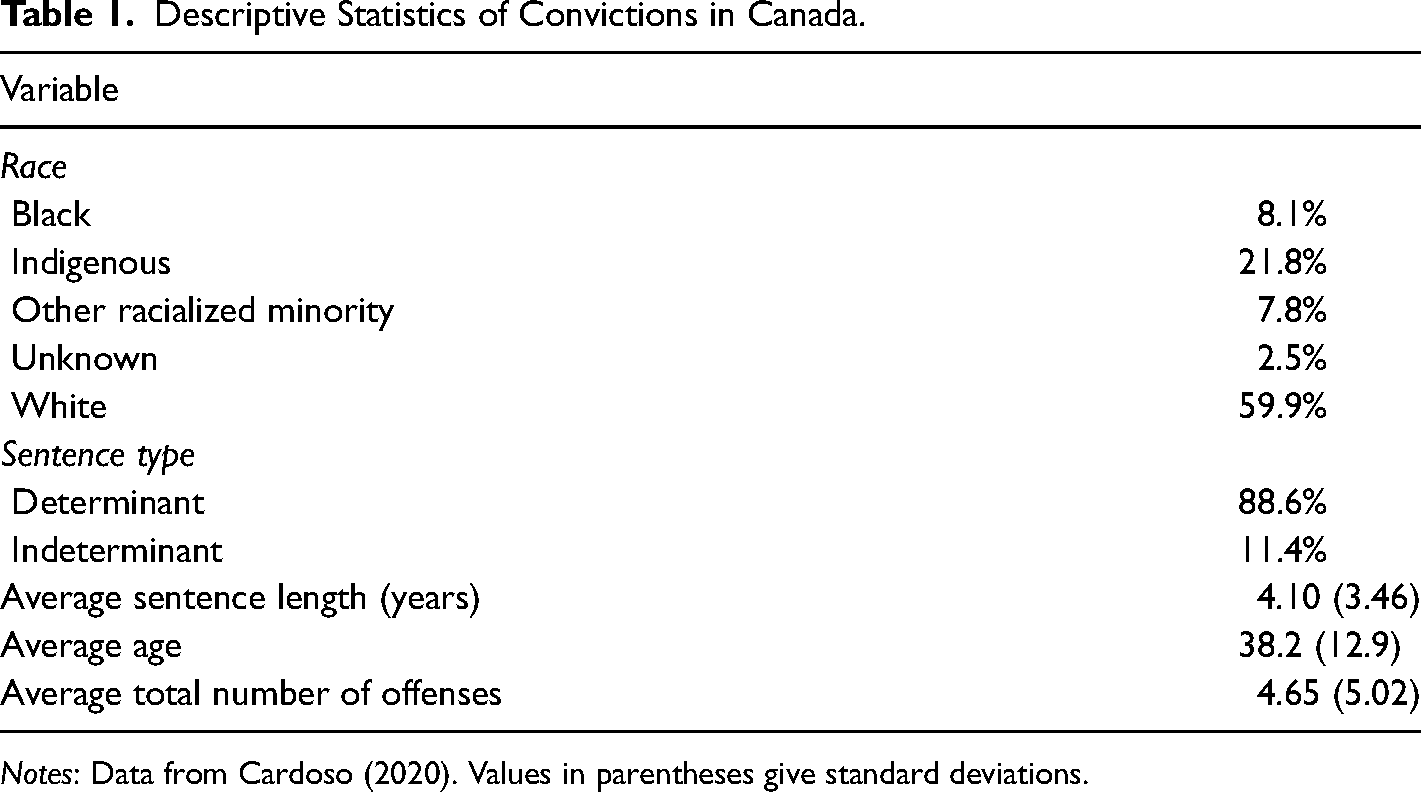
Notes: Data from Cardoso (2020). Values in parentheses give standard deviations.
Most, 93.7%, federally incarcerated individuals are male. Black and Indigenous people, and in particular Indigenous women, are over-represented among the federally incarcerated population. In total, 21.8% of incarcerated men are Indigenous, and 30.8% of incarcerated women are Indigenous, even though only 4.9% of the overall population in Canada self-identified as Indigenous in 2016. Furthermore, Black people make up 8.3% of the federally incarcerated population, compared to only 3.5% of the overall Canadian population. In contrast, white people made up 72.9% of the overall Canadian population in 2016, but only 61.4% of the current sample.
Figure 1 summarizes racial and gendered differences in the static risk and dynamic need scores of federally incarcerated individuals. Clear patterns standout: across all groups, dynamic needs tend to be higher than static risk. 58.7% of all incarcerated individuals rank as “high” on dynamic needs compared to 45% who rank similarly for static risk. Overall, the results show that Indigenous men and women score higher on both static risk and dynamic needs compared to Black and white men and women. For example, 66% of Indigenous men score high in dynamic needs compared to 52% of white men. Similarly, 57% of Indigenous men score high in static risk compared to 44% of white men. Comparing Indigenous women and white women reveals a similar pattern but a larger disparity: 60% of Indigenous women compared to 40% of white women scored high on dynamic needs; and 37% of Indigenous women scored high on static risk compared to 18% of white women.
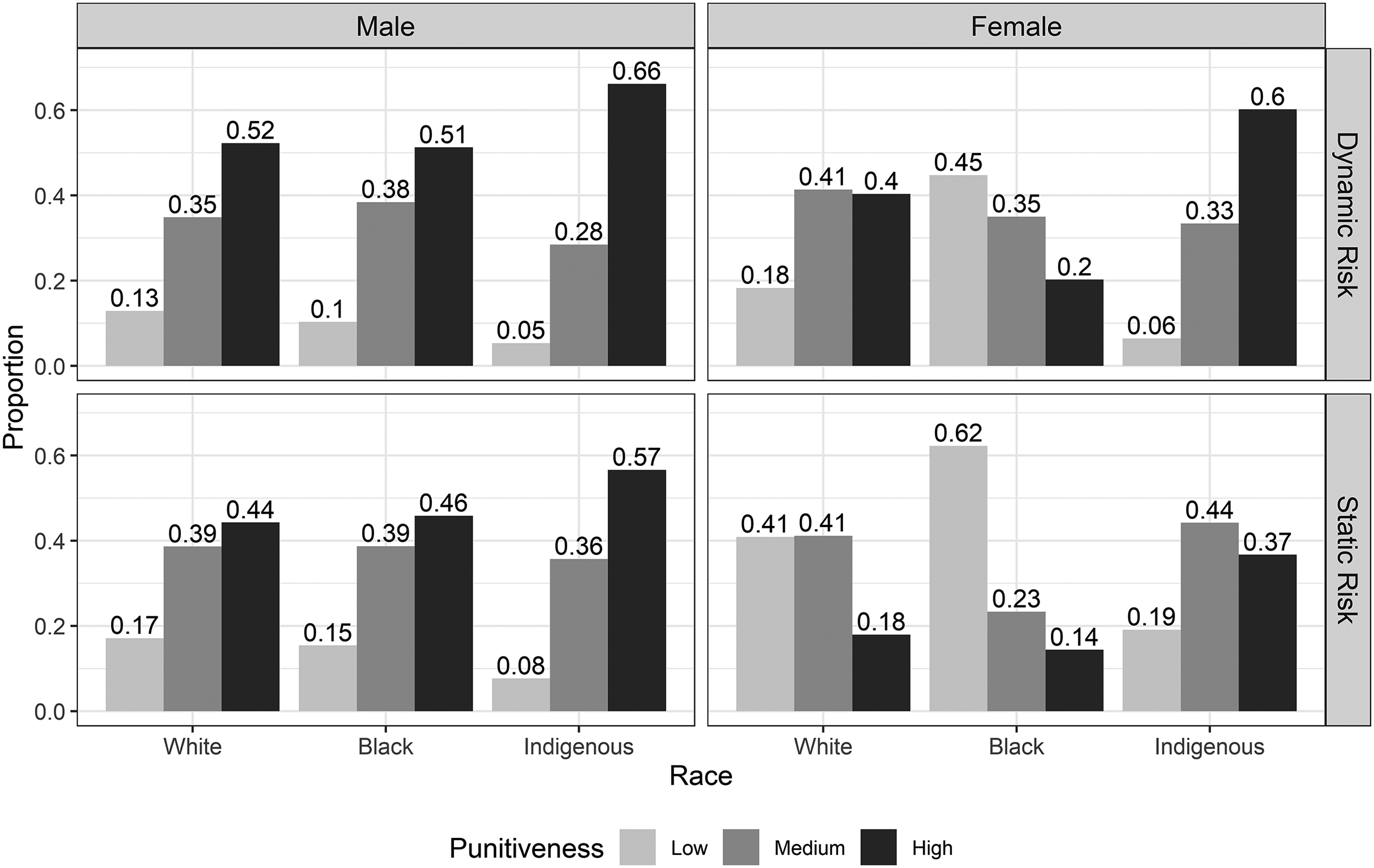
Racial and gender disparities in dynamic and static risk assessment outcomes.
Interestingly, Black women rank the least “risky” on both static and dynamic assessments among all groups. For example, 20% of Black women scored high on dynamic need, half and one-third the share of white and Indigenous women, respectively. Similarly, 62% of Black women scored low on static risk, compared to 41% of white and 19% of Indigenous women.
Figure 2 summarizes racial and gendered differences in the offender security level and reintegration potential scores. Generally, Indigenous and Black people are more likely to receive higher offender security level scores than their white counterparts, though this pattern held more for men than for women. For example, 17% of Black men and 15% of Indigenous men received offender security level scores of high compared to 12% of white men. Similarly, 15% of Indigenous women received offender security level scores of high relative to 9% of white and Black women. Black women receive lower scores than Indigenous and white women: while the same percentage of Black and white women received high offender security level scores, more Black women received offender security scores of low.
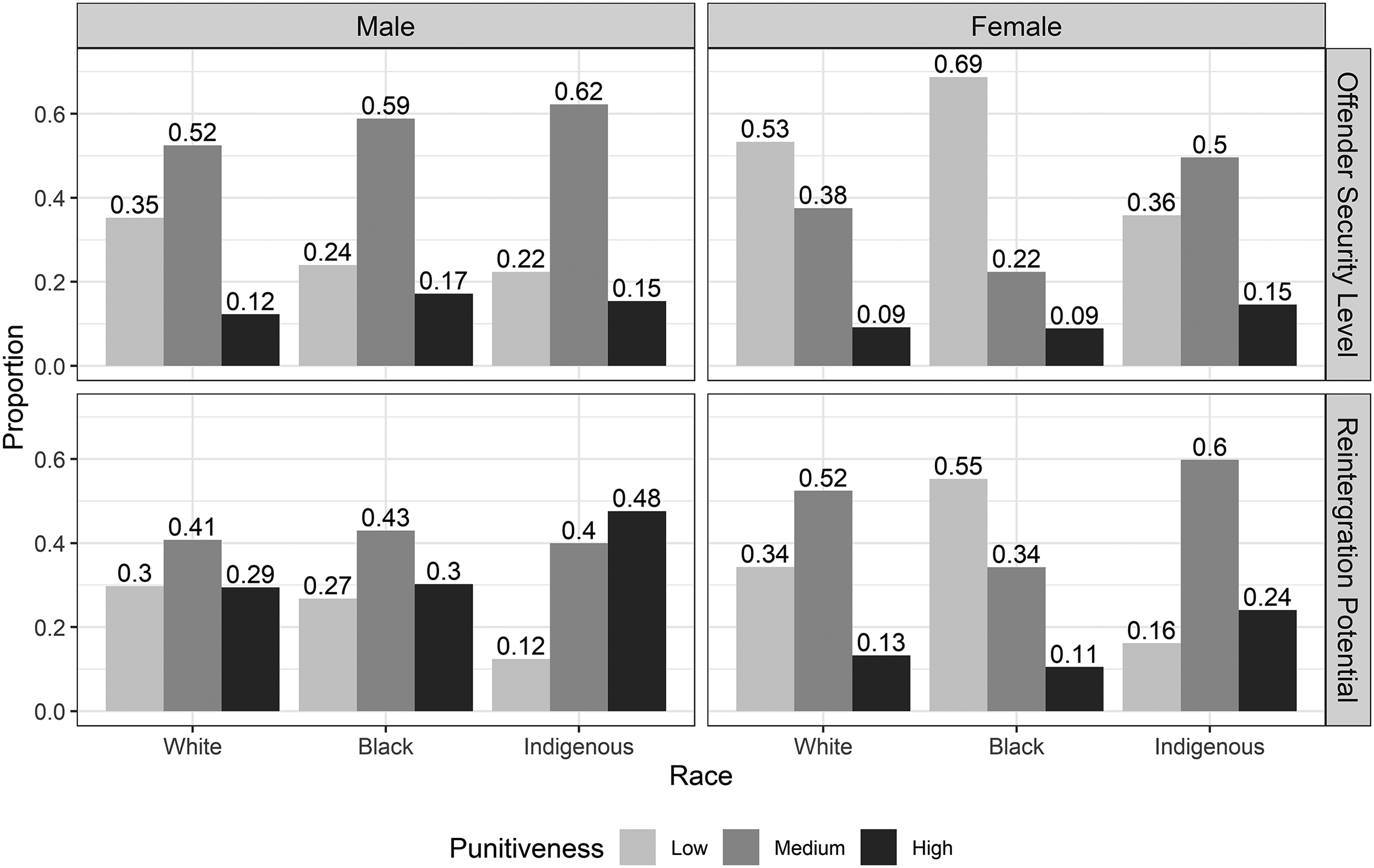
Racial and gender disparities in offender security and reintegration potential.
Similar race by gender patterns appear to hold for reintegration potential scores. Indigenous women appear significantly more likely to receive worse reintegration potential scores relative to Black and white women. Again, Black women appear to receive the best risk scores among all groups.
Results: Race and Gender Disparities in Risk Assessment Scores
Table 2 presents the results of ordinal logistic regression models which characterize the effect of race, gender, and their interaction on the actuarial risk assessment scores. Analysis of risk assessment scores and institutional housing outcomes were run on a subset of sentences where risk assessment scores assigned at intake could be determined (n = 29,332). 10 Analysis of parole outcomes were run on a subset of cases who were both incarcerated and eligible for parole by their last year in the dataset (n = 15,189). As mentioned, risk assessment scores are recoded from “low” (least restrictive), “medium,” to “high” (most restrictive). Positive coefficients can be interpreted as positively correlated with higher (more restrictive) risk scores. Model 1 tests the association between race and gender and offender security level while Model 2 tests the association between race and gender and reintegration potential.
Racial and Gender Disparities in Offender Security Level and Reintegration Potential Scores Received by Federally Incarcerated Canadians.
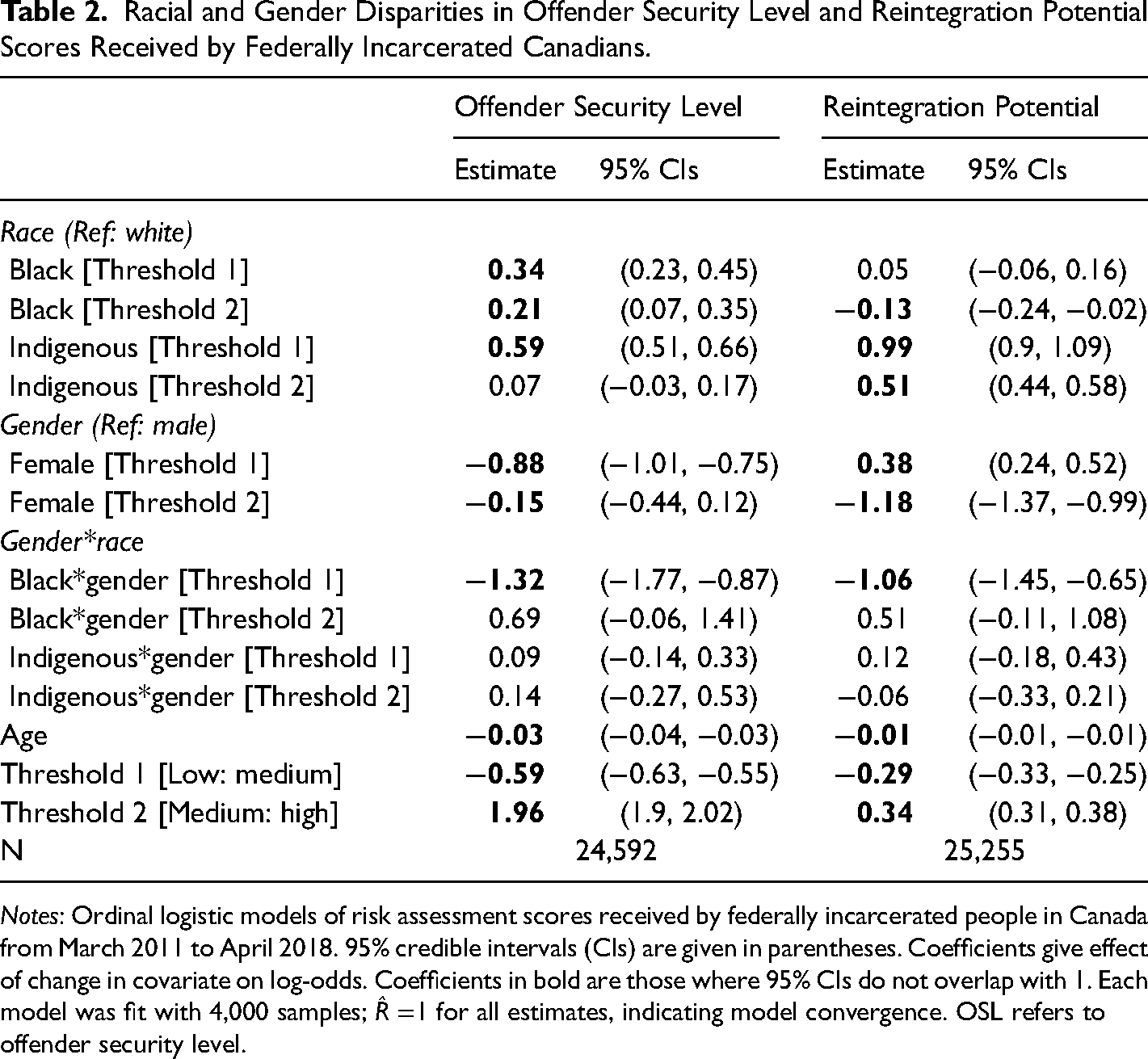
Notes: Ordinal logistic models of risk assessment scores received by federally incarcerated people in Canada from March 2011 to April 2018. 95% credible intervals (CIs) are given in parentheses. Coefficients give effect of change in covariate on log-odds. Coefficients in bold are those where 95% CIs do not overlap with 1. Each model was fit with 4,000 samples; R̂ =1 for all estimates, indicating model convergence. OSL refers to offender security level.
The results confirm the hypotheses and the utility of a modeling approach that allows for the effect of race and gender to vary across different thresholds (e.g., the threshold from minimum to medium security prison and the threshold from medium to maximum security prison). Model 1 shows that Black and Indigenous men are at a disadvantage relative to white men in offender security level scores they receive but that this disadvantage is larger in the determination of whether a person received an offender security level score of medium (rather than low) and less of an effect on whether a person received a score of high (rather than medium). In this regard Indigenous men are particularly disadvantaged: relative to both Black and white men, Indigenous men are significantly more likely to receive offender security level scores of medium relative to minimum. Model 1 also suggests that while Black men are more likely to receive higher offender security level scores relative to white men, this difference is not statistically significant for Indigenous men.
Interestingly, this pattern does not replicate among women. We find, across all racial groups, women receive lower offender security level scores than men, however, the effect of gender is limited to determinations between low and medium risk, and there are significant differences by race. Surprisingly, the “ameliorative” effect of gender is most pronounced among Black women, who receive the lowest risk scores of all groups. That is, Black women in general receive less severe scores than white women, inconsistent with our expectations. Indigenous women, however, receive higher scores than white women.
Figure 3 summarizes this information in posterior prediction plots that give the marginal predicted proportions or distribution of scores for racial group by gender, while holding age at its mean value, 36.7 years. Among men, it estimates that 69.9% of Black men and 74.4% of Indigenous men would receive offender security scores of medium, while 22.6% of Black men and just 18.2% of Indigenous men would receive offender security scores of low. This compares to a prediction that 64% of white men would receive offender security scores of medium and 29.7% would receive scores of low. As implied by the results of Table 1, the differences in the predicted probability of receiving scores corresponding to the highest scores are small: we would estimate that 7.5% of Black men and 7.4% of Indigenous men would receive scores of “high risk,” compared to 5.9% of white men.
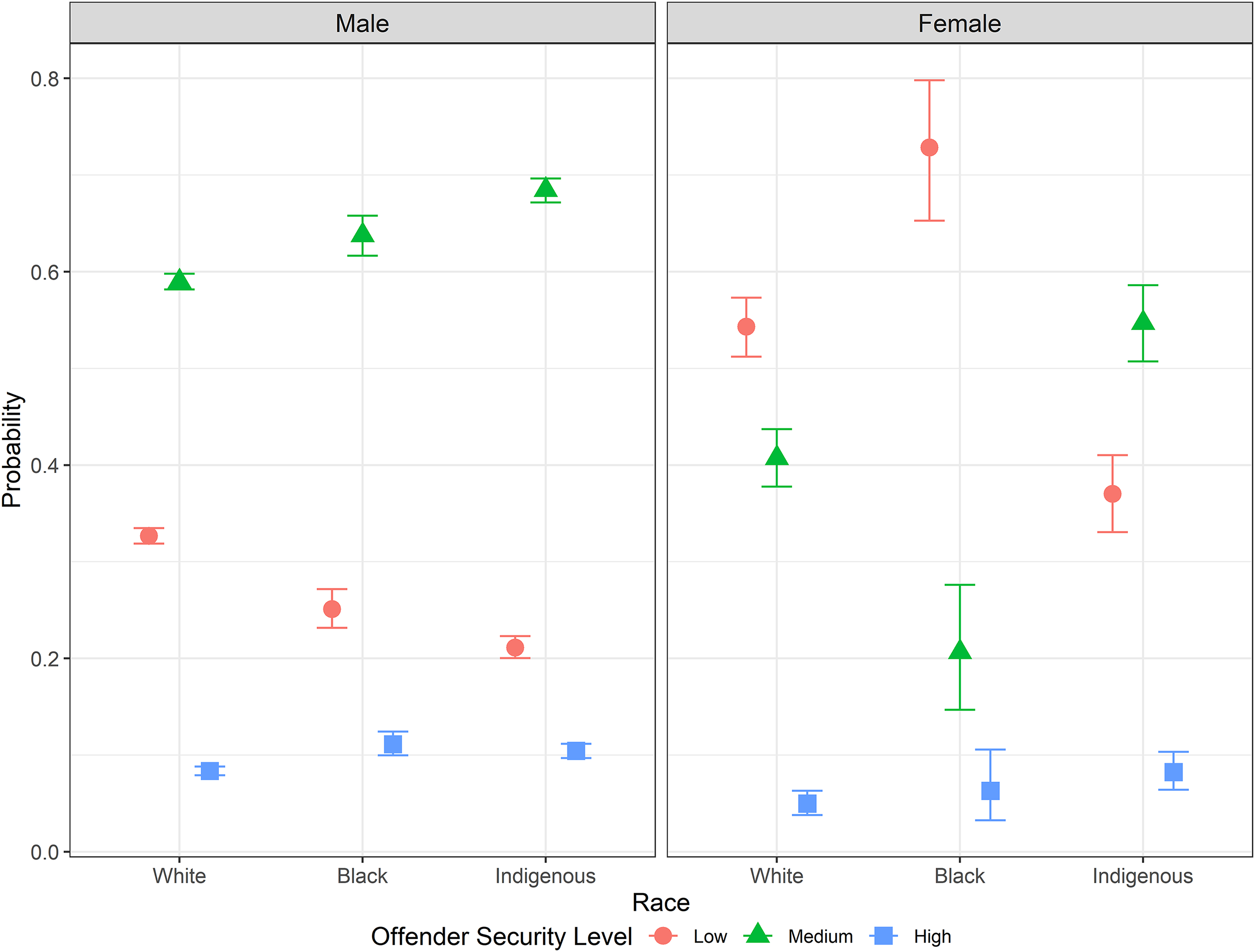
Predicted probability of offender security level by race and gender.
Figure 3 also shows that across all racial groups, women receive lower offender security level scores than men, but the effect is most pronounced among Black Canadians. We estimate that white women are 1.67 times more likely to receive security scores of low relative to white men, while Indigenous women are 1.85 times more likely to receive scores of low compared to Indigenous men. Black women are also more likely to receive this low score compared to Black men, but the effect is larger than for white and Indigenous women: Black women are 2.72 times more likely than Black men to receive offender security scores of low. Among women, we estimate that Indigenous women are worse off and are significantly more likely than both Black and white women to receive offender security level scores of medium. Relative to white women, Indigenous women are more likely to receive offender security level scores of high.
Table 2 also presents the results of analysis of reintegration potential scores received by race and gender. Here, the results are somewhat more mixed and less consistent with our hypotheses. For example, while we find that Black men are slightly less likely than white men to receive the worst reintegration potential score, Indigenous men are significantly more likely to receive worse scores across both thresholds. As with offender security level, Indigeneity is more strongly associated with the jump from low to medium.
The relationship between gender and reintegration potential scores varies considerably by race, such that it is hard to speak of a consistent effect of gender. For white and Indigenous women, gender increases the odds of moderately restrictive reintegration potential score relative to the least restrictive score but decreases the odds of receiving the most restrictive score relative to white men. Black women are in contrast, more likely than Black men to receive the least restrictive reintegration potential score and less likely to receive the most restrictive score.
Overall, this means that the patterns observed within women differ from those observed within men, easily visualized in Figure 4, which gives predicted probabilities generated by the model. Reintegration potential scores of Indigenous men are the most restrictive: unlike any other group, we predict that scores corresponding with the most restrictive treatment are more likely than either moderate or low scores. Black men and white men do not differ much in the scores that they receive, whereas Black women receive the least restrictive scores, though there is considerable uncertainty in that estimate. Indigenous women are at a disadvantage, though this is largely related to the lower probability of receiving the least restrictive scores.
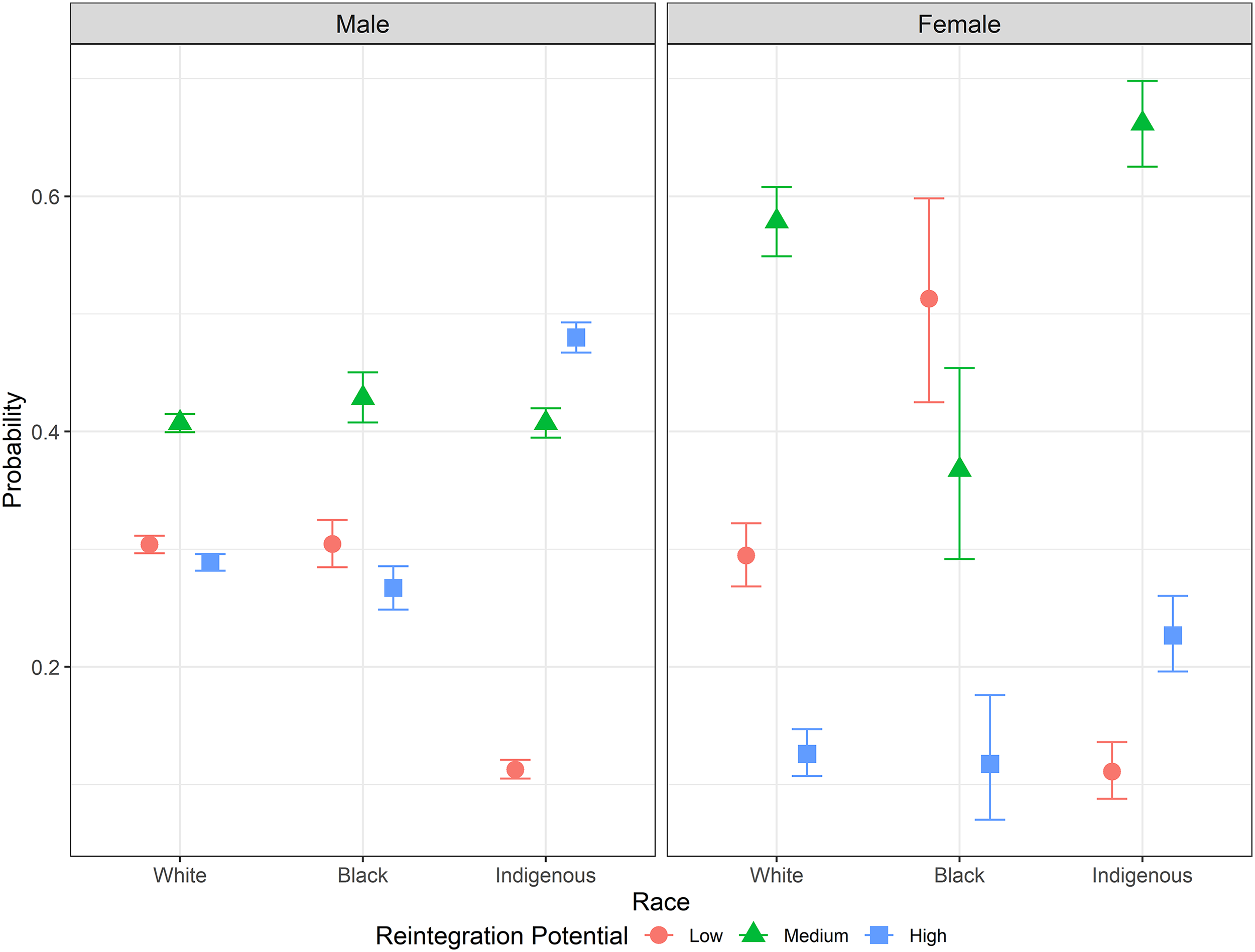
Predicted probability plots of reintegration potential score by race and gender.
Results: Institutional Housing and Parole
These disparities in actuarial risk assessment scores are large and concerning. However, as we noted, actuarial risk assessment scores do not exert a deterministic influence on the treatment of federally incarcerated persons. While institutional housing, for example, is strongly determined by offender security level, correctional personnel have the ability to over-ride these scores and house, for example, individuals who receive scores of “low” in medium security prison. Similarly, parole decisions are not completely determined by actuarial risk assessments, and correctional staff have the ability to over-ride the recommendations produced by the reintegration potential score (Cohen et al., 2016; Correctional Service Canada, 2019a).
In the tables below we explore racial and gender differences in actual outcomes—institutional housing and parole status—by race and gender. Unlike in our previous regressions, here we test explicitly for disparate treatment. While other factors may inform institutional housing and parole decisions, actuarial assessments should be the strongest determining factor, such that once we control for this factor, we should observe few variations by race and gender.
Table 3 presents the results from the logistic regression model that considers the relationship between race, gender, and parole status once eligible. Rather than model the three-way interaction between race, gender, and reintegration potential scores, we opt to split the sample by gender. Results suggest that Black and Indigenous men are less likely to be on parole once eligible compared to white men, but the disparity fades the higher (more restrictive) the reintegration potential score. Among women, a racial disparity also exists such that controlling for reintegration potential scores, Black women are less likely to be on parole than white women.
Effect of Race, Gender, and Reintegration Potential Score on Parole Outcomes.
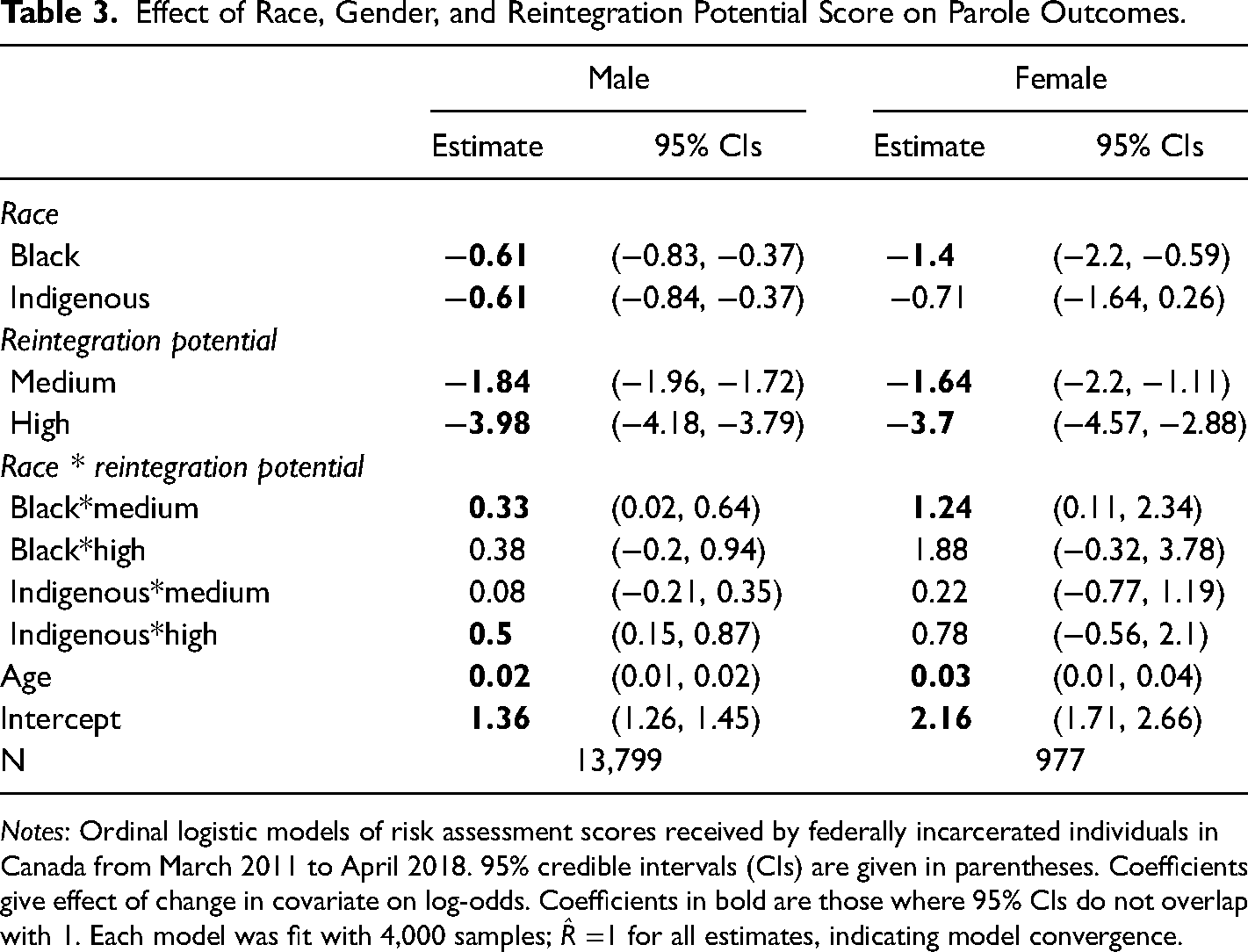
Notes: Ordinal logistic models of risk assessment scores received by federally incarcerated individuals in Canada from March 2011 to April 2018. 95% credible intervals (CIs) are given in parentheses. Coefficients give effect of change in covariate on log-odds. Coefficients in bold are those where 95% CIs do not overlap with 1. Each model was fit with 4,000 samples; R̂ =1 for all estimates, indicating model convergence.
Figure 5 provides a visual summary which plots the predicted probability of being on parole, controlling for reintegration potential scores and at average age. Among men, the pattern is quite clear: Black and Indigenous men who receive reintegration scores of low and medium are significantly less likely to be on parole once eligible relative to their white counterparts. Among men who receive the least restrictive reintegration score, we estimate that there is a 79.5% chance that white men will be on parole; among Black and Indigenous men this probability is 68.8%. Among men who receive moderately restrictive reintegration potential scores, we estimate that the chance of being on parole is 38.2% for white men, compared to 31.8% for Black men and 26.6% for Indigenous men. We observe no racial differences in the probability of being on parole among men who receive the most restrictive reintegration potential score. Among women, we find that the only evidence of disparities exists for Black women who receive the least restrictive reintegration parole scores: they are significantly less likely than similarly classified white women to be on parole once eligible.
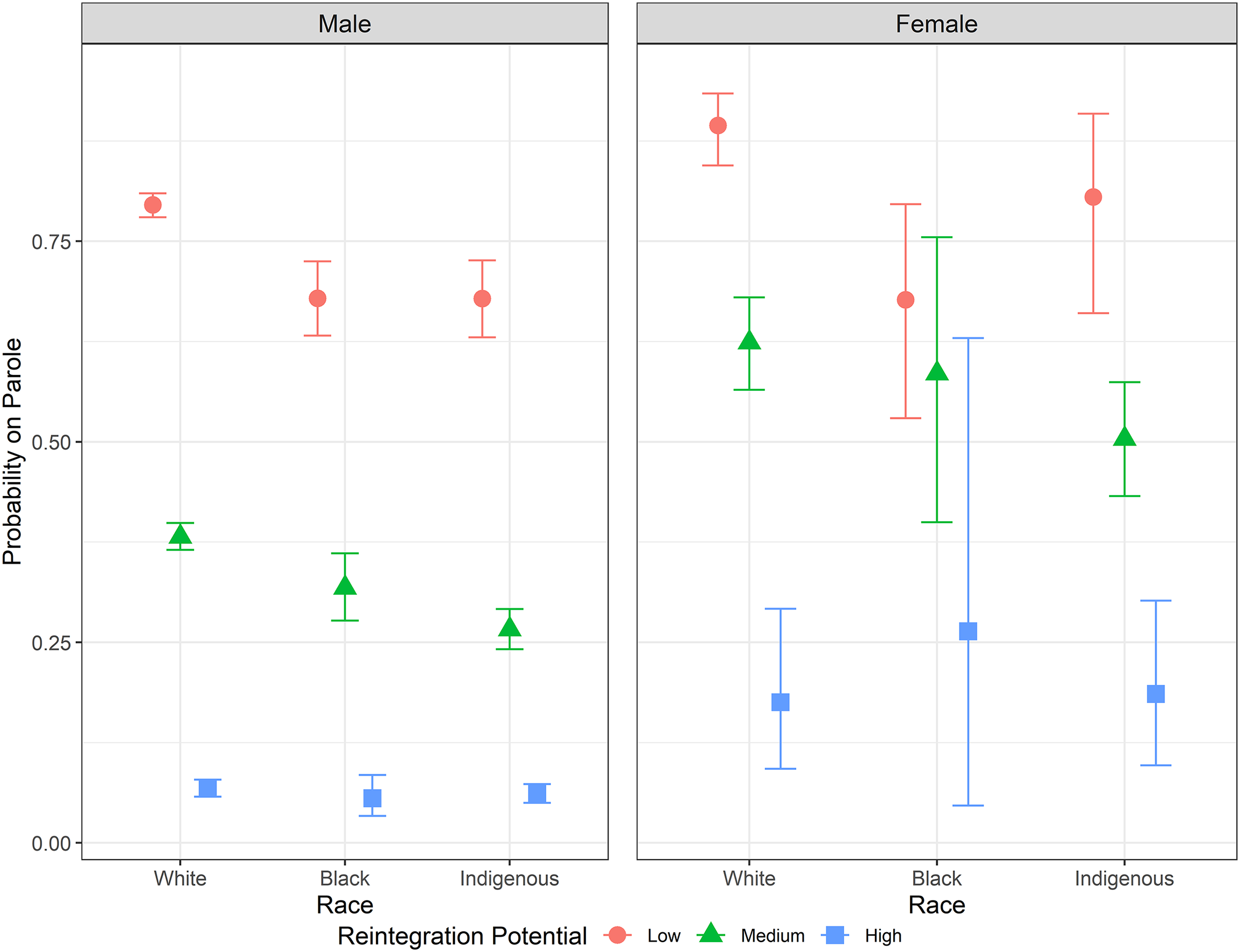
Predicted probability of being on parole by race and gender.
Table 4 presents the results of the ordinal logistic regression model that examines the effect of race and offender security level scores on institutional housing and Figure 6 visualizes the results as predicted probabilities. Since federally incarcerated women in Canada are almost exclusively housed in multilevel institutions, our analysis looks only at men.
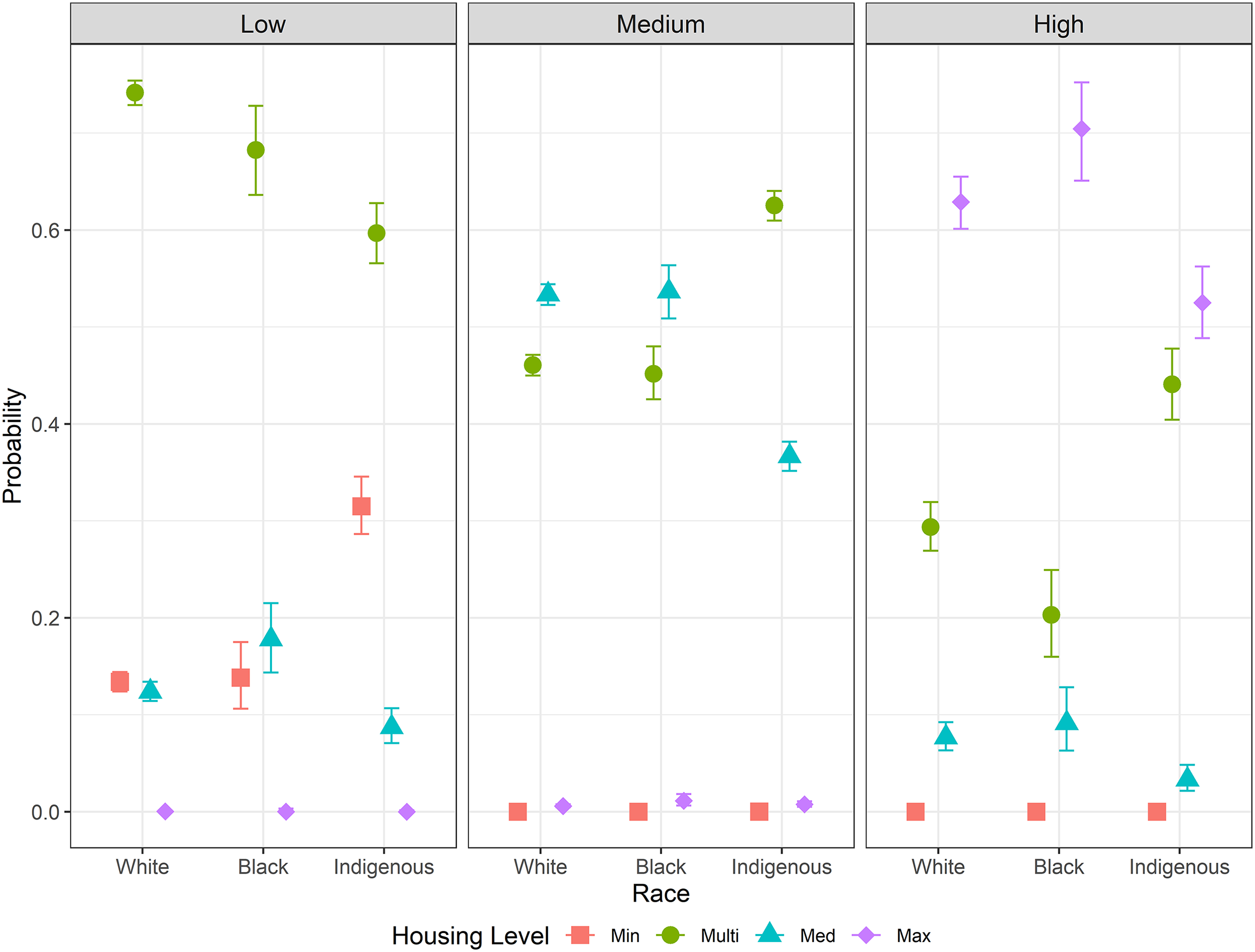
Predicted probability of institutional housing by offender security level score and race.
Effect of Race and Offender Security Level Scores on Institutional Housing Among Male Federally Incarcerated Canadians.
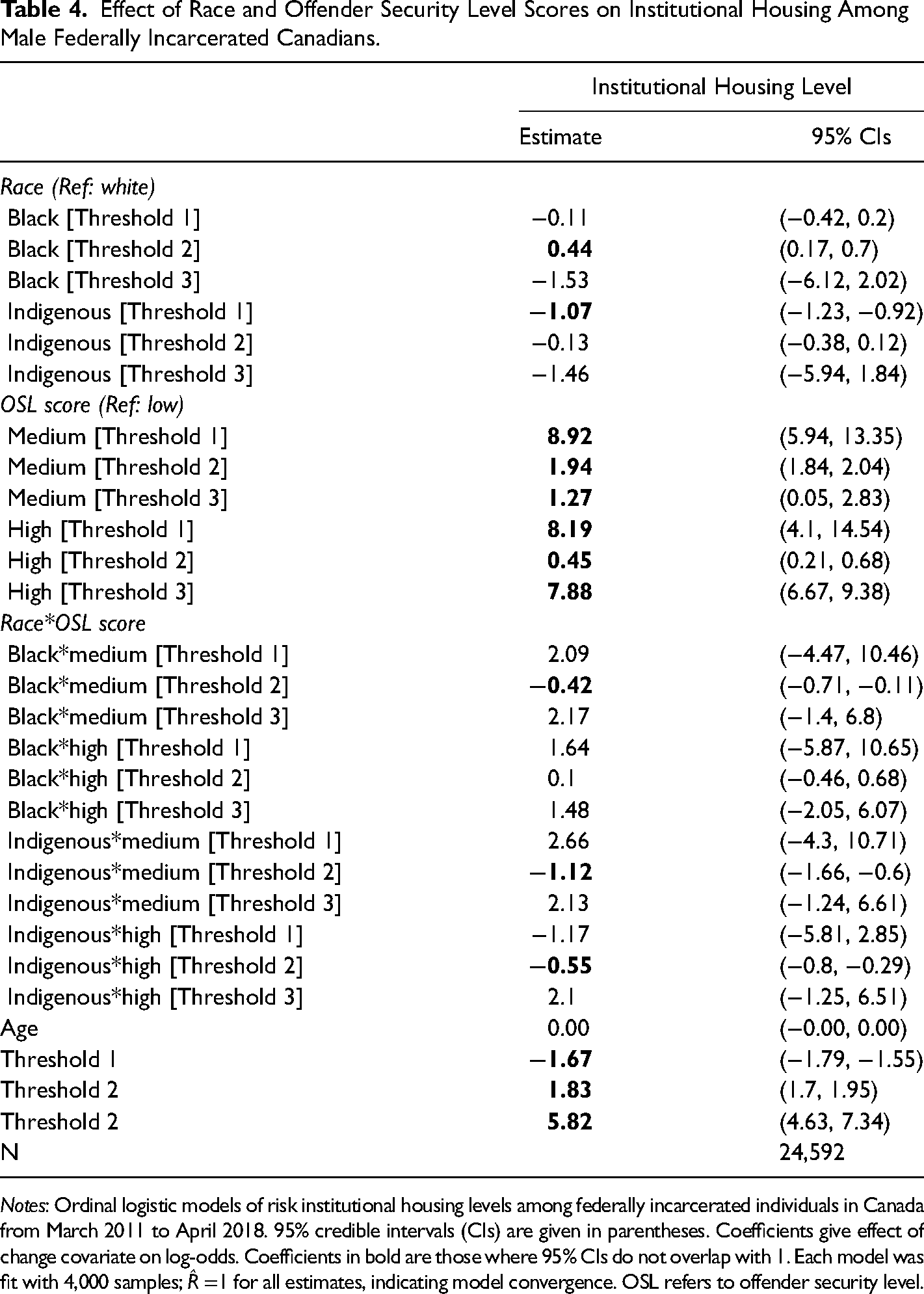
Notes: Ordinal logistic models of risk institutional housing levels among federally incarcerated individuals in Canada from March 2011 to April 2018. 95% credible intervals (CIs) are given in parentheses. Coefficients give effect of change covariate on log-odds. Coefficients in bold are those where 95% CIs do not overlap with 1. Each model was fit with 4,000 samples; R̂ =1 for all estimates, indicating model convergence. OSL refers to offender security level.
Strikingly, we generally find that conditional on the offender security level scores they receive, Indigenous men are less likely to be incarcerated in maximum security prison relative to white men, and that Black men appear to be the most disadvantaged. Figure 6 visualizes this quite clearly. Among men who receive the least restrictive offender security level score there are no differences between Black and white men, but Indigenous men are more likely to be housed in minimum security prison and less likely to be housed in medium security prison and multilevel institutions. Among men who receive moderately severe offender security level scores again, we observe no statistically significant difference between Black and white men but find that Indigenous men are more likely to be housed in multilevel institutions and less likely to be housed in medium security prisons. Although few men who receive moderate offender security level scores are housed in maximum security prison, Indigenous men with these scores are significantly less likely than both Black and white men to be housed in maximum security prison.
The clearest and largest difference appears among men who receive the highest (most severe) offender security level score. Again, among these men, Indigenous men are significantly more likely to be housed in multilevel or medium security prison than Black or white men. However, Black men are significantly more likely than white men to be housed in maximum security prison and less likely to be housed in medium security prison.
Discussion and Conclusion
In summary, we find important racial and gender disparities in risk assessment scores assigned to federally incarcerated individuals in Canada and evidence of racial bias in how those scores affect the decisions made by carceral personnel, consistent with theoretical expectations of conflict and critical race theory. Our first finding largely confirms, in large sample and at the federal level, results from smaller, qualitative, and provincial analyses: that of large disparities in static risk and dynamic need scores. We find pronounced disparities in the dynamic and static risk scores that Indigenous persons receive relative both to Black and white persons. Although women as a group receive lower dynamic and static risk scores than men, the white/Indigenous disparity is larger among women than it is among men. Furthermore, Indigenous/white disparities in inferred risk generated from dynamic need scores are significantly higher than disparities in risk inferred from static risk scores.
Our finding here underscores the concern that dynamic need scores individualize the social marginalization that Indigenous people experience and transform it into individual markers of risk. As Hannah-Moffat (2005) notes, this may be particularly concerning insofar as the higher dynamic risk scores incarcerated Indigenous people receive puts pressure on them to participate in rehabilitation programs to “transform” themselves and reduce their perceived risk. Disturbingly, this process may actually absolve the state from addressing the systemic factors that cause disparities in dynamic risk scores in the first place (Hannah-Moffat, 2005).
Our findings also uncover important patterns with regard to the treatment of incarcerated Black Canadians. Black women receive the lowest risk score of all groups in federal prison and by a considerable margin. Extant empirical research, particularly of the overlapping disadvantages that Black women in Canada experience, do not provide much by way of anticipation of why federally incarcerated Black women would score lowest among all incarcerated individuals on assessments of both dynamic and static risk and we suggest this might constitute an important site for future research. It could be, for example, that this pattern is a consequence of disparities Black Canadian women experience earlier in the criminal-legal system, such that relative to other groups, “low risk” Black Canadian women are disproportionately more likely to be sentenced to federal prison and appear in the dataset.
We also interestingly observe little difference in measured static risk and dynamic need assessment scores received by Black and white men. As with Black women, we anticipated that Black men would receive higher risk assessment scores than white men given the considerable evidence that Black Canadian men experience significant social discrimination and marginalization which should be present in both dynamic and static risk assessment scores (Reitz & Banerjee, 2009). As with Black women, it may be that “low risk” Black men are more likely to be federally incarcerated than white men and appear in the dataset.
Regarding actuarial assessments that most directly influence decision making—offender security level and reintegration potential scores—we uncover a similar pattern in which both Indigenous men and women are significantly more likely to receive risk assessment scores that imply far more restrictive treatment than white people. We also find disparities in the offender security level scores that Black men receive relative to white men (though smaller than the white/Indigenous disparity) and no difference in the reintegration potential scores Black and white men receive. Again, we find that Black women receive offender security scores and reintegration scores that imply the least restrictive treatment.
One advantage of our modeling approach is that it maximizes the data available and allows us to demonstrate that most of the association between race and these two scores lies in the probability between receiving scores that are the least severe and moderately severe. For example, most (though not all) of the disparity in offender security level scores lies in the estimated probability that white, Black, and Indigenous people will receive scores that imply differences in recommendations for minimum versus medium security prison. Race exerts less of an effect on the probability that a federally incarcerated person will be recommended for maximum versus medium security prison, though the relationship is still present. This is consistent with research on police officers, which finds that police officers have more room to exercise their discretion in lower-level offenses and that racial bias is more common in these offenses (Mitchell & Caudy, 2015).
Finally, we interrogate the racial and gender variation of the impact that actuarial risk assessment scores have on the lived experiences of federally incarcerated persons, specifically opportunities for parole and institutional housing. We find that, conditional on the reintegration potential scores that they receive, Black and Indigenous men are at a significant disadvantage in the probability that they will be released on parole, consistent with past research (Ricciardelli et al., 2019; Struthers Montford & Hannah-Moffat, 2020). The evidence here is suggestive of racial bias: reintegration potential scores capture most of the information that should inform parole decisions and, once taken into account, there should be little variation by race. We uncover significant variation by race. We find that among men who receive the least restrictive reintegration potential scores (implying that they are the most likely to reintegrate successfully) Black and Indigenous men are 11 percentage points less likely to be on parole once eligible compared to white men. Among men who receive scores that are moderately restrictive, Black and Indigenous men are 6 and 11.6 percentage points less likely to be on parole, respectively.
The pattern is strikingly different for women: controlling for reintegration potential score, we find evidence that Black women are significantly less likely than white women to be on parole. Specifically, Black women who receive reintegration potential scores that imply that they have the best chance of successful reintegration into society are 22 percentage points less likely than white women to be on parole. Although there is considerable uncertainty in this estimate, it is statistically significant and one that suggests significant racial bias against Black women in parole decisions.
Finally, we find that the effect of offender security level scores on housing outcomes is powerfully moderated by race such that relative to their Black and white counterparts with comparable offender security level scores, Indigenous men tend to be placed in less restrictive housing than implied by their offender security level scores. This finding contributes to a somewhat mixed literature on the use of over-rides in provincial housing decisions. Wormith et al., (2015), for example, find that correctional staff are significantly more likely to increase the risk levels of non-Indigenous persons relative to Indigenous persons in Ontario and are more likely to reduce the risk assessment scores of Indigenous persons. They theorize that corrections personnel may be attempting to counteract systemic bias in Canadian corrections. Our finding that, after controlling for offender security level, Indigenous persons are less likely to be sentenced to more restrictive institutions is consistent with this theory. However, our findings suggest that an important and overlooked disparity exists for Black Canadians and suggests that similar scrutiny in racial bias should be applied to the treatment of Black Canadians.
Limitations and Future Directions
While important, our findings are limited in several ways. Most importantly, we lack the data required to formally test for racial bias in the assessments used to generate the ordinal risk assessment scores we have access to (see Goel et al., 2021). Because we lack some of the data that informs static risk, dynamic need, offender security level, and reintegration potential scores, we opt to present age-adjusted disparity measures. The disparities we observe could be attributable to factors measured in the Custody Rating scale which we cannot account for, racial disparities in over-rides, or racial bias in the assessments themselves. Outside our final set of analyses on parole and carceral housing decisions, our analysis of disparities is therefore largely descriptive and provides little leverage on the mechanisms that produce these disparities and should constitute sites for future research.
Furthermore, although offender security level scores are the most important contributors to carceral housing decisions, other factors may drive some of the results. For example, the finding that Indigenous men are more likely to be housed in multilevel institutions is affected by the prevalence of multilevel institutions in regions where Indigenous persons are most likely to reside or the impact of Gladue reports on sentencing (R. v. Gladue, 1999). The over-representation of Black Canadians in maximum security institutions net offender security level scores may similarly reflect structural decisions concerning where institutions are placed. 11 Future research, which may be able to incorporate these data, may be able to determine their impact on the disparities we observe.
Similarly, our ability to capture all the factors that contribute to status on parole once eligible are limited. Although the reintegration potential score is a strong determinant of parole decisions, we cannot control for other factors such as behavior while incarcerated, a parolee's release plan, and program completion, which may affect parole decisions.
Finally, we lack access to the raw data fed into the algorithms so we cannot fully characterize how ecological factors surrounding the incarcerated person, such as Black/white disparities in arrests for out of sight traffic offenses, affect risk scores. This would provide a more robust empirical analysis of the “individualization” of social inequality which animates much of the research literature.
Footnotes
Declaration of Conflicting Interests
The author(s) declared no potential conflicts of interest with respect to the research, authorship, and/or publication of this article.
Funding
The author(s) received no financial support for the research, authorship, and/or publication of this article.
