



Abstract
In the effort to prevent school shootings in the United States, policies that aim to arm teachers with guns have received considerable attention. Recent research on public support for these policies finds that African Americans are substantially less likely to support them, indicating that support for arming teachers is a racial issue. Given the racialized nature of support for punitive crime policies in the United States, it is possible that racial sentiment shapes support for arming teachers as well. This study aims to determine the association between two types of racial sentiment—explicit negative feelings toward racial/ethnic minority groups and racial resentment—and support for arming teachers using a nationally representative data set. While explicit negative feelings toward African Americans and Hispanics are not associated with support for arming teachers, those with racial resentments are significantly more likely to support arming teachers. Racial resentment also weakens the effect of other variables found to be associated with support for arming teachers, including conservative ideology and economic pessimism. Implications for policy and research are discussed.
Keywords
A contentious area of debate in American crime discourse surrounds what to do to prevent school shootings. There have been many proposals put forth to enhance school safety, including arming teachers with guns. The logic behind such an intervention is that an armed teacher (or other individual who is already in the school) will be able to respond to an active shooter more quickly than police who are called to respond to the scene. The push to arm teachers has sparked an intense amount of debate. Americans are largely divided in support for arming teachers along political lines, with conservative Americans being more likely to support arming teachers (Baranauskas, 2020; Horowitz, 2018).
Recent research has also found that support for arming teachers is largely divided into racial lines, with African Americans being significantly less likely to support policies that aim to arm teachers with guns (Baranauskas, 2020; Shamserad et al., 2020). This makes sense given greater patterns in attitudes toward crime and justice among people of color, namely that African Americans are more likely to be distrustful of the police and the criminal justice system (see Brunson, 2007; Sharp & Johnson, 2009; Tyler, 2005) and less supportive of punitive measures to address crime (Unnever & Cullen, 2010). In fact, modern crime policy in the United States is racial in nature, as many “tough on crime” policies have been sold to the public as implicit indicators of how the criminal justice system will be used to control the Black population, policies that have led to people of color being disproportionately impacted by the criminal justice system (Alexander, 2012; Beckett & Sasson, 2004; Simon, 2007).
It is possible that support for arming teachers in the United States is driven by racial sentiment as well. Even though school shootings have largely been committed by White offenders (Muschert, 2007; Schiele & Stewart, 2001; Schutten et al., 2020), there are concerns that arming teachers will lead to a disproportionate amount of violence against students of color (Ifill, 2018), as is evidenced by research on the “school-to-prison pipeline” which finds that policies that increase security measures in American schools have been disproportionately detrimental to students of color (Darensbourg et al., 2010; Marchbanks et al., 2018; Skiba & Peterson, 1999; Skiba et al., 1997). If support for arming teachers is driven by racial sentiment, then it would give credence to the idea that arming teachers is another way to police students of color in American schools.
The current study examines the association between support for arming teachers and two types of racial sentiment: explicit negative feelings toward racial/ethnic minority groups and racial resentment. There is already an established connection between racial sentiments and crime policy. Racial resentment is particularly noteworthy, as it has been found to be associated with less support for gun control measures and more support for punitive crime policies (Burton et al., 2020; Filindra & Kaplan, 2016; Morris & LeCount, 2020; O’Brien et al., 2013; Pickett & Baker, 2014). Using a nationally representative data set of American voters, this study examines the association between racial sentiment and support for arming teachers, controlling for a variety of factors that have been shown to be associated with support for arming teachers (see Baranauskas, 2020).
Theoretical Perspectives and Prior Research
School shootings are high-profile events that receive a lot of attention from the media and the public. In the wake of school shootings, much of the discussion of these shootings focuses on interventions aimed at preventing school shootings in the future. These interventions often focus on increasing the number of armed individuals in American schools, either security personnel (Crews et al., 2013) or arming the teachers themselves (Utter & True, 2000; Weatherby, 2015; Weiler et al., 2020). The push to arm teachers was particularly salient in the aftermath of the shooting at the Marjory Stoneman Douglas High School in Parkland, Florida in February 2018, as the state commission tasked with investigating the shooting concluded that an armed teacher could have substantially reduced casualties (MSD Public Safety Commission, 2019).
Recent studies have shown that Americans are largely mixed in their support for arming teachers with no clear consensus that they would support such a policy. Nationally representative data have revealed that about 34% (Baranauskas, 2020) to 45% (Horowitz, 2018) of Americans support arming teachers with guns. Surveys of students have revealed that only about 20% (Shamserad et al., 2020) to 34% (Croft et al., 2019) of students support arming teachers. Those who support arming teachers tend to be White, male, and on the conservative side of the political spectrum (Baranauskas, 2020; Shamserad et al., 2020).
Race has been shown to play an important role in support of arming teachers. In Baranauskas’ (2020) analysis, race was the most important factor that predicted attitudes toward arming teachers, with Black respondents being significantly more likely to oppose arming teachers (controlling for a variety of attitudes relevant to gun culture and instrumental fears). Shamserad et al. (2020) not only find that Black students are more likely to oppose arming teachers than White students, but they are also more likely to anticipate feeling less safe if teachers in their school are armed. However, neither of these studies examine the impact of racial sentiments such as explicit racism or racial resentment on arming teachers.
Why might racial sentiment matter in support of arming teachers? This may seem counter-intuitive, as the vast majority of school shootings have been committed by White offenders (Muschert, 2007; Schiele & Stewart, 2001; Schutten et al., 2020). However, a wealth of research has shown that racial sentiments are connected to both general crime and school policy in the United States as well as attitudes toward guns and gun control.
In March 2018, President of the National Association for the Advancement of Colored People's Legal Defense and Educational Fund (LDF) Sherrilyn Ifill wrote a piece for Time entitled “Black Children will be the Victims of Armed Teachers.” In this piece, Ifill argues that it is students of color who will be disproportionately targeted by armed teachers, even though the perpetrators of school shootings in the United States have been almost exclusively White. Ifill's argument reflects a deeper criticism of crime policy in the United States wherein measures to address crime disproportionately impact people of color. This is most evident in policies adopted in the latter part of the 20th century under the war on crime and war on drugs that are disproportionately enforced against Black and Latino citizens and have led to mass incarceration (see Alexander, 2012).
Behavior-control policies on the school level have helped to fuel mass incarceration and the disproportionate impact of crime control on people of color. The phenomenon known as the “school-to-prison pipeline” describes a process wherein the punitive philosophy that rules the American criminal justice system has spread to public schools (Heitzeg, 2009; Schiraldi & Ziedenberg, 2002; Wald & Losen, 2003). The adoption of zero-tolerance policies and the presence of sworn School Resource Officers (SROs) in schools have led to students becoming involved with the criminal justice system for relatively minor behavioral offenses such as disorderly conduct (Lawrence, 2007; Na & Gottfredson, 2013; Theriot, 2009). African American students are hit particularly hard by the school-to-prison pipeline; they are more likely than other students to experience harsh discipline (Darensbourg et al., 2010; Marchbanks et al., 2018; Skiba & Peterson, 1999; Skiba et al., 1997). Even when students of color are not immediately punished via a criminal justice intervention, they are more likely to experience forms of exclusionary discipline such as out-of-school suspensions that hinder their academic performance and drive them to associate with deviant peers, leading to delinquent behavior (Brooks et al., 2000; Brown, 2007; Kupchik & Ward, 2014; Mendez et al., 2002; Poulin et al., 2001; Wald & Kurlaender, 2003).
Ifill (2018) argues that the targeting of students of color by armed teachers is the next logical step in extending the treatment of people of color by the criminal justice system to the public school system. Research has shown that people are likely to hold stereotypes of Black people as dangerous (Quillian & Pager, 2001; Schaller et al., 2003), stereotypes that often lead to undue attention and violence (Carbado & Roithmayr, 2014; Harris, 2003; Richardson & Goff, 2012). For instance, police are more likely to stop and search (Farrell et al., 2004; Rosich, 2007; Weitzer & Tuch, 2004) and use excessive force (Ayres & Borowsky, 2008; Fyfe, 1982a, 1982b; Skogan & Frydl, 2004) against people of color, who are also more likely than White suspects to die in police custody (Burch, 2011). Experimental research has shown that people are quicker to shoot a Black person than a White person, even when that person is unarmed (Correll et al., 2007). Anecdotally, instances such as the shooting of 12-year-old Tamir Rice by police show that Black children are not immune from being stereotyped as dangerous and being treated with violence (see Rios, 2015).
Furthermore, support for various crime control policies in the United States has historically been an implicit indicator of racial sentiment. In kicking off the war on crime, Richard Nixon painted the protests and civil disobedience of civil rights activists as a breakdown of law and order and respect for authority. Ronald Reagan continued in this trend, eschewing explicit racial narratives in favor of calls to address urban crime and drug use as well as attacking welfare, which he condemned as breeding laziness and providing a handout to the (implicitly Black) undeserving (Beckett & Sasson, 2004). Policymakers throughout the latter part of the 20th century and into the 21st century have adopted crime policies that disproportionately impact people of color (Alexander, 2012; Simon, 2007). It is possible that support for arming teachers is another attitude that implicitly signals what one believes ought to be done about a racialized crime problem.
Research has also investigated the role of racial sentiment in support of gun control. While overt racism and stereotypes of African Americans as violent are not associated with attitudes toward various gun control measures (Kleck, 1996; O’Brien et al., 2013), measures of racial resentment are. Racial resentment is based on beliefs held by many white Americans that African Americans violate the traditional American values of self-reliance and hard work (Hughes, 1997; Kinder & Sanders, 1996; Tuch & Hughes, 2011). It is a subtle measure of racism that relates to beliefs that African Americans are given special privileges and opportunities (such as affirmative action) or are simply not working hard enough to overcome their disadvantaged social and economic standing. Research has shown racial resentment to be related to opposition to racial policies (Feldman & Huddy, 2005; Tuch & Hughes, 2011), voting behavior and political opinions (Knuckey, 2005; Knuckey, 2011; Wilson & Brewer, 2013), views on crime and justice (see Carter & Corra, 2016; Drakulich 2015b, 2015c), and a preference for punitive measures to address crime (Morris & LeCount, 2020; Pickett & Baker, 2014; Pickett et al., 2014).
In terms of gun control, research has shown racial resentment to be positively associated with opposition to gun control. O’Brien et al. (2013) find that White respondents who have racial resentment are more likely to have a gun in their home and more likely to support concealed carry laws. Similarly, Filindra and Kaplan (2016) find that White respondents with racial resentment are more likely to oppose government regulation of firearms. Burton et al. (2020) find that those with racial resentment are less likely to support gun control measures to protect against school shootings, offering evidence that racial resentment may shape interventions to prevent school violence. The current study examines two types of racial sentiments: explicit negative feelings toward racial/ethnic groups as well as racial resentment. Given the racialized nature of crime, school, and gun policy in the United States, it is hypothesized that both types of racial sentiments will be positively associated with support for arming teachers, with racial resentments having a much stronger association.
Data, Measures, and Method
Data for this study come from the 2018 Pilot Study of the American National Election Studies (ANES). The ANES is a study on political issues and voting behavior. It is given each election year and is nationally representative of voting-age U.S. citizens. The 2018 iteration of the study was conducted via the YouGov panel—an “opt-in panel”—and completed via the Internet. The YouGov panel consists of a diverse array of potential respondents who are regularly invited to complete surveys. For the ANES survey, 2,500 respondents were selected out of 2,770 completed questionnaires to reflect the U.S. voting population, with respondents being matched to U.S. citizens by gender, age, race, and education based on the 2016 American Community Survey.
Measures
The dependent variable is support for arming teachers with guns. The 2018 ANES contains the question: “Do you favor, oppose, or neither favor nor oppose allowing school teachers to carry guns at school?” Responses ranged on a 7-item scale from “favor a great deal” to “oppose a great deal.” Responses were coded so that higher values indicate more support for arming teachers. Table 1 includes weighted descriptive statistics for all variables. On average, respondents were only slightly opposed to arming teachers with guns.
Descriptive Statistics.
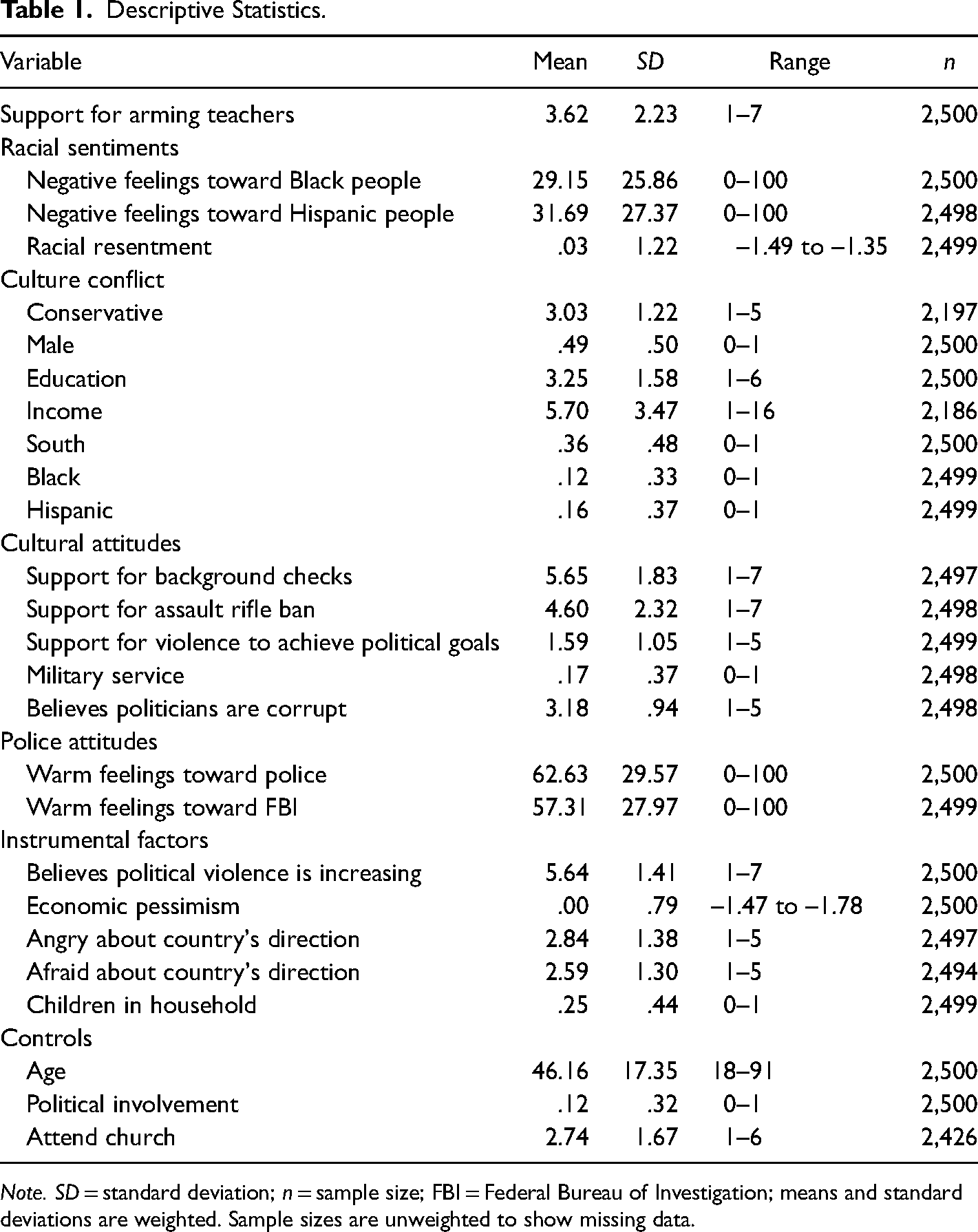
Note. SD = standard deviation; n = sample size; FBI = Federal Bureau of Investigation; means and standard deviations are weighted. Sample sizes are unweighted to show missing data.
The current study includes two types of racial sentiments: negative affect toward racial/ethnic groups and racial resentment. Negative affect taps into explicit feelings toward particular groups and was measured via feeling thermometers. Respondents were asked how warmly they felt toward various racial and ethnic groups on a scale of 1 to 100, with 1 indicating very cold or unfavorable feelings and 100 indicating very warm or favorable feelings. The current study includes feelings toward Black people and Hispanic people. I reverse-coded these feeling thermometers so that higher values indicate more negative feelings toward each of these groups.
Racial resentment taps into implicit racial sentiments. Measures of racial resentment generally relate to views that people of color have not worked hard enough to overcome disadvantaged social positions and thus any assistance to them solely based on race is unearned. The 2018 ANES contains four questions tapping into racial resentment. Respondents were asked on a five-item scale the degree to which they agree with the following statements: “Irish, Italians, Jewish and many other minorities overcame prejudice and worked their way up. Blacks should do the same without any special favors”; “It's really a matter of some people not trying hard enough; if blacks would only try harder”; “Generations of slavery and discrimination have created conditions that make it difficult for blacks to work their way out of the lower class”; and “Over the past few years, blacks have gotten less than they deserve.” An exploratory factor analysis revealed that these four questions loaded onto one factor, with the latter two questions revere-coded so that higher values indicate more resentment. An additive scale of these four standardized variables was created as a racial resentment variable (alpha = .89).
The current study also considers a number of other variables that may impact support for arming teachers, as detailed by Baranauskas (2020). According to the culture conflict perspective, demographic variables related to political ideology, gender, education, income, region of the country, and race may influence attitudes toward guns and gun control. Since guns are an important political issue, I control for political ideology. Respondents were asked about their political–ideological affiliation on a 5-item scale ranging from very liberal to very conservative. This variable was coded so that higher values indicate a greater affiliation with conservative ideology. As seen in Table 1, the average ideological affiliation was quite moderate. Gender is included as a dummy variable with males coded as 1 and females coded as 0. About 49% of respondents were male. For education, respondents were asked the highest level of education completed with six items: no high school, high school graduate, some college, 2-year degree, 4-year degree, and post-graduate degree. The average respondent had between some college and a 2-year degree. Respondents were asked which of 16 income ranges describes their family income. The average respondent income was between $50,000 and $60,000. The survey also asked the respondent to report the region of the country in which they live: Northeast, Midwest, South, or West. The South variable is a dummy variable with those living in the South coded as 1 and all other regions coded as 0. About 36% of respondents reside in the South. Dummy variables were created for two racial groups—Black and Hispanic respondents. Each was coded as 1 for each respective variable. About 12% of respondents are Black and about 16% are Hispanic.
Other cultural attitudes may influence support for arming teachers (Baranauskas, 2020; Kleck et al., 2009; Utter & True, 2000). The current study controls for support for two gun-control measures. Respondents were asked on a seven-item: “Do you favor, oppose, or neither favor nor oppose requiring background checks for gun purchases at gun shows or other private sales?” and “Do you favor, oppose, or neither favor nor oppose banning the sale of semi-automatic ‘assault-style’ rifles?” Table 1 indicates that respondents were in favor of background checks on average, but only slightly above neutral in banning assault rifles. The current study also controls for factors associated with a “pro-gun” culture that embraces the use of guns or violence for self-defense and is distrustful of the government. Respondents were asked the degree to which they feel it is justified for people to use violence to pursue political goals with responses on a five-item scale from “Not at all” to “A great deal.” On average, respondents were a little bit accepting of political violence. While a measure of acceptance of violence for defense was not available in the survey, the current study examines military service as a proxy. Military service is a binary variable with those who currently or previously served in the armed forces coded as 1. About 17% of respondents served in the military at some point. Additionally, I include a measure of the degree to which respondents feel that the politicians running the government are corrupt (five-item scale), with respondents on average viewing about half the politicians running the government as corrupt.
Attitudes toward law enforcement have been found to be associated with support for arming teachers (Baranauskas, 2020) and other views on guns and gun control (Carlson, 2012, 2015a). Attitudes toward law enforcement were measured via two different feeling thermometers: feelings toward the police and feelings toward the Federal Bureau of Investigation (FBI). For these variables, higher values indicate more positive feelings toward the police or the FBI. Table 1 indicates that on average, respondents felt fairly warm toward the police and slightly less warm toward the FBI.
Another set of variables relates to instrumental fears about the state of society. Peoples’ perception of the crime problem in this country may influence support for arming teachers. I include a measure of whether the respondent believes that violence related to politics has increased or decreased in the United States (seven-item scale). Furthermore, Carlson (2015a, 2015b) observes in the context of economic decline, arming oneself is often a reaction to economic insecurity and the resulting crime. The 2018 ANES includes three questions about attitudes toward the economy. Respondents were asked, “Would you say that as compared to one year ago, the nation's economy is now better, about the same, or worse?”; “What about 12 months from now? Compared to now, do you think the nation's economy will be better, about the same, or worse in 12 months?”; and “So far as you and your family are concerned, how worried are you about your current financial situation?” An exploratory factor analysis revealed that these four questions loaded onto one factor. An additive scale of these three standardized variables was created as an economic pessimism variable (alpha = .73).
Other instrumental concerns relate to emotional concerns and proximity to the school shooting problem. For emotional concerns, the analysis includes the degrees of anger and fear that respondents express at the way things are currently going in the country (both on a five-item scale from “Not at all” angry/afraid to “Extremely” angry/afraid). The study also taps into proximity to the issue of school shootings by including a dummy variable that indicates if the respondent has children under the age of 18 years in the household; those with children in the household are coded as 1 and those without are coded as 0. About 25% of respondents have children in their households.
Other controls relate to demographic factors that may influence public opinion. The age of the respondent was included in the analysis. Respondents range in age from 18 to 91 years with an average age of 46 years. Since arming teachers is a political issue, it is possible that those who are more involved in politics will have stronger opinions on the matter. The analysis controls for political involvement, measured by whether or not the respondent has attended marches, rallies, or demonstrations related to political or social issues in the last year. I also control for the frequency of church attendance (six-item scale), which may be an indicator of conventional norm development. 1
Method
The analysis for the current study uses ordinary least squares (OLS) regression. The dependent variable has seven answer categories and is treated as continuous. In separate analyses, I ran ordinal models and found that they were substantively identical to the OLS models. The OLS models are reported here for ease of interpretation. The analysis also uses sample weights, which were provided by the ANES to make the survey generalizable to the U.S. adult population.
Less than 1% of cases were missing data for the vast majority of variables. Conservative ideology and income are two variables that were each missing data in about 12% of cases. I used a multiple imputation strategy (Allison, 2002), imputing 20 data sets in a process that comprised all of the variables in the current analysis and several auxiliary variables: affective feelings toward Barack Obama, Brett Kavanaugh, socialists, and capitalists.
Results
Table 2 presents unstandardized and standardized regression coefficients predicting support for arming teachers. Model 1 is a baseline model with none of the racial sentiment variables. Echoing the results of Baranauskas (2020), respondents who are Black, have higher education and incomes, support gun control measures, feel warmly toward the FBI, are pessimistic about the economy, and are angry about the country's direction are less likely to support arming teachers. Respondents who are conservative, support the police, and have children in their household are more likely to support arming teachers.
OLS Regression Models Predicting Support for Arming Teachers with Guns.
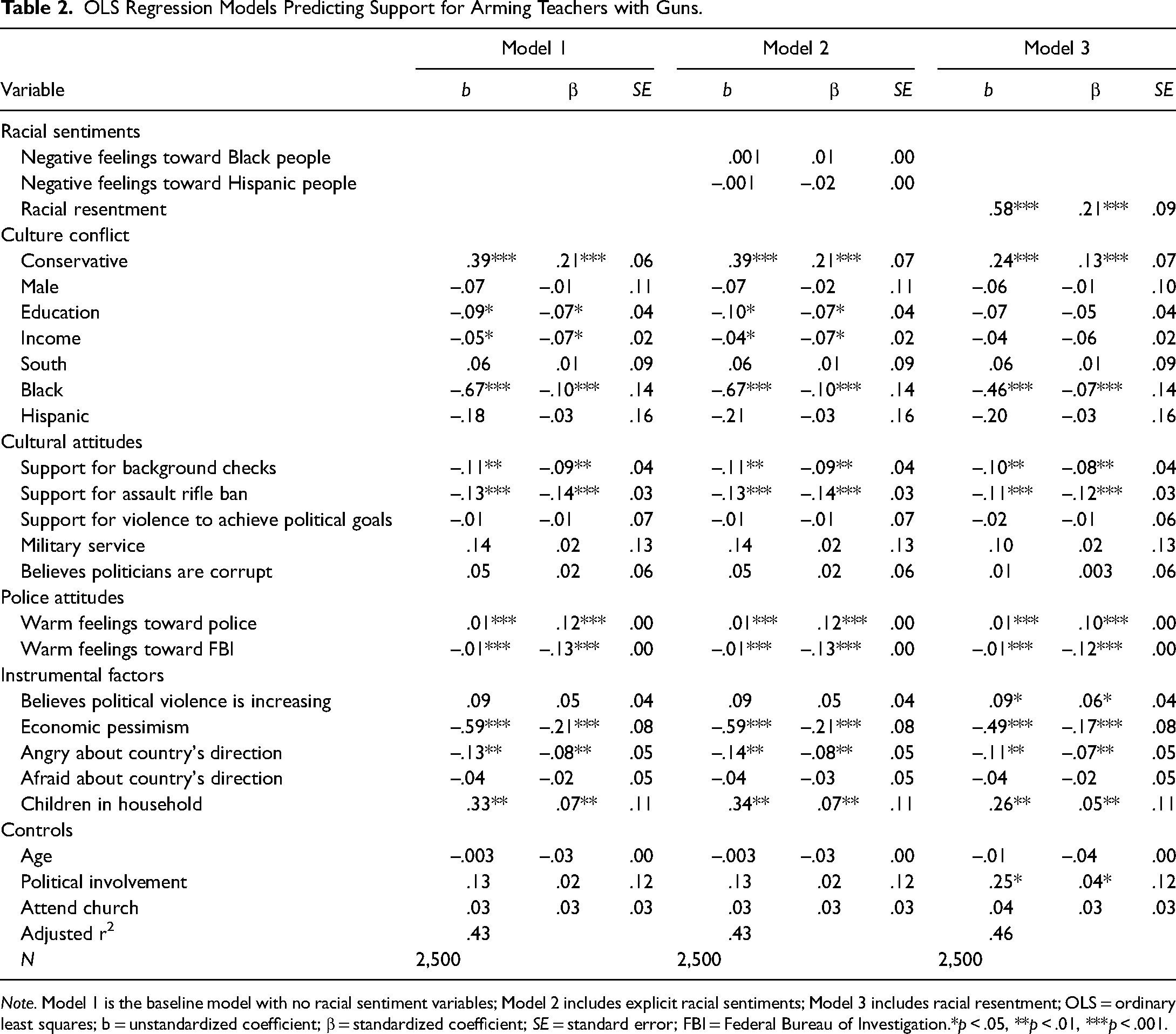
Note. Model 1 is the baseline model with no racial sentiment variables; Model 2 includes explicit racial sentiments; Model 3 includes racial resentment; OLS = ordinary least squares; b = unstandardized coefficient; β = standardized coefficient; SE = standard error; FBI = Federal Bureau of Investigation.*p < .05, **p < .01, ***p < .001.
Model 2 includes explicit negative sentiment toward Black people and Hispanic people. Neither negative feelings toward Black people nor Hispanic people are significantly associated with support for arming teachers. This reflects the findings of prior research, which shows that overt racial sentiment has no impact on gun control measures (Kleck, 1996; O’Brien et al., 2013). The inclusion of these variables does not substantially change any of the other coefficients compared to Model 1.
Model 3 replaces the explicit racial feelings variables with the racial resentment variables. Not only are those who hold racial resentments significantly more likely to support arming teachers, but the impact of racial resentment on support for arming teachers is also stronger than any other variable in the model. Racial resentment also moderates the relationship between a number of variables and support for arming teachers. Support for arming teachers among conservatives and those with children decreases with the inclusion of racial resentment. The standardized coefficient for the conservative variable decrease in magnitude by about 38% from Model 1 to Model 3. This implies that racial resentment is a big reason why conservatives and those with children support arming teachers.
Other variables either decrease in magnitude or are no longer significant with the inclusion of racial resentment. The standardized coefficients for Black respondents and economic pessimists decrease by about 30% and 19%, respectively, from Model 1 to Model 3. This makes sense for Black respondents, as they are less likely to hold racial resentments (correlation = –.19, significant at p < .001). The correlation between economic pessimism and racial resentment is moderately strong and negative (–.52, significant at p < .001), indicating that those who are pessimistic about the economy are also less likely to have racial resentments. The coefficient for anger about the country's direction also decreases, but not by much. The coefficients for education and income are no longer significant with the inclusion of racial resentment. It is possible that those with more education and income are less likely to support arming teachers because they are generally less likely to hold racial resentments.
With the inclusion of racial resentment in Model 3, the perception that political violence is increasing and political involvement both become significantly associated with support for arming teachers. Those who believe that political violence is increasing and those involved in politics are more likely to support arming teachers, controlling for racial resentment. This indicates that racial resentment is suppressing the effects of these variables on support for arming teachers. Correlations indicate that the perception that political violence is rising (–.05, significant at p < .05) and political involvement (–.24, significant at p < .001) are both negatively correlated with racial resentment. The coefficient for political involvement is particularly strong, having a slightly stronger association with support for arming teachers than the conservative coefficient in Model 3.
Discussion
Why do Americans support arming teachers with guns? The results of the current analysis suggest that racial resentment is the most important factor. Those who hold such resentments are more likely to support arming teachers. There are a number of important implications of this finding. In terms of research, the current findings provide further evidence that race plays an important role in shaping attitudes toward crime and crime control. Specifically, this study adds to an important empirical domain that finds that forms of symbolic and implicit racism are associated with such outcomes as shaping crime as a social problem (Drakulich, 2015b), support for punitive crime policies (Drakulich, 2015c), perceptions of criminal danger (Drakulich & Siller, 2015), and attitudes toward police use of force (Carter & Corra, 2016).
The finding that racial resentment drives support for arming teachers also implies that arming teachers with guns is another way to use institutionalized violence to control the Black population. It is not a stretch to think that the schools most likely to see teachers be armed are the schools that are deemed the most dangerous: inner-city schools with student bodies that are largely African American. These are the same schools that have seen increases in arrests of students by SROs. When faced with a potential threat from a student who is already likely to be stereotyped as dangerous or criminal (see Schaller et al., 2003), it is possible that teachers will be more likely to result to violent means to address this threat (see Correll et al., 2007).
An interesting irony about the association between racial resentment and support for arming teachers is that the recent push to arm teachers has been a reaction to school shootings, which have largely been a White phenomenon (Muschert, 2007; Schiele & Stewart, 2001; Schutten et al., 2020). Nearly all of the recent school shootings that have received mass media attention were perpetrated by White (or non-Black) attackers. The finding that the narratives supporting the arming of teachers resonates with those who hold racial resentments provides evidence that there continues to be an underlying racial directive in narratives of crime and crime control in the United States. Just as support for the war on crime and “tough on crime” rhetoric has been implicit support for using the criminal justice system to deal with the Black population (see Beckett & Sasson, 2004; Simon, 2007), so too is support for arming teachers a way of implicitly supporting the use of violence to control Black students.
The current findings also show that racial resentment helps to explain why a number of the culture conflict variables are associated with support for arming teachers. More specifically, when racial resentment is taken into account, the statistically significant link between conservatives and support for arming teachers decreases substantially. This is not surprising, as the aforementioned racialized narratives surrounding crime were historically crafted by Republican politicians, designed to resonate with a conservative southern electorate (Beckett & Sasson, 2004).
Another important moderating effect is that support for arming teachers among those with children in the household decreases when racial resentment is taken into account. Support for arming teachers among those with children is likely driven by altruistic fears of the victimization of children at school (see Burton et al., 2020; Drakulich, 2015a, Haynes & Rader, 2015). This finding implies that these altruistic fears may be shaped by racial resentments as well. This makes sense, as fear of crime is often influenced by racial sentiment (Chiricos et al., 1997; Drakulich, 2012). In combination with the aforementioned racial nature of “tough on crime” rhetoric, it is possible that those with racial resentments are more likely to support “tough” measures to protect their children.
Another interesting moderation occurs between economic pessimism and racial resentment. When racial resentment is controlled for, those who are pessimistic about the economy are more likely to support arming teachers than they are when racial resentment is not taken into account. While the specific mechanisms driving the association between economic pessimism and support for arming teachers are unclear (Baranauskas, 2020), the current study suggests that racial sentiment plays a role. Notably, those who are pessimistic about the economy are less likely to hold racial resentments. It is possible that those concerned with the economy are less concerned with matters of race or crime control policies in schools. Future research can explore this relationship more closely.
The results also indicate that racial resentment strengthens the association between two variables and support for arming teachers: the perception that political violence is increasing and political involvement. Those who view political violence as increasing and those who are involved in politics are less likely to hold racial resentments. It is possible that without racial resentment, those who view political violence as increasing are those more concerned with school safety and likely to support this measure to protect students. The relationship between political involvement and support for arming teachers is interesting. Based on the current study's theoretical framework, racial resentment and conservative ideology help to drive support for arming teachers. Yet political involvement is only associated with support for arming teachers when these two variables are taken into account. Furthermore, the relationship is in a positive direction, indicating that absent racial resentment and conservative ideology, those more involved in politics are more likely to support arming teachers. Future research can further unpack this association between political involvement and support for arming teachers.
There are a number of limitations to this study. The data used in this study are cross-sectional, making it difficult to establish time order. However, since the key variables of Black respondents, conservative ideology, and racial resentment are either time-invariant or deep-seated beliefs, it is likely that these variables preclude the formation of an opinion on arming teachers. It should also be noted that the data were collected within a year after the shooting at the Douglas school and in the wake of popular discussion on the efficacy of arming teachers, which may have impacted responses to the dependent variable.
Additionally, there are other variables related to a racial sentiment that may impact support for arming teachers. Measures of implicit or hidden racism using instruments such as the Implicit Association Test have been shown to shape Americans’ views on crime and crime policy (Drakulich, 2015b, 2015c; Drakulich & Siller, 2015). It is possible that they may impact support for arming teachers as well. Furthermore, the current data do not allow for the consideration of other school security policies or the racial composition of respondents’ local schools. Future research can consider these variables to determine their impact on support for arming teachers.
Conclusion
In the aftermath of the school shooting in Parkland, Florida in 2018, the debate as to whether or not to arm teachers received an immense amount of attention. While much of the debate focused on the necessity for teachers to protect themselves and their students in the absence of an effective law enforcement presence, a subset of the voices speaking out against the arming of teachers pointed out the potential disparity in how a policy of arming teachers would affect students of color. Ifill’s (2018) piece made a bold assertion: if you give teachers guns, they will be more likely to use them against students of color, particularly Black students. This contention is bold but reasonable, given the United States’ history of using the criminal justice system and institutionalized violence to control and harm Black people (e.g., Alexander 2012; Beckett & Sasson, 2004). It is also reasonable given the findings of this study that support for arming teachers with firearms is associated with racial resentment.
What does this mean for the debate on arming teachers? The most important implication is that we as a nation need to be aware of the racial undertones that tinge this debate. In many ways, crime narratives in the United States are racial narratives. The policies that are implemented to control crime are inherently policies that seek to control people of color. In the debate on arming teachers, we need to ask the question: can Americans justify the adoption of a school-safety measure if it is possible that it will lead to violence against students of color? Unfortunately, the history of crime control policies adopted by the United States since the middle of the 20th century implies that this is an acceptable trade-off in the minds of the American public.
This leads to considerations that policymakers and school administrators need to be aware of in the case that a school does decide to arm its teachers. Armed teachers need to be cognizant of the biases that they hold that may lead to them being more likely to use their firearms against students of color. In recent years, there has been a push to include implicit bias training in the education of law enforcement (e.g., Fridell, 2016; Nix et al., 2017; Smith, 2015); such training would benefit teachers and other armed individuals in schools as well. At the very least, the potential cost on the lives of students of color needs to be a key consideration by school boards (see Weiler et al., 2020) and other policymakers when adopting policies that increase the number of armed individuals in American schools.
Footnotes
Declaration of Conflicting Interests
The authors declared no potential conflicts of interest with respect to the research, authorship, and/or publication of this article.
Funding
The authors received no financial support for the research, authorship, and/or publication of this article.
