




Abstract
Objectives
YouTube is the second most visited website in the world and can be a useful resource for patients to gain insight into surgical procedures. A multitude of studies have evaluated the quality of otolaryngology-specific healthcare information available on the YouTube platform, but to our knowledge, the online content regarding functional endoscopic sinus surgery available on this site has not been systematically evaluated.
Study Design
Cross sectional study.
Setting
Online.
Methods
YouTube was searched using the keywords “sinus surgery.” Variables including video length, total number of views, authorship (academic, private practice physician, patient, or third party), objective (advertisement, informative, or patient perspective), inclusion of intra-operative footage, and discussion of balloon sinuplasty were recorded and analyzed by a single reviewer.
Results
Two-hundred twenty-two videos met inclusion criteria, with a median length of 4 minutes, and a median of 3349 views. The majority of videos were informative (n = 145, 65%), narrated (n = 151, 68%), and did not mention balloon sinuplasty (n = 189, 85%) nor contain intra-operative footage (n = 116, 52%). Private practice physicians were the most common authors (n = 113, 51%), followed by patients (n = 70, 32%), third parties (n = 28, 13%) and academics (n = 11, 5%).
Conclusions
Sinus surgery is one of the most common ambulatory procedures performed. Online resources such as YouTube can be useful for improving health literacy and patient comfort with medical topics such as functional endoscopic sinus surgery, but it is important for clinicians and patients to understand that there is a spectrum in the authorship, content, and quality of sinus surgery related videos posted online.
Introduction
The internet is increasingly used as a resource for patients to research healthcare information. About seventy-eight percent of Americans use the internet, and 72% of internet users search online for healthcare related topics.1–3 YouTube (www.youtube.com) is the second most visited website in the world, making it a potentially significant resource for patients wishing to gain insight into surgical procedures. 4
At its best, the internet can provide rapid access to multiple sources of information from both professional and lay perspectives, increasing health literacy and giving otolaryngology patients valuable insight regarding the indications, procedural details, expectations, recovery, and outcomes of sinonasal surgery. At its worst, the internet can mislead patients with anecdotal or factually incorrect information. Unfortunately, there are no safeguards in place to regulate content, and thus the quality and veracity of information on platforms such as YouTube is variable. Furthermore, patients may not be aware of the financial motivations and other biases which may underlie the nature of medical information presented online to the lay public.
A multitude of studies have evaluated the quality of otolaryngology-specific healthcare information available on the YouTube platform, with results previously reported for rhytidectomy, thyroid cancer, obstructive sleep apnea, otoplasty, and adenotonsillectomy.5–9 To our knowledge, a similar study has not been performed regarding functional endoscopic sinus surgery (FESS), despite the fact that sinus surgery is one of the most commonly performed otolaryngic procedures. The number of sinus surgeries performed has been increasing in recent years, making FESS one of the most common ambulatory procedures performed worldwide. Recent estimates report 257,000 sinus procedures performed annually in the United States alone. 10 , 11
Despite the significant and growing prevalence of sinus surgery, many patients may not understand important aspects of surgical care, including potential complications, typical post-operative course, and need for further long-term medical treatment. 12 With this in mind, it is important that patients have access to accurate information regarding sinus surgery, in order to facilitate informed decision making and develop proper expectations post-FESS. We performed a cross-sectional analysis of video content pertaining to sinus surgery on YouTube in order to characterize the current resources available to patients on this widely available online platform, and furthermore to identify areas for improvement in internet patient education regarding sinonasal procedures.
Methods
The keywords “sinus surgery” were used to query the website YouTube on 1/2019. The default search parameters on YouTube were used with search results sorted by relevance. The first 250 videos were reviewed by one researcher and assessed for content pertaining to endoscopic sinus surgery. Videos that were not relevant to sinus surgery or duplicates were excluded from our data set. Two-hundred twenty-two videos met inclusion criteria. This study was exempt from IRB approval per VCU IRB guidelines.
Recorded variables included video length, total number of views, authorship (academic physician, private practice physician, patient, or third party), objective (advertisement, informative, or patient perspective), inclusion of intra-operative footage, and discussion of balloon sinuplasty. Definitions for video objective were closely adapted from those published by Nissan et al., and are delineated below:
13
“Information: Videos that provided information regarding sinus surgery were assigned this primary objective. Videos in this category may include images of the procedure itself, information from a physician or other source, or information on alternative procedures. Videos in this category may include the contact information of the pertaining physician or clinic—but do not make any direct written or verbal recommendation for the viewer to schedule a consult with any particular physician. Videos in this category also do not offer a favorable perspective of one physician’s work in comparison to a “norm.” Videos in this category also do not offer “pros” regarding sinus surgery without accompanying “cons.” “Patient’s perspective: Videos that provided the unadulterated perspective of a sinus surgery patient were assigned the primary objective “to provide the patient’s perspective.” Videos in this category may include a patient discussing his/her experiences regarding any aspects of the procedure. Videos in this category may not show any clear signs of physician-sponsorship, such as the patient reading from a script. Videos in this category may include the contact information of the pertaining physician or clinic but do not make any direct written or verbal recommendation for the viewer to schedule a consult with any particular physician. Videos in this category also do not offer a favorable perspective of one physician’s work in comparison to a “norm.” Videos in this category also do not offer “pros” regarding sinus surgery without accompanying “cons.” “Advertisement: The primary purpose of videos in this category is to promote one specific physician or clinic. Videos that fall into this category fail to meet one or more of the exclusion criteria in categories 1 and 2.”
Statistical Analysis
Video characteristics were summarized by medians and interquartile ranges (Q1, Q3) or frequencies and percentages, where appropriate. Summary statistics were presented for each video characteristic, overall and by authorship, views, and video objective. The number of views was analyzed as both continuous and categorical. Number of views was dichotomized based on a cutoff of 10,000 views (views >10,000 vs. views ≤10,000) and based on the 75th percentile (bottom 75% vs. top 25% views).
Chi-squared tests were performed to determine the association between categorical variables (video narration, objective, discussion of balloon sinuplasty, inclusion of intra-operative footage, and authorship) and authorship, categorical views, and video objective. Continuous variables were checked for normality by assessing the curve from a QQ-plot. If continuous variables did not meet the assumption of normality, the Kruskal-Wallis test was employed rather than ANOVA to investigate the relationships between views and length of video with authorship. All statistical analyses were performed in SAS 9.4.
Results
There were 222 videos surveyed after application of exclusion criteria, with a median video length of 4 (IQR:2.2, 8.8) minutes and median of 3349 (IQR:591, 20901) views. The majority of videos were identified as informative in objective (n = 145, 65%), narrated (n = 151, 68%), and did not mention balloon sinuplasty (n = 189, 85%) or have intra-operative footage (n = 116, 52%). Private practice physicians were the most common authorship type (n = 113, 51%), followed by patient (n = 70, 32%), third party (n = 28, 13%) and academic (n = 11, 5%; Table 1).
Summary of Characteristics of all 222 Videos Included in Study.

aNumber of views and video length reported as median (IQR:Q1,Q3). PP=private practice.
There were 16 videos which accounted for roughly 75% of total views. Of the top 16 videos, the most frequent video objective was informative (n = 12, 75%), followed by patient perspective (n = 3, 19%) and advertisement (n = 1, 6%). The majority did not include a discussion of balloon sinuplasty (n = 11, 69%) and were shorter than five minutes in video length (n = 9, 56%). The single video with the largest number of views (2,210,037) included a balloon sinuplasty medical device animation and was uploaded 3 years prior to data collection.
Whether a video was narrated (p < 0.0001), balloon sinuplasty was mentioned (p = 0.0265), and intra-operative footage was included (p < 0.0001) all differed by authorship type. Video narration was most prevalent in content created by academic authors (n = 11, 100%), followed by patient (n = 59, 84%), third party (n = 21, 75%), and private practice physician (n = 60, 53%). Discussion of balloon sinuplasty was most common among third party vendors (n = 9, 32%), followed by private practice physicians (n = 16, 14%) and patients (n = 8, 11%). No academic authors discussed balloon sinuplasty in reviewed videos (n = 0, 0%). Private practice physicians were most likely to upload intra-operative footage (n = 89, 79%), followed by academic authors (n = 6, 55%), third party vendors (n = 8, 29%), and patients (n = 3, 4%; Table 2).
Video Characteristics by Authorship.
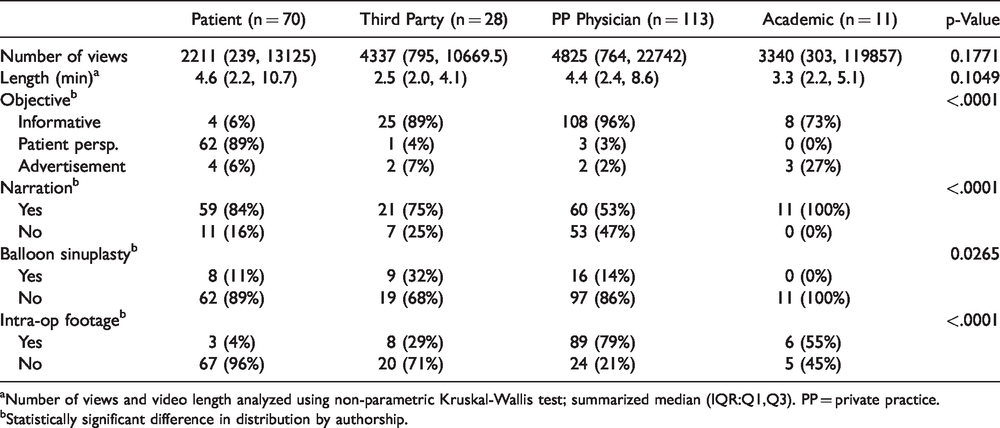
aNumber of views and video length analyzed using non-parametric Kruskal-Wallis test; summarized median (IQR:Q1,Q3). PP = private practice.
bStatistically significant difference in distribution by authorship.
Continuous variables including number of views and video length were analyzed using a Kruskal-Wallis test, because inspection of the QQ-plots suggested that they were not normally distributed. The number of views (p = 0.1771) and the video length (p = 0.1040) did not appear to differ by authorship type (Table 2). Authorship, video objective, and whether balloon sinuplasty was mentioned did not differ by number of views, regardless of which cutoff criteria (>10,000 views vs. 75th percentile) was used. Whether balloon sinuplasty was mentioned did not differ by type of video objective (p = 0.1824).
Discussion
The current study identified 222 videos related to sinus surgery on the YouTube site. Analysis of these videos demonstrated that the online content relating to sinus surgery varied significantly regarding authorship and objective. It is likely that intended audience for this content also varied substantially, although it may be difficult for members of the lay public to differentiate and identify those videos with the most relevant and reliable patient-oriented clinical information.
The majority of analyzed videos contained informative content (65%), addressing a wide variety of subtopics, including but not limited to disease-related information about chronic sinusitis, details of balloon sinuplasty procedures, typical patient experiences surrounding sinonasal surgery, expectations regarding post-operative course following FESS, and instructions on how to correctly perform high volume nasal saline irrigations. One-hundred six videos (48%) contained intraoperative footage, of which 47 (44%) were narrated by physicians. Most of the intraoperative footage was uploaded by private practice physicians (55%), and many of these narrated videos included technical content and jargon suggesting a professional audience, potentially limiting utility for patients wishing to gain a better understanding of treatment options. Analysis of video content also identified a substantial number of unnarrated videos containing intraoperative footage, which accounted for 51% of the informational videos analyzed. Given the fact that these videos contained technical content without voiceover to orient viewers or provide clinical context, they are again likely to be of limited utility to patients.
There was a reported increase in the use of balloon sinuplasty, so it was in our interest to evaluate the information available regarding its use. 14 33 (15%) videos evaluated mentioned balloon sinuplasty. One of the videos had a questionable claim that sinuses that are opened with it will remain open even though there was a study in the past that reported restenosis of sinuses is possible. 15 Overall the videos evaluated were informative in showing how balloon sinuplasty worked. It is worth noting that the video with the most views was an animation which showed how balloon sinuplasty worked.
Another common category of YouTube video content related to FESS dealt with patient perspectives (n = 70). These videos typically presented a member of the lay public discussing personal experiences during the peri- and post-operative periods surrounding sinus surgery. Although it is undoubtedly helpful for patients to relate to other individuals undergoing similar procedures, and to have patient-oriented perspective on expectations following surgery, it is not surprising that these videos varied widely in content, tone, and accuracy. Some patients described unbearable pain, while others experienced little to no discomfort. Demonstrations of post-operative care were problematic, at times including practices contrary to typical medical advice, including frequent nose-blowing, 16 application of external ice packs as a primary method for controlling epistaxis, and use of tap rather than distilled water in high volume saline irrigations. 17 As there is a rare but serious risk of fatal Naegleria fowleri infection related to sinonasal irrigation with tap or well water, 18 such inaccuracies, while easily overlooked by patients, could have potentially devastating consequences. Other areas of misinformation included erroneous procedure names and incorrect understanding of the role of medications such as oxymetazoline. Although small, such errors may ultimately result in patient confusion and clouded expectations. All in all, 17/223 (8%) of videos analyzed by the evaluator were deemed to have misinformation.
The popularity and ease of access of file sharing sites such as YouTube, combined with a lack of peer review or monitoring, provides a potentially potent platform for self-promotion and marketing. Although advertising of a practice or results may not be problematic, video content shaped by undisclosed financial bias has the potential to mislead patients. Examples of such videos include local news pieces featuring surgeons reporting extremely positive clinical outcomes, without providing adequate background in which to interpret these data.
Sixteen videos accounted for >75% of the total views of videos analyzed regarding sinus surgery (see Table 3). Interestingly, none of the videos associated with >75% of views were within the first 10 search results produced by querying “sinus surgery” on YouTube at the time of writing this article. These results are in contrast to prior studies that have reported a large majority of internet users only select links on the first page of results, and may be reassuring in suggesting that patients are exerting extra effort in seeking out relevant healthcare information. 19
Brief Summary of the 16 Videos Accounting for >75% of Total Views.
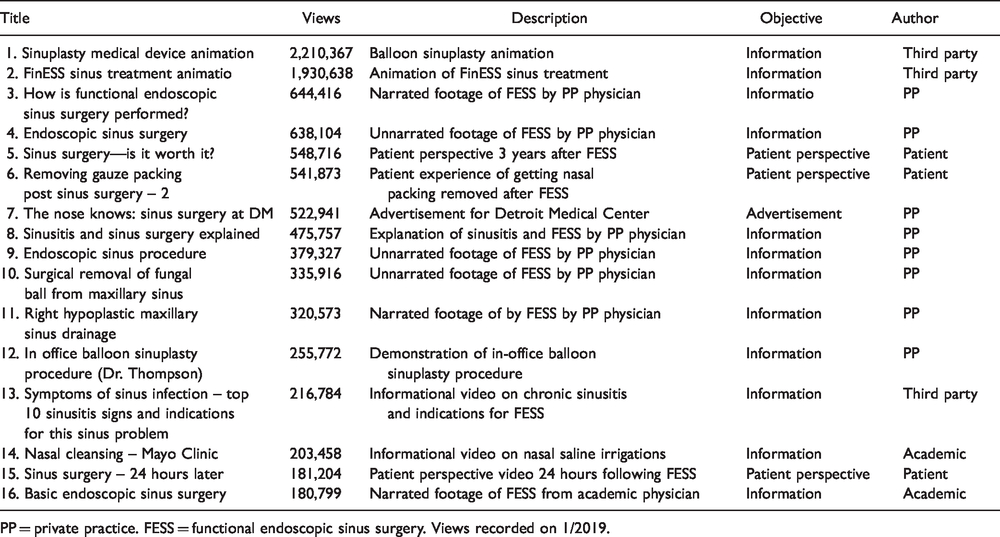
PP = private practice. FESS = functional endoscopic sinus surgery. Views recorded on 1/2019.
Analysis of YouTube video content presents several limitations. This was a cross-sectional study examining videos that were available on YouTube during early 2019. By its nature, the internet is ever-changing, and certain content may be become more or less accessible via search algorithms over short periods of time. Search results are altered as new videos are uploaded, and furthermore the YouTube algorithm continues to evolve, demonstrating the dynamic nature of online search results. 20 Although the current data are useful as an illustration of the variety in content and utility of information available online to patients considering sinus surgery, they are limited as a static snapshot of a continually changing informational landscape.
An additional weakness of the current study was the lack of an objective measure or standardized tool to assess the quality of online surgical video content. As online resources become increasingly important to patients, it is important for the medical community to develop rigorous scientific methods to assess available information and identify that of greatest value.
A final limitation of this study was that other elements of the YouTube website, such as the comments section underlying video content, were not fully explored. Video comments require little effort to create and are shielded by anonymity, and thus can be an area of substantial misinformation that may nevertheless influence patients in important and unknown ways. Further research would be helpful to better understand what online resources are used by patients, specifically regarding sinus surgery, and how these sites affect patient decision making in both explicit and implicit ways.
It is important for physicians to understand what health care information is available to and sought out by patients outside of the confines of the doctor-patient relationship. As the internet assumes an increasingly prominent position in day-to-day life, online resources have become a mainstream source of medical information for many individuals. Well-informed consent is a significant factor in optimizing surgical outcomes and avoiding malpractice in sinus surgery, and thus it is critical that surgeons are aware of the variety of external sources that shape patient expectations. 21
In an ideal world the clinician would serve as the central source of guidance for a patient considering surgery, but studies have demonstrated that recall of medical information following clinical encounters is quite limited, ranging from 34% to 88% after appointments. 22 It is thus not surprising that patients turn to online resources to bolster their understanding. Although online sites have great positive potential, they may also significantly misinform and even mislead patients. It is thus critical that the medical community understand the content of online resources like YouTube in order to preferentially direct patients to reliable information, and also to shape the creation of new resources that are tailored to provide the type of guidance that patients are seeking out.
Footnotes
Authors’ Note
Presented at the Annual ARS Meeting, September 13-14, 2019, New Orleans, LA.
Ethical Approval
This study was approved by our institutional review board.
Declaration of Conflicting Interests
The author(s) declared no potential conflicts of interest with respect to the research, authorship, and/or publication of this article.
Funding
The author(s) received no financial support for the research, authorship, and/or publication of this article.
Statement of Human and Animal Rights
This article does not contain any studies with human or animal subjects.
Statement of Informed Consent
There are no human subjects in this article and informed consent is not applicable.
