



Abstract
Objectives
This position paper from the Fragility Fracture Network (FFN) responds to the observed global variation in weight-bearing prescriptions after hip fracture surgery in older adults.
Methods
The paper summarises current guidelines and evidence regarding unrestricted weight-bearing after hip fracture surgery.
Results
The synthesis of available evidence supports the endorsement of unrestricted weight-bearing after surgery to enhance patient outcomes.
Conclusion
The FFN endorses unrestricted weight-bearing and recommends healthcare professionals, institutions, and policymakers re-evaluate practices favouring limited or non-weight-bearing prescriptions and establish a standardised system for monitoring and auditing, with clear justification and documentation of any restrictions.
Introduction
Hip fractures are associated with persistent pain, disability, and increased mortality. 1 Early surgery is the treatment of choice with a primary objective to alleviate pain and restore pre-fracture mobility.2,3 To facilitate this, unrestricted weight-bearing after hip fracture surgery is recommended by national guidelines.4,5
Despite these recommendations, a recent survey of 389 health professionals from across 71 countries reported considerable global variation in weight-bearing prescription after hip fracture surgery.
6
Overall, 73.5% of healthcare professionals reported unrestricted weight-bearing as the prescription of choice, with a notable disparity between high-income countries (86.3%) and low- and middle-income countries (41%) (Figure 1). Response to ‘Most Frequent Weight-Bearing Prescription’ by Country
6

The Fragility Fracture Network (FFN) is an international organisation that focuses on enhancing the multidisciplinary care of patients with fragility fractures, including efforts for secondary prevention (https://fragilityfracturenetwork.org/).
This FFN position paper serves as a response to the observed global variation in weight-bearing status as part of the patient’s rehabilitation prescription. The FFN endorses unrestricted weight-bearing after hip fracture surgery. This paper aims to substantiate this endorsement by the following means: 1. A summary of current guidelines on weight-bearing after hip fracture surgery. 2. A summary of the evidence on the association between unrestricted weight-bearing and outcomes.
Further, this paper will report barriers and facilitators to unrestricted weight-bearing to aid healthcare professionals, institutions, and policymakers in implementing this best practice.
Guidelines Summary
For the purpose of this position paper, recently recommended terminology to define weight-bearing will be employed: non weight-bearing, limited weight-bearing, or unrestricted weight-bearing. 7 This terminology represents the only validated, consensus-based standard, addressing the variability in weight-bearing terminology. 8
Guidelines Weight-Bearing Statements
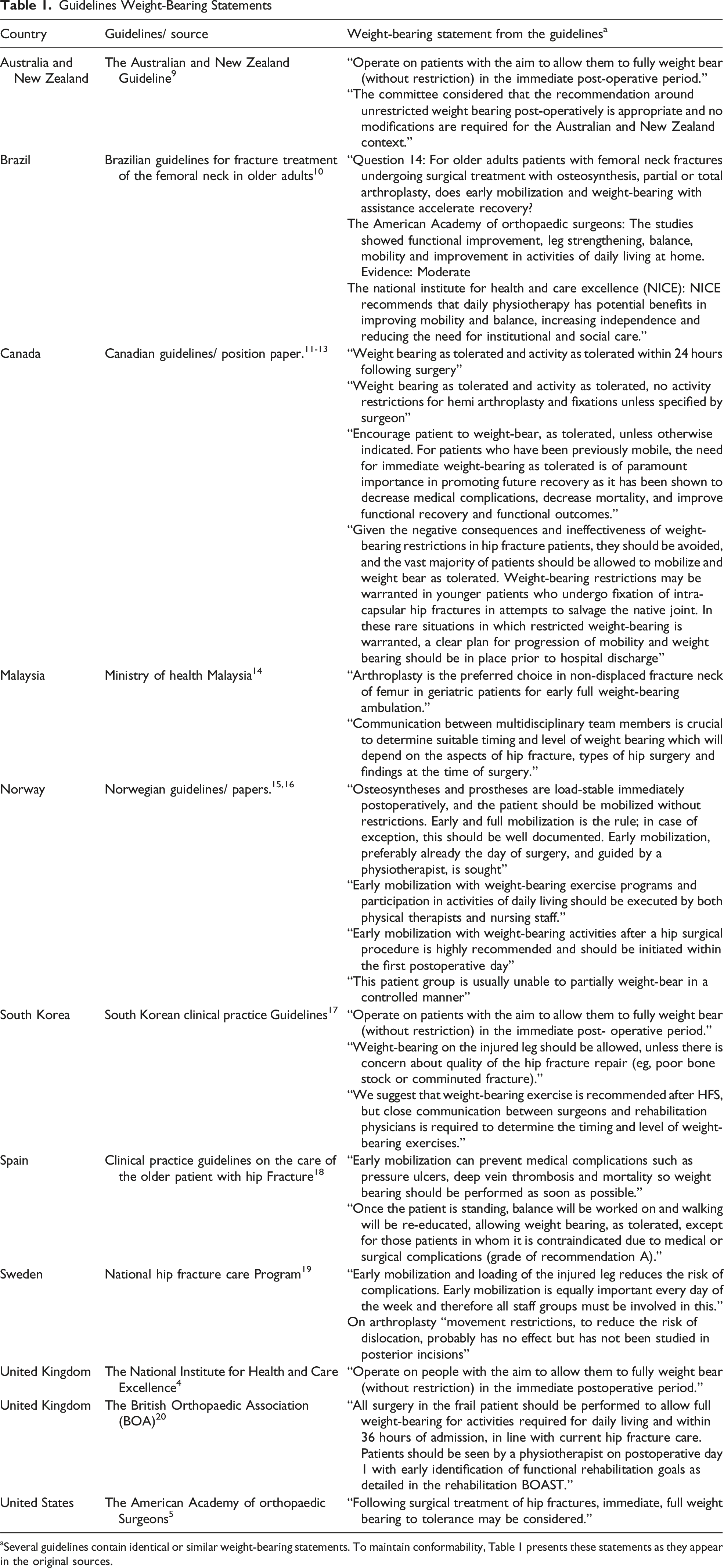
aSeveral guidelines contain identical or similar weight-bearing statements. To maintain conformability, Table 1 presents these statements as they appear in the original sources.
Weight-Bearing and Outcomes
Unrestricted weight-bearing is associated with improved functional outcomes, including reduced postoperative pain and increased mobility,21-23 as well as a higher likelihood of being discharged to home vs to rehabilitation or nursing facilities.22,24,25 In contrast, non- or limited- weight-bearing is associated with loss of mobility, which can adversely affect overall recovery. 24
Unrestricted weight-bearing from the first postoperative day results in fewer major and minor complications, such as deep vein thrombosis, pulmonary embolism, urinary tract infections, pressure sores, delirium, transfusion, and mortality within the first 30 days after surgery.25,26 Additionally, there is no evidence to suggest an association between unrestricted weight-bearing and the risk of revision surgeries due to fixation failure.21,27 On the other hand, non- or limited- weight-bearing is associated with a higher incidence of adverse events, including increased mortality, surgical site infections, pneumonia, cardiac arrest, delirium, and deep vein thrombosis.26,28 Notably, a study by Ottesen and colleagues, 26 which controlled for factors such as demographics, comorbidities, functional level and procedure type, found that patients prescribed limited weight-bearing were nearly 60% more likely to die within 30 days compared to those prescribed unrestricted weight-bearing.
Unrestricted weight-bearing is associated with shorter hospital stays,23,25 reducing overall hospital costs. In contrast, limited weight-bearing is associated with increased hospital stay.26,29 Unrestricted weight-bearing is also associated with a greater likelihood of home discharge compared to limited- or non- weight-bearing, reducing cost and burden on social care systems. 30
Implementation Challenges
Despite these recommendations, non- or limited- weight-bearing protocols are still in place. The rationale behind limited/non weight-bearing prescriptions includes patient-related factors such as poor bone quality from advanced osteoporosis and the fracture type (ie, subtrochanteric fracture), process-related factors such as the surgery type, reduction achieved, or the risk of implant failure, and structure-related factors such as the surgeries completed before holiday periods.30-35
In addition, clinicians identified further challenges in clinical practice and healthcare systems. Variability in training, the absence of standardised protocols, reliance on subjective experience over evidence-based guidelines, and the lack of routine audits and evaluations collectively lead to inconsistencies in practice.31,35 These challenges underscore the need for evidence-informed standardisation to optimise care.
Modern implants support unrestricted weight-bearing when fracture reduction is adequate, and the implant is appropriately positioned. Surgeons tend to accept that arthroplasty removes concerns about fracture healing altogether. Intramedullary fixations offer load-sharing, allowing for weight-bearing, and extramedullary implants, such as sliding hip screws, can be used successfully under unrestricted weight-bearing protocols, provided surgeons achieve adequate reduction and secure fixation. 36
Despite this, inconsistencies in weight-bearing protocols persist, with allowances for non- or limited weight-bearing often justified by implant type or perceived fracture stability. Such justifications may reflect clinical caution or health system limitations rather than absolute contraindications, especially when evidence suggests that unrestricted weight-bearing does not increase fixation failure.31,37-39 Importantly, older adults with hip fractures often struggle to comply with weight-bearing restrictions, tending to load the limb as needed to mobilise.39,40 This may lead some clinicians to adopt a precautionary approach, selectively applying restrictions to those they believe are more likely to adhere to the restriction, further contributing to variation in practice.
Furthermore, many guidelines support unrestricted weight-bearing, and some include conditional phrasing such as “may be considered” or “unless otherwise indicated”. This language allows for clinical discretion in complex cases, but it may also contribute to variation in implementation by permitting more conservative interpretations. Recent consensus acknowledges that in cases where non or limited weight-bearing is prescribed, it should be explicitly justified, with a clear rationale, defined duration, and specific nature of the restriction. 7
Recommendation
This paper represents the global FFN position that advocates for the prescription of unrestricted weight-bearing following hip fracture surgery in response to observed global variations in clinical practice. This endorsement is supported by the available evidence indicating that unrestricted weight-bearing improves clinical outcomes.
The FFN also recommends that healthcare professionals, institutions, and policymakers worldwide re-evaluate practices which lead to the prescription of limited- or non- weight-bearing prescriptions after hip fracture surgery in their organisations, in the face of increasing and compelling evidence demonstrating the benefits of unrestricted weight-bearing protocols.
We advocate for a standardised system to monitor and audit weight-bearing status, ensuring that if limited- or non- weight-bearing is prescribed, the duration of the restriction and rationale are clearly documented. The FFN serves to actively promote the standardisation of orthogeriatric care following hip fracture, inclusive of unrestricted weight-bearing protocols. This is achieved through advocacy, education, and collaboration with professional organisations from both FFN Global and the network of National FFNs. Several countries have already integrated unrestricted weight-bearing into their national hip fracture guidelines, and further collaboration is needed to support global adoption.
There should be global consistency in applying evidence-based protocols to ensure that all patients benefit equally from the latest best practices in hip fracture management. By incorporating regular audits and monitoring into routine practice, adherence to best practices such as unrestricted weight-bearing can be promoted, facilitating continuous improvement in patient care.
Footnotes
ORCID iDs

Ethical Statement
Author Contributions
Conceptualisation: KJS, FF, RM. Project administration and resources: FF, RM. Supervision: KJS and DW. Writing- original draft preparation: RT and KJS. Writing- review and editing the manuscript: RT, KJS, FF, RM, DW, AT, LB, LFC, MC, JLD, JCV, JYL, JKL, HMK, COT, MP, TS, JS, IT, RMYW, WM. All authors approved the final draft.
Funding
The author(s) disclosed receipt of the following financial support for the research, authorship, and/or publication of this article: The publication of this paper is supported by the Fragility Fracture Network.
Declaration of Conflicting Interest
The author(s) declared the following potential conflicts of interest with respect to the research, authorship, and/or publication of this article: The authors are members of the Fragility Fracture Network.