




Abstract
Introduction
The digital patient is created from a new health care environment. The path between patients and health care providers has adopted new advanced information technologies (IT), which means that contact and information between patients and health care providers can take place at any time of the day, and are expected to increases the availability of for patients, and become more time effective for the health care organization. 1
Digital health services (DHS) have begun to establish themselves in the Swedish market, which has attracted attention among different stakeholders (Capio Go, Mindoktor, and KRY). Rexha and Telemo-Nilsson concluded that DHS has been developed as a response to patients becoming more familiar with technology and claims that the service should be integrated as a part of the traditional health care service. 2 It can be assumed that enabling patients to have faster access to care is the primary motivation for adopting digital care solutions, and physicians in turn see the potential to save patients time as their biggest motivation for using digital care. However, some professionals and patients have different opinions about DHS and the digital care meeting. Physicians have expressed concerns about the process (eg, availability and increased workload, change in working methods, and uncertainty about digital tools and information security). Another factor that might threaten the service is if it is not officially sustainable; therefore, the DHS should be used carefully and with clarity about which patients’ the service can or cannot help. 2
Health care should be sustainable and equitable. To take full advantage of digital and virtual solutions, both patients and health care professionals’ experiences are crucial to the evaluation process. Studies on digital care indicate that concerns exist, for instance, regarding how digital care impacts the quality of care, the contact between the patient and health care personnel, and equity of care. 3 The effects of e-health from the stakeholders’ perspective are less clear. eHealth interventions can be described as a complement to traditional primary care, but can also challenge the role that primary health care staff will play in the future, and therefore the interest of employees is of great importance in determining the success of various new working methods. 4 Job satisfaction has been discussed when primary health care providers have assumed expanded roles because it can have a direct impact on workload and experienced work autonomy and thus negatively affect their job satisfaction.5,6 These concerns should be considered in further discussions that may contribute to the development of digital health care.
According to the National Board of Health in Sweden, 7 DHS means to use digital tools to exchange digital information in order to achieve and maintain health. Because Region Skane, southern Sweden, plans to implement a new Digital Primary Healthcare Service (DPHC) using digital written patient dialogues for permanent use, the aim of the present study was to explore general practitioners’ (GPs) experiences and satisfaction, using digital written patient dialogues.
Methods
Study Design
Present study gathered a number of actors with the ability to define what was of interest in this early phase to design a pilot study. There have been representatives from the local primary care organization, representatives from different levels of management and research representatives with assignments and experience in running interdisciplinary projects with the health care providers as end-user. Therefore, the study’s intent was to shed light on physicians’ experiences of communication, technical functionality and the service as a general activity.
As a consequence, this study was conducted using a convergent mixed method. The first part was a quantitative questionnaire survey with fixed response options, and the second part was a qualitative interview design using the “critical incident technique” (CIT) to offer a more complete picture of the context.
The concept of DPHC began with a patient call to the Swedish Healthcare Direct (1177 Vårdguiden, advisory nurses)
8
by telephone about the patient’s health condition, and nurses identified the patient eligible to participate in the pilot study. Then the patient was informed about the available Digital Doctor Reception (DDR); if the patient agreed to use the digital technology, the patient received a web address (link) to a referenced website, legitimized with a personal bank identification (Bank.ID), and completed a “medical history,” including cause of contact, background disease/s, and current inconvenience. The present pilot project was designed so the nurses included patients consecutively all day and night, then the record form was handled digitally by a GP between 6
Included GPs were senior employees trained in the concept after allowing their participation. The GPs worked with the present project outside regular working hours, which in most cases meant that the digital patient dialogue took place at each GP’s home. Inclusion criteria of the patients were: adults (>18 years) with the following predetermined diagnosis according to Appendix A, Swedish-speaking and assessed by a nurse to be able to participate in the study. The GPs and patients had access to digital technology (computer, telephone, or tablets), and the patients had access to the application Bank.ID, which enables digital identification. Patients with diagnoses that do not meet the inclusion criteria (Appendix A), that nurses considered unable to take in information about the study, or that did not have access to the application Bank.ID were excluded from the study.
The pilot study included 6 GPs who participated in the study after providing written informed consent. In the first part of the evaluation, the present study design used questionnaires with fixed response options (Appendix B); these questionnaires were complete during February and March 2019. To offer a more complete picture with respect to the questionnaire survey, a qualitative interview was conducted using the CIT, as described by Fridlund et al. 9 The same author (BI) performed all six interviews. Interviews were recorded and lasted 25 to 45 minutes. Ethical approval was obtained from the Regional Ethical Review Board in Lund, Sweden (Dnr: 2018/213), and the Office of Medical Service, southern Sweden.
Analyses
Statistics (Descriptive Part)
Collected variables were analyzed with the statistical software SPSS version 24.0 (IBM COrp, Armonk, NY), and are described in tables and figures with absolute and relative frequencies (n, %), when appropriate. The relative frequencies were dichotomized to evaluate positive response rates, based on a 5-degree Index-scale, to objectively obtain overall summaries in 3 domains: Experience communication, Experience technical functionality, and General experience DPHC. These index values summarize the percentages, strengths, and appellations as follows, inspired by Altman 10 : <0.20 = None or very bad experience; 0.21-0.40 = Bad experience; 0.41-0.60 = Fairly good experience; 0.61-0.80 = Good experience; and 0.81-1.00 = Very good experience. These index values are described as question index values (Q-IV) and domain index values (D-IV), when appropriate. Finally, an Overall satisfaction with the concept is described with a median (Md) and interquartile range (IQR) value.
CIT (Qualitative Part)
For the critical incidents to be as complete as possible, 4 requirements were met. The interview focused on critical incidents that had a strong positive or negative effect (1) with regard to the physicians’ experiences of using the new digital service system. The first author encouraged the respondents to describe the incidents precisely (2), what led to the incident (3), and how the incidents impended or assisted a successful or an unsuccessful result (4). To operationalize the interviews, the opening questions are presented in Figure 1.

Opening questions used regarding critical incidents that had an effect on digital written dialogues in primary health care.
Each question was complemented by follow-up questions such as: Can you describe in more detail in what way this situation was facilitated/hindered? Can you describe in more detail how you managed these situations?
The interviews were audio-recorded, transcribed verbatim, and then read carefully several times (by the authors BI and AJ) to create a good overview of the material and to identify CIT that responded to the purpose. Meaningful experiences and actions with regard to communication, technical functionality, and general experience were delimited, compared for similarities and differences, and grouped into subcategories. To give a description of the general character, the subcategories in experiences of CIT and actions were then grouped into respective categories. From these categories, one main area in both experiences of CIT and actions emerged. Through the process of analysis, there were repeated discussions about the categories between the authors BI and AJ until an agreement was reached.
Results
Descriptive Findings
The survey included 6 informants (50% women vs men), with a mean ± SD age of 52 ± 11 years, and worked in their profession as a GP in mean ± SD of 17 ± 13 years. The respondents’ Overall satisfaction with the DPHC concept were Md 6.5 (IQR 6-9) graded on a 10-point Likert-type scale (1 = Not at all satisfied; 10 = Completely satisfied).
Communication
The overall relative answers to questions in the domain Communication are presented in Table 1, and the D-IV suggest a Fairly good experience regarding communication abilities [(D-IV, 0.57 (Table 4)]. The results demonstrate that in the experience of GPs, the concept provided the same opportunity for giving advice, support, and teaching (Q1) and there were no reduced communication issues based on gender (Q3). However, it is notable that in the GPs’ experience certain symptoms could be more difficult to communicate (Q2) and that the concept does not achieve the same opportunity for trust in the communication situation (Q8), compared with a physical visit.
Domain Communication: Summary of Relative Questions Values, Answer Options, a Question Index Value (Q-IV), and a Mean Domain Index Value (D-IV). a
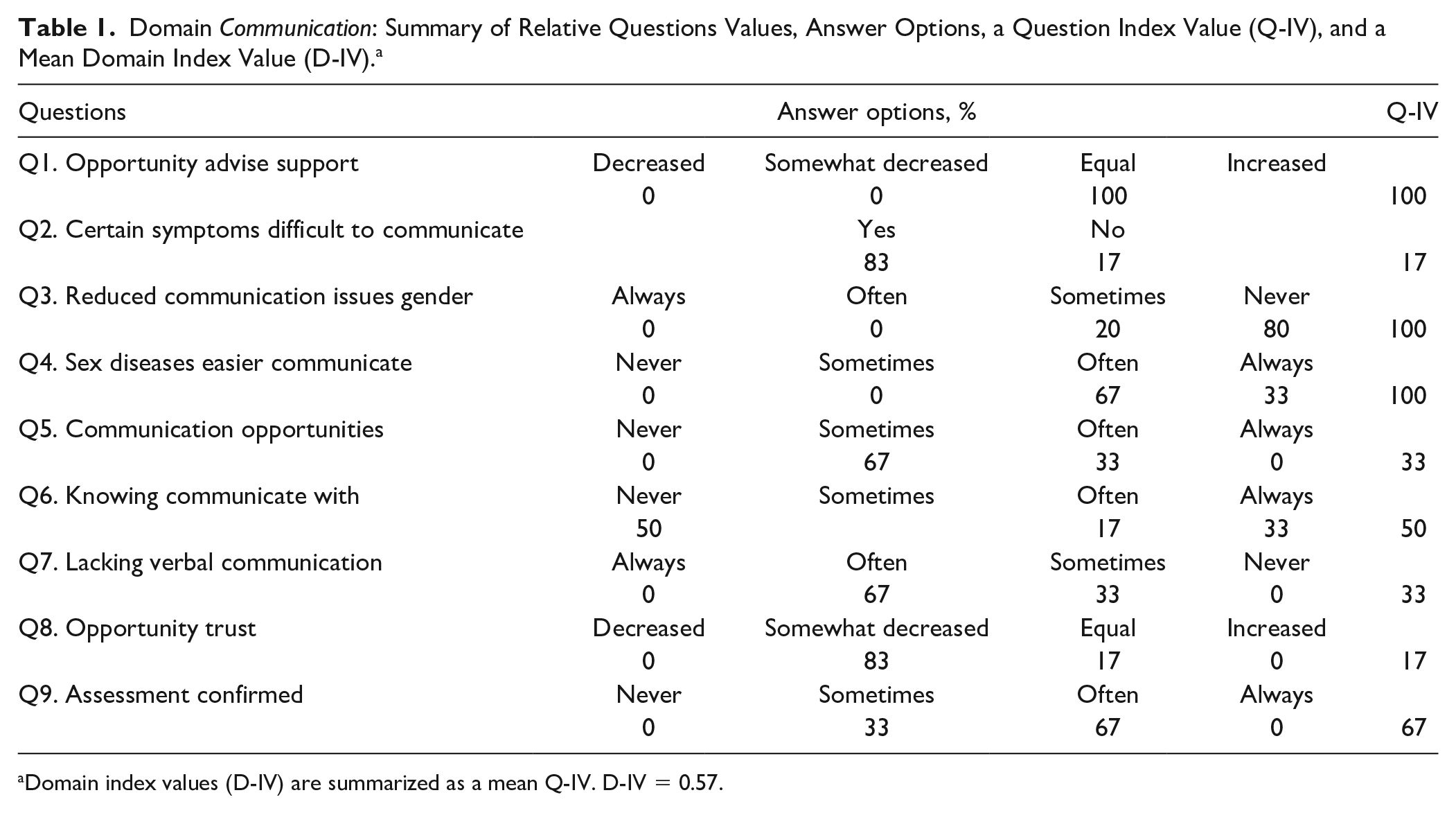
Domain index values (D-IV) are summarized as a mean Q-IV. D-IV = 0.57.
Technical Functionality
In the domain Technical functionality, GPs described their experience in this part of the evaluation as Very good [D-IV 0.87 (Table 4)]. The GPs felt the technical design was very reliable (Q10) and IT-safe (Q11) and expressed that the concept entailed reasonable processing times (Q12) (Table 2).
Domain Technical Functionality: Summary of Relative Questions Values, Answer Options, a Question Index Value (Q-IV), and a Mean Domain Index Value (D-IV). a
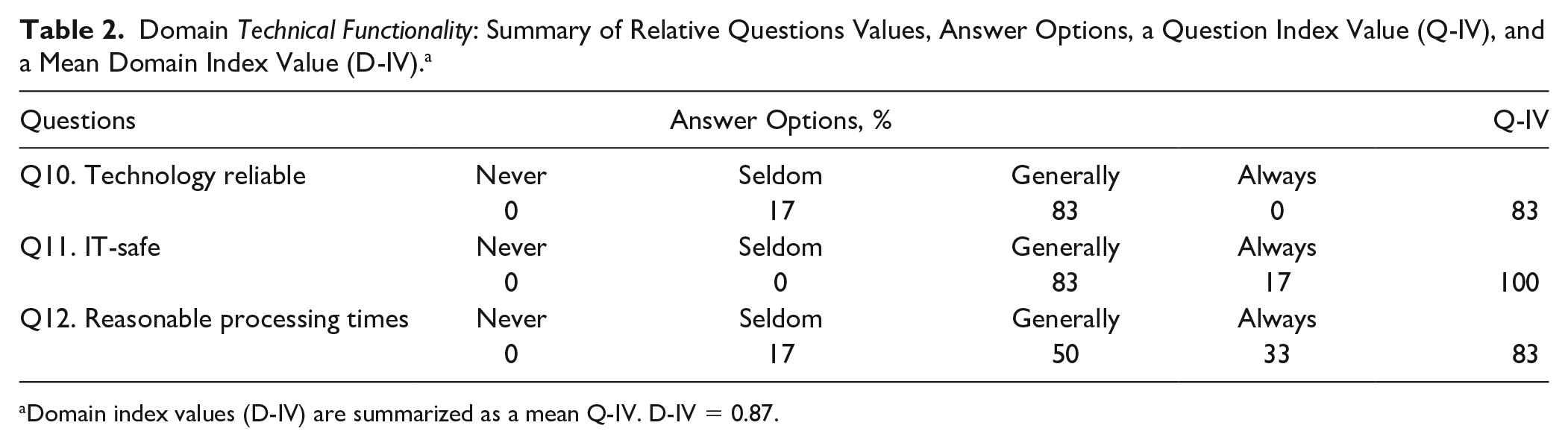
Domain index values (D-IV) are summarized as a mean Q-IV. D-IV = 0.87.
General Experience of Digital Primary Health Care
This domain showed trends for varying experiences, with a D-IV of 0.52 (Table 4), and Q-IV varying between 0 and 1.0 (Table 3). The GPs felt very well prepared (Q13), had benefit from photos (Q26), and would like to see the concept being further developed (Q27). Areas in which the respondents were more hesitant were whether the concept entailed the same opportunity to assess adequate level of care (Q18) and coordinate other resources (Q19) and whether the concept was for all patients (Q24).
Domain General Experience DPHC: Summary of Relative Questions Values, Answer Options, a Question Index Value (Q-IV), and a Mean Domain Index Value (D-IV). a

Domain index values (D-IV) are summarized as a mean Q-IV. D-IV =
Respondents’ Overall experiences, summarized as percentages, strengths, and appellations are presented in Table 4.

The present domain index values (D-IV) summarize the percentages, strengths, and experience appellations as follows: <0.20 = No or very bad experience; 0.21-0.40 = Bad experience; 0.41-0.60 = Fairly good experience; 0.61-0.80 = Good experience; and 0.81-1.00 = Very good experience. The Overall experience is described as a mean D-IV.
Evaluation inspired by Altman. 10
Qualitative Findings
The CIT results were divided into eight subcategories, three categories, and finally one main area; Hovering between traditional and digital primary health care (Table 5). Regarding how to manage these incidents, 46 actions emerged in 5 subcategories, 2 categories, and one main area: Using active strategies to handle the digital care system (Table 6).
Summary of Quotations, Incidents, Subcategories, Categories, and the Main Area With Regard to Experiences (Each Subcategory Labeled With Associated Numbers of Incidents).
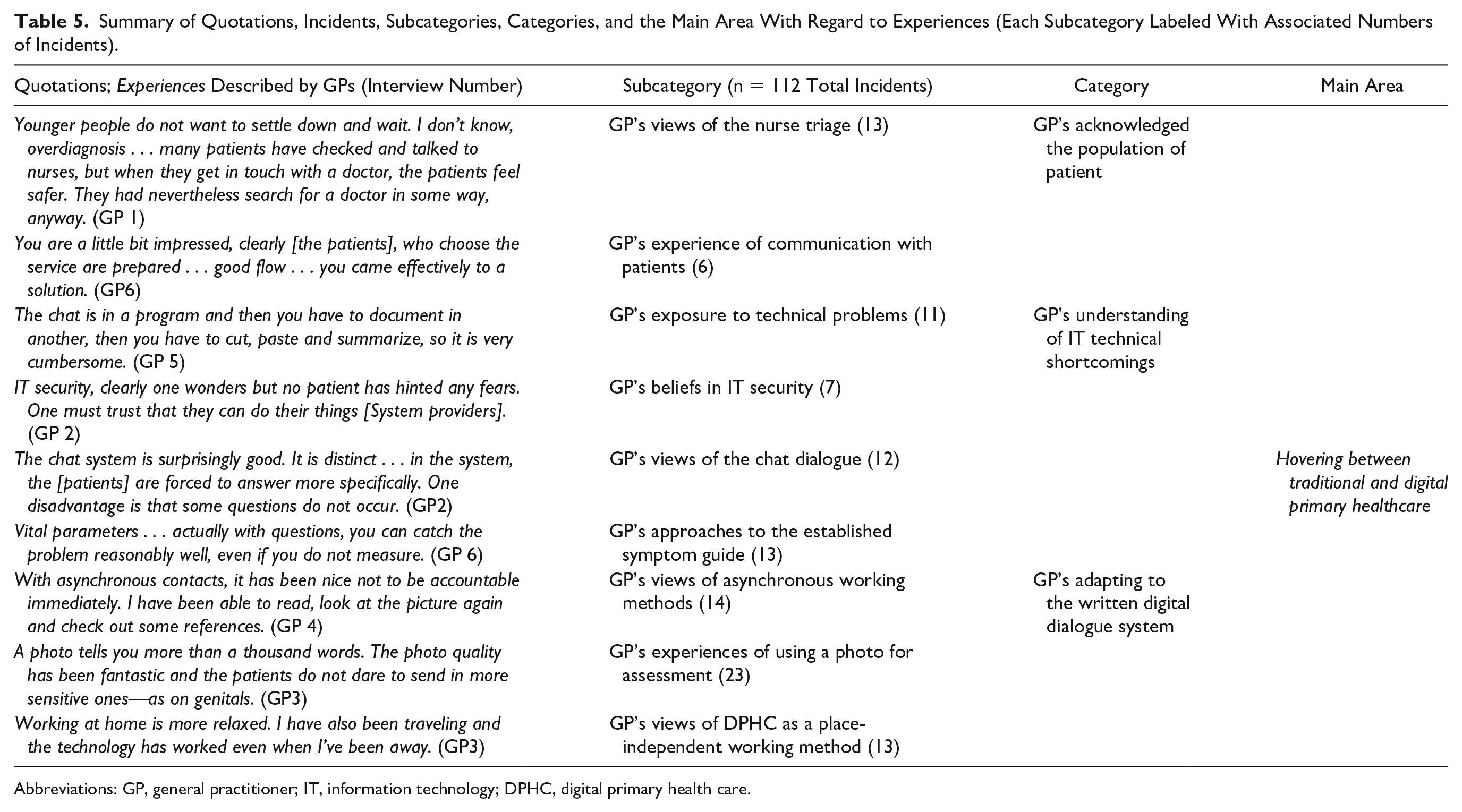
Abbreviations: GP, general practitioner; IT, information technology; DPHC, digital primary health care.
Summary of Quotations, Subcategories, Categories, and the Main Area With Regard to Actions (Each Subcategory Labeled With Associated Numbers of Actions).

Abbreviation: GP, general practitioner.
Hovering Between Traditional and Digital Primary Health Care
GPs acknowledged the population of patients
The fact that patients were initially triaged by nurses to the DPHC service was perceived positively; however, there were different views according current symptoms and purpose, and it was expected that some symptoms could be handled by the nurses themselves. However, the GPs expressed that some patients would probably have continued to contact the traditional primary health care until they were confirmed by a GP, which might affect the aim of reducing the workload for other services in the health care sector.
The GPs agreed that patients were well prepared for the present chat function. There were no difficulties in reading what patients wrote, although sometimes, the written dialogue was short and contained spelling errors. The GPs felt that patients took their time and wrote well, overall, with regard to different questions. The GPs also felt that in many cases they received positive feedback when they had finished the chat.
GPs’ understanding of IT technical shortcomings
The GPs described that they had to use one program for the chat, one journal system for reading and documentation in the primary care records, and another system for reading hospital records. They felt that it was sometimes difficult and time-consuming to connect to the last 2 systems and that problems often occurred after the computers were updated. When using the chat program, some GPs experienced that patients sometimes did not get the correct web-link, and therefore they probably missed some patients for a short period. In addition, GPs noted that sometimes it felt unpleasant and time-consuming to transfer documents and/or photos from the chat system to the patient’s personal record.
However, the GPs were convinced that these problems were related to the fact that the DPHC was only conducted in project form and would disappear with a permanent solution. The GPs also perceived the DPHC to be IT-safe (that it was the correct patient they chatted with), although the patient had to log in with a bank-ID. However, it had happened that a spouse had logged in and spoke for her or his partner. Regarding IT security, the GPs generally believed that they had to rely on the system and its storage of patient data but were aware that data security is a large and complicated area.
GP adapting to the written digital dialogue system
The GPs stated that present chat opportunity was a good complement to traditional forms of primary health care because the patients were able to contact the DPHC in a time-independent manner. They described the benefits of being able to read patients’ self-described history, some medical records in connection with the contact, which they considered to be a significant patient safety factor. However, the GPs felt that the predetermined questions in the chat-tool were not suitable for all patient when describing their health status.
Not having access to vital parameters was not perceived as a major problem, partly because the diagnoses were predetermined. The GPs thought that the chat-function admitted a decent view regarding the patient’s health condition. However, all GPs thought that headaches were not an appropriate symptom to treat via the chat-function, and some GPs stated that it was impossible to assess neck and muscle stiffness, as well as the patient’s estimation of discomfort. Symptoms of genital diseases, in both men and women, were considered to be discussed if the procedure was to be permanent, for example, in the symptom guide, only external genital complaints were suggested to be included.
Some GPs described several advantages of the asynchronous working method. They could study a picture or go back into the patient’s journal and review relevant references before and/or between contacts. Disadvantages of this asynchronous working method were described if the GPs had contact with several patients at the same time (and therefore had to assess different patients’ health status several times). However, they did not see any patient safety issues, and it was always possible to go back and check into records and what was previously written in the chat.
The GPs described the opportunity to see a photo as a great benefit and expressed astonishment at the good quality of the supplied photos, especially regarding skin conditions. But in some cases, the GPs lacked the ability to physically examine the patient. In addition, they saw being able to save the photos in the patients’ medical records for future follow-up as a great advantage and attaching photos did not seem to worry patients. Even photos depicting symptoms of genital discomfort were sent in, which could be considered very challenging for the patients. However, sometimes the GPs felt that patients might experience the chat-function as less sensitive than a physical visit.
The GPs also described the benefits of working in their own homes, which they described as quieter and less prone to disturbances than the usual workplace. At the same time, there was an agreement that a home workplace is a complement to traditional primary health care, which includes colleagues and peripheral resources. It was also pointed out that regulations governing home workplaces must be followed and that the home environment must achieve the duty of secrecy.
Using Active Strategies to Handle the Digital Care System
GP preparing the patient for the best medical action
The GPs had a restrictive approach to prescribing antibiotics. Some patients expected antibiotic prescriptions; the GPs described that they had to use their pedagogical ability to explain the restrictiveness, and they felt that patients accepted this. Based on the individual history of the patient and the patient’s records, a small number of drugs (however, no addictive drugs) have been prescribed.
The GPs described working alone and the need to sometimes get confirmation from a colleague. Although the system includes a “collegial consultation function,” they described that when confronted with diffuse symptoms, they sometimes contacted each other by telephone and/or sent photos before making a decision. In addition, the GPs were able to leave the patient data in the chat-system so that the next day’s GP could follow up if needed. Sometimes GPs have triaged patients to another level of care, such as the traditional primary care center or an emergency department, if the GP considered that a patient needed a physical visit.
GPs using tools to overcome technology barriers
The GPs described that it was stressful when they sometimes had a “hard time” connecting and/or got “thrown out” of various systems. They described that they usually used the “trial and error” method to get the technology to work properly, which could mean restarting, updating, and/or running a virus program. GPs also described the image transfer process as time-consuming and expressed wishes that if the project is to be permanent, the image-saving function must work automatically.
Discussion
It seems that the present design, using digital written patient dialogues, has the potential to become a complement to traditional forms of primary health care in Sweden. This is in line with examples from the United Kingdom and Denmark, which demonstrates that digital solutions can have a major impact on both patients’ results and the effectiveness of resources, especially if they are targeted to the right patient population. 3 A general GP view was that the patients who choose the present service were well prepared and that the concept offered a good flow, although some included symptoms were perceived as manageable by the advisory nurses. However, Ekman, 11 concluded that digital care services differ from traditional care in some ways. Patients are generally younger, utilization is higher in metropolitan areas, and users often seek help for different conditions compared with office-based primary care. Therefore, an important position is how to develop the right patients and symptom groups. New technologies are often spread unevenly in the population and according to Rogers, 12 there are 5 categories of users: innovators, early users, early majority, late majority, and laggards. The latter groups probably include many patients who have limited resources to test and therefore limited ability to communicate within the different new eHealth variants, even though these patients would probably benefit greatly from digital services. Therefore, it has to be considered that our GPs’ experiences are probably based on a majority of “early users.”
Our results also demonstrate that the GPs’ experience that the concept provides the same opportunity for giving advice, support, and teaching. However, in Sweden, it was discussed earlier whether primary care is able to achieve expectations with regard to coordination and continuity, and a survey demonstrated that Swedish primary care physicians did not always have the mandate, time, and IT support needed to coordinate and plan healthcare for their patients. 13 Based on our result, we think our written dialogues provides the same level of opportunity as a physical visit.
In the Technical functionality domain, the GPs’ experiences of this part of the evaluation were Very good. But uncertainties were raised when the technology did not work properly or if the patients experienced problems when using the written dialogues. The GPs described that it was sometimes stressful and that they had a “hard time” connecting and/or got “thrown out” of the systems, and that they used the “trial and error” method to get the technology to work properly. This “trial and error” method probably affects/stresses their workload and needs to be solved, maybe partly with education but also together with different web designers, in order to make the concept work more stably. Notably, none of the participating GPs commented an otherwise stressful working climate. This can probably be explained by the fact that participating GPs worked voluntarily, outside their regular working hours, and it is therefore difficult to comment on how a similar concept affects the daily work at a regular primary care center.
Patients’ and physicians’ concerns about how digital solutions may affect the quality of care have been described previously; physicians in particular have expressed concerns that the consumption of care may increase. 3 As far as the present author knows, there are no major studies that can confirm this in the Swedish context. However, the digital health care “meeting” is approaching for diseases and illness that do not require a physical examination. As mentioned above, future work must, therefore, result in which symptoms (and therefore which patient groups) are most suitable for this concept.
Today, 2 different modes of communication are mainly used in the “digital meeting,” either a video-based or a text-based medical contact is offered. The video-based medical meeting uses synchronous communication (contact in real time), and the text-based medical contact offers an asynchronous communication approach in which the physician responds within hours. The GPs in the present study expressed satisfaction in that working from home felt relaxed, even though the way of working entailed an asynchronous working method. There are probably several reasons why asynchronous communication might be preferred. We think it is more flexible for both the GP and the patient. The patient can respond within a time frame that suits (increases acceptability), and the GP can handle several patients at the same time, which probably increases the efficiency of access, although it means different patients’ health status is assessed several times.
An experienced advantage with present web design was that all communication between GPs and patients was documented. We think this part of the dialogue could contribute to an increased patient safety factor, since it is a part of the patient’s participation in their own care and medical history. However, an earlier survey had demonstrated the value of a permanent personal physician, and indicated that patients with a permanent personal physician experience more effective coordination of their health care, and encounter fewer problems resulting from shortcomings in dialogue. 14 Using written patient dialogues might, therefore, be the reason why GPs sometimes did not experience the same opportunity for trust in the communication situations.
It is not possible to draw any clear conclusions from our survey about the digital written dialogues in primary health care. However, the results could be an element in understanding how digital written dialogues are experienced and the conditions under which these physicians work. The aim was to contribute to a better understanding of strengths and weaknesses and to initiate further discussions that could contribute to the development of digital care, which is one future e-health goal, according to the Swedish Government’s “Vision of e-Health 2025.” 15
Strength and Limitations
First, the design of the present pilot study could have geographical limitations, for example, in areas where it is not possible to have cooperative collaboration with advisory nurses. However, in areas with overall similar conditions it may appear to be an alternative to traditional primary care.
Second, the method we used to explore the experiences has both advantages and disadvantages. Normally, questionnaire surveys have a low response rate, but all included physicians responded to both parts of our pilot study. A further disadvantage of questionnaire surveys is that the respondents cannot convey developing responses; therefore, we chose to supplement with a qualitative part to obtain as nuanced a picture of the questionnaires as possible, and we believe that our selected converging mixed method design provides an in-depth interpretation that can improve the image of this new digital concept.
As a final point, regarding the validity and reliability of the interviews, we cannot estimate the honesty of the answers collected or that we consistently interpreted the CIT correctly. However, our questions have been asked in an honest and investigative manner, and we believe that we have had a good conversation climate. But it must be pointed out that the result is based only on a few questionnaire respondents and interviews; therefore, we cannot comment on the overall strength of reliability.
Conclusion and Implications
This pilot study suggests that present design using digital written patient dialogues offers a good complement to traditional primary healthcare. The GPs described satisfaction and expressed Good experiences of the concept, although further design development is needed. Further studies are necessary to assess how the technology can be sharpened, as well as how the organization, community costs, and above all, the patients’ health are affected.
Footnotes
Appendix A
Appendix B
Acknowledgements
The authors thank all involved respondents and the advisory nurses for their willingness to participate in this study.
Author Contributions
All authors participated in the design of the study. AJ and BI participated in the enrolment of the respondents and the writing of the manuscript. AJ performed the statistical analysis, BI and AJ analyzed the interviews, and ML participated in drafting the article for important intellectual content and the writing of the manuscript. Finally, all authors contributed to the final approval of the version to be submitted.
Ethics Approval and Informed Consent
Ethical approval was obtained from the Regional Ethical Review Board in Lund, Sweden (Dnr: 2018/213), and the Office of Medical Service, southern Sweden. The study protocol was approved by the department head, and the respondents were informed that information would be kept confidential and that they could withdraw participation at any time with no explanation. All collected data were stored securely, accessible to the research team only.
Declaration of Conflicting Interests
The author(s) declared no potential conflicts of interest with respect to the research, authorship, and/or publication of this article.
Funding
The author(s) disclosed receipt of the following financial support for the research, authorship, and/or publication of this article: Costs for implementing the project and the ethical board application were paid by the Office Medical Service, Region Skane, Sweden.
