




Abstract
Views on the medical efficacy and acceptability of marijuana have changed over the years. California was the first state permitting individuals to use medical marijuana. Even with a long history of use and widespread agreement around the effectiveness of medical marijuana, the literature is sparse about the role health care providers, including pharmacists, play in this interaction. The purpose of this article is to shed light on knowledge and attitudes of pharmacists regarding medical marijuana. We developed a survey for pharmacists about their level of knowledge and attitudes toward medical marijuana. The survey was distributed using SurveyMonkey. It consisted of 44 questions and an opportunity to provide comments. We collaborated with the California Pharmacists Association who provided a link to the survey in October 2017 to their members. Results from 474 responses indicate a majority of providers believe that marijuana has medical efficacy. Yet most providers report that they neither have much information about medical marijuana nor do they know where to get such information. One area of particular concern is the potential for drug interactions. Pharmacists would feel more comfortable discussing medical marijuana if it was approved by the Food and Drug Administration. Moreover, they believe more research needs to occur. The variance between California and federal policy leads to dysfunction among pharmacists providing information to patients. We believe federal policy should change.
Introduction
Since California passed proposition 215 in 1996 legalizing medical marijuana, the majority of states plus the District of Columbia, Puerto Rico, and Guam have passed similar legislation. Moreover, public views of medical marijuana have changed dramatically over time—today 91% of adult respondents support use of medical marijuana when approved by a physician. 1 Opinions of health care professionals have changed too with many physicians and others supporting medical marijuana.2-5 In 1989, 41% of physicians believed medical marijuana should be legalized, though views on its use varied by specialty. 6 A majority of oncologists, 54%, believed that marijuana should be available by prescription and 48% said they would prescribe it to patients. 7 Most hospice professionals also favored legalization and believed that it could be used effectively to manage symptoms. 8 This finding is consistent with an international poll of physicians reported in the New England Journal of Medicine in 2013 that revealed 76% of respondents supported its use. 9 Many who opposed it, cited concerns about dosage and legitimacy of the supply chain.
Such issues have drawn attention of public health professionals who have been exploring their relationship to new legalization frameworks. 10 There has been scholarship on the effect of increased access, whether it be through legislation or technology.11-14 Another common concern is the role marijuana might play in traffic fatalities, the rate of suicides, or emergency room visits.15-20
The legal environment of marijuana is murky and problematic with legalization in many states but not at the federal level. Federal law matters especially because the Food and Drug Administration (FDA) has considerable authority over the prescription drug industry. This situation raises many issues regarding medical marijuana. A 2007 paper addressed many of these, including legal and practice issues that pharmacists may face. 21 Since every state has different laws and regulations for medical marijuana, it is difficult to provide standard advice but the American Pharmacists Association (APhA) did so in 2015. 22
The importance of pharmacists for both medical and recreational marijuana continues to evolve as the availability of cannabis becomes more widespread. They are being asked to provide information and support to patients, and in some states such as California, are considered medical providers.23,24 Some research has described the views of medical professionals—doctors, and medical students, but little is known about pharmacists’ views and opinions regarding medical marijuana. 25
Although the existing literature is limited, a few studies have explored how pharmacy students view medical marijuana. In a 2015 study, most pharmacy students, like other health professionals, stated that they believed marijuana should be legalized. However, the students also reported that they could not respond appropriately to a range of client concerns around the efficacy and impact of medical marijuana. 26 These findings were corroborated in a later study that revealed 80% of students would like medical marijuana addressed in the curriculum. 27
Another important study focused on pharmacists in Minnesota (shortly before legalization of medical cannabis in 2014). It sought to assess competency and the degree to which they felt confident about interacting with patients. The answers provided to the 14 questions represent an important step in identifying problems and issues pharmacists confront in an era of ever-increasing legalization, for it revealed, “an overwhelming majority felt incompetent in medical cannabis clinical knowledge.” 28 This finding is particularly significant as the Minnesota law requires not only that patients are certified by health care professionals, and be part of the state registry but that patients receive their medical marijuana from a Cannabis Patient Center under the care of a licensed pharmacist who is onsite. 29
Since further research is clearly warranted, we decided to explore this situation in California, a state that has been grappling with these issues for more than 20 years. Specifically, we sought, in association with the California Pharmacists Association (CPhA), to determine the degree to which the knowledge issue remains widespread as well as the present status of their attitudes and opinions.
Data and Methods
The authors and support staff developed a survey. It was amended following a prelimary test on a small number of pharmacy students and faculty. The survey was revised based on those responses for content and clarity as well as to reduce completion time.
The survey, conducted in October 2017, had 44 questions plus opportunity to provide comments. Many of the questions were designed using 7-point Likert-type scales. These were divided into 4 sections. The first, gathered demographic information regarding age, gender, race, industry experience, and so on. The next focused on respondents’ knowledge of medical marijuana and interactions with patients. The third dealt with participants’ opinions regarding medical marijuana and dispensing options. The final area focused on educational and research issues, including future policy developments. These results are reported with descriptive statistics, specifically percentages. At the end of the survey, respondents were provided space to amplify any answers that they had provided earlier.
Participants in the survey were members of the CPhA, the largest association of its kind in the state. Pharmacists, technicians, and pharmacy students are eligible for membership. A link for the anonymous survey housed on SurveyMonkey.com was sent to the membership. The survey was available for 4 weeks. To increase response rates, potential participants were offered a chance to win a gift card and 2 reminders were sent out, asking them to participate in the survey, to all members of the CPhA.
Stata was used to provide P values. The null hypothesis was an equal distribution of responses across choices. Pearson chi-square P values are shown in Table 2.
Results
A total of 474 surveys were completed. This is not a large proportion of the more tha 6,000 members of the CPhA, but it does, for the most part, seem to be representative of the CPhA as a whole. Table 1 shows that most respondents were pharmacists (84%) and women (59%). Forty-nine percent were Asian, 39% Caucasian, and 12% were Hispanic, African American, or other. Seventy-two percent of respondents were younger than 50 years. A large proportion had 5 years or less of experience as a health care professional (44%), 12% had 6 to 10 years, and 13% had 11 to 20 years of experience.
Demographic Profile.
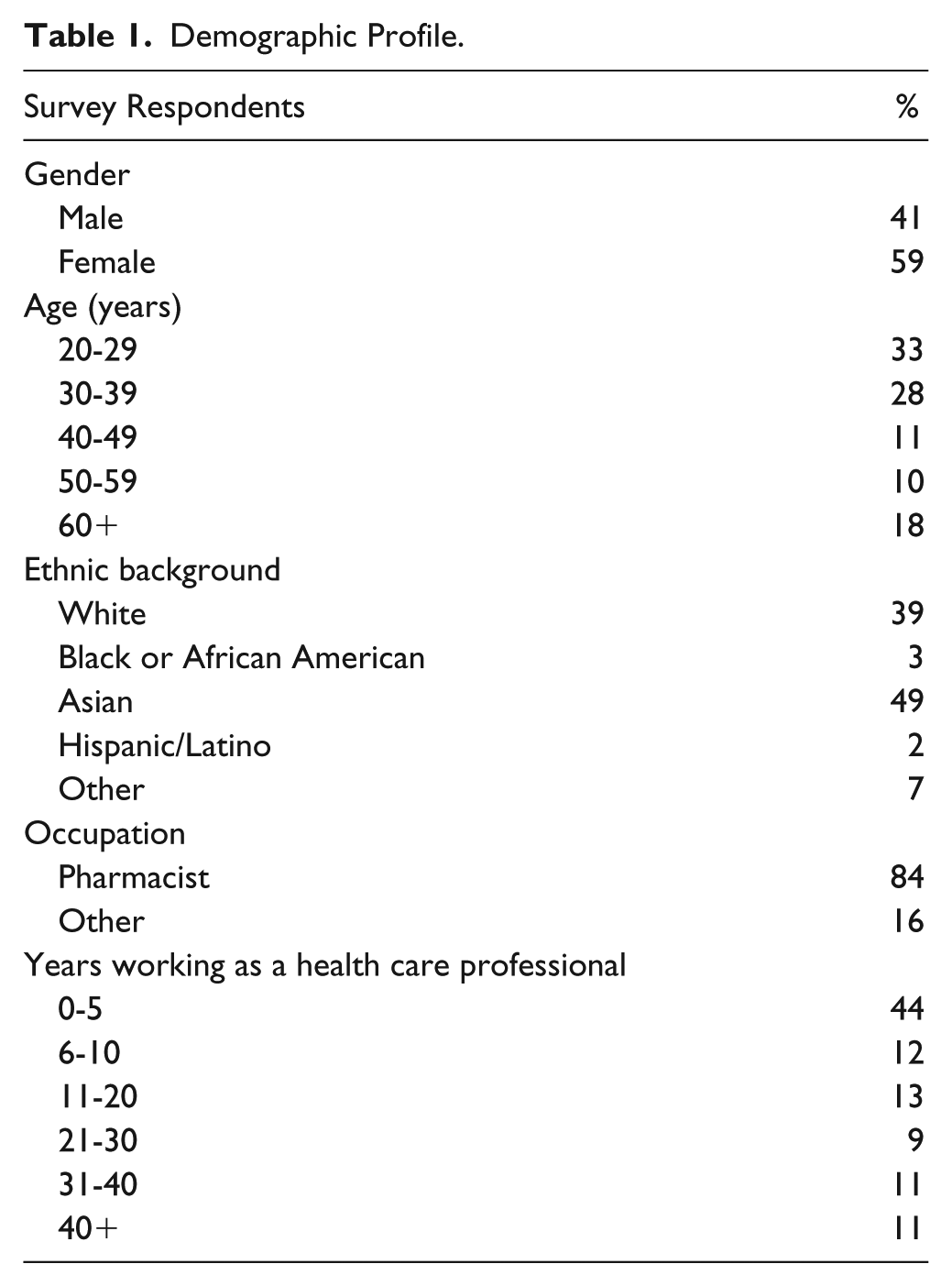
Table 2 shows selected survey results. When participants were asked specifically about the extent of their knowledge regarding medical marijuana, most answered they had “very little” (32%) or only “some knowledge” (25%). Less than 5% of respondents stated that they had a “professional level of knowledge.” Thus, not surprisingly, when questioned about risks and side effects, most of the participants declared they only have “some knowledge” (28%) or “moderate knowledge” (26%). Similar results were obtained about dosage and marijuana types. Most responded they had either no knowledge (15%) or very little knowledge (38%) of the various types of marijuana. Only 4% responded that they had a professional level of knowledge in this area. Table 2 also indicates respondent attitudes regarding medical marijuana. The clear majority (almost 75%) think medical marijuana has medical efficacy. The majority indicated they know where to find information about medical marijuana. However, 92% felt more education about marijuana was needed and more than 91% preferred continuing education credits be available for marijuana education. The bottom of Table 2 shows priority research topics. Respondents could select multiple topics and the result was a relatively even distribution. The P value was .085. Topics of greatest interest include pain management, effect on specific diseases, and dosage.
Results.

Survey comments (not shown) were very informative and generally fell into three categories: industry governance/distribution policies, research, and knowledge. The first category concerned ability to dispense the product. One example was the “state board of pharmacy needs to allow pharmacists to participate in distribution and sale of Medical Marijuana.” Another person added, “I have my own pharmacy and would love to be able to dispense marijuana legally.”
Comments about the need for more and better research featured prominently. For example, one person stated, “If there is more info available from studies on strain and efficacy of delivery methods, then providers would be able to recommend the proper dosage and types of marijuana available.” Another responded that the “federal government should facilitate and encourage rather than hamper the research of medical marijuana.” Another person stated, “The overall lack of systematic research was of great concern. There are just not enough concrete studies to significantly recommend marijuana with confidence as a pharmacist.” Similarly, a person stated, “more evidence-based research needs to be conducted and evaluated before efficacy can be established.” Finally, there was a call for specific areas to be investigated, “research needs to distinguish the difference in effect on symptoms (such as pain) and a change in the course of the disease where relevant (eg, mucosal healing in Crohn’s/inflammatory bowel disease).”
The final category of comments was knowledge. Primarily, respondents discussed the need for more education. One respondent suggested, “a lot more education needs to take place on medical marijuana along with supporting research using clinically acceptable standards in order to judge its place in therapy and society.” Another person stated, “More CEs should be given on medical marijuana and more patients should be encouraged to ask their pharmacist about it and how it may interact with their current drugs.” The other issue raised was the need to educate the consumer about the benefits and pitfalls of using marijuana as well as related safety issues such as driving.
Discussion
The study findings raise important issues, especially considering marijuana’s growing popularity and usage. The level of pharmacists’ knowledge in this area deserves careful consideration. Findings from the survey show most pharmacists (55%) believed that they knew where to find information about medical marijuana. This is mildly reassuring, but serious concerns arise when the knowledge question is explored further since few possess information themselves. Fewer than 10% stated they had a high or professional level of knowledge, most acknowledged they only had very little (33%) or some (25%) knowledge. This is reflected in their responses to specific areas—the highest level, concerns risk and side effects where 50% possess moderate to professional levels of knowledge. However, almost 70% had little or no knowledge of dosing, and almost 43% had no to very little knowledge of different types/forms of medical marijuana products. Clearly, if patients go seeking advice from pharmacists about either dosage or different types of products, pharmacists do not generally possess the necessary knowledge to help unless they engage in further research.
This lack of knowledge may explain why pharmacists typically do not discuss medical marijuana with patients (44% never, 38% rarely; and in less than 10% of occasions when they could have). Particularly interesting is pharmacists’ beliefs that adverse effects for patients are moderately (20%), very (34%), and extremely important (16%). Similarly, they responded that drug interactions for patients using medical marijuana are moderately (14%), very (41%), and extremely important (19%). Lack of discussion with patients is surprising and disturbing given pharmacists’ concern with potential for negative effects. Moreover, most pharmacists indicated that if asked, they would never provide information to patients about either where to get medical marijuana (62%) or about particular types or forms of medical marijuana (62%).
These findings raise issues regarding where patients can get information about medical marijuana and how it might affect their overall health. In addition, most pharmacists (54%) indicate that they neither ask patients about their medical marijuana use nor do they monitor it (67%). Therefore, it seems not only is there a problem regarding availability of important information but also if pharmacists are willing to ask about patient use. We believe much of this reluctance to discuss medical marijuana is due to its marginal legal and social status, outside the traditional framework. This is primarily a social problem, not a professional one. Most pharmacists (almost 75%) agreed they would feel more comfortable discussing medical marijuana if it was FDA approved. Altering the status of marijuana in this way would lead to a dramatic change since almost half the respondents are distinctly uncomfortable with the current system and a third neither approve or disapprove. Still, there is no consensus regarding the role of pharmacies as dispensaries (39% are supportive and 39% oppose). There is less support in hospitals (30% are supportive and 43% oppose). However, most (53%) of respondents would be more in favor of medical marijuana if it was available with a prescription from a pharmacy.
This pilot study has a response rate of less than 10% of all members of the CPhA. We do not know the extent of any sample bias. Perhaps those motivated to respond have a different profile of most members. Future research is necessary to address this issue.
More research concerning the efficacy and utility of marijuana to treat specific medical conditions needs to be carried out. Fifty-eight percent of respondents “strongly agree” and 26% “agree” with the statement “more research should be conducted on the use of marijuana for medical purposes.” When given a list of potential research topics, their responses clearly indicate a belief that research should occur across a wide range of areas from pain management, dosing to efficacy to specific medical conditions. However, a relatively high P value suggests pharmacists do not have a very clear idea of priorities.
Conclusion
Social change and medical knowledge are propelling marijuana to the mainstream of therapeutic options. However, discordance between state and federal policy renders marijuana dispensing and care dysfunctional. Pharmacists committed to patients are caught in an awkward position, unable to dispense marijuana and reluctant to violate the letter and spirit of federal law in working with patients to access and properly use cannabis products. The public mood is clear, and not just in California. We believe federal reform should be enacted to free development of supply and care options available to consumers. This would make the overwhelming majority of pharmacists more comfortable providing marijuana-related care to patients.
Health care providers, managers, and policy makers should anticipate further legitimization of medical marijuana. This has consequences for supply at the level of communities. The Canadian Pharmacists Association recommended retail dispensing of marijuana at pharmacies and this proposal is under serious consideration at the federal level in Canada. Parallel consideration of distribution at retail pharmacies in the United States seems likely. Alternatively, distribution of marijuana through homeopathic, natural health food, and other less regulated channels could also emerge.
Footnotes
Acknowledgements
Authors would like to acknowledge the valueable contributions of Brandon Le and Stephanie Zeng to development of this paper.
Declaration of Conflicting Interests
The author(s) declared no potential conflicts of interest with respect to the research, authorship, and/or publication of this article.
Funding
The author(s) received no financial support for the research, authorship, and/or publication of this article.
