




Abstract
Aim:
This study analyses discourses on marijuana in the Polish daily press and explores ways of defining “the marijuana problem” during a debate about legalisation of medical marijuana.
Methods:
384 press articles published in three national newspapers in 2015–2016 were analysed. The method used was discourse analysis. The theoretical background was social constructionism, including Spector and Kitsuse’s four-stage constructionist model of defining social problems.
Results:
The study shows that marijuana problems were mainly constructed through criminal and politically medical discourses. In addition to celebrity and pop culture discourses, recreational marijuana use discourses and social problems discourses were identified.
Discussion:
The marijuana problem can be defined differently through various discourses. Definitions pertain to diverse marijuana meanings ranging from a negative marijuana-as-drug, through an ambivalent recreational marijuana up to a positively valued medical marijuana. The research pointed out that, from a discursive standpoint, the marijuana problem may be viewed as a complex network of relations between particular discourses, marijuana meanings, claim-makers and the media.
Conclusion:
Different definitions of the marijuana problem are constructed through a dynamic discursive and social process. Various claim-makers try to impose their meanings on marijuana. Mass media are not neutral. They also participate in defining the marijuana problem.
Keywords
Marijuana is the most popular illicit drug worldwide, in Europe and in Poland (EMCDDA, 2019; UNODC, 2016). However, in various public discussions marijuana, apart from being treated as a dangerous substance (“poison”), is sometimes considered as a “remedy” (Acevedo, 2007). Since the 1990s, marijuana as well as other cannabis derivatives have been (re)medicalised and have become the object of scientific and political debates (Sznitman & Lewis, 2015; Taylor, 2016).
Fluctuations in approaching marijuana indicate that, it is a historically changing problem depending on social interpretation. In public discourses marijuana acquires various meanings related to such diverse ideas as: “illicit drug”, “crime”, “soft recreational substance”, “natural plant”, “medical substance” (Acevedo, 2007; Sandberg, 2012). This diversity, fluctuation and ambiguity of meanings reveals that the problem called “marijuana” can be defined differently by various social actors.
This study focuses on the process of defining the “marijuana problem” through different discourses. In line with a the constructionist approach it is assumed that the social process is essential for defining the marijuana problem. Potentially, several possible problems can be related to marijuana. It may be marijuana use among youth, marijuana dependence and problematic use in the general population, illegal supply by criminal groups, but it may be also criminalising non-problematic users due to a restrictive drug policy or denying access to medical marijuana because of lacking legal regulations. These problems have different meanings, scale and may affect various persons. However, in order to make any of these issues part of the public agenda it is necessary to define the marijuana problem, articulate it and institutionalise it.
In 2015–2016, a public debate concerning medical marijuana and its legalisation occurred in Poland. This debate led to the altering and widening of the definition of the marijuana problem. Instead of being viewed as a solely criminal issue, the problem received also a new dimension due to medical marijuana. The term “medical marijuana” refers to cannabinoid-based products authorised for medical use (EMCDDA, 2018).
In order to outline a broader context for the marijuana problem in Poland, one should note that Polish drug policy is among the most restrictive in the EU (Bujalski, Dąbrowska, & Wieczorek, 2017). Since 2000, the criminalisation of drugs has continued. The focus on prohibition and penalisation makes Polish drug policy similar to the policies in Scandinavia, where criminal control and sanctions are the preferred measures against drugs, including marijuana (Egnell, Villman, & Obstbaum, 2019; Lenke & Olsson, 2002). However, differently than in Scandinavia, medical or welfare solutions are poorly available in Poland. Therefore, treatment cannot be considered as a real alternative to the dominant criminalisation (Krajewski, 2007). Despite the restrictive drug policy, recreational marijuana use in Poland has grown, especially among 15 to 24 year olds (EMCDDA, 2019; KBPN, 2018). In 2016, 42% of Polish teenagers reported having used marijuana or hashish at least once in a lifetime, whereas 21% had used it in the last year and 9.9% during the last 30 days (CBOS, KBPN, 2016, p. 221). In 2008, these data were respectively: 30.5%, 16.4%, and 7.3% (CBOS, KBPN, 2016, p. 221). This trend is more dynamic than in majority of the Nordic countries. However, even in Scandinavia, marijuana use, especially among young adults, has been growing or at least not diminishing (Egnell et al., 2019).
The Polish legalisation debate was intensified after the parlamentary elections in October 2015. A new anti-establishment party, Kukiz’15, that entered parliament, promoted medical marijuana (MM) and declared the need to change the law. The process was led by Piotr Liroy-Marzec, an anti-systemic politician, celebrity and a former rap singer. In February 2016, he proposed a draft law to parliament. However, further legislative work was obstructed by the ruling conservative party, halting the legalisation process for several months. It gained a new momentum in August 2016 when Tomasz Kalita, a former social democratic politician, contributed to the debate. He became an oncological patient and demanded access to MM. His very emotional social media posts were widely commented on. In support of Kalita’s claims, the social democratic opposition quickly sent another draft law to parliament (so-called “lex Kalita”) aiming at MM legalisation. The ruling conservative party was put under pressure by the opposition, social activists and the media. As a result, the legislative process was relaunched. Finally, in November 2017 MM gained the legal status of a pharmaceutical preparation. But it took one year more for the authorities to grant a marketing authorisation for MM.
The goal of the study is to analyse how marijuana, especially MM, was defined through various discourses in the Polish daily press during the legalisation debate (2015–2016). It explores how different discourses and claim-makers constructed medical marijuana and the marijuana problem. Moreover, the author proposes to use Spector and Kitsuse’s (1973, 1977) model of constructing social problems for interpreting the MM legalisation process. The term “marijuana problem” is to be understood as a social process of defining what kind of marijuana problem is relevant to a given society, whether it has predominantly a criminal, medical or social nature. The expression “marijuana problem” suggests that this is a single issue. However, it is rather a bulk of problems that are publicly articulated. For the police who promote criminal discourse, marijuana is a criminal problem. For some politicians, doctors, social activists and patients who use medical or politically medical discourse, marijuana is a medical substance. For some celebrities, activists or youth who endorse celebrity or contestation discourses, marijuana is a “soft” recreational substance that should not be criminalised. In pluralistic societies various discourses exist and compete for a dominant position and the media and public attention. As Laclau and Mouffe (1985) point out, it is not possible to monopolise or fix the meaning of specific issues or ideas, as various competitive discourses exist and offer alternative explanations. Therefore, the marijuana problem tends to be defined in a particular way by a dominant discourse but it can be also articulated differently, especially when new circumstances arise.
The study contributes to the area of media discourses on marijuana. It investigates the role of social actors, including the media, in challenging traditional criminalisation of marijuana and promoting a new definition of the marijuana problem by its medicalisation and politicisation. Traditional criminalisation of marijuana has been challenged worldwide by claims about its medicalisation or liberalisation of drug policies (Park & Holody, 2018; Stringer & Maggard, 2016). Such claims also appear in the Nordic countries (Egnell et al., 2019) and they might change the social context for defining the marijuana problem. As the study suggests, even in countries with restrictive drug policies, such as Poland or the Nordic states, redefinition of the marijuana problem might be possible, especially when new claim-makers can access the mainstream media and propose their alternative problem definition. These new claim-makers may be anti-establishment parties, charismatic celebrities, social activists, etc.
The main and novel contribution of the study is based on two findings. Firstly, politicisation of medical marijuana was explored. Previous works concerning discourses on marijuana (Månsson, 2016; Sznitman & Lewis, 2015) did not elaborate on political aspects of MM. Secondly, the current report investigates the role of the media in defining and recognising social problems, including marijuana. The study demonstrates that the media may make claims (directly or indirectly) and promote specific definitions of marijuana. In particular, the study explores: (a) how the marijuana problem is constructed through politically medical, criminal and other discourses; (b) the role of privileged actors in defining marijuana (social) problem; (c) legalisation debate as a dynamic social process; and (d) the role of the media in promoting particular discourses and problem definitions.
Theoretical framework
The research is based on social constructionism. It is assumed that: (1) the marijuana problem is not a static condition but a dynamic historical process that can undergo changes; (2) constructing (defining) the marijuana problem depends on various meanings attributed to marijuana, such as medical marijuana, marijuana-as-drug, and recreational marijuana; (3) the process of defining the marijuana problem has a discursive character, which implies a discursive struggle for imposing specific meanings on marijuana; (4) discursive process depends on activities of various actors, including the media.
Our linguistic categories “do not neutrally reflect our world (…) and social relations but, rather, play an active role in creating and changing them” (Jørgensen & Phillips, 2002, p. 1). Constructionism implies that ideas or problems that seem to be objective and “natural” are socially mediated and defined (Hacking, 1999). They are not fixed but fluctuate. Therefore, constructionists emphasise the role of “subjective”, historical or social factors contributing to defining specific issues in a particular way. Constructionists explore social problems as dynamic processes and activities of social groups (Loseke, 2003; Schneider, 1985). Defining problems requires actors who make claims and convince public opinion that their postulates are justified. Spector and Kitsuse (1973, 1977) proposed a dynamic four-stage model of “natural history” of social problems. The model implies that social problems are constructed according to the following scheme: (1) collective claims about some conditions perceived as problematic are made; (2) the claims are officially recognised and responded to; (3) the claims re-emerge due to the dissatisfaction with the official response; (4) institutionalisation phase: e.g. alternative institutions are developed or the claimants may transform the existing system.
Approaching marijuana from the constructionist point of view has already been proposed by some authors (Acevedo, 2007; Lancaster, Seear, & Ritter, 2017; Månsson, 2016). However, previous studies have not explored the possibility of reconstructing legalisation debate as a discursive process of defining social problems related to marijuana. The current work investigates how the definition of medical marijuana is related to particular discourses and meanings attributed to marijuana. Although the main focus is on MM, it is not possible to separate it from other meanings linked with marijuana.
The constructionist assumption is also related to the concept of discourse. Discourse can be defined in various ways (Fairclough, 2003, 2012; Gee, 2005; van Dijk, 2011). Usually, it implies the analysis of language in use (Gee & Handford, 2012). Theoretical studies tend to focus on discourse in the singular. However, in empirical studies, based on media texts, a variety of discourses are analysed. The study applies the following definition: “Discourses are semiotic ways of construing aspects of the world (physical, social or mental) that can generally be identified with different positions or perspectives of different groups of social actors” (Fairclough, 2012, p. 11). This implies that: (a) discourse is a semiotic process linking sign, its object and the meaning, (b) it involves active human interpretation and possibility of defining social reality, (c) various discourses depend on different perspectives of social actors.
Discourse is a domain of social practices and power, defining what is good/bad, normal/abnormal (Fairclough, 1992; van Dijk, 1993). Imposing particular meanings involves a discursive struggle and “marginalizing (…) or de-legitimating alternative constructions” (Hall, 2005, p. 63). Some social actors, due to their special status (experts, state officials, politicians) and privileged access to the media, can play a predominant role in defining social problems, including drugs.
Press discourses about marijuana or cannabis have been explored by various authors (Abalo, 2019; Acevedo, 2007; Haines-Saah et al., 2014; Kim & Kim, 2018; Månsson, 2016; McGinty et al., 2016; Olsson, 2008; Park & Holody, 2018; Stringer & Maggard, 2016; Sznitman & Lewis, 2015; Tieberghien, 2014). In a constructionist study, Acevedo (2007) mapped changes in the legal classification of marijuana in the UK. Following experts’ advice, marijuana was re-classified as a less harmful drug in 2004. However, the media and other social actors questioned this re-definition. They highlighted negative aspects of marijuana. Marijuana consumers who had been presented as occasional users started to be portrayed as addicts who needed treatment or as criminals deserving punishment. In another study, Sznitman and Lewis (2015) analysed how medicalisation challenged criminalisation of marijuana in the Israeli press. It turned out that medical topics dominated in 69% of news (Sznitman & Lewis, 2015, p. 449). However, the trend towards medicalisation of marijuana in the press was quite stable despite a significant rise in the use of MM by patients. In Scandinavia, Månsson (2016) compared Swedish discourses on marijuana in 2002 and 2012. She discovered that juridical (criminal) discourses, along with discourses related to social problems or medicine, dominated in both periods. However, in 2012 new discourses emerged: economic and recreational. Swedish press discourses on marijuana were also examined by Abalo (2019), who focused on legalisation. According to Abalo, liberal discourses related to legalisation of MM and recreational marijuana have gained more visibility in the media in recent years.
Previous research suggests that marijuana is usually constructed through dominant criminal (juridical) or medical discourses (Månsson, 2016; Sznitman & Lewis, 2015). However, there are also new developments (Abalo, 2019; Kim & Kim, 2018). Traditional criminalisation is challenged by discourses related to legalisation or economisation of marijuana (McGinty et al., 2016; Stringer & Maggard, 2016).
Despite the growing interest in marijuana, our knowledge about its discursive and cultural aspects is not sufficient. Attitudes and policies related to marijuana have been changing. The ESPAD survey (the European School Survey Project on Alcohol and Other Drugs) shows that adolescents in Europe, including Scandinavia, perceive marijuana use as less risky than previous generations (Egnell et al., 2019). Positive messages about marijuana seem to spread especially through the social media (Park & Holody, 2018). One might expect in the future new claims requesting more liberal marijuana policies in Europe. This trend may affect also Scandinavia. For example, Månsson (2014) investigated Swedish online discussions about marijuana. Internet users demand more liberal regulations. Similar claims may be observed in Finland where a new initiative calling for the decriminalisation of marijuana was proposed to the Parliament (Yle.fi, 2019). These developments illustrate a discursive process of defining and (re)negotiating marijuana (Abalo, 2019).
In Poland, there have been no studies on marijuana discourses. Recently, Polish authors have mainly focused on new psychoactive substances (Bujalski et al., 2017; Dąbrowska & Bujalski, 2013; Jabłońska, Kidawa, Malczewski, Sałustowicz, & Wiszejko-Wierzbicka, 2017). New drugs attracted media interest and overshadowed “traditional” drugs. However, in 2015–2016 the marijuana problem came back into focus in conjunction with the legalisation debate.
Method
The methodology is based on discourse analysis (Fairclough, 2003; Gee, 2005; Jørgensen & Phillips, 2002; Phillips & Hardy, 2002; van Dijk, 2011; Wodak & Krzyżanowski, 2008). Besides, some elements of critical discourse analysis (CDA) have been applied. CDA emphasises the need for critical reading of the press news, analysing texts in a wider social context and exploring effects of power (Fairclough, 1992; Fairclough, 2012; van Dijk, 1993). However, CDA postulation of researchers’ active engagement in a social change was not endorsed.
To operationalise the term “discourse”, it was supposed that discourses manifested themselves in the press news. Moreover, it was assumed that media messages tended to represent mainstream opinions and expressed social concerns about marijuana (Acevedo, 2007).
A basic unit of the analysis was a news article. However, discourse analysis requires also exploring bigger sets of articles that form thematic discursive threads. Examining discourse requires going beyond a single article to embrace meanings produced due to the intertextuality (Fairclough, 2003). For any particular text, “there is a set of other texts and a set of voices which are potentially relevant, and potentially incorporated” (Fairclough, 2003, p. 47). The idea of intertextuality implies that texts can refer to other texts, contain citations or build on other texts. Therefore, single articles need to be interpreted in a wider textual context. This assumption led to identifying distinct sets of the press articles that were related to a common topic (e.g. criminality, medical marijuana, and celebrities). These sets of articles were defined as discursive threads and were treated as manifestations of different discourses.
Data
The analysis involved texts retrieved from the internet sites of three Polish national newspapers: Rzeczpospolita, Gazeta Wyborcza, and Fakt (www.rp.pl, www.wyborcza.pl, www.fakt.pl). These media were chosen because they: (1) represent mainstream journalism in Poland, have a national reach, established brands and high circulation; (2) represent various points on a spectrum of socio-political perspectives (left-liberal Gazeta Wyborcza, centrist Rzeczpospolita, and Fakt – the most popular tabloid); (3) offer search tools on their webpages.
The keyword for identifying texts was “marijuana” (Polish marihuana). The corpus included news published within a 14-month period (1 September 2015–31 October 2016). To make the sample consistent, only verbal materials were analysed.
Analysis
The analysis was performed in three stages. Firstly, all identified articles were read in extenso to specify their main theme. The news were coded and clustered according to seven thematic categories: (a) criminality; (b) politically medical (medical marijuana); (c) medical (medicine/science); (d) celebrities/popular culture; (e) recreational marijuana and its legalisation; (f) social problems; (g) other, including economy (see the column Discourse in Table 1). Categorisation of articles and their assignment to particular discourses was based on their main topic. For example, a news item covering a criminal story was assigned to criminal discourse. The categories were partially established a priori, based on previous research (Abalo, 2019; Kim & Kim, 2018; Månsson, 2016; Sznitman & Lewis, 2015). However, they were empirically adjusted when reading the texts. Reliability for coding was checked. Each article was independently coded by two persons: the author and a linguist having experience in analysing press discourses. Interrater reliability was measured using Krippendorff’s alpha (Hayes & Krippendorff, 2007). K alpha was 0.86.
Discourses and meanings related to marijuana.
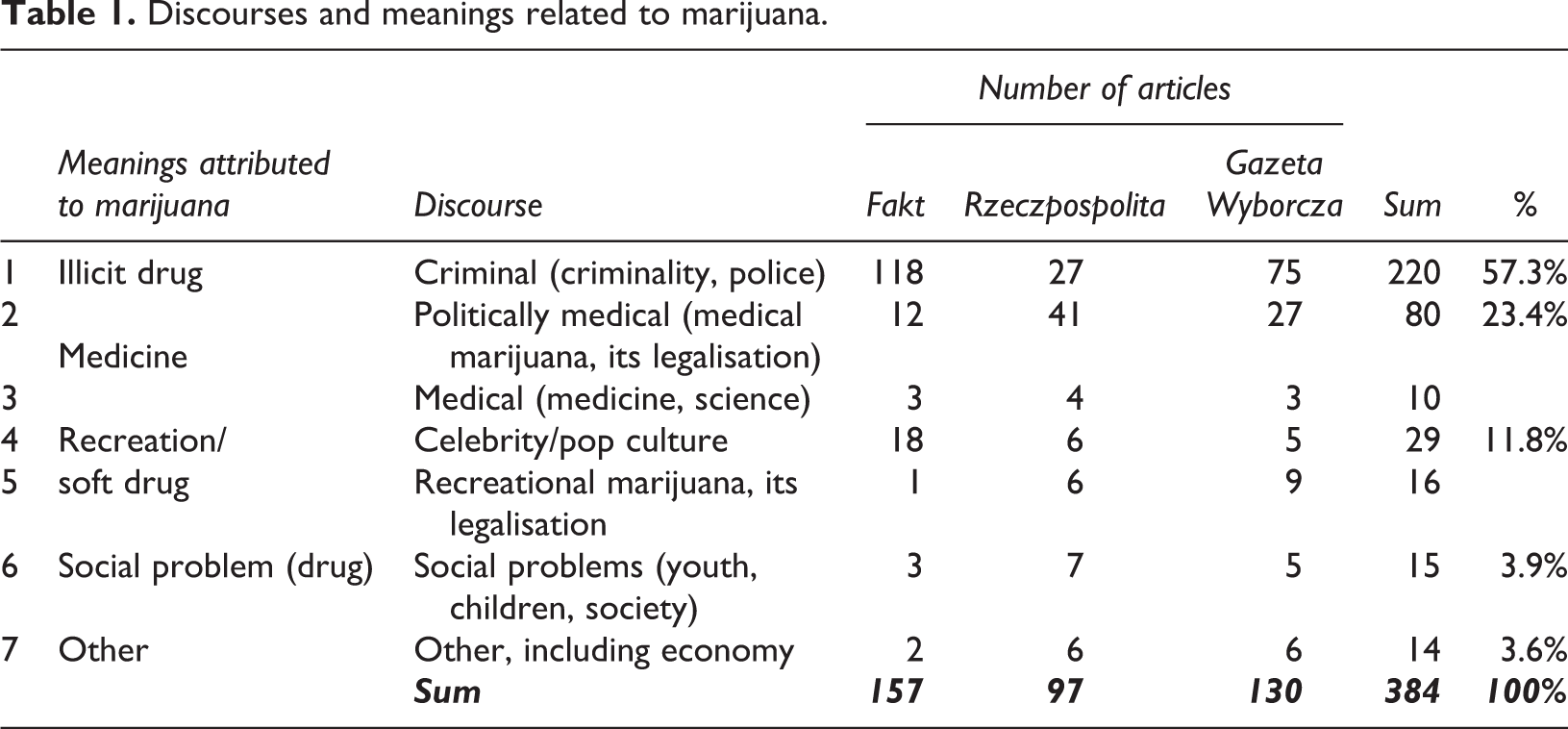
In the second stage, all articles where re-read in order to identify the most popular meanings attributed to marijuana. The identified discourses contributed to four main marijuana definitions: illicit drug, medicine, soft drug, social problem (see the column Meanings attributed to marijuana in Table 1).
At the final stage, each discourse was qualitatively analysed. When analysing news articles, the following questions were considered: (1) What is the characteristics of particular discourses? (2) What meaning is attributed to marijuana? (3) Who speaks (is cited) and makes claims in the texts? Special attention was paid to a discursive struggle between criminalisation and medicalisation of marijuana.
Results
Based on the above-described methodology, six major discourses were recognised: (1) criminal; (2) politically medical (medical marijuana); (3) medical (medicine, science); (4) celebrity/pop culture; (5) recreational marijuana and its legalisation; (6) social problems (youth, children, society). Other discourses, including economic, played a marginal role (3.6%).
Four major definitions of marijuana were identified: (1) “illicit drug” as an effect of criminal discourse (57.3% of articles); (2) “medicine” emerging from politically medical and medical discourses (23.4%); (3) “soft drug” resulting from celebrity and recreational marijuana discourses (11.8%); (4) “social problem” manifested in social problem discourse about youth and society (3.9%). In quantitative terms (number of articles), criminal discourse was a dominant one. However, it was challenged by politically medical (and medical) discourse that appeared in almost a quarter of the press news.
Characteristics of marijuana-related discourses and meanings are presented below. A special emphasis was placed on criminal and politically medical discourses that dominated in the three Polish newspapers.
Criminal discourse
The Polish daily press predominantly focused on criminal aspects of marijuana such as organised crime, trafficking, penalising possession, illegal cultivation, football hooligans and drugs. The only exception was Rzeczpospolita (Rz) where politically medical topics dominated.
The most frequent criminal news in the Polish press concerned police actions against drug-related crime, especially the work by the Polish Central Bureau of Investigation (CBSP), a special police unit dealing with organised crime. The criminal news – in all three newspapers – was quite (stereo)typical. Its content, structure and actors were repeatedly similar. The police played a major role. Criminals, despite being somehow active, were in a passive relation to the police. They were tracked, detained, arrested, and interrogated. Moreover, the newspapers often cited police officers who commented on marijuana-related crimes, which enabled them to present the marijuana problem from their perspective.
The structure of the criminal news formed a sequence: (1) the police seized marijuana/drugs and arrested criminals (success of the police), (2) description of the action (what happened), (3) information about criminals and their wrongdoing (guilt), (4) possible punishment (catharsis effect: wrongdoing will be punished). Below, two exemplary criminal news items are briefly discussed.
CBSP: Football hooligans of Krakow based club tried to smuggle 65 kg of marijuana
Football hooligans linked to one of Krakow’s sports clubs tried to smuggle to Poland 65 kg of marijuana worth PLN 2 M. Policemen from CBSP detained 5 persons. (…) press-officer (…) informed (…) “All arrested were accused of participating in the organised criminal group and trafficking considerable amount of drugs. (…) [The gang] resold it further in the milieu of Krakow [football] hooligans”. ( Rz, 30 August 2016).
The news defined marijuana as an illicit drug. The main actors were the police (and the Border Guard). The keynote was the success of the law enforcement agencies in combating organised crime and football hooligans. A police press officer commented on the situation.
In another story, published in the tabloid, the same news structure can be observed.
Marijuana worth PLN 1,5 M! – No one will smoke it
CBSP officers seized almost 52 kg of marijuana in a warehouse in the Elbląg area. Two men who prepared drugs for the sale were arrested. The black market value of marijuana amounts to about PLN 1,6 M. (…) The police launched the action a few minutes after a tow truck had parked in front of the building. They knocked on the door. Nobody opened but two men jumped out of the window. Both of them were detained (…) The men can face a 10-year prison sentence. ( Fakt, 4 July 2016)
The main difference between the two news items was in the stylistics and in the description of the offenders (football hooligans vs. “ordinary” criminals). The tabloid news was more dynamic and expressive. The title was emotional, emphasised by the exclamation mark, and referred to a stereotypic common knowledge (marijuana is usually smoked but since it was seized, no one will smoke it). Despite some differences, both texts followed the same pattern. The powerfulness of such stories consists in their frequency and stereotypical character. It is through such narratives that the meaning of marijuana-as-drug becomes obvious and dominant.
Politically medical (and medical) discourse
The meaning of medical marijuana was mainly defined through politically medical discourse. News items representing “purely” medical/scientific discourse were rare (2.6%). MM was constructed by two types of actors: persons making public claims (they are called in the study: “primary level actors”), or the press reporting about the claimants and citing them (“meta-level actors”). Generally, positive claims about MM prevailed but there were also some ambiguous or negative reports. Primary level actors such as activists, patients, medical experts or opposition politicians presented MM as an effective medicine. Ambiguous opinions were expressed by officials of the ruling conservative party and by the President. They admitted that MM might be useful but called for more scientific evidence. Additionally, they strongly condemned marijuana-as-drug and highlighted the difference between medical and recreational use. Negative claims concerning MM were expressed only by a few actors but among them was an influential conservative Minister of Health.
Meta-level actors (the newspapers) also expressed their views. Left-liberal Gazeta Wyborcza explicitly supported legalisation of MM. Centrist Rzeczpospolita had rather a distanced attitude; however, it cited many supporters of legalisation. The tabloid Fakt tended to back legalisation but also published ambiguous or misleading messages about MM confusing it with marijuana-as-drug.
During the analysis three main discursive threads about MM were identified. They consisted of news related to persons who became “iconic” claim-makers. Interestingly, each newspaper preferred a different claim-maker.
Piotr Liroy-Marzec (Fakt)
All newspapers linked Piotr Liroy-Marzec, a celebrity politician, with MM, but only the tabloid made him into the key figure of legalisation. His main opponent was the Minister of Health Konstanty Radziwiłł who denied MM. According to the Minister “there is no such a thing as medical marijuana. There is, maybe, a possibility to use some marijuana derivatives for medical purposes” ( Fakt, 1 October 2016). The tabloid, however, preferred Liroy-Marzec’s perspective. According to Fakt, Liroy-Marzec “devastated” the conservative Minister during their discussions. News about the conflict between two politicians emphasised their personal animosity and contained emotional vocabulary (scandal, making fool of people, devastated [the minister], [the minister] is totally incompetent). Liroy-Marzec presented MM in an emotional way as “a key issue for our parents, sisters, brothers and grandparents. For all who are seriously ill” ( Fakt, 29 January 2016).
Dr. Marek Bachański (Gazeta Wyborcza)
The left-liberal Gazeta Wyborcza (GW) tended to prefer a neurologist Dr. Marek Bachański in the context of MM. His name was mentioned 80 times in several articles. Bachański was the first doctor in Poland to use MM. However, in 2015 he was accused of breaching medical protocols and was dismissed from the hospital.
Medical marijuana. Dr. Bachański’s disciplinary dismissal from work
Dr. Marek Bachański started to use marijuana-based medicines (…). He cured patients suffering from intractable epilepsy. In July [2015], the hospital’s director forbade him to prescribe cannabis-based medicines (…). His superiors claimed the doctor had not notified the bioethical committee about his [experimental] therapy (…). The doctor denied accusations. (…) He provided marijuana-based medicines to seven [child] patients. Their parents requested to reinstate the doctor (…) and fought for the continuation of marijuana-based therapy (…) Several dozens of persons demonstrated in front of the hospital. Among them was Dorota Gudaniec, mother of an ill Max, the first patient cured with the use of marijuana. (…) “Today, the best doctor in Poland has been dismissed – Dr. Marek Bachański!!! It is a scandal!”, (…) [she] posted on Facebook. ( GW, 27 October 2015)
The story presented MM in an emotional way, as an effective medicine. MM users were young children, victims of a severe disease. They also became victims of bureaucratic processes and a conflict between Dr. Bachański and his superiors. The parents of juvenile patients demanded access to MM. The hospital and its management were presented as major opponents of marijuana-based therapy. Dr. Bachański and Ms. Gudaniec were given the voice to comment on the situation which manifested the newspapers’ solidarity with them and expressed indirect support for MM. Gazeta Wyborcza cited Gudaniec’s emotional social media post about Dr. Bachański. In several other news items GW also highlighted Dr. Bachański’s leading role in the context of MM.
Tomasz Kalita (Rzeczpospolita)
Tomasz Kalita was mentioned 56 times in Rzeczpospolita (Rz). He became an iconic figure for MM legalisation in 2016. The newspaper reported about his deadly illness and his fight against the impersonal bureaucracy of the public healthcare system. Kalita’s individual problems were presented in the macro context of legalisation. He claimed that the opponents of MM tried to portray him as a “legal junkie” who wanted to access drugs due to his oncological status. However, he argued that he just wanted to save his life. According to Kalita, “in Poland everything is ideologically biased and categorised as black-or-white, which leads to unnecessary tensions” ( Rz, 29 October 2016). These words indicate that political and ideological factors influenced the debate about MM.
Another two texts covered Kalita’s meeting with the Polish President whom he asked for support. The President did not express a clear view on MM. He was not against it; however, he insisted that experts should do more research.
Other discourses
All other discourses on marijuana played a lesser role in the three Polish newspapers. However, they also formed a relevant context for defining the marijuana problem. Therefore, they were included in the analysis, too.
Celebrity/pop culture discourse
The discourse about celebrities was mostly visible in the tabloid. This discourse mainly articulated the meaning of recreational marijuana (RM), defining it as a relatively harmless “soft” substance. RM users were presented either as celebrities or ordinary people (not criminals). Claim-makers who spoke about RM were mainly celebrities, especially music stars. A popular musician Zbigniew Wodecki confessed that he was in favour of RM. Another Polish singer Kora supported legalisation of RM. The tabloid mentioned that she suffered from cancer and she “admitted that she happened to smoke this soft drug” ( Fakt, 10 November 2015). The tabloid did not link the singer’s marijuana use with the attempt to alleviate her health problems.
Despite the general tendency to legitimise RM through celebrity discourse, some celebrities condemned marijuana and spoke about its negative consequences (e.g. a female TV star confessed that she had been given marijuana in her youth and had been sexually abused). Therefore, the overall picture of RM resulting from celebrity discourse was rather ambiguous, although positive opinions dominated.
Recreational marijuana and legalisation discourse
Legalisation claims related to RM were rare. They were presented mainly in two opinion-forming newspapers (Rzeczpospolita and GW). They usually reported about marijuana legalisation in North or Latin America. GW put legalisation in the context of personal freedom, pluralism and liberal democracy, whereas Rzeczpospolita tended to focus on socio-political or economic aspects. In Rzeczpospolita, RM received some negative connotations of an illicit drug. This illustrates the ambiguity of RM.
Social problems discourse
Differently than in Sweden (Månsson, 2016), discourse about social problems played a marginal role in Polish news (3.9% of articles). This discourse defined marijuana as a drug but not from a criminal perspective. Marijuana was portrayed as a problem affecting youth or other social groups. Social problems discourse tended to refer to statistical data about marijuana use or articulated warnings that marijuana consumption among youth had increased.
Other residual discourses
Residual discourses (coded as “other”) played a marginal role in all three newspapers (3.6% of texts). They were often somehow related to economic topics. In such news marijuana or cannabis was presented as an agricultural, industrial, or a commercial product.
Discussion
In 2015–2016, the Polish daily press constructed marijuana mainly through two dominant discourses: criminal versus politically medical. The discursive struggle between criminalisation and medicalisation of marijuana seems to be quite a universal phenomenon (Månsson, 2016; Sznitman & Lewis, 2015). The study confirmed the binary tendency to present marijuana predominantly either as a poison (drug) or a remedy (Acevedo, 2007). However, differently than the previous research suggested, in Poland medical marijuana had a strongly political dimension. It was promoted by a new anti-establishment party that supported MM legalisation. “Pure” medicalisation would be endorsed by medical experts or scientists. Political medicalisation was a discursive strategy applied mainly by politicians to achieve social support and implement the political programme. To some extent, political medicalisation became part of a political game played between the opposition and the conservative government. Whereas the anti-establishment or left-wing opposition constructed marijuana as an effective medicine, the ruling party was more sceptical.
Not all stakeholders recognised MM. Nevertheless, it was crucial that MM was present in the media for a relatively long time. It enabled MM supporters to sustain their marijuana problem definition. Besides, some reports about MM were highly emotional and strongly positive, which fostered people’s acceptance. MM users were presented not as “legal junkies” or deviants but as “our brothers and sisters”. It confirms that medicalisation of marijuana is linked with presenting its users as victims (Sznitman & Lewis, 2015).
Table 2 illustrates the network of relations between particular discourses, marijuana meanings and problem definitions, users, claim-makers and the newspapers.
Various dimensions of a discursive construction of the marijuana problem.
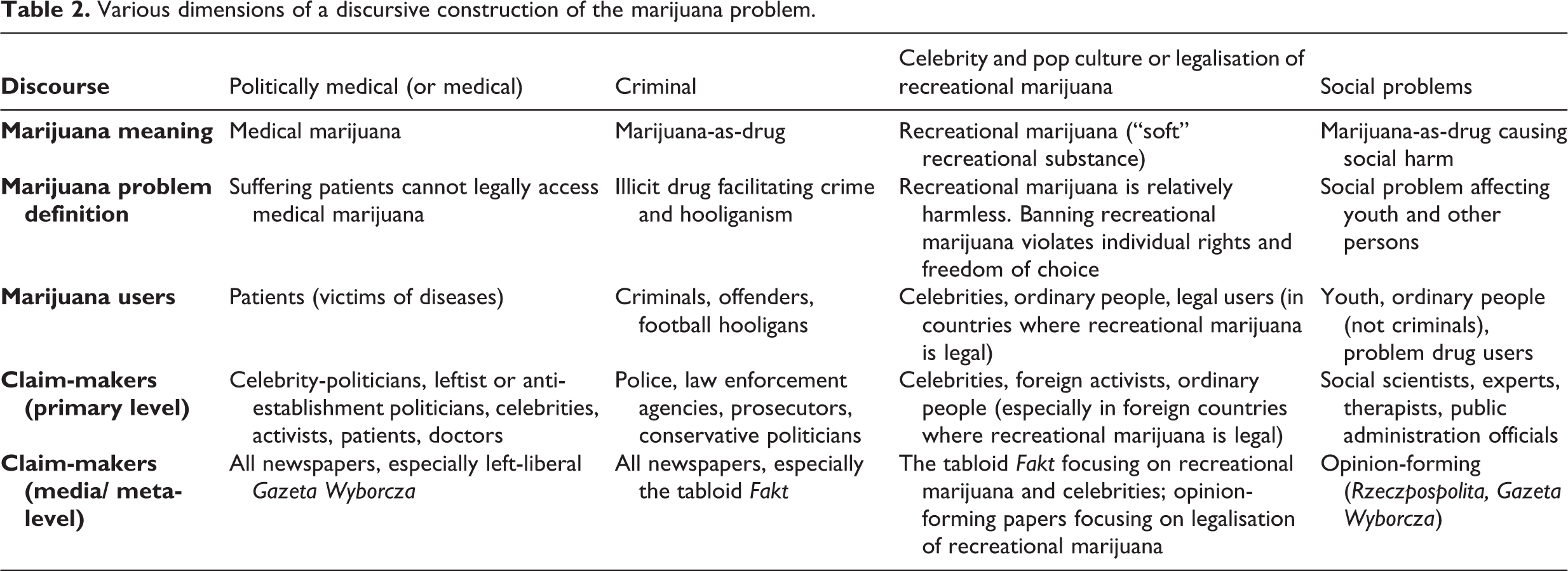
The study validated the constructionist model of social problems to interpret legalisation debate in Poland. According to Spector and Kitsuse (1973, 1977), group activities and claims are crucial for the emergence of social problems. However, based on the current analysis, it is proposed to divide the first definitional stage into two sub-stages: (1) making claims by primary level actors (politicians, activists, patients); (2) identifying, recognising and spreading the claims by the media (meta-level). The second stage of defining the marijuana problem began with the launch of the legislative process. It indicated that the social problem of medical marijuana was preliminarily acknowledged. However, after a short peak, the downturn came. Legalisation of MM was hindered by the ruling party. This led the opposition, activists and patients to express publicly their discontent. Moreover, they intensified the pressure on the government and proposed a new draft law (“lex Kalita”). Their claims where once again identified and publicised by the media. It was the third stage, with the re-emergence of the legalisation claims. Finally, the institutionalisation phase occurred. The new definition of the marijuana problem was endorsed due to the legalisation of MM and the legal system was changed.
This development shows the validity of Spector’s and Kitsuse’s model. However, the role of the media as participants of the claim-making process has to be highlighted. Spector and Kitsuse mention the media in their model but they mainly focus on primary level actors, the “real” claim-makers. As the current study indicates, the media as meta-level actors – despite their ambiguous or ambivalent reports – contribute to the marijuana problem definition.
The study develops the constructionist framework by emphasising the role of discourses and the media in defining marijuana problems. Claim-making is a discursive process that implies negotiating meanings and striving for hegemony (Abalo, 2019). As it was presented, marijuana is the object of various discourses. Medicalisation of marijuana does not annul the traditional meaning of marijuana-as-drug but it expands the polysemic potential of marijuana. The emergence of MM changes the system of meanings related to marijuana. The criminal discourse has to “make concessions” to a new politically medical discourse. The complex and polysemic system of marijuana meanings may be viewed as a dynamic continuum – ranging from a negatively evaluated illicit drug, through an ambivalent RM, up to a mainly positively assessed medical substance (see Figure 1).

Main meanings, discourses and evaluations related to marijuana.
Meanings attributed to marijuana are not absolutely separable, stable and univocal. As previous studies indicate, the boundaries between recreational and medical marijuana can be blurred (Hakkarainen et al., 2019; Pedersen & Sandberg, 2013). Also, the boundaries between marijuana-as-drug and recreational marijuana are not sharp. For example, the police equate RM with the illicit drug although the supporters of RM try to make various distinctions between these two notions (e.g. RM is a natural plant cultivated for own use whereas marijuana-as-drug is illegally grown and often synthetically modified for sale). The fluidity of meanings is part of a discursive process (Laclau & Mouffe, 1985). Marijuana is an object of a constant linguistic, political, medical and ideological negotiation. Various actors try to impose their preferred meanings on it. The Polish legalisation debate was co-shaped by actors related to the state power (politicians, the police). Their influence indicates that power holders and politicians try to control discourses on drugs.
The study indicates that the media are not absolutely neutral or transparent information providers, but they contribute to defining the marijuana problem. In the analysed case, the newspapers’ involvement in the debate consisted of: (1) deciding that marijuana is newsworthy (not silencing the issue); (2) selecting information and putting it in particular contexts (criminality, politics, patients, etc.); (3) simplifying the marijuana problem and preferring dominant meanings; (4) selecting primary level actors and giving them the opportunity to talk about marijuana (favouring privileged actors: the police, politicians, celebrities); (5) presenting implicit or explicit journalistic evaluation of MM.
As has been mentioned, legalisation has to be viewed as a historical process. In Poland, the public debate took more than one year. Then, the legal and the authorisation process took almost an additional two years. The processual, historical approach indicates that changes take time and institutionalisation of MM may proceed slowly. Nevertheless, the compromise reached in the legalisation of medical marijuana does not seem to be currently questioned by any significant political or social grouping in Poland.
Conclusions
The study examined how different discourses constructed the marijuana problem by attributing various meanings to marijuana. Marijuana, due to its polysemy and specific status oscillating between legality and illegality, is prone to be constructed in various ways by different stakeholders, including power holders. The research confirmed the validity of the constructionist approach to social problems (Spector & Kitsuse, 1977) but it emphasised the role of the media in the process of defining and recognising the marijuana problem. The constructionist perspective highlights the processual, social and discursive character of social problems. Despite the restrictive drug policy and traditional criminalisation of marijuana, which makes the Polish case analogous to the situation in Scandinavia, the new politically medical definition was established and recognised. It was possible due to new claim-makers, especially the anti-establishment party Kukiz’15. They changed the marijuana problem definition and the social context for MM legalisation. As Abalo’s (2019) and Månsson’s (2014, 2016) studies suggest, some potential for such claims may also exists in Scandinavia. However, the contingency of discursive processes implies that it is not possible to foresee future developments. Therefore, further monitoring and investigation of marijuana discourses is needed (Egnell et al., 2019).
The research has some inevitable limitations. It was based on the analysis of three mainstream national newspapers. The reason for choosing such an approach was to make the sample of texts more consistent. As a result, the scope of the media and texts was limited. No other influential media have been explored (e.g., magazines, TV, social media). The study was based on the analysis of textual materials only. No visuals were taken into account. Besides, the study focused on one country in a certain period (2015–2016). Therefore, it might be interesting to consider in the future a comparative study covering various countries over a longer timeframe, or to explore other types of media, including various internet sources.
Footnotes
Acknowledgements
The author would like to thank two independent reviewers whose critical comments made it possible to clarify and systematise the findings presented in the article.
Declaration of conflicting interests
The author declared no potential conflicts of interest with respect to the research, authorship, and/or publication of this article.
Funding
The author received no financial support for the research, authorship, and/or publication of this article.
